

UCHIME improves sensitivity and speed of chimera detection
Open accessThe DOI matches its Crossref record; 21 of the 21 references it cites were found in a registry or an index.
Abstract
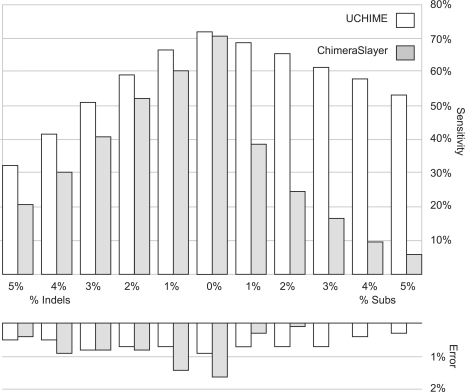
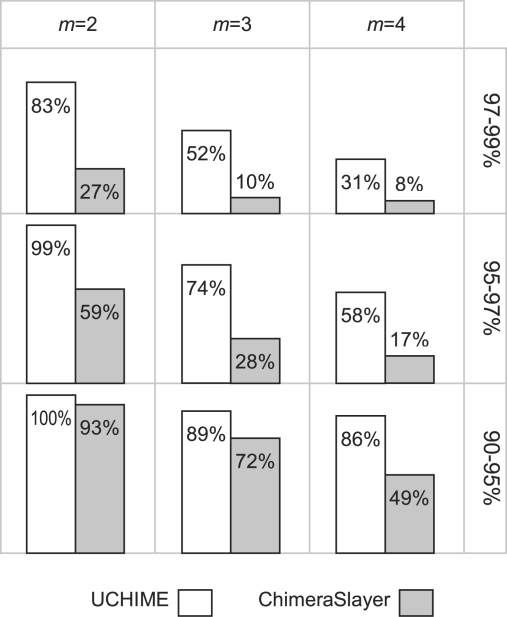
Motivation: Chimeric DNA sequences often form during polymerase chain reaction amplification, especially when sequencing single regions (e.g. 16S rRNA or fungal Internal Transcribed Spacer) to assess diversity or compare populations. Undetected chimeras may be misinterpreted as novel species, causing inflated estimates of diversity and spurious inferences of differences between populations. Detection and removal of chimeras is therefore of critical importance in such experiments. Results: We describe UCHIME, a new program that detects chimeric sequences with two or more segments. UCHIME either uses a database of chimera-free sequences or detects chimeras de novo by exploiting abundance data. UCHIME has better sensitivity than ChimeraSlayer (previously the most sensitive database method), especially with short, noisy sequences. In testing on artificial bacterial communities with known composition, UCHIME de novo sensitivity is shown to be comparable to Perseus. UCHIME is >100× faster than Perseus and >1000× faster than ChimeraSlayer. Contact: robert@drive5.com Availability: Source, binaries and data: http://drive5.com/uchime. Supplementary information: Supplementary data are available at Bioinformatics online.
Overview
The claims and statistics of this paper haven’t been checked yet.
Free: it reads the open-access text and checks the first 5 claims that cite a source we can check. Create a free account to check every claim.
Integrity signals
Registry
Cites
Statistics
Figures

Verification
Claims the paper makes
The claims and statistics of this paper haven’t been checked yet.
Free: it reads the open-access text and checks the first 5 claims that cite a source we can check. Create a free account to check every claim.
Claims other papers make about this one
Each is checked against this paper’s own text: does it say what the citing paper says it does?
In the citing paper
“The remaining sequencing were processed to reduce sequencing noise by a pre-clustering methodology59, and to remove chimeric sequences using UCHIME60.”
From The links between ecosystem multifunctionality and above- and belowground biodiversity are mediated by climate (2015) · cites this paper as [60]
Self-check
Percentages, sums and reported differences re-computed from the paper’s own numbers.
The self-check needs the paper’s full text.
Citations
Cites
Gapped BLAST and PSI-BLAST: a new generation of protein database search programs
Altschul, S. (1997) · Nucleic Acids Research · doi:10.1093/nar/25.17.3389 · Cited by 73,302
Search and clustering orders of magnitude faster than BLAST
Edgar, R. C. (2010) · Bioinformatics · doi:10.1093/bioinformatics/btq461 · Cited by 20,826
Self-citationSTACKEBRANDT, E., & GOEBEL, B. M. (1994) · International Journal of Systematic and Evolutionary Microbiology · doi:10.1099/00207713-44-4-846 · Cited by 7,083
The Ribosomal Database Project: improved alignments and new tools for rRNA analysis
Cole, J. R., Wang, Q., Cardenas, E., Fish, J., Chai, B., Farris, R. J., Kulam-Syed-Mohideen, A. S., McGarrell, D. M., Marsh, T., Garrity, G. M., et al. (2009) · Nucleic Acids Research · doi:10.1093/nar/gkn879 · Cited by 4,762
Recent developments in the MAFFT multiple sequence alignment program
Katoh, K., & Toh, H. (2008) · Briefings in Bioinformatics · doi:10.1093/bib/bbn013 · Cited by 3,586
Chimeric 16S rRNA sequence formation and detection in Sanger and 454-pyrosequenced PCR amplicons
Haas, B. J., Gevers, D., Earl, A. M., Feldgarden, M., Ward, D. V., Giannoukos, G., Ciulla, D., Tabbaa, D., Highlander, S. K., Sodergren, E., et al. (2011) · Genome Research · doi:10.1101/gr.112730.110 · Cited by 3,473
Self-citationBiological Sequence Analysis: Probabilistic Models of Proteins and Nucleic Acids
Durbin, R., Eddy, S. R., Krogh, A., & Mitchison, G. (1998) · Cambridge University Press eBooks · doi:10.1017/cbo9780511790492 · Cited by 3,246
Removing Noise From Pyrosequenced Amplicons
Quince, C., Lanzen, A., Davenport, R. J., & Turnbaugh, P. J. (2011) · BMC Bioinformatics · doi:10.1186/1471-2105-12-38 · Cited by 1,592
Self-citationBellerophon: a program to detect chimeric sequences in multiple sequence alignments
Huber, T., Faulkner, G., & Hugenholtz, P. (2004) · Bioinformatics · doi:10.1093/bioinformatics/bth226 · Cited by 1,529
Shukla, S., Mishra, B., Avashthi, H., & Chandra, M. (2022) · Bioinformatics · doi:10.1016/b978-0-323-89775-4.00003-1 · Cited by 1,244
A new version of the RDP (Ribosomal Database Project)
Maidak, B. L., Cole, J. R., Parker, C. T., Garrity, G. M., Larsen, N., Li, B., Lilburn, T. G., McCaughey, M. J., Olsen, G. J., Overbeek, R., et al. (1999) · Nucleic Acids Research · doi:10.1093/nar/27.1.171 · Cited by 895
Mason, S. J., & Graham, N. E. (2002) · Quarterly Journal of the Royal Meteorological Society · doi:10.1256/003590002320603584 · Cited by 868
Ashelford, K. E., Chuzhanova, N. A., Fry, J. C., Jones, A. J., & Weightman, A. J. (2005) · Applied and Environmental Microbiology · doi:10.1128/aem.71.12.7724-7736.2005 · Cited by 795
New Screening Software Shows that Most Recent Large 16S rRNA Gene Clone Libraries Contain Chimeras
Ashelford, K. E., Chuzhanova, N. A., Fry, J. C., Jones, A. J., & Weightman, A. J. (2006) · Applied and Environmental Microbiology · doi:10.1128/aem.00556-06 · Cited by 678
Acinas, S. G., Sarma-Rupavtarm, R., Klepac-Ceraj, V., & Polz, M. F. (2005) · Applied and Environmental Microbiology · doi:10.1128/aem.71.12.8966-8969.2005 · Cited by 625
Thompson, J. R. (2002) · Nucleic Acids Research · doi:10.1093/nar/30.9.2083 · Cited by 448
Wang, G. C., & Wang, Y. (1997) · Applied and Environmental Microbiology · doi:10.1128/aem.63.12.4645-4650.1997 · Cited by 337
Wang, G. C. Y., & Wang, Y. (1996) · Microbiology · doi:10.1099/13500872-142-5-1107 · Cited by 258
Lahr, D. J. G., & Katz, L. A. (2009) · BioTechniques · doi:10.2144/000113219 · Cited by 189
Trees, Stars, and Multiple Biological Sequence Alignment
Altschul, S. F., & Lipman, D. J. (1989) · SIAM Journal on Applied Mathematics · doi:10.1137/0149012 · Cited by 138
An open source chimera checker for the fungal ITS region
Nilsson, R. H., Abarenkov, K., Veldre, V., Nylinder, S., Wit, P. D., Brosché, S., Alfredsson, J. F., Ryberg, M. K., & Kristiansson, E. (2010) · Molecular Ecology Resources · doi:10.1111/j.1755-0998.2010.02850.x · Cited by 137
Cited by
DADA2: High–resolution sample inference from Illumina amplicon data
Callahan, B. J., McMurdie, P. J., Rosen, M. J., Han, A. W., Johnson, A. J. A., & Holmes, S. P. (2016) · Nature Methods · doi:10.1038/nmeth.3869 · Cited by 35,698
Two new Later Stone Age sites from the Final Pleistocene in the Falémé Valley, eastern Senegal
Ndiaye, M., Lespez, L., Tribolo, C., Rassé, M., Hadjas, I., Davidoux, S., Huysecom, É., & Douze, K. (2024) · Monash University Research Portal (Monash University) · doi:10.3929/ethz-b-000667478 · Cited by 23,868
UPARSE: highly accurate OTU sequences from microbial amplicon reads
Edgar, R. C. (2013) · Nature Methods · doi:10.1038/nmeth.2604 · Cited by 16,707
Self-citationVSEARCH: a versatile open source tool for metagenomics
(2016) · doi:10.7717/peerj.2584 · Cited by 10,773
Self-citationKozich, J. J., Westcott, S. L., Baxter, N. T., Highlander, S. K., & Schloss, P. D. (2013) · Applied and Environmental Microbiology · doi:10.1128/aem.01043-13 · Cited by 7,112
Metadata
- Authors
- Edgar, R. C., Haas, B. J., Clemente, J. C., Quince, C., & Knight, R.
- Affiliations
- Broad Institute (US)
- 1 Tiburon, CA, USA, 2Genome Sequencing and Analysis Program, The Broad Institute, Cambridge, MA 02142, 3Department of Chemistry and Biochemistry, University of Colorado, Boulder, CO 80309, USA and 4School of Engineering, University of Glasgow, Glasgow G12 8LT, UK
- Corresponding author
- Edgar, Robert C.
- Venue
- Bioinformatics
- Publisher
- Oxford University Press (OUP)
- Published
- 2011-06-23
- Volume
- 27
- Issue
- 16
- Pages
- 2194-2200
- ISSN
- 1367-4803 (ISSN-L)
- 1367-4811
- PMC
- PMC3150044
- OpenAlex
- W2136879569
- Cited by
- 15,114
- References
- 21
- Citations by year
- 2026: 552 · 2025: 849 · 2024: 1030 · 2023: 1050 · 2022: 1440 · 2021: 1568 · 2020: 1680 · 2019: 1527 · 2018: 1462 · 2017: 1274 · 2016: 1036 · 2015: 686 · 2014: 510 · 2013: 292 · 2012: 132
- FWCI
- 122.46
- Type
- journal article
- Language
- en
- Open access
- hybrid
- doi.org
- Licence
- Locations
- Bioinformatics (publishedVersion, cc-by-nc)
- PubMed Central (publishedVersion, cc-by-nc)
- PubMed (publishedVersion)
- eScholarship (California Digital Library) (submittedVersion)
- ENLIGHTEN (Jurnal Bimbingan dan Konseling Islam) (submittedVersion)
- HighWire Press Open Archive (submittedVersion)
- UEA Digital Repository (University of East Anglia) (submittedVersion)
- Funders
- Howard Hughes Medical Institute
- National Institutes of Health
- Engineering and Physical Sciences Research Council (EP/H003851/1)
- National Human Genome Research Institute (U54HG004969, R01HG004872, HG004872)
- Topics
- Life Sciences › Biochemistry, Genetics and Molecular Biology › Molecular Biology › Genomics and Phylogenetic Studies
- Physical Sciences › Environmental Science › Ecology › Microbial Community Ecology and Physiology
- Physical Sciences › Environmental Science › Ecology › Environmental DNA in Biodiversity Studies
- Keywords
- chimeric sequences, PCR artifacts, 16S rRNA, ITS sequences, bacterial diversity, sequence abundance, Perseus, bioinformatics software
- MeSH terms
- Algorithms, Software, Polymerase Chain Reaction, Artifacts, Sequence Analysis, DNA, Computational Biology
About these checks
Registry, retraction, Cites and statistics results are computed, not judged, with one exception: a printed reference that no index lists is read once by a model before it counts as a citation error. Claims are extracted by a model and kept only when their quote appears verbatim in the text; each cited source is then checked, with a model’s help, for whether it says what the claim relies on. Those verdicts can be wrong — read the claim’s quote and the cited source before relying on one.
Statistics and arithmetic are recomputed, not judged.
Confidence bands are shown only for fields calibrated on our annotated test set. None is calibrated yet, so no band is shown.
What counts as a claim ›How we measure confidence ›How we check this ›
Are you an author, or do you see a problem with this page? Request a review
Data sources
Bibliographic data: Semantic Scholar, OpenAlex, Crossref.
Contains information from the Semantic Scholar Academic Graph Datasets, made available under the ODC Attribution License (ODC-BY 1.0).
Semantic Scholar’s data is described in: Kinney, R., et al. (2023). The Semantic Scholar Open Data Platform. arXiv:2301.10140.
