

BioBERT: a pre-trained biomedical language representation model for biomedical text mining
Open accessThe DOI matches its Crossref record; 48 of the 48 references it cites were found in a registry or an index.
Abstract
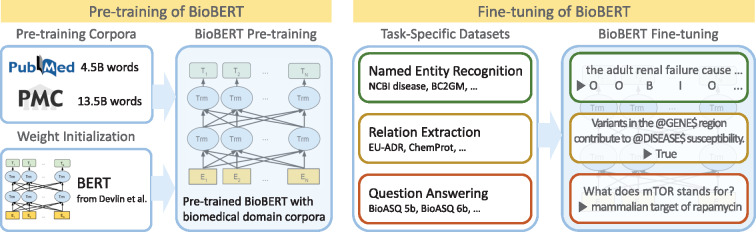
Motivation: Biomedical text mining is becoming increasingly important as the number of biomedical documents rapidly grows. With the progress in natural language processing (NLP), extracting valuable information from biomedical literature has gained popularity among researchers, and deep learning has boosted the development of effective biomedical text mining models. However, directly applying the advancements in NLP to biomedical text mining often yields unsatisfactory results due to a word distribution shift from general domain corpora to biomedical corpora. In this article, we investigate how the recently introduced pre-trained language model BERT can be adapted for biomedical corpora. Results: We introduce BioBERT (Bidirectional Encoder Representations from Transformers for Biomedical Text Mining), which is a domain-specific language representation model pre-trained on large-scale biomedical corpora. With almost the same architecture across tasks, BioBERT largely outperforms BERT and previous state-of-the-art models in a variety of biomedical text mining tasks when pre-trained on biomedical corpora. While BERT obtains performance comparable to that of previous state-of-the-art models, BioBERT significantly outperforms them on the following three representative biomedical text mining tasks: biomedical named entity recognition (0.62% F1 score improvement), biomedical relation extraction (2.80% F1 score improvement) and biomedical question answering (12.24% MRR improvement). Our analysis results show that pre-training BERT on biomedical corpora helps it to understand complex biomedical texts. Availability and implementation: We make the pre-trained weights of BioBERT freely available at https://github.com/naver/biobert-pretrained, and the source code for fine-tuning BioBERT available at https://github.com/dmis-lab/biobert.
Overview
The claims and statistics of this paper haven’t been checked yet.
Free: it reads the open-access text and checks the first 5 claims that cite a source we can check. Create a free account to check every claim.
Integrity signals
Registry
Cites
Statistics
Figures
Verification
Claims the paper makes
The claims and statistics of this paper haven’t been checked yet.
Free: it reads the open-access text and checks the first 5 claims that cite a source we can check. Create a free account to check every claim.
Claims other papers make about this one
Each is checked against this paper’s own text: does it say what the citing paper says it does?
The source backs part of the claim, not all of it — or backs it for a different population, condition or comparison.
In the citing paper
“Transformer models have proven their strong capabilities on learning long-term dependency on natural language processing tasks [19-21], and more recently on computer vision tasks [22-24].”
From DFDT: An End-to-End DeepFake Detection Framework Using Vision Transformer (2022) · cites this paper as [21]
Experimental — accuracy not yet measuredThe source backs part of the claim, not all of it — or backs it for a different population, condition or comparison.
In the citing paper
“A BioBERT-based model44 outperformed rule-based and traditional machine learning approaches.”
From Text classification models for assessing the completeness of randomized controlled trial publications based on CONSORT reporting guidelines (2024) · cites this paper as [44]
Experimental — accuracy not yet measuredThe source backs part of the claim, not all of it — or backs it for a different population, condition or comparison.
In the citing paper
“Popular LLMs, such as GPT-4, Llama, and BERT, often require large memory capacity13,58–61, making it challenging to run them on devices with limited memory, such as embedded systems, laptops, and mobile phones62.”
From Foundation metrics for evaluating effectiveness of healthcare conversations powered by generative AI (2024) · cites this paper as [61]
Experimental — accuracy not yet measuredThe source backs part of the claim, not all of it — or backs it for a different population, condition or comparison.
In the citing paper
“Healthcare represents a compelling domain for LLM use because the vast majority of actionable patient data is locked within unstructured clinical text, including electronic health records, clinical notes, and biomedical literature [4,5].”
From Explainability of decoder-only clinical large language models: A scoping review (2026) · cites this paper as [4]
Experimental — accuracy not yet measuredThe source backs part of the claim, not all of it — or backs it for a different population, condition or comparison.
In the citing paper
“Conventional natural language processing (NLP) approaches suffer from limited scalability and generalizability, and struggle to interpret implicit or vague temporal expressions.”
From TimeX: Phenotype Onset Extraction from Clinical Narratives (2026) · cites this paper as [20]
Experimental — accuracy not yet measured
14 more claims about this paper
Create a free account to see every claim other papers make about this one.
Self-check
Percentages, sums and reported differences re-computed from the paper’s own numbers.
The self-check needs the paper’s full text.
Citations
Cites
Vaswani, A., Shazeer, N., Parmar, N., Uszkoreit, J., Jones, L., Gomez, A. N., Kaiser, L., & Polosukhin, I. (2017) · arXiv · doi:10.48550/arxiv.1706.03762 · Cited by 120,404
LeCun, Y., Bengio, Y., & Hinton, G. (2015) · Nature · doi:10.1038/nature14539 · Cited by 84,126
Exploiting Generative AI to Scale up Intelligent Tutoring Systems
Jakubův, J., Chvalovský, K., Goertzel, Z., Kaliszyk, C., Olšák, M., Piotrowski, B., Schulz, S., Suda, M., & Urban, J. (2023) · DROPS (Schloss Dagstuhl – Leibniz Center for Informatics) · doi:10.4230/lipics.itp.2023.19 · Cited by 76,658
BERT: Pre-training of Deep Bidirectional Transformers for Language Understanding
Devlin, J., Chang, M.-W., Lee, K., & Toutanova, K. (2018) · arXiv · doi:10.48550/arxiv.1810.04805 · Cited by 73,173 · cited 3×
“BERT (Devlin et al., 2019) is a contextualized word representation model that is based on a masked language model and pretrained using bidirectional transformers (Vaswani et al., 2017). Due to the nature of language modeling where future words cannot be seen, previous language models were limited to a combination of t…”
BackgroundMethodInfluentialBERT: Pre-training of Deep Bidirectional Transformers for Language Understanding
Devlin, J., Chang, M.-W., Lee, K., & Toutanova, K. (2019) · Proceedings of the 2019 Conference of the North American Chapter of the Association for Computational Linguistics: Human Language Technologies, Volume 1 (Long and Short Papers) · doi:10.18653/v1/n19-1423 · Cited by 54,325 · cited 3×
“BERT (Devlin et al., 2019) is a contextualized word representation model that is based on a masked language model and pretrained using bidirectional transformers (Vaswani et al., 2017). Due to the nature of language modeling where future words cannot be seen, previous language models were limited to a combination of t…”
BackgroundMethodInfluentialGlove: Global Vectors for Word Representation
Pennington, J., Socher, R., & Manning, C. (2014) · Proceedings of the 2014 Conference on Empirical Methods in Natural Language Processing (EMNLP) · doi:10.3115/v1/d14-1162 · Cited by 34,071
Distributed Representations of Words and Phrases and their Compositionality
Mikolov, T., Sutskever, I., Chen, K., Corrado, G., & Dean, J. (2013) · arXiv · doi:10.48550/arxiv.1310.4546 · Cited by 24,533
Deep Contextualized Word Representations
Peters, M., Neumann, M., Iyyer, M., Gardner, M., Clark, C., Lee, K., & Zettlemoyer, L. (2018) · Proceedings of the 2018 Conference of the North American Chapter of the Association for Computational Linguistics: Human Language Technologies, Volume 1 (Long Papers) · doi:10.18653/v1/n18-1202 · Cited by 11,983 · cited 2×
“For instance, ELMo (Peters et al. , 2018) uses a bidirectional language model while CoVe (McCann et al. , 2017) uses machine translation to embed context information into word representations.”
BackgroundMethodSQuAD: 100,000+ Questions for Machine Comprehension of Text
Rajpurkar, P., Zhang, J., Lopyrev, K., & Liang, P. (2016) · Proceedings of the 2016 Conference on Empirical Methods in Natural Language Processing · doi:10.18653/v1/d16-1264 · Cited by 6,208
Google's Neural Machine Translation System: Bridging the Gap between Human and Machine Translation
Wu, Y., Schuster, M., Chen, Z., Le, Q. V., Norouzi, M., Macherey, W., Krikun, M., Cao, Y., Gao, Q., Macherey, K., et al. (2016) · arXiv · doi:10.48550/arxiv.1609.08144 · Cited by 5,319 · cited 2×
“One of the common settings while fine-tuning BERT (BioBERT) is the use of “main” — 2019/2/5 — 1:36 — page 4 — #4 Lee et al. WordPiece tokenization (Wu et al. , 2016) which can mitigate the out-of-vocabulary issue.”
Background
Research works printed but not linked: 1
- Krallinger M. et al (2017) Overview of the BioCreative VI chemical-protein interaction track. In: Proceedings of the BioCreative VI Workshop, Bethesda, MD, USA, pp. 141– 146. https://academic.oup.com/database/article/doi/10.1093/database/bay073/5055578. · doi:10.1093/database/bay073/5055578
Cited by
Items 601–700 of 1,099
Monarch Mixer: A Simple Sub-Quadratic GEMM-Based Architecture
Fu, D. Y., Arora, S., Grogan, J., Johnson, I., Eyuboglu, E. S., Thomas, A. W., Spector, B., Poli, M., Rudra, A., & Ré, C. (2023) · neural information processing systems · doi:10.52202/075280-3390 · Cited by 80
Wang, J., Yang, Z., Yao, Z., & Yu, H. Z. (2024) · arXiv (Cornell University) · doi:10.48550/arxiv.2402.17887 · Cited by 81
“Medical Large Language Model Medical LLMs have evolved from adapting existing models like BERT using biomedical datasets (Gu et al., 2021; Lee et al., 2020), to integrating document linking (Yasunaga et al., 2022b) and knowledge graphs (Yasunaga et al., 2022a).”
MethodPakhale, K. (2023) · arXiv (Cornell University) · doi:10.13140/rg.2.2.26160.94729 · Cited by 79
Terranova, N., Renard, D., Shahin, M. H., Menon, S., Cao, Y., Hop, C. E. C. A., Hayes, S., Madrasi, K., Stodtmann, S., Tensfeldt, T., et al. (2024) · Clinical Pharmacology & Therapeutics · doi:10.1002/cpt.3053 · Cited by 78
“Several biomedical and clinical domain-specific LLMs have been developed in the past few years, such as PubMedBERT, 71 BioBERT, 72 Med-BERT BERT, 73 and ClinicalBERT.”
MethodSearching for scientific evidence in a pandemic: An overview of TREC-COVID
Roberts, K. E., Alam, T., Bedrick, S. D., Demner‐Fushman, D., Lo, K., Soboroff, I. M., Voorhees, E. M., Wang, L. L., & Hersh, W. (2021) · Journal of Biomedical Informatics · doi:10.1016/j.jbi.2021.103865 · Cited by 78
“This included a neural index run (NIR) automatic system that appended a BioBERT [48] embedding to the traditional document representation, an automatic relevance feedback (RF) system, and a relevance feedback with BERT-based re-ranking (RFRR) system.”
MethodDeep learning-based methods for natural hazard named entity recognition
Sun, J., Liu, Y., Cui, J., & He, H. (2022) · Scientific Reports · doi:10.1038/s41598-022-08667-2 · Cited by 78
“The pretraining model was the static method Word2Vec in the early stage, and then many dynamic methods were proposed, such as BERT 29 , ALBERT 30 and XLNET 31 .”
MethodYang, G., Liu, X., Shi, J., Wang, Z., & Wang, G. (2024) · Computer Methods and Programs in Biomedicine Update · doi:10.1016/j.cmpbup.2024.100158 · Cited by 78
Evaluating GPT and BERT models for protein–protein interaction identification in biomedical text
Rehana, H., Çam, N. B., Basmaci, M., Zheng, J., Jemiyo, C., He, Y. O., Özgür, A., & Hur, J. (2024) · Bioinformatics Advances · doi:10.1093/bioadv/vbae133 · Cited by 79
“5 and GPT-4 variants, against masked language models like BioBERT, PubMedBERT, and SciBERT in a PPI prediction task.”
BackgroundMethodInfluentialThe rise of small language models in healthcare: A comprehensive survey
Garg, M., Raza, S., Rayana, S., Liu, X., & Sohn, S. (2026) · Computer Science Review · doi:10.1016/j.cosrev.2026.100999 · Cited by 81
Continual Pre-Training Mitigates Forgetting in Language and VisionPreprint
Cossu, A., Tuytelaars, T., Carta, A., Passaro, L., Lomonaco, V., & Bacciu, D. (2022) · arXiv (Cornell University) · doi:10.48550/arxiv.2205.09357 · Cited by 79
Enhancing Activity Prediction Models in Drug Discovery with the Ability to Understand Human LanguagePreprint
Seidl, P., Vall, A., Hochreiter, S., & Klambauer, G. (2023) · arXiv (Cornell University) · doi:10.48550/arxiv.2303.03363 · Cited by 81
“For the text encoder input, we experimented with BioBERT (Lee et al., 2020), Sentence-T5 (Ni et al., 2021) based on T5 (Raffel et al., 2020), KV-PLM (Zeng et al., 2022b), Galactica (Taylor et al., 2022), CLIP text-encoder (Radford et al., 2021), and Latent Semantic Analysis (LSA) (Deerwester et al., 1990) representati…”
MethodInfluentialOn the limitations of large language models in clinical diagnosis
Reese, J. T., Danis, D., Caufield, J. H., Groza, T., Casiraghi, E., Valentini, G., Mungall, C. J., & Robinson, P. N. (2023) · medRxiv · doi:10.1101/2023.07.13.23292613 · Cited by 46
PERL: Pivot-based Domain Adaptation for Pre-trained Deep Contextualized Embedding Models
Ben-David, E., Rabinovitz, C., & Reichart, R. (2020) · Transactions of the Association for Computational Linguistics · doi:10.1162/tacl_a_00328 · Cited by 78
“, 2018);10 (d) BERT; and (e) Fine-tuned BERT (following (Lee et al., 2020; Han and Eisenstein, 2019)): This model is identical to PERL, except that the finetuning stage is performed with a standard MLM instead of our pivot-based MLM.”
BackgroundMethodMeasurement of Semantic Textual Similarity in Clinical Texts: Comparison of Transformer-Based Models
Yang, X., He, X., Zhang, H., Ma, Y., Bian, J., & Wu, Y. (2020) · JMIR Medical Informatics · doi:10.2196/19735 · Cited by 78
“Although previous studies [40-44] have shown that pretraining transformer models with domain-specific corpora could enhance their performances in domain-related downstream tasks (such as clinical concept extraction), our results in this study indicated that this strategy might not be helpful for…”
ResultClustering-based Inference for Biomedical Entity Linking
Angell, R., Monath, N., Mohan, S., Yadav, N., & McCallum, A. (2021) · Conference of the North American Chapter of the Association for Computational Linguistics: Human Language Technologies (NAACL-HLT) · doi:10.18653/v1/2021.naacl-main.205 · Cited by 78
“…ψ ( · , · ) and φ ( · , · ) using two separate deep transformer encoders (Vaswani et al., 2017) for our mention-mention affinity model and mention-entity affinity model — specifically we use the BERT architecture (Devlin et al., 2019) initialized using the weights from BioBERT (Lee et al., 2019).”
MethodEfficient Domain Adaptation of Language Models via Adaptive Tokenization
Sachidananda, V., Kessler, J. S., & Lai, Y.-A. (2021) · Workshop on Simple and Efficient Natural Language Processing (SustaiNLP) · doi:10.18653/v1/2021.sustainlp-1.16 · Cited by 77
ERNIE-GeoL: A Geography-and-Language Pre-trained Model and its Applications in Baidu Maps
Huang, J., Wang, H., Sun, Y., Shi, Y., Huang, Z., Zhuo, A., & Feng, S. (2022) · ACM SIGKDD Conference on Knowledge Discovery and Data Mining (KDD) · doi:10.1145/3534678.3539021 · Cited by 77
“Existing domain-specific PTMs mainly lie in the domain of healthcare [1, 14], biomedical [8, 10, 16], and academic & research [2].”
BackgroundAdapting vs. Pre-training Language Models for Historical Languages
Manjavacas, E., & Fonteyn, L. (2022) · Journal of Data Mining & Digital Humanities · doi:10.46298/jdmdh.9152 · Cited by 78
“In this investigation, SciBERT was compared to BioBERT [Lee et al., 2020], another domain-specific model for Biomedical NLP that was adapted from BERT to an even larger corpus of articles from PubMed emcompassing ca. 18B tokens.”
A pre-trained BERT for Korean medical natural language processing
Kim, Y., Kim, J.-H., Lee, J. M., Jang, M. J., Yum, Y., Kim, S., Shin, U., Kim, Y.-M., Joo, H. J., & Song, S. (2022) · Scientific Reports · doi:10.1038/s41598-022-17806-8 · Cited by 77
“Lee et al. proposed BioBERT, which is a representative pre-trained model specialized in textual analysis in the biomedical domain 10 .”
BackgroundSelf-citationNamed Entity Recognition in Electronic Health Records: A Methodological Review
Durango, M. C., Torres-Silva, E. A., & Orozco‐Duque, A. (2023) · Healthcare Informatics Research · doi:10.4258/hir.2023.29.4.286 · Cited by 78
“Another example is BioClinicalBERT, which was initialized using BioBERT weights and was additionally pre-trained on the Medical Information Mart for Intensive Care (MIMIC-III) datasets [74].”
MethodKrasadakis, P., Sakkopoulos, E., & Verykios, V. S. (2024) · Electronics · doi:10.3390/electronics13030648 · Cited by 77
“Some recent remarkable mentions include the works of the first BERT implementation in the BioMedical field [53] pretrained on PubMed data or the work in [54], in which the authors induced knowledge in an LSTM model for improved results with domain-specific features and word embeddings.”
BackgroundRT: a Retrieving and Chain-of-Thought framework for few-shot medical named entity recognition
Li, M., Zhou, H., Yang, H., & Zhang, R. (2024) · Journal of the American Medical Informatics Association · doi:10.1093/jamia/ocae095 · Cited by 55
“When designing models based on SLMs, most previous work in the medical domain prefers to directly use biomedical PLMs, such as ClinicalBERT, 9 BioBERT, 10 and GatorTron-base, 11 which have been fine-tuned on the biomedical and/or clinical corpora.”
MethodCarrino, C. P., Armengol-Estapé, J., Gutiérrez-Fandiño, A., Palao, J. L., Pàmies, M., González-Agirre, A., & Villegas, M. (2021) · arXiv (Cornell University) · doi:10.48550/arxiv.2109.03570 · Cited by 77
“We tokenized with the Byte-Level BPE algorithm introduced in [25] and employed in the original RoBERTa [19], unlike previous biomedical language models [6, 13, 18] that use WordPiece [11] or SentencePiece [16] segmentations.”
BackgroundMethodInfluentialMultilingual Large Language Models: A Systematic SurveyPreprint
Zhu, S., Supryadi, Xu, S., Sun, H., Pan, L., Cui, M., Du, J., Jin, R., Branco, A., & Xiong, D. (2024) · arXiv (Cornell University) · doi:10.48550/arxiv.2411.11072 · Cited by 79
Llama-3.1-FoundationAI-SecurityLLM-Base-8B Technical ReportPreprint
Kassianik, P., Saglam, B., Chen, A., Nelson, B., Vellore, A., Aufiero, M., Burch, F., Kedia, D., Zohary, A., Weerawardhena, S., et al. (2025) · arXiv.org · doi:10.48550/arxiv.2504.21039 · Cited by 56
“Continued pretraining was initially proposed for transformer-based models as a way to improve domain-specific adaptation [11, 23, 25, 27, 35, 44, 68].”
Silvestri, S., Islam, S., Papastergiou, S., Tzagkarakis, C., & Ciampi, M. (2023) · Sensors · doi:10.3390/s23020651 · Cited by 76
“In our experimental assessment, we adopted SecBERT, which is based on classic BERT architecture, because it is shown in the literature that the pretraining on a closed-domain corpus is able to improve the performance of a neural language model when it is fine-tuned on tasks of the same domain [35,54].”
MethodCloud-based federated learning implementation across medical centers
Rajendran, S., Obeid, J. S., Binol, H., D`Agostino, R., Foley, K., Zhang, W., Austin, P., Brakefield, J., Gurcan, M. N., & Topaloglu, U. (2021) · JCO Clinical Cancer Informatics · doi:10.1200/cci.20.00060 · Cited by 76
“Image classification, speech recognition, and natural language processing have seen some noteworthy achievements.(2) Moreover, thanks to machine learning (ML), hospitals can accomplish more efficient clinical workflows by reducing unnecessary procedures, which leads to further cost reductions.”
BackgroundTrain No Evil: Selective Masking for Task-Guided Pre-Training
Gu, Y., Zhang, Z., Wang, X., Liu, Z., & Sun, M. (2020) · Conference on Empirical Methods in Natural Language Processing (EMNLP) · doi:10.18653/v1/2020.emnlp-main.566 · Cited by 78
Clinical Natural Language Processing for Radiation Oncology: A Review and Practical Primer
Bitterman, D. S., Miller, T. A., Mak, R. H., & Savova, G. K. (2021) · International Journal of Radiation Oncology*Biology*Physics · doi:10.1016/j.ijrobp.2021.01.044 · Cited by 66
Laparra, E., Mascio, A., Velupillai, S. U., & Miller, T. A. (2021) · Yearbook of Medical Informatics · doi:10.1055/s-0041-1726522 · Cited by 76
Semantic Information Retrieval on Medical Texts: Research Challenges, Survey, and Open Issues
Tamine, L., & Goeuriot, L. (2021) · ACM Computing Surveys · doi:10.1145/3462476 · Cited by 79
“Second, training the embeddings over multiple corpora leads to significantly better performance regardless of the types of embeddings and tasks [28, 85, 162].”
BackgroundMethodDiao, S., Xu, T., Xu, R., Wang, J., & Zhang, T. (2023) · Proceedings of the conference - Association for Computational Linguistics. Meeting · doi:10.18653/v1/2023.acl-long.280 · Cited by 78
A survey for large language models in biomedicine
Wang, C., Li, M., He, J., Wang, Z., Darzidehkalani, E., Chen, Z., Ye, J., Li, T., Su, Y., Ke, J., et al. (2025) · Artificial Intelligence in Medicine · doi:10.1016/j.artmed.2025.103268 · Cited by 77
Large language models in biomedicine and healthcare
Zhou, J., Li, H., Chen, S., Chen, Z., Han, Z., & Gao, X. (2025) · Yearbook of pediatric endocrinology · doi:10.1038/s44387-025-00047-1 · Cited by 77
Khan, S. N., Danishuddin, Khan, M. W. A., Guarnera, L., & Akhtar, S. M. F. (2026) · Frontiers in Artificial Intelligence · doi:10.3389/frai.2025.1743921 · Cited by 80
Using the contextual language model BERT for multi-criteria classification of scientific articles
Ambalavanan, A. K., & Devarakonda, M. V. (2020) · Journal of Biomedical Informatics · doi:10.1016/j.jbi.2020.103578 · Cited by 77
A Comprehensive Guide to Explainable AI: From Classical Models to LLMsPreprint
Song, X., HSIEH, W.-C., Bi, Z., Jiang, C., Liu, J., Peng, B., Zhang, S., Pan, X., Xu, J., Wang, J., et al. (2024) · OSF Preprints (OSF Preprints) · doi:10.31219/osf.io/wbk36 · Cited by 79
Memorization vs. Generalization : Quantifying Data Leakage in NLP Performance Evaluation
Elangovan, A., He, J., & Verspoor, K. (2021) · Proceedings of the 16th Conference of the European Chapter of the Association for Computational Linguistics: Main Volume · doi:10.18653/v1/2021.eacl-main.113 · Cited by 75
Multi-Cell Compositional LSTM for NER Domain Adaptation
Chen, J., & Zhang, Y. (2020) · Proceedings of the conference - Association for Computational Linguistics. Meeting · doi:10.18653/v1/2020.acl-main.524 · Cited by 75
“In particular, we use the same batch size as our method and the Adam optimizer with an initial learning rate 3e-5 in B ERT fine-tuning baselines.”
BackgroundMethodQin, X., Liu, J., Wang, Y., Liu, Y., Deng, K., Ma, Y., Zou, K., Li, L., & Sun, X. (2021) · Journal of Clinical Epidemiology · doi:10.1016/j.jclinepi.2021.01.010 · Cited by 64
Artificial intelligence (AI) in drug design and discovery: A comprehensive review
Bhat, A. R., & Ahmed, S. (2025) · In Silico Research in Biomedicine · doi:10.1016/j.insi.2025.100049 · Cited by 80
Multiple features for clinical relation extraction: A machine learning approach
Alimova, I., & Tutubalina, E. (2020) · Journal of Biomedical Informatics · doi:10.1016/j.jbi.2020.103382 · Cited by 59
A Benchmark for Lease Contract ReviewPreprint
Leivaditi, S., Rossi, J., & Kanoulas, E. (2020) · arXiv.org · doi:10.48550/arxiv.2010.10386 · Cited by 54
“For the vast majority of the models, the motivation was either extending BERT’s language knowledge to specific professional languages (e.g. BioBert (Lee et al., 2019), SciBert (Beltagy et al., 2019)) or reducing the computational needs for pre-training and fine-tuning models (e.g. ALBERT (Lan et al.,…”
BackgroundZhang, X., Talukdar, N., Vemulapalli, S., Ahn, S., Wang, J., Han, M., Murtaza, S. M. B., Leshchiner, D. R., Dave, A. A., Joseph, D. F., et al. (2024) · medRxiv · doi:10.1101/2024.02.07.24302444 · Cited by 77
“In our previous study, we investigated several BERT variations such as BioBERT 13 , clinicalBERT 14 , and PubMedBERT 15 , and found that fine-tuning on PubMedBERT yielded the best results.”
MethodMiniGPT-Med: Large Language Model as a General Interface for Radiology Diagnosis
Alkhaldi, A., Alnajim, R., Al-Abdullatef, L., Alyahya, R., Chen, J., Zhu, D., Alsinan, A. Z., & Elhoseiny, M. (2024) · Transactions on machine learning research · doi:10.48550/arxiv.2407.04106 · Cited by 75
“BioViL (Bannur et al., 2023), BioBERT (Lee et al., 2019), and BioGPT (Luo et al., 2022) all have tackled a more domain-specific language model pretraining.”
BackgroundLee, R. Y., Kross, E. K., Torrence, J., Li, K. S., Sibley, J., Cohen, T., Lober, W. B., Engelberg, R. A., & Curtis, J. R. (2023) · JAMA Network Open · doi:10.1001/jamanetworkopen.2023.1204 · Cited by 74
When FLUE Meets FLANG: Benchmarks and Large Pretrained Language Model for Financial Domain
Shah, R., Chawla, K., Eidnani, D., Shah, A., Du, W., Chava, S., Raman, N., Smiley, C., Chen, J., & Yang, D. (2022) · Proceedings of the 2022 Conference on Empirical Methods in Natural Language Processing · doi:10.18653/v1/2022.emnlp-main.148 · Cited by 74
Hou, W., Lin, C., Yu, L., Qin, J., Yu, R., & Wang, L. (2023) · IEEE Transactions on Medical Imaging · doi:10.1109/tmi.2023.3253760 · Cited by 74
“In the natural language processing field, masked signal modeling based models ( i.e. , BERT [34] and its improvements [35], [36]) have spurred a rapid succession of contextual language representations.”
BERT-GT: cross-sentence n-ary relation extraction with BERT and Graph Transformer
Lai, P., & Lu, Z. (2020) · Bioinformatics · doi:10.1093/bioinformatics/btaa1087 · Cited by 75
Wang, S. Y., Tseng, B., & Hernandez‐Boussard, T. (2022) · Ophthalmology Science · doi:10.1016/j.xops.2022.100127 · Cited by 74
“34,35 However, computation becomes unwieldy as clinical documentation becomes longer, so input note length for free-text models must be limited regardless of how free-text is incorporated.”
BackgroundDrBERT: A Robust Pre-trained Model in French for Biomedical and Clinical domains
Labrak, Y., Bazoge, A., Dufour, R., Rouvier, M., Morin, E., Daille, B., & Gourraud, P. (2023) · Proceedings of the conference - Association for Computational Linguistics. Meeting · doi:10.18653/v1/2023.acl-long.896 · Cited by 74
Adapting BERT to Implicit Discourse Relation Classification with a Focus on Discourse Connectives
Kishimoto, Y., Murawaki, Y., & Kurohashi, S. (2020) · Language Resources and Evaluation · Cited by 73
DeepNote-GNN: predicting hospital readmission using clinical notes and patient network
Golmaei, S. N., & Luo, X. (2021) · ACM International Conference on Bioinformatics, Computational Biology, and Health Informatics (ACM-BCB) · doi:10.1145/3459930.3469547 · Cited by 73
Natural Language Interfaces to Data
Quamar, A., Efthymiou, V., Lei, C., & Lei, C. (2022) · Foundations and Trends in Databases · doi:10.1561/1900000078 · Cited by 74
““BioBERT: a pre-trained biomedical language representation model for biomedical text mining”.”
MethodZhang, Y., & Zhang, H. (2023) · Neural Processing Letters · doi:10.1007/s11063-023-11266-5 · Cited by 76
“BioBERT [31] pretrains a biomedical domain-specific language representation model using large-scale biomedical corpora.”
BackgroundData-Centric Foundation Models in Computational Healthcare: A Survey
Zhang, Y., Gao, J. G., Tan, Z., Zhou, L., Ding, K., Zhou, M., Zhang, S., & Wang, D. (2026) · ACM Computing Surveys · doi:10.1145/3800677 · Cited by 75
“…recognize that much less data and fewer training epochs are needed for domain-specific pre-training of medical FMs. Representative initialization pathways include biomedical language adaptation from BERT/LLaMA families and vision-language transfer from CLIP-style pre-training [57, 119, 214, 257].”
Kovačević, A., Bašaragin, B., Milošević, N., & Nenadić, G. (2024) · Artificial Intelligence in Medicine · doi:10.1016/j.artmed.2024.102845 · Cited by 72
OpenChemIE: An Information Extraction Toolkit for Chemistry Literature
Fan, V., Qian, Y., Wang, A., Wang, A. W., Coley, C. W., & Barzilay, R. (2024) · Journal of Chemical Information and Modeling · doi:10.1021/acs.jcim.4c00572 · Cited by 73
BioReason: Incentivizing Multimodal Biological Reasoning within a DNA-LLM Model
Fallahpour, A., Magnuson, A., Gupta, P., Ma, S., Naimer, J., Shah, A., Duan, H., Ibrahim, O., Goodarzi, H., Maddison, C. J., et al. (2025) · neural information processing systems · doi:10.52202/085713-3728 · Cited by 75
TrialBench: Multi-Modal AI-Ready Datasets for Clinical Trial Prediction
Chen, J., Hu, Y., Cai, M., Lu, Y., Wang, Y., Cao, X., Lin, M., Xu, H., Wu, J., Cao, X., et al. (2025) · Scientific Data · doi:10.1038/s41597-025-05680-8 · Cited by 75
“The multi-modal model utilizes message-passing neural networks (MPNNs) 12 , Bio-BERT 13 , MeSH embedding layer 14 , Graph-based Attention Model (GRAM) 15 , and DANet basic blocks 16 to process each modality, respectively.”
van der Vegt, A. H., Scott, I. A., Dermawan, K., Schnetler, R. J., Kalke, V. R., & Lane, P. J. (2023) · Journal of the American Medical Informatics Association · doi:10.1093/jamia/ocad075 · Cited by 72
ChestXRayBERT: A Pretrained Language Model for Chest Radiology Report Summarization
Cai, X., Liu, S., Han, J., Yang, L., Liu, Z., & Liu, T. (2023) · IEEE Transactions on Multimedia · doi:10.1109/tmm.2021.3132724 · Cited by 72
“BioBERT [43] is recently proposed to characterize the semantic features of texts in the biomedical field, and it is pre-trained on large-scale biomedical corpora (PubMed abstracts [44] and PMC full-text articles [45]).”
BackgroundMethodPredicting in-hospital mortality by combining clinical notes with time-series data
Deznabi, I., Iyyer, M., & Fiterau, M. (2021) · Findings of the Association for Computational Linguistics: ACL-IJCNLP 2021 · doi:10.18653/v1/2021.findings-acl.352 · Cited by 37
Nested Named Entity Recognition with Partially-Observed TreeCRFs
Fu, Y., Tan, C., Chen, M., Huang, S., & Huang, F. (2021) · Proceedings of the AAAI Conference on Artificial Intelligence · doi:10.1609/aaai.v35i14.17519 · Cited by 72
The Diminishing Returns of Masked Language Models to Science
Hong, Z., Ajith, A., Pauloski, J., Duede, E., Chard, K., & Foster, I. (2023) · Findings of the Association for Computational Linguistics: ACL 2023 · doi:10.18653/v1/2023.findings-acl.82 · Cited by 24
“We consider 14 BERT models: seven from existing literature (BERT-Base, BERT-Large, SciBERT, PubMedBERT, BioBERT v1.”
MethodInfluentialMediTab: Scaling Medical Tabular Data Predictors via Data Consolidation, Enrichment, and Refinement
Wang, Z., Gao, C., Xiao, C., & Sun, J. (2024) · International Joint Conference on Artificial Intelligence · doi:10.24963/ijcai.2024/670 · Cited by 72
“We use a pre-trained bidirectional transformer model named BioBERT [Lee et al. , 2020] as the classifier for MediTab .”
MethodA systematic review of ethical considerations of large language models in healthcare and medicine
Fareed, M., Fatima, M., Uddin, J., Ahmed, A., & Sattar, M. A. (2025) · Frontiers in Digital Health · doi:10.3389/fdgth.2025.1653631 · Cited by 73
Evidence-based Fact-Checking of Health-related Claims
Sarrouti, M., Ben Abacha, A., Mrabet, Y., & Demner-Fushman, D. (2021) · Findings of the Association for Computational Linguistics: EMNLP 2021 · doi:10.18653/v1/2021.findings-emnlp.297 · Cited by 71
“In our experiments, we used the BERT (baseuncased), SciBERT (scivocab-uncased), BioBERT (v1.”
MethodInfluentialA Machine Learning Evaluation of Maintenance Records for Common Failure Modes in PV Inverters
Gunda, T., Hackett, S., Kraus, L., Downs, C., Jones, R., McNalley, C., Bolen, M., & Walker, A. (2020) · IEEE Access · doi:10.1109/access.2020.3039182 · Cited by 71
“Additional text-based ML techniques that focus on relationship extraction and sentence sequence patterns within the text descriptions can help support the development of these capabilities [53], [54].”
BackgroundEnhancing Clinical BERT Embedding using a Biomedical Knowledge Base
Hao, B., Zhu, H., & Paschalidis, I. (2020) · Proceedings of the 28th International Conference on Computational Linguistics · doi:10.18653/v1/2020.coling-main.57 · Cited by 48
“For example, (Zhu et al., ; Alsentzer et al., 2019; Lee et al., 2020) pre-trained different language models on the biomedical and clinical corpora and the models showed significant improvement on various downstream tasks.”
BackgroundMethodBottom-Up Constituency Parsing and Nested Named Entity Recognition with Pointer Networks
Yang, S., & Tu, K. (2022) · Proceedings of the conference - Association for Computational Linguistics. Meeting · doi:10.18653/v1/2022.acl-long.171 · Cited by 71
Hierarchical label-wise attention transformer model for explainable ICD coding
Liu, L., Perez‐Concha, O., Nguyen, A. N., Bennett, V., & Jorm, L. R. (2022) · Journal of Biomedical Informatics · doi:10.1016/j.jbi.2022.104161 · Cited by 72
“In the biomedical NLP community, there are some domainspecific BERT models, which were pretrained on biomedical datasets, such as BioBERT [34], ClinicalBERT [35], BlueBERT [36] and PubMedBERT [37].”
Su, P., & Vijay‐Shanker, K. (2022) · BMC Bioinformatics · doi:10.1186/s12859-022-04642-w · Cited by 73
“Specifically, we experiment with the three wellknown models: BioBERT [17], BlueBERT [18] and SciBERT [19].”
BackgroundMethodInfluentialMcMaster, C., Chan, J., Liew, D. F. L., Su, E., Frauman, A. G., Chapman, W. W., & Pires, D. E. V. (2022) · Journal of Biomedical Informatics · doi:10.1016/j.jbi.2022.104265 · Cited by 73
aeroBERT-Classifier: Classification of Aerospace Requirements Using BERT
Ray, A. T., Cole, B. F., Fischer, O. J. P., White, R. T., & Mavris, D. N. (2023) · Aerospace · doi:10.3390/aerospace10030279 · Cited by 71
BioPlanner: Automatic Evaluation of LLMs on Protocol Planning in Biology
O’Donoghue, O., Shtedritski, A., Ginger, J., Abboud, R., Ghareeb, A. E., & Rodriques, S. G. (2023) · Conference on Empirical Methods in Natural Language Processing (EMNLP) · doi:10.18653/v1/2023.emnlp-main.162 · Cited by 74
Natural language processing with transformers: a review
Țucudean, G., Bucos, M., Drăgulescu, B., & Căleanu, C. D. (2024) · PeerJ Computer Science · doi:10.7717/peerj-cs.2222 · Cited by 71
“…example, within the medical domain, Rasmy et al. (2021) successfully tackled the challenge of disease prediction from electronic health records, while Lee et al. (2020) and Yang et al. (2020) effectively addressed complex NLP challenges like biomedical text mining and clinical concept extraction.”
BackgroundLarge Language Models for Health Care Text Classification: Systematic Review
Sakai, H., & Lam, S. S. (2026) · JMIR AI · doi:10.2196/79202 · Cited by 74
“For example, Lee et al [100] introduced BioBERT (Biomedical Bidirectional Encoder Representations from Transformers), a BERT model further pretrained on biomedical text from PubMed and PubMed Central, which demonstrated improved performance on named entity recognition and question-answering tasks…”
Almanac: Retrieval-Augmented Language Models for Clinical MedicinePreprint
Zakka, C., Chaurasia, A., Shad, R., Dalal, A. R., Kim, J. L., Moor, M., Alexander, K. M., Ashley, E. A., Boyd, J. H., Boyd, K., et al. (2023) · arXiv (Cornell University) · doi:10.48550/arxiv.2303.01229 · Cited by 72
In-Context Explainers: Harnessing LLMs for Explaining Black Box ModelsPreprint
Kroeger, N., Ley, D., Krishna, S., Agarwal, C., & Lakkaraju, H. (2023) · arXiv (Cornell University) · doi:10.48550/arxiv.2310.05797 · Cited by 71
“Recent advances in LLMs are changing the paradigm of NLP research and have led to their widespread use across applications spanning machine translation [16], question-answering [1], text generation [15], and medical data records [3, 4].”
BackgroundMachine learning based natural language processing of radiology reports in orthopaedic trauma
Olthof, A. W., Shouche, P., Fennema, E. M., IJpma, F. F. A., Koolstra, R. H. C., Stirler, V. M. A., van Ooijen, P. M. A., & Cornelissen, L. J. (2021) · Computer Methods and Programs in Biomedicine · doi:10.1016/j.cmpb.2021.106304 · Cited by 70
Graph Enhanced Contrastive Learning for Radiology Findings Summarization
Hu, J., Li, Z., Chen, Z., Li, Z., Wan, X., & Chang, T. (2022) · Proceedings of the conference - Association for Computational Linguistics. Meeting · doi:10.18653/v1/2022.acl-long.320 · Cited by 70
Semantics Driven Embedding Learning for Effective Entity Alignment
Zhong, Z., Zhang, M., Fan, J., & Dou, C. (2022) · IEEE International Conference on Data Engineering (ICDE) · doi:10.1109/icde53745.2022.00205 · Cited by 70
“This can be partially addressed by extending pre-trained models with domain-specific vocabulary by pre-training on the domain-specific corpus [30], [31].”
BackgroundMOOC-BERT: Automatically Identifying Learner Cognitive Presence From MOOC Discussion Data
Liu, Z., Kong, X., Chen, H., Liu, S., & Yang, Z. (2023) · IEEE Transactions on Learning Technologies · doi:10.1109/tlt.2023.3240715 · Cited by 71
“Unlike deep learning meth-ods,PLMslikeBERTandMOOC-BERT,followtheparadigmof pretrainingandthenfinetuning[39],[40],[55].”
BackgroundImproving Log-Based Anomaly Detection by Pre-Training Hierarchical Transformers
Huang, S.-H., Liu, Y., Fung, C. J., Wang, H., Yang, H.-L., & Luan, Z.-Z. (2023) · IEEE transactions on computers · doi:10.1109/tc.2023.3257518 · Cited by 54
“For example, BioBERT [20] is pre-trained on biomedical domain corpora based on the original BERT model and vastly outperforms BERT and previous state-of-the-art models on various biomedical text mining tasks.”
BackgroundMethodBioREx: Improving biomedical relation extraction by leveraging heterogeneous datasets
Lai, P., Wei, C.-H., Luo, L., Chen, Q., & Lu, Z. (2023) · Journal of Biomedical Informatics · doi:10.1016/j.jbi.2023.104487 · Cited by 71
The Efficiency Spectrum of Large Language Models: An Algorithmic SurveyPreprint
Ding, T., Chen, T., Zhu, H., Jiang, J., Zhong, Y., Zhou, J., Wang, G., Zhu, Z., Zharkov, I., & Liang, L. (2023) · arXiv (Cornell University) · doi:10.13140/rg.2.2.32142.54087/1 · Cited by 73
He, K., Mao, R., Lin, Q., Ruan, Y., Lan, X., Feng, M., & Cambria, E. (2024) · doi:10.2139/ssrn.4809363 · Cited by 69
Biomedical-domain pre-trained language model for extractive summarization
Du, Y., Li, Q., Wang, L., & He, Y. (2020) · Knowledge-Based Systems · doi:10.1016/j.knosys.2020.105964 · Cited by 70
Yan, C., Fu, X., Liu, X., Zhang, Y., Gao, Y., Wu, J. Y., & Li, Q. (2022) · Intelligent Medicine · doi:10.1016/j.imed.2022.03.003 · Cited by 69
Deep learning based classification of multi-label chest X-ray images via dual-weighted metric loss
Jin, Y., Lu, H., Zhu, W., & Huo, W. (2023) · Computers in Biology and Medicine · doi:10.1016/j.compbiomed.2023.106683 · Cited by 70
Improving accuracy of GPT-3/4 results on biomedical data using a retrieval-augmented language model
Soong, D., Sridhar, S., Si, H., Wagner, J.-S., Sá, A. C. C., Yu, C. Y., Karagoz, K., Guan, M., Kumar, S., Hamadeh, H., et al. (2024) · PLOS Digital Health · doi:10.1371/journal.pdig.0000568 · Cited by 49
“Three scoring metrics were utilized to objectively compare outputs between models using a set of evaluation-based questions focused on disease characterization, genetic subtypes, treatment options, and clinical outcomes in diffuse large B-cell lymphoma DLBCL.”
MethodKraišniković, C., Harb, R., Plass, M., Zoughbi, W. A., Holzinger, A., & Müller, H. (2024) · Engineering Applications of Artificial Intelligence · doi:10.1016/j.engappai.2024.109561 · Cited by 69
BiMediX: Bilingual Medical Mixture of Experts LLM
Pieri, S., Mullappilly, S. S., Khan, F. S., Anwer, R. M., Khan, S., Baldwin, T., & Cholakkal, H. (2024) · Findings of the Association for Computational Linguistics: EMNLP 2024 · doi:10.18653/v1/2024.findings-emnlp.989 · Cited by 20
“Early BERT-style open medical language models leveraged the PubMed corpus for either continuous pre-training (Lee et al., 2020; Huang et al., 2019) or specific domain training from scratch (Beltagy et al., 2019; Gu et al., 2021; Shin et al., 2020).”
The molecular blueprint of targeted radionuclide therapy
Primac, I., Tabury, K., Tasdogan, A., Baatout, S., & Herrmann, K. (2025) · Nature Reviews Clinical Oncology · doi:10.1038/s41571-025-01069-z · Cited by 70
TWilBert: Pre-trained deep bidirectional transformers for Spanish Twitter
González, J. Á., Hurtado, L.-F., & Plà, F. (2020) · Neurocomputing · doi:10.1016/j.neucom.2020.09.078 · Cited by 69
Catelli, R., Casola, V., Pietro, G. D., Fujita, H., & Esposito, M. (2020) · Knowledge-Based Systems · doi:10.1016/j.knosys.2020.106649 · Cited by 69
Effective entity matching with transformers
Li, Y., Li, J., Suhara, Y., Doan, A., & Tan, W.-C. (2023) · The VLDB Journal · doi:10.1007/s00778-023-00779-z · Cited by 69
“That is, by simply choosing the appropriate pre-trained LM, extensions of Ditto can support multi-lingual EM with XLM [35], adapt to domain-specific datasets with SciB-ERT [5] or BioBERT [36]) and achieve higher accuracy with larger models such as T5 [59].”
MethodClinical Prompt Learning With Frozen Language Models
Taylor, N., Zhang, Y., Joyce, D. W., Gao, Z., Kormilitzin, A., & Nevado‐Holgado, A. J. (2023) · IEEE Transactions on Neural Networks and Learning Systems · doi:10.1109/tnnls.2023.3294633 · Cited by 68
MedAide: Information fusion and anatomy of medical intents via LLM-based agent collaboration
Yang, D., Wei, J., Li, M., Liu, J., Liu, L., Hu, M., He, J., Ju, Y., Zhou, W., Liu, Y., et al. (2025) · Information Fusion · doi:10.1016/j.inffus.2025.103743 · Cited by 68
“The encoder is constructed on top of BioBERT [19] to learn prototype representations by performing fine-grained intent classification.”
Metadata
- Authors
- Lee, J., Yoon, W., Kim, S., Kim, D., Kim, S., So, C. H., & Kang, J.
- Affiliations
- Korea University (KR)
- Corresponding author
- Kang, Jaewoo
- Venue
- Bioinformatics
- Publisher
- Oxford University Press (OUP)
- Published
- 2019-09-10
- Volume
- 36
- Issue
- 4
- Pages
- 1234-1240
- ISSN
- 1367-4803 (ISSN-L)
- 1367-4811
- PMC
- PMC7703786
- OpenAlex
- W2911489562
- Semantic Scholar
- 1e43c7084bdcb6b3102afaf301cce10faead2702
- Cited by
- 7,218
- References
- 46
- Citations by year
- 2026: 1144 · 2025: 1386 · 2024: 1118 · 2023: 1100 · 2022: 940 · 2021: 861 · 2020: 532 · 2019: 133
- FWCI
- 204.40
- Type
- journal article
- Language
- en
- Open access
- hybrid
- doi.org
- Licence
- Locations
- Bioinformatics (publishedVersion, cc-by)
- PubMed Central (publishedVersion, cc-by)
- PubMed (publishedVersion)
- arXiv (Cornell University) (submittedVersion)
- arXiv (Cornell University)
- Funders
- National Research Foundation of Korea(NRF) funded by the Korea government (NRF-2017R1A2A1A17069645, NRF-2017M3C4A7065887, NRF-2014M3C9A3063541)
- Topics
- Health Sciences › Medicine › Health Informatics › Biomedical Text Mining and Ontologies
- Physical Sciences › Computer Science › Artificial Intelligence › Topic Modeling
- Physical Sciences › Computer Science › Artificial Intelligence › Machine Learning in Healthcare
- Keywords
- BioBERT, pre-trained language models, BERT, biomedical text mining, biomedical named entity recognition, biomedical relation extraction, biomedical question answering, fine-tuning
- MeSH terms
- Language, Natural Language Processing, Software, Data Mining
About these checks
Registry, retraction, Cites and statistics results are computed, not judged, with one exception: a printed reference that no index lists is read once by a model before it counts as a citation error. Claims are extracted by a model and kept only when their quote appears verbatim in the text; each cited source is then checked, with a model’s help, for whether it says what the claim relies on. Those verdicts can be wrong — read the claim’s quote and the cited source before relying on one.
Statistics and arithmetic are recomputed, not judged.
Confidence bands are shown only for fields calibrated on our annotated test set. None is calibrated yet, so no band is shown.
What counts as a claim ›How we measure confidence ›How we check this ›
Are you an author, or do you see a problem with this page? Request a review
Data sources
Bibliographic data: Semantic Scholar, OpenAlex, Crossref.
Contains information from the Semantic Scholar Academic Graph Datasets, made available under the ODC Attribution License (ODC-BY 1.0).
Semantic Scholar’s data is described in: Kinney, R., et al. (2023). The Semantic Scholar Open Data Platform. arXiv:2301.10140.
