

BioBERT: a pre-trained biomedical language representation model for biomedical text mining
Open accessThe DOI matches its Crossref record; 48 of the 48 references it cites were found in a registry or an index.
Abstract
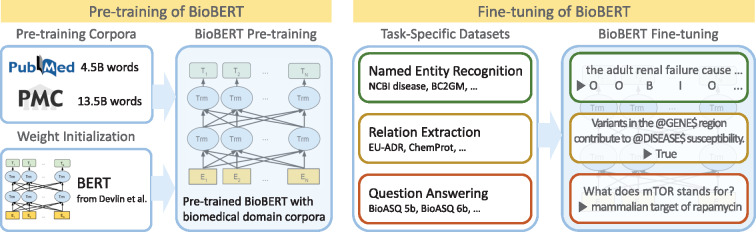
Motivation: Biomedical text mining is becoming increasingly important as the number of biomedical documents rapidly grows. With the progress in natural language processing (NLP), extracting valuable information from biomedical literature has gained popularity among researchers, and deep learning has boosted the development of effective biomedical text mining models. However, directly applying the advancements in NLP to biomedical text mining often yields unsatisfactory results due to a word distribution shift from general domain corpora to biomedical corpora. In this article, we investigate how the recently introduced pre-trained language model BERT can be adapted for biomedical corpora. Results: We introduce BioBERT (Bidirectional Encoder Representations from Transformers for Biomedical Text Mining), which is a domain-specific language representation model pre-trained on large-scale biomedical corpora. With almost the same architecture across tasks, BioBERT largely outperforms BERT and previous state-of-the-art models in a variety of biomedical text mining tasks when pre-trained on biomedical corpora. While BERT obtains performance comparable to that of previous state-of-the-art models, BioBERT significantly outperforms them on the following three representative biomedical text mining tasks: biomedical named entity recognition (0.62% F1 score improvement), biomedical relation extraction (2.80% F1 score improvement) and biomedical question answering (12.24% MRR improvement). Our analysis results show that pre-training BERT on biomedical corpora helps it to understand complex biomedical texts. Availability and implementation: We make the pre-trained weights of BioBERT freely available at https://github.com/naver/biobert-pretrained, and the source code for fine-tuning BioBERT available at https://github.com/dmis-lab/biobert.
Overview
The claims and statistics of this paper haven’t been checked yet.
Free: it reads the open-access text and checks the first 5 claims that cite a source we can check. Create a free account to check every claim.
Integrity signals
Registry
Cites
Statistics
Figures
Verification
Claims the paper makes
The claims and statistics of this paper haven’t been checked yet.
Free: it reads the open-access text and checks the first 5 claims that cite a source we can check. Create a free account to check every claim.
Claims other papers make about this one
Each is checked against this paper’s own text: does it say what the citing paper says it does?
The source backs part of the claim, not all of it — or backs it for a different population, condition or comparison.
In the citing paper
“Transformer models have proven their strong capabilities on learning long-term dependency on natural language processing tasks [19-21], and more recently on computer vision tasks [22-24].”
From DFDT: An End-to-End DeepFake Detection Framework Using Vision Transformer (2022) · cites this paper as [21]
Experimental — accuracy not yet measuredThe source backs part of the claim, not all of it — or backs it for a different population, condition or comparison.
In the citing paper
“A BioBERT-based model44 outperformed rule-based and traditional machine learning approaches.”
From Text classification models for assessing the completeness of randomized controlled trial publications based on CONSORT reporting guidelines (2024) · cites this paper as [44]
Experimental — accuracy not yet measuredThe source backs part of the claim, not all of it — or backs it for a different population, condition or comparison.
In the citing paper
“Popular LLMs, such as GPT-4, Llama, and BERT, often require large memory capacity13,58–61, making it challenging to run them on devices with limited memory, such as embedded systems, laptops, and mobile phones62.”
From Foundation metrics for evaluating effectiveness of healthcare conversations powered by generative AI (2024) · cites this paper as [61]
Experimental — accuracy not yet measuredThe source backs part of the claim, not all of it — or backs it for a different population, condition or comparison.
In the citing paper
“Healthcare represents a compelling domain for LLM use because the vast majority of actionable patient data is locked within unstructured clinical text, including electronic health records, clinical notes, and biomedical literature [4,5].”
From Explainability of decoder-only clinical large language models: A scoping review (2026) · cites this paper as [4]
Experimental — accuracy not yet measuredThe source backs part of the claim, not all of it — or backs it for a different population, condition or comparison.
In the citing paper
“Conventional natural language processing (NLP) approaches suffer from limited scalability and generalizability, and struggle to interpret implicit or vague temporal expressions.”
From TimeX: Phenotype Onset Extraction from Clinical Narratives (2026) · cites this paper as [20]
Experimental — accuracy not yet measured
14 more claims about this paper
Create a free account to see every claim other papers make about this one.
Self-check
Percentages, sums and reported differences re-computed from the paper’s own numbers.
The self-check needs the paper’s full text.
Citations
Cites
Vaswani, A., Shazeer, N., Parmar, N., Uszkoreit, J., Jones, L., Gomez, A. N., Kaiser, L., & Polosukhin, I. (2017) · arXiv · doi:10.48550/arxiv.1706.03762 · Cited by 120,404
LeCun, Y., Bengio, Y., & Hinton, G. (2015) · Nature · doi:10.1038/nature14539 · Cited by 84,126
Exploiting Generative AI to Scale up Intelligent Tutoring Systems
Jakubův, J., Chvalovský, K., Goertzel, Z., Kaliszyk, C., Olšák, M., Piotrowski, B., Schulz, S., Suda, M., & Urban, J. (2023) · DROPS (Schloss Dagstuhl – Leibniz Center for Informatics) · doi:10.4230/lipics.itp.2023.19 · Cited by 76,658
BERT: Pre-training of Deep Bidirectional Transformers for Language Understanding
Devlin, J., Chang, M.-W., Lee, K., & Toutanova, K. (2018) · arXiv · doi:10.48550/arxiv.1810.04805 · Cited by 73,173 · cited 3×
“BERT (Devlin et al., 2019) is a contextualized word representation model that is based on a masked language model and pretrained using bidirectional transformers (Vaswani et al., 2017). Due to the nature of language modeling where future words cannot be seen, previous language models were limited to a combination of t…”
BackgroundMethodInfluentialBERT: Pre-training of Deep Bidirectional Transformers for Language Understanding
Devlin, J., Chang, M.-W., Lee, K., & Toutanova, K. (2019) · Proceedings of the 2019 Conference of the North American Chapter of the Association for Computational Linguistics: Human Language Technologies, Volume 1 (Long and Short Papers) · doi:10.18653/v1/n19-1423 · Cited by 54,325 · cited 3×
“BERT (Devlin et al., 2019) is a contextualized word representation model that is based on a masked language model and pretrained using bidirectional transformers (Vaswani et al., 2017). Due to the nature of language modeling where future words cannot be seen, previous language models were limited to a combination of t…”
BackgroundMethodInfluentialGlove: Global Vectors for Word Representation
Pennington, J., Socher, R., & Manning, C. (2014) · Proceedings of the 2014 Conference on Empirical Methods in Natural Language Processing (EMNLP) · doi:10.3115/v1/d14-1162 · Cited by 34,071
Distributed Representations of Words and Phrases and their Compositionality
Mikolov, T., Sutskever, I., Chen, K., Corrado, G., & Dean, J. (2013) · arXiv · doi:10.48550/arxiv.1310.4546 · Cited by 24,533
Deep Contextualized Word Representations
Peters, M., Neumann, M., Iyyer, M., Gardner, M., Clark, C., Lee, K., & Zettlemoyer, L. (2018) · Proceedings of the 2018 Conference of the North American Chapter of the Association for Computational Linguistics: Human Language Technologies, Volume 1 (Long Papers) · doi:10.18653/v1/n18-1202 · Cited by 11,983 · cited 2×
“For instance, ELMo (Peters et al. , 2018) uses a bidirectional language model while CoVe (McCann et al. , 2017) uses machine translation to embed context information into word representations.”
BackgroundMethodSQuAD: 100,000+ Questions for Machine Comprehension of Text
Rajpurkar, P., Zhang, J., Lopyrev, K., & Liang, P. (2016) · Proceedings of the 2016 Conference on Empirical Methods in Natural Language Processing · doi:10.18653/v1/d16-1264 · Cited by 6,208
Google's Neural Machine Translation System: Bridging the Gap between Human and Machine Translation
Wu, Y., Schuster, M., Chen, Z., Le, Q. V., Norouzi, M., Macherey, W., Krikun, M., Cao, Y., Gao, Q., Macherey, K., et al. (2016) · arXiv · doi:10.48550/arxiv.1609.08144 · Cited by 5,319 · cited 2×
“One of the common settings while fine-tuning BERT (BioBERT) is the use of “main” — 2019/2/5 — 1:36 — page 4 — #4 Lee et al. WordPiece tokenization (Wu et al. , 2016) which can mitigate the out-of-vocabulary issue.”
Background
Research works printed but not linked: 1
- Krallinger M. et al (2017) Overview of the BioCreative VI chemical-protein interaction track. In: Proceedings of the BioCreative VI Workshop, Bethesda, MD, USA, pp. 141– 146. https://academic.oup.com/database/article/doi/10.1093/database/bay073/5055578. · doi:10.1093/database/bay073/5055578
Cited by
Items 901–1,000 of 1,099
Extracting Adverse Drug Events from Clinical NotesPreprint
Mahendran, D., & McInnes, B. T. (2021) · PubMed Central · doi:10.48550/arxiv.2104.10791 · Cited by 54
Is Domain Adaptation Worth Your Investment? Comparing BERT and FinBERT on Financial Tasks
Peng, B., Chersoni, E., Hsu, Y.-Y., & Huang, C. (2021) · Workshop on Economics and Natural Language Processing (ECONLP) · doi:10.18653/v1/2021.econlp-1.5 · Cited by 55
“…in such architectures, leading to the publication of Transformers trained on different types of in-domain text, e.g., scien-tific articles (Beltagy et al., 2019), biomedical text (Lee et al., 2020; Gu et al., 2020), clinical notes (Alsentzer et al., 2019), and patent corpora (Lee and Hsiang, 2020).”
BackgroundOn the Effect of Pretraining Corpora on In-context Learning by a Large-scale Language ModelPreprint
Shin, S., Lee, S.-W., Ahn, H., Kim, S., Kim, H., Kim, B., Cho, K., Lee, G., Park, W., Ha, J.-W., et al. (2022) · arXiv (Cornell University) · doi:10.48550/arxiv.2204.13509 · Cited by 54
“Previous studies argue pretraining with the corpus similar to the downstream task improves the downstream performance, but these observations are often limited to the case where a pretrained language model is finetuned for the downstream task (Gururangan et al., 2020; Lee et al., 2020; Micheli et al., 2020).”
BackgroundInfluentialSelf-citationDeep learning methods for protein function prediction
Boadu, F., Lee, A., & Cheng, J. (2025) · PROTEOMICS · doi:10.1002/pmic.202300471 · Cited by 53
PubHealthTab: A Public Health Table-based Dataset for Evidence-based Fact Checking
Akhtar, M., Cocarascu, O., & Simperl, E. P. B. (2022) · Findings of the Association for Computational Linguistics: NAACL · doi:10.18653/v1/2022.findings-naacl.1 · Cited by 54
“BioBERT: A domain-specific BERT model, pretrained on PubMed abstracts and PMC full-text articles (Lee et al., 2020).”
MethodA rule-free workflow for the automated generation of databases from scientific literature
Gilligan, L. P. J., Cobelli, M., Taufour, V., & Sanvito, S. (2023) · npj Computational Materials · doi:10.1038/s41524-023-01171-9 · Cited by 53
“Furthermore, there have been a number of BERT architectures adapted to outperform the conventional BERT model in various disparate NLP domains, including but not limited to the fields of general scientific literature [32], financial sentiment analysis [33], and biomedical text-mining [34].”
BackgroundLEAP: LLM instruction-example adaptive prompting framework for biomedical relation extraction
Zhou, H., Li, M., Xiao, Y., Yang, H., & Zhang, R. (2024) · Journal of the American Medical Informatics Association · doi:10.1093/jamia/ocae147 · Cited by 54
Extracting medical entities from social media
Šćepanović, S., Martín-López, E., Quercia, D., & Baykaner, K. (2020) · ACM Conference on Health, Inference, and Learning (CHIL) · doi:10.1145/3368555.3384467 · Cited by 53
Data and Representation for Turkish Natural Language Inference
Budur, E., Özçelik, R., Güngör, T., & Potts, C. (2020) · Conference on Empirical Methods in Natural Language Processing (EMNLP) · doi:10.18653/v1/2020.emnlp-main.662 · Cited by 55
“At the same time, BERT models have been released for a variety of individual languages (see Wolf et al., 2019) and specialized domains (Alsentzer et al., 2019; Lee et al., 2020).”
BackgroundMedical Entity Disambiguation Using Graph Neural Networks
Vretinaris, A., Lei, C., Efthymiou, V., Qin, X., & Özcan, F. (2021) · ACM SIGMOD International Conference on Management of Data (SIGMOD) · doi:10.1145/3448016.3457328 · Cited by 53
“In this work, we choose BioBERT [23], a deep learning-based clinical NER model, fine-tuned on the medical KB.”
MethodImproving BERT Model Using Contrastive Learning for Biomedical Relation Extraction
Su, P., Peng, Y., & Vijay‐Shanker, K. (2021) · Workshop on Biomedical Language Processing (BioNLP) · doi:10.18653/v1/2021.bionlp-1.1 · Cited by 53
Nugent, T., Stelea, N., & Leidner, J. L. (2021) · Lecture notes in computer science · doi:10.1007/978-3-030-86967-0_12 · Cited by 53
Schindler, D., Bensmann, F., Dietze, S., & Krüger, F. (2022) · PeerJ Computer Science · doi:10.7717/peerj-cs.835 · Cited by 55
“Different adaptions of the BERT pre-training procedure exist for scienti fi c literature resulting in the two well established models BioBERT ( Lee et al., 2019 ) ( M BB , sw , − ) and SciBERT ( Beltagy, Lo & Cohan, 2019 ) ( M SB , sw , − ).”
MethodChen, Q., Allot, A., Leaman, R., Islamaj, R., Du, J., Li, F., Wang, K., Xu, S., Zhang, Y., Bagherzadeh, P., et al. (2022) · Database · doi:10.1093/database/baac069 · Cited by 54
Tejani, A. S., Ng, Y. S., Xi, Y., Fielding, J. R., Browning, T. G., & Rayan, J. C. (2022) · Radiology Artificial Intelligence · doi:10.1148/ryai.220007 · Cited by 53
Protein Language Models and Structure Prediction: Connection and ProgressionPreprint
Hu, B., Xia, J., Zheng, J., Tan, C., Huang, Y., Xu, Y., & Li, S. Z. (2022) · arXiv (Cornell University) · doi:10.48550/arxiv.2211.16742 · Cited by 54
“Furthermore, because Pre-trained LMs are not datahungry to labelled data and present better performance, they gradually stepped into different domains, including financial, computer vision and biomedical applications (Araci, 2019; Bengio et al., 2022; Lee et al., 2020; Mikolov et al., 2013; Wang et al., 2022a), etc.”
BackgroundA Survey of GPT-3 Family Large Language Models Including ChatGPT and GPT-4Preprint
Kalyan, K. S. (2023) · arXiv (Cornell University) · doi:10.48550/arxiv.2310.12321 · Cited by 55
Large language models overcome the challenges of unstructured text data in ecology
Castro, A., Pinto, J., Reino, L., Pipek, P., & Capinha, C. (2024) · Ecological Informatics · doi:10.1016/j.ecoinf.2024.102742 · Cited by 52
Conversational health agents: a personalized large language model-powered agent framework
Abbasian, M., Azimi, I., Rahmani, A. M., & Jain, R. (2025) · JAMIA Open · doi:10.1093/jamiaopen/ooaf067 · Cited by 52
“12 This category emerged in response to research indicating that general-domain LLMs often struggle with healthcare-specific tasks due to domain shift, 25,26 and relying solely on prompt engineering may not significantly improve their healthcare-specific performance.”
Luo, X., Gandhi, P., Storey, S., & Huang, K. (2021) · IEEE Journal of Biomedical and Health Informatics · doi:10.1109/jbhi.2021.3123192 · Cited by 52
COVIDSum: A linguistically enriched SciBERT-based summarization model for COVID-19 scientific papers
Cai, X., Liu, S., Yang, L., Lu, Y., Zhao, J., Shen, D. G., & Liu, T. (2022) · Journal of Biomedical Informatics · doi:10.1016/j.jbi.2022.103999 · Cited by 52
“Since we focus on abstractive summarization of scientific literature in biomedical field, we adopt BioBERT [45] and SciBERT [9] as sequence”
InfluentialCoVERT: A Corpus of Fact-checked Biomedical COVID-19 Tweets
Mohr, I., Wührl, A., & Klinger, R. (2022) · Language Resources and Evaluation Conference (LREC) · doi:10.63317/4oadvny6pdem · Cited by 55
Natural Language Processing in Pathology
Úbeda, P. L., Martín‐Noguerol, T., Aneiros‐Fernández, J., & Luna, A. (2022) · American Journal Of Pathology · doi:10.1016/j.ajpath.2022.07.012 · Cited by 52
“An NLP-based classi fi er relying on ad hoc linguistic rules de fi ned on a large data set of 27,239 pathology reports was developed and tested, achieving a micro-F1 score of 98.14%.”
BackgroundMethodInfluentialNamed entity recognition of building construction defect information from text with linguistic noise
Jeon, K., Lee, G., Yang, S., & Jeong, H. D. (2022) · Automation in Construction · doi:10.1016/j.autcon.2022.104543 · Cited by 52
Chen, P., Zhang, M., Yu, X., & Li, S. (2022) · BMC Medical Informatics and Decision Making · doi:10.1186/s12911-022-02059-2 · Cited by 52
“introduced the first BERT pretraining model based on English medical text data, BioBERT, which was the first domain-specific language representation model pretrained on a large-scale biomedical corpus [21], but was not intended for Chinese medical text.”
MethodaeroBERT-NER: Named-Entity Recognition for Aerospace Requirements Engineering using BERT
Ray, A. T., Pinon-Fischer, O. J., Mavris, D. N., White, R. T., & Cole, B. F. (2023) · AIAA SciTech Forum · doi:10.2514/6.2023-2583 · Cited by 53
Localizing in-domain adaptation of transformer-based biomedical language models
Buonocore, T. M., Crema, C., Redolfi, A., Bellazzi, R., & Parimbelli, E. (2023) · Journal of Biomedical Informatics · doi:10.1016/j.jbi.2023.104431 · Cited by 52
Automated ICD coding using extreme multi-label long text transformer-based models
Liu, L., Perez‐Concha, O., Nguyen, A. N., Bennett, V., & Jorm, L. R. (2023) · Artificial Intelligence in Medicine · doi:10.1016/j.artmed.2023.102662 · Cited by 53
TransICD: Transformer Based Code-Wise Attention Model for Explainable ICD Coding
Biswas, B., Pham, T.-H., & Zhang, P. (2021) · Lecture notes in computer science · doi:10.1007/978-3-030-77211-6_56 · Cited by 52
Koshiyama, A., Firoozye, N., & Treleaven, P. (2020) · Proceedings of the First ACM International Conference on AI in Finance · doi:10.1145/3383455.3422539 · Cited by 38
“Though very recent, BERT has been used as a basis for many research projects and applications of natural language processing [61, 30, 50].”
Lu, Z., Sim, J.-A., Wang, J. X., Forrest, C. B., Krull, K. R., Srivastava, D. K., Hudson, M. M., Robison, L. L., Baker, J. N., & Huang, I. (2021) · Journal of Medical Internet Research · doi:10.2196/26777 · Cited by 53
“Similar methods may include SciBERT [62], trained by texts in Semantic Scholar; BioBERT [49], trained by texts in PubMed; and Clinical BERT [51], trained by clinical notes in MIMIC-III [63].”
Biomedical named entity recognition based on fusion multi-features embedding
Li, M., Yang, H., & Liu, Y. (2023) · Technology and Health Care · doi:10.3233/thc- · Cited by 52
Medical mT5: An Open-Source Multilingual Text-to-Text LLM for The Medical DomainPreprint
García-Ferrero, I., Agerri, R., Salazar, A. A., Cabrio, E., de la Iglesia, I., Lavelli, A., Magnini, B., Molinet, B., Ramirez-Romero, J., Rigau, G., et al. (2024) · arXiv (Cornell University) · doi:10.48550/arxiv.2404.07613 · Cited by 52
“1 (Lee et al., 2020), which has been pretrained on a large English-only biomedical dataset.”
InfluentialClinical Trial Information Extraction with BERT
Liu, X., Hersch, G. L., Khalil, I., & Devarakonda, M. V. (2021) · IEEE International Conference on Healthcare Informatics (ICHI) · doi:10.1109/ichi52183.2021.00092 · Cited by 51
“Meanwhile, pre-trained language models, such as BERT, have demonstrated superior performance over previous baselines across NLP tasks [7], [8].”
A Survey of Deep Learning for Electronic Health Records
Xu, J., Xi, X., Chen, J., Sheng, V. S., Ma, J., & Cui, Z. (2022) · Applied Sciences · doi:10.3390/app122211709 · Cited by 51
MuLan-Methyl—multiple transformer-based language models for accurate DNA methylation prediction
Zeng, W., Gautam, A., & Huson, D. H. (2022) · GigaScience · doi:10.1093/gigascience/giad054 · Cited by 51
ViSoBERT: A Pre-Trained Language Model for Vietnamese Social Media Text Processing
Nguyen, N., Phan, T., Nguyen, D.-V., & Nguyen, K. V. (2023) · Conference on Empirical Methods in Natural Language Processing (EMNLP) · doi:10.18653/v1/2023.emnlp-main.315 · Cited by 51
Evaluation and Analysis of Large Language Models for Clinical Text Augmentation and Generation
Latif, A., & Kim, J. (2024) · IEEE Access · doi:10.1109/access.2024.3384496 · Cited by 51
“In the clinical domain, domain-specific adaptations of BERT, such as BioBERT [20] and Clinical-BERT [21], have been used for various clinical language processing tasks.”
MethodAlomari, E. A. (2024) · Computer Modeling in Engineering & Sciences · doi:10.32604/cmes.2024.052256 · Cited by 52
Meshkin, H., Zirkle, J., Arabidarrehdor, G., Chaturbedi, A., Chakravartula, S., Mann, J., Thrasher, B., & Li, Z. (2024) · Briefings in Bioinformatics · doi:10.1093/bib/bbae354 · Cited by 51
Wang, J., Zhang, G., Wang, W., Zhang, K., & Sheng, Y. (2021) · Journal of Cloud Computing · doi:10.1186/s13677-020-00218-2 · Cited by 43
“Therefore, NLP models designed for universal natural language understanding always perform poorly in medical text mining tasks [7].”
BackgroundInfluentialReview: Privacy-Preservation in the Context of Natural Language Processing
Mahendran, D., Luo, C., & McInnes, B. T. (2021) · IEEE Access · doi:10.1109/access.2021.3124163 · Cited by 51
“Since most of the datasets belong to the clinical or healthcare domain, we can specifically use BioBERT [91] or Clinical BERT [92].”
MethodSurvey on natural language processing in medical image analysis.
Liu, Z., He, M., Jiang, Z., Wu, Z., Dai, H., Zhang, L., Luo, S., Han, T., Li, X., Jiang, X., et al. (2022) · PubMed Central · doi:10.11817/j.issn.1672-7347.2022.220376 · Cited by 51
Unsupervised Pre-training for Biomedical Question AnsweringPreprint
Kommaraju, V., Gunasekaran, K. P., Li, K., Bansal, T., McCallum, A., Williams, I., & Istrate, A.-M. (2020) · arXiv (Cornell University) · doi:10.48550/arxiv.2009.12952 · Cited by 51
Pruneski, J. A., Pareek, A., Nwachukwu, B. U., Martin, R. K., Kelly, B. T., Karlsson, J., Pearle, A. D., Kiapour, A. M., & Williams, R. J. (2023) · Knee Surgery, Sports Traumatology, Arthroscopy · doi:10.1007/s00167-022-07272-0 · Cited by 50
“, clinical bio-BERT, trained on PubMed literature) to allow for greater accuracy with specific tasks [2, 26].”
BackgroundNLPeer: A Unified Resource for the Computational Study of Peer Review
Dycke, N., Kuznetsov, I., & Gurevych, I. (2023) · Proceedings of the 61st Annual Meeting of the Association for Computational Linguistics (Volume 1: Long Papers) · doi:10.18653/v1/2023.acl-long.277 · Cited by 50
Accelerating Training of Transformer-Based Language Models with Progressive Layer Dropping
Zhang, M., & He, Y. (2020) · arXiv · doi:10.48550/arxiv.2010.13369 · Cited by 50
The RareDis corpus: A corpus annotated with rare diseases, their signs and symptoms
Martínez-deMiguel, C., Segura-Bédmar, I., Chacón-Solano, E., & Guerrero‐Aspizua, S. (2021) · Journal of Biomedical Informatics · doi:10.1016/j.jbi.2021.103961 · Cited by 50
Past and future uses of text mining in ecology and evolution
Farrell, M. J., Brierley, L., Willoughby, A. R., Yates, A., & Mideo, N. (2022) · Proceedings of the Royal Society B Biological Sciences · doi:10.1098/rspb.2021.2721 · Cited by 50
“There also exist systematic inequalities in the representation and performance of NLP technologies across languages [91,100]: largely because of the historical dominance of English as the lingua franca of scientific publishing, current scientific language models are designed only for English texts [101,102].”
BackgroundChandra, R., & Ranjan, M. (2022) · PLoS ONE · doi:10.1371/journal.pone.0273476 · Cited by 50
“We note that there exists specialised BERT pre-trained models such as those for medicine and law [168–173], but there is nothing yet developed for philosophy.”
BackgroundGani, M. O., Ayyasamy, R. K., Sangodiah, A., & Fui, Y. T. (2023) · Education and Information Technologies · doi:10.1007/s10639-023-11842-1 · Cited by 50
“SciBERT (Beltagy et al., 2019), which was trained using scientific corpora, and BioBERT (Lee et al., 2020), which was trained using biomedical corpora, are examples of domain-specific embedding.”
MethodControl, coordination, and adaptation functions in construction contracts: A machine-coding model
Fu, Y., Xu, C., Zhang, L., & Chen, Y. (2023) · Automation in Construction · doi:10.1016/j.autcon.2023.104890 · Cited by 50
Use of SNOMED CT in Large Language Models: Scoping Review
Chang, E., & Sung, S. (2024) · JMIR Medical Informatics · doi:10.2196/62924 · Cited by 49
“The differing word distributions in general and biomedical corpora pose challenges for biomedical text mining models [14].”
BackgroundMethodA hybrid framework with large language models for rare disease phenotyping
Wu, J., Dong, H., Li, Z., Wang, H., Li, R., Patra, A., Dai, C., Ali, W., Scordis, P., & Wu, H. (2024) · BMC Medical Informatics and Decision Making · doi:10.1186/s12911-024-02698-7 · Cited by 50
“BERT-based models can be effectively adapted by adding an extra layer fined-tuned for Named Entity Recognition using token-level labels, an example is BioBERT-NER [30] fine-tuned on top of BioBERT [31].”
BackgroundMethodGoyal, N., & Singh, N. (2024) · Neurocomputing · doi:10.1016/j.neucom.2024.129171 · Cited by 51
Ren, Z.-H., Zeng, X., Lao, Y., You, Z., Shang, Y., Zou, Q., & Chen, L. (2025) · Nature Communications · doi:10.1038/s41467-025-59431-9 · Cited by 50
“Since noexistingmethodseffectivelypredictDDIsinzero-shotscenarios,we evaluated the predictive performance of ZetaDDIE and its variants, containing ZetaDDIE without BST, ZetaDDIE with BioBERT 38 , ZetaDDIE with Premodel, and ZetaDDIE with BioSentVec 26,27 .”
Overview of the CLEF eHealth Evaluation Lab 2019
Kelly, L., Suominen, H., Goeuriot, L., Neves, M., Kanoulas, E., Li, D., Azzopardi, L. A., Spijker, R., Zuccon, G., Scells, H., et al. (2019) · Lecture notes in computer science · doi:10.1007/978-3-030-28577-7_26 · Cited by 50
“MLT-DFKI utilized Google Translate to convert documents into English and then relied on pre-trained BioBERT [17] to perform the prediction of ICD-10 codes.”
Leveraging Dependency Forest for Neural Medical Relation Extraction
Song, L., Zhang, Y., Gildea, D., Yu, M., Wang, Z., & Su, J. (2019) · Conference on Empirical Methods in Natural Language Processing (EMNLP) · doi:10.18653/v1/d19-1020 · Cited by 50
TopoAct: Visually Exploring the Shape of Activations in Deep Learning
Rathore, A., Chalapathi, N., Palande, S., & Wang, B. (2021) · Computer Graphics Forum · doi:10.1111/cgf.14195 · Cited by 50
Boosting Low-Resource Biomedical QA via Entity-Aware Masking Strategies
Pergola, G., Kochkina, E., Gui, L., Liakata, M., & He, Y. (2021) · Conference of the European Chapter of the Association for Computational Linguistics · doi:10.18653/v1/2021.eacl-main.169 · Cited by 50
Labels in a haystack: Approaches beyond supervised learning in biomedical applications
Yakimovich, A., Beaugnon, A., Huang, Y., & Özkırımlı, E. (2021) · Patterns · doi:10.1016/j.patter.2021.100383 · Cited by 52
“BioBERT has also been further fine-tuned through transfer learning for specific NLP tasks such as biomedical Named Entity Recognition.”
MethodBERT-Based Transfer-Learning Approach for Nested Named-Entity Recognition Using Joint Labeling
Agrawal, A., Tripathi, S., Vardhan, M., Sihag, V. K., Choudhary, G., & Dragoni, N. (2022) · Applied Sciences · doi:10.3390/app12030976 · Cited by 50
“Further details on the models that were used in the experiment can be found in [30,35].”
MethodHu, W., & Wang, S. Y. (2022) · Translational Vision Science & Technology · doi:10.1167/tvst.11.3.37 · Cited by 50
Improving Biomedical Information Retrieval with Neural Retrievers
Luo, M., Mitra, A., Gokhale, T., & Baral, C. R. (2022) · Proceedings of the AAAI Conference on Artificial Intelligence · doi:10.1609/aaai.v36i10.21352 · Cited by 50
Applications of natural language processing in ophthalmology: present and future
Chen, J., & Baxter, S. L. (2022) · Frontiers in Medicine · doi:10.3389/fmed.2022.906554 · Cited by 50
“BERT models have also been trained on biomedical text and include: clinicalBERT trained on EHR notes (50) and bioBERT trained on biomedical publications (51).”
MethodCohortGPT: An Enhanced GPT for Participant Recruitment in Clinical StudyPreprint
Guan, Z., Wu, Z., Liu, Z., Wu, D., Ren, H., Li, Q., Li, X., & Liu, N. (2023) · arXiv (Cornell University) · doi:10.48550/arxiv.2307.11346 · Cited by 50
“As shown, for the IU-RR dataset (Figure 3 (a)), when only a limited number of training samples (e.g., 185) are accessible, the F1-Score performance of the proposed method integrated with ChatGPT (0.69) or GPT-4 (0.81) could outperform the traditional fine-tuning strategy (0.44 for BioBERT and 0.25 for BioGPT).”
BackgroundMethodInfluentialImpacts of generative artificial intelligence on the future of labor market: a systematic review
Salari, N., Beiromvand, M., Hosseinian-Far, A., Habibi, J., Babajani, F., & Mohammadi, M. (2025) · Computers in Human Behavior Reports · doi:10.1016/j.chbr.2025.100652 · Cited by 49
“Accordingly, OpenAI ’ s ChatGPT and Google ’ s Gemini (previously known as Bard) are used in chatbots, language translators, and other programs, generating text that is often indistinguishable from human-written content (Lee et al., 2019).”
Kaur, R., Ginige, J. A., & Obst, O. (2023) · Expert Systems with Applications · doi:10.1016/j.eswa.2022.118997 · Cited by 48
Wang, G., Gao, K., Liu, Q., Wu, Y., Zhang, K., Zhou, W., & Guo, C. (2023) · Journal of Medical Internet Research · doi:10.2196/49771 · Cited by 48
“The BERT model is adept at identifying intricate semantic patterns in text, thereby generating high-quality text representations [19].”
MathBERT: A Pre-trained Language Model for General NLP Tasks in Mathematics Education
Shen, J. T., Yamashita, M., Prihar, E., Heffernan, N., Wu, X., Graff, B., & Lee, D. (2021) · arXiv · doi:10.48550/arxiv.2106.07340 · Cited by 47
A pre-training and self-training approach for biomedical named entity recognition
Gao, S., Kotevska, O., Sorokine, A., & Christian, J. B. (2021) · PLOS ONE · doi:10.1371/journal.pone.0246310 · Cited by 46
“For our BERT model, we utilize the pre-trained WordPiece vocabulary and model weights from BlueBERT Base [53], which is the BERT Base model pre-trained on PubMed abstracts and MIMIC III clinical notes, as this model has shown superior performance on biomedical and medical NER tasks compared to other BERT-based models…”
MethodLyu, W., Dong, X., Wong, R., Zheng, S., Abell-Hart, K., Wang, F., & Chen, C. (2022) · arXiv · doi:10.48550/arxiv.2208.10240 · Cited by 46
“Unstructured clinical notes are often in free narrative form, but contain complementary and rich contextual information, such as a patient’s symptoms, disease course and treatment(Lee et al., 2020).”
BackgroundMethodInfluentialLarge language models: an overview of foundational architectures, recent trends, and a new taxonomy
Mienye, I. D., Jere, N., Obaido, G., Ogunruku, O. O., Esenogho, E., & Modisane, C. (2025) · Discover Applied Sciences · doi:10.1007/s42452-025-07668-w · Cited by 46
“Domain-specific models Specialized for particular fields, models such as BioBERT [145] and LegalBERT [146] offer enhanced accuracy within their domains due to targeted training and fine-tuning.”
The 2022 n2c2/UW shared task on extracting social determinants of health
Lybarger, K., Yetisgen, M., & Uzuner, Ö. (2023) · Journal of the American Medical Informatics Association · doi:10.1093/jamia/ocad012 · Cited by 46
Mitchell, J. R., Szepietowski, P., Howard, R., Reisman, P., Jones, J. D., Lewis, P., Fridley, B. L., & Rollison, D. E. (2022) · Journal of Medical Internet Research · doi:10.2196/27210 · Cited by 45
“Lee et al [54] performed transfer learning on BERT using nearly 18 billion words extracted from PubMed abstracts.”
MethodPretraining to Recognize PICO Elements from Randomized Controlled Trial Literature.
Tian, K., Shirui, Z., & Chunhua, W. (2019) · Studies in Health Technology and Informatics · doi:10.3233/shti190209 · Cited by 45
Clay, B., Bergman, H. I., Salim, S., Pergola, G., Shalhoub, J., & Davies, A. H. (2025) · Computers in Biology and Medicine · doi:10.1016/j.compbiomed.2025.109808 · Cited by 41
SciBERT: A Pretrained Language Model for Scientific Text
Beltagy, I., Lo, K., & Cohan, A. (2019) · arXiv · doi:10.48550/arxiv.1903.10676 · Cited by 41
“Recent work on domain adaptation of BERT includes B IO B ERT (Lee et al., 2019) and C LINI - CAL B ERT (Alsentzer et al., 2019; Huang et al., 2019).”
MethodResultInfluentialTan, R. S. Y. C., Lin, Q., Low, G. H., Lin, R., Goh, T. C., Chang, C. C. E., Lee, F. F., Chan, W. Y., Tan, W. C., Tey, H. J., et al. (2023) · Journal of the American Medical Informatics Association · doi:10.1093/jamia/ocad133 · Cited by 41
“17,25 In addition, it was observed that while GatorTron’s incremental gain in accuracy over Bio-BERT was smaller compared with gains over non-transformer models, model run time for GatorTron was faster than BioBERT (2.5 min vs 11 min) to achieve best results due to the need to run fewer epochs (1…”
BackgroundInfluentialAdvancing PICO element detection in biomedical text via deep neural networks.
Jin, D., & Szolovits, P. (2020) · Bioinformatics · doi:10.1093/bioinformatics/btaa256 · Cited by 41
Contextualized medication information extraction using Transformer-based deep learning architectures
Chen, A., Yu, Z., Yang, X., Guo, Y., Bian, J., & Wu, Y. (2023) · Journal of Biomedical Informatics · doi:10.1016/j.jbi.2023.104370 · Cited by 40
Leveraging generative AI for clinical evidence synthesis needs to ensure trustworthiness
Zhang, G., Jin, Q., Jered McInerney, D., Chen, Y., Wang, F., Cole, C. L., Yang, Q., Wang, Y., Malin, B. A., Peleg, M., et al. (2024) · Journal of Biomedical Informatics · doi:10.1016/j.jbi.2024.104640 · Cited by 40
Detecting Causal Language Use in Science Findings
Yu, B., Li, Y., & Wang, J. (2019) · Proceedings of the 2019 Conference on Empirical Methods in Natural Language Processing and the 9th International Joint Conference on Natural Language Processing (EMNLP-IJCNLP) · doi:10.18653/v1/d19-1473 · Cited by 40
“To test whether the dataset size is sufficient to build a strong prediction model, we ran a learning curve test by setting aside 20% of the dataset for testing (i.e., about 600 examples), and then trained the BioBERT model with the 10%, 20%, ..., 100% of the remaining data (i.e., about 2500).”
BackgroundMethodInfluentialCui, F., Zhang, Z., Cao, C., Zou, Q., Chen, D., & Su, X. (2022) · PROTEOMICS · doi:10.1002/pmic.202100197 · Cited by 40
PhenoBERT: A Combined Deep Learning Method for Automated Recognition of Human Phenotype Ontology
Feng, Y., Qi, L., & Tian, W. (2023) · IEEE/ACM Transactions on Computational Biology and Bioinformatics · doi:10.1109/tcbb.2022.3170301 · Cited by 38
“Then, the tokens are embedded into a dense matrix EE 2 R k (cid:4) d using the pre-trained BioBERT [26], where d is the number of dimensions of the encoded token vector.”
MethodStojanov, R., Popovski, G., Cenikj, G., Koroušić Seljak, B., & Eftimov, T. (2021) · Journal of Medical Internet Research · doi:10.2196/28229 · Cited by 37
“Specifically, the 3 BERT models that were used were the original pretrained BERT model [10], the pretrained BioBERT standard model [15], and the BioBERT large model [15].”
Kaur, N., & Mittal, A. (2022) · Journal of Biomedical Informatics · doi:10.1016/j.jbi.2022.104220 · Cited by 37
Higher education assessment practice in the era of generative AI tools
(2024) · Journal of Applied Learning & Teaching · doi:10.37074/jalt.2024.7.1.28 · Cited by 37
Hurtful Words: Quantifying Biases in Clinical Contextual Word Embeddings
Zhang, H., Lu, A. X., Abdalla, M., McDermott, M., & Ghassemi, M. (2020) · arXiv · doi:10.48550/arxiv.2003.11515 · Cited by 37
“First, existing models are initialized from BioBERT [39] or BERTBASE [16], though SciBERT [6] outperforms BioBERT on a number of downstream tasks.”
MethodClinical insights: A comprehensive review of language models in medicine
Neveditsin, N., Lingras, P., & Mago, V. (2025) · PLOS Digital Health · doi:10.1371/journal.pdig.0000800 · Cited by 37
“Another notable model, BioBERT, was pre-trained on the PubMed library and fine-tuned for tasks such as named entity recognition (NER), relation extraction (RE), and medical question answering (QA) [84].”
Generating dermatopathology reports from gigapixel whole slide images with HistoGPT
Tran, M., Schmidle, P., Guo, R. R., Wagner, S. J., Koch, V., Lupperger, V., Novotny, B., Murphree, D. H., Hardway, H. D., D’Amato, M., et al. (2025) · Nature Communications · doi:10.1038/s41467-025-60014-x · Cited by 36
Enhancing evidence-based medicine with natural language argumentative analysis of clinical trials.
Mayer, T., Marro, S., Cabrio, E., & Villata, S. (2021) · Artificial Intelligence in Medicine · doi:10.1016/j.artmed.2021.102098 · Cited by 36
“For BioBERT, we used version 1.1.”
MethodInfluentialAssessing Empathy in Large Language Models with Real-World Physician-Patient Interactions
Luo, M., Warren, C. J., Cheng, L., Abdul-Muhsin, H. M., & Banerjee, I. (2024) · 2024 IEEE International Conference on Big Data (BigData) · doi:10.1109/bigdata62323.2024.10825307 · Cited by 36
“Large Language Models (LLMs) have exhibited exceptional performance in clinical and biomedical areas [24, 33].”
Benchmarking Large Language Models in Evidence-Based Medicine
Li, J., Deng, Y., Sun, Q., Zhu, J., Tian, Y., Li, J., & Zhu, T. (2025) · IEEE Journal of Biomedical and Health Informatics · doi:10.1109/jbhi.2024.3483816 · Cited by 35
“Building upon BERT’s architecture, specialized language models like BioBERT [26], PubMedBERT [19], and BioClinicalBERT [48] have been developed and trained on biomedical corpora, such as biomedical literature and clinical notes.”
Toward assessing clinical trial publications for reporting transparency
Kilicoglu, H., Rosemblat, G., Hoang, L., Wadhwa, S., Peng, Z., Malički, M., Schneider, J., & ter Riet, G. (2021) · Journal of Biomedical Informatics · doi:10.1016/j.jbi.2021.103717 · Cited by 34
Advances in Machine Learning Approaches to Heart Failure with Preserved Ejection Fraction
Ahmad, F. S., Luo, Y., Wehbe, R. M., Thomas, J. D., & Shah, S. J. (2022) · Heart Failure Clinics · doi:10.1016/j.hfc.2021.12.002 · Cited by 34
Clinical Reading Comprehension: A Thorough Analysis of the emrQA Dataset
Yue, X., Jimenez Gutierrez, B., & Sun, H. (2020) · Proceedings of the 58th Annual Meeting of the Association for Computational Linguistics · doi:10.18653/v1/2020.acl-main.410 · Cited by 33
GatorTron: A Large Language Model for Clinical Natural Language Processing
Yang, X., PourNejatian, N., Shin, H. C., Smith, K. E., Parisien, C., Compas, C., Martin, C., Flores, M. G., Zhang, Y., Magoc, T., et al. (2022) · doi:10.1101/2022.02.27.22271257 · Cited by 33
Ravi, A., Neinstein, A., & Murray, S. G. (2023) · ATS Scholar · doi:10.34197/ats-scholar.2023-0036ps · Cited by 31
Metadata
- Authors
- Lee, J., Yoon, W., Kim, S., Kim, D., Kim, S., So, C. H., & Kang, J.
- Affiliations
- Korea University (KR)
- Corresponding author
- Kang, Jaewoo
- Venue
- Bioinformatics
- Publisher
- Oxford University Press (OUP)
- Published
- 2019-09-10
- Volume
- 36
- Issue
- 4
- Pages
- 1234-1240
- ISSN
- 1367-4803 (ISSN-L)
- 1367-4811
- PMC
- PMC7703786
- OpenAlex
- W2911489562
- Semantic Scholar
- 1e43c7084bdcb6b3102afaf301cce10faead2702
- Cited by
- 7,218
- References
- 46
- Citations by year
- 2026: 1144 · 2025: 1386 · 2024: 1118 · 2023: 1100 · 2022: 940 · 2021: 861 · 2020: 532 · 2019: 133
- FWCI
- 204.40
- Type
- journal article
- Language
- en
- Open access
- hybrid
- doi.org
- Licence
- Locations
- Bioinformatics (publishedVersion, cc-by)
- PubMed Central (publishedVersion, cc-by)
- PubMed (publishedVersion)
- arXiv (Cornell University) (submittedVersion)
- arXiv (Cornell University)
- Funders
- National Research Foundation of Korea(NRF) funded by the Korea government (NRF-2017R1A2A1A17069645, NRF-2017M3C4A7065887, NRF-2014M3C9A3063541)
- Topics
- Health Sciences › Medicine › Health Informatics › Biomedical Text Mining and Ontologies
- Physical Sciences › Computer Science › Artificial Intelligence › Topic Modeling
- Physical Sciences › Computer Science › Artificial Intelligence › Machine Learning in Healthcare
- Keywords
- BioBERT, pre-trained language models, BERT, biomedical text mining, biomedical named entity recognition, biomedical relation extraction, biomedical question answering, fine-tuning
- MeSH terms
- Language, Natural Language Processing, Software, Data Mining
About these checks
Registry, retraction, Cites and statistics results are computed, not judged, with one exception: a printed reference that no index lists is read once by a model before it counts as a citation error. Claims are extracted by a model and kept only when their quote appears verbatim in the text; each cited source is then checked, with a model’s help, for whether it says what the claim relies on. Those verdicts can be wrong — read the claim’s quote and the cited source before relying on one.
Statistics and arithmetic are recomputed, not judged.
Confidence bands are shown only for fields calibrated on our annotated test set. None is calibrated yet, so no band is shown.
What counts as a claim ›How we measure confidence ›How we check this ›
Are you an author, or do you see a problem with this page? Request a review
Data sources
Bibliographic data: Semantic Scholar, OpenAlex, Crossref.
Contains information from the Semantic Scholar Academic Graph Datasets, made available under the ODC Attribution License (ODC-BY 1.0).
Semantic Scholar’s data is described in: Kinney, R., et al. (2023). The Semantic Scholar Open Data Platform. arXiv:2301.10140.
