

The DOI matches its Crossref record; 5 of the 5 references it cites were found in a registry or an index.
The unfolded protein response in amyotrophic later sclerosis: results of a phase 2 trial
Abstract
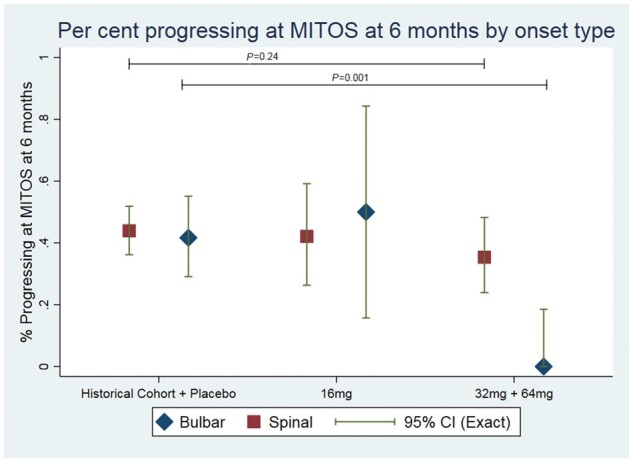
Strong evidence suggests that endoplasmic reticulum stress plays a critical role in the pathogenesis of amyotrophic lateral sclerosis (ALS) through altered regulation of proteostasis. Robust preclinical findings demonstrated that guanabenz selectively inhibits endoplasmic reticulum stress-induced eIF2α-phosphatase, allowing misfolded protein clearance, reduces neuronal death and prolongs survival in in vitro and in vivo models. However, its safety and efficacy in patients with ALS are unknown. To address these issues, we conducted a multicentre, randomized, double-blind trial with a futility design. Patients with ALS who had displayed an onset of symptoms within the previous 18 months were randomly assigned in a 1:1:1:1 ratio to receive 64 mg, 32 mg or 16 mg of guanabenz or placebo daily for 6 months as an add-on therapy to riluzole. The purpose of the placebo group blinding was to determine safety but not efficacy. The primary outcome was the proportion of patients progressing to higher stages of disease within 6 months as measured using the ALS Milano-Torino staging system, compared with a historical cohort of 200 patients with ALS. The secondary outcomes were the rate of decline in the total revised ALS functional rating scale score, slow vital capacity change, time to death, tracheotomy or permanent ventilation and serum light neurofilament level at 6 months. The primary assessment of efficacy was performed using intention-to-treat analysis. The treatment arms using 64 mg and 32 mg guanabenz, both alone and combined, reached the primary hypothesis of non-futility, with the proportions of patients who progressed to higher stages of disease at 6 months being significantly lower than that expected under the hypothesis of non-futility and a significantly lower difference in the median rate of change in the total revised ALS functional rating scale score. This effect was driven by patients with bulbar onset, none of whom (0/18) progressed to a higher stage of disease at 6 months compared with those on 16 mg guanabenz (4/8; 50%), the historical cohort alone (21/49; 43%; P = 0.001) or plus placebo (25/60; 42%; P = 0.001). The proportion of patients who experienced at least one adverse event was higher in any guanabenz arm than in the placebo arm, with higher dosing arms having a significantly higher proportion of drug-related side effects and the 64 mg arm a significantly higher drop-out rate. The number of serious adverse events did not significantly differ between the guanabenz arms and the placebo. Our findings indicate that a larger trial with a molecule targeting the unfolded protein response pathway without the alpha-2 adrenergic related side-effect profile of guanabenz is warranted.
Overview
The claims and statistics of this paper haven’t been checked yet.
Run the check — free, no account needed. It reads the open-access text and checks the sources it cites.
Integrity signals
Registry
Cites
Statistics
Figures
Verification
Claims the paper makes
The claims and statistics of this paper haven’t been checked yet.
Run the check — free, no account needed. It reads the open-access text and checks the sources it cites.
Claims other papers make about this one
Each is checked against this paper’s own text: does it say what the citing paper says it does?
The source backs part of the claim, not all of it — or backs it for a different population, condition or comparison.
In the citing paper
“A Phase 3 clinical trial has revealed that, in patients with recent ALS diagnosis, administration of the antihypertensive guanabenz inhibits progression to the life-threatening bulbar stage 98 .”
From Hallmarks of aging: An expanding universe (2023) · cites this paper as [98]
Experimental — accuracy not yet measured
Self-check
Percentages, sums and reported differences re-computed from the paper’s own numbers.
The self-check needs the paper’s full text.
Citations
Cites
Self-propagation of pathogenic protein aggregates in neurodegenerative diseases
Jucker, M., & Walker, L. C. (2013) · Nature · doi:10.1038/nature12481 · Cited by 1,663
The integrated stress response: From mechanism to disease
Costa-Mattioli, M., & Walter, P. (2020) · Science · doi:10.1126/science.aat5314 · Cited by 1,617
Non–cell autonomous toxicity in neurodegenerative disorders: ALS and beyond
Ilieva, H., Polymenidou, M., & Cleveland, D. W. (2009) · Journal of Cell Biology · doi:10.1083/jcb.200908164 · Cited by 1,008
Oxidative and endoplasmic reticulum stress interplay in sporadic amyotrophic lateral sclerosis
Ilieva, E. V., Ayala, V., Jove, M., Dalfo, E., Cacabelos, D., Povedano, M., Bellmunt, M. J., Ferrer, I., Pamplona, R., & Portero-Otin, M. (2007) · Brain · doi:10.1093/brain/awm190 · Cited by 358
Miller, R. G., Moore, D. H., Forshew, D. A., Katz, J. S., Barohn, R. J., Valan, M., Bromberg, M. B., Goslin, K. L., Graves, M. C., McCluskey, L. F., et al. (2011) · Neurology · doi:10.1212/wnl.0b013e31822dc7a5 · Cited by 70
Research works printed but not linked: 65
- Ito, 2014, Basophilic inclusions and neuronal intermediate filament inclusions in amyotrophic lateral sclerosis and frontotemporal lobar degeneration, Neuropathology, 34, 589, 10.1111/neup.12119 · DOI
- Arbour, 2017, New perspectives on amyotrophic lateral sclerosis: The role of glial cells at the neuromuscular junction, J Physiol, 595, 647, 10.1113/JP270213 · DOI
- Philips, 2014, Glial cells in amyotrophic lateral sclerosis, Exp Neurol, 262, 111, 10.1016/j.expneurol.2014.05.015 · DOI
- Souza, 2016, Far beyond the motor neuron: The role of glial cells in amyotrophic lateral sclerosis, Arq Neuro-Psiquiatr, 74, 849, 10.1590/0004-282X20160117 · DOI
- Kang, 2013, Degeneration and impaired regeneration of gray matter oligodendrocytes in amyotrophic lateral sclerosis, Nat Neurosci, 16, 571, 10.1038/nn.3357 · DOI · Paper page
- Brown, 2017, Amyotrophic lateral sclerosis, N Engl J Med, 377, 1602, 10.1056/NEJMc1710379 · DOI
- Walter, 2011, The unfolded protein response: From stress pathway to homeostatic regulation, Science, 334, 1081, 10.1126/science.1209038 · DOI
- Shrivastava, 2017, Physico-pathologic mechanisms involved in neurodegeneration: misfolded protein-plasma membrane interactions, Neuron, 95, 33, 10.1016/j.neuron.2017.05.026 · DOI
- Munch, 2011, Self-propagation and transmission of misfolded mutant SOD1: Prion or prion-like phenomenon?, Cell Cycle, 10, 1711, 10.4161/cc.10.11.15560 · DOI
- Munch, 2011, Prion-like propagation of mutant superoxide dismutase-1 misfolding in neuronal cells, Proc Natl Acad Sci U S A, 108, 3548, 10.1073/pnas.1017275108 · DOI
- Polymenidou, 2011, The seeds of neurodegeneration: Prion-like spreading in ALS, Cell, 147, 498, 10.1016/j.cell.2011.10.011 · DOI
- Lee, 2015, Prion-like mechanism in amyotrophic lateral sclerosis: Are protein aggregates the key?, Exp Neurobiol, 24, 1, 10.5607/en.2015.24.1.1 · DOI
- Kanekura, 2009, ER stress and unfolded protein response in amyotrophic lateral sclerosis, Mol Neurobiol, 39, 81, 10.1007/s12035-009-8054-3 · DOI
- Maharjan, 2016, ER strikes again: Proteostasis dysfunction in ALS, EMBO J, 35, 798, 10.15252/embj.201694117 · DOI
- Parakh, 2016, Protein folding alterations in amyotrophic lateral sclerosis, Brain Res, 1648, 633, 10.1016/j.brainres.2016.04.010 · DOI
- Wang, 2011, The unfolded protein response in familial amyotrophic lateral sclerosis, Hum Mol Genet, 20, 1008, 10.1093/hmg/ddq546 · DOI
- Walker, 2011, Stress signaling from the endoplasmic reticulum: A central player in the pathogenesis of amyotrophic lateral sclerosis, IUBMB Life, 63, 754
- Vats, 2018, Expression analysis of protein homeostasis pathways in the peripheral blood mononuclear cells of sporadic amyotrophic lateral sclerosis patients, J Neurol Sci, 387, 85, 10.1016/j.jns.2018.01.035 · DOI
- Atkin, 2008, Endoplasmic reticulum stress and induction of the unfolded protein response in human sporadic amyotrophic lateral sclerosis, Neurobiol Dis, 30, 400, 10.1016/j.nbd.2008.02.009 · DOI · Paper page
- Ruegsegger, 2016, Proteostasis impairment in ALS, Brain Res, 1648, 571, 10.1016/j.brainres.2016.03.032 · DOI
- Yerbury, 2016, Walking the tightrope: Proteostasis and neurodegenerative disease, J Neurochem, 137, 489, 10.1111/jnc.13575 · DOI
- Lin, 2008, Endoplasmic reticulum stress in disease pathogenesis, Annu Rev Pathol, 3, 399, 10.1146/annurev.pathmechdis.3.121806.151434 · DOI
- Ron, 2012, Protein-folding homeostasis in the endoplasmic reticulum and nutritional regulation, Cold Spring Harb Perspect Biol, 4, 10.1101/cshperspect.a013177 · DOI
- Sasaki, 2010, Endoplasmic reticulum stress in motor neurons of the spinal cord in sporadic amyotrophic lateral sclerosis, J Neuropathol Exp Neurol, 69, 346, 10.1097/NEN.0b013e3181d44992 · DOI · Paper page
- Tsaytler, 2011, Selective inhibition of a regulatory subunit of protein phosphatase 1 restores proteostasis, Science, 332, 91, 10.1126/science.1201396 · DOI
- Vaccaro, 2013, Pharmacological reduction of ER stress protects against TDP-43 neuronal toxicity in vivo, Neurobiol Dis, 55, 64, 10.1016/j.nbd.2013.03.015 · DOI
- Barbezier, 2011, Antiprion drugs 6-aminophenanthridine and guanabenz reduce PABPN1 toxicity and aggregation in oculopharyngeal muscular dystrophy, EMBO Mol Med, 3, 35, 10.1002/emmm.201000109 · DOI
- Wang, 2014, Guanabenz, which enhances the unfolded protein response, ameliorates mutant SOD1-induced amyotrophic lateral sclerosis, Neurobiol Dis., 71, 317, 10.1016/j.nbd.2014.08.010 · DOI
- Jiang, 2014, Guanabenz delays the onset of disease symptoms, extends lifespan, improves motor performance and attenuates motor neuron loss in the SOD1 G93A mouse model of amyotrophic lateral sclerosis, Neuroscience, 277, 132, 10.1016/j.neuroscience.2014.03.047 · DOI
- Das, 2015, Preventing proteostasis diseases by selective inhibition of a phosphatase regulatory subunit, Science, 348, 239, 10.1126/science.aaa4484 · DOI
- Dalla Bella, 2017, Protein misfolding, amyotrophic lateral sclerosis and guanabenz: Protocol for a phase II RCT with futility design (ProMISe trial), BMJ Open, 7, e015434, 10.1136/bmjopen-2016-015434 · DOI
- Brooks, 2000, El Escorial revisited: Revised criteria for the diagnosis of amyotrophic lateral sclerosis, Amyotroph Lateral Scler Other Motor Neuron Disord, 1, 293, 10.1080/146608200300079536 · DOI · Paper page
- Sharp, 2015, The Hamilton Rating Scale for Depression, Occup Med (Lond), 65, 340, 10.1093/occmed/kqv043 · DOI
- Chio, 2015, Development and evaluation of a clinical staging system for amyotrophic lateral sclerosis, J Neurol Neurosurg Psychiatry, 86, 38, 10.1136/jnnp-2013-306589 · DOI
- Tramacere, 2015, The MITOS system predicts long-term survival in amyotrophic lateral sclerosis, J Neurol Neurosurg Psychiatry, 86, 1180, 10.1136/jnnp-2014-310176 · DOI
- Lauria, 2015, Erythropoietin in amyotrophic lateral sclerosis: A multicentre, randomised, double blind, placebo controlled, phase III study, J Neurol Neurosurg Psychiatry, 86, 879, 10.1136/jnnp-2014-308996 · DOI
- Fang, 2018, Stage at which riluzole treatment prolongs survival in patients with amyotrophic lateral sclerosis: A retrospective analysis of data from a dose-ranging study, Lancet Neurol, 17, 416, 10.1016/S1474-4422(18)30054-1 · DOI · Paper page
- Lunetta, 2020, The Italian multicenter experience with edaravone in amyotrophic lateral sclerosis, J Neurol, 267, 3258, 10.1007/s00415-020-09993-z · DOI
- Kimura, 2006, Progression rate of ALSFRS-R at time of diagnosis predicts survival time in ALS, Neurology, 66, 265, 10.1212/01.wnl.0000194316.91908.8a · DOI
- Atassi, 2014, The PRO-ACT database: Design, initial analyses, and predictive features, Neurology, 83, 1719, 10.1212/WNL.0000000000000951 · DOI
- Cudkowicz, 2010, Toward more efficient clinical trials for amyotrophic lateral sclerosis, Amyotroph Lateral Scler, 11, 259, 10.3109/17482960903358865 · DOI
- Bedlack, 2019, Lunasin does not slow ALS progression: Results of an open-label, single-center, hybrid-virtual 12-month trial, Amyotroph Lateral Scler Frontotemporal Degener, 20, 285, 10.1080/21678421.2018.1556698 · DOI
- Glass, 2016, Transplantation of spinal cord-derived neural stem cells for ALS: Analysis of phase 1 and 2 trials, Neurology, 87, 392, 10.1212/WNL.0000000000002889 · DOI
- Goutman, 2018, Long-term Phase 1/2 intraspinal stem cell transplantation outcomes in ALS, Ann Clin Transl Neurol, 5, 730, 10.1002/acn3.567 · DOI
- Levine, 2017, Phase I clinical trial of safety of L-serine for ALS patients, Amyotroph Lateral Scler Frontotemporal Degener, 18, 107, 10.1080/21678421.2016.1221971 · DOI
- Maier, 2015, Interleukin-1 antagonist anakinra in amyotrophic lateral sclerosis–A pilot study, PLoS One, 10, e0139684, 10.1371/journal.pone.0139684 · DOI
- Statland, 2019, Rasagiline for amyotrophic lateral sclerosis: A randomized, controlled trial, Muscle Nerve, 59, 201, 10.1002/mus.26335 · DOI
- Paganoni, 2020, Trial of sodium phenylbutyrate-taurursodiol for amyotrophic lateral sclerosis, N Engl J Med, 383, 919, 10.1056/NEJMoa1916945 · DOI · Paper page
- Fang, 2017, Comparison of the King's and MiToS staging systems for ALS, Amyotroph Lateral Scler Frontotemporal Degener, 18, 227, 10.1080/21678421.2016.1265565 · DOI
- Bakker, 2017, Assessment of the factorial validity and reliability of the ALSFRS-R: A revision of its measurement model, J Neurol, 264, 1413, 10.1007/s00415-017-8538-4 · DOI
- Franchignoni, 2013, Evidence of multidimensionality in the ALSFRS-R Scale: A critical appraisal on its measurement properties using Rasch analysis, J Neurol Neurosurg Psychiatry, 84, 1340, 10.1136/jnnp-2012-304701 · DOI
- Fournier, 2020, Development and validation of the Rasch-Built Overall Amyotrophic Lateral Sclerosis Disability Scale (ROADS), JAMA Neurol, 77, 480, 10.1001/jamaneurol.2019.4490 · DOI
- Beghi, 2013, Randomized double-blind placebo-controlled trial of acetyl-L-carnitine for ALS, Amyotroph Lateral Scler Frontotemporal Degener, 14, 397, 10.3109/21678421.2013.764568 · DOI
- Cudkowicz, 2013, Dexpramipexole versus placebo for patients with amyotrophic lateral sclerosis (EMPOWER): A randomised, double-blind, phase 3 trial, Lancet Neurol, 10.1016/S1474-4422(13)70221-7 · DOI
- Verstraete, 2012, Lithium lacks effect on survival in amyotrophic lateral sclerosis: A phase IIb randomised sequential trial, J Neurol Neurosurg Psychiatry, 83, 557, 10.1136/jnnp-2011-302021 · DOI · Paper page
- van den Berg, 2019, Revised Airlie House consensus guidelines for design and implementation of ALS clinical trials, Neurology, 92, e1610, 10.1212/WNL.0000000000007242 · DOI
- Verde, 2019, Neurofilament light chain in serum for the diagnosis of amyotrophic lateral sclerosis, J Neurol Neurosurg Psychiatry, 90, 157, 10.1136/jnnp-2018-318704 · DOI
- Benatar, 2018, Neurofilament light: A candidate biomarker of presymptomatic amyotrophic lateral sclerosis and phenoconversion, Ann Neurol, 84, 130, 10.1002/ana.25276 · DOI
- Benatar, 2020, Validation of serum neurofilaments as prognostic and potential pharmacodynamic biomarkers for ALS, Neurology, 95, e59, 10.1212/WNL.0000000000009559 · DOI
- Carrara, 2017, Decoding the selectivity of eIF2α holophosphatases and PPP1R15A inhibitors, Nat Struct Mol Biol, 24, 708, 10.1038/nsmb.3443 · DOI
- Li, 2013, Stress granules as crucibles of ALS pathogenesis, J Cell Biol, 201, 361, 10.1083/jcb.201302044 · DOI
- Saxena, 2009, A role for motoneuron subtype-selective ER stress in disease manifestations of FALS mice, Nat Neurosci, 12, 627, 10.1038/nn.2297 · DOI · Paper page
- Ciechanover, 2015, Degradation of misfolded proteins in neurodegenerative diseases: Therapeutic targets and strategies, Exp Mol Med, 47, e147, 10.1038/emm.2014.117 · DOI · Paper page
- Nordlund, 2008, SOD1-associated ALS: A promising system for elucidating the origin of protein-misfolding disease, HFSP J., 2, 354, 10.2976/1.2995726 · DOI
- Shellikeri, 2020, Neuropathology of speech network distinguishes bulbar from nonbulbar amyotrophic lateral sclerosis, J Neuropathol Exp Neurol, 79, 284, 10.1093/jnen/nlz130 · DOI
Cited by
Sorted by citations
Hallmarks of aging: An expanding universe
López-Otín, C., Blasco, M. A., Partridge, L., Serrano, M., & Kroemer, G. (2023) · Cell · doi:10.1016/j.cell.2022.11.001 · Cited by 6,549
Metadata
- Authors
- Dalla Bella, E., Bersano, E., Antonini, G., Borghero, G., Capasso, M., Caponnetto, C., Chiò, A., Corbo, M., Filosto, M., Giannini, F., Spataro, R., Lunetta, C., Mandrioli, J., Messina, S., Monsurrò, M. R., Mora, G., Riva, N., Rizzi, R., Siciliano, G., Silani, V., Simone, I., Sorarù, G., Tugnoli, V., Verriello, L., Volanti, P., Furlan, R., Nolan, J. M., Abgueguen, E., Tramacere, I., & Lauria, G.
- Affiliations
- 3rd Neurology Unit and Motor Neuron Disease Centre, Fondazione IRCCS Istituto Neurologico “Carlo Besta”, Milan 20133, Italy
- NESMOS Department, Neuromuscolar Disease Unit, Sant'Andrea Hospital and University of Rome “Sapienza”, Rome 00189, Italy
- Neurologic Unit, Monserrato University Hospital, Cagliari 09042, Italy
- Neurologic Clinic, SS. Annunziata Hospital, Chieti 66100, Italy
- San Martino Polyclinic Hospital, Genoa 16132, Italy
- ALS Centre “Rita Levi Montalcini”, Department of Neuroscience, University of Turin, Turin, Italy
- Department of Neurorehabilitaton, Casa Cura Policlinico, Milan, Italy
- Department of Clinical and Experimental Sciences, University of Brescia, ASST Spedali Civili Brescia and NeMO-Brescia Clinical Centre for Neuromuscular Diseases, Brescia, Italy
- Department of Medical and Surgery Sciences and Neurosciences, University of Siena, Siena, Italy
- ALS Research Centre, BioNeC, University of Palermo, Palermo, Italy
- NEuroMuscular Omnicentre of Milan, Milan, Italy
- Department of Neurosciences, Azienda Ospedaliero Universitaria di Modena, Modena, Italy
- Unit of Neurology and Neuromuscular Disorders, Department of Clinical and Experimental Medicine and University of Messina, AOU Policlinico “G. Martino”, Messina, Italy
- “Luigi Vanvitelli” Campania University Naples, Napoli, Italy
- ICS Maugeri IRCCS, Milan, Italy
- Department of Neurology IRCCS “San Raffaele” Hospital, Milan, Italy
- Neurology Unit, Department of Neuro-Motor Diseases, Azienda Unità Sanitaria Locale, IRCCS of Reggio Emilia, Reggio Emilia, Italy
- Department of Clinical and Experimental Medicine, Neurology Unit, University of Pisa, Pisa, Italy
- Department of Neurology-Stroke Unit and Laboratory of Neuroscience, Istituto Auxologico Italiano IRCCS, Milan, Italy
- Department of Neurology and Psychiatry, University of Bari, Italy
- Department of Neurosciences, University of Padua, Italy
- Department of Neuroscience and Rehabilitation, Division of Neurology, University Hospital of Ferrara, Ferrara, Italy
- Neurology Unit, S. Maria della Misericordia University Hospital, Udine, Italy
- Intensive Neurorehabilitation Unit, ICS Maugeri IRCCS, Mistretta, Italy
- Clinical Neuroimmunology Unit, Institute of Experimental Neurology, Division of Neuroscience, San Raffaele Scientific Institute, Milan, Italy
- Drew University, Caspersen School of Graduate Studies, Madison, NJ, USA
- InFlectis BioScience, Nantes, France
- Scientific Directorate, Fondazione IRCCS Istituto Neurologico “Carlo Besta”, Milan, Italy
- ORCID
- Venue
- Brain
- Publisher
- Oxford University Press (OUP)
- Published
- 2021-04-27
- Volume
- 144
- Issue
- 9
- Pages
- 2635-2647
- ISSN
- 0006-8950
- 1460-2156
- PMC
- PMC8557337
- Cited by
- 59
- References
- 5
- Language
- en
- Funders
- Fondazione Italiana di Ricerca per la Sclerosi Laterale Amiotrofica (FGCR 01/2013, 2014–005367-32)
- Ricerca Corrente of the Ministry of Health to the Fondazione IRCCS Istituto Neurologico “Carlo Besta” of Milan
About these checks
Registry, retraction, Cites and statistics results are computed, not judged, with one exception: a printed reference that no index lists is read once by a model before it counts as a citation error. Claims are extracted by a model and kept only when their quote appears verbatim in the text; each cited source is then checked, with a model’s help, for whether it says what the claim relies on. Those verdicts can be wrong — read the claim’s quote and the cited source before relying on one.
Statistics and arithmetic are recomputed, not judged.
Confidence bands are shown only for fields calibrated on our annotated test set. None is calibrated yet, so no band is shown.
What counts as a claim ›How we measure confidence ›How we check this ›
Are you an author, or do you see a problem with this page? Request a review
How to cite
Cite CoChat for the checks on this page, and the paper for its own findings.
- This page
- CoChat. (2026). Citation check: The unfolded protein response in amyotrophic later sclerosis: results of a phase 2 trial. https://app.cochat.ai/papers/10.1093/brain/awab167
- The paper
- Dalla Bella, E., Bersano, E., Antonini, G., Borghero, G., Capasso, M., Caponnetto, C., Chiò, A., Corbo, M., Filosto, M., Giannini, F., Spataro, R., Lunetta, C., Mandrioli, J., Messina, S., Monsurrò, M. R., Mora, G., Riva, N., Rizzi, R., Siciliano, G., . . . Lauria, G. (2021). The unfolded protein response in amyotrophic later sclerosis: results of a phase 2 trial. Brain. https://doi.org/10.1093/brain/awab167
