

TDP-43 real-time quaking induced conversion reaction optimization and detection of seeding activity in CSF of amyotrophic lateral sclerosis and frontotemporal dementia patients
Open accessThe DOI matches its Crossref record; 55 of the 56 references it cites were found in a registry or an index.
Abstract
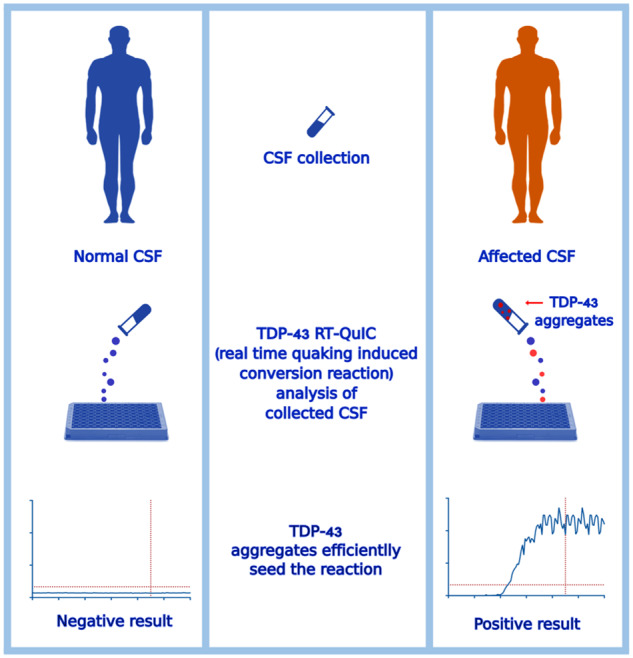
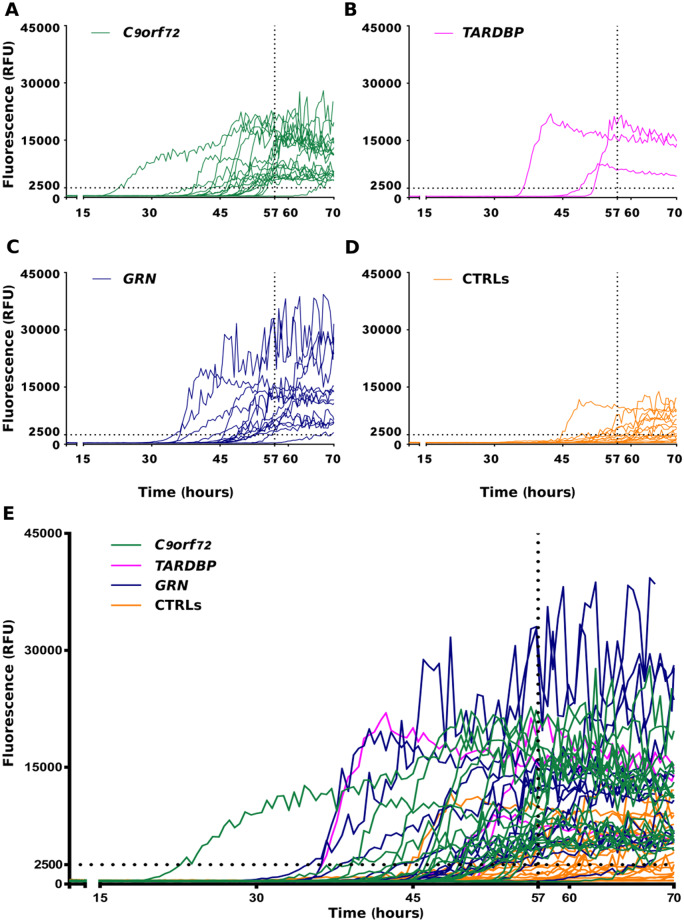
The pathological deposition of the transactive response DNA-binding protein of 43 kDa occurs in the majority (∼97%) of amyotrophic lateral sclerosis and in around 45% of frontotemporal lobar degeneration cases. Amyotrophic lateral sclerosis and frontotemporal lobar degeneration clinically overlap, presenting a continuum of phenotypes. Both amyotrophic lateral sclerosis and frontotemporal lobar degeneration lack treatments capable of interfering with the underlying pathological process and early detection of transactive response DNA-binding protein of 43 kDa pathology would facilitate the development of disease-modifying drugs. The real-time quaking-induced conversion reaction showed the ability to detect prions in several peripheral tissues of patients with different forms of prion and prion-like diseases. Despite transactive response DNA-binding protein of 43 kDa displays prion-like properties, to date the real-time quaking-induced conversion reaction technology has not yet been adapted to this protein. The aim of this study was to adapt the real-time quaking-induced conversion reaction technique for the transactive response DNA-binding protein of 43 kDa substrate and to exploit the intrinsic ability of this technology to amplify minute amount of mis-folded proteins for the detection of pathological transactive response DNA-binding protein of 43 kDa species in the cerebrospinal fluid of amyotrophic lateral sclerosis and frontotemporal lobar degeneration patients. We first optimized the technique with synthetic transactive response DNA-binding protein of 43 kDa–pre-formed aggregates and with autopsy-verified brain homogenate samples and subsequently analysed CSF samples from amyotrophic lateral sclerosis and frontotemporal lobar degeneration patients and controls. Transactive response DNA-binding protein of 43 kDa real-time quaking-induced conversion reaction was able to detect as little as 15 pg of transactive response DNA-binding protein of 43 kDa aggregates, discriminating between a cohort of patients affected by amyotrophic lateral sclerosis and frontotemporal lobar degeneration and age-matched controls with a total sensitivity of 94% and a specificity of 85%. Our data give a proof-of-concept that transactive response DNA-binding protein of 43 kDa is a suitable substrate for the real-time quaking-induced conversion reaction. Transactive response DNA-binding protein of 43 kDa real-time quaking-induced conversion reaction could be an innovative and useful tool for diagnosis and drug development in amyotrophic lateral sclerosis and frontotemporal lobar degeneration. The cerebrospinal fluid detection of transactive response DNA-binding protein of 43 kDa pathological aggregates may be exploited as a disease biomarker for amyotrophic lateral sclerosis and frontotemporal lobar degeneration patients.
Overview
The claims and statistics of this paper haven’t been checked yet.
Free: it reads the open-access text and checks the first 5 claims that cite a source we can check. Create a free account to check every claim.
Integrity signals
Registry
Cites
Statistics
Figures




Verification
Claims the paper makes
The claims and statistics of this paper haven’t been checked yet.
Free: it reads the open-access text and checks the first 5 claims that cite a source we can check. Create a free account to check every claim.
Claims other papers make about this one
Each is checked against this paper’s own text: does it say what the citing paper says it does?
In the citing paper
“A recent study using real time quaking‐induced conversion assay, a test based on the amplification of misfolded proteins and used for detection of prion proteins, showed in vitro TDP‐43 aggregate formation in CSF.”
From New developments of biofluid‐based biomarkers for routine diagnosis and disease trajectories in frontotemporal dementia (2022) · cites this paper as [100]
In the citing paper
“In a recent proof‐of‐concept small clinical study this assay discriminated FTD and ALS patients from controls with 94% sensitivity and 85% specificity.”
From New developments of biofluid‐based biomarkers for routine diagnosis and disease trajectories in frontotemporal dementia (2022) · cites this paper as [100]
In the citing paper
“Diagnosis is typically delayed for up to 6 years. 100”
From New developments of biofluid‐based biomarkers for routine diagnosis and disease trajectories in frontotemporal dementia (2022) · cites this paper as [100]
Self-check
Percentages, sums and reported differences re-computed from the paper’s own numbers.
The self-check needs the paper’s full text.
Citations
Cites
McKhann, G. M., Knopman, D. S., Chertkow, H., Hyman, B. T., Jack, C. R., Kawas, C. H., Klunk, W. E., Koroshetz, W. J., Manly, J. J., Mayeux, R., et al. (2011) · Alzheimer's & Dementia · doi:10.1016/j.jalz.2011.03.005 · Cited by 18,657
ggplot2: Elegant Graphics for Data Analysis
Wickham, H. (2009) · doi:10.1007/978-0-387-98141-3 · Cited by 14,447
Ubiquitinated TDP-43 in Frontotemporal Lobar Degeneration and Amyotrophic Lateral Sclerosis
Neumann, M., Sampathu, D. M., Kwong, L. K., Truax, A. C., Micsenyi, M. C., Chou, T. T., Bruce, J., Schuck, T., Grossman, M., Clark, C. M., et al. (2006) · Science · doi:10.1126/science.1134108 · Cited by 6,576 · cited 8×
“Subsequent studies showed abnormal accumulation of TDP-43 in neurodegenerative disorders other than FTLD and ALS, collectively named TDP-43 proteinopathies (Nonaka and Hasegawa, 2018).”
BackgroundInfluentialEl Escorial revisited: revised criteria for the diagnosis of amyotrophic lateral sclerosis
Brooks, B. R., Miller, R. G., Swash, M., & Munsat, T. L. (2000) · Amyotrophic Lateral Sclerosis and Other Motor Neuron Disorders · doi:10.1080/146608200300079536 · Cited by 5,433
Sensitivity of revised diagnostic criteria for the behavioural variant of frontotemporal dementia
Rascovsky, K., Hodges, J. R., Knopman, D., Mendez, M. F., Kramer, J. H., Neuhaus, J., van Swieten, J. C., Seelaar, H., Dopper, E. G. P., Onyike, C. U., et al. (2011) · Brain · doi:10.1093/brain/awr179 · Cited by 5,221
Classification of primary progressive aphasia and its variants
Gorno-Tempini, M. L., Hillis, A. E., Weintraub, S., Kertesz, A., Mendez, M., Cappa, S. F., Ogar, J. M., Rohrer, J. D., Black, S., Boeve, B. F., et al. (2011) · Neurology · doi:10.1212/wnl.0b013e31821103e6 · Cited by 5,141
Clinical and biomarker changes in dominantly inherited Alzheimer's disease
Bateman, R. J., Xiong, C., Benzinger, T. L. S., Fagan, A. M., Goate, A., Fox, N. C., Marcus, D. S., Cairns, N. J., Xie, X., Blazey, T. M., et al. (2012) · New England Journal of Medicine · doi:10.1056/nejmoa1202753 · Cited by 3,814 · cited 1×
“In fact, like amyloid b-deposition in AD (Bateman et al., 2012), it is”
BackgroundAppelhof, B., Bakker, C., Van Duinen-van den Ijssel, J. C. L., Zwijsen, S. A., Smalbrugge, M., Verhey, F. R. J., de Vugt, M. E., Zuidema, S. U., & Koopmans, R. T. C. M. (2017) · Dementia and Geriatric Cognitive Disorders · doi:10.1159/000477087 · Cited by 2,760
Arai, T., Hasegawa, M., Akiyama, H., Ikeda, K., Nonaka, T., Mori, H., Mann, D., Tsuchiya, K., Yoshida, M., Hashizume, Y., et al. (2006) · Biochemical and Biophysical Research Communications · doi:10.1016/j.bbrc.2006.10.093 · Cited by 2,732
Qualitative Assessment of Verbal Fluency Performance in Frontotemporal Dementia
van den Berg, E., Jiskoot, L. C., Grosveld, M. J. H., van Swieten, J. C., & Papma, J. M. (2017) · Dementia and Geriatric Cognitive Disorders · doi:10.1159/000477538 · Cited by 2,046
Criteria for the diagnosis of corticobasal degeneration
Armstrong, M. J., Litvan, I., Lang, A. E., Bak, T. H., Bhatia, K. P., Borroni, B., Boxer, A. L., Dickson, D. W., Grossman, M., Hallett, M., et al. (2013) · Neurology · doi:10.1212/wnl.0b013e31827f0fd1 · Cited by 1,904 · cited 1×
“One had a clinical diagnosis of cortico-basal syndrome (CBS), one of mild cognitive impairment (MCI) and one was diagnosed as AD according to current clinical diagnostic criteria (McKhann et al., 2011; Armstrong et al., 2013).”
MethodSelf-citationConverging Mechanisms in ALS and FTD: Disrupted RNA and Protein Homeostasis
Ling, S.-C., Polymenidou, M., & Cleveland, D. W. (2013) · Neuron · doi:10.1016/j.neuron.2013.07.033 · Cited by 1,811 · cited 9×
“Subsequent studies showed abnormal accumulation of TDP-43 in neurodegenerative disorders other than FTLD and ALS, collectively named TDP-43 proteinopathies (Nonaka and Hasegawa, 2018).”
BackgroundInfluentialBang, J., Spina, S., & Miller, B. L. (2015) · The Lancet · doi:10.1016/s0140-6736(15)00461-4 · Cited by 1,144
TDP‐43 immunoreactivity in hippocampal sclerosis and Alzheimer's disease
Amador‐Ortiz, C., Lin, W., Ahmed, Z., Personett, D., Davies, P., Duara, R., Graff‐Radford, N. R., Hutton, M. L., & Dickson, D. W. (2007) · Annals of Neurology · doi:10.1002/ana.21154 · Cited by 916
Discriminating α-synuclein strains in Parkinson’s disease and multiple system atrophy
Shahnawaz, M., Mukherjee, A., Pritzkow, S., Mendez, N., Rabadia, P., Liu, X., Hu, B., Schmeichel, A., Singer, W., Wu, G., et al. (2020) · Nature · doi:10.1038/s41586-020-1984-7 · Cited by 820
Johnson, B. S., Snead, D., Lee, J. J., McCaffery, J. M., Shorter, J., & Gitler, A. D. (2009) · Journal of Biological Chemistry · doi:10.1074/jbc.m109.010264 · Cited by 782
Alpha‐synuclein RT ‐Qu IC in the CSF of patients with alpha‐synucleinopathies
Fairfoul, G., McGuire, L. I., Pal, S., Ironside, J. W., Neumann, J., Christie, S., Joachim, C., Esiri, M., Evetts, S. G., Rolinski, M., et al. (2016) · Annals of Clinical and Translational Neurology · doi:10.1002/acn3.338 · Cited by 608 · cited 5×
“, 2014), a-synuclein oligomers in the CSF of patients with Parkinson’s disease and Lewy body dementia (Fairfoul et al., 2016; Shahnawaz et al., 2017; Groveman et al., 2018; van Rumund et al., 2019; Shahnawaz et al., 2020) and tau in the CSF of patients with Pick’s disease (Saijo et al.”
BackgroundInfluentialALS motor phenotype heterogeneity, focality, and spread: Deconstructing motor neuron degeneration
Ravits, J. M., & La Spada, A. R. (2009) · Neurology · doi:10.1212/wnl.0b013e3181b6bbbd · Cited by 604
Amyotrophic lateral sclerosis—a model of corticofugal axonal spread
Braak, H., Brettschneider, J., Ludolph, A. C., Lee, V. M., Trojanowski, J. Q., & Tredici, K. D. (2013) · Nature Reviews Neurology · doi:10.1038/nrneurol.2013.221 · Cited by 527
Prion-like Properties of Pathological TDP-43 Aggregates from Diseased Brains
Nonaka, T., Masuda-Suzukake, M., Arai, T., Hasegawa, Y., Akatsu, H., Obi, T., Yoshida, M., Murayama, S., Mann, D. M. A., Akiyama, H., et al. (2013) · Cell Reports · doi:10.1016/j.celrep.2013.06.007 · Cited by 521
Shahnawaz, M., Tokuda, T., Waragai, M., Mendez, N., Ishii, R., Trenkwalder, C., Mollenhauer, B., & Soto, C. (2017) · JAMA Neurology · doi:10.1001/jamaneurol.2016.4547 · Cited by 489
Groveman, B. R., Orrù, C. D., Hughson, A. G., Raymond, L. D., Zanusso, G., Ghetti, B., Campbell, K. J., Safar, J., Galasko, D., & Caughey, B. (2018) · Acta Neuropathologica Communications · doi:10.1186/s40478-018-0508-2 · Cited by 421
Mackenzie, I. R. A., & Neumann, M. (2016) · Journal of Neurochemistry · doi:10.1111/jnc.13588 · Cited by 381
Updated TDP-43 in Alzheimer’s disease staging scheme
Josephs, K. A., Murray, M. E., Whitwell, J. L., Tosakulwong, N., Weigand, S. D., Petrucelli, L., Liesinger, A. M., Petersen, R. C., Parisi, J. E., & Dickson, D. W. (2016) · Acta Neuropathologica · doi:10.1007/s00401-016-1537-1 · Cited by 372
Neurodegenerative Diseases: Expanding the Prion Concept
Walker, L. C., & Jucker, M. (2015) · Annual Review of Neuroscience · doi:10.1146/annurev-neuro-071714-033828 · Cited by 361
A Test for Creutzfeldt–Jakob Disease Using Nasal Brushings
Orrú, C. D., Bongianni, M., Tonoli, G., Ferrari, S., Hughson, A. G., Groveman, B. R., Fiorini, M., Pocchiari, M., Monaco, S., Caughey, B., et al. (2014) · New England Journal of Medicine · doi:10.1056/nejmoa1315200 · Cited by 355
Phosphorylated TDP-43 in Alzheimer’s disease and dementia with Lewy bodies
Arai, T., Mackenzie, I. R. A., Hasegawa, M., Nonoka, T., Niizato, K., Tsuchiya, K., Iritani, S., Onaya, M., & Akiyama, H. (2009) · Acta Neuropathologica · doi:10.1007/s00401-008-0480-1 · Cited by 345
Sequential distribution of pTDP-43 pathology in behavioral variant frontotemporal dementia (bvFTD)
Brettschneider, J., Del Tredici, K., Irwin, D. J., Grossman, M., Robinson, J. L., Toledo, J. B., Fang, L., Van Deerlin, V. M., Ludolph, A. C., Lee, V. M.-Y., et al. (2014) · Acta Neuropathologica · doi:10.1007/s00401-013-1238-y · Cited by 312
Neuropathology of amyotrophic lateral sclerosis and its variants
Saberi, S., Stauffer, J. E., Schulte, D. J., & Ravits, J. (2015) · Neurologic Clinics · doi:10.1016/j.ncl.2015.07.012 · Cited by 282
Porta, S., Xu, Y., Restrepo, C. R., Kwong, L. K., Zhang, B., Brown, H. J., Lee, E. B., Trojanowski, J. Q., & Lee, V. M.-Y. (2018) · Nature Communications · doi:10.1038/s41467-018-06548-9 · Cited by 248
Rapid and Sensitive RT-QuIC Detection of Human Creutzfeldt-Jakob Disease Using Cerebrospinal Fluid
Orrú, C. D., Groveman, B. R., Hughson, A. G., Zanusso, G., Coulthart, M. B., & Caughey, B. (2015) · mBio · doi:10.1128/mbio.02451-14 · Cited by 246
Furukawa, Y., Kaneko, K., Watanabe, S., Yamanaka, K., & Nukina, N. (2011) · Journal of Biological Chemistry · doi:10.1074/jbc.m111.231209 · Cited by 240
Detection of Misfolded Aβ Oligomers for Sensitive Biochemical Diagnosis of Alzheimer’s Disease
Salvadores, N., Shahnawaz, M., Scarpini, E., Tagliavini, F., & Soto, C. (2014) · Cell Reports · doi:10.1016/j.celrep.2014.02.031 · Cited by 197
The Pathobiology of TDP-43 C-Terminal Fragments in ALS and FTLD
Berning, B. A., & Walker, A. K. (2019) · Frontiers in Neuroscience · doi:10.3389/fnins.2019.00335 · Cited by 193
Barghorn, S., Biernat, J., & Mandelkow, E. (2005) · Amyloid Proteins · doi:10.1385/1-59259-874-9:035 · Cited by 190
A new method for purification of recombinant human α-synuclein in Escherichia coli
Huang, C., Ren, G., Zhou, H., & Wang, C.-C. (2005) · Protein Expression and Purification · doi:10.1016/j.pep.2005.02.014 · Cited by 183
High diagnostic value of second generation CSF RT-QuIC across the wide spectrum of CJD prions
Franceschini, A., Baiardi, S., Hughson, A. G., McKenzie, N., Moda, F., Rossi, M., Capellari, S., Green, A., Giaccone, G., Caughey, B., et al. (2017) · Scientific Reports · doi:10.1038/s41598-017-10922-w · Cited by 182
Self-citationJiang, L.-L., Che, M.-X., Zhao, J., Zhou, C.-J., Xie, M.-Y., Li, H.-Y., He, J.-H., & Hu, H.-Y. (2013) · Journal of Biological Chemistry · doi:10.1074/jbc.m113.463828 · Cited by 162
Saijo, E., Ghetti, B. F., Zanusso, G., Oblak, A. L., Furman, J. L., Diamond, M. I., Kraus, A., & Caughey, B. W. (2017) · Acta Neuropathologica · doi:10.1007/s00401-017-1692-z · Cited by 158
Towards a TDP-43-Based Biomarker for ALS and FTLD
Feneberg, E., Gray, E., Ansorge, O., Talbot, K., & Turner, M. R. (2018) · Molecular Neurobiology · doi:10.1007/s12035-018-0947-6 · Cited by 146
Incidence and extent of TDP-43 accumulation in aging human brain
Uchino, A., Takao, M., Hatsuta, H., Sumikura, H., Nakano, Y., Nogami, A., Saito, Y., Arai, T., Nishiyama, K., & Murayama, S. (2015) · Acta Neuropathologica Communications · doi:10.1186/s40478-015-0215-1 · Cited by 144
In vitro prion-like behaviour of TDP-43 in ALS
Smethurst, P., Newcombe, J., Troakes, C., Simone, R., Chen, Y.-R., Patani, R., & Sidle, K. (2016) · Neurobiology of Disease · doi:10.1016/j.nbd.2016.08.007 · Cited by 139
van Rumund, A., Green, A. J. E., Fairfoul, G., Esselink, R. A. J., Bloem, B. R., & Verbeek, M. M. (2019) · Annals of Neurology · doi:10.1002/ana.25447 · Cited by 139
Lin, W.-L., & Dickson, D. W. (2008) · Acta Neuropathologica · doi:10.1007/s00401-008-0408-9 · Cited by 134
Budini, M., Buratti, E., Stuani, C., Guarnaccia, C., Romano, V., De Conti, L., & Baralle, F. E. (2012) · Journal of Biological Chemistry · doi:10.1074/jbc.m111.288720 · Cited by 129
Self-citationGenetic screening in sporadic ALS and FTD
Turner, M. R., Al-Chalabi, A., Chio, A., Hardiman, O., Kiernan, M. C., Rohrer, J. D., Rowe, J., Seeley, W., & Talbot, K. (2017) · Journal of Neurology, Neurosurgery & Psychiatry · doi:10.1136/jnnp-2017-315995 · Cited by 124
Self-citationFrontotemporal dementia: a bridge between dementia and neuromuscular disease
Ng, A. S. L., Rademakers, R., & Miller, B. L. (2015) · Annals of the New York Academy of Sciences · doi:10.1111/nyas.12638 · Cited by 119
Tsermentseli, S., Leigh, P. N., & Goldstein, L. H. (2012) · Cortex · doi:10.1016/j.cortex.2011.02.004 · Cited by 112
Geser, F., Robinson, J. L., Malunda, J. A., Xie, S. X., Clark, C. M., Kwong, L. K., Moberg, P. J., Moore, E. M., Van Deerlin, V. M., Lee, V. M.-Y., et al. (2010) · Archives of Neurology · doi:10.1001/archneurol.2010.254 · Cited by 108
Delineation of the Core Aggregation Sequences of TDP‐43 C‐Terminal Fragment
Saini, A., & Chauhan, V. S. (2011) · ChemBioChem · doi:10.1002/cbic.201100427 · Cited by 87
TAR-DNA Binding Protein 43 in Pick Disease
Freeman, S. H., Spires-Jones, T., Hyman, B. T., Growdon, J. H., & Frosch, M. P. (2008) · Journal of Neuropathology & Experimental Neurology · doi:10.1097/nen.0b013e3181609361 · Cited by 81
From nucleation to widespread propagation: A prion-like concept for ALS
Maniecka, Z., & Polymenidou, M. (2015) · Virus Research · doi:10.1016/j.virusres.2014.12.032 · Cited by 61
Nonaka, T., & Hasegawa, M. (2017) · Cold Spring Harbor Perspectives in Medicine · doi:10.1101/cshperspect.a024463 · Cited by 51
Prion-like mechanisms in amyotrophic lateral sclerosis
Ayers, J. I., & Cashman, N. R. (2018) · Handbook of clinical neurology · doi:10.1016/b978-0-444-63945-5.00018-0 · Cited by 46
Rascovsky, K., Hodges, J. R., Knopman, D. S., Mendez, M. F., Kramer, J. H., Grossman, M., & Miller, B. L. (2012) · Brain · doi:10.1093/brain/aws031 · Cited by 6
Cited by
Plasma extracellular vesicle tau and TDP-43 as diagnostic biomarkers in FTD and ALS
(2024) · doi:10.1038/s41591-024-02937-4 · Cited by 217
Boeve, B. F., Boxer, A. L., Kumfor, F., Pijnenburg, Y., & Rohrer, J. D. (2022) · The Lancet Neurology · doi:10.1016/s1474-4422(21)00341-0 · Cited by 218
Designing the next-generation clinical care pathway for Alzheimer’s disease
Hampel, H., Au, R., Mattke, S., van der Flier, W. M., Aisen, P., Apostolova, L., Chen, C., Cho, M., De Santi, S., Gao, P., et al. (2022) · Nature Aging · doi:10.1038/s43587-022-00269-x · Cited by 191
Frontotemporal lobar degeneration
Grossman, M., Seeley, W. W., Boxer, A. L., Hillis, A. E., Knopman, D. S., Ljubenov, P. A., Miller, B., Piguet, O., Rademakers, R., Whitwell, J. L., et al. (2023) · Nature Reviews Disease Primers · doi:10.1038/s41572-023-00447-0 · Cited by 178
Frontotemporal Dementia, Where Do We Stand? A Narrative Review
Antonioni, A., Raho, E. M., Lopriore, P., Pace, A. P., Latino, R. R., Assogna, M., Mancuso, M., Gragnaniello, D., Granieri, E., Pugliatti, M., et al. (2023) · International Journal of Molecular Sciences · doi:10.3390/ijms241411732 · Cited by 145
Metadata
- Authors
- Scialò, C., Tran, T. H., Salzano, G., Novi, G., Caponnetto, C., Chiò, A., Calvo, A., Canosa, A., Moda, F., Caroppo, P., Silani, V., Ticozzi, N., Ratti, A., Borroni, B., Benussi, L., Ghidoni, R., Furlanis, G., Manganotti, P., Senigagliesi, B., Parisse, P., Brasselet, R., Buratti, E., & Legname, G.
- Affiliations
- Scuola Internazionale Superiore di Studi Avanzati (IT)
- Ospedale Policlinico San Martino (IT)
- University of Turin (IT)
- Fondazione IRCCS Istituto Neurologico Carlo Besta (IT)
- University of Milan (IT)
- University of Brescia (IT)
- Centro San Giovanni di Dio Fatebenefratelli (IT)
- University of Trieste (IT)
- Elettra-Sincrotrone Trieste S.C.p.A. (IT)
- International Centre for Genetic Engineering and Biotechnology (IT)
- Corresponding author
- Legname, Giuseppe
- ORCID
- Scialò, Carlo
- Tran, Thanh Hoa
- Salzano, Giulia
- Novi, Giovanni
- Caponnetto, Claudia
- Chiò, Adriano
- Calvo, Andrea
- Canosa, Antonio
- Moda, Fabio
- Caroppo, Paola
- Silani, Vincenzo
- Ticozzi, Nicola
- Ratti, Antonia
- Borroni, Barbara
- Benussi, Luisa
- Ghidoni, Roberta
- Furlanis, Giovanni
- Manganotti, Paolo
- Senigagliesi, Beatrice
- Parisse, Pietro
- Brasselet, Romain
- Buratti, Emanuele
- Legname, Giuseppe
- Venue
- Brain Communications
- Publisher
- Oxford University Press (OUP)
- Published
- 2020
- Volume
- 2
- Issue
- 2
- Pages
- fcaa142-fcaa142
- ISSN
- 2632-1297 (ISSN-L)
- PMC
- PMC7566418
- OpenAlex
- W3086212084
- Cited by
- 123
- References
- 56
- Citations by year
- 2026: 22 · 2025: 35 · 2024: 14 · 2023: 19 · 2022: 19 · 2021: 12 · 2020: 2
- FWCI
- 5.63
- Type
- journal article
- Language
- en
- Open access
- gold
- doi.org
- Licence
- Locations
- Brain Communications (publishedVersion, cc-by-nc)
- PubMed Central (publishedVersion, cc-by-nc)
- PubMed (publishedVersion)
- Archivio Istituzionale della Ricerca (Universita Degli Studi Di Milano) (submittedVersion, cc-by)
- Institutional Research Information System University of Turin (University of Turin) (submittedVersion, other-oa)
- SDL (submittedVersion)
- Institutional Research Information System (Università degli Studi di Brescia) (submittedVersion)
- Funders
- Scuola Internazionale Superiore di Studi Avanzati intramural
- Italian Ministry of Health (GR-2013-02355724, GR-2013-02355764)
- Frontotemporal Degeneration Susan Marcus Memorial
- Clinical Research Pilot
- Topics
- Health Sciences › Medicine › Clinical Neurology › Amyotrophic Lateral Sclerosis Research
- Life Sciences › Biochemistry, Genetics and Molecular Biology › Molecular Biology › Prion Diseases and Protein Misfolding
- Life Sciences › Neuroscience › Cellular and Molecular Neuroscience › Alzheimer's disease research and treatments
- Keywords
- TDP-43, amyotrophic lateral sclerosis, frontotemporal lobar degeneration, cerebrospinal fluid biomarkers, seeding activity, prion-like proteins, protein misfolding, disease diagnosis, sensitivity and specificity, brain homogenate
About these checks
Registry, retraction, Cites and statistics results are computed, not judged, with one exception: a printed reference that no index lists is read once by a model before it counts as a citation error. Claims are extracted by a model and kept only when their quote appears verbatim in the text; each cited source is then checked, with a model’s help, for whether it says what the claim relies on. Those verdicts can be wrong — read the claim’s quote and the cited source before relying on one.
Statistics and arithmetic are recomputed, not judged.
Confidence bands are shown only for fields calibrated on our annotated test set. None is calibrated yet, so no band is shown.
What counts as a claim ›How we measure confidence ›How we check this ›
Are you an author, or do you see a problem with this page? Request a review
Data sources
Bibliographic data: Semantic Scholar, OpenAlex, Crossref.
Contains information from the Semantic Scholar Academic Graph Datasets, made available under the ODC Attribution License (ODC-BY 1.0).
Semantic Scholar’s data is described in: Kinney, R., et al. (2023). The Semantic Scholar Open Data Platform. arXiv:2301.10140.
