

Frequency of Maternal Touch Predicts Resting Activity and Connectivity of the Developing Social Brain
Open accessThe DOI matches its Crossref record; 99 of the 99 references it cites were found in a registry or an index.
Abstract
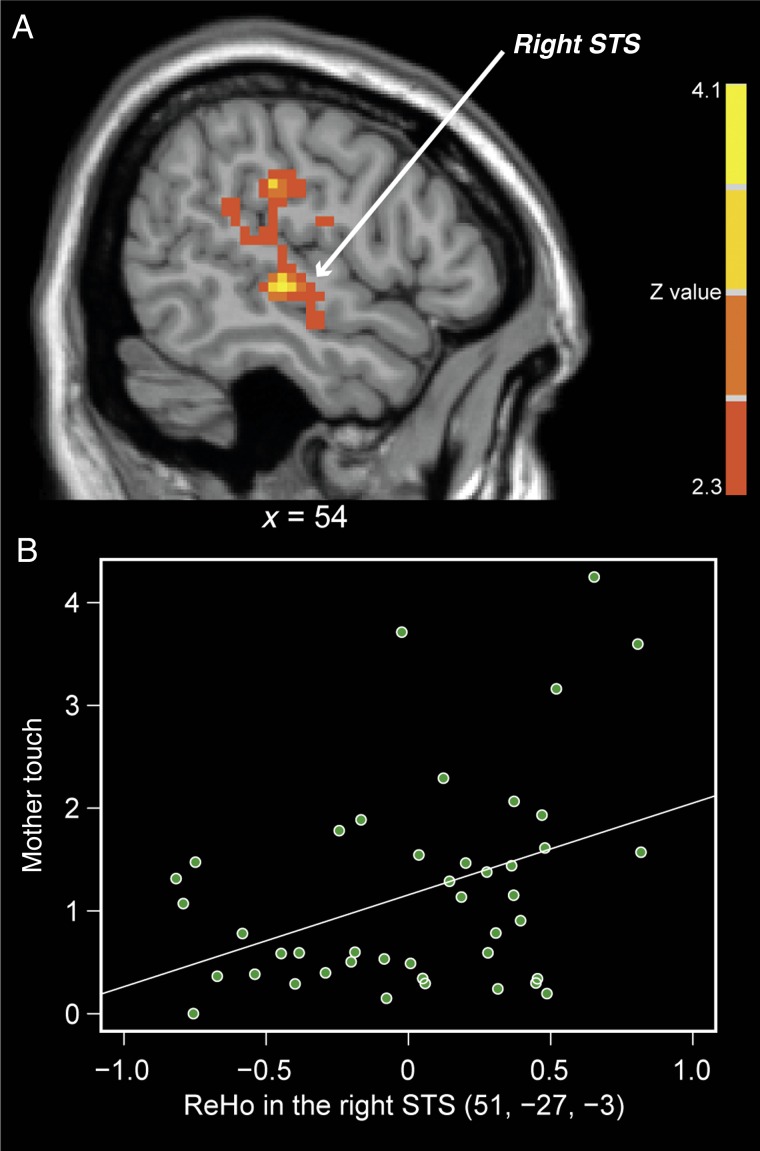
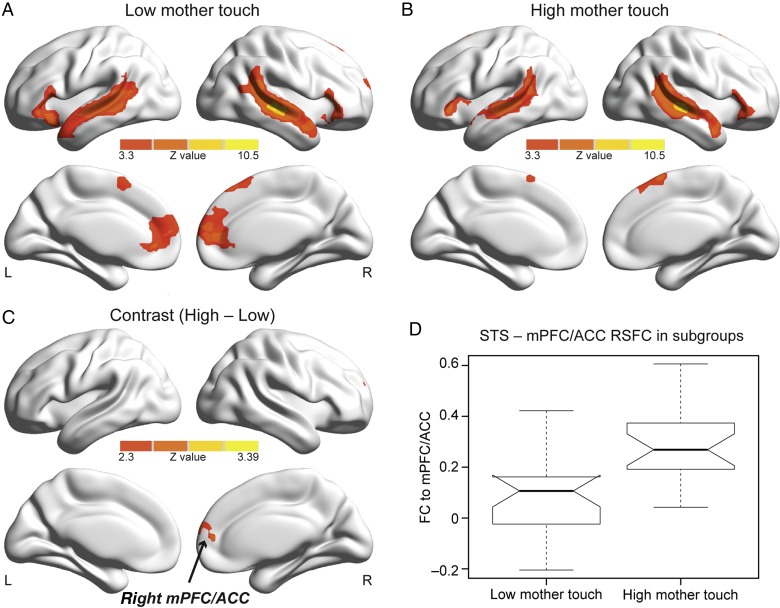
Previous behavioral research points to a positive relationship between maternal touch and early social development. Here, we explored the brain correlates of this relationship. The frequency of maternal touch was recorded for 43 five-year-old children during a 10 min standardized play session. Additionally, all children completed a resting-state functional magnetic resonance imaging session. Investigating the default mode network revealed a positive relation between the frequency of maternal touch and activity in the right posterior superior temporal sulcus (pSTS) extending into the temporo-parietal junction. Using this effect as a seed in a functional connectivity analysis identified a network including extended bilateral regions along the temporal lobe, bilateral frontal cortex, and left insula. Compared with children with low maternal touch, children with high maternal touch showed additional connectivity with the right dorso-medial prefrontal cortex. Together these results support the notion that childhood tactile experiences shape the developing "social brain" with a particular emphasis on a network involved in mentalizing.
Overview
The claims and statistics of this paper haven’t been checked yet.
Free: it reads the open-access text and checks the first 5 claims that cite a source we can check. Create a free account to check every claim.
Integrity signals
Registry
Cites
Statistics
Figures
Verification
Claims the paper makes
The claims and statistics of this paper haven’t been checked yet.
Free: it reads the open-access text and checks the first 5 claims that cite a source we can check. Create a free account to check every claim.
Claims other papers make about this one
Each is checked against this paper’s own text: does it say what the citing paper says it does?
The cited source says what the claim attributes to it.
In the citing paper
“Recent findings suggest that touch also promotes the development and connectivity of brain areas (Brauer et al., 2016; Björnsdotter et al., 2014) associated with social cognition and the “social brain” (Adolphs, 2009, Brothers, 2002, Frith, 2007).”
From The impact of atypical sensory processing on social impairments in autism spectrum disorder (2018) · cites this paper as Brauer et al., 2016
Self-check
Percentages, sums and reported differences re-computed from the paper’s own numbers.
The self-check needs the paper’s full text.
Citations
Cites
A default mode of brain function
Raichle, M. E., MacLeod, A. M., Snyder, A. Z., Powers, W. J., Gusnard, D. A., & Shulman, G. L. (2001) · Proceedings of the National Academy of Sciences · doi:10.1073/pnas.98.2.676 · Cited by 12,190 · cited 2×
“It sheds light on the so-called “default mode network” (DMN, Long et al. 2008)— a distributed set of brain regions that are activewhenparticipants are wakefully at rest but suppressed when they perform a task (Shulman et al. 1997; Gusnard and Raichle 2001; Raichle et al. 2001).”
BackgroundJenkinson, M., Bannister, P., Brady, M., & Smith, S. (2002) · NeuroImage · doi:10.1006/nimg.2002.1132 · Cited by 11,888 · cited 2×
“2012), the frame-wise displacement (FD) of time series was computed (Jenkinson et al. 2002).”
BackgroundFunctional connectivity in the motor cortex of resting human brain using echo‐planar mri
Biswal, B., Zerrin Yetkin, F., Haughton, V. M., & Hyde, J. S. (1995) · Magnetic Resonance in Medicine · doi:10.1002/mrm.1910340409 · Cited by 9,812
Power, J. D., Barnes, K. A., Snyder, A. Z., Schlaggar, B. L., & Petersen, S. E. (2012) · NeuroImage · doi:10.1016/j.neuroimage.2011.10.018 · Cited by 7,429 · cited 2×
“The study was approved by the Institutional Review Board of Leipzig University (Germany).”
BackgroundMethodKendall, M. G. (1957) · Biometrika · doi:10.2307/2333282 · Cited by 6,383
Epigenetic programming by maternal behavior
Weaver, I. C. G., Cervoni, N., Champagne, F. A., D'Alessio, A. C., Sharma, S., Seckl, J. R., Dymov, S., Szyf, M., & Meaney, M. J. (2004) · Nature Neuroscience · doi:10.1038/nn1276 · Cited by 6,177 · cited 1×
“Tactile input was found to increase cortisol receptors in the hippocampus and to make the offspring’s stress response more efficient (Liu et al. 1997; Weaver et al. 2004; for corresponding human work, see McGowan et al. 2009).”
BackgroundA component based noise correction method (CompCor) for BOLD and perfusion based fMRI
Behzadi, Y., Restom, K., Liau, J., & Liu, T. T. (2007) · NeuroImage · doi:10.1016/j.neuroimage.2007.04.042 · Cited by 4,502 · cited 2×
“5 years age range (prepuberty, based on 82 subjects); 5) spatially normalizing images by using the parameters from the segmentation procedure in each subject and resampling voxel size to 3 × 3 × 3 mm(3); 6) spatially smoothing images with a 6-mm full-width-at-half-maximum (FWHM) Gaussian kernel (for RSFConly); 7) nuis…”
MethodBrainNet Viewer: A Network Visualization Tool for Human Brain Connectomics
Xia, M., Wang, J., & He, Y. (2013) · PLoS ONE · doi:10.1371/journal.pone.0068910 · Cited by 4,106 · cited 2×
“The correlation map (r-map) was then transformed into a Z-map via the “rest_TFRtoZ” function in the REST toolbox (Song et al. 2011; http://www.restfmri.net) and further corrected for multiple comparisons using Gaussian Random Field (GRF) theory (Z > 2.3, cluster-wise P < 0.05, GRF corrected) with a…”
MethodInfluentialMovement‐Related effects in fMRI time‐series
Friston, K. J., Williams, S., Howard, R., Frackowiak, R. S. J., & Turner, R. (1996) · Magnetic Resonance in Medicine · doi:10.1002/mrm.1910350312 · Cited by 3,774 · cited 2×
“…6 head motion parameters for the current time point, 6 head motion parameters for the preceding time point, and their 12 corresponding values squared (Friston et al. 1996); the CompCor procedure comprised detrending, variance (i.e., WM and CSF) normalization, and PC analysis; and 8) band-pass…”
MethodMethods to detect, characterize, and remove motion artifact in resting state fMRI
Power, J. D., Mitra, A., Laumann, T. O., Snyder, A. Z., Schlaggar, B. L., & Petersen, S. E. (2014) · NeuroImage · doi:10.1016/j.neuroimage.2013.08.048 · Cited by 3,748 · cited 1×
“Given recent concerns regarding the confounding influence of micromovements on intrinsic functional connectivity analyses (Power et al. 2012, 2014; Satterthwaite et al. 2012; Van Dijk et al. 2012), the frame-wise displacement (FD) of time series was computed (Jenkinson et al. 2002).”
Background
Cited by
The impact of atypical sensory processing on social impairments in autism spectrum disorder
Thye, M. D., Bednarz, H. M., Herringshaw, A. J., Sartin, E. B., & Kana, R. K. (2018) · Developmental Cognitive Neuroscience · doi:10.1016/j.dcn.2017.04.010 · Cited by 513
“brain areas (Brauer et al., 2016; Björnsdotter et al., 2014) associated with social cognition and the “social brain” (Adolphs, 2009; Brothers,”
Social touch and human development
Cascio, C. J., Moore, D., & McGlone, F. (2019) · Developmental Cognitive Neuroscience · doi:10.1016/j.dcn.2018.04.009 · Cited by 503
Emotion Perception from Face, Voice, and Touch: Comparisons and Convergence
Schirmer, A., & Adolphs, R. (2017) · Trends in Cognitive Sciences · doi:10.1016/j.tics.2017.01.001 · Cited by 381
“Social interactions elicit spontaneous and strategic expressions that we commonly classify as emotions, and that profoundly influence a perceiver’s mental state and ongoing behavior [13,57,71].”
BackgroundSelf-citationBalasco, L., Provenzano, G., & Bozzi, Y. (2020) · Frontiers in Psychiatry · doi:10.3389/fpsyt.2019.01016 · Cited by 177
“Touch is considered one of the most basic ways to sense the external world (106) and has been reported to have a significant role in role in several social aspects such as communication (107), developing social bonds (108), and overall physical development and connectivity of brain areas (109, 110).”
BackgroundThe soothing function of touch: affective touch reduces feelings of social exclusion
von Mohr, M., Kirsch, L. P., & Fotopoulou, A. (2017) · Scientific Reports · doi:10.1038/s41598-017-13355-7 · Cited by 181
Metadata
- Authors
- Brauer, J., Xiao, Y., Poulain, T., Friederici, A. D., & Schirmer, A.
- Affiliations
- Max Planck Institute for Human Cognitive and Brain Sciences (DE)
- Leipzig University (DE)
- National University of Singapore (SG)
- Venue
- Cerebral Cortex
- Publisher
- Oxford University Press (OUP)
- Published
- 2016-05-26
- Volume
- 26
- Issue
- 8
- Pages
- 3544-3552
- ISSN
- 1047-3211 (ISSN-L)
- 1460-2199
- PMC
- PMC4961023
- OpenAlex
- W2394698332
- Cited by
- 141
- References
- 96
- Citations by year
- 2026: 8 · 2025: 11 · 2024: 9 · 2023: 10 · 2022: 11 · 2021: 21 · 2020: 16 · 2019: 14 · 2018: 22 · 2017: 15 · 2016: 4
- FWCI
- 11.67
- Type
- journal article
- Language
- en
- Open access
- hybrid
- doi.org
- Licence
- cc-by-nc
- Locations
- Cerebral Cortex (publishedVersion, cc-by-nc)
- Europe PMC (PubMed Central) (publishedVersion, cc-by-nc)
- PubMed Central (publishedVersion, cc-by-nc)
- PubMed (publishedVersion)
- Max Planck Digital Library (submittedVersion, other-oa)
- HighWire Press Open Archive (submittedVersion)
- MPG.PuRe (Max Planck Society) (submittedVersion, other-oa)
- Funders
- European Research Council (ERC269505)
- Topics
- Life Sciences › Neuroscience › Cognitive Neuroscience › Functional Brain Connectivity Studies
- Social Sciences › Psychology › Social Psychology › Action Observation and Synchronization
- Life Sciences › Neuroscience › Cognitive Neuroscience › Tactile and Sensory Interactions
- Keywords
- maternal touch, social brain development, default mode network, posterior superior temporal sulcus, temporoparietal junction, functional connectivity, mentalization, early childhood social development, tactile experience, prefrontal cortex, insula, children
- MeSH terms
- Affect, Brain, Brain Mapping, Child, Preschool, Female, Humans, Magnetic Resonance Imaging, Male, Maternal Behavior, Mother-Child Relations, Neural Pathways, Play and Playthings, Rest, Social Behavior, Touch, Theory of Mind
About these checks
Registry, retraction, Cites and statistics results are computed, not judged, with one exception: a printed reference that no index lists is read once by a model before it counts as a citation error. Claims are extracted by a model and kept only when their quote appears verbatim in the text; each cited source is then checked, with a model’s help, for whether it says what the claim relies on. Those verdicts can be wrong — read the claim’s quote and the cited source before relying on one.
Statistics and arithmetic are recomputed, not judged.
Confidence bands are shown only for fields calibrated on our annotated test set. None is calibrated yet, so no band is shown.
What counts as a claim ›How we measure confidence ›How we check this ›
Are you an author, or do you see a problem with this page? Request a review
How to cite
Cite CoChat for the checks on this page, and the paper for its own findings.
- This page
- CoChat. (2026). Citation check: Frequency of Maternal Touch Predicts Resting Activity and Connectivity of the Developing Social Brain. https://app.cochat.ai/papers/10.1093/cercor/bhw137
- The paper
- Brauer, J., Xiao, Y., Poulain, T., Friederici, A. D., & Schirmer, A. (2016). Frequency of Maternal Touch Predicts Resting Activity and Connectivity of the Developing Social Brain. Cerebral Cortex. https://doi.org/10.1093/cercor/bhw137
Data sources
Bibliographic data: Semantic Scholar, OpenAlex, Crossref.
Contains information from the Semantic Scholar Academic Graph Datasets, made available under the ODC Attribution License (ODC-BY 1.0).
Semantic Scholar’s data is described in: Kinney, R., et al. (2023). The Semantic Scholar Open Data Platform. arXiv:2301.10140.
