

Frequency of Maternal Touch Predicts Resting Activity and Connectivity of the Developing Social Brain
Open accessThe DOI matches its Crossref record; 99 of the 99 references it cites were found in a registry or an index.
Abstract
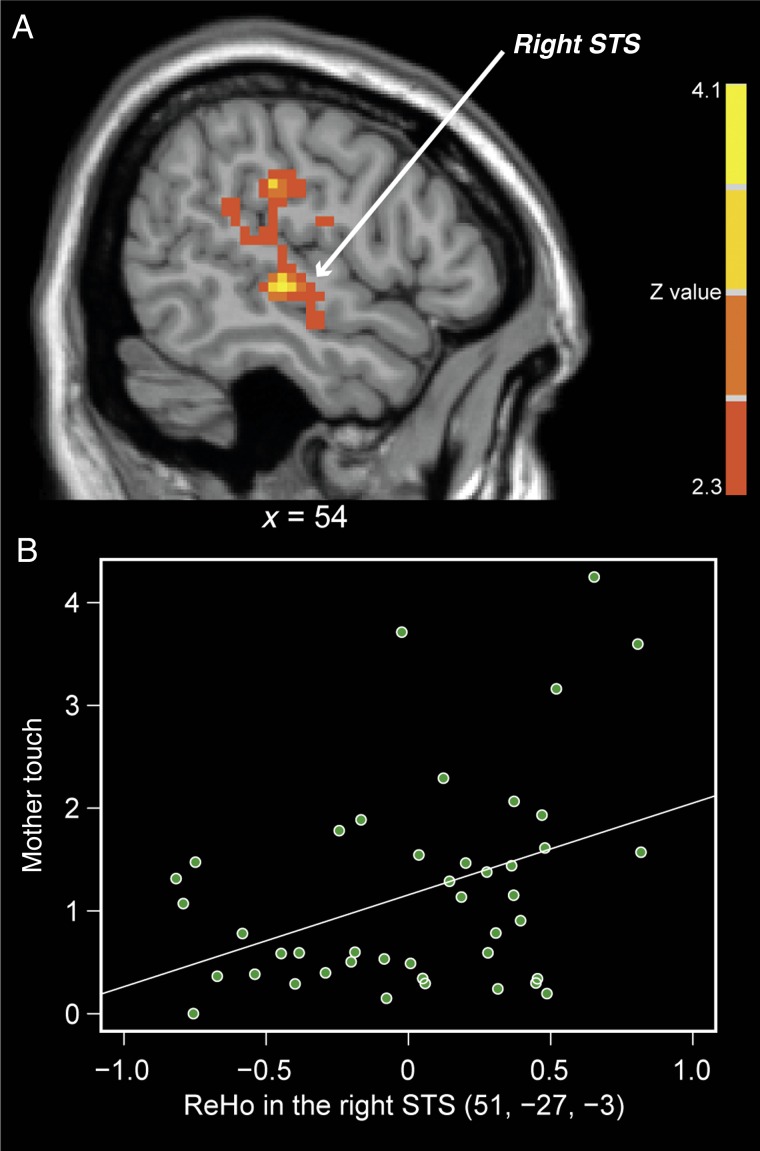
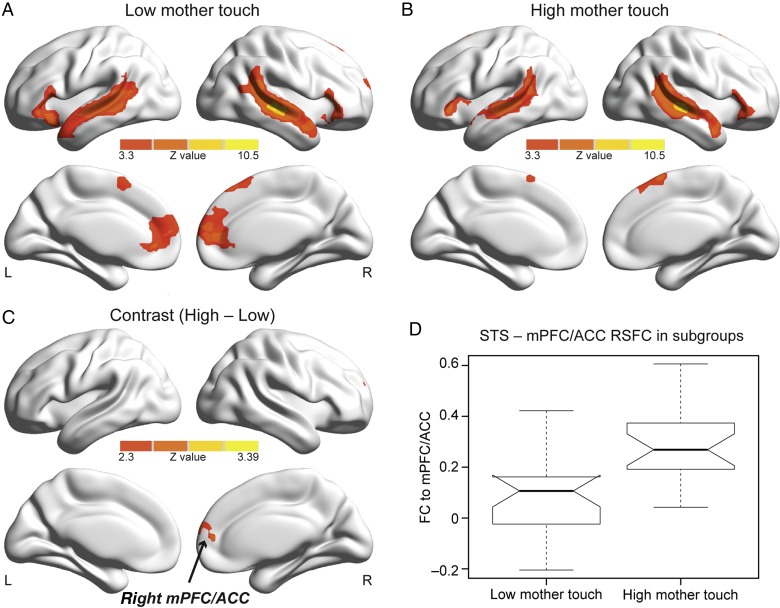
Previous behavioral research points to a positive relationship between maternal touch and early social development. Here, we explored the brain correlates of this relationship. The frequency of maternal touch was recorded for 43 five-year-old children during a 10 min standardized play session. Additionally, all children completed a resting-state functional magnetic resonance imaging session. Investigating the default mode network revealed a positive relation between the frequency of maternal touch and activity in the right posterior superior temporal sulcus (pSTS) extending into the temporo-parietal junction. Using this effect as a seed in a functional connectivity analysis identified a network including extended bilateral regions along the temporal lobe, bilateral frontal cortex, and left insula. Compared with children with low maternal touch, children with high maternal touch showed additional connectivity with the right dorso-medial prefrontal cortex. Together these results support the notion that childhood tactile experiences shape the developing "social brain" with a particular emphasis on a network involved in mentalizing.
Overview
The claims and statistics of this paper haven’t been checked yet.
Free: it reads the open-access text and checks the first 5 claims that cite a source we can check. Create a free account to check every claim.
Integrity signals
Registry
Cites
Statistics
Figures
Verification
Claims the paper makes
The claims and statistics of this paper haven’t been checked yet.
Free: it reads the open-access text and checks the first 5 claims that cite a source we can check. Create a free account to check every claim.
Claims other papers make about this one
Each is checked against this paper’s own text: does it say what the citing paper says it does?
The cited source says what the claim attributes to it.
In the citing paper
“Recent findings suggest that touch also promotes the development and connectivity of brain areas (Brauer et al., 2016; Björnsdotter et al., 2014) associated with social cognition and the “social brain” (Adolphs, 2009, Brothers, 2002, Frith, 2007).”
From The impact of atypical sensory processing on social impairments in autism spectrum disorder (2018) · cites this paper as Brauer et al., 2016
Self-check
Percentages, sums and reported differences re-computed from the paper’s own numbers.
The self-check needs the paper’s full text.
Citations
Cites
A default mode of brain function
Raichle, M. E., MacLeod, A. M., Snyder, A. Z., Powers, W. J., Gusnard, D. A., & Shulman, G. L. (2001) · Proceedings of the National Academy of Sciences · doi:10.1073/pnas.98.2.676 · Cited by 12,190 · cited 2×
“It sheds light on the so-called “default mode network” (DMN, Long et al. 2008)— a distributed set of brain regions that are activewhenparticipants are wakefully at rest but suppressed when they perform a task (Shulman et al. 1997; Gusnard and Raichle 2001; Raichle et al. 2001).”
BackgroundJenkinson, M., Bannister, P., Brady, M., & Smith, S. (2002) · NeuroImage · doi:10.1006/nimg.2002.1132 · Cited by 11,888 · cited 2×
“2012), the frame-wise displacement (FD) of time series was computed (Jenkinson et al. 2002).”
BackgroundFunctional connectivity in the motor cortex of resting human brain using echo‐planar mri
Biswal, B., Zerrin Yetkin, F., Haughton, V. M., & Hyde, J. S. (1995) · Magnetic Resonance in Medicine · doi:10.1002/mrm.1910340409 · Cited by 9,812
Power, J. D., Barnes, K. A., Snyder, A. Z., Schlaggar, B. L., & Petersen, S. E. (2012) · NeuroImage · doi:10.1016/j.neuroimage.2011.10.018 · Cited by 7,429 · cited 2×
“The study was approved by the Institutional Review Board of Leipzig University (Germany).”
BackgroundMethodKendall, M. G. (1957) · Biometrika · doi:10.2307/2333282 · Cited by 6,383
Epigenetic programming by maternal behavior
Weaver, I. C. G., Cervoni, N., Champagne, F. A., D'Alessio, A. C., Sharma, S., Seckl, J. R., Dymov, S., Szyf, M., & Meaney, M. J. (2004) · Nature Neuroscience · doi:10.1038/nn1276 · Cited by 6,177 · cited 1×
“Tactile input was found to increase cortisol receptors in the hippocampus and to make the offspring’s stress response more efficient (Liu et al. 1997; Weaver et al. 2004; for corresponding human work, see McGowan et al. 2009).”
BackgroundA component based noise correction method (CompCor) for BOLD and perfusion based fMRI
Behzadi, Y., Restom, K., Liau, J., & Liu, T. T. (2007) · NeuroImage · doi:10.1016/j.neuroimage.2007.04.042 · Cited by 4,502 · cited 2×
“5 years age range (prepuberty, based on 82 subjects); 5) spatially normalizing images by using the parameters from the segmentation procedure in each subject and resampling voxel size to 3 × 3 × 3 mm(3); 6) spatially smoothing images with a 6-mm full-width-at-half-maximum (FWHM) Gaussian kernel (for RSFConly); 7) nuis…”
MethodBrainNet Viewer: A Network Visualization Tool for Human Brain Connectomics
Xia, M., Wang, J., & He, Y. (2013) · PLoS ONE · doi:10.1371/journal.pone.0068910 · Cited by 4,106 · cited 2×
“The correlation map (r-map) was then transformed into a Z-map via the “rest_TFRtoZ” function in the REST toolbox (Song et al. 2011; http://www.restfmri.net) and further corrected for multiple comparisons using Gaussian Random Field (GRF) theory (Z > 2.3, cluster-wise P < 0.05, GRF corrected) with a…”
MethodInfluentialMovement‐Related effects in fMRI time‐series
Friston, K. J., Williams, S., Howard, R., Frackowiak, R. S. J., & Turner, R. (1996) · Magnetic Resonance in Medicine · doi:10.1002/mrm.1910350312 · Cited by 3,774 · cited 2×
“…6 head motion parameters for the current time point, 6 head motion parameters for the preceding time point, and their 12 corresponding values squared (Friston et al. 1996); the CompCor procedure comprised detrending, variance (i.e., WM and CSF) normalization, and PC analysis; and 8) band-pass…”
MethodMethods to detect, characterize, and remove motion artifact in resting state fMRI
Power, J. D., Mitra, A., Laumann, T. O., Snyder, A. Z., Schlaggar, B. L., & Petersen, S. E. (2014) · NeuroImage · doi:10.1016/j.neuroimage.2013.08.048 · Cited by 3,748 · cited 1×
“Given recent concerns regarding the confounding influence of micromovements on intrinsic functional connectivity analyses (Power et al. 2012, 2014; Satterthwaite et al. 2012; Van Dijk et al. 2012), the frame-wise displacement (FD) of time series was computed (Jenkinson et al. 2002).”
BackgroundEpigenetic regulation of the glucocorticoid receptor in human brain associates with childhood abuse
McGowan, P. O., Sasaki, A., D'Alessio, A. C., Dymov, S., Labonté, B., Szyf, M., Turecki, G., & Meaney, M. J. (2009) · Nature Neuroscience · doi:10.1038/nn.2270 · Cited by 3,531 · cited 1×
“Tactile input was found to increase cortisol receptors in the hippocampus and to make the offspring’s stress response more efficient (Liu et al. 1997; Weaver et al. 2004; for corresponding human work, see McGowan et al. 2009).”
BackgroundDPARSF: a MATLAB toolbox for “pipeline” data analysis of resting-state fMRI
Yan (2010) · Frontiers in System Neuroscience · doi:10.3389/fnsys.2010.00013 · Cited by 3,475
Searching for a baseline: Functional imaging and the resting human brain
Gusnard, D. A., & Raichle, M. E. (2001) · Nature Reviews Neuroscience · doi:10.1038/35094500 · Cited by 3,371 · cited 1×
“Key words: affective touch, C-tactile afferents, resting-state fMRI, stroking, theory of mind”
BackgroundLiu, D., Diorio, J., Tannenbaum, B., Caldji, C., Francis, D., Freedman, A., Sharma, S., Pearson, D., Plotsky, P. M., & Meaney, M. J. (1997) · Science · doi:10.1126/science.277.5332.1659 · Cited by 3,170 · cited 1×
“Tactile input was found to increase cortisol receptors in the hippocampus and to make the offspring’s stress response more efficient (Liu et al. 1997; Weaver et al. 2004; for corresponding human work, see McGowan et al. 2009).”
BackgroundRegional homogeneity approach to fMRI data analysis.
Zang, Y., Jiang, T., Lu, Y., He, Y., & Tian, L. (2004) · NeuroImage · doi:10.1016/j.neuroimage.2003.12.030 · Cited by 2,614 · cited 4×
“Although its physiological underpinnings are still incompletely understood, ReHo shows some convergence with other analysis methods for fMRI time series (Zang et al. 2004).”
BackgroundMethodInfluentialThe influence of head motion on intrinsic functional connectivity MRI
Van Dijk, K. R. A., Sabuncu, M. R., & Buckner, R. L. (2012) · NeuroImage · doi:10.1016/j.neuroimage.2011.07.044 · Cited by 2,344 · cited 2×
“The study was approved by the Institutional Review Board of Leipzig University (Germany).”
BackgroundMethodUnbiased average age-appropriate atlases for pediatric studies
Fonov, V., Evans, A. C., Botteron, K., Almli, C. R., McKinstry, R. C., & Collins, D. L. (2011) · NeuroImage · doi:10.1016/j.neuroimage.2010.07.033 · Cited by 2,290 · cited 2×
“…of each subject; 4) segmenting MPRAGE images into gray matter, white matter (WM), and cerebrospinal fluid (CSF) based on the NIH pediatric atlas (Fonov et al. 2011; http://www.bic.mni. mcgill.ca/ServicesAtlases/NIHPD-obj1) using its asymmetric, T1 version and a 4.5–8.5 years age range…”
MethodInfluentialCommon blood flow changes across visual tasks: II. Decreases in cerebral cortex
Shulman, G. L., Fiez, J. A., Corbetta, M., Buckner, R. L., Miezin, F. M., Raichle, M. E., & Petersen, S. E. (1997) · Journal of Cognitive Neuroscience · doi:10.1162/jocn.1997.9.5.648 · Cited by 1,890 · cited 2×
“It sheds light on the so-called “default mode network” (DMN, Long et al. 2008)— a distributed set of brain regions that are activewhenparticipants are wakefully at rest but suppressed when they perform a task (Shulman et al. 1997; Gusnard and Raichle 2001; Raichle et al. 2001).”
BackgroundREST: A Toolkit for Resting-State Functional Magnetic Resonance Imaging Data Processing
Song, X.-W., Dong, Z.-Y., Long, X.-Y., Li, S.-F., Zuo, X.-N., Zhu, C.-Z., He, Y., Yan, C.-G., & Zang, Y.-F. (2011) · PLoS ONE · doi:10.1371/journal.pone.0025031 · Cited by 1,872 · cited 6×
“The correlation map (r-map) was then transformed into a Z-map via the “rest_TFRtoZ” function in the REST toolbox (Song et al. 2011; http://www.restfmri.net) and further corrected for multiple comparisons using Gaussian Random Field (GRF) theory (Z > 2.3, cluster-wise P < 0.05, GRF corrected) with a minimum cluster siz…”
BackgroundMethodInfluentialThe Social Brain: Neural Basis of Social Knowledge
Adolphs, R. (2009) · Annual Review of Psychology · doi:10.1146/annurev.psych.60.110707.163514 · Cited by 1,827
Social cognition and the brain: A meta-analysis
Van Overwalle, F. (2009) · Human Brain Mapping · doi:10.1002/hbm.20547 · Cited by 1,792
Voice-selective areas in human auditory cortex
Belin, P., Zatorre, R. J., Lafaille, P., Ahad, P., & Pike, B. (2000) · Nature · doi:10.1038/35002078 · Cited by 1,771 · cited 2×
“, emotional) analysis (Belin et al. 2000; Schirmer and Kotz 2006; Watson et al. 2014; but see Schirmer et al. 2012) as does the integration of dynamic social signals across the different”
BackgroundDunbar, R. I. M., & Shultz, S. (2007) · Science · doi:10.1126/science.1145463 · Cited by 1,542
The oscillating brain: Complex and reliable
Zuo, X.-N., Di Martino, A., Kelly, C., Shehzad, Z. E., Gee, D. G., Klein, D. F., Castellanos, F. X., Biswal, B. B., & Milham, M. P. (2010) · NeuroImage · doi:10.1016/j.neuroimage.2009.09.037 · Cited by 1,449 · cited 2×
“value of all voxels within the brain mask from the score of individual voxels and then dividing the result by the subject’s standard deviation (Zuo et al. 2010).”
BackgroundMethodHoffman, E. A., & Haxby, J. V. (2000) · Nature Neuroscience · doi:10.1038/71152 · Cited by 1,235
Govindarajulu, Z., Kendall, M., & Gibbons, J. D. (1992) · Technometrics · doi:10.2307/1269571 · Cited by 1,130
Satterthwaite, T. D., Wolf, D. H., Loughead, J., Ruparel, K., Elliott, M. A., Hakonarson, H., Gur, R. C., & Gur, R. E. (2012) · NeuroImage · doi:10.1016/j.neuroimage.2011.12.063 · Cited by 1,125 · cited 2×
“Given recent concerns regarding the confounding influence of micromovements on intrinsic functional connectivity analyses (Power et al. 2012, 2014; Satterthwaite et al. 2012; Van Dijk et al. 2012), the frame-wise displacement (FD) of time series was computed (Jenkinson et al.”
BackgroundCoding of pleasant touch by unmyelinated afferents in humans
Löken, L. S., Wessberg, J., Morrison, I., McGlone, F., & Olausson, H. (2009) · Nature Neuroscience · doi:10.1038/nn.2312 · Cited by 1,120 · cited 2×
“CT afferents are tuned to light pressure, moderate stroking at a rate of 1–10 cm/s (Olausson et al. 2002; Löken et al. 2009), and prefer stimulation at skin temperature (Ackerley et al. 2014).”
BackgroundDiscriminative and affective touch: Sensing and feeling.
McGlone, F., Wessberg, J., & Olausson, H. (2014) · Neuron · doi:10.1016/j.neuron.2014.05.001 · Cited by 1,112 · cited 1×
“Key words: affective touch, C-tactile afferents, resting-state fMRI, stroking, theory of mind”
BackgroundUnmyelinated tactile afferents signal touch and project to insular cortex
Olausson, H., Lamarre, Y., Backlund, H., Morin, C., Wallin, B. G., Starck, G., Ekholm, S., Strigo, I., Worsley, K., Vallbo, Å. B., et al. (2002) · Nature Neuroscience · doi:10.1038/nn896 · Cited by 994 · cited 3×
“” Specifically, research identified a special mechanoreceptor called the C-tactile (CT) afferent (Iggo 1960; Iggo andMuir 1969; Olausson et al. 2002; Vrontou et al. 2013).”
BackgroundThe structure and function of a slowly adapting touch corpuscle in hairy skin
Iggo, A., & Muir, A. R. (1969) · The Journal of Physiology · doi:10.1113/jphysiol.1969.sp008721 · Cited by 817
The social brain in psychiatric and neurological disorders
Kennedy, D. P., & Adolphs, R. (2012) · Trends in Cognitive Sciences · doi:10.1016/j.tics.2012.09.006 · Cited by 791 · cited 4×
“With respect to social processing, we identified areas implicated in thementalizing (STS/dorsal mPFC), empathy (insula), and mirroring (IFG, motor) networks of the social brain (Kennedy and Adolphs 2012).”
BackgroundInfluentialOn the relationship between the “default mode network” and the “social brain
Mars, R. B., Neubert, F.-X., Noonan, M. P., Sallet, J., Toni, I., & Rushworth, M. F. S. (2012) · Frontiers in Human Neuroscience · doi:10.3389/fnhum.2012.00189 · Cited by 766 · cited 3×
“As such there is much anatomical overlap between the DMN and the “social brain” (Mars et al. 2012).”
BackgroundResultChampagne, F., Diorio, J., Sharma, S., & Meaney, M. J. (2001) · Proceedings of the National Academy of Sciences · doi:10.1073/pnas.221224598 · Cited by 707 · cited 1×
“Additionally, it was shown to up-regulate the number of oxytocin receptors in numerous brain regions such that, as adults, individuals are more caring towards own pups (Champagne et al. 2001).”
BackgroundBeyond the right hemisphere: brain mechanisms mediating vocal emotional processing
Schirmer, A., & Kotz, S. A. (2006) · Trends in Cognitive Sciences · doi:10.1016/j.tics.2005.11.009 · Cited by 693 · cited 1×
“Key words: affective touch, C-tactile afferents, resting-state fMRI, stroking, theory of mind”
BackgroundSelf-citationFrith, C. D. (2007) · Philosophical Transactions of the Royal Society B: Biological Sciences · doi:10.1098/rstb.2006.2003 · Cited by 690 · cited 3×
“…in others, our sensitivity to their emotions, thoughts, and intentions, and our ability to meaningfully interact with them are presumably supported by dedicated brain processes separate from those supporting our dealings with the inanimate world (Dunbar and Shultz 2007; Frith 2007; Adolphs 2009).”
BackgroundInfant-Mother Attachment: Factors Related to Its Development and Changes over Time
Egeland, B. R., & Farber, E. A. (1984) · Child Development · doi:10.1111/j.1467-8624.1984.tb03813.x · Cited by 652 · cited 1×
“Key words: affective touch, C-tactile afferents, resting-state fMRI, stroking, theory of mind”
BackgroundInfant–mother attachment: Factors related to its development and changes over time
Egeland, B., & Farber, E. A. (1984) · Child Development · doi:10.2307/1130127 · Cited by 652
Feldman, R., Eidelman, A. I., Sirota, L., & Weller, A. (2002) · Pediatrics · doi:10.1542/peds.110.1.16 · Cited by 637 · cited 1×
“For example, it was shown that touch promotes responsiveness to and engagement with a caregiver (Watt 1990; Peláez-Nogueras et al. 1996; Feldman et al. 2002; Jean et al. 2014) and that it furthers the formation of social attachments.”
BackgroundCoding gestural behavior with the NEUROGES-ELAN system
Lausberg, H., & Sloetjes, H. (2009) · Behavior Research Methods · doi:10.3758/brm.41.3.841 · Cited by 605
Zuo, X.-N., Xu, T., Jiang, L., Yang, Z., Cao, X.-Y., He, Y., Zang, Y.-F., Castellanos, F. X., & Milham, M. P. (2013) · NeuroImage · doi:10.1016/j.neuroimage.2012.10.017 · Cited by 505 · cited 2×
“We analyzed ReHo using REST (Song et al. 2011; http://www. restfmri.net) following the procedures from previous studies (Zang et al. 2004; Zuo et al. 2013).”
MethodHuman C-Tactile Afferents Are Tuned to the Temperature of a Skin-Stroking Caress
Ackerley, R., Backlund Wasling, H., Liljencrantz, J., Olausson, H., Johnson, R. D., & Wessberg, J. (2014) · The Journal of Neuroscience · doi:10.1523/jneurosci.2847-13.2014 · Cited by 474 · cited 2×
“2009), and prefer stimulation at skin temperature (Ackerley et al. 2014).”
BackgroundLi, W., Mai, X., & Liu, C. (2014) · Frontiers in Human Neuroscience · doi:10.3389/fnhum.2014.00074 · Cited by 462 · cited 2×
“Key words: affective touch, C-tactile afferents, resting-state fMRI, stroking, theory of mind”
BackgroundNeural basis of eye gaze processing deficits in autism
Pelphrey, K. A., Morris, J. P., & McCarthy, G. (2005) · Brain · doi:10.1093/brain/awh404 · Cited by 446 · cited 2×
“…there are reports of hypoactivity in the right pSTS of autistic individuals to stimuli involving irony (Wang et al. 2007), gaze-object incongruity (Pelphrey et al. 2005), awkward social scenarios (Pantelis et al. 2015), or the recognition of emotions from point-light displays (Alaerts et al.…”
BackgroundGrossmann, K., Grossmann, K. E., Spangler, G., Suess, G., & Unzner, L. (1985) · Monographs of the Society for Research in Child Development · doi:10.2307/3333836 · Cited by 413 · cited 1×
“Mothers who engaged in more frequent affectionate touch were more likely to have securely attached children than mothers who engaged in little affectionate touch (Ainsworth 1979; Egeland and Farber 1984; Grossmann et al. 1985; Anisfeld et al. 1990; Weiss et al. 2000).”
BackgroundRomantic love: an fMRI study of a neural mechanism for mate choice.
Fisher, H., Aron, A., & Brown, L. L. (2005) · Journal of Comparative Neurology · doi:10.1002/cne.20772 · Cited by 396 · cited 1×
“With respect to emotional processing, right pSTS activity oscillated with nuclei in the basal ganglia known for their role in the appreciation of rewards (Fisher et al. 2005; Muranishi et al. 2011).”
BackgroundTopography of social touching depends on emotional bonds between humans
Suvilehto, J. T., Glerean, E., Dunbar, R. I. M., Hari, R., & Nummenmaa, L. (2015) · Proceedings of the National Academy of Sciences · doi:10.1073/pnas.1519231112 · Cited by 385 · cited 2×
“Touch powerfully communicates emotions and contributes to the formation of social bonds (Suvilehto et al. 2015).”
BackgroundThe emergence of the social brain network: evidence from typical and atypical development
JOHNSON, M. H., GRIFFIN, R., CSIBRA, G., HALIT, H., FARRONI, T., DE HAAN, M., TUCKER, L. A., BARON–COHEN, S., & RICHARDS, J. (2005) · Development and Psychopathology · doi:10.1017/s0954579405050297 · Cited by 369 · cited 1×
“Although humans are born with a strong social interest and a capacity for forming social bonds, the complex social functioning of an adult requires many years of maturation and learning (Johnson et al. 2005; Happé and Frith 2014).”
BackgroundBrain mechanisms for processing affective touch
Gordon, I., Voos, A. C., Bennett, R. H., Bolling, D. Z., Pelphrey, K. A., & Kaiser, M. D. (2013) · Human Brain Mapping · doi:10.1002/hbm.21480 · Cited by 353 · cited 2×
“For one, studies exploring the processing of CT appropriate, gentle touch typically report pSTS activation in the right rather than the left hemisphere (Gordon et al. 2013; Voos et al. 2013; Bennett et al. 2014).”
BackgroundHands Touching Hands: Affective and Evaluative Effects of an Interpersonal Touch
Fisher, J. D., Rytting, M., & Heslin, R. (1976) · Sociometry · doi:10.2307/3033506 · Cited by 322 · cited 1×
“Touch is an inconspicuous social cue (Fisher et al. 1976) that, in our study, was embedded in a rich visual scene and, thus, occasionally missed.”
BackgroundCameron, N. M., Champagne, F. A., Parent, C., Fish, E. W., Ozaki-Kuroda, K., & Meaney, M. J. (2005) · Neuroscience & Biobehavioral Reviews · doi:10.1016/j.neubiorev.2005.03.022 · Cited by 320 · cited 1×
“In a series of studies, Meaney and colleagues placed rodent pups with adoptive dams for whom they measured licking and grooming or isolated pups and provided standard care that included varying amounts of tactile stimulation from a brush (for review, see Cameron et al. 2005).”
BackgroundPreterm infant massage therapy research: a review
Field, T., Diego, M., & Hernandez-Reif, M. (2010) · Infant Behavior and Development · doi:10.1016/j.infbeh.2009.12.004 · Cited by 317 · cited 1×
“Research conducted primarily on infants points to a positive relationship between physical contact and general developmental markers such as body weight, motor control, or emotional management (Weiss 2005; Field et al. 2010).”
BackgroundThe Dynamical Balance of the Brain at Rest
Deco, G., & Corbetta, M. (2011) · The Neuroscientist · doi:10.1177/1073858409354384 · Cited by 310 · cited 1×
“Using an RSFC approach, it was shown that certain regions supporting a particular motor or mental function slowly oscillate together when participants are without a task (Biswal et al. 1995; Deco and Corbetta 2011).”
MethodAttachment as Related to Mother-Infant Interaction
Ainsworth, M. D. S. (1979) · Advances in the Study of Behavior · doi:10.1016/s0065-3454(08)60032-7 · Cited by 299 · cited 1×
“Key words: affective touch, C-tactile afferents, resting-state fMRI, stroking, theory of mind”
BackgroundAnnual Research Review: Towards a developmental neuroscience of atypical social cognition
Happé, F., & Frith, U. (2014) · Journal of Child Psychology and Psychiatry · doi:10.1111/jcpp.12162 · Cited by 293 · cited 3×
“Of note, certain individual abilities such as the understanding of other’s mental states that differ from one’s own mental state evolve in a protracted manner spanning across developmental periods (for reviews, see Happé and Frith 2014; Lagattuta et al. 2015; Sprung et al. 2015).”
BackgroundGenetic identification of C fibres that detect massage-like stroking of hairy skin in vivo
Vrontou, S., Wong, A. M., Rau, K. K., Koerber, H. R., & Anderson, D. J. (2013) · Nature · doi:10.1038/nature11810 · Cited by 288
Cutaneous mechanoreceptors with afferent C fibres
Iggo, A. (1960) · The Journal of Physiology · doi:10.1113/jphysiol.1960.sp006491 · Cited by 287 · cited 1×
“Specifically, research identified a special mechanoreceptor called the C-tactile (CT) afferent (Iggo 1960; Iggo andMuir 1969; Olausson et al. 2002; Vrontou et al. 2013).”
BackgroundAnisfeld, E., Casper, V., Nozyce, M. L., & Cunningham, N. (1990) · Child Development · doi:10.1111/j.1467-8624.1990.tb02888.x · Cited by 266 · cited 2×
“Mothers who engaged in more frequent affectionate touch were more likely to have securely attached children than mothers who engaged in little affectionate touch (Ainsworth 1979; Egeland and Farber 1984; Grossmann et al. 1985; Anisfeld et al. 1990; Weiss et al. 2000).”
BackgroundThe Selectivity and Functional Connectivity of the Anterior Temporal Lobes
Simmons, W. K., Reddish, M., Bellgowan, P. S. F., & Martin, A. (2010) · Cerebral Cortex · doi:10.1093/cercor/bhp149 · Cited by 243 · cited 2×
“For example, temporal regions identified by contrasting the visual encoding of people versus nonsocial objects were found to remain functionally connected after the task through slow oscillations in blood oxygenation (Simmons et al. 2010).”
BackgroundWang, A. T., Lee, S. S., Sigman, M., & Dapretto, M. (2007) · Archives of General Psychiatry · doi:10.1001/archpsyc.64.6.698 · Cited by 227 · cited 2×
“Looking at nontactile social processing, there are reports of hypoactivity in the right pSTS of autistic individuals to stimuli involving irony (Wang et al. 2007), gaze-object incongruity (Pelphrey et al.”
BackgroundStack, D. M., & Muir, D. W. (1992) · Child Development · doi:10.1111/j.1467-8624.1992.tb01711.x · Cited by 220 · cited 1×
“First, there ismuch evidence indicating that infantsfindphysical contactwith their caregiver rewarding (Stack and Muir 1992).”
BackgroundSelf-Processing and the Default Mode Network: Interactions with the Mirror Neuron System
Molnar-Szakacs, I., & Uddin, L. Q. (2013) · Frontiers in Human Neuroscience · doi:10.3389/fnhum.2013.00571 · Cited by 217
Autistic traits are associated with diminished neural response to affective touch
Voos, A. C., Pelphrey, K. A., & Kaiser, M. D. (2013) · Social Cognitive and Affective Neuroscience · doi:10.1093/scan/nss009 · Cited by 205 · cited 2×
“For one, studies exploring the processing of CT appropriate, gentle touch typically report pSTS activation in the right rather than the left hemisphere (Gordon et al. 2013; Voos et al. 2013; Bennett et al. 2014).”
BackgroundBrain Mechanisms for Processing Affective (and Nonaffective) Touch Are Atypical in Autism
Kaiser, M. D., Yang, D. Y.-J., Voos, A. C., Bennett, R. H., Gordon, I., Pretzsch, C., Beam, D., Keifer, C., Eilbott, J., McGlone, F., et al. (2016) · Cerebral Cortex · doi:10.1093/cercor/bhv125 · Cited by 202 · cited 1×
“Looking at tactile perception, Kaiser et al. (2015) found that autism reduces the strength with which CT-appropriate touch activates the right pSTS, among other areas, but enhances responses to non-CT touch in parietal somatosensory areas.”
BackgroundAddressing head motion dependencies for small-world topologies in functional connectomics
Yan, C.-G., Craddock, R. C., He, Y., & Milham, M. P. (2013) · Frontiers in Human Neuroscience · doi:10.3389/fnhum.2013.00910 · Cited by 194 · cited 2×
“The study was approved by the Institutional Review Board of Leipzig University (Germany).”
BackgroundMethodInfluentialStack, D. M., & Muir, D. W. (1992) · Child Development · doi:10.2307/1131572 · Cited by 184
Anisfeld, E., Casper, V., Nozyce, M. L., et al. (1990) · Child Development · doi:10.2307/1130769 · Cited by 179
Default mode network as revealed with multiple methods for resting-state functional MRI analysis
Long, X., Zuo, X., Kiviniemi, V. J., Yang, Y., Zou, Q., Zhu, C.-Z., Jiang, T., Yang, H., Gong, Q., Wang, L. Y., et al. (2008) · Journal of Neuroscience Methods · doi:10.1016/j.jneumeth.2008.03.021 · Cited by 171 · cited 2×
“It sheds light on the so-called “default mode network” (DMN, Long et al. 2008)— a distributed set of brain regions that are activewhenparticipants are wakefully at rest but suppressed when they perform a task (Shulman et al. 1997; Gusnard and Raichle 2001; Raichle et al. 2001).”
BackgroundKong, F., Wang, X., Hu, S., & Liu, J. (2015) · NeuroImage · doi:10.1016/j.neuroimage.2015.08.020 · Cited by 167 · cited 2×
“2011), psychological resilience (Kong et al. 2015), unwanted thoughts (Kühn et al.”
BackgroundUnderconnectivity of the superior temporal sulcus predicts emotion recognition deficits in autism
Alaerts, K., Woolley, D. G., Steyaert, J., Di Martino, A., Swinnen, S. P., & Wenderoth, N. (2014) · Social Cognitive and Affective Neuroscience · doi:10.1093/scan/nst156 · Cited by 149 · cited 3×
“2015), or the recognition of emotions from point-light displays (Alaerts et al. 2014).”
BackgroundChildren's emotion understanding: A meta-analysis of training studies
Sprung, M. S., Münch, H. M., Harris, P. L., Ebesutani, C. K., & Hofmann, S. G. (2015) · Developmental Review · doi:10.1016/j.dr.2015.05.001 · Cited by 146 · cited 1×
“Of note, certain individual abilities such as the understanding of other’s mental states that differ from one’s own mental state evolve in a protracted manner spanning across developmental periods (for reviews, see Happé and Frith 2014; Lagattuta et al. 2015; Sprung et al. 2015).”
BackgroundResting-State Neural Activity across Face-Selective Cortical Regions Is Behaviorally Relevant
Zhu, Q., Zhang, J., Luo, Y. L. L., Dilks, D. D., & Liu, J. (2011) · Journal of Neuroscience · doi:10.1523/jneurosci.0873-11.2011 · Cited by 126 · cited 2×
“Like DMN activity, RSFC was shown to predict performance in social paradigms (Zhu et al. 2011; Takeuchi et al. 2013, 2014).”
BackgroundMethodWeiss, S. J., Wilson, P., Hertenstein, M. J., & Campos, R. (2000) · Infant Behavior and Development · doi:10.1016/s0163-6383(00)00030-8 · Cited by 116 · cited 1×
“Mothers who engaged in more frequent affectionate touch were more likely to have securely attached children than mothers who engaged in little affectionate touch (Ainsworth 1979; Egeland and Farber 1984; Grossmann et al. 1985; Anisfeld et al. 1990; Weiss et al. 2000).”
BackgroundRegional homogeneity of resting state fMRI signals predicts Stop signal task performance
Tian, L., Ren, J., & Zang, Y. (2011) · NeuroImage · doi:10.1016/j.neuroimage.2011.11.098 · Cited by 112 · cited 2×
“Mothers were told that this part of the procedures was recorded on video tape, but no information about our interest in touch was provided.”
BackgroundMethodNevalainen, P., Lauronen, L., & Pihko, E. (2014) · Frontiers in Human Neuroscience · doi:10.3389/fnhum.2014.00158 · Cited by 111 · cited 1×
“Second, other aspects of the somatosensory system appear largely intact at birth (Rees et al. 2010; Nevalainen et al. 2014).”
BackgroundDevelopment of brain mechanisms for processing affective touch
Björnsdotter, M., Gordon, I., Pelphrey, K. A., Olausson, H., & Kaiser, M. D. (2014) · Frontiers in Behavioral Neuroscience · doi:10.3389/fnbeh.2014.00024 · Cited by 109 · cited 2×
“Last, a study in children aged 5 and above found adult-like brain responseswhen comparing CTwith non-CT touch (Björnsdotter et al. 2014).”
BackgroundMethodInfants' preference for touch stimulation in face-to-face interactions
Peláez, M., Gewirtz, J. L., Field, T. M., Cigales, M., Malphurs, J. E., Clasky, S., & Sanchez, A. (1996) · Journal of Applied Developmental Psychology · doi:10.1016/s0193-3973(96)90025-8 · Cited by 108 · cited 1×
“For example, it was shown that touch promotes responsiveness to and engagement with a caregiver (Watt 1990; Peláez-Nogueras et al. 1996; Feldman et al. 2002; Jean et al. 2014) and that it furthers the formation of social attachments.”
BackgroundRegional homogeneity of the resting-state brain activity correlates with individual intelligence
Wang, L., Song, M., Jiang, T., Zhang, Y., & Yu, C. (2010) · Neuroscience Letters · doi:10.1016/j.neulet.2010.11.046 · Cited by 98 · cited 2×
“The interaction was recorded on video by 2 cameras (AXIS Q1755), 1 positioned in front, and 1 above the sofa.”
MethodPeople-selectivity, audiovisual integration and heteromodality in the superior temporal sulcus
Watson, R., Latinus, M., Charest, I., Crabbe, F., & Belin, P. (2014) · Cortex · doi:10.1016/j.cortex.2013.07.011 · Cited by 98 · cited 4×
“, emotional) analysis (Belin et al. 2000; Schirmer and Kotz 2006; Watson et al. 2014; but see Schirmer et al. 2012) as does the integration of dynamic social signals across the different”
BackgroundInfluentialPantelis, P. C., Byrge, L., Tyszka, J. M., Adolphs, R., & Kennedy, D. P. (2015) · Social Cognitive and Affective Neuroscience · doi:10.1093/scan/nsv021 · Cited by 97 · cited 2×
“2005), awkward social scenarios (Pantelis et al. 2015), or the recognition of emotions from point-light displays (Alaerts et al.”
BackgroundAssociation between resting-state functional connectivity and empathizing/systemizing
Takeuchi, H., Taki, Y., Nouchi, R., Sekiguchi, A., Hashizume, H., Sassa, Y., Kotozaki, Y., Miyauchi, C. M., Yokoyama, R., Iizuka, K., et al. (2014) · NeuroImage · doi:10.1016/j.neuroimage.2014.05.031 · Cited by 95
Emotional expressions in voice and music: Same code, same effect?
Escoffier, N., zhong, J., Schirmer, A., & Qiu, A. (2012) · Human Brain Mapping · doi:10.1002/hbm.22029 · Cited by 90 · cited 2×
“For commercial re-use, please contact journals.permissions@oup.com Escoffier et al. 2013).”
BackgroundSelf-citationOn the spatial organization of sound processing in the human temporal lobe: A meta-analysis
Schirmer, A., Fox, P. M., & Grandjean, D. (2012) · NeuroImage · doi:10.1016/j.neuroimage.2012.06.025 · Cited by 86 · cited 1×
“…engages the right pSTS especially in the context of nonverbal (e.g., emotional) analysis (Belin et al. 2000; Schirmer and Kotz 2006; Watson et al. 2014; but see Schirmer et al. 2012) as does the integration of dynamic social signals across the different nonverbal channels (Watson et al. 2014).”
BackgroundSelf-citationfNIRS detects temporal lobe response to affective touch
Bennett, R. H., Bolling, D. Z., Anderson, L. C., Pelphrey, K. A., & Kaiser, M. D. (2014) · Social Cognitive and Affective Neuroscience · doi:10.1093/scan/nst008 · Cited by 79 · cited 2×
“For one, studies exploring the processing of CT appropriate, gentle touch typically report pSTS activation in the right rather than the left hemisphere (Gordon et al. 2013; Voos et al. 2013; Bennett et al. 2014).”
BackgroundLateralization for dynamic facial expressions in human superior temporal sulcus
Winter, F. D., Zhu, Q., den Stock, J. V., Nelissen, K., Peeters, R. R., de Gelder, B., Vanduffel, W., & Vandenbulcke, M. (2014) · NeuroImage · doi:10.1016/j.neuroimage.2014.11.020 · Cited by 74
The synchronization of spontaneous BOLD activity predicts extraversion and neuroticism
Wei, L., Duan, X., Yang, Y., Liao, W., Gao, Q. C., Ding, J.-R., Zhang, Z., Zeng, W., Li, Y., Lu, G., et al. (2011) · Brain Research · doi:10.1016/j.brainres.2011.08.060 · Cited by 73 · cited 2×
“Mothers were told that this part of the procedures was recorded on video tape, but no information about our interest in touch was provided.”
BackgroundXiao, Y., Friederici, A. D., Margulies, D. S., & Bräuer, J. (2015) · NeuroImage · doi:10.1016/j.neuroimage.2015.12.008 · Cited by 69 · cited 1×
“This protocol had been used successfully in previous studies (Xiao et al. 2016a, 2016b).”
MethodSelf-citationLagattuta, K. H., Kramer, H. J., Kennedy, K., Lara, K. H., Goldfarb, D., & Tashjian, S. M. (2015) · Advances in child development and behavior · doi:10.1016/bs.acdb.2014.11.005 · Cited by 68 · cited 1×
“Of note, certain individual abilities such as the understanding of other’s mental states that differ from one’s own mental state evolve in a protracted manner spanning across developmental periods (for reviews, see Happé and Frith 2014; Lagattuta et al. 2015; Sprung et al. 2015).”
BackgroundAlaerts, K., Nayar, K., Kelly, C., Raithel, J., Milham, M. P., & Di Martino, A. (2015) · Social Cognitive and Affective Neuroscience · doi:10.1093/scan/nsv029 · Cited by 68 · cited 2×
“Connectivity of the pSTS—a CT afferent target— appears to develop until individuals reach adolescence (Alaerts et al. 2015).”
BackgroundMethodResting state functional connectivity associated with trait emotional intelligence
Takeuchi, H., Taki, Y., Nouchi, R., Sekiguchi, A., Hashizume, H., Sassa, Y., Kotozaki, Y., Miyauchi, C. M., Yokoyama, R., Iizuka, K., et al. (2013) · NeuroImage · doi:10.1016/j.neuroimage.2013.06.044 · Cited by 66 · cited 2×
“Like DMN activity, RSFC was shown to predict performance in social paradigms (Zhu et al. 2011; Takeuchi et al. 2013, 2014).”
BackgroundMethodHyatt, C. J., Calhoun, V. D., Pearlson, G. D., & Assaf, M. (2015) · Human Brain Mapping · doi:10.1002/hbm.22827 · Cited by 65 · cited 1×
“Moreover, the previous research has found that activity in STS and TPJ during a mentalizing task and during rest is positively associated (Hyatt et al. 2015).”
BackgroundThe neural basis of unwanted thoughts during resting state
Kühn, S., Vanderhasselt, M.-A., De Raedt, R., & Gallinat, J. (2014) · Social Cognitive and Affective Neuroscience · doi:10.1093/scan/nst117 · Cited by 65 · cited 2×
“2015), unwanted thoughts (Kühn et al. 2014), and intelligence (Wang et al.”
BackgroundInactivation of the putamen selectively impairs reward history-based action selection
Muranishi, M., Inokawa, H., Yamada, H., Ueda, Y., Matsumoto, N., Nakagawa, M., & Kimura, M. (2011) · Experimental Brain Research · doi:10.1007/s00221-011-2545-y · Cited by 51 · cited 1×
“With respect to emotional processing, right pSTS activity oscillated with nuclei in the basal ganglia known for their role in the appreciation of rewards (Fisher et al. 2005; Muranishi et al. 2011).”
BackgroundMaternal touch predicts social orienting in young children
Reece, C., Ebstein, R., Cheng, X., Ng, T., & Schirmer, A. (2016) · Cognitive Development · doi:10.1016/j.cogdev.2016.05.001 · Cited by 51
Self-citationXiao, Y., Friederici, A. D., Margulies, D. S., & Bräuer, J. (2015) · Neuropsychologia · doi:10.1016/j.neuropsychologia.2015.09.003 · Cited by 48 · cited 1×
“This protocol had been used successfully in previous studies (Xiao et al. 2016a, 2016b).”
MethodSelf-citationJean, A. D. L., Stack, D. M., & Arnold, S. (2014) · Infant and Child Development · doi:10.1002/icd.1870 · Cited by 25 · cited 2×
“For example, it was shown that touch promotes responsiveness to and engagement with a caregiver (Watt 1990; Peláez-Nogueras et al. 1996; Feldman et al. 2002; Jean et al. 2014) and that it furthers the formation of social attachments.”
BackgroundInteraction, intervention, and development in small-for-gestational-age infants
Watt, J. (1990) · Infant Behavior and Development · doi:10.1016/0163-6383(90)90035-7 · Cited by 25 · cited 1×
“For example, it was shown that touch promotes responsiveness to and engagement with a caregiver (Watt 1990; Peláez-Nogueras et al. 1996; Feldman et al. 2002; Jean et al. 2014) and that it furthers the formation of social attachments.”
BackgroundHaptic perception and the psychosocial functioning of preterm, low birth weight infants
Weiss, S. J. (2005) · Infant Behavior and Development · doi:10.1016/j.infbeh.2005.05.006 · Cited by 22 · cited 2×
“Key words: affective touch, C-tactile afferents, resting-state fMRI, stroking, theory of mind”
BackgroundDevelopment of the somatosensory system
Rees, S. M., Walker, D. W., & Jennings, E. A. (2010) · Cambridge University Press eBooks · doi:10.1017/cbo9780511711848.011 · Cited by 11 · cited 1×
“Second, other aspects of the somatosensory system appear largely intact at birth (Rees et al. 2010; Nevalainen et al. 2014).”
Background
Cited by
The impact of atypical sensory processing on social impairments in autism spectrum disorder
Thye, M. D., Bednarz, H. M., Herringshaw, A. J., Sartin, E. B., & Kana, R. K. (2018) · Developmental Cognitive Neuroscience · doi:10.1016/j.dcn.2017.04.010 · Cited by 513
“brain areas (Brauer et al., 2016; Björnsdotter et al., 2014) associated with social cognition and the “social brain” (Adolphs, 2009; Brothers,”
Social touch and human development
Cascio, C. J., Moore, D., & McGlone, F. (2019) · Developmental Cognitive Neuroscience · doi:10.1016/j.dcn.2018.04.009 · Cited by 503
Emotion Perception from Face, Voice, and Touch: Comparisons and Convergence
Schirmer, A., & Adolphs, R. (2017) · Trends in Cognitive Sciences · doi:10.1016/j.tics.2017.01.001 · Cited by 381
“Social interactions elicit spontaneous and strategic expressions that we commonly classify as emotions, and that profoundly influence a perceiver’s mental state and ongoing behavior [13,57,71].”
BackgroundSelf-citationBalasco, L., Provenzano, G., & Bozzi, Y. (2020) · Frontiers in Psychiatry · doi:10.3389/fpsyt.2019.01016 · Cited by 177
“Touch is considered one of the most basic ways to sense the external world (106) and has been reported to have a significant role in role in several social aspects such as communication (107), developing social bonds (108), and overall physical development and connectivity of brain areas (109, 110).”
BackgroundThe soothing function of touch: affective touch reduces feelings of social exclusion
von Mohr, M., Kirsch, L. P., & Fotopoulou, A. (2017) · Scientific Reports · doi:10.1038/s41598-017-13355-7 · Cited by 181
Metadata
- Authors
- Brauer, J., Xiao, Y., Poulain, T., Friederici, A. D., & Schirmer, A.
- Affiliations
- Max Planck Institute for Human Cognitive and Brain Sciences (DE)
- Leipzig University (DE)
- National University of Singapore (SG)
- Venue
- Cerebral Cortex
- Publisher
- Oxford University Press (OUP)
- Published
- 2016-05-26
- Volume
- 26
- Issue
- 8
- Pages
- 3544-3552
- ISSN
- 1047-3211 (ISSN-L)
- 1460-2199
- PMC
- PMC4961023
- OpenAlex
- W2394698332
- Cited by
- 141
- References
- 96
- Citations by year
- 2026: 8 · 2025: 11 · 2024: 9 · 2023: 10 · 2022: 11 · 2021: 21 · 2020: 16 · 2019: 14 · 2018: 22 · 2017: 15 · 2016: 4
- FWCI
- 11.67
- Type
- journal article
- Language
- en
- Open access
- hybrid
- doi.org
- Licence
- cc-by-nc
- Locations
- Cerebral Cortex (publishedVersion, cc-by-nc)
- Europe PMC (PubMed Central) (publishedVersion, cc-by-nc)
- PubMed Central (publishedVersion, cc-by-nc)
- PubMed (publishedVersion)
- Max Planck Digital Library (submittedVersion, other-oa)
- HighWire Press Open Archive (submittedVersion)
- MPG.PuRe (Max Planck Society) (submittedVersion, other-oa)
- Funders
- European Research Council (ERC269505)
- Topics
- Life Sciences › Neuroscience › Cognitive Neuroscience › Functional Brain Connectivity Studies
- Social Sciences › Psychology › Social Psychology › Action Observation and Synchronization
- Life Sciences › Neuroscience › Cognitive Neuroscience › Tactile and Sensory Interactions
- Keywords
- maternal touch, social brain development, default mode network, posterior superior temporal sulcus, temporoparietal junction, functional connectivity, mentalization, early childhood social development, tactile experience, prefrontal cortex, insula, children
- MeSH terms
- Affect, Brain, Brain Mapping, Child, Preschool, Female, Humans, Magnetic Resonance Imaging, Male, Maternal Behavior, Mother-Child Relations, Neural Pathways, Play and Playthings, Rest, Social Behavior, Touch, Theory of Mind
About these checks
Registry, retraction, Cites and statistics results are computed, not judged, with one exception: a printed reference that no index lists is read once by a model before it counts as a citation error. Claims are extracted by a model and kept only when their quote appears verbatim in the text; each cited source is then checked, with a model’s help, for whether it says what the claim relies on. Those verdicts can be wrong — read the claim’s quote and the cited source before relying on one.
Statistics and arithmetic are recomputed, not judged.
Confidence bands are shown only for fields calibrated on our annotated test set. None is calibrated yet, so no band is shown.
What counts as a claim ›How we measure confidence ›How we check this ›
Are you an author, or do you see a problem with this page? Request a review
Data sources
Bibliographic data: Semantic Scholar, OpenAlex, Crossref.
Contains information from the Semantic Scholar Academic Graph Datasets, made available under the ODC Attribution License (ODC-BY 1.0).
Semantic Scholar’s data is described in: Kinney, R., et al. (2023). The Semantic Scholar Open Data Platform. arXiv:2301.10140.
