

Frequency of Maternal Touch Predicts Resting Activity and Connectivity of the Developing Social Brain
Open accessThe DOI matches its Crossref record; 99 of the 99 references it cites were found in a registry or an index.
Abstract
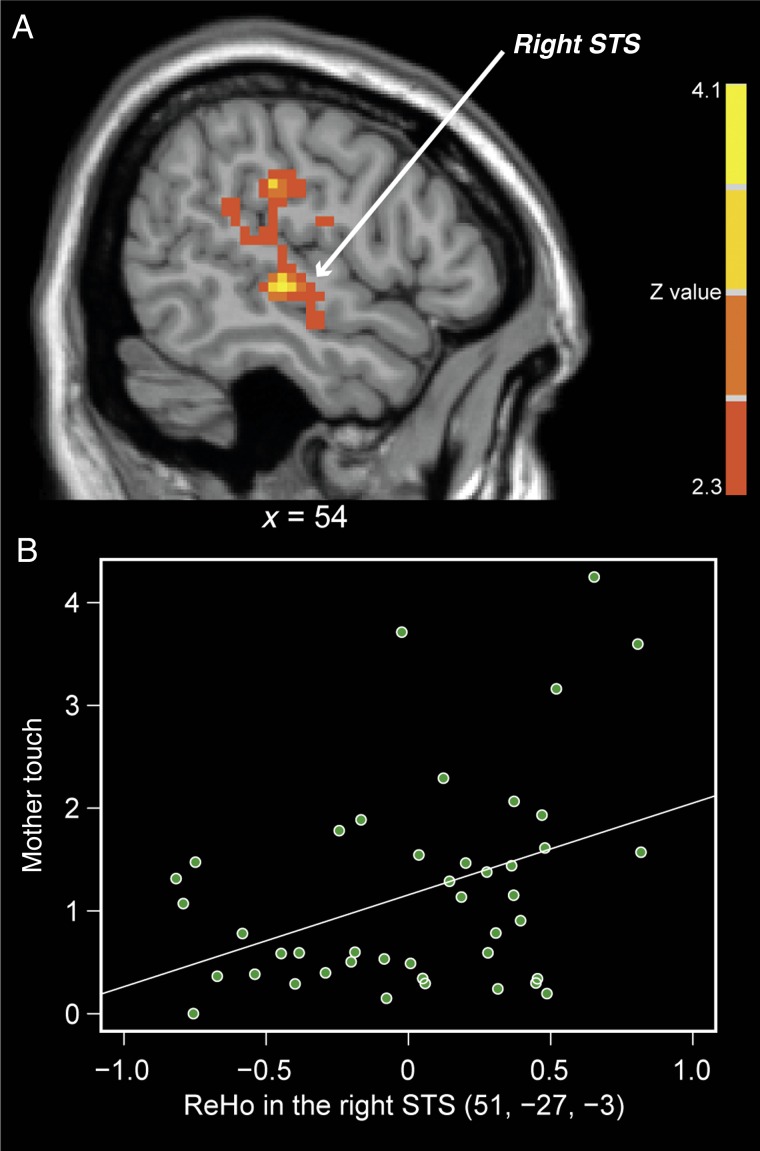
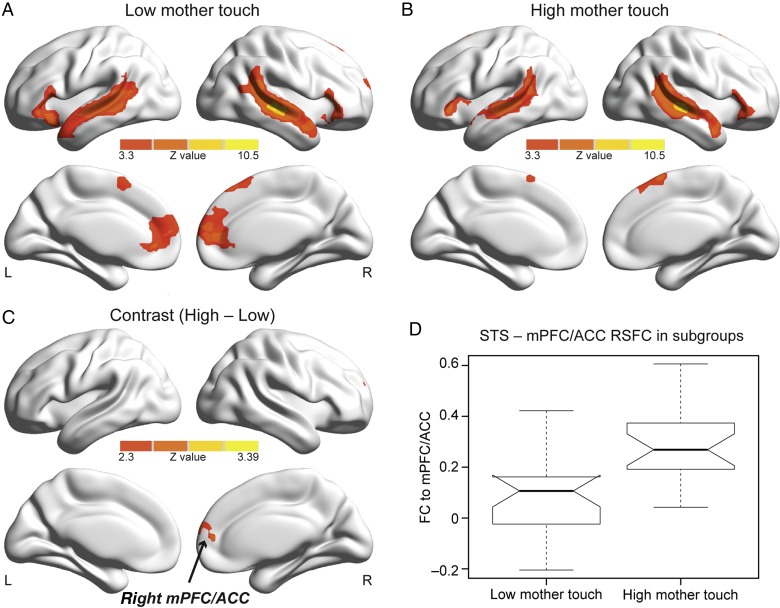
Previous behavioral research points to a positive relationship between maternal touch and early social development. Here, we explored the brain correlates of this relationship. The frequency of maternal touch was recorded for 43 five-year-old children during a 10 min standardized play session. Additionally, all children completed a resting-state functional magnetic resonance imaging session. Investigating the default mode network revealed a positive relation between the frequency of maternal touch and activity in the right posterior superior temporal sulcus (pSTS) extending into the temporo-parietal junction. Using this effect as a seed in a functional connectivity analysis identified a network including extended bilateral regions along the temporal lobe, bilateral frontal cortex, and left insula. Compared with children with low maternal touch, children with high maternal touch showed additional connectivity with the right dorso-medial prefrontal cortex. Together these results support the notion that childhood tactile experiences shape the developing "social brain" with a particular emphasis on a network involved in mentalizing.
Overview
The claims and statistics of this paper haven’t been checked yet.
Free: it reads the open-access text and checks the first 5 claims that cite a source we can check. Create a free account to check every claim.
Integrity signals
Registry
Cites
Statistics
Figures
Verification
Claims the paper makes
The claims and statistics of this paper haven’t been checked yet.
Free: it reads the open-access text and checks the first 5 claims that cite a source we can check. Create a free account to check every claim.
Claims other papers make about this one
Each is checked against this paper’s own text: does it say what the citing paper says it does?
The cited source says what the claim attributes to it.
In the citing paper
“Recent findings suggest that touch also promotes the development and connectivity of brain areas (Brauer et al., 2016; Björnsdotter et al., 2014) associated with social cognition and the “social brain” (Adolphs, 2009, Brothers, 2002, Frith, 2007).”
From The impact of atypical sensory processing on social impairments in autism spectrum disorder (2018) · cites this paper as Brauer et al., 2016
Self-check
Percentages, sums and reported differences re-computed from the paper’s own numbers.
The self-check needs the paper’s full text.
Citations
Cites
A default mode of brain function
Raichle, M. E., MacLeod, A. M., Snyder, A. Z., Powers, W. J., Gusnard, D. A., & Shulman, G. L. (2001) · Proceedings of the National Academy of Sciences · doi:10.1073/pnas.98.2.676 · Cited by 12,190 · cited 2×
“It sheds light on the so-called “default mode network” (DMN, Long et al. 2008)— a distributed set of brain regions that are activewhenparticipants are wakefully at rest but suppressed when they perform a task (Shulman et al. 1997; Gusnard and Raichle 2001; Raichle et al. 2001).”
BackgroundJenkinson, M., Bannister, P., Brady, M., & Smith, S. (2002) · NeuroImage · doi:10.1006/nimg.2002.1132 · Cited by 11,888 · cited 2×
“2012), the frame-wise displacement (FD) of time series was computed (Jenkinson et al. 2002).”
BackgroundFunctional connectivity in the motor cortex of resting human brain using echo‐planar mri
Biswal, B., Zerrin Yetkin, F., Haughton, V. M., & Hyde, J. S. (1995) · Magnetic Resonance in Medicine · doi:10.1002/mrm.1910340409 · Cited by 9,812
Power, J. D., Barnes, K. A., Snyder, A. Z., Schlaggar, B. L., & Petersen, S. E. (2012) · NeuroImage · doi:10.1016/j.neuroimage.2011.10.018 · Cited by 7,429 · cited 2×
“The study was approved by the Institutional Review Board of Leipzig University (Germany).”
BackgroundMethodKendall, M. G. (1957) · Biometrika · doi:10.2307/2333282 · Cited by 6,383
Epigenetic programming by maternal behavior
Weaver, I. C. G., Cervoni, N., Champagne, F. A., D'Alessio, A. C., Sharma, S., Seckl, J. R., Dymov, S., Szyf, M., & Meaney, M. J. (2004) · Nature Neuroscience · doi:10.1038/nn1276 · Cited by 6,177 · cited 1×
“Tactile input was found to increase cortisol receptors in the hippocampus and to make the offspring’s stress response more efficient (Liu et al. 1997; Weaver et al. 2004; for corresponding human work, see McGowan et al. 2009).”
BackgroundA component based noise correction method (CompCor) for BOLD and perfusion based fMRI
Behzadi, Y., Restom, K., Liau, J., & Liu, T. T. (2007) · NeuroImage · doi:10.1016/j.neuroimage.2007.04.042 · Cited by 4,502 · cited 2×
“5 years age range (prepuberty, based on 82 subjects); 5) spatially normalizing images by using the parameters from the segmentation procedure in each subject and resampling voxel size to 3 × 3 × 3 mm(3); 6) spatially smoothing images with a 6-mm full-width-at-half-maximum (FWHM) Gaussian kernel (for RSFConly); 7) nuis…”
MethodBrainNet Viewer: A Network Visualization Tool for Human Brain Connectomics
Xia, M., Wang, J., & He, Y. (2013) · PLoS ONE · doi:10.1371/journal.pone.0068910 · Cited by 4,106 · cited 2×
“The correlation map (r-map) was then transformed into a Z-map via the “rest_TFRtoZ” function in the REST toolbox (Song et al. 2011; http://www.restfmri.net) and further corrected for multiple comparisons using Gaussian Random Field (GRF) theory (Z > 2.3, cluster-wise P < 0.05, GRF corrected) with a…”
MethodInfluentialMovement‐Related effects in fMRI time‐series
Friston, K. J., Williams, S., Howard, R., Frackowiak, R. S. J., & Turner, R. (1996) · Magnetic Resonance in Medicine · doi:10.1002/mrm.1910350312 · Cited by 3,774 · cited 2×
“…6 head motion parameters for the current time point, 6 head motion parameters for the preceding time point, and their 12 corresponding values squared (Friston et al. 1996); the CompCor procedure comprised detrending, variance (i.e., WM and CSF) normalization, and PC analysis; and 8) band-pass…”
MethodMethods to detect, characterize, and remove motion artifact in resting state fMRI
Power, J. D., Mitra, A., Laumann, T. O., Snyder, A. Z., Schlaggar, B. L., & Petersen, S. E. (2014) · NeuroImage · doi:10.1016/j.neuroimage.2013.08.048 · Cited by 3,748 · cited 1×
“Given recent concerns regarding the confounding influence of micromovements on intrinsic functional connectivity analyses (Power et al. 2012, 2014; Satterthwaite et al. 2012; Van Dijk et al. 2012), the frame-wise displacement (FD) of time series was computed (Jenkinson et al. 2002).”
Background
Cited by
The impact of atypical sensory processing on social impairments in autism spectrum disorder
Thye, M. D., Bednarz, H. M., Herringshaw, A. J., Sartin, E. B., & Kana, R. K. (2018) · Developmental Cognitive Neuroscience · doi:10.1016/j.dcn.2017.04.010 · Cited by 513
“brain areas (Brauer et al., 2016; Björnsdotter et al., 2014) associated with social cognition and the “social brain” (Adolphs, 2009; Brothers,”
Social touch and human development
Cascio, C. J., Moore, D., & McGlone, F. (2019) · Developmental Cognitive Neuroscience · doi:10.1016/j.dcn.2018.04.009 · Cited by 503
Emotion Perception from Face, Voice, and Touch: Comparisons and Convergence
Schirmer, A., & Adolphs, R. (2017) · Trends in Cognitive Sciences · doi:10.1016/j.tics.2017.01.001 · Cited by 381
“Social interactions elicit spontaneous and strategic expressions that we commonly classify as emotions, and that profoundly influence a perceiver’s mental state and ongoing behavior [13,57,71].”
BackgroundSelf-citationBalasco, L., Provenzano, G., & Bozzi, Y. (2020) · Frontiers in Psychiatry · doi:10.3389/fpsyt.2019.01016 · Cited by 177
“Touch is considered one of the most basic ways to sense the external world (106) and has been reported to have a significant role in role in several social aspects such as communication (107), developing social bonds (108), and overall physical development and connectivity of brain areas (109, 110).”
BackgroundThe soothing function of touch: affective touch reduces feelings of social exclusion
von Mohr, M., Kirsch, L. P., & Fotopoulou, A. (2017) · Scientific Reports · doi:10.1038/s41598-017-13355-7 · Cited by 181
The dual nature of early-life experience on somatosensory processing in the human infant brain
Maitre, N. L., Key, A. P., Chorna, O. D., Slaughter, J. C., Matusz, P. J., Wallace, M. T., & Murray, M. M. (2017) · Current Biology · doi:10.1016/j.cub.2017.02.036 · Cited by 177
Resting-state Functional MRI Studies on Infant Brains: a Decade of Gap-Filling Efforts
Zhang, H., Shen, D., & Lin, W.-L. (2018) · NeuroImage · doi:10.1016/j.neuroimage.2018.07.004 · Cited by 149
Affective Interpersonal Touch in Close Relationships: A Cross-Cultural Perspective
Sorokowska, A., Saluja, S., Sorokowski, P., Frąckowiak, T., Karwowski, M., Aavik, T., Akello, G., Alm, C., Amjad, N., Anjum, A., et al. (2021) · Personality and Social Psychology Bulletin · doi:10.1177/0146167220988373 · Cited by 178
“, 2010) and the amount of maternal touch predicts the development of infantile social brain areas (Brauer et al., 2016).”
BackgroundAffective and non-affective touch evoke differential brain responses in 2-month-old infants
Jönsson, E. H., Kotilahti, K., Heiskala, J., Wasling, H. B., Olausson, H., Croy, I., Mustaniemi, H., Hiltunen, P., Tuulari, J. J., Scheinin, N. M., et al. (2018) · NeuroImage · doi:10.1016/j.neuroimage.2017.12.024 · Cited by 143
“They further found that connectivity of areas in the “social brain” differed between children who received high and low frequency of maternal touch (Brauer et al., 2016).”
BackgroundCarozza, S., & Leong, V. (2021) · Frontiers in Neuroscience · doi:10.3389/fnins.2020.613378 · Cited by 145
“These changes may be mediated by the maturation of the social brain, as frequent maternal touch is associated with greater activity and connectivity of cortical regions implicated in social processing (Brauer et al., 2016).”
BackgroundSocial touch, CT touch and massage therapy: A narrative review
Field, T. (2019) · Developmental Review · doi:10.1016/j.dr.2019.01.002 · Cited by 86
What are C-tactile afferents and how do they relate to “affective touch”?
Schirmer, A., Croy, I., & Ackerley, R. (2023) · Neuroscience & Biobehavioral Reviews · doi:10.1016/j.neubiorev.2023.105236 · Cited by 109
“, 2019) and correlational evidence from humans (Brauer et al., 2016; Della Longa et al., 2019; Reece et al., 2016).”
Self-citationAffective touch: A meta-analysis on sex differences
Russo, V., Ottaviani, C., & Spitoni, G. F. (2019) · Neuroscience & Biobehavioral Reviews · doi:10.1016/j.neubiorev.2019.09.037 · Cited by 126
The body comes first. Embodied reparation and the co-creation of infant bodily-self
Montirosso, R., & McGlone, F. P. (2020) · Neuroscience & Biobehavioral Reviews · doi:10.1016/j.neubiorev.2020.03.003 · Cited by 108
“Notably, in children aged 5, maternal touch was predictive of resting activity in insula and in right posterior superior temporal sulcus, regions associated with the developing social brain and social perception (Brauer et al., 2016).”
BackgroundCrucianelli, L., Wheatley, L., Filippetti, M. L., Jenkinson, P. M., Kirk, E., & Fotopoulou, A. (2018) · Developmental Cognitive Neuroscience · doi:10.1016/j.dcn.2018.01.010 · Cited by 97
“substantial level of agreement was considered acceptable in this context, as it reflects the complexity of tactile interactions and methods reported in previous studies (see Reece et al., 2016; Brauer et al., 2016).”
Gentle touch perception: From early childhood to adolescence
Croy, I., Sehlstedt, I., Wasling, H. B., Ackerley, R., & Olausson, H. (2017) · Developmental Cognitive Neuroscience · doi:10.1016/j.dcn.2017.07.009 · Cited by 96
Sensitivity to CT-optimal, Affective Touch Depends on Adult Attachment Style
Krahé, C., von Mohr, M., Gentsch, A., Guy, L., Vari, C., Nolte, T., & Fotopoulou, A. (2018) · Scientific Reports · doi:10.1038/s41598-018-32865-6 · Cited by 80
Li, Q., Becker, B., Wernicke, J., Chen, Y., Zhang, Y., Li, R., Le, J., Kou, J., Zhao, W., & Kendrick, K. M. (2018) · Psychoneuroendocrinology · doi:10.1016/j.psyneuen.2018.11.016 · Cited by 88
Mother-newborn separation at birth in hospitals: A possible risk for neurodevelopmental disorders?
Császár-Nagy, N., & Bókkon, I. (2017) · Neuroscience & Biobehavioral Reviews · doi:10.1016/j.neubiorev.2017.08.013 · Cited by 89
“Brauer et al. (2016) measured the frequency of maternal touch for 43 five-year-old children in a 10-min play session.”
BackgroundTherapeutic Alliance as Active Inference: The Role of Therapeutic Touch and Synchrony
McParlin, Z., Cerritelli, F., Friston, K. J., & Esteves, J. E. (2022) · Frontiers in Psychology · doi:10.3389/fpsyg.2022.783694 · Cited by 77
Neel, M. L., Yoder, P. J., Matusz, P. J., Murray, M. M., Miller, A., Burkhardt, S., Emery, L., Hague, K., Kjeldsen, C. P., Purnell, J., et al. (2019) · BMC Pediatrics · doi:10.1186/s12887-019-1455-1 · Cited by 78
The why, who and how of social touch
Suvilehto, J. T., Čekaitė, A., & Morrison, I. (2023) · Nature Reviews Psychology · doi:10.1038/s44159-023-00217-5 · Cited by 79
Devine, S. L., Walker, S. C., Makdani, A. D., Stockton, E. R., McFarquhar, M., McGlone, F. P., & Trotter, P. D. (2020) · Frontiers in Psychology · doi:10.3389/fpsyg.2020.557171 · Cited by 70
How spontaneous brain activity and narcissistic features shape social interaction
Scalabrini, A., Huang, Z., Mucci, C., Perrucci, M. G., Ferretti, A., Fossati, A., Romani, G. L., Northoff, G., & Ebisch, S. J. H. (2017) · Scientific Reports · doi:10.1038/s41598-017-10389-9 · Cited by 60
Is the voice an auditory face? An ALE meta-analysis comparing vocal and facial emotion processing
Schirmer, A. (2017) · Social Cognitive and Affective Neuroscience · doi:10.1093/scan/nsx142 · Cited by 66
“Moreover, the overall right hemisphere bias accords with the more general pattern observed for nonverbal signals in the literature (Brauer et al., 2016; Schirmer et al., 2016b; Schirmer and Adolphs, 2017).”
BackgroundSelf-citationBehavioural discrimination of noxious stimuli in infants is dependent on brain maturation
Green, G., Hartley, C., Hoskin, A., Duff, E. P., Shriver, A., Wilkinson, D. J. C., Adams, E., Rogers, R., Moultrie, F., & Slater, R. (2018) · Pain · doi:10.1097/j.pain.0000000000001425 · Cited by 64
“Estimated cumulative prior pain exposure 14 (4-21)”
BackgroundSocial touch during development: Long-term effects on brain and behavior
Bales, K. L., Witczak, L. R., Simmons, T. C., Savidge, L. E., Rothwell, E. S., Rogers, F. D., Manning, R., Heise, M. J., Englund, M., & Razo, R. A. (2018) · Neuroscience & Biobehavioral Reviews · doi:10.1016/j.neubiorev.2018.09.019 · Cited by 62
Processing of affective and emotionally neutral tactile stimuli in the insular cortex
Davidovic, M., Starck, G., & Olausson, H. (2017) · Developmental Cognitive Neuroscience · doi:10.1016/j.dcn.2017.12.006 · Cited by 59
Is Our Self Related to Personality? A Neuropsychodynamic Model
Scalabrini, A., Mucci, C., & Northoff, G. (2018) · Frontiers in Human Neuroscience · doi:10.3389/fnhum.2018.00346 · Cited by 61
“For instance, a recent study (Brauer et al., 2016) indicated how 5-year old children exposed to higher maternal touch experiences show additional regional connectivity within the right dorso-medial prefrontal cortex and may benefit in terms of ‘‘social brain development.”
BackgroundPosterior Superior Temporal Sulcus Responses Predict Perceived Pleasantness of Skin Stroking
Davidovic, M., Jönsson, E. H., Olausson, H., & Björnsdotter, M. (2016) · Frontiers in Human Neuroscience · doi:10.3389/fnhum.2016.00432 · Cited by 62
“For instance, early experiences such as frequency of maternal touch (Brauer et al., 2016), attachmentrelated stress (Nolte et al., 2013), and a range of other attachmentrelated processes (Vrticka and Vuilleumier, 2012) influence the functioning of social brain regions such as the STS.”
BackgroundAguirre, M., Couderc, A., Epinat‐Duclos, J., & Mascaro, O. (2019) · Developmental Cognitive Neuroscience · doi:10.1016/j.dcn.2019.100639 · Cited by 57
“Tactile stimulation is a part of the typical repertoire of mammalian caregiving behaviors (Feldman, 2011), and touching and being touched is crucial for bodily and neuro-cognitive development in humans and in non-human primates (Brauer et al., 2016; Bremner and Spence, 2017; Cascio et al., 2019; Feldman et al., 2014;…”
Sensory-based interventions in the NICU: systematic review of effects on preterm brain development
Beltrán, M. I., Dudink, J., de Jong, T. M., Benders, M. J. N. L., & van den Hoogen, A. (2021) · Pediatric Research · doi:10.1038/s41390-021-01718-w · Cited by 59
Depression predicts interpersonal problems partially through the attitude towards social touch
Triscoli, C., Croy, I., & Sailer, U. (2018) · Journal of Affective Disorders · doi:10.1016/j.jad.2018.12.054 · Cited by 56
The role of C-tactile nerve fibers in human social development
Croy, I., Fairhurst, M. T., & McGlone, F. P. (2021) · Current Opinion in Behavioral Sciences · doi:10.1016/j.cobeha.2021.06.010 · Cited by 54
Maternal touch predicts social orienting in young children
Reece, C., Ebstein, R., Cheng, X., Ng, T., & Schirmer, A. (2016) · Cognitive Development · doi:10.1016/j.cogdev.2016.05.001 · Cited by 51
Self-citationBeltrán, M. I., Dijkerman, H. C., & Keizer, A. (2020) · PLoS ONE · doi:10.1371/journal.pone.0241041 · Cited by 59
“Moreover, higher frequency of affective touch in infancy was found to predict cognitive and neurobehavioral development in very early infancy [39, 40] and the development of connectivity in areas related to the social brain across the first 10 years of life [41].”
BackgroundMcGlone, F. P., Moberg, K. U., Norholt, H., Eggart, M., & Müller-Oerlinghausen, B. (2024) · Frontiers in Psychiatry · doi:10.3389/fpsyt.2024.1390673 · Cited by 52
“Under the condition of repeated soft touch we may then expect also increased synaptic interconnectivity (78, 79).”
BackgroundEEG captures affective touch: CT-optimal touch and neural oscillations
Mohr, M. V., Crowley, M. J., Walthall, J., Mayes, L. C., Pelphrey, K. A., & Rutherford, H. J. V. (2018) · Cognitive Affective & Behavioral Neuroscience · doi:10.3758/s13415-017-0560-6 · Cited by 52
“Despite the mounting evidence for the impact of gentle touch on regulatory function and social bonds (Brauer et al., 2016; Field, 2010; Suvilehto et al., 2015), examination of tactile systems has been largely neglected in social neuroscience research.”
BackgroundThe multidimensional representational space of observed socio-affective touch experiences
Masson, H. L., Plas, S. V. D., Daniëls, N., & de Beeck, H. O. (2018) · NeuroImage · doi:10.1016/j.neuroimage.2018.04.007 · Cited by 53
Neural correlates of developing theory of mind competence in early childhood
Xiao, Y., Geng, F., Riggins, T., Chen, G., & Redcay, E. (2018) · NeuroImage · doi:10.1016/j.neuroimage.2018.09.079 · Cited by 49
“…study, we utilized the resting-state functional magnetic resonance imaging (rs-fMRI) technique, which allows for the study of intrinsic brain networks devoid of any explicit tasks in very young children (e.g., Brauer et al., 2016; Riggins et al., 2016; Xiao et al., 2016; Vanderwal et al., 2015).”
MethodSelf-citationFarroni, T., Longa, L. D., & Valori, I. (2021) · Current Opinion in Behavioral Sciences · doi:10.1016/j.cobeha.2021.10.007 · Cited by 49
Emotion Measurements Through the Touch of Materials Surfaces
Bertheaux, C., Toscano, R., Fortunier, R., Roux, J., Charier, D. J., & Borg, C. (2020) · Frontiers in Human Neuroscience · doi:10.3389/fnhum.2019.00455 · Cited by 47
Farber, M. J., Gee, D. G., & Hariri, A. R. (2020) · European Journal of Neuroscience · doi:10.1111/ejn.15003 · Cited by 46
“, 2014), and three included records examined parenting in relation to intrinsic functional connectivity (Brauer et al., 2016; Degeilh et al., 2018; Graham et al., 2015), which assesses the strength of correlated activity between brain regions when participants are “at rest” or otherwise not engaged by an experimental…”
BackgroundInfluentialPhysical contact in parent-infant relationship and its effect on fostering a feeling of safety
Yoshida, S., & Funato, H. (2021) · iScience · doi:10.1016/j.isci.2021.102721 · Cited by 51
“This figure was modified from (Yoshida et al., 2020). temporal sulcus of late infants becomes responsive to maternal touch, which suggests that the processing of somatosensory information in a social context is taking place (Brauer et al., 2016).”
BackgroundSmirni, D., Smirni, P., Carotenuto, M., Parisi, L., Quatrosi, G., & Roccella, M. (2019) · Brain Sciences · doi:10.3390/brainsci9120368 · Cited by 41
Caregiver–child proximity as a dimension of early experience
Barnett, W., Hansen, C. L., Bailes, L. G., & Humphreys, K. L. (2022) · Development and Psychopathology · doi:10.1017/s0954579421001644 · Cited by 47
“Finally, in a study of 5-year-olds, frequency of maternal touch during a maternal – child interaction was associated with stronger connectivity of the posterior superior temporal sulcus and other nodes in the social brain (Brauer et al., 2016).”
BackgroundPereira, N. D. S. C., Ferreira, C. F., Lampert, C., Arcego, D. M., Toniazzo, A. P., Bernardi, J. R., da Silva, D. C., Toigo, E. V. P., Diehl, L. A., Krolow, R., et al. (2016) · International Journal of Developmental Neuroscience · doi:10.1016/j.ijdevneu.2016.10.001 · Cited by 45
“…in rodents (Coutellier et al., 2008; Champagne et al., 003; van Hasselt et al., 2012; Liu et al., 1997; Singh-Taylor et al., 015) and humans (Brauer et al., 2016), whereas abnormal or defiient care increases the vulnerability to stress-related disorders, oth in humans (Kim et al., 2016) and…”
BackgroundTemporal signatures of processing voiceness and emotion in sound
Schirmer, A., & Gunter, T. C. (2017) · Social Cognitive and Affective Neuroscience · doi:10.1093/scan/nsx020 · Cited by 42
“Moreover, it agrees with other evidence suggesting that the right hemisphere is more relevant than the left for social processing (for a review see Brauer et al., 2016).”
BackgroundSelf-citationSocial touch — a tool rather than a signal
Schirmer, A., Croy, I., & Schweinberger, S. R. (2022) · Current Opinion in Behavioral Sciences · doi:10.1016/j.cobeha.2021.101100 · Cited by 38
Self-citationHandling newborn monkeys alters later exploratory, cognitive, and social behaviors
Simpson, E. A., Sclafani, V., Paukner, A., Kaburu, S., Suomi, S. J., & Ferrari, P. F. (2017) · Developmental Cognitive Neuroscience · doi:10.1016/j.dcn.2017.07.010 · Cited by 38
“in regions associated with mentalizing (Brauer et al., 2016).”
Hardin, J. S., Jones, N. A., Mize, K. D., & Platt, M. (2021) · Neuropsychobiology · doi:10.1159/000511604 · Cited by 37
Masson, H. L., de Beeck, H. O., & Boets, B. (2020) · NeuroImage · doi:10.1016/j.neuroimage.2020.117009 · Cited by 32
Lo, C., Chu, S. T., Penney, T. B., & Schirmer, A. (2020) · Neuroscience · doi:10.1016/j.neuroscience.2020.09.037 · Cited by 31
Self-citationSpapé, M., Harjunen, V. J., & Ravaja, N. (2017) · Biological Psychology · doi:10.1016/j.biopsycho.2017.01.002 · Cited by 30
The right touch: Stroking of CT-innervated skin promotes vocal emotion processing
Schirmer, A., & Gunter, T. C. (2017) · Cognitive Affective & Behavioral Neuroscience · doi:10.3758/s13415-017-0537-5 · Cited by 30
Self-citationEpigenetic protection: maternal touch and DNA-methylation in early life
Wigley, I. L. C. M., Mascheroni, E., Bonichini, S., & Montirosso, R. (2021) · Current Opinion in Behavioral Sciences · doi:10.1016/j.cobeha.2021.09.004 · Cited by 52
Bytomski, A., Ritschel, G., Bierling, A. L., Bendas, J., Weidner, K., & Croy, I. (2020) · Psychology & Neuroscience · doi:10.1037/pne0000184 · Cited by 30
Bäuml, J., Baumann, N., Avram, M., Bratec, S. M., Breeman, L. D., Berndt, M. T., Bilgin, A., Jaekel, J., Wolke, D., & Sorg, C. (2018) · Biological Psychiatry Cognitive Neuroscience and Neuroimaging · doi:10.1016/j.bpsc.2018.11.005 · Cited by 30
Maternal sensitivity and infant neural response to touch: an fNIRS study
Mateus, V., Osório, A., Miguel, H. O., Cruz, S., & Sampaio, A. (2021) · Social Cognitive and Affective Neuroscience · doi:10.1093/scan/nsab069 · Cited by 26
“In turn, neuroimaging findings show that 5-year-old children exposed more frequently to maternal touch (presumed to occur more often in the context of sensitive parent–infant interactions) revealed stronger resting-state activity and connectivity in social areas of the brain, particularly in the right pSTS (Brauer et…”
BackgroundNist, M. D., Harrison, T. M., Tate, J. A., Robinson, A., Balas, M. C., & Pickler, R. H. (2020) · Nursing Inquiry · doi:10.1111/nin.12368 · Cited by 25
Kopf, D. (2021) · Zeitschrift für Gerontologie und Geriatrie · doi:10.1007/s00391-021-01995-4 · Cited by 25
“resting activity and connectivity of the “social brain”, according to a functional magnetic resonance imaging (MRI) study [3].”
MethodMiguel, H. O., Gonçalves, Ó. F., & Sampaio, A. (2019) · Developmental Psychobiology · doi:10.1002/dev.21891 · Cited by 21
Social touch alters newborn monkey behavior
Simpson, E. A., Maylott, S. E., Lazo, R. J., Leonard, K. A., Kaburu, S., Suomi, S. J., Paukner, A., & Ferrari, P. F. (2019) · Infant Behavior and Development · doi:10.1016/j.infbeh.2019.101368 · Cited by 22
“, more attentive to photos of faces compared to houses, and greater brain resting activity and connectivity in areas associated with mentalizing, suggesting enhanced social cognitive skills (Brauer et al., 2016; Reece et al., 2016).”
BackgroundVicarious ratings of social touch the effect of age and autistic traits
Haggarty, C. J., Moore, D., Trotter, P. D., Hagan, R., McGlone, F. P., & Walker, S. C. (2021) · Scientific Reports · doi:10.1038/s41598-021-98802-2 · Cited by 21
The Midas Effect: How Somatosensory Impressions Shape Affect and Other-Concern
Schirmer, A., Wijaya, M. T., & Liu, S. (2016) · Springer eBooks · doi:10.1007/978-1-4939-6418-5_17 · Cited by 21
Self-citationPerez, A., Panagiotopoulou, E., Curtis, P., & Roberts, R. E. (2021) · BJPsych Open · doi:10.1192/bjo.2021.925 · Cited by 20
“Previous research has shown that touch may not only have a unique contribution to the formation of social bonds, 25 conveying social support, but also act as a stress buffer, playing a critical regulatory role in the body ’ s responses to acute life stressors.”
Chajes, J. R., Stern, J. A., Kelsey, C. M., & Großmann, T. (2022) · Frontiers in Neuroscience · doi:10.3389/fnins.2022.892482 · Cited by 20
Touching to connect, explore, and explain: how the human brain makes social touch meaningful
Morrison, I. (2023) · The Senses and Society · doi:10.1080/17458927.2023.2200065 · Cited by 21
“Yet any such role has been under-researched, despite the region’s recurring yet inconsistent appearance across human brain imaging studies of affective touch (e.g. Brauer et al. 2016; Davidovic et al. 2016; Singh et al. 2014; Gordon et al. 2013; Voos, Pelphrey, and Kaiser 2013).”
BackgroundIntrinsic brain activity associated with eye gaze during mother–child interaction
Kuboshita, R., Fujisawa, T. X., Makita, K., Kasaba, R., Okazawa, H., & Tomoda, A. (2020) · Scientific Reports · doi:10.1038/s41598-020-76044-y · Cited by 19
Bryant, L. K., Woynaroski, T. G., Wallace, M. T., & Cascio, C. J. (2019) · Journal of Autism and Developmental Disorders · doi:10.1007/s10803-019-04043-8 · Cited by 18
Past and present experiences with maternal touch affect infants’ attention toward emotional faces
Addabbo, M., Licht, V., & Turati, C. (2021) · Infant Behavior and Development · doi:10.1016/j.infbeh.2021.101558 · Cited by 17
The role of affective touch in modulating emotion processing among preschool children
Longa, L. D., Carnevali, L., & Farroni, T. (2023) · Journal of Experimental Child Psychology · doi:10.1016/j.jecp.2023.105726 · Cited by 19
A touch-scaffolded model of human prosociality
Su, J., & Su, Y. (2018) · Neuroscience & Biobehavioral Reviews · doi:10.1016/j.neubiorev.2018.07.008 · Cited by 18
An integrative perspective on the role of touch in the development of intersubjectivity
Plinio, S. D., Scalabrini, A., & Ebisch, S. J. H. (2022) · Brain and Cognition · doi:10.1016/j.bandc.2022.105915 · Cited by 15
Low maternal licking/grooming stimulation increases pain sensitivity in male mouse offspring
Sakamoto, T., Ishio, Y., Ishida, Y., Mogi, K., & Kikusui, T. (2020) · EXPERIMENTAL ANIMALS · doi:10.1538/expanim.20-0030 · Cited by 18
“For example, maternal touch in children supports neurodevelopmental outcomes [21].”
Bellard, A., Mathew, J., Sun, W., Denkow, L., Najm, A., Michael‐Grigoriou, D., Trotter, P. D., McGlone, F. P., Fairhurst, M. T., & Cazzato, V. (2023) · Scientific Reports · doi:10.1038/s41598-023-39484-w · Cited by 14
“There was also a significant main effect of Relationship [F(1, 33) = 68.”
BackgroundMethodInfluentialMothers’ interoceptive sensibility mediates affective interaction between mother and infant
Suga, A., Naruto, Y., Maulina, V. V. R., Uraguchi, M., Ozaki, Y., & Ohira, H. (2022) · Scientific Reports · doi:10.1038/s41598-022-09988-y · Cited by 14
Pregnant women with depressive and anxiety symptoms read, talk, and sing less to their fetuses
Hernandez‐Reif, M., Kendrick, A., & Avery, D. M. (2018) · Journal of Affective Disorders · doi:10.1016/j.jad.2017.12.108 · Cited by 16
Bellard, A., Trotter, P. D., McGlone, F., & Cazzato, V. (2023) · Social Cognitive and Affective Neuroscience · doi:10.1093/scan/nsad060 · Cited by 11
Ciarrusta, J., Dimitrova, R., & McAlonan, G. M. (2020) · Progress in brain research · doi:10.1016/bs.pbr.2020.05.004 · Cited by 13
Beijers, R., Cassidy, J. A., Lustermans, H., & de Weerth, C. (2019) · Child Development · doi:10.1111/cdev.13146 · Cited by 12
Touch in psychotherapy: Experiences, desires and attitudes in a large population survey
Tanzer, M., Koukoutsakis, A., Galouzidi, I., Jenkinson, P. M., Hammond, C., Banissy, M. J., & Fotopoulou, A. (2025) · Psychotherapy Research · doi:10.1080/10503307.2025.2534971 · Cited by 11
“…of attachment style, social affiliations and social bonds, including dimensions of adult attachment style (Ainsworth, 1979; Bowlby, 1969; Brauer et al., 2016; Dunbar, 2010; Fotopoulou & Tsakiris, 2017; Montagu, 1978; Morrison, 2016; Reite, 1990; Shaver & Mikulincer, 2010; Takeuchi et…”
Brain Structural Alterations in Left-Behind Children: A Magnetic Resonance Imaging Study
Fu, Y., Xiao, Y., Du, M., Mao, C., Fu, G., Yang, L., Liu, X., Sweeney, J. A., Lui, S., & Yan, Z. (2019) · Frontiers in Neural Circuits · doi:10.3389/fncir.2019.00033 · Cited by 11
“Previous studies pointed that, maternal touch had a positive relationship with the brain development, especially in the social brain (McGlone et al., 2014; Brauer et al., 2016), of which the medial lemniscus is a crucially relevant afferent pathway.”
BackgroundSelf-citationLoizou, C. P. (2021) · Speech Communication · doi:10.1016/j.specom.2021.04.001 · Cited by 10
Carnevali, L., Longa, L. D., Dragovic, D., & Farroni, T. (2024) · Infancy · doi:10.1111/infa.12580 · Cited by 9
Taneja, P., Olausson, H., Trulsson, M., Vase, L., Svensson, P. J., & Baad‐Hansen, L. (2019) · European Journal of Pain · doi:10.1002/ejp.1391 · Cited by 9
Bai, T., Zhang, L., Xie, X., Xiao, G., Huang, W., Li, D., Zu, M., Wei, L., Zuo, X., Gong-Jun, J. I., et al. (2019) · Social Cognitive and Affective Neuroscience · doi:10.1093/scan/nsaa008 · Cited by 10
“Additionally, during resting states, connectivity between the TPJ and mPFC are also linked with social cognition and behavior (Brauer et al., 2016; Van Overwalle and Marien, 2016).”
BackgroundChen, H., Fu, S., Zhi, X., Wang, Y., Liu, F., Li, Y., Ren, F., Zhang, J., Ren, L., & Wang, Y. (2025) · Neuropsychiatric Disease and Treatment · doi:10.2147/ndt.s488059 · Cited by 9
“116 Enhancing our comprehension of the brain’s functional mechanisms in response to affective touch could aid in alleviating stress, pain, anxiety, depression, and other mental health conditions.”
The impact of touch on bonding and neurodevelopment
Bendas, J., & Croy, I. (2021) · Elsevier eBooks · doi:10.1016/b978-0-12-817986-4.00048-1 · Cited by 8
Zhongyi, Y. I., Yang, W., & Ye, H. (2018) · Acta Psychologica Sinica · doi:10.3724/sp.j.1041.2018.00793 · Cited by 10
Interoception Across the Lifespan
Carr, L., Donaghy, R., & Brewer, R. (2024) · Springer eBooks · doi:10.1007/978-3-031-68521-7_10 · Cited by 7
Early maternal touch predicts prosocial behaviour in adolescents: the mediation role of attachment
Zhang, K., & Su, J. (2025) · International Journal of Adolescence and Youth · doi:10.1080/02673843.2025.2537374 · Cited by 6
“Besides the behavioural evidence, an extra neuroimaging study by Brauer et al. (2016) also suggested the importance of maternal touch in prosocial development.”
Bian, D., Zheng, Z., Swanson, A. R., Weitlauf, A. S., Woynaroski, T. G., Cascio, C. J., Key, A. P. F., Warren, Z. E., & Sarkar, N. (2018) · IEEE Transactions on Neural Systems and Rehabilitation Engineering · doi:10.1109/tnsre.2018.2854672 · Cited by 7
“impact the “social brain” [15].”
Zorjan, S., Wolke, D., Baumann, N., Sorg, C., & Bratec, S. M. (2024) · Journal of Child Psychology and Psychiatry · doi:10.1111/jcpp.14033 · Cited by 5
“Maternal sensitivity and touch can affect the resting-state connectivity of AIS regions (Brauer, Xiao, Poulain, Friederici, & Schirmer, 2016; Chajes, Stern, Kelsey, & Gross-mann, 2022), social reappraisal can reduce negative feelings by recruiting key AIS regions (Xie et al., 2016), and the…”
Brzozowska, A., Longo, M. R., Mareschal, D., Wiesemann, F., & Gliga, T. (2022) · Developmental Psychobiology · doi:10.1002/dev.22290 · Cited by 6
“Moreover, the frequency of maternal touch during a play session has been shown to predict activation of and connectivity between areas belonging to the “social brain,” including right posterior superior temporal sulcus and left insula, in 5-year-olds (Brauer et al., 2016).”
Yang, L., Li, X., Xie, Z., & Lujun, S. (2024) · PLoS ONE · doi:10.1371/journal.pone.0295812 · Cited by 6
“The touch experience in early development plays an important role in the healthy development of children [8].”
BackgroundDevelopment of interoception: the critical role of maternal affective touch in early attachment
Solano-Durán, P., & Isaac, V. (2026) · Frontiers in Neuroscience · doi:10.3389/fnins.2026.1748486 · Cited by 4
“Children who experienced higher levels of maternal touch show increased structural and functional connectivity in right-hemisphere insula and ACC (Brauer et al., 2016).”
Bruno, F., Lau, C., Tagliaferro, C., Quilty, L. C., & Chiesi, F. (2023) · European Journal of Investigation in Health Psychology and Education · doi:10.3390/ejihpe13090134 · Cited by 4
“Interestingly, the frequency of touch from one’s mother predicts resting activity and connectivity within the developing child’s social brain [4].”
BackgroundA Neural Signature of Touch Aversion and Interpersonal Problems in Borderline Personality Disorder
Voelter, J., Postin, D., Croy, I., Hurlemann, R., & Scheele, D. (2025) · Psychotherapy and Psychosomatics · doi:10.1159/000545973 · Cited by 4
“Interpersonal touch is crucial for the development of the social [56, 57], and early experiences of social touch during infancy can signi fi cantly in fl uence later attachment behavior [58].”
Vicarious Ratings of Social Touch, the Effect of Age and Autistic TraitsPreprint
Haggarty, C. J., Moore, D., Trotter, P. D., Hagan, R., McGlone, F., & Walker, S. C. (2021) · Research Square · doi:10.21203/rs.3.rs-671854/v1 · Cited by 4
Metadata
- Authors
- Brauer, J., Xiao, Y., Poulain, T., Friederici, A. D., & Schirmer, A.
- Affiliations
- Max Planck Institute for Human Cognitive and Brain Sciences (DE)
- Leipzig University (DE)
- National University of Singapore (SG)
- Venue
- Cerebral Cortex
- Publisher
- Oxford University Press (OUP)
- Published
- 2016-05-26
- Volume
- 26
- Issue
- 8
- Pages
- 3544-3552
- ISSN
- 1047-3211 (ISSN-L)
- 1460-2199
- PMC
- PMC4961023
- OpenAlex
- W2394698332
- Cited by
- 141
- References
- 96
- Citations by year
- 2026: 8 · 2025: 11 · 2024: 9 · 2023: 10 · 2022: 11 · 2021: 21 · 2020: 16 · 2019: 14 · 2018: 22 · 2017: 15 · 2016: 4
- FWCI
- 11.67
- Type
- journal article
- Language
- en
- Open access
- hybrid
- doi.org
- Licence
- cc-by-nc
- Locations
- Cerebral Cortex (publishedVersion, cc-by-nc)
- Europe PMC (PubMed Central) (publishedVersion, cc-by-nc)
- PubMed Central (publishedVersion, cc-by-nc)
- PubMed (publishedVersion)
- Max Planck Digital Library (submittedVersion, other-oa)
- HighWire Press Open Archive (submittedVersion)
- MPG.PuRe (Max Planck Society) (submittedVersion, other-oa)
- Funders
- European Research Council (ERC269505)
- Topics
- Life Sciences › Neuroscience › Cognitive Neuroscience › Functional Brain Connectivity Studies
- Social Sciences › Psychology › Social Psychology › Action Observation and Synchronization
- Life Sciences › Neuroscience › Cognitive Neuroscience › Tactile and Sensory Interactions
- Keywords
- maternal touch, social brain development, default mode network, posterior superior temporal sulcus, temporoparietal junction, functional connectivity, mentalization, early childhood social development, tactile experience, prefrontal cortex, insula, children
- MeSH terms
- Affect, Brain, Brain Mapping, Child, Preschool, Female, Humans, Magnetic Resonance Imaging, Male, Maternal Behavior, Mother-Child Relations, Neural Pathways, Play and Playthings, Rest, Social Behavior, Touch, Theory of Mind
About these checks
Registry, retraction, Cites and statistics results are computed, not judged, with one exception: a printed reference that no index lists is read once by a model before it counts as a citation error. Claims are extracted by a model and kept only when their quote appears verbatim in the text; each cited source is then checked, with a model’s help, for whether it says what the claim relies on. Those verdicts can be wrong — read the claim’s quote and the cited source before relying on one.
Statistics and arithmetic are recomputed, not judged.
Confidence bands are shown only for fields calibrated on our annotated test set. None is calibrated yet, so no band is shown.
What counts as a claim ›How we measure confidence ›How we check this ›
Are you an author, or do you see a problem with this page? Request a review
Data sources
Bibliographic data: Semantic Scholar, OpenAlex, Crossref.
Contains information from the Semantic Scholar Academic Graph Datasets, made available under the ODC Attribution License (ODC-BY 1.0).
Semantic Scholar’s data is described in: Kinney, R., et al. (2023). The Semantic Scholar Open Data Platform. arXiv:2301.10140.
