

Frequency of Maternal Touch Predicts Resting Activity and Connectivity of the Developing Social Brain
Open accessThe DOI matches its Crossref record; 99 of the 99 references it cites were found in a registry or an index.
Abstract
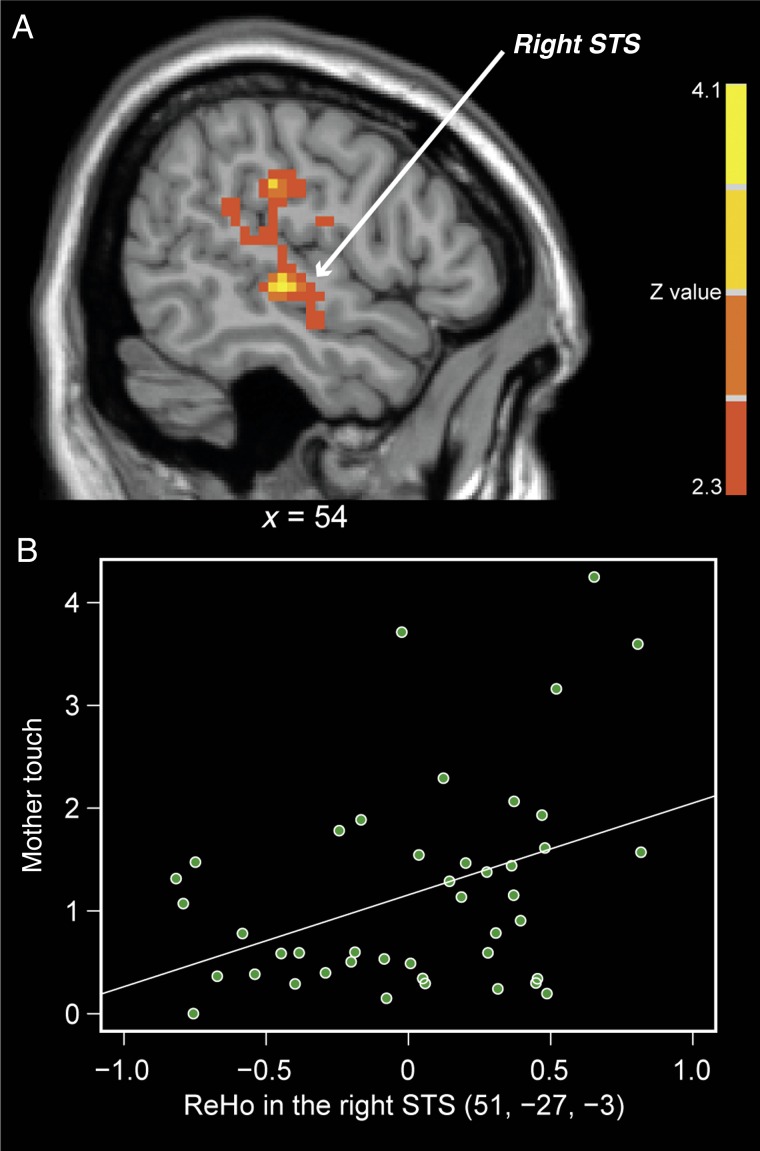
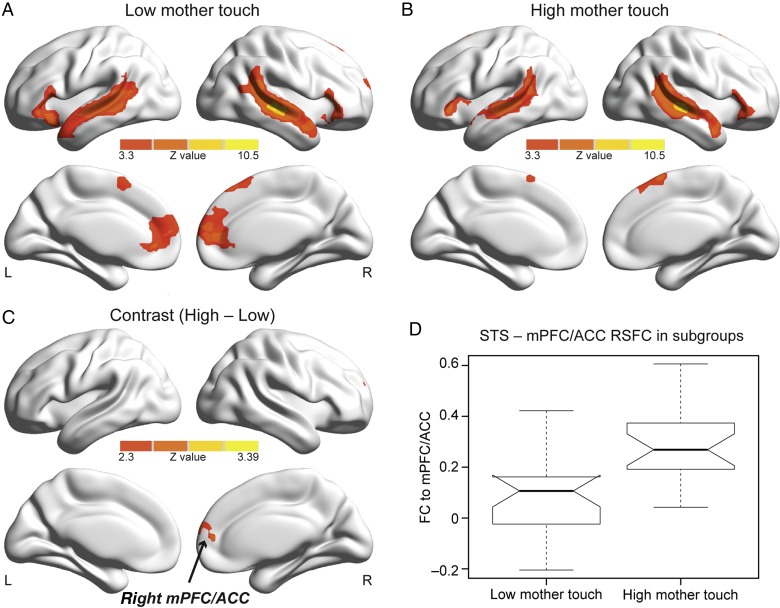
Previous behavioral research points to a positive relationship between maternal touch and early social development. Here, we explored the brain correlates of this relationship. The frequency of maternal touch was recorded for 43 five-year-old children during a 10 min standardized play session. Additionally, all children completed a resting-state functional magnetic resonance imaging session. Investigating the default mode network revealed a positive relation between the frequency of maternal touch and activity in the right posterior superior temporal sulcus (pSTS) extending into the temporo-parietal junction. Using this effect as a seed in a functional connectivity analysis identified a network including extended bilateral regions along the temporal lobe, bilateral frontal cortex, and left insula. Compared with children with low maternal touch, children with high maternal touch showed additional connectivity with the right dorso-medial prefrontal cortex. Together these results support the notion that childhood tactile experiences shape the developing "social brain" with a particular emphasis on a network involved in mentalizing.
Overview
The claims and statistics of this paper haven’t been checked yet.
Free: it reads the open-access text and checks the first 5 claims that cite a source we can check. Create a free account to check every claim.
Integrity signals
Registry
Cites
Statistics
Figures
Verification
Claims the paper makes
The claims and statistics of this paper haven’t been checked yet.
Free: it reads the open-access text and checks the first 5 claims that cite a source we can check. Create a free account to check every claim.
Claims other papers make about this one
Each is checked against this paper’s own text: does it say what the citing paper says it does?
The cited source says what the claim attributes to it.
In the citing paper
“Recent findings suggest that touch also promotes the development and connectivity of brain areas (Brauer et al., 2016; Björnsdotter et al., 2014) associated with social cognition and the “social brain” (Adolphs, 2009, Brothers, 2002, Frith, 2007).”
From The impact of atypical sensory processing on social impairments in autism spectrum disorder (2018) · cites this paper as Brauer et al., 2016
Self-check
Percentages, sums and reported differences re-computed from the paper’s own numbers.
The self-check needs the paper’s full text.
Citations
Cites
A default mode of brain function
Raichle, M. E., MacLeod, A. M., Snyder, A. Z., Powers, W. J., Gusnard, D. A., & Shulman, G. L. (2001) · Proceedings of the National Academy of Sciences · doi:10.1073/pnas.98.2.676 · Cited by 12,190 · cited 2×
“It sheds light on the so-called “default mode network” (DMN, Long et al. 2008)— a distributed set of brain regions that are activewhenparticipants are wakefully at rest but suppressed when they perform a task (Shulman et al. 1997; Gusnard and Raichle 2001; Raichle et al. 2001).”
BackgroundJenkinson, M., Bannister, P., Brady, M., & Smith, S. (2002) · NeuroImage · doi:10.1006/nimg.2002.1132 · Cited by 11,888 · cited 2×
“2012), the frame-wise displacement (FD) of time series was computed (Jenkinson et al. 2002).”
BackgroundFunctional connectivity in the motor cortex of resting human brain using echo‐planar mri
Biswal, B., Zerrin Yetkin, F., Haughton, V. M., & Hyde, J. S. (1995) · Magnetic Resonance in Medicine · doi:10.1002/mrm.1910340409 · Cited by 9,812
Power, J. D., Barnes, K. A., Snyder, A. Z., Schlaggar, B. L., & Petersen, S. E. (2012) · NeuroImage · doi:10.1016/j.neuroimage.2011.10.018 · Cited by 7,429 · cited 2×
“The study was approved by the Institutional Review Board of Leipzig University (Germany).”
BackgroundMethodKendall, M. G. (1957) · Biometrika · doi:10.2307/2333282 · Cited by 6,383
Epigenetic programming by maternal behavior
Weaver, I. C. G., Cervoni, N., Champagne, F. A., D'Alessio, A. C., Sharma, S., Seckl, J. R., Dymov, S., Szyf, M., & Meaney, M. J. (2004) · Nature Neuroscience · doi:10.1038/nn1276 · Cited by 6,177 · cited 1×
“Tactile input was found to increase cortisol receptors in the hippocampus and to make the offspring’s stress response more efficient (Liu et al. 1997; Weaver et al. 2004; for corresponding human work, see McGowan et al. 2009).”
BackgroundA component based noise correction method (CompCor) for BOLD and perfusion based fMRI
Behzadi, Y., Restom, K., Liau, J., & Liu, T. T. (2007) · NeuroImage · doi:10.1016/j.neuroimage.2007.04.042 · Cited by 4,502 · cited 2×
“5 years age range (prepuberty, based on 82 subjects); 5) spatially normalizing images by using the parameters from the segmentation procedure in each subject and resampling voxel size to 3 × 3 × 3 mm(3); 6) spatially smoothing images with a 6-mm full-width-at-half-maximum (FWHM) Gaussian kernel (for RSFConly); 7) nuis…”
MethodBrainNet Viewer: A Network Visualization Tool for Human Brain Connectomics
Xia, M., Wang, J., & He, Y. (2013) · PLoS ONE · doi:10.1371/journal.pone.0068910 · Cited by 4,106 · cited 2×
“The correlation map (r-map) was then transformed into a Z-map via the “rest_TFRtoZ” function in the REST toolbox (Song et al. 2011; http://www.restfmri.net) and further corrected for multiple comparisons using Gaussian Random Field (GRF) theory (Z > 2.3, cluster-wise P < 0.05, GRF corrected) with a…”
MethodInfluentialMovement‐Related effects in fMRI time‐series
Friston, K. J., Williams, S., Howard, R., Frackowiak, R. S. J., & Turner, R. (1996) · Magnetic Resonance in Medicine · doi:10.1002/mrm.1910350312 · Cited by 3,774 · cited 2×
“…6 head motion parameters for the current time point, 6 head motion parameters for the preceding time point, and their 12 corresponding values squared (Friston et al. 1996); the CompCor procedure comprised detrending, variance (i.e., WM and CSF) normalization, and PC analysis; and 8) band-pass…”
MethodMethods to detect, characterize, and remove motion artifact in resting state fMRI
Power, J. D., Mitra, A., Laumann, T. O., Snyder, A. Z., Schlaggar, B. L., & Petersen, S. E. (2014) · NeuroImage · doi:10.1016/j.neuroimage.2013.08.048 · Cited by 3,748 · cited 1×
“Given recent concerns regarding the confounding influence of micromovements on intrinsic functional connectivity analyses (Power et al. 2012, 2014; Satterthwaite et al. 2012; Van Dijk et al. 2012), the frame-wise displacement (FD) of time series was computed (Jenkinson et al. 2002).”
Background
Cited by
Items 101–154 of 154
It's Safe to Look: Maternal Touch Affects Infants’ Fear Bias
Addabbo, M., Guida, E., Licht, V., & Turati, C. (2025) · Developmental Science · doi:10.1111/desc.70039 · Cited by 3
“…exploratory behaviors of a novel object, reduce evasive behavior toward a stranger (Tanaka et al. 2021), modulates children’s brain connectivity in areas that belong to the “social brain” (Brauer et al. 2016) and infants’ visual preferences toward emotional facial expressions (Addabbo et al. 2021).”
Nature Versus Nurture: The Biology and Psychology of Empathy
Demetriou, H. (2018) · Palgrave Macmillan UK eBooks · doi:10.1057/978-1-137-54844-3_5 · Cited by 4
Tactile Biography Questionnaire: A contribution to its validation in an Italian sample
Wigley, I. L. C. M., Pastore, M., Mascheroni, E., Tremolada, M., Bonichini, S., & Montirosso, R. (2022) · PLoS ONE · doi:10.1371/journal.pone.0274477 · Cited by 3
“During childhood, the frequency of affective touch enacted with parents and siblings was associated with the strength of connectivity of the posterior superior temporal sulcus and other nodes of the social brain [13] PLOS ONE”
BackgroundPisula, W., Łukasik, A., Kawa, R., & Pisula, E. (2018) · Psychology · doi:10.4236/psych.2018.99132 · Cited by 3
L’osmose émersive: De la peau vivante à la peau vécue
Andrieu, B. (2019) · Spirale · doi:10.3917/spi.089.0040 · Cited by 3
Low maternal care enhances the skin barrier resistance of offspring in mice
Sakamoto, T., Ishio, Y., Ishida, Y., Mogi, K., & Kikusui, T. (2019) · PLoS ONE · doi:10.1371/journal.pone.0219674 · Cited by 4
Grichtchouk, O., de Oliveira, J. M., Campagnoli, R. R., Franklin, C. M., Corrêa, M. F., Pereira, M. G., Vargas, C. D., David, I. A., Souza, G. G. L., Gleiser, S., et al. (2022) · Frontiers in Psychology · doi:10.3389/fpsyg.2022.817699 · Cited by 3
Roberto Canitano, Y. B., Canitano, R., Bozzi, Y., & Dhossche, D. (2020) · Frontiers research topics · doi:10.3389/978-2-88963-869-7 · Cited by 5
Brain oscillatory dynamics during discriminative vs CT-optimal touch
Pereira, A. R., da‐Silva, M., Ribeiro‐Carreira, A., Sampaio, A., & González-Villar, A. J. (2025) · Biological Psychology · doi:10.1016/j.biopsycho.2025.109018 · Cited by 2
“Affective touch is crucial throughout our lifespan, influencing our development as individuals (Brauer et al., 2016), as well as in our everyday somatosensory experiences, significantly shaping social relationships (Cascio et al., 2019; Morrison et al., 2010; Walker & McGlone, 2013).”
Keeping in Touch with Mental Health: The Orienting Reflex and Behavioral Outcomes from Calatonia
Blanchard, A. R., & Comfort, W. E. (2020) · Brain Sciences · doi:10.3390/brainsci10030182 · Cited by 2
Soft-Brush: A Novel Tendon Driven Tactile Stimulator for Affective Touch in Children with Autism
Zheng, Z., Bian, D., Swanson, A. R., Weitlauf, A. S., Warren, Z. E., & Sarkar, N. (2018) · Advances in intelligent systems and computing · doi:10.1007/978-3-319-94373-2_2 · Cited by 2
Analiza interakcji dziecko–rodzic. Wprowadzenie dla studentów, klinicystów i badaczy
Niedźwiecka, A. (2021) · Wydawnictwo Liberi Libri eBooks · doi:10.47943/lib.9788363487539 · Cited by 2
Relevanz von Berührung für die frühkindliche Entwicklung
Grunwald, M., & Müller, S. M. (2022) · Springer eBooks · doi:10.1007/978-3-662-64012-8_7 · Cited by 4
The role of caregiver touch in early neurodevelopment and parent-infant interactional synchronyPreprint
Carozza, S., & Leong, V. (2020) · PsyArXiv (OSF Preprints) · doi:10.31234/osf.io/5jc78 · Cited by 2
Affective function of touch and the neurophysiological mechanism
Yang, Y., Dong, L. I., Cui, Q., & Jiang, Z. (2022) · Advances in Psychological Science · doi:10.3724/sp.j.1042.2022.00324 · Cited by 2
Yong, R., Chai, H., Ran, L., Li, Y., & An, B. (2023) · PLoS ONE · doi:10.1371/journal.pone.0291952 · Cited by 2
“Maternal grooming in rodents can be a stimulation of somatosensory which supports neurodevelopmental outcomes [33] and regulates the central nervous system dysfunction from separation effects [34–36].”
BackgroundKollakowski, N., Pletti, C., & Paulus, M. (2025) · Developmental Science · doi:10.1111/desc.70009 · Cited by 1
Nozawa, H., & Kato, M. (2025) · Computers in Human Behavior Artificial Humans · doi:10.1016/j.chbah.2025.100186 · Cited by 2
Abdus-Saboor, I. (2026) · Annual Review of Neuroscience · doi:10.1146/annurev-neuro-102124-022220 · Cited by 1
Ealy, P. J. (2017) · UWM Digital Commons (University of Wisconsin–Milwaukee) · Cited by 1
Kail, M. (2021) · Language Interaction and Acquisition · doi:10.1075/lia.20016.kai · Cited by 1
Relevance of Touch for Early Childhood Development
Mueller, S. M., & Grunwald, M. (2023) · Springer eBooks · doi:10.1007/978-3-662-67860-2_7 · Cited by 2
Motor sensory physiotherapy intervention in premature infants in neonatal intensive care unit (NICU)
Tsigaras, G., Hristara-Papadopoulou, A., Georgiadou, A., Chalkia, A., Vargiami, E., & Kallistratos, I. (2024) · International Journal of Health Sciences · doi:10.53730/ijhs.v8n3.15141 · Cited by 1
“…to the clinical response of the infant (Fox et al., 2010; Malina, 2004; Hadders-Algra, 2000; Cabral et al., 2016; Moyer-Mileur et al., 2013; Bonnier, 2008; Meena et al., 2012; Alvarado-Guerrero et al., 2011; Chorna et al., 2014; Brauer et al., 2016; Fox et al., 2010; Spittle et al., 2007).”
BackgroundVicarious ratings of social touch, the effect of age and autistic traitsPreprint
Haggarty, C. J., Moore, D., Trotter, P. D., Hagan, R., McGlone, F. P., & Walker, S. C. (2021) · PsyArXiv (OSF Preprints) · doi:10.31234/osf.io/e38hn · Cited by 1
Sarto‐Jackson, I. (2018) · International Journal of Child Youth and Family Studies · doi:10.18357/ijcyfs91201818117
Social Touch and Massage Therapy Research
Field, T. M. (2017) · Oxford University Press eBooks · doi:10.1093/obo/9780199828340-0194
Moura, A. A. (2019) · Portuguese National Funding Agency for Science, Research and Technology (RCAAP Project by FCT)
Hazem, N. (2018) · theses.fr (ABES) · doi:10.70675/5b493cbcz1239z4b06z8cd1zd063121df617 · Cited by 3
How Diversity in Nature Impacts Political Psychology
Rabin, J. S. (2020) · Identity in a changing world · doi:10.1007/978-3-030-38270-4_4
Ali, H., & Cordero, M. I. (2023) · PsyArXiv (OSF Preprints) · doi:10.31234/osf.io/24sjv
Parenting learned from chimpanzee research
Nakamura, N. (2024) · Japanese Journal of Animal Psychology · doi:10.2502/janip.74.1.11
Evidence-Based Physiotherapy and Rehabilitation Practices in Cerebral Palsy
Apaydın, Y., & Kırmızı, M. (2024) · doi:10.69860/nobel.9786053358794.5
The Role of Posture in the Formation of Social Relationships
Pitterman, H., & Nowicki, S. (2024) · Springer eBooks · doi:10.1007/978-3-031-70064-4_6
A pleasure that lasts: Convergent neural processes underpin comfort with prolonged gentle stroking
Cheng, X., Maeß, B., & Schirmer, A. (2025) · Cortex · doi:10.1016/j.cortex.2025.04.012
“Indeed, more touch has been correlated with greater resting activity and functional connectivity in developing brain networks referred to as the “ social brain ” (Brauer, Xiao, Poulain, Friederici, & Schirmer, 2016).”
Self-citationAffective and instrumental touch dissociate in the social brain networkPreprint
Zamboni, E., Kennerley, A. J., & Sirri, L. (2025) · Research Square · doi:10.21203/rs.3.rs-7670697/v1
Brain response to CT-related touch in infants: Contribution of temperament and maternal touch
Mascheroni, E., Peruzzo, D., Giubergia, A., Cordolcini, L., Ciceri, T., Wigley, I. L. C. M., Castagna, A., Riva, B., Montano, F., Agarwal, N., et al. (2025) · Journal of Experimental Child Psychology · doi:10.1016/j.jecp.2025.106419
Touch: the forgotten sense in a digital world
Croy, I. (2025) · The Project Repository Journal · doi:10.54050/prj2524179
Touching Autism Spectrum Disorder: Somatosensory Abnormalities in Shank3b and Cntnap2 Mouse Models
Balasco, L. (2023) · Iris (University of Trento) · doi:10.15168/11572_370647 · Cited by 1
English, T. (2020) · UNSWorks (University of New South Wales, Sydney, Australia) · doi:10.26190/unsworks/22184
Kollakowski, N.-A. (2024) · doi:10.5282/edoc.34045
Cues For Synchrony: Exploring Social Drivers of Synchronous Interactions Across Neurodevelopment
Carnevali, L. (n.d.) · Padua Research Archive (University of Padova)
Toque social nas interações mãe-bebé - padrões comportamentais e correlatos neurais
Serra, J. A. F. (2023) · Portuguese National Funding Agency for Science, Research and Technology (RCAAP Project by FCT)
Sujetaitė, D. (2024) · Lithuanian University of Health Sciences
Berührung in der Eltern-Kind-Beziehung
Friedrich, Y., & Croy, I. (2026) · Springer eBooks · doi:10.1007/978-3-642-54061-5_37-1
Gastaldi, F. G. M., Lin, S., Mastrokoukou, S., Fabris, M. A., & Longobardi, C. (2026) · International Journal of Early Years Education · doi:10.1080/09669760.2026.2645349
“…regulation skills (Feldman, Singer, and Zagoory 2010; Feldman and Eidelman 2007; Sorokowska et al. 2021), more positive cognitive and neurobiological development (Feldman and Eidelman 2007), and development in areas related to the social brain in middle childhood (7–10 years) (Brauer et al. 2016).”
Touch Modulates Gamma‐Band Network Dynamics in the Infant Brain
Polver, S., Addabbo, M., Turati, C., Arrigoni, E., Quadrelli, E., Pisoni, A., & Bulf, H. (2026) · Developmental Psychobiology · doi:10.1002/dev.70151
La représentation de l’informativité chez l’enfant
Aguirre, M. (2021) · theses.fr (ABES) · doi:10.70675/34c56888zf035z4ab0zba21z1221fd7f4be3
Brzozowska, A., Reise, B., Antova, A., Henning, C., & Hoehl, S. (2026) · bioRxiv (Cold Spring Harbor Laboratory) · doi:10.64898/2026.05.13.724779
“…received from caregivers during a free play interaction is positively correlated with resting activity within the so-called “social brain” network (Brauer et al., 2016), which includes the superior temporal sulcus – a region known to be involved in biological motion processing (Pelphrey & Morris,…”
Carnevali, L., Blanco, B., Rozhko, M., Weatherhead, M., Johnson, M. H., Lloyd‐Fox, S., & The PIPKIN Study Team (2026) · bioRxiv (Cold Spring Harbor Laboratory) · doi:10.64898/2026.05.13.724776 · Cited by 1
“This interpretation aligns with prior work linking tactile and affective caregiving to neural systems involved in social processing, including increased activity and connectivity in mentalizing-related regions (49) and enhanced caregiver-infant synchrony (52, 53).”
Maternal touch contributes to development of child empathy: a longitudinal study
Wu, Q., & Su, J. (2026) · Early Child Development and Care · doi:10.1080/03004430.2026.2693786
“Studies by Brauer et al. (2016) found that maternal touch frequency predicted resting activity and connectivity of the social brain network – a key neural substrate for empathy.”
Amegandjin, C. A., Carreño-Muñoz, M. I., Francavilla, R., Kamda, J. L. D., Roussel, M., do Nascimento, A. S. F., Farley, A., Chehrazi, P., Chama, A. G. C., Chattopadhyaya, B., et al. (2026) · bioRxiv (Cold Spring Harbor Laboratory) · doi:10.64898/2026.07.22.740050
Cognitive Neural Mechanisms and Applications of Social Touch
郑, 宇. (2026) · Advances in Psychology · doi:10.12677/ap.2026.1610500
Sindelar, M. T. (2025) · RIUFLO - Repositorio Institucional UFLO
Metadata
- Authors
- Brauer, J., Xiao, Y., Poulain, T., Friederici, A. D., & Schirmer, A.
- Affiliations
- Max Planck Institute for Human Cognitive and Brain Sciences (DE)
- Leipzig University (DE)
- National University of Singapore (SG)
- Venue
- Cerebral Cortex
- Publisher
- Oxford University Press (OUP)
- Published
- 2016-05-26
- Volume
- 26
- Issue
- 8
- Pages
- 3544-3552
- ISSN
- 1047-3211 (ISSN-L)
- 1460-2199
- PMC
- PMC4961023
- OpenAlex
- W2394698332
- Cited by
- 141
- References
- 96
- Citations by year
- 2026: 8 · 2025: 11 · 2024: 9 · 2023: 10 · 2022: 11 · 2021: 21 · 2020: 16 · 2019: 14 · 2018: 22 · 2017: 15 · 2016: 4
- FWCI
- 11.67
- Type
- journal article
- Language
- en
- Open access
- hybrid
- doi.org
- Licence
- cc-by-nc
- Locations
- Cerebral Cortex (publishedVersion, cc-by-nc)
- Europe PMC (PubMed Central) (publishedVersion, cc-by-nc)
- PubMed Central (publishedVersion, cc-by-nc)
- PubMed (publishedVersion)
- Max Planck Digital Library (submittedVersion, other-oa)
- HighWire Press Open Archive (submittedVersion)
- MPG.PuRe (Max Planck Society) (submittedVersion, other-oa)
- Funders
- European Research Council (ERC269505)
- Topics
- Life Sciences › Neuroscience › Cognitive Neuroscience › Functional Brain Connectivity Studies
- Social Sciences › Psychology › Social Psychology › Action Observation and Synchronization
- Life Sciences › Neuroscience › Cognitive Neuroscience › Tactile and Sensory Interactions
- Keywords
- maternal touch, social brain development, default mode network, posterior superior temporal sulcus, temporoparietal junction, functional connectivity, mentalization, early childhood social development, tactile experience, prefrontal cortex, insula, children
- MeSH terms
- Affect, Brain, Brain Mapping, Child, Preschool, Female, Humans, Magnetic Resonance Imaging, Male, Maternal Behavior, Mother-Child Relations, Neural Pathways, Play and Playthings, Rest, Social Behavior, Touch, Theory of Mind
About these checks
Registry, retraction, Cites and statistics results are computed, not judged, with one exception: a printed reference that no index lists is read once by a model before it counts as a citation error. Claims are extracted by a model and kept only when their quote appears verbatim in the text; each cited source is then checked, with a model’s help, for whether it says what the claim relies on. Those verdicts can be wrong — read the claim’s quote and the cited source before relying on one.
Statistics and arithmetic are recomputed, not judged.
Confidence bands are shown only for fields calibrated on our annotated test set. None is calibrated yet, so no band is shown.
What counts as a claim ›How we measure confidence ›How we check this ›
Are you an author, or do you see a problem with this page? Request a review
Data sources
Bibliographic data: Semantic Scholar, OpenAlex, Crossref.
Contains information from the Semantic Scholar Academic Graph Datasets, made available under the ODC Attribution License (ODC-BY 1.0).
Semantic Scholar’s data is described in: Kinney, R., et al. (2023). The Semantic Scholar Open Data Platform. arXiv:2301.10140.
