

External validation of prognostic models: what, why, how, when and where?
Open accessThe DOI matches its Crossref record; 45 of the 46 references it cites were found in a registry or an index.
Abstract
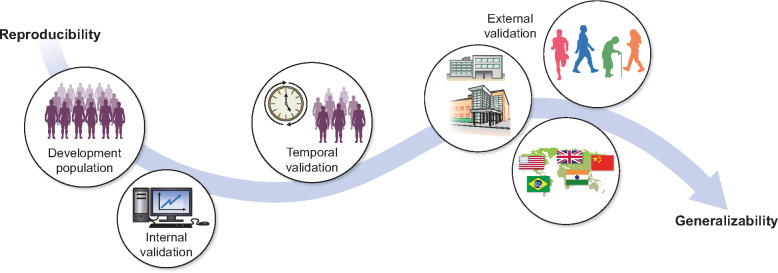
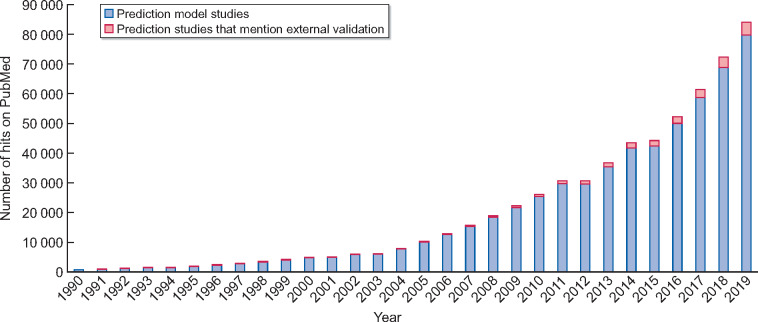
Prognostic models that aim to improve the prediction of clinical events, individualized treatment and decision-making are increasingly being developed and published. However, relatively few models are externally validated and validation by independent researchers is rare. External validation is necessary to determine a prediction model's reproducibility and generalizability to new and different patients. Various methodological considerations are important when assessing or designing an external validation study. In this article, an overview is provided of these considerations, starting with what external validation is, what types of external validation can be distinguished and why such studies are a crucial step towards the clinical implementation of accurate prediction models. Statistical analyses and interpretation of external validation results are reviewed in an intuitive manner and considerations for selecting an appropriate existing prediction model and external validation population are discussed. This study enables clinicians and researchers to gain a deeper understanding of how to interpret model validation results and how to translate these results to their own patient population.
Overview
The claims and statistics of this paper haven’t been checked yet.
Free: it reads the open-access text and checks the first 5 claims that cite a source we can check. Create a free account to check every claim.
Integrity signals
Registry
Cites
Statistics
Figures
Verification
Claims the paper makes
The claims and statistics of this paper haven’t been checked yet.
Free: it reads the open-access text and checks the first 5 claims that cite a source we can check. Create a free account to check every claim.
Self-check
Percentages, sums and reported differences re-computed from the paper’s own numbers.
The self-check needs the paper’s full text.
Citations
Cites
An Introduction to the Bootstrap
Efron, B., & Tibshirani, R. J. (1994) · doi:10.1201/9780429246593 · Cited by 40,500
Decision curve analysis: a novel method for evaluating prediction models
Vickers, A. J., & Elkin, E. B. (2006) · Medical Decision Making · doi:10.1177/0272989x06295361 · Cited by 6,341
Assessing the Performance of Prediction Models: A Framework for Traditional and Novel Measures
Steyerberg, E. W., Vickers, A. J., Cook, N. R., Gerds, T., Gonen, M., Obuchowski, N., Pencina, M. J., & Kattan, M. W. (2010) · Epidemiology · doi:10.1097/ede.0b013e3181c30fb2 · Cited by 5,170 · cited 1×
“net benefit, decision analysis) may also be assessed but are generally complementary to the discrimination and calibration results [22].”
BackgroundMoons, K. G. M., Altman, D. G., Reitsma, J. B., Ioannidis, J. P. A., Macaskill, P., Steyerberg, E. W., Vickers, A. J., Ransohoff, D. F., & Collins, G. S. (2015) · Annals of Internal Medicine · doi:10.7326/m14-0698 · Cited by 5,147 · cited 3×
“For researchers planning an external validation study we highly recommend consulting the Transparent Reporting of a multivariable prediction model for Individual Prognosis Or Diagnosis checklist and explanation and elaboration document [4].”
BackgroundMethodClinical Prediction Models: A Practical Approach to Development, Validation, and Updating
Steyerberg, E. W. (2019) · Statistics for Biology and Health · doi:10.1007/978-3-030-16399-0 · Cited by 3,281
An Introduction to the Bootstrap.
Buckland, S. T., Efron, B., & Tibshirani, R. J. (1994) · Biometrics · doi:10.2307/2532810 · Cited by 3,103
PROBAST: A Tool to Assess the Risk of Bias and Applicability of Prediction Model Studies
Wolff, R. F., Moons, K. G. M., Riley, R. D., Whiting, P. F., Westwood, M., Collins, G. S., Reitsma, J. B., Kleijnen, J., Mallett, S., & for the PROBAST Group† (2019) · Annals of Internal Medicine · doi:10.7326/m18-1376 · Cited by 2,984 · cited 1×
“Bias in prognostic models can be assessed using the Prediction model Risk Of Bias ASsessment Tool tool [31].”
MethodInternal validation of predictive models
Steyerberg, E. W., Harrell, F. E., Borsboom, G. J. J. M., Eijkemans, M. J. C., Vergouwe, Y., & Habbema, J. D. F. (2001) · Journal of Clinical Epidemiology · doi:10.1016/s0895-4356(01)00341-9 · Cited by 2,746
Use and Misuse of the Receiver Operating Characteristic Curve in Risk Prediction
Cook, N. R. (2007) · Circulation · doi:10.1161/circulationaha.106.672402 · Cited by 2,112 · cited 1×
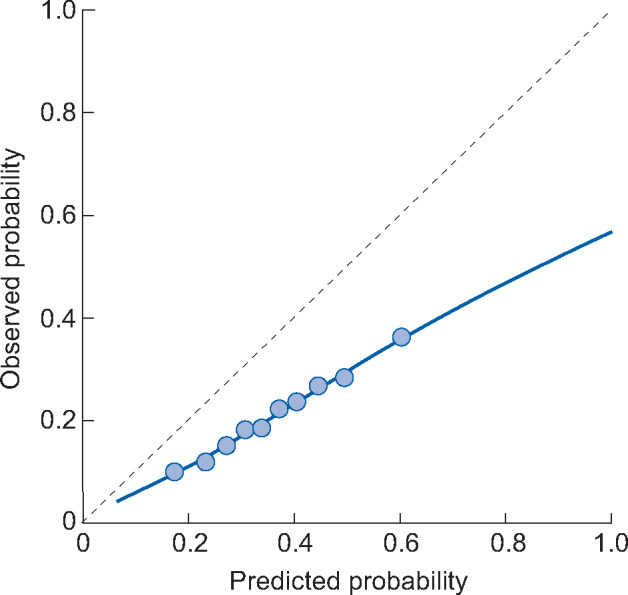
“When assessing the overall performance of a prognostic model, it is important to take both discrimination and calibration into account, as well as the intended use of the model [4, 26, 27].”
MethodUno, H., Cai, T., Pencina, M. J., D'Agostino, R. B., & Wei, L. J. (2011) · Statistics in Medicine · doi:10.1002/sim.4154 · Cited by 1,535 · cited 1×
“For Cox proportional hazards prediction models a time-toevent C-index such as Harrel’s C-index or Uno’s C-index can be computed [21, 25].”
Method
Cited by
Developing clinical prediction models: a step-by-step guide
Efthimiou, O., Seo, M., Chalkou, K., Debray, T., Egger, M., & Salanti, G. (2024) · BMJ · doi:10.1136/bmj-2023-078276 · Cited by 544
Shyam Sunder, S., Sharma, U. C., & Pokharel, S. (2023) · Signal Transduction and Targeted Therapy · doi:10.1038/s41392-023-01469-6 · Cited by 508
Freeman, K., Geppert, J., Stinton, C., Todkill, D., Johnson, S., Clarke, A., & Taylor-Phillips, S. (2021) · BMJ · doi:10.1136/bmj.n1872 · Cited by 338
Transforming Cardiovascular Care With Artificial Intelligence: From Discovery to Practice
Khera, R., Oikonomou, E. K., Nadkarni, G. N., Morley, J. R., Wiens, J., Butte, A. J., & Topol, E. J. (2024) · Journal of the American College of Cardiology · doi:10.1016/j.jacc.2024.05.003 · Cited by 264
Binuya, M. A. E., Engelhardt, E. G., Schats, W., Schmidt, M. K., & Steyerberg, E. W. (2022) · BMC Medical Research Methodology · doi:10.1186/s12874-022-01801-8 · Cited by 246
Metadata
- Authors
- Ramspek, C. L., Jager, K. J., Dekker, F. W., Zoccali, C., & van Diepen, M.
- Affiliations
- Leiden University Medical Center (NL)
- Amsterdam Public Health (NL)
- CNR-IFC, Clinical Epidemiology of Renal Diseases and Hypertension, Reggio Calabria, Italy
- Department of Clinical Epidemiology, Leiden University Medical Center, Leiden, The Netherlands
- Venue
- Clinical Kidney Journal
- Publisher
- Oxford University Press (OUP)
- Published
- 2020-11-24
- Volume
- 14
- Issue
- 1
- Pages
- 49-58
- ISSN
- 2048-8505 (ISSN-L)
- 2048-8513
- PMC
- PMC7857818
- OpenAlex
- W3109609494
- Cited by
- 887
- References
- 46
- Citations by year
- 2026: 197 · 2025: 209 · 2024: 194 · 2023: 162 · 2022: 96 · 2021: 28
- FWCI
- 11.62
- Type
- journal article
- Language
- en
- Open access
- gold
- doi.org
- Licence
- Locations
- Clinical Kidney Journal (publishedVersion, cc-by-nc)
- Europe PMC (PubMed Central) (publishedVersion, cc-by-nc)
- PubMed Central (publishedVersion, cc-by-nc)
- PubMed (publishedVersion)
- Leiden Repository (Leiden University) (submittedVersion, cc-by-nc)
- Data Archiving and Networked Services (DANS) (submittedVersion, other-oa)
- Data Archiving and Networked Services (DANS) (submittedVersion, cc-by-nc)
- Pure Amsterdam UMC (submittedVersion, cc-by)
- Funders
- Dutch Kidney Foundation (16OKG12)
- Topics
- Physical Sciences › Mathematics › Statistics and Probability › Statistical Methods in Epidemiology
- Social Sciences › Decision Sciences › Statistics, Probability and Uncertainty › Meta-analysis and systematic reviews
- Health Sciences › Health Professions › Health Information Management › Artificial Intelligence in Healthcare
- Keywords
- external validation, prognostic model, prediction model, generalizability, reproducibility, clinical implementation, clinical decision-making
About these checks
Registry, retraction, Cites and statistics results are computed, not judged, with one exception: a printed reference that no index lists is read once by a model before it counts as a citation error. Claims are extracted by a model and kept only when their quote appears verbatim in the text; each cited source is then checked, with a model’s help, for whether it says what the claim relies on. Those verdicts can be wrong — read the claim’s quote and the cited source before relying on one.
Statistics and arithmetic are recomputed, not judged.
Confidence bands are shown only for fields calibrated on our annotated test set. None is calibrated yet, so no band is shown.
What counts as a claim ›How we measure confidence ›How we check this ›
Are you an author, or do you see a problem with this page? Request a review
How to cite
Cite CoChat for the checks on this page, and the paper for its own findings.
- This page
- CoChat. (2026). Citation check: External validation of prognostic models: what, why, how, when and where? https://app.cochat.ai/papers/10.1093/ckj/sfaa188
- The paper
- Ramspek, C. L., Jager, K. J., Dekker, F. W., Zoccali, C., & van Diepen, M. (2021). External validation of prognostic models: what, why, how, when and where? Clinical Kidney Journal. https://doi.org/10.1093/ckj/sfaa188
Data sources
Bibliographic data: Semantic Scholar, OpenAlex, Crossref.
Contains information from the Semantic Scholar Academic Graph Datasets, made available under the ODC Attribution License (ODC-BY 1.0).
Semantic Scholar’s data is described in: Kinney, R., et al. (2023). The Semantic Scholar Open Data Platform. arXiv:2301.10140.
