

Genome-wide association mapping of salinity tolerance in rice (Oryza sativa)
Open accessThe DOI matches its Crossref record; 81 of the 81 references it cites were found in a registry or an index.
Abstract
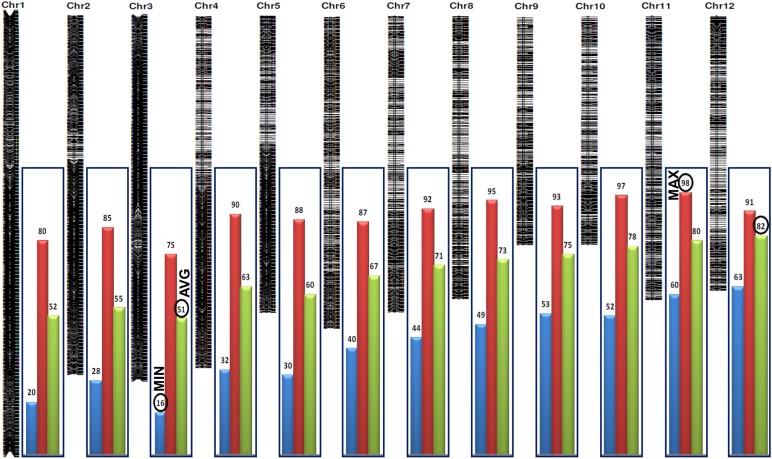
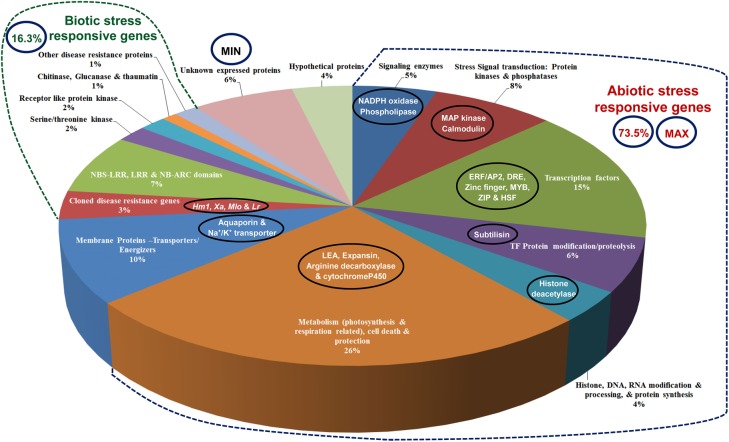
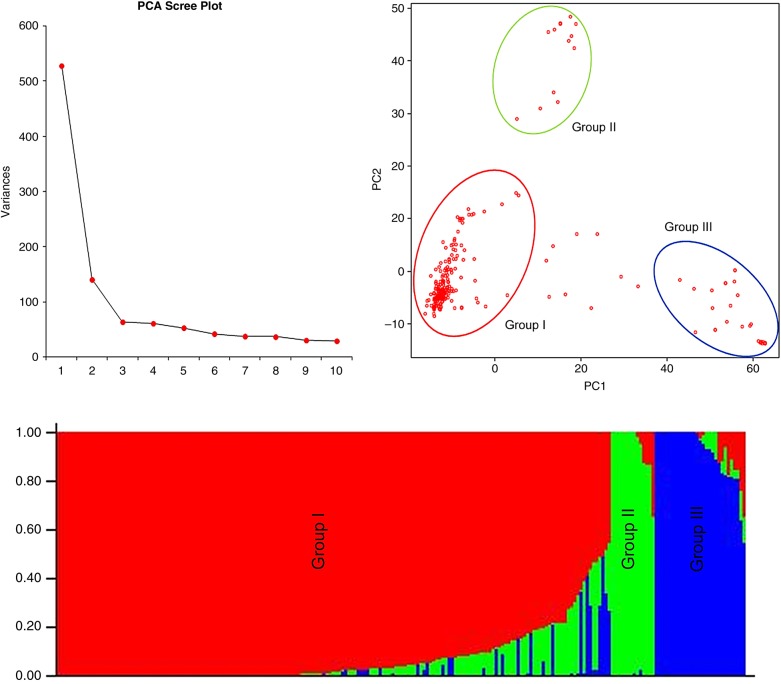
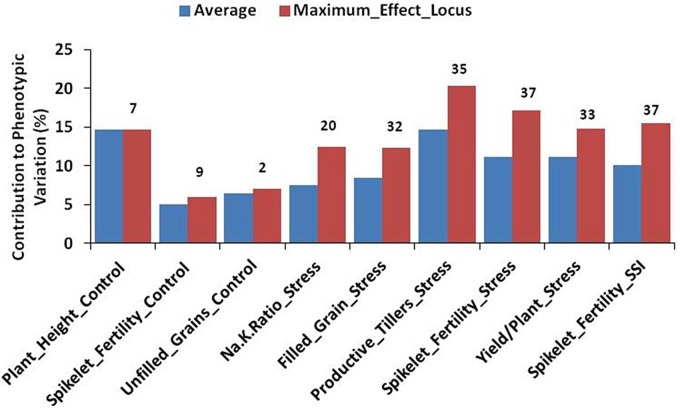
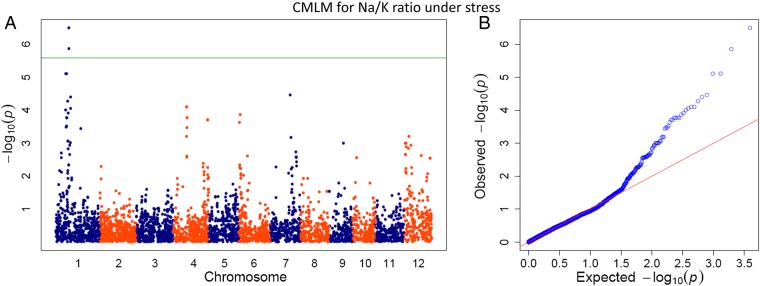
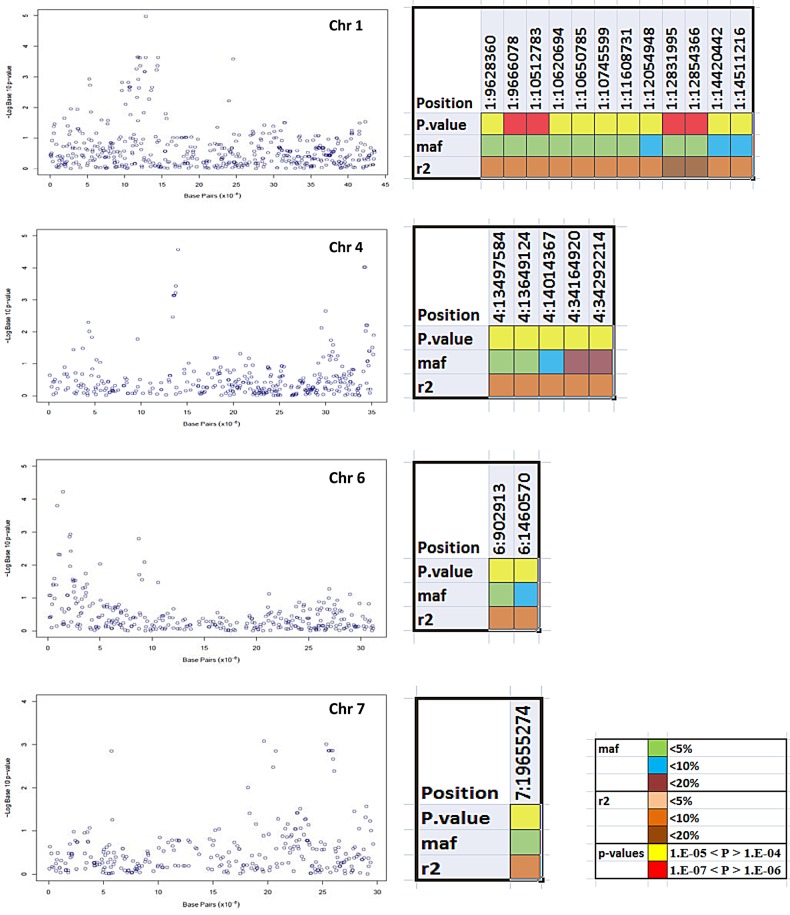
Salinity tolerance in rice is highly desirable to sustain production in areas rendered saline due to various reasons. It is a complex quantitative trait having different components, which can be dissected effectively by genome-wide association study (GWAS). Here, we implemented GWAS to identify loci controlling salinity tolerance in rice. A custom-designed array based on 6,000 single nucleotide polymorphisms (SNPs) in as many stress-responsive genes, distributed at an average physical interval of <100 kb on 12 rice chromosomes, was used to genotype 220 rice accessions using Infinium high-throughput assay. Genetic association was analysed with 12 different traits recorded on these accessions under field conditions at reproductive stage. We identified 20 SNPs (loci) significantly associated with Na(+)/K(+) ratio, and 44 SNPs with other traits observed under stress condition. The loci identified for various salinity indices through GWAS explained 5-18% of the phenotypic variance. The region harbouring Saltol, a major quantitative trait loci (QTLs) on chromosome 1 in rice, which is known to control salinity tolerance at seedling stage, was detected as a major association with Na(+)/K(+) ratio measured at reproductive stage in our study. In addition to Saltol, we also found GWAS peaks representing new QTLs on chromosomes 4, 6 and 7. The current association mapping panel contained mostly indica accessions that can serve as source of novel salt tolerance genes and alleles. The gene-based SNP array used in this study was found cost-effective and efficient in unveiling genomic regions/candidate genes regulating salinity stress tolerance in rice.
Overview
The claims and statistics of this paper haven’t been checked yet.
Free: it reads the open-access text and checks the first 5 claims that cite a source we can check. Create a free account to check every claim.
Integrity signals
Registry
Cites
Statistics
Figures
Verification
Claims the paper makes
The claims and statistics of this paper haven’t been checked yet.
Free: it reads the open-access text and checks the first 5 claims that cite a source we can check. Create a free account to check every claim.
Claims other papers make about this one
Each is checked against this paper’s own text: does it say what the citing paper says it does?
The source backs part of the claim, not all of it — or backs it for a different population, condition or comparison.
In the citing paper
“A novel QTL present on chromosome number 1 was reported and was called “Saltol” which is associated with salt tolerance at seedling stage [153].”
From Impact of Climate Change on Crops Adaptation and Strategies to Tackle Its Outcome: A Review (2019) · cites this paper as [153]
Experimental — accuracy not yet measured
Self-check
Percentages, sums and reported differences re-computed from the paper’s own numbers.
The self-check needs the paper’s full text.
Citations
Cites
Controlling the False Discovery Rate: A Practical and Powerful Approach to Multiple Testing
Benjamini, Y., & Hochberg, Y. (1995) · Journal of the Royal Statistical Society Series B: Statistical Methodology · doi:10.1111/j.2517-6161.1995.tb02031.x · Cited by 109,482
PLINK: a tool set for whole-genome association and population-based linkage analyses.
Purcell, S., Neale, B., Todd-Brown, K., Thomas, L., Ferreira, M. A. R., Bender, D., Maller, J., Sklar, P., de Bakker, P. I. W., Daly, M. J., et al. (2007) · The American Journal of Human Genetics · doi:10.1086/519795 · Cited by 34,089 · cited 2×
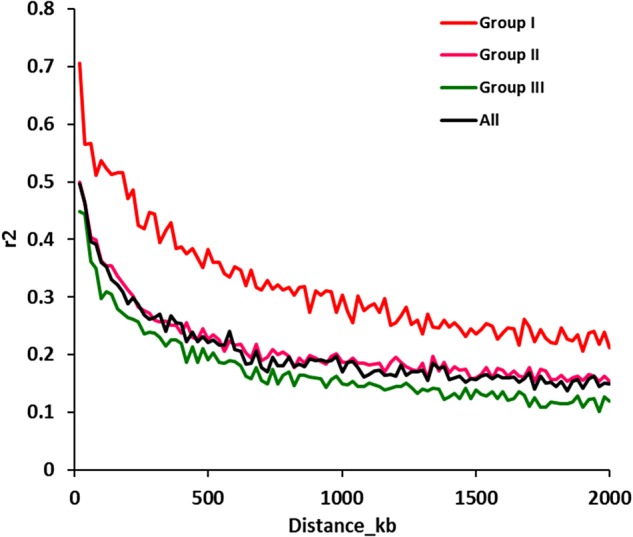
“For all pairs of SNPs, r2 was calculated using the --r2 --ld-window-kb 2,000 --ld-window 99999 --ld-window-r2 0 command in PLINK.45 The command was used to calculate LD association among SNP pairs to a distance of 2,000 kb.”
MethodInference of Population Structure Using Multilocus Genotype Data
Pritchard, J. K., Stephens, M., & Donnelly, P. (2000) · Genetics · doi:10.1093/genetics/155.2.945 · Cited by 33,908
genalex 6: genetic analysis in Excel. Population genetic software for teaching and research
PEAKALL, R., & SMOUSE, P. E. (2006) · Molecular Ecology Notes · doi:10.1111/j.1471-8286.2005.01155.x · Cited by 16,589
Pahlich, E., & Gerlitz, C. (1980) · Phytochemistry · doi:10.1016/0031-9422(80)85004-7 · Cited by 10,599
Principal components analysis corrects for stratification in genome-wide association studies
Price, A. L., Patterson, N. J., Plenge, R. M., Weinblatt, M. E., Shadick, N. A., & Reich, D. (2006) · Nature Genetics · doi:10.1038/ng1847 · Cited by 10,248
TASSEL: software for association mapping of complex traits in diverse samples
Bradbury, P. J., Zhang, Z., Kroon, D. E., Casstevens, T. M., Ramdoss, Y., & Buckler, E. S. (2007) · Bioinformatics · doi:10.1093/bioinformatics/btm308 · Cited by 7,759
The Structure of Haplotype Blocks in the Human Genome
Gabriel, S. B., Schaffner, S. F., Nguyen, H., Moore, J. M., Roy, J., Blumenstiel, B., Higgins, J., DeFelice, M., Lochner, A., Faggart, M., et al. (2002) · Science · doi:10.1126/science.1069424 · Cited by 5,863
Yu, J., Pressoir, G., Briggs, W. H., Vroh Bi, I., Yamasaki, M., Doebley, J. F., McMullen, M. D., Gaut, B. S., Nielsen, D. M., Holland, J. B., et al. (2006) · Nature Genetics · doi:10.1038/ng1702 · Cited by 4,133
Cold, salinity and drought stresses: An overview
Mahajan, S., & Tuteja, N. (2005) · Archives of Biochemistry and Biophysics · doi:10.1016/j.abb.2005.10.018 · Cited by 2,925
Research works printed but not linked: 11
- Blumwald E. Grover A. 2006, Salt tolerance, In: Plant biotechnology: current and future uses of genetically modified crops. John Wiley and Sons Ltd, UK, pp. 206– 24.
- 2000, Current Science, 78, 162
- 2010, PNAS, 107, 21611, 10.1073/pnas.1010179107 · DOI · Paper page
- To, 2006, Nature genetics, 38, 904, 10.1038/ng1847 · DOI · Paper page
- 2003, Annual review of plant biology, 54, 357, 10.1146/annurev.arplant.54.031902.134907 · DOI · Paper page
- 2011, Nature genetics, 44, 32, 10.1038/ng.1018 · DOI · Paper page
- 2009, PNAS, 106, 12273, 10.1073/pnas.0900992106 · DOI · Paper page
- Doyle J.J. Doyle J.L. 1987, A rapid DNA isolation procedure for small quantities of fresh leaf tissue, Phytochem. Bull., 19, 11– 15.
- 2012, PNAS, 109, 8872, 10.1073/pnas.1120813109 · DOI · Paper page
- 2013, Journal of genetics, 92, 433, 10.1007/s12041-013-0285-4 · DOI
- 2013, Journal of Experimental Botany, 64, 3099, 10.1093/jxb/ert182 · DOI
Cited by
Impact of Climate Change on Crops Adaptation and Strategies to Tackle Its Outcome: A Review
Raza, A., Razzaq, A., Mehmood, S. S., Zou, X., Zhang, X., Lv, Y., & Xu, J. (2019) · Plants · doi:10.3390/plants8020034 · Cited by 1,762
“Kumar et al. (2015) reported various genes regulating the salinity tolerance in rice by using infinium high-throughput SNPs arrays.”
BackgroundAtta, K., Mondal, S., Gorai, S., Singh, A. P., Kumari, A., Ghosh, T., Roy, A., Hembram, S., Gaikwad, D. J., Mondal, S., et al. (2023) · Frontiers in Plant Science · doi:10.3389/fpls.2023.1241736 · Cited by 523
Landrace Germplasm for Improving Yield and Abiotic Stress Adaptation
Dwivedi, S. L., Ceccarelli, S., Blair, M. W., Upadhyaya, H. D., Are, A. K., & Ortiz, R. (2016) · Trends in Plant Science · doi:10.1016/j.tplants.2015.10.012 · Cited by 422
“The SNPs associated with Na/K ratio were in complete linkage disequilibrium [81].”
BackgroundPlant abiotic stress challenges from the changing environment
Pereira, A. (2016) · Frontiers in Plant Science · doi:10.3389/fpls.2016.01123 · Cited by 338
Smart Engineering of Genetic Resources for Enhanced Salinity Tolerance in Crop Plants
Arzani, A., & Ashraf, M. (2016) · Critical Reviews in Plant Sciences · doi:10.1080/07352689.2016.1245056 · Cited by 286
“In rice, Kumar et al. (2015) implemented the GWA approach and detected 20 SNPs significantly linked with NaC/KC ratio.”
Method
Metadata
- Authors
- Kumar, V., Singh, A., Mithra, S. V. A., Krishnamurthy, S. L., Parida, S. K., Jain, S., Tiwari, K. K., Kumar, P., Rao, A. R., Sharma, S. K., Khurana, J. P., Singh, N. K., & Mohapatra, T.
- Affiliations
- National Research Centre on Plant Biotechnology (IN)
- Central Soil Salinity Research Institute (IN)
- Indian Agricultural Statistics Research Institute (IN)
- University of Delhi (IN)
- Corresponding author
- Mohapatra, T.
- ORCID
- Venue
- DNA Research
- Publisher
- Oxford University Press (OUP)
- Published
- 2015-01-27
- Volume
- 22
- Issue
- 2
- Pages
- 133-145
- ISSN
- 1340-2838 (ISSN-L)
- 1756-1663
- PMC
- PMC4401324
- OpenAlex
- W2153322520
- Cited by
- 328
- References
- 81
- Citations by year
- 2026: 21 · 2025: 9 · 2024: 24 · 2023: 17 · 2022: 46 · 2021: 51 · 2020: 33 · 2019: 33 · 2018: 26 · 2017: 30 · 2016: 25 · 2015: 12
- FWCI
- 21.31
- Type
- journal article
- Language
- en
- Open access
- gold
- doi.org
- Licence
- cc-by-nc
- Locations
- DNA Research (publishedVersion, cc-by-nc)
- Europe PMC (PubMed Central) (publishedVersion, cc-by-nc)
- PubMed Central (publishedVersion, cc-by-nc)
- PubMed (publishedVersion)
- Funders
- Indian Council of Agricultural Research
- Topics
- Life Sciences › Biochemistry, Genetics and Molecular Biology › Genetics › Genetic Mapping and Diversity in Plants and Animals
- Life Sciences › Agricultural and Biological Sciences › Plant Science › Plant Stress Responses and Tolerance
- Life Sciences › Agricultural and Biological Sciences › Plant Science › Rice Cultivation and Yield Improvement
- Keywords
- salt tolerance, rice, genome-wide association study, single nucleotide polymorphisms, quantitative trait loci, Na+/K+ ratio, salt stress, stress response genes, candidate genes
- MeSH terms
- Oryza, Multifactorial Inheritance, Polymorphism, Single Nucleotide, Chromosomes, Plant, Quantitative Trait Loci, Salt Tolerance, Genome-Wide Association Study
About these checks
Registry, retraction, Cites and statistics results are computed, not judged, with one exception: a printed reference that no index lists is read once by a model before it counts as a citation error. Claims are extracted by a model and kept only when their quote appears verbatim in the text; each cited source is then checked, with a model’s help, for whether it says what the claim relies on. Those verdicts can be wrong — read the claim’s quote and the cited source before relying on one.
Statistics and arithmetic are recomputed, not judged.
Confidence bands are shown only for fields calibrated on our annotated test set. None is calibrated yet, so no band is shown.
What counts as a claim ›How we measure confidence ›How we check this ›
Are you an author, or do you see a problem with this page? Request a review
How to cite
Cite CoChat for the checks on this page, and the paper for its own findings.
- This page
- CoChat. (2026). Citation check: Genome-wide association mapping of salinity tolerance in rice (Oryza sativa). https://app.cochat.ai/papers/10.1093/dnares/dsu046
- The paper
- Kumar, V., Singh, A., Mithra, S. V. A., Krishnamurthy, S. L., Parida, S. K., Jain, S., Tiwari, K. K., Kumar, P., Rao, A. R., Sharma, S. K., Khurana, J. P., Singh, N. K., & Mohapatra, T. (2015). Genome-wide association mapping of salinity tolerance in rice (Oryza sativa). DNA Research. https://doi.org/10.1093/dnares/dsu046
Data sources
Bibliographic data: Semantic Scholar, OpenAlex, Crossref.
Contains information from the Semantic Scholar Academic Graph Datasets, made available under the ODC Attribution License (ODC-BY 1.0).
Semantic Scholar’s data is described in: Kinney, R., et al. (2023). The Semantic Scholar Open Data Platform. arXiv:2301.10140.
