

Spreading Uncertainty, Shrinking Birth Rates: A Natural Experiment for Italy
Open accessThe DOI matches its Crossref record; 92 of the 95 references it cites were found in a registry or an index.
Abstract
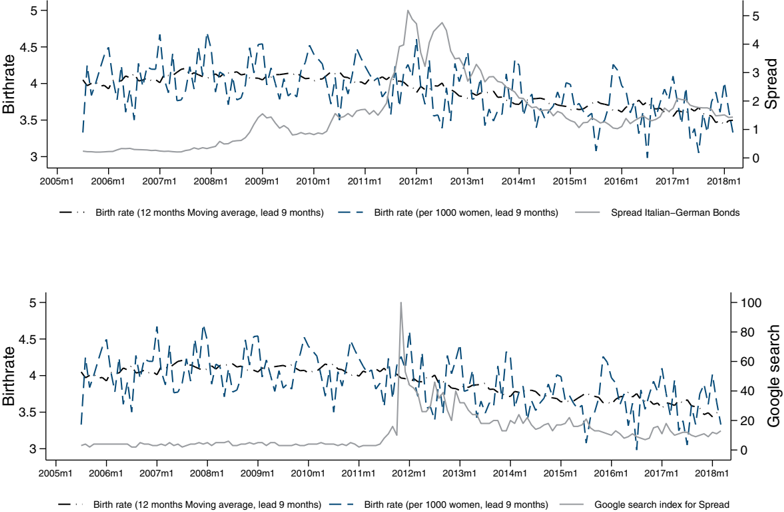
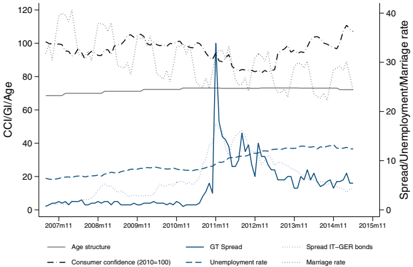
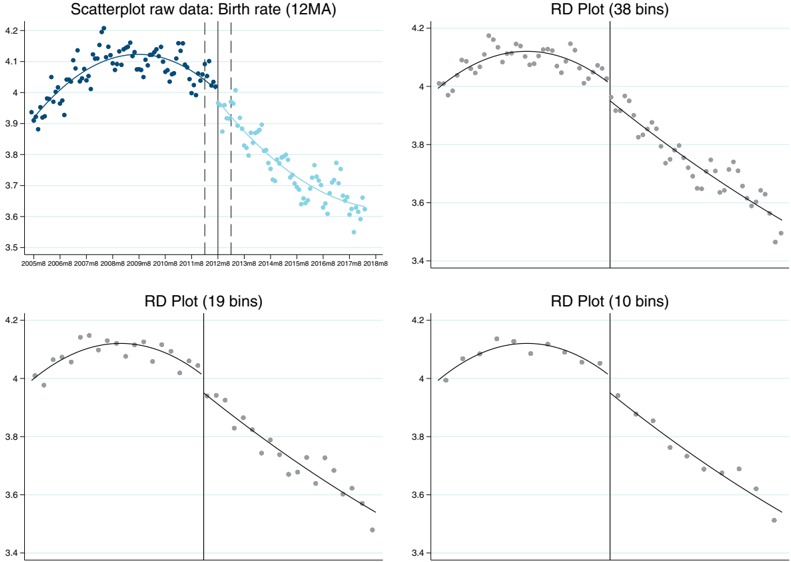
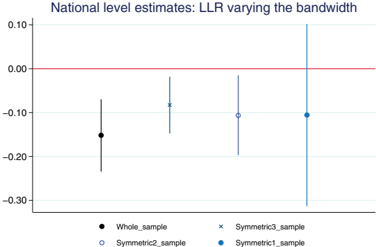
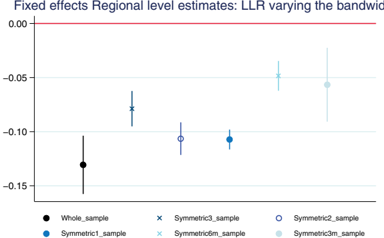
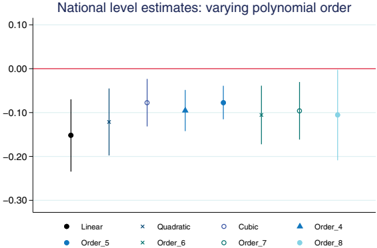
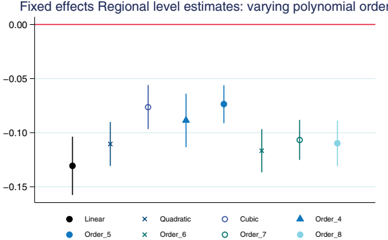
Many previous studies have documented the procyclicality of fertility to business cycles or labour market indicators in Western countries. However, part of the recent fertility decline witnessed since the Great Recession has been left unexplained by traditional measures. The present study advances the notion that birth postponement might have accelerated in response to rising uncertainty, which fuelled negative expectations and declining levels of confidence about the future. To provide empirical support for the causal effect of perceived uncertainty on birth rates, we focus on Italy’s sovereign debt crisis of 2011–2012 as a natural experiment. Perceived uncertainty is measured using Google trends for the term ‘spread’—which acted as somewhat of a barometer for the crisis both in the media and everyday conversations—to capture the general public’s degree of concern about the stability of Italian public finances. A regression discontinuity in time identifies the effect of perceived uncertainty on birth rates in Italy as a drop between 1.5% and 5%, depending on model specification.
Overview
The claims and statistics of this paper haven’t been checked yet.
Free: it reads the open-access text and checks the first 5 claims that cite a source we can check. Create a free account to check every claim.
Integrity signals
Registry
Cites
Statistics
Figures
Verification
Claims the paper makes
The claims and statistics of this paper haven’t been checked yet.
Free: it reads the open-access text and checks the first 5 claims that cite a source we can check. Create a free account to check every claim.
Self-check
Percentages, sums and reported differences re-computed from the paper’s own numbers.
The self-check needs the paper’s full text.
Citations
Cites
Knight, F. H. (1921) · Cited by 16,705
Modernity and Self-Identity: Self and Society in the Late Modern Age
Giddens, A. (2020) · The New Social Theory Reader · doi:10.4324/9781003060963-59 · Cited by 13,417
(2002) · Cited by 13,211
Risk Society, Towards a New Modernity
Leiss, W., Beck, U., Ritter, M., Lash, S., & Wynne, B. (1994) · Canadian Journal of Sociology / Cahiers canadiens de sociologie · doi:10.2307/3341155 · Cited by 12,546
Risk Society: Towards a New Modernity
Boyd, W., Beck, U., & Shrader-Frechette, K. S. (1993) · Economic Geography · doi:10.2307/143601 · Cited by 9,215
Modernity and self-identity: self and society in the late modern age
(1992) · Choice Reviews Online · doi:10.5860/choice.29-3618 · Cited by 5,633
Regression discontinuity designs in economics
Lee, D. S., & Lemieux, T. (2010) · Journal of Economic Literature · doi:10.1257/jel.48.2.281 · Cited by 4,534
Detecting influenza epidemics using search engine query data
Ginsberg, J., Mohebbi, M. H., Patel, R. S., Brammer, L., Smolinski, M. S., & Brilliant, L. (2009) · Nature · doi:10.1038/nature07634 · Cited by 4,295
Interrupted time series regression for the evaluation of public health interventions: a tutorial
Lopez Bernal, J., Cummins, S., & Gasparrini, A. (2016) · International Journal of Epidemiology · doi:10.1093/ije/dyw098 · Cited by 3,049
Keynes, J. M. (1973) · Palgrave Macmillan UK eBooks · doi:10.1007/978-1-349-00843-8 · Cited by 2,575
Research works printed but not linked: 9
- Askitas, N. and Zimmermann, K. F. (2011). Detecting Mortgage Delinquencies. IZA Discussion Paper Series . Bonn, Germany: Institute for the Study of Labor.
- Billari, F. C. and Zagheni, E. (2017). Big data and population processes: a revolution? In Petrucci, A. and Verde, R. (Eds.). SIS 2017. Statistics and Data Science: New Challenges, New Generations. 28-30 June 2017 Florence (Italy). Proceedings of the Conference of the Italian Statistical Society . Firenze, Italy: Firenze University Press, pp. 167-178.
- CENSIS (2018), 15 Rapporto Censis Sulla Comunicazione . Milano; FrancoAngeli.
- Cepernich, C. (2012). Storie di subprime. Downgrading, Spread e Default. La Narrazione Della Grande Crisi Tra Informazione e Popolarizzazione. Il Mulino , 3 /2012, 409-433.
- Clark, A. and Lepinteur, A. (2020). A Natural Experiment on Job Insecurity and Fertility in France . Review of Economics and Statistics. Just accepted.
- Coombs, W. T. and Holladay, S. J. (2004). Reasoned action in crisis communication: an attribution theory-based approach to crisis management. In Millar, D.P. and Heath, R.L. (Eds.) Responding to Crisis Communication Approach to Crisis Communication . Hillsdale: Lawrence Erlbaum Associates, pp. 95-115.
- Kreyenfeld, M., Andersson, G. and Pailhe ´, A. (2012). Economic uncertainty and family dynamics in. Europe: Introduction. Demographic Research , 27 , 835-852.
- Lanzieri, G. (2013). Towards a 'baby recession' in Europe? Europe (in Million) , 16 , 16-539.
- Ojala, J., Zagheni, E., Billari, F. and Weber, I. (2017). Fertility and its meaning: Evidence from search behavior. In Eleventh International AAAI Conference on Web and Social Media, 11(1) .
Cited by
Pandemic Roller‐Coaster? Birth Trends in Higher‐Income Countries During the COVID‐19 Pandemic
Sobotka, T., Zeman, K., Jasilioniene, A., Winkler‐Dworak, M., Brzozowska, Z., Alustiza‐Galarza, A., Németh, L., & Jdanov, D. (2024) · Population and Development Review · doi:10.1111/padr.12544 · Cited by 171
Employment uncertainty and fertility intentions: Stability or resilience?
Gatta, A., Mattioli, F., Mencarini, L., & Vignoli, D. (2022) · Population Studies · doi:10.1080/00324728.2021.1939406 · Cited by 170
Self-citationSociety at a Glance 2024: OECD Social Indicators
OECD (2024) · Society at a Glance · doi:10.1787/918d8db3-en · Cited by 162
The Formation and Realization of Fertility Goals Among a US Cohort in the Post‐Recession Years
Guzzo, K. B. (2022) · Population and Development Review · doi:10.1111/padr.12509 · Cited by 139
Societal Pessimism and the Transition to Parenthood: A Future Too Bleak to Have Children?
Ivanova, K., & Balbo, N. (2024) · Population and Development Review · doi:10.1111/padr.12620 · Cited by 142
Metadata
- Authors
- Comolli, C. L., & Vignoli, D.
- Affiliations
- University of Lausanne (CH)
- University of Florence (IT)
- Corresponding author
- Comolli, Chiara L
- Venue
- European Sociological Review
- Publisher
- Oxford University Press (OUP)
- Published
- 2021-02-01
- Volume
- 37
- Issue
- 4
- Pages
- 555-570
- ISSN
- 0266-7215 (ISSN-L)
- 1468-2672
- OpenAlex
- W3127266565
- Cited by
- 172
- References
- 95
- Citations by year
- 2026: 6 · 2025: 21 · 2024: 111 · 2023: 14 · 2022: 15 · 2021: 5
- FWCI
- 57.11
- Type
- journal article
- Language
- en
- Open access
- hybrid
- doi.org
- Licence
- Locations
- European Sociological Review (publishedVersion, cc-by-nc-nd)
- Archivio istituzionale della ricerca (Alma Mater Studiorum Università di Bologna) (submittedVersion, cc-by-nc-nd)
- Florence Research (University of Florence) (submittedVersion, cc-by-nc-nd)
- Funders
- Strategic Research Council of the Academy of Finland (293103)
- Tackling Inequality in Time of Austerity
- Swedish Research Council
- Linnaeus Center for Social Policy and Family Dynamics in Europe (349-2007-8701)
- European Union’s Horizon 2020 research and innovation programme
- ERC (725961)
- Topics
- Social Sciences › Demography › Family Dynamics and Relationships
- Health Sciences › Medicine › Reproductive Medicine › Reproductive Health and Technologies
- Social Sciences › Gender Studies › Gender, Labor, and Family Dynamics
- Keywords
- fertility decline, perceived uncertainty, birth postponement, sovereign debt crisis, Google Trends, public confidence, natural experiment, regression discontinuity design
About these checks
Registry, retraction, Cites and statistics results are computed, not judged, with one exception: a printed reference that no index lists is read once by a model before it counts as a citation error. Claims are extracted by a model and kept only when their quote appears verbatim in the text; each cited source is then checked, with a model’s help, for whether it says what the claim relies on. Those verdicts can be wrong — read the claim’s quote and the cited source before relying on one.
Statistics and arithmetic are recomputed, not judged.
Confidence bands are shown only for fields calibrated on our annotated test set. None is calibrated yet, so no band is shown.
What counts as a claim ›How we measure confidence ›How we check this ›
Are you an author, or do you see a problem with this page? Request a review
Data sources
Bibliographic data: Semantic Scholar, OpenAlex, Crossref.
Contains information from the Semantic Scholar Academic Graph Datasets, made available under the ODC Attribution License (ODC-BY 1.0).
Semantic Scholar’s data is described in: Kinney, R., et al. (2023). The Semantic Scholar Open Data Platform. arXiv:2301.10140.
