

Spreading Uncertainty, Shrinking Birth Rates: A Natural Experiment for Italy
Open accessThe DOI matches its Crossref record; 92 of the 95 references it cites were found in a registry or an index.
Abstract
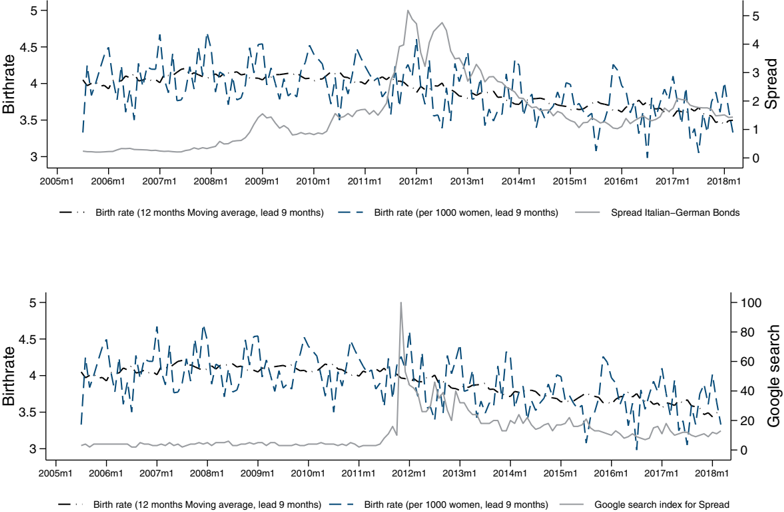
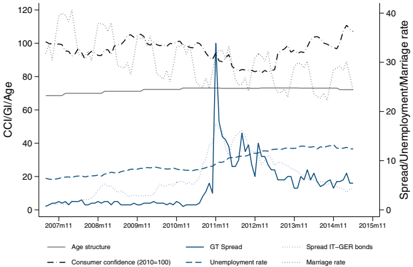
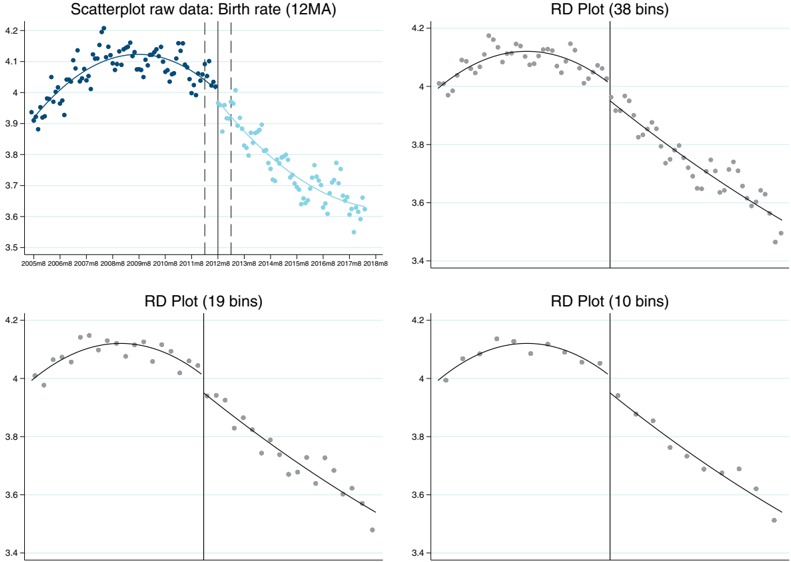
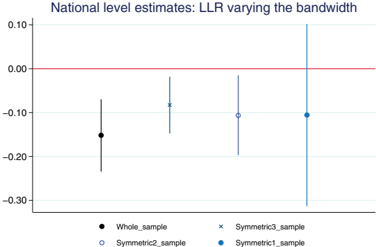
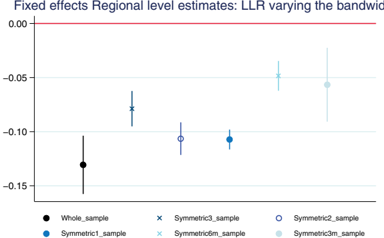
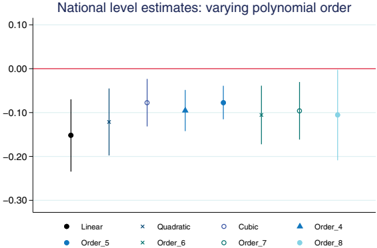
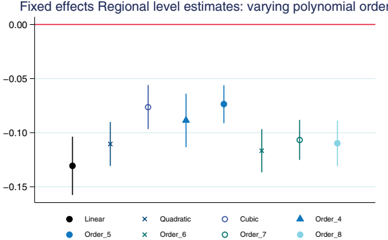
Many previous studies have documented the procyclicality of fertility to business cycles or labour market indicators in Western countries. However, part of the recent fertility decline witnessed since the Great Recession has been left unexplained by traditional measures. The present study advances the notion that birth postponement might have accelerated in response to rising uncertainty, which fuelled negative expectations and declining levels of confidence about the future. To provide empirical support for the causal effect of perceived uncertainty on birth rates, we focus on Italy’s sovereign debt crisis of 2011–2012 as a natural experiment. Perceived uncertainty is measured using Google trends for the term ‘spread’—which acted as somewhat of a barometer for the crisis both in the media and everyday conversations—to capture the general public’s degree of concern about the stability of Italian public finances. A regression discontinuity in time identifies the effect of perceived uncertainty on birth rates in Italy as a drop between 1.5% and 5%, depending on model specification.
Overview
The claims and statistics of this paper haven’t been checked yet.
Free: it reads the open-access text and checks the first 5 claims that cite a source we can check. Create a free account to check every claim.
Integrity signals
Registry
Cites
Statistics
Figures
Verification
Claims the paper makes
The claims and statistics of this paper haven’t been checked yet.
Free: it reads the open-access text and checks the first 5 claims that cite a source we can check. Create a free account to check every claim.
Self-check
Percentages, sums and reported differences re-computed from the paper’s own numbers.
The self-check needs the paper’s full text.
Citations
Cites
Knight, F. H. (1921) · Cited by 16,705
Modernity and Self-Identity: Self and Society in the Late Modern Age
Giddens, A. (2020) · The New Social Theory Reader · doi:10.4324/9781003060963-59 · Cited by 13,417
(2002) · Cited by 13,211
Risk Society, Towards a New Modernity
Leiss, W., Beck, U., Ritter, M., Lash, S., & Wynne, B. (1994) · Canadian Journal of Sociology / Cahiers canadiens de sociologie · doi:10.2307/3341155 · Cited by 12,546
Risk Society: Towards a New Modernity
Boyd, W., Beck, U., & Shrader-Frechette, K. S. (1993) · Economic Geography · doi:10.2307/143601 · Cited by 9,215
Modernity and self-identity: self and society in the late modern age
(1992) · Choice Reviews Online · doi:10.5860/choice.29-3618 · Cited by 5,633
Regression discontinuity designs in economics
Lee, D. S., & Lemieux, T. (2010) · Journal of Economic Literature · doi:10.1257/jel.48.2.281 · Cited by 4,534
Detecting influenza epidemics using search engine query data
Ginsberg, J., Mohebbi, M. H., Patel, R. S., Brammer, L., Smolinski, M. S., & Brilliant, L. (2009) · Nature · doi:10.1038/nature07634 · Cited by 4,295
Interrupted time series regression for the evaluation of public health interventions: a tutorial
Lopez Bernal, J., Cummins, S., & Gasparrini, A. (2016) · International Journal of Epidemiology · doi:10.1093/ije/dyw098 · Cited by 3,049
Keynes, J. M. (1973) · Palgrave Macmillan UK eBooks · doi:10.1007/978-1-349-00843-8 · Cited by 2,575
Research works printed but not linked: 9
- Askitas, N. and Zimmermann, K. F. (2011). Detecting Mortgage Delinquencies. IZA Discussion Paper Series . Bonn, Germany: Institute for the Study of Labor.
- Billari, F. C. and Zagheni, E. (2017). Big data and population processes: a revolution? In Petrucci, A. and Verde, R. (Eds.). SIS 2017. Statistics and Data Science: New Challenges, New Generations. 28-30 June 2017 Florence (Italy). Proceedings of the Conference of the Italian Statistical Society . Firenze, Italy: Firenze University Press, pp. 167-178.
- CENSIS (2018), 15 Rapporto Censis Sulla Comunicazione . Milano; FrancoAngeli.
- Cepernich, C. (2012). Storie di subprime. Downgrading, Spread e Default. La Narrazione Della Grande Crisi Tra Informazione e Popolarizzazione. Il Mulino , 3 /2012, 409-433.
- Clark, A. and Lepinteur, A. (2020). A Natural Experiment on Job Insecurity and Fertility in France . Review of Economics and Statistics. Just accepted.
- Coombs, W. T. and Holladay, S. J. (2004). Reasoned action in crisis communication: an attribution theory-based approach to crisis management. In Millar, D.P. and Heath, R.L. (Eds.) Responding to Crisis Communication Approach to Crisis Communication . Hillsdale: Lawrence Erlbaum Associates, pp. 95-115.
- Kreyenfeld, M., Andersson, G. and Pailhe ´, A. (2012). Economic uncertainty and family dynamics in. Europe: Introduction. Demographic Research , 27 , 835-852.
- Lanzieri, G. (2013). Towards a 'baby recession' in Europe? Europe (in Million) , 16 , 16-539.
- Ojala, J., Zagheni, E., Billari, F. and Weber, I. (2017). Fertility and its meaning: Evidence from search behavior. In Eleventh International AAAI Conference on Web and Social Media, 11(1) .
Cited by
Pandemic Roller‐Coaster? Birth Trends in Higher‐Income Countries During the COVID‐19 Pandemic
Sobotka, T., Zeman, K., Jasilioniene, A., Winkler‐Dworak, M., Brzozowska, Z., Alustiza‐Galarza, A., Németh, L., & Jdanov, D. (2024) · Population and Development Review · doi:10.1111/padr.12544 · Cited by 171
Employment uncertainty and fertility intentions: Stability or resilience?
Gatta, A., Mattioli, F., Mencarini, L., & Vignoli, D. (2022) · Population Studies · doi:10.1080/00324728.2021.1939406 · Cited by 170
Self-citationSociety at a Glance 2024: OECD Social Indicators
OECD (2024) · Society at a Glance · doi:10.1787/918d8db3-en · Cited by 162
The Formation and Realization of Fertility Goals Among a US Cohort in the Post‐Recession Years
Guzzo, K. B. (2022) · Population and Development Review · doi:10.1111/padr.12509 · Cited by 139
Societal Pessimism and the Transition to Parenthood: A Future Too Bleak to Have Children?
Ivanova, K., & Balbo, N. (2024) · Population and Development Review · doi:10.1111/padr.12620 · Cited by 142
Baby bust in the wake of the COVID-19 pandemic? First results from the new STFF data seriesPreprint
Sobotka, T., Jasilioniene, A., Galarza, A. A., Zeman, K., Németh, L., & Jdanov, D. A. (2021) · SocArXiv (OSF Preprints) · doi:10.31235/osf.io/mvy62 · Cited by 100
Narratives of the Future Affect Fertility: Evidence from a Laboratory Experiment
Vignoli, D., Minello, A., Bazzani, G., Matera, C., & Rapallini, C. (2022) · European Journal of Population / Revue européenne de Démographie · doi:10.1007/s10680-021-09602-3 · Cited by 197
“Comolli and Vignoli (2021) showed that the general public responds to the media’s framing of uncertainty, with implications for childbearing.”
BackgroundSelf-citationPerceived consequences of the COVID-19 pandemic and childbearing intentions in Poland
Malicka, I., Mynarska, M. A., & Świderska, J. (2021) · Journal of Family Research · doi:10.20377/jfr-666 · Cited by 62
“The recent effects of the Great Recession amplified the importance of economic uncertainty for childbearing (Caltabiano et al., 2017;Comolli et al., 2021; Comolli & Vignoli, 2021; Comolli, 2017; Matysiak et al., 2020).”
BackgroundGuetto, R., Bazzani, G., & Vignoli, D. (2022) · Vienna Yearbook of Population Research · doi:10.1553/populationyearbook2022.res1.6 · Cited by 70
“More recently, the European sovereign debt crisis has received considerable attention in the media, and the simplified narratives presented in the press have served as a multiplier of uncertainty, contributing to shrinking birth rates (Comolli and Vignoli, 2021).”
Self-citationDisentangling the Swedish fertility decline of the 2010s
Ohlsson‐Wijk, S., & Andersson, G. (2022) · Demographic Research · doi:10.4054/demres.2022.47.12 · Cited by 57
“Some scholars (Vignoli et al. 2020a, b; Comolli and Vignoli 2021) instead highlight the role of real or perceived uncertainties.”
BackgroundCognitive schemas and fertility motivations in the U.S. during the COVID-19 pandemic
Manning, W. D., Guzzo, K. B., Longmore, M. A., & Giordano, P. C. (2022) · Vienna Yearbook of Population Research · doi:10.1553/populationyearbook2022.res1.7 · Cited by 39
“, 2020b); and that perceived uncertainty at the macro level due to the debt crisis influenced fertility (Comolli and Vignoli, 2021).”
BackgroundComolli, C. L. (2023) · European Journal of Population / Revue européenne de Démographie · doi:10.1007/s10680-023-09684-1 · Cited by 45
Self-citationEducation and Fertility: A Review of Recent Research in Europe
Vasireddy, S., Berrington, A. M., Kuang, B., & Kulu, H. (2023) · Comparative Population Studies · doi:10.12765/cpos-2023-21 · Cited by 43
Employment Instability and Childbirth over the Last 20 Years in Italy
Scherer, S., & Brini, E. (2023) · European Journal of Population / Revue européenne de Démographie · doi:10.1007/s10680-023-09680-5 · Cited by 29
“However, the exact consequences of instability are highly dependent on the specific type of instability, as well as national contexts (Ayllón, 2019; Comolli & Vignoli, 2021; Kristensen & Lappegård, 2022).”
BackgroundFrom bust to boom? Birth and fertility responses to the COVID-19 pandemicPreprint
Sobotka, T., Jasilioniene, A., Zeman, K., Winkler‐Dworak, M., Brzozowska, Z., Galarza, A. A., Németh, L., & Jdanov, D. A. (2022) · SocArXiv (OSF Preprints) · doi:10.31235/osf.io/87acb · Cited by 33
Delayed Fertility as a Driver of Fertility Decline?
Beaujouan, E. (2023) · The Springer Series on Demographic Methods and Population Analysis · doi:10.1007/978-3-031-29666-6_4 · Cited by 21
Luppi, F., Arpino, B., & Rosina, A. (2022) · PLoS ONE · doi:10.1371/journal.pone.0271384 · Cited by 23
“In periods of economic recessions, increased economic uncertainty has been shown to have detrimental consequences on fertility [60].”
BackgroundFertility and Media Narratives of the Economy: Evidence From Italian News Coverage
Guetto, R., Morabito, M. F., Vollbracht, M., & Vignoli, D. (2023) · Demography · doi:10.1215/00703370-10607928 · Cited by 29
Self-citationPerelli‐Harris, B., Gerber, T. P., & Hilevych, Y. (2024) · European Journal of Population / Revue européenne de Démographie · doi:10.1007/s10680-024-09713-7 · Cited by 24
“Macro-analyses of economic uncertainty that examine unemployment rates, consumer confidence, and economic policy can explain some, but not all, of the decline in European fertility after the Great Recession of 2008 (Matysiak et al., 2021; Comolli & Vignoli, 2021; Goldstein et al., 2013).”
BackgroundEffects of pandemics uncertainty on fertility
Wang, Y., Gözgör, G., & Lau, C. K. M. (2022) · Frontiers in Public Health · doi:10.3389/fpubh.2022.854771 · Cited by 20
“For instance, Gozgor et al. (51), Alderotti et al. (52), ChabeFerret and Gobbi (53), Comolli and Vignoli (54), Hanappi et al. (55), Hondroyiannis (56), Matysiak et al. (57), and Sobotka et al. (58) find that a higher uncertainty decreases fertility rates.”
BackgroundCOVID-19 and Fertility in Canada: a Commentary
Fostik, A. L. (2021) · Canadian Studies in Population · doi:10.1007/s42650-021-00054-y · Cited by 16
Resources, aspirations and first births during the Great Recession
Comolli, C. L. (2021) · Advances in Life Course Research · doi:10.1016/j.alcr.2021.100405 · Cited by 15
Self-citationHelm, S., Kemper, J. A., White, S., & Dean, D. (2024) · Environmental Sociology · doi:10.1080/23251042.2024.2408779 · Cited by 14
“Amidst perceived global uncertainties, people may weigh the decision to have a child against their visions of societal development (Comolli and Vignoli 2021; Hellstrand et al. 2021).”
Rapid changes in birth counts in Brazilian major cities during the COVID-19 pandemic
de Lima, E. E. C., Soares, C. F., & da Silva, J. H. C. M. (2022) · Vienna Yearbook of Population Research · doi:10.1553/populationyearbook2022.dat.3 · Cited by 11
Impact of the COVID-19 pandemic on pregnancy postponement – evidence from Japan
Matsushima, M., Yamada, H., Kondo, N., Arakawa, Y., & Tabuchi, T. (2023) · Journal of Biosocial Science · doi:10.1017/s0021932022000451 · Cited by 13
Climate change concerns and fertility intentions: first evidence from Italy
Puglisi, C., Muttarak, R., & Vignoli, D. (2025) · Genus · doi:10.1186/s41118-025-00244-5 · Cited by 20
“…of contemporary fertility dynamics, particularly in low-fertility countries, has recently witnessed a surge of attention toward the role played by uncertainty (Comolli & Vignoli, 2021; Gatta et al., 2021; Lappegård et al., 2022; Novelli et al., 2021; Vignoli et al., 2020a, 2020b, 2022).”
InfluentialSelf-citationStephani, N. (2024) · Media Asia · doi:10.1080/01296612.2024.2335013 · Cited by 8
“Increasing concern about declining birth rates has become a popular topic in the media (Akagawa, 2019; Comolli & Vignoli, 2021), including in Indonesian online news outlets.”
Badolato, L., Hayford, S. R., & Guzzo, K. B. (2025) · Genus · doi:10.1186/s41118-025-00251-6 · Cited by 14
“This literature examines the relationship between macro-level uncertainty, uncertainty in individuals’ lives, and fertility behaviors (Comolli & Vignoli, 2021; Currie & Schwandt, 2014; Manning et al., 2022; Min & Taylor, 2018; Schneider, 2015).”
Gray, E., Evans, A., & Reimondos, A. (2022) · Australian Population Studies · doi:10.37970/aps.v6i1.101 · Cited by 9
“Increased uncertainty of daily life and lack of job security has been posited as a reason for falling fertility rates in many high-income countries in recent years (Comolli & Vignoli 2021).”
BackgroundPandemic babies? Fertility in the aftermath of the first COVID-19 wave across European regions
Nitsche, N., Jasilioniene, A., Nisén, J., Li, P., Kniffka, M. S., Schöley, J., Andersson, G. B. J., Bagavos, C., Berrington, A. M., Čipin, I., et al. (2022) · doi:10.4054/mpidr-wp-2022-027 · Cited by 11
“Thus, if containment measures or other nationalized factors such as media exposure affected birth rates primarily, a more nationally homogeneous and less regionally diverse fertility response to the first pandemic wave may be present (Comolli & Vignoli, 2021).”
BackgroundSelf-citationHadadian, F., Abbasi, M., Parsajam, T., Haseli, A., & Rostami, N. (2025) · BMC Women s Health · doi:10.1186/s12905-025-03986-8 · Cited by 9
“Conversely, Italy’s media emphasis on youth unemployment led to lower fertility rates, even amid prevailing cultural expectations [65].”
Raybould, A., Mynarska, M. A., & Sear, R. (2023) · Perspectives on Sexual and Reproductive Health · doi:10.1111/psrh.12248 · Cited by 10
“26,27 The phrasing of the responses under this theme in our study ( “ COVID-19 tops it off ” ) is potentially indicative of this, as does the fact that people who gave these responses tended not to be intending a(nother) child at all both in March 2020 and January 2021.”
Motivations for changing fertility plans and behaviours during the COVID-19 pandemic in Italy
Luppi, F., Arpino, B., & Rosina, A. (2022) · Journal of Family Studies · doi:10.1080/13229400.2022.2159855 · Cited by 10
“…overview see e.g. Kelsey & Quiggin, 1992) and consistent with pre-pandemic studies on economic uncertainty and fertility (Caltabiano et al., 2017; Comolli & Vignoli, 2021), those with more stable occupations are less prone to abandon the pre-COVID fertility plans and show higher chances to have…”
Detecting economic insecurity in Italy: a latent transition modelling approach
Giambona, F., Grassini, L., & Vignoli, D. (2022) · Statistical Methods & Applications · doi:10.1007/s10260-021-00609-y · Cited by 8
“In line with such a framework, recent papers suggest that the subjective side of employment uncertainty may affect family choices over and above its objective side (Comolli and Vignoli 2021; Bolano and Vignoli 2021; Gatta et al 2021).”
BackgroundSelf-citationVanella, P., Greil, A. L., & Deschermeier, P. (2023) · Comparative Population Studies · doi:10.12765/cpos-2023-02 · Cited by 6
Trends in fertility preferences among Italian young adults
Luppi, F., Bellani, D., & Rosina, A. (2025) · Population Studies · doi:10.1080/00324728.2025.2542833 · Cited by 8
“This is particularly evident in uncertain times, when precarious economic conditions make it unlikely for individuals to feel secure about raising children (Comolli and Vignoli 2021; Luppi et al. 2022).”
Torres, A. F. C., Acosta, E., Pardo, I., Sacco, N., & Urdinola, B. P. (2023) · Population Space and Place · doi:10.1002/psp.2735 · Cited by 5
Retirement Planning and the Climate Crisis: The Millennial Perspective
Hettinger, M., Helm, S., & Walker, K. (2024) · Journal of Family and Economic Issues · doi:10.1007/s10834-024-10001-z · Cited by 3
Societal pessimism and trajectories of fertility expectations among Dutch non-parents
Ivanova, K. (2025) · Genus · doi:10.1186/s41118-025-00246-3 · Cited by 3
“…structural factors, such as persistent gender inequality in the division of paid and unpaid labor (e.g., Goldscheider et al., 2015), the increasing precariousness of employment conditions (e.g., Comolli & Vignoli, 2021; Mills & Blossfeld, 2013), and housing unaffordability (e.g., van Wijk, 2024).”
García‐Pereiro, T., Mencarini, L., Patimo, R., & Tanturri, M. L. (2025) · European Journal of Population / Revue européenne de Démographie · doi:10.1007/s10680-025-09743-9 · Cited by 3
“Recent literature attributes these difficulties in achieving the desired fertility to increased economic uncertainty and labour market vulnerability of the younger generations (e.g.,Comolli & Vignoli, 2021; García-Pereiro & Paterno, 2024).”
Ramos, V. J., Kreyenfeld, M. R., Alonso-Pérez, E., Gellert, P. R., Heisig, J. P., & O’Sullivan, J. L. (2025) · Population Research and Policy Review · doi:10.1007/s11113-025-09969-9 · Cited by 5
“Subsequent macro-level papers have operationalized uncertainty beyond these objective markers, instead using Google trends (Comolli & Vignoli, 2021) and (traditional) media coverage (Guetto et al., 2023) to remain close to the understanding of “uncertainty” in common parlance and found these…”
Lappegård, T., Kristensen, A. P., & Dommermuth, L. (2025) · Genus · doi:10.1186/s41118-025-00278-9 · Cited by 5
“Consequently, how well people feel protected from such risks could moderate the influence of perceived uncertainty on childbearing decisions (Aassve et al., 2021; Berrington et al., 2024; Comolli & Vignoli, 2021).”
COVID-19 and fertility intentions: a qualitative study in six regions of Russia
Kazenin, K. I. (2022) · Population and Economics · doi:10.3897/popecon.6.e93480 · Cited by 5
Subnational variations in births and marriages during the COVID-19 pandemic in South Korea
Jung, M., & Lee, D. S. (2023) · Demographic Research · doi:10.4054/demres.2023.48.30 · Cited by 4
“It was anticipated that in these countries, like in Korea, the already low levels of work–life balance and high levels of economic uncertainty due to competitive labour markets would be exacerbated by the pandemic and would, in turn, depress fertility (Comolli and Vignoli 2021; Luppi, Arpino, and Rosina 2020).”
BackgroundThe Impact of Objective and Subjective Factors on Fertility in Times of Uncertainty
Kurylo, I., & AKSYONOVA, S. Y. (2023) · Demography and social economy · doi:10.15407/dse2023.02.021 · Cited by 3
Xu, X., Gauthier, A. H., Stulp, G., & van den Bosch, A. P. J. (2024) · Social Science Computer Review · doi:10.1177/08944393241269406 · Cited by 3
“Many previous studies have identi fi ed factors that are impactful on fertility intentions, such as age, migration status (Guetto & Panichella, 2013), economic stability (Comolli & Vignoli, 2021), and union formation (Lesthaeghe, 2020).”
Jones, R. (2025) · International Journal of Environmental Research and Public Health · doi:10.3390/ijerph22010087 · Cited by 6
Fasfous, M. W., Abdel-Fattah, M. N., & Ibrahim, S. A. (2025) · International Journal of Environmental Research and Public Health · doi:10.3390/ijerph22081228 · Cited by 4
“Conversely, economic uncertainty reduces fertility intentions in European countries, as concerns about managing climate-Int induced challenges prompt individuals to opt for a smaller number of children who can have their basic needs met [61,65].”
Luppi, F., Arpino, B., & Rosina, A. (2024) · Population (English Edition) · doi:10.3917/popu.2401.0143 · Cited by 2
Subjective Evaluations of Personal and Public Well-Being and Expected Future Childbearing
Guzzo, K. B., & Hayford, S. R. (2025) · Contemporary perspectives on family research · doi:10.1108/s1530-353520250000030006 · Cited by 2
Singh, P., Gemmill, A., & Bruckner, T. A. (2023) · Economics & Human Biology · doi:10.1016/j.ehb.2023.101315 · Cited by 3
OECD (2024) · Society at a glance · doi:10.1787/006fe2b8-en · Cited by 2
Disentangling the Role of Composition Factors in Fertility Responses to Unemployment
García‐Pereiro, T., Misuraca, R., Pace, R., & Patimo, R. (2024) · Social Sciences · doi:10.3390/socsci13120683 · Cited by 1
Uncertainty and Partisan Fertility in Europe
Comolli, C. L. (2025) · Springer eBooks · doi:10.1007/978-3-031-96736-8_18 · Cited by 1
Self-citationComolli, C. L., & Albertini, M. (2025) · Genus · doi:10.1186/s41118-025-00277-w · Cited by 2
“…through the media narrative exposure and news coverage, citizens become informed about the current economic and labor market situation of their country, and, through that narrative, they become more or less exposed to contextual employment uncertainty (Comolli & Vignoli, 2021; Guetto et al., 2023).”
Self-citationFertility trends across migrant generations reexamined: insights from Finnish register data
Estévez, J. L., & Rotkirch, A. (2026) · European Sociological Review · doi:10.1093/esr/jcag009 · Cited by 3
Job loss and births. A couple-level study of Norwegian plant closures
Tyagi, R., Brini, E., & Vignoli, D. (2026) · Social Science Research · doi:10.1016/j.ssresearch.2026.103358 · Cited by 1
Self-citationINVESTIGATION OF NULLIPAROUS WOMEN'S ATTITUDES TOWARD FERTILITY AND CHILDBEARING
Acer, M. H., ÖZBEK, H., & Çakır, D. (2023) · Cumhuriyet Tıp Dergisi/Cumhuriyet Üniversitesi Tıp Fakültesi dergisi · doi:10.7197/cmj.1345351 · Cited by 2
OECD (2024) · Society at a glance · doi:10.1787/15025af7-en · Cited by 1
Expected years after labour market exit
OECD (2024) · Society at a glance · doi:10.1787/bb2c49e5-en · Cited by 1
OECD (2024) · Society at a glance · doi:10.1787/bd399581-en · Cited by 2
Denisova, I. A., Kalabikhina, I. E., & Кузнецова, П. О. (2024) · Государственное управление. Электронный вестник · doi:10.55959/msu2070-1381-105-2024-232-243 · Cited by 8
Errico, L., Mosca, A., & Rondinella, S. (2025) · Italian Economic Journal · doi:10.1007/s40797-024-00307-0 · Cited by 3
Subjective Well-Being and Fertility Uncertainty During the Pandemic
Guzzo, K. B., Juteau, G., Manning, W. D., & Dush, C. M. K. (2025) · The Springer series on demographic methods and population analysis · doi:10.1007/978-3-031-89737-5_12 · Cited by 1
Guo, Y., Mou, Y., Peng, Y., & Zhang, C. (2025) · Frontiers in Public Health · doi:10.3389/fpubh.2025.1631821 · Cited by 1
Luppi, F., Arpino, B., & Rosina, A. (2022) · SocArXiv (OSF Preprints) · doi:10.31235/osf.io/qpwba · Cited by 1
Suicide rates have been falling on average, but country trends can differ markedly
OECD (2024) · Society at a glance · doi:10.1787/3a69e5d9-en · Cited by 1
The mean age of women at first birth has risen by 3 years within two decades
OECD (2024) · Society at a glance · doi:10.1787/1a2cc4ab-en · Cited by 1
Suicide rates are between two and eight times higher for men than for women across OECD countries
OECD (2024) · Society at a glance · doi:10.1787/89962214-en · Cited by 1
Childlessness increased markedly in many countries among younger cohorts of women
OECD (2024) · Society at a glance · doi:10.1787/5d7082a7-en
Levels and trends of life satisfaction vary considerably across countries
OECD (2024) · Society at a glance · doi:10.1787/5e988e06-en
Wealth is more concentrated at the top than income
OECD (2024) · Society at a glance · doi:10.1787/3c0833e8-en
Few respondents feel that they could access public benefits in times of need
OECD (2024) · Society at a glance · doi:10.1787/50fd1503-en
Inflation outpaced household income growth in most countries in 2022
OECD (2024) · Society at a glance · doi:10.1787/ca597f34-en
Unemployment rates remain low across the OECD countries
OECD (2024) · Society at a glance · doi:10.1787/736c20ad-en
Low-income dwellers face a significant housing cost burden
OECD (2024) · Society at a glance · doi:10.1787/ce0b9f3f-en
Interpreting OECD social indicators
OECD (2024) · Society at a glance · doi:10.1787/8d86a8be-en
A continuum of family support throughout childhood
OECD (2024) · Society at a glance · doi:10.1787/bffd783d-en
Half of the total number of doctors and 87% of long-term care workers across the OECD are women
OECD (2024) · Society at a glance · doi:10.1787/0d5d8925-en
More than one‑third of people in the OECD are at risk of falling into poverty
OECD (2024) · Society at a glance · doi:10.1787/2e163629-en
More than half of the population perceives corruption in government
OECD (2024) · Society at a glance · doi:10.1787/2f147ef6-en
The share of young adults living with their parents has increased in many countries
OECD (2024) · Society at a glance · doi:10.1787/7d5fbce0-en
OECD (2024) · Society at a glance · doi:10.1787/73e5872b-en
In most OECD countries there has been a decline in electoral participation
OECD (2024) · Society at a glance · doi:10.1787/60e7cbf3-en
Young people tend to vote less than adults age 25‑50
OECD (2024) · Society at a glance · doi:10.1787/3336a888-en
Over the past 30 years, incomes of the bottom 10% grew slower than mean, median and top incomes
OECD (2024) · Society at a glance · doi:10.1787/954bc09c-en
Most spending goes to pensions and health
OECD (2024) · Society at a glance · doi:10.1787/ddbe58cb-en
OECD (2024) · Society at a glance · doi:10.1787/2ddeca93-en
Employment rates in late 2023 were generally above pre‑COVID‑19 levels
OECD (2024) · Society at a glance · doi:10.1787/52540d87-en
In most OECD countries, women participate more than men in education and training
OECD (2024) · Society at a glance · doi:10.1787/8b14e9ab-en
Men and women spend 4.5 more years after labour market exit in 2022 than in 1980
OECD (2024) · Society at a glance · doi:10.1787/3f313b2a-en
Internet usage has increased in all OECD countries in the past two decades
OECD (2024) · Society at a glance · doi:10.1787/33b2f627-en
Marked decline in smoking rates among adults in most OECD countries
OECD (2024) · Society at a glance · doi:10.1787/2553397c-en
OECD (2024) · Society at a glance · doi:10.1787/66c98ef2-en · Cited by 1
OECD (2024) · Society at a glance · doi:10.1787/52ecea63-en
Fertility rates across the OECD are typically below the population replacement rate
OECD (2024) · Society at a glance · doi:10.1787/ced9b6a5-en
OECD (2024) · Society at a glance · doi:10.1787/528d724e-en
Median income varies by a factor eight across OECD countries
OECD (2024) · Society at a glance · doi:10.1787/3f4a64c1-en
Almost one in five 15‑year‑olds have been drunk at least twice in their life
OECD (2024) · Society at a glance · doi:10.1787/e058a977-en
Metadata
- Authors
- Comolli, C. L., & Vignoli, D.
- Affiliations
- University of Lausanne (CH)
- University of Florence (IT)
- Corresponding author
- Comolli, Chiara L
- Venue
- European Sociological Review
- Publisher
- Oxford University Press (OUP)
- Published
- 2021-02-01
- Volume
- 37
- Issue
- 4
- Pages
- 555-570
- ISSN
- 0266-7215 (ISSN-L)
- 1468-2672
- OpenAlex
- W3127266565
- Cited by
- 172
- References
- 95
- Citations by year
- 2026: 6 · 2025: 21 · 2024: 111 · 2023: 14 · 2022: 15 · 2021: 5
- FWCI
- 57.11
- Type
- journal article
- Language
- en
- Open access
- hybrid
- doi.org
- Licence
- Locations
- European Sociological Review (publishedVersion, cc-by-nc-nd)
- Archivio istituzionale della ricerca (Alma Mater Studiorum Università di Bologna) (submittedVersion, cc-by-nc-nd)
- Florence Research (University of Florence) (submittedVersion, cc-by-nc-nd)
- Funders
- Strategic Research Council of the Academy of Finland (293103)
- Tackling Inequality in Time of Austerity
- Swedish Research Council
- Linnaeus Center for Social Policy and Family Dynamics in Europe (349-2007-8701)
- European Union’s Horizon 2020 research and innovation programme
- ERC (725961)
- Topics
- Social Sciences › Demography › Family Dynamics and Relationships
- Health Sciences › Medicine › Reproductive Medicine › Reproductive Health and Technologies
- Social Sciences › Gender Studies › Gender, Labor, and Family Dynamics
- Keywords
- fertility decline, perceived uncertainty, birth postponement, sovereign debt crisis, Google Trends, public confidence, natural experiment, regression discontinuity design
About these checks
Registry, retraction, Cites and statistics results are computed, not judged, with one exception: a printed reference that no index lists is read once by a model before it counts as a citation error. Claims are extracted by a model and kept only when their quote appears verbatim in the text; each cited source is then checked, with a model’s help, for whether it says what the claim relies on. Those verdicts can be wrong — read the claim’s quote and the cited source before relying on one.
Statistics and arithmetic are recomputed, not judged.
Confidence bands are shown only for fields calibrated on our annotated test set. None is calibrated yet, so no band is shown.
What counts as a claim ›How we measure confidence ›How we check this ›
Are you an author, or do you see a problem with this page? Request a review
Data sources
Bibliographic data: Semantic Scholar, OpenAlex, Crossref.
Contains information from the Semantic Scholar Academic Graph Datasets, made available under the ODC Attribution License (ODC-BY 1.0).
Semantic Scholar’s data is described in: Kinney, R., et al. (2023). The Semantic Scholar Open Data Platform. arXiv:2301.10140.
