

Association between systolic blood pressure and dementia in the Whitehall II cohort study: role of age, duration, and threshold used to define hypertension
Open accessThe DOI matches its Crossref record; 31 of the 32 references it cites were found in a registry or an index.
Abstract
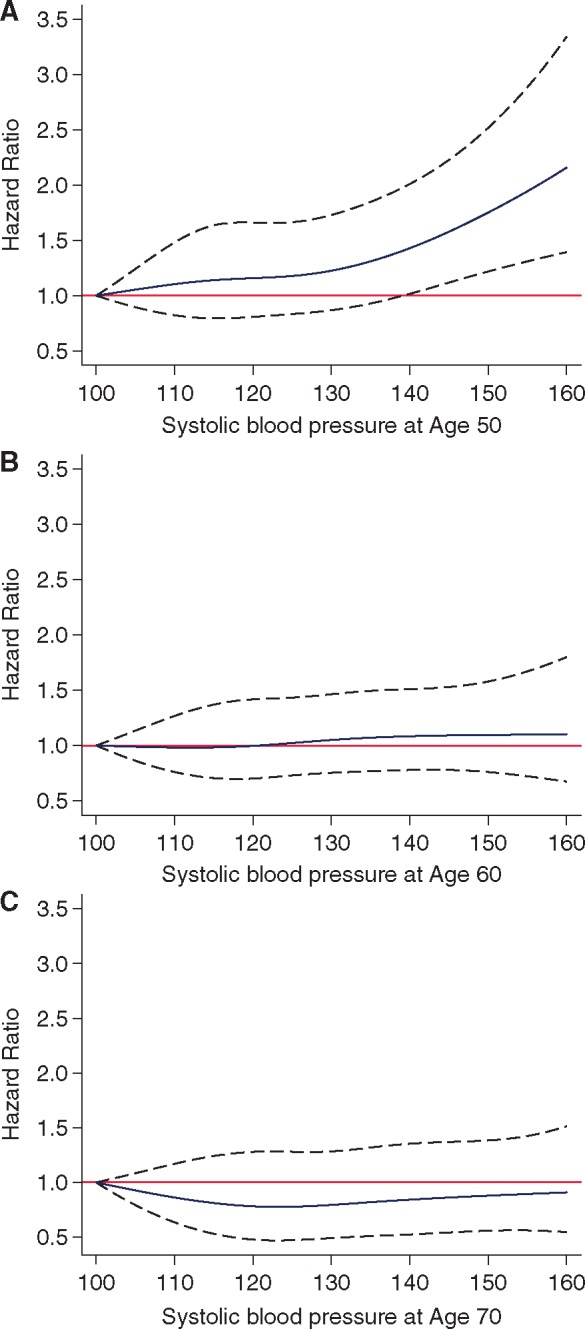
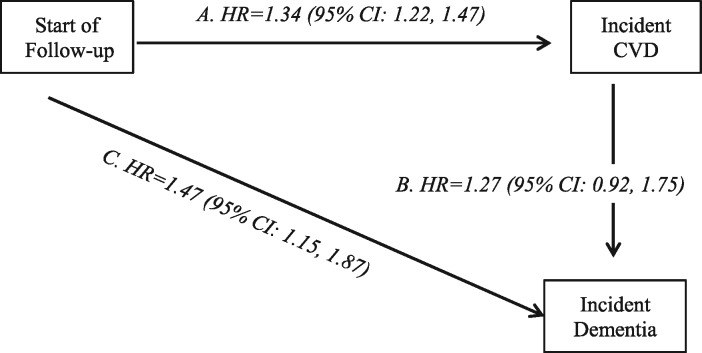
Aims: To examine associations of diastolic and systolic blood pressure (SBP) at age 50, 60, and 70 years with incidence of dementia, and whether cardiovascular disease (CVD) over the follow-up mediates this association. Methods and results: Systolic and diastolic blood pressure were measured on 8639 persons (32.5% women) from the Whitehall II cohort study in 1985, 1991, 1997, and 2003. Incidence of dementia (n dementia/n total = 385/8639) was ascertained from electronic health records followed-up until 2017. Cubic splines using continuous blood pressure measures suggested SBP ≥130 mmHg at age 50 but not at age 60 or 70 was associated with increased risk of dementia, confirmed in Cox regression analyses adjusted for sociodemographic factors, health behaviours, and time varying chronic conditions [hazard ratio (HR) 1.38; 95% confidence interval (95% CI) 1.11, 1.70]. Diastolic blood pressure was not associated with dementia. Participants with longer exposure to hypertension (SBP ≥ 130 mmHg) between mean ages of 45 and 61 years had an increased risk of dementia compared to those with no or low exposure to hypertension (HR 1.29, 95% CI 1.00, 1.66). In multi-state models, SBP ≥ 130 mmHg at 50 years of age was associated with greater risk of dementia in those free of CVD over the follow-up (HR 1.47, 95% CI 1.15, 1.87). Conclusion: Systolic blood pressure ≥130 mmHg at age 50, below the conventional ≥140 mmHg threshold used to define hypertension, is associated with increased risk of dementia; in these persons this excess risk is independent of CVD.
Overview
The claims and statistics of this paper haven’t been checked yet.
Free: it reads the open-access text and checks the first 5 claims that cite a source we can check. Create a free account to check every claim.
Integrity signals
Registry
Cites
Statistics
Figures
Verification
Claims the paper makes
The claims and statistics of this paper haven’t been checked yet.
Free: it reads the open-access text and checks the first 5 claims that cite a source we can check. Create a free account to check every claim.
Claims other papers make about this one
Each is checked against this paper’s own text: does it say what the citing paper says it does?
The source backs part of the claim, not all of it — or backs it for a different population, condition or comparison.
In the citing paper
“In those with persistent systolic blood pressure of 130 mm Hg or higher, from mean age 45 to 61 years, dementia risk is increased even if free of cardiovascular disease relative to those without hypertension (1·3, 1·0–1·7).”
From Dementia prevention, intervention, and care: 2020 report of the Lancet Commission (2020) · cites this paper as [13]
Experimental — accuracy not yet measuredThe source backs part of the claim, not all of it — or backs it for a different population, condition or comparison.
In the citing paper
“For example, midlife obesity, 105,111,112 hypertension, 85,[105][106][107] prehypertension (systolic blood pressure from 120 to 139 mm Hg or diastolic pressure from 80 to 89 mm Hg) 85 and high cholesterol 113 are associated with an increased risk of dementia in later life.”
From 2023 Alzheimer's disease facts and figures (2023) · cites this paper as [106]
Experimental — accuracy not yet measuredThe cited source says what the claim attributes to it.
In the citing paper
“In a UK cohort study of 8639 civil servants, a single measure of systolic blood pressure of 130 mm Hg or higher at age 50 years but not at age 60 or 70 years was associated with increased risk of dementia (1·4, 1·1–1·7).”
From Dementia prevention, intervention, and care: 2020 report of the Lancet Commission (2020) · cites this paper as [13]
The cited source says what the claim attributes to it.
In the citing paper
“These factors include hypertension 85,[105][106][107] and diabetes.[108][109][110]”
From 2023 Alzheimer's disease facts and figures (2023) · cites this paper as [106]
The check wasn’t confident either way, so it gives no verdict — never disputed.
In the citing paper
“Of note, blood pressure declines in later life and this decline is associated with and, potentially caused by, dementia development (HR 2·4, 95% CI 1·4–4·2).”
From Dementia prevention, intervention, and care: 2020 report of the Lancet Commission (2020) · cites this paper as [13]
Experimental — accuracy not yet measured
Self-check
Percentages, sums and reported differences re-computed from the paper’s own numbers.
The self-check needs the paper’s full text.
Citations
Cites
(2013) · European Heart Journal · doi:10.1093/eurheartj/eht151 · Cited by 13,655
Harrell, F. E. (2001) · Springer Series in Statistics · doi:10.1007/978-1-4757-3462-1 · Cited by 9,195
Rao, S. J. (2003) · Journal of the American Statistical Association · doi:10.1198/jasa.2003.s263 · Cited by 1,941
15-year longitudinal study of blood pressure and dementia
Skoog, I., Nilsson, L., Persson, G., Lernfelt, B., Landahl, S., Palmertz, B., Andreasson, L.-A., Odén, A., & Svanborg, A. (1996) · The Lancet · doi:10.1016/s0140-6736(96)90608-x · Cited by 1,726
Defeating Alzheimer's disease and other dementias: a priority for European science and society
Winblad, B., Amouyel, P., Andrieu, S., Ballard, C., Brayne, C., Brodaty, H., Cedazo-Minguez, A., Dubois, B., Edvardsson, D., Feldman, H., et al. (2016) · The Lancet Neurology · doi:10.1016/s1474-4422(16)00062-4 · Cited by 1,676 · cited 2×
“Poor characterization of the age when hypertension carries a risk is also reflected in dementia guidelines as they only use the generic term ‘mid-life’.(10) Our data show considerable differences in dementia risk over the two decade age-span, elevated SBP at age 50 but not at age 60 increased risk of dementia.”
BackgroundMidlife cardiovascular risk factors and risk of dementia in late life
Whitmer, R. A., Sidney, S., Selby, J., Johnston, S. C., & Yaffe, K. (2005) · Neurology · doi:10.1212/01.wnl.0000149519.47454.f2 · Cited by 1,238
The age-dependent relation of blood pressure to cognitive function and dementia
Qiu, C., Winblad, B., & Fratiglioni, L. (2005) · The Lancet Neurology · doi:10.1016/s1474-4422(05)70141-1 · Cited by 1,138 · cited 2×
“The findings of this longitudinal observational study of over 8000 men and women support the hypothesis that hypertension in mid-life but not late life is associated with increased risk of dementia.(3,5) We show that high SBP at age 50 was associated with increased risk of dementia, much under the conventional 140 mmH…”
BackgroundMethodMidlife blood pressure and dementia: the Honolulu–Asia aging study☆
Launer, L. J., Ross, G. W., Petrovitch, H., Masaki, K., Foley, D., White, L. R., & Havlik, R. J. (2000) · Neurobiology of Aging · doi:10.1016/s0197-4580(00)00096-8 · Cited by 1,008
(2003) · Archives of Internal Medicine · doi:10.1001/archinte.163.9.1069 · Cited by 988 · cited 1×
“Randomized trials on older adults show no effect of lowering of blood pressure on the risk of dementia.(1,2) Age is known to modify the association between hypertension and dementia.”
BackgroundWeber, M. A., Schiffrin, E. L., White, W. B., Mann, S., Lindholm, L. H., Kenerson, J. G., Flack, J. M., Carter, B. L., Materson, B. J., Ram, C. V. S., et al. (2014) · The Journal of Clinical Hypertension · doi:10.1111/jch.12237 · Cited by 986 · cited 1×
“Three, it is unclear whether the 140 mmHg systolic blood pressure (SBP) threshold to define hypertension(14) in mid-life is appropriate for dementia risk, given age-specific treatment targets recommended in recent reports aimed at reducing cardiovascular disease (CVD).(15,16) To address some of these limitations, we e…”
BackgroundLauner, L. J. (1995) · JAMA · doi:10.1001/jama.1995.03530230032026 · Cited by 908
Peters, R., Beckett, N., Forette, F., Tuomilehto, J., Clarke, R., Ritchie, C., Waldman, A., Walton, I., Poulter, R., Ma, S., et al. (2008) · The Lancet Neurology · doi:10.1016/s1474-4422(08)70143-1 · Cited by 770 · cited 1×
“Randomized trials on older adults show no effect of lowering of blood pressure on the risk of dementia.(1,2) Age is known to modify the association between hypertension and dementia.”
BackgroundProdromal Alzheimer's disease: successive emergence of the clinical symptoms
Amieva, H., Le Goff, M., Millet, X., Orgogozo, J. M., Pérès, K., Barberger‐Gateau, P., Jacqmin‐Gadda, H., & Dartigues, J. F. (2008) · Annals of Neurology · doi:10.1002/ana.21509 · Cited by 737 · cited 1×
“The validity of dementia cases in our study is supported by modelling changes in the global cognitive score in the 10 years before dementia diagnosis (Supplementary material online, Figure S1) as in studies that use a ‘gold-standard’ dementia ascertainment procedure.(17)”
MethodUntreated Blood Pressure Level Is Inversely Related to Cognitive Functioning: The Framingham Study
Elias, M. F., Wolf, P. A., D'Agostino, R. B., Cobb, J., & White, L. R. (1993) · American Journal of Epidemiology · doi:10.1093/oxfordjournals.aje.a116868 · Cited by 652
Accounting for Bias Due to Selective Attrition: The Example of Smoking and Cognitive Decline
Weuve, J., Tchetgen Tchetgen, E. J., Glymour, M. M., Beck, T. L., Aggarwal, N. T., Wilson, R. S., Evans, D. A., & Mendes de Leon, C. F. (2012) · Epidemiology · doi:10.1097/ede.0b013e318230e861 · Cited by 514
The relationship of hypertension in the elderly to AD, vascular dementia, and cognitive function
Posner, H. B., Tang, M.-X., Luchsinger, J., Lantigua, R., Stern, Y., & Mayeux, R. (2002) · Neurology · doi:10.1212/wnl.58.8.1175 · Cited by 329
A Procedure to Tabulate and Plot Results after Flexible Modeling of a Quantitative Covariate
Orsini, N., & Greenland, S. (2011) · The Stata Journal: Promoting communications on statistics and Stata · doi:10.1177/1536867x1101100101 · Cited by 321
Risk Factors for Dementia in the Cardiovascular Health Cognition Study
Kuller, L. H., Lopez, O. L., Newman, A., Beauchamp, N. J., Burke, G., Dulberg, C., Fitzpatrick, A., Fried, L., & Haan, M. N. (2003) · Neuroepidemiology · doi:10.1159/000067109 · Cited by 294
Low Blood Pressure and Risk of Dementia in the Kungsholmen Project: A 6-Year Follow-up Study
Qiu, C., von Strauss, E., Fastbom, J., Winblad, B., & Fratiglioni, L. (2003) · Archives of Neurology · doi:10.1001/archneur.60.2.223 · Cited by 291
Risk factors for Alzheimer's disease: a population-based, longitudinal study in Manitoba, Canada
Tyas, S. L., Manfreda, J., Strain, L. A., & Montgomery, P. R. (2001) · International Journal of Epidemiology · doi:10.1093/ije/30.3.590 · Cited by 272
Yamada, M., Kasagi, F., Sasaki, H., Masunari, N., Mimori, Y., & Suzuki, G. (2003) · Journal of the American Geriatrics Society · doi:10.1046/j.1532-5415.2003.51117.x · Cited by 255
Change in Blood Pressure and Incident Dementia: A 32-Year Prospective Study
Stewart, R., Xue, Q.-L., Masaki, K., Petrovitch, H., Ross, G. W., White, L. R., & Launer, L. J. (2009) · Hypertension · doi:10.1161/hypertensionaha.109.128744 · Cited by 205
Vascular Risks and Incident Dementia: Results from a Cohort Study of the Very Old
Brayne, C., Gill, C., Huppert, F. A., Barkley, C., Gehlhaar, E., Girling, D. M., O’Connor, D. W., & Paykel, E. S. (1998) · Dementia and Geriatric Cognitive Disorders · doi:10.1159/000017043 · Cited by 159
Is Hypertension Associated With an Accelerated Aging of the Brain?
Tzourio, C., Laurent, S., & Debette, S. (2014) · Hypertension · doi:10.1161/hypertensionaha.113.00147 · Cited by 152
Developmental and vascular risk factors for Alzheimer's disease
Borenstein, A. R., Wu, Y., Mortimer, J. A., Schellenberg, G. D., McCormick, W. C., Bowen, J. D., McCurry, S. M., & Larson, E. B. (2004) · Neurobiology of Aging · doi:10.1016/j.neurobiolaging.2004.04.010 · Cited by 142
Li, G., Rhew, I. C., Shofer, J. B., Kukull, W. A., Breitner, J. C. S., Peskind, E., Bowen, J. D., McCormick, W., Teri, L., Crane, P. K., et al. (2007) · Journal of the American Geriatrics Society · doi:10.1111/j.1532-5415.2007.01233.x · Cited by 137
Hypertension, cognitive decline and dementia
Duron, E., & Hanon, O. (2008) · Archives of Cardiovascular Diseases · doi:10.1016/s1875-2136(08)71801-1 · Cited by 123
Hypertension and Its Role in Cognitive Function: Current Evidence and Challenges for the Future
Hughes, T. M., & Sink, K. M. (2016) · American Journal of Hypertension · doi:10.1093/ajh/hpv180 · Cited by 115
Joint effect of mid- and late-life blood pressure on the brain: The AGES-Reykjavik Study
Muller, M., Sigurdsson, S., Kjartansson, O., Aspelund, T., Lopez, O. L., Jonnson, P. V., Harris, T. B., van Buchem, M., Gudnason, V., Launer, L. J., et al. (2014) · Neurology · doi:10.1212/wnl.0000000000000517 · Cited by 94
Passive case‐finding for Alzheimer's disease and dementia in two U.S. communities
Knopman, D. S., Petersen, R. C., Rocca, W. A., Larson, E. B., & Ganguli, M. (2011) · Alzheimer's & Dementia · doi:10.1016/j.jalz.2010.11.001 · Cited by 51
Hypertension in 2017—What Is the Right Target?
Chobanian, A. V. (2017) · JAMA · doi:10.1001/jama.2017.0105 · Cited by 42 · cited 4×
“This approach also allows the development of clear neuroprotective guidelines, contributing to the debate on the correct target for blood pressure.(16) Finally, the use of IPW ensures that missing data do not affect results, as they are known to be more common in those at greater risk of adverse health outcomes.”
BackgroundInfluential
Cited by
Dementia prevention, intervention, and care: 2020 report of the Lancet Commission
Livingston, G., Huntley, J., Sommerlad, A., Ames, D., Ballard, C., Banerjee, S., Brayne, C., Burns, A., Cohen-Mansfield, J., Cooper, C., et al. (2020) · The Lancet · doi:10.1016/s0140-6736(20)30367-6 · Cited by 10,430
“13 In those with persistent systolic blood pressure of 130 mm Hg or higher, from mean age 45 to 61 years, dementia risk is increased even if free of cardiovascular disease relative to those without hyper tension A further cohort study has provided potential insights into mechanisms, reporting that…”
RetractedHeart Disease and Stroke Statistics—2023 Update: A Report From the American Heart Association
Tsao, C. W., Aday, A. W., Almarzooq, Z. I., Anderson, C. A. M., Arora, P., Avery, C. L., Baker-Smith, C. M., Beaton, A. Z., Boehme, A. K., Buxton, A. E., et al. (2023) · Circulation · doi:10.1161/cir.0000000000001123 · Cited by 8,300
Heart Disease and Stroke Statistics—2022 Update: A Report From the American Heart Association
Tsao, C. W., Aday, A. W., Almarzooq, Z. I., Alonso, A., Beaton, A. Z., Bittencourt, M. S., Boehme, A. K., Buxton, A. E., Carson, A. P., Commodore-Mensah, Y., et al. (2022) · Circulation · doi:10.1161/cir.0000000000001052 · Cited by 5,987
2023 Alzheimer's disease facts and figures
(2023) · Alzheimer's & Dementia · doi:10.1002/alz.13016 · Cited by 3,212
Martin, S. S., Aday, A. W., Almarzooq, Z. I., Anderson, C. A. M., Arora, P., Avery, C. L., Baker-Smith, C. M., Barone Gibbs, B., Beaton, A. Z., Boehme, A. K., et al. (2024) · Circulation · doi:10.1161/cir.0000000000001209 · Cited by 2,800
Metadata
- Authors
- Abell, J. G., Kivimäki, M., Dugravot, A., Tabak, A. G., Fayosse, A., Shipley, M., Sabia, S., & Singh-Manoux, A.
- Affiliations
- Inserm (FR)
- Department of Epidemiology and Public Health, University College London, London, UK
- INSERM, U1018, Centre for Research in Epidemiology and Population Health, Université Paris-Saclay, Hôpital Paul Brousse, Bât 15/16, 16 Avenue Paul Vaillant Couturier, 94807 Villejuif Cedex, France
- University College London (GB)
- Venue
- European Heart Journal
- Publisher
- Oxford University Press (OUP)
- Published
- 2018-06-12
- Volume
- 39
- Issue
- 33
- Pages
- 3119-3125
- ISSN
- 0195-668X (ISSN-L)
- 1522-9645
- PMC
- PMC6122131
- OpenAlex
- W2808600489
- Cited by
- 252
- References
- 32
- Citations by year
- 2026: 13 · 2025: 36 · 2024: 31 · 2023: 32 · 2022: 37 · 2021: 34 · 2020: 32 · 2019: 25 · 2018: 11
- FWCI
- 19.75
- Type
- journal article
- Language
- en
- Open access
- hybrid
- doi.org
- Licence
- Locations
- European Heart Journal (publishedVersion, cc-by)
- Europe PMC (PubMed Central) (publishedVersion, cc-by)
- PubMed Central (publishedVersion, cc-by)
- PubMed (publishedVersion)
- UCL Discovery (University College London) (submittedVersion)
- Semmelweis University Repository (Semmelweis University) (submittedVersion)
- Funders
- National Institutes of Health
- NIH (R01AG013196, R01AG034454)
- UK Medical Research Council
- MRC (K013351)
- The British Heart Foundation
- BHF (RG/13/2/30098)
- Horizon2020 (643576)
- EC Horizon2020 (LIFEPATH 633666)
- NordForsk
- Academy of Finland (311492)
- Topics
- Health Sciences › Medicine › Psychiatry and Mental health › Dementia and Cognitive Impairment Research
- Health Sciences › Medicine › Cardiology and Cardiovascular Medicine › Blood Pressure and Hypertension Studies
- Health Sciences › Medicine › Cardiology and Cardiovascular Medicine › Cardiovascular Health and Disease Prevention
- Keywords
- systolic blood pressure, dementia, hypertension, hypertension threshold, cardiovascular disease, diastolic blood pressure, dementia incidence, Whitehall II cohort, middle-aged adults
- MeSH terms
- Age Factors, Blood Pressure, Cardiovascular Diseases, Dementia, England, Female, Follow-Up Studies, Humans, Hypertension, Male, Middle Aged, Risk Factors, Systole, Cohort Studies, Health Behavior, Incidence
About these checks
Registry, retraction, Cites and statistics results are computed, not judged, with one exception: a printed reference that no index lists is read once by a model before it counts as a citation error. Claims are extracted by a model and kept only when their quote appears verbatim in the text; each cited source is then checked, with a model’s help, for whether it says what the claim relies on. Those verdicts can be wrong — read the claim’s quote and the cited source before relying on one.
Statistics and arithmetic are recomputed, not judged.
Confidence bands are shown only for fields calibrated on our annotated test set. None is calibrated yet, so no band is shown.
What counts as a claim ›How we measure confidence ›How we check this ›
Are you an author, or do you see a problem with this page? Request a review
Data sources
Bibliographic data: Semantic Scholar, OpenAlex, Crossref.
Contains information from the Semantic Scholar Academic Graph Datasets, made available under the ODC Attribution License (ODC-BY 1.0).
Semantic Scholar’s data is described in: Kinney, R., et al. (2023). The Semantic Scholar Open Data Platform. arXiv:2301.10140.
