

Relationship between hypoglycaemia, cardiovascular outcomes, and empagliflozin treatment in the EMPA-REG OUTCOME® trial
Open accessThe DOI matches its Crossref record; 35 of the 35 references it cites were found in a registry or an index.
Abstract
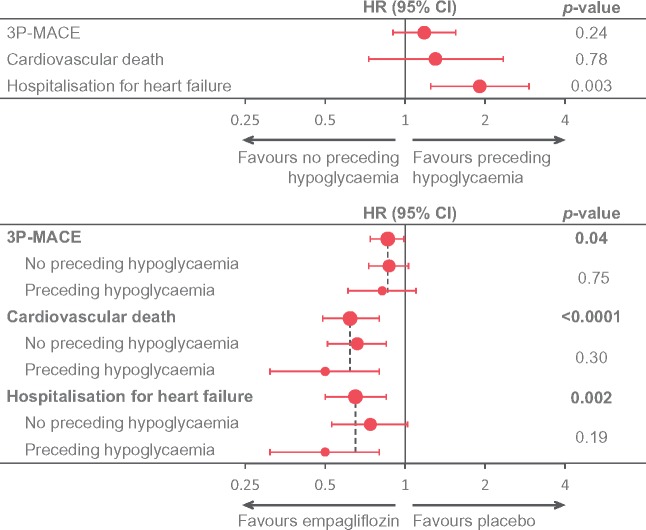
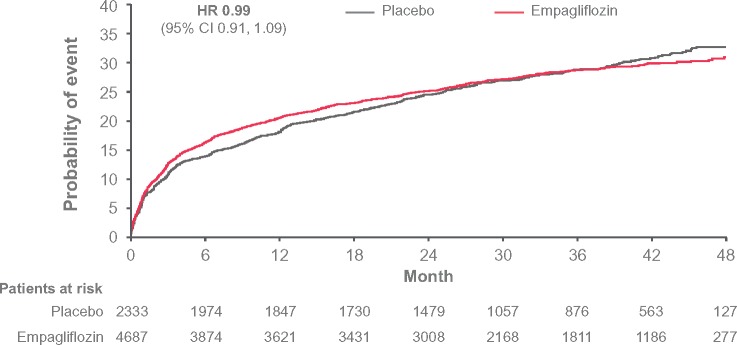
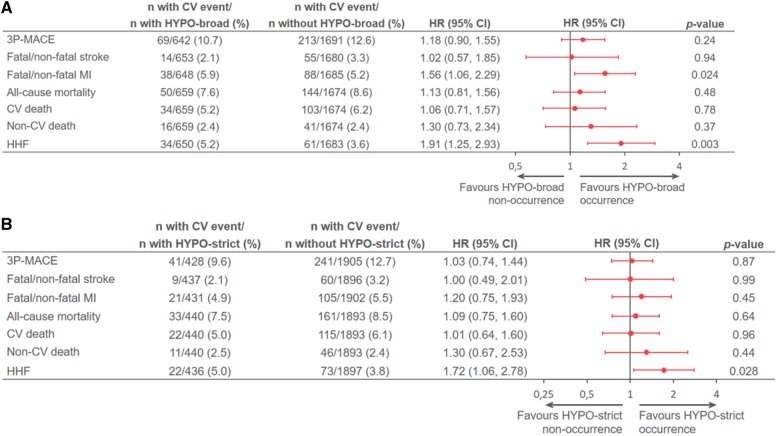
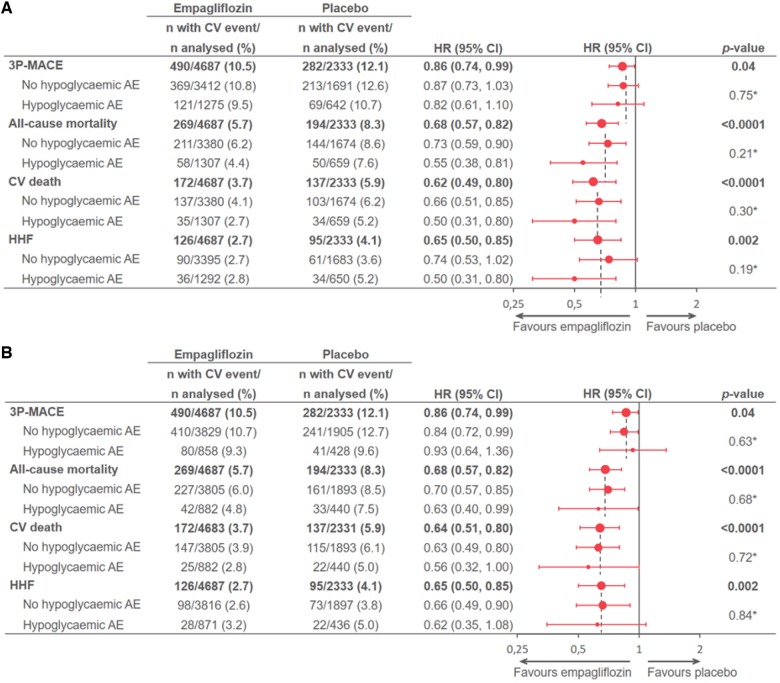
Aims: Hypoglycaemia, in patients with Type 2 diabetes (T2D) is associated with an increased risk for cardiovascular (CV) events. In EMPA-REG OUTCOME, the sodium-glucose co-transporter-2 inhibitor empagliflozin reduced the risk of CV death by 38% and heart failure hospitalization (HHF) by 35%, while decreasing glycated haemoglobin (HbA1c) without increasing hypoglycaemia. We investigated CV outcomes in patients with hypoglycaemia during the trial and the impact of hypoglycaemia on the treatment effect of empagliflozin. Methods and results: About 7020 patients with T2D (HbA1c 7–10%) were treated with empagliflozin 10 or 25 mg, or placebo and followed for median 3.1 years. The relationship between on-trial hypoglycaemia and CV outcomes, and effects of empagliflozin on outcomes by incident hypoglycaemia [HYPO-broad: symptomatic hypoglycaemia with plasma glucose (PG) ≤70 mg/dL, any hypoglycaemia with PG <54 mg/dL, or severe hypoglycaemia, and HYPO-strict: hypoglycaemia with PG <54 mg/dL, or severe hypoglycaemia] was investigated using adjusted Cox regression models with time-varying covariates for hypoglycaemia and interaction with treatment. HYPO-broad occurred in 28% in each group and HYPO-strict in 19%. In the placebo group, hypoglycaemia was associated with an increased risk of HHF for both HYPO-broad [hazard ratio (HR, 95% confidence interval, CI) 1.91 (1.25–2.93)] and HYPO-strict [1.72 (1.06–2.78)]. HYPO-broad (but not HYPO-strict) was associated with an increased risk of myocardial infarction (MI) [HR 1.56 (1.06–2.29)]. Empagliflozin improved CV outcomes, regardless of occurrence of hypoglycaemia (P-for interactions >0.05). Conclusion: In this post hoc exploratory analysis, hypoglycaemia was associated with an increased risk of HHF and MI. Hypoglycaemia risk was not increased with empagliflozin and incident hypoglycaemia did not attenuate its cardio-protective effects.
Overview
The claims and statistics of this paper haven’t been checked yet.
Free: it reads the open-access text and checks the first 5 claims that cite a source we can check. Create a free account to check every claim.
Integrity signals
Registry
Cites
Statistics
Figures
Verification
Claims the paper makes
The claims and statistics of this paper haven’t been checked yet.
Free: it reads the open-access text and checks the first 5 claims that cite a source we can check. Create a free account to check every claim.
Claims other papers make about this one
Each is checked against this paper’s own text: does it say what the citing paper says it does?
The source backs part of the claim, not all of it — or backs it for a different population, condition or comparison.
In the citing paper
“Diabetes may increase the risk of cardiac arrhythmias via several factors including: associated CV risk factors (e.g.hypertension), CVD (i.e.CAD, prior MI, HF, or stroke), and diabetes-associated factors such as glucose control or diabetic neuropathy.157,[569][570][571][572]”
From 2023 ESC guidelines for the management of cardiovascular disease in patients with diabetes. (2023) · cites this paper as [570]
Experimental — accuracy not yet measured
Self-check
Percentages, sums and reported differences re-computed from the paper’s own numbers.
The self-check needs the paper’s full text.
Citations
Cites
McDonagh, T. A., Metra, M., Adamo, M., Gardner, R. S., Baumbach, A., Böhm, M., Burri, H., Butler, J., Čelutkienė, J., Chioncel, O., et al. (2021) · European Heart Journal · doi:10.1093/eurheartj/ehab670 · Cited by 19,442
Empagliflozin, Cardiovascular Outcomes, and Mortality in Type 2 Diabetes
Zinman, B., Wanner, C., Lachin, J. M., Fitchett, D., Bluhmki, E., Hantel, S., Mattheus, M., Devins, T., Johansen, O. E., Woerle, H. J., et al. (2015) · New England Journal of Medicine · doi:10.1056/nejmoa1504720 · Cited by 12,315 · cited 6×
“The trial further showed that empagliflozin, in patients with T2D and CV disease, reduced major adverse CV events (MACE) by 14%, CV mortality by 38%, hospitalization for HF (HHF) by 35%, and the composite of CV mortality or HHF by 34%.(14) Notably, this was the first time that a glucose-lowering agent had been shown t…”
BackgroundMethodResultInfluentialSelf-citation2016 ESC Guidelines for the diagnosis and treatment of acute and chronic heart failure
Ponikowski, P., Voors, A. A., Anker, S. D., Bueno, H., Cleland, J. G. F., Coats, A. J. S., Falk, V., González-Juanatey, J. R., Harjola, V.-P., Jankowska, E. A., et al. (2016) · European Heart Journal · doi:10.1093/eurheartj/ehw128 · Cited by 11,429
European Guidelines on cardiovascular disease prevention in clinical practice (version 2012)
Authors/Task Force Members:, Perk, J., De Backer, G., Gohlke, H., Graham, I., Reiner, Ž., Verschuren, M., Albus, C., Benlian, P., Boysen, G., et al. (2012) · European Heart Journal · doi:10.1093/eurheartj/ehs092 · Cited by 8,490
2016 European Guidelines on cardiovascular disease prevention in clinical practice
Piepoli, M. F., Hoes, A. W., Agewall, S., Albus, C., Brotons, C., Catapano, A. L., Cooney, M.-T., Corrà, U., Cosyns, B., Deaton, C., et al. (2016) · European Heart Journal · doi:10.1093/eurheartj/ehw106 · Cited by 6,457
Glucose control and vascular complications in veterans with type 2 diabetes
Duckworth, W., Abraira, C., Moritz, T., Reda, D., Emanuele, N., Reaven, P. D., Zieve, F. J., Marks, J., Davis, S. N., Hayward, R., et al. (2009) · New England Journal of Medicine · doi:10.1056/nejmoa0808431 · Cited by 4,762
Davies, M. J., D’Alessio, D. A., Fradkin, J., Kernan, W. N., Mathieu, C., Mingrone, G., Rossing, P., Tsapas, A., Wexler, D. J., & Buse, J. B. (2018) · Diabetes Care · doi:10.2337/dci18-0033 · Cited by 3,518
(2013) · European Heart Journal · doi:10.1093/eurheartj/eht108 · Cited by 1,955
Emergency Hospitalizations for Adverse Drug Events in Older Americans
Budnitz, D. S., Lovegrove, M. C., Shehab, N., & Richards, C. L. (2011) · New England Journal of Medicine · doi:10.1056/nejmsa1103053 · Cited by 1,820
Severe hypoglycemia and risks of vascular events and death
Zoungas, S., Patel, A., Chalmers, J., de Galan, B. E., Li, Q., Billot, L., Woodward, M., Ninomiya, T., Neal, B., MacMahon, S., et al. (2010) · New England Journal of Medicine · doi:10.1056/nejmoa1003795 · Cited by 1,471
Bonds, D. E., Miller, M. E., Bergenstal, R. M., Buse, J. B., Byington, R. P., Cutler, J. A., Dudl, R. J., Ismail-Beigi, F., Kimel, A. R., Hoogwerf, B., et al. (2010) · BMJ · doi:10.1136/bmj.b4909 · Cited by 933
(2014) · Revista Española de Cardiología (English Edition) · doi:10.1016/j.rec.2013.10.013 · Cited by 609
Amiel, S. A., Aschner, P., Childs, B., Cryer, P. E., de Galan, B. E., Frier, B. M., Gonder-Frederick, L., Heller, S. R., Jones, T., Khunti, K., et al. (2019) · The Lancet Diabetes & Endocrinology · doi:10.1016/s2213-8587(18)30315-2 · Cited by 526
Association between 7 years of intensive treatment of type 1 diabetes and long-term mortality
Orchard, T. J., Nathan, D. M., Zinman, B., Cleary, P., Brillon, D., Backlund, J.-Y. C., & Lachin, J. M. (2015) · JAMA · doi:10.1001/jama.2014.16107 · Cited by 437
Self-citationSGLT-2 inhibitors and cardiovascular risk: Proposed pathways and review of ongoing outcome trials
Inzucchi, S. E., Zinman, B., Wanner, C., Ferrari, R., Fitchett, D., Hantel, S., Espadero, R.-M., Woerle, H.-J., Broedl, U. C., & Johansen, O. E. (2015) · Diabetes and Vascular Disease Research · doi:10.1177/1479164114559852 · Cited by 399
Self-citationHypoglycemia and cardiovascular risks
Frier, B. M., Schernthaner, G., & Heller, S. R. (2011) · Diabetes Care · doi:10.2337/dc11-s220 · Cited by 381 · cited 2×
“It is possible, as suggested by others, that acute hypoglycaemia might have a deleterious impact on an already vulnerable myocardium (as a result of autonomic activation, electrophysiological alterations, haemodynamic changes, and/or effects via the coagulation system).(9,10,24) However, another possibility is that gr…”
BackgroundHsu, P.-F., Sung, S.-H., Cheng, H.-M., Yeh, J.-S., Liu, W.-L., Chan, W.-L., Chen, C.-H., Chou, P., & Chuang, S.-Y. (2013) · Diabetes Care · doi:10.2337/dc12-0916 · Cited by 249
Does hypoglycaemia increase the risk of cardiovascular events? A report from the ORIGIN trial
The ORIGIN Trial Investigators, Mellbin, L. G., Rydén, L., Riddle, M. C., Probstfield, J., Rosenstock, J., Díaz, R., Yusuf, S., & Gerstein, H. C. (2013) · European Heart Journal · doi:10.1093/eurheartj/eht332 · Cited by 247
Fitchett, D., Butler, J., van de Borne, P., Zinman, B., Lachin, J. M., Wanner, C., Woerle, H. J., Hantel, S., George, J. T., Johansen, O. E., et al. (2018) · European Heart Journal · doi:10.1093/eurheartj/ehx511 · Cited by 242
Self-citationZinman, B., Inzucchi, S. E., Lachin, J. M., Wanner, C., Ferrari, R., Fitchett, D., Bluhmki, E., Hantel, S., Kempthorne-Rawson, J., Newman, J., et al. (2014) · Cardiovascular Diabetology · doi:10.1186/1475-2840-13-102 · Cited by 239 · cited 3×
“Definition of HHF and other outcomes has been reported,(14,16) and all CV outcome events, HF hospitalizations, and CV deaths were prospectively adjudicated by blinded Clinical Events Committees.(14,15)”
MethodSelf-citationJohnston, S. S., Conner, C., Aagren, M., Smith, D. M., Bouchard, J., & Brett, J. (2011) · Diabetes Care · doi:10.2337/dc10-1915 · Cited by 189 · cited 1×
“Another area for further research in CV outcome trials not analysed in the present study, given the observation of an association between preceding hypoglycaemia and MI risk, is to test the clinical hypothesis whether it could be an association between hypoglycaemia and coronary revascularization procedures, as shown…”
ResultDEVOTE 3: temporal relationships between severe hypoglycaemia, cardiovascular outcomes and mortality
on behalf of the DEVOTE Study Group, Pieber, T. R., Marso, S. P., McGuire, D. K., Zinman, B., Poulter, N. R., Emerson, S. S., Pratley, R. E., Woo, V., Heller, S., et al. (2018) · Diabetologia · doi:10.1007/s00125-017-4422-0 · Cited by 148
Self-citationNirantharakumar, K., Marshall, T., Kennedy, A., Narendran, P., Hemming, K., & Coleman, J. J. (2012) · Diabetic Medicine · doi:10.1111/dme.12002 · Cited by 132
Cosmi, F., Shen, L., Magnoli, M., Abraham, W. T., Anand, I. S., Cleland, J. G., Cohn, J. N., Cosmi, D., De Berardis, G., Dickstein, K., et al. (2018) · European Journal of Heart Failure · doi:10.1002/ejhf.1146 · Cited by 119 · cited 1×
“Insulin treatment is known to induce weight gain, sodium, and fluid retention,(25) all associated with deleterious vascular effects(26) and in some HF trials, is associated with worse outcomes.(11) While insulin treatment may just be a marker of severity of disease (i.”
BackgroundWang, Q., Liu, Y., Fu, Q., Xu, B., Zhang, Y., Kim, S., Tan, R., Barbagallo, F., West, T., Anderson, E., et al. (2017) · Circulation · doi:10.1161/circulationaha.116.022281 · Cited by 116 · cited 1×
“confounder by indication), there exist some mechanistic data to suggest that insulin may adversely affect myocardial contractility mediated by b2-adrenergic receptor activation pathways.(27) Although our expanded analysis that included an adjustment for insulin use at baseline confirmed an association of increased ris…”
BackgroundHypoglycemia, Cardiovascular Outcomes, and Death: The LEADER Experience
Zinman, B., Marso, S. P., Christiansen, E., Calanna, S., Rasmussen, S., Buse, J. B., & the LEADER Publication Committee on behalf of the LEADER Trial Investigators (2018) · Diabetes Care · doi:10.2337/dc17-2677 · Cited by 108
Self-citationStandl, E., Stevens, S. R., Armstrong, P. W., Buse, J. B., Chan, J. C. N., Green, J. B., Lachin, J. M., Scheen, A., Travert, F., Van de Werf, F., et al. (2018) · Diabetes Care · doi:10.2337/dc17-1778 · Cited by 76
Lu, C.-L., Shen, H.-N., Hu, S. C., Wang, J.-D., & Li, C.-Y. (2016) · Diabetes Care · doi:10.2337/dc15-2418 · Cited by 66
The proarrhythmic effect of hypoglycemia: evidence for increased risk from ischemia and bradycardia
Nordin, C. (2013) · Acta Diabetologica · doi:10.1007/s00592-013-0528-0 · Cited by 61 · cited 2×
“It is possible, as suggested by others, that acute hypoglycaemia might have a deleterious impact on an already vulnerable myocardium (as a result of autonomic activation, electrophysiological alterations, haemodynamic changes, and/or effects via the coagulation system).(9,10,24) However, another possibility is that gr…”
BackgroundHeller, S. R., Bergenstal, R. M., White, W. B., Kupfer, S., Bakris, G. L., Cushman, W. C., Mehta, C. R., Nissen, S. E., Wilson, C. A., Zannad, F., et al. (2017) · Diabetes, Obesity and Metabolism · doi:10.1111/dom.12871 · Cited by 58
Fitzpatrick, C., Chatterjee, S., Seidu, S., Bodicoat, D. H., Ng, G. A., Davies, M. J., & Khunti, K. (2018) · Diabetes, Obesity and Metabolism · doi:10.1111/dom.13348 · Cited by 57 · cited 1×
“It is possible, as suggested by others, that acute hypoglycaemia might have a deleterious impact on an already vulnerable myocardium (as a result of autonomic activation, electrophysiological alterations, haemodynamic changes, and/or effects via the coagulation system).(9,10,24) However, another possibility is that gr…”
BackgroundUnderstanding the impact of hypoglycemia on the cardiovascular system
Davis, I., Ahmadizadeh, I., Randell, J., Younk, L. M., & Davis, S. N. (2017) · Expert Review of Endocrinology & Metabolism · doi:10.1080/17446651.2017.1275960 · Cited by 51 · cited 1×
“a marker of frailty and high risk.(20,22,23) Recent studies suggest that there is a temporal association between hypoglycaemia and outcomes with the highest risk of CV events and all-cause mortality occurring early (e.”
BackgroundGans, R. O. B., Bilo, H. J. G., & Donker, A. J. M. (1996) · Nephrology Dialysis Transplantation · doi:10.1093/oxfordjournals.ndt.a027401 · Cited by 24
Vasculotoxic Effects of Insulin and Its Role in Atherosclerosis: What is the Evidence?
Nandish, S., Bailon, O., Wyatt, J., Smith, J., Stevens, A., Lujan, M., & CHILTON, R. J. (2011) · Current Atherosclerosis Reports · doi:10.1007/s11883-011-0165-4 · Cited by 23
Lo, S., Yang, Y., Kornelius, E., Huang, J., Lai, Y., Huang, C., & Chiou, J. (2019) · Diabetes Obesity and Metabolism · doi:10.1111/dom.13746 · Cited by 15 · cited 1×
“during the first weeks and months following a severe hypoglycaemic episode) and that these risks decline during the following months, yet remain higher also in long-term follow-up.(4,7)”
Background
Cited by
2023 ESC guidelines for the management of cardiovascular disease in patients with diabetes.
Marx, N., Federici, M., Schütt, K., Müller-Wieland, D., Ajjan, R. A., Antunes, M. J., Christodorescu, R. M., Crawford, C., Di Angelantonio, E., Eliasson, B., et al. (2023) · European Heart Journal · doi:10.1093/eurheartj/ehad192 · Cited by 1,642
Rangaswami, J., Bhalla, V., de Boer, I. H., Staruschenko, A., Sharp, J. A., Singh, R. R., Lo, K. B., Tuttle, K., Vaduganathan, M., Ventura, H., et al. (2020) · Circulation · doi:10.1161/cir.0000000000000920 · Cited by 192
Li, X., Lü, Q., Qiu, Y., do Carmo, J. M., Wang, Z., da Silva, A. A., Mouton, A. J., Omoto, A. C. M., Hall, M. E., Li, J., et al. (2021) · Journal of the American Heart Association · doi:10.1161/jaha.120.018298 · Cited by 127
“3,27,28,29 Although SGLT2 inhibitors reduce fasting blood glucose in diabetic mellitus animals and in people with type 2 diabetes mellitus, previous studies have also shown beneficial effects of these drugs in the absence of major changes in blood glucose and in non-diabetic mellitus models of HF.…”
Li, J., Albajrami, O., Zhuo, M., Hawley, C. E., & Paik, J. M. (2020) · Clinical Journal of the American Society of Nephrology · doi:10.2215/cjn.02690320 · Cited by 61
Inzucchi, S. E., Khunti, K., FITCHETT, D. H., Wanner, C., Mattheus, M., George, J. T., Ofstad, A. P., & Zinman, B. (2020) · The Journal of Clinical Endocrinology & Metabolism · doi:10.1210/clinem/dgaa321 · Cited by 50
“This is, moreover, consistent with previous subgroup analyses of the EMPA-REG OUTCOME trial, which found CV risk reduction regardless of prior coronary artery bypass graft (47, 48), peripheral artery disease (48, 49), heart failure (48, 50), atrial fibrillation (48), chronic kidney disease (51), microvascular disease…”
ResultSelf-citation
Metadata
- Authors
- Fitchett, D., Inzucchi, S. E., Wanner, C., Mattheus, M., George, J. T., Vedin, O., Zinman, B., & Johansen, O. E.
- Affiliations
- St. Michael's Hospital (CA)
- Yale University (US)
- Universitätsklinikum Würzburg (DE)
- Boehringer Ingelheim (Germany) (DE)
- Boehringer Ingelheim (Sweden) (SE)
- Mount Sinai Hospital (CA)
- Boehringer Ingelheim (Norway) (NO)
- Corresponding author
- Fitchett, David
- ORCID
- Venue
- European Heart Journal
- Publisher
- Oxford University Press (OUP)
- Published
- 2019-08-31
- Volume
- 41
- Issue
- 2
- Pages
- 209-217
- ISSN
- 0195-668X (ISSN-L)
- 1522-9645
- PMC
- PMC6945517
- OpenAlex
- W2970825172
- Semantic Scholar
- a5746e17212e3c77cd2d8480dec025c1a283e86f
- Cited by
- 34
- References
- 35
- Citations by year
- 2026: 1 · 2025: 2 · 2024: 3 · 2023: 4 · 2022: 2 · 2021: 5 · 2020: 14 · 2019: 3
- FWCI
- 4.87
- Type
- journal article
- Language
- en
- Open access
- hybrid
- doi.org
- Licence
- Locations
- European Heart Journal (publishedVersion, cc-by-nc)
- PubMed Central (publishedVersion, cc-by-nc)
- PubMed (publishedVersion)
- Funders
- Boehringer Ingelheim and Eli Lilly and Company
- AstraZeneca
- Topics
- Health Sciences › Medicine › Endocrinology, Diabetes and Metabolism › Diabetes Treatment and Management
- Health Sciences › Medicine › Endocrinology, Diabetes and Metabolism › Diabetes Management and Research
- Health Sciences › Medicine › Cardiology and Cardiovascular Medicine › Heart Failure Treatment and Management
- Keywords
- empagliflozin, type 2 diabetes, cardiovascular outcomes, heart failure hospitalization, myocardial infarction, cardiovascular mortality, SGLT2 inhibitors, HbA1c, treatment effect modification, EMPA-REG OUTCOME trial, time-varying covariates
- MeSH terms
- Sodium-Glucose Transporter 2 Inhibitors, Benzhydryl Compounds, Blood Glucose, Cardiovascular Diseases, Diabetes Mellitus, Type 2, Female, Follow-Up Studies, Glucosides, Glycated Hemoglobin, Humans, Hypoglycemia, Male, Middle Aged, Prognosis, Risk Factors, Time Factors
About these checks
Registry, retraction, Cites and statistics results are computed, not judged, with one exception: a printed reference that no index lists is read once by a model before it counts as a citation error. Claims are extracted by a model and kept only when their quote appears verbatim in the text; each cited source is then checked, with a model’s help, for whether it says what the claim relies on. Those verdicts can be wrong — read the claim’s quote and the cited source before relying on one.
Statistics and arithmetic are recomputed, not judged.
Confidence bands are shown only for fields calibrated on our annotated test set. None is calibrated yet, so no band is shown.
What counts as a claim ›How we measure confidence ›How we check this ›
Are you an author, or do you see a problem with this page? Request a review
Data sources
Bibliographic data: Semantic Scholar, OpenAlex, Crossref.
Contains information from the Semantic Scholar Academic Graph Datasets, made available under the ODC Attribution License (ODC-BY 1.0).
Semantic Scholar’s data is described in: Kinney, R., et al. (2023). The Semantic Scholar Open Data Platform. arXiv:2301.10140.
