

Horizontal Gene Transfer Contributes to the Evolution of Arthropod Herbivory
Open accessThe DOI matches its Crossref record; 152 of the 152 references it cites were found in a registry or an index.
Abstract
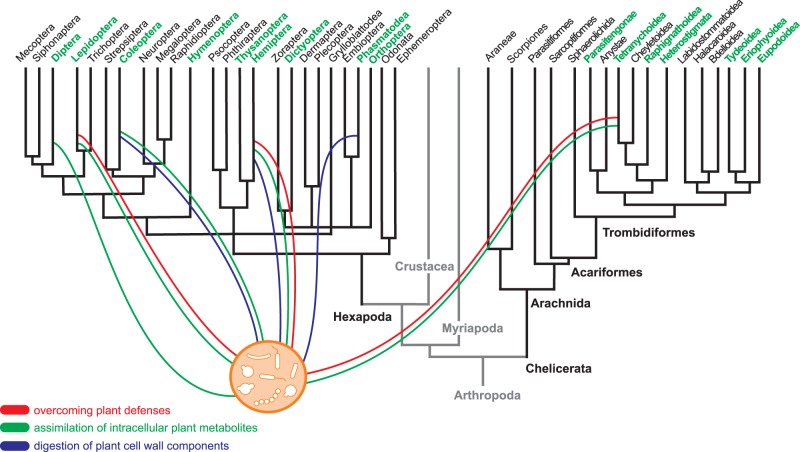
Within animals, evolutionary transition toward herbivory is severely limited by the hostile characteristics of plants. Arthropods have nonetheless counteracted many nutritional and defensive barriers imposed by plants and are currently considered as the most successful animal herbivores in terrestrial ecosystems. We gather a body of evidence showing that genomes of various plant feeding insects and mites possess genes whose presence can only be explained by horizontal gene transfer (HGT). HGT is the asexual transmission of genetic information between reproductively isolated species. Although HGT is known to have great adaptive significance in prokaryotes, its impact on eukaryotic evolution remains obscure. Here, we show that laterally transferred genes into arthropods underpin many adaptations to phytophagy, including efficient assimilation and detoxification of plant produced metabolites. Horizontally acquired genes and the traits they encode often functionally diversify within arthropod recipients, enabling the colonization of more host plant species and organs. We demonstrate that HGT can drive metazoan evolution by uncovering its prominent role in the adaptations of arthropods to exploit plants.
Overview
The claims and statistics of this paper haven’t been checked yet.
Free: it reads the open-access text and checks the first 5 claims that cite a source we can check. Create a free account to check every claim.
Integrity signals
Registry
Cites
Statistics
Figures
Verification
Claims the paper makes
The claims and statistics of this paper haven’t been checked yet.
Free: it reads the open-access text and checks the first 5 claims that cite a source we can check. Create a free account to check every claim.
Claims other papers make about this one
Each is checked against this paper’s own text: does it say what the citing paper says it does?
The source backs part of the claim, not all of it — or backs it for a different population, condition or comparison.
In the citing paper
“A notable example in animals is the presence of microbial genes in the genome of the coffee borer beetle Hypothenemus hampei, which facilitates the digestion of caffeine and reflects a functional adaptation through HGT [35].”
From Origin and Evolution of Genes in Eukaryotes: Mechanisms, Dynamics, and Functional Implications (2025) · cites this paper as [35]
Experimental — accuracy not yet measured
Self-check
Percentages, sums and reported differences re-computed from the paper’s own numbers.
The self-check needs the paper’s full text.
Citations
Cites
The Carbohydrate-Active EnZymes database (CAZy): an expert resource for Glycogenomics
Cantarel, B. L., Coutinho, P. M., Rancurel, C., Bernard, T., Lombard, V., & Henrissat, B. (2009) · Nucleic Acids Research · doi:10.1093/nar/gkn663 · Cited by 5,972 · cited 2×
“GHs are delineated into specific families and sub-families through the curated Carbohydrate-Active database of enzymes involved in carbohydrate metabolism (Cantarel et al. 2009).”
OrthoMCL: Identification of Ortholog Groups for Eukaryotic Genomes
Li, L., Stoeckert, C. J., & Roos, D. S. (2003) · Genome Research · doi:10.1101/gr.1224503 · Cited by 5,707 · cited 1×
“Using the plethora of sequenced genomes, families of orthologues can be systemically classified (Tatusov et al. 1997; Li et al. 2003).”
Carpita, N., & Gibeaut, D. (1993) · The Plant Journal · doi:10.1046/j.1365-313x.1993.00999.x · Cited by 3,651 · cited 1×
“In some plant species, these composite fibers form a thick rigid layer (for instance in woody plants), and pose a barrier for arthropods aiming to feed on plant nutrients (Carpita and Gibeaut 1993; Whetten and Sederoff 1995; Heredia 2003; Sorensen et al. 2010).”
A Genomic Perspective on Protein Families
Tatusov, R. L., Koonin, E. V., & Lipman, D. J. (1997) · Science · doi:10.1126/science.278.5338.631 · Cited by 3,590 · cited 1×
“Using the plethora of sequenced genomes, families of orthologues can be systemically classified (Tatusov et al. 1997; Li et al. 2003).”
Herbivory in Relation to Plant Nitrogen Content
Mattson, W. J. (1980) · Annual Review of Ecology and Systematics · doi:10.1146/annurev.es.11.110180.001003 · Cited by 3,425 · cited 2×
“As many plant species and tissues are characterized by a relatively high carbohydrate content, but low protein and vitamin levels (Mattson 1980; Strong et al. 1984; Awmack and Leather 2002), herbivorous animals need to optimize the assimilation of the limited supply of nutrients in plant tissues.”
Phylogenomics resolves the timing and pattern of insect evolution
Misof, B., Liu, S., Meusemann, K., Peters, R. S., Donath, A., Mayer, C., Frandsen, P. B., Ware, J., Flouri, T., Beutel, R. G., et al. (2014) · Science · doi:10.1126/science.1257570 · Cited by 2,694 · cited 1×
“For many arthropod studies, both requirements can be met as a significant part of the arthropod phylogenomic tree is well mapped and keeps improving due to the increasing number of sequenced arthropod genomes and transcriptomes (Regier et al. 2010; Wheat and Wahlberg 2013; Misof et al. 2014).”
Plant Immunity to Insect Herbivores
Howe, G. A., & Jander, G. (2008) · Annual Review of Plant Biology · doi:10.1146/annurev.arplant.59.032607.092825 · Cited by 2,427 · cited 2×
“Plant resistance to herbivory can be achieved by physical barriers such as trichomes and waxy cuticles and/or by the production of chemical defenses (Howe and Jander 2008).”
Host Plant Quality and Fecundity in Herbivorous Insects
Awmack, C. S., & Leather, S. R. (2002) · Annual Review of Entomology · doi:10.1146/annurev.ento.47.091201.145300 · Cited by 2,201 · cited 2×
“As many plant species and tissues are characterized by a relatively high carbohydrate content, but low protein and vitamin levels (Mattson 1980; Strong et al. 1984; Awmack and Leather 2002), herbivorous animals need to optimize the assimilation of the limited supply of nutrients in plant tissues.”
Schoonhoven, L. M., Jermy, T., & van Loon, J. J. A. (1998) · Springer eBooks · doi:10.1007/978-1-4899-3200-6 · Cited by 1,686 · cited 2×
“The arthropod phylum is now considered to harbor the most successful animal herbivores in terrestrial ecosystems, both in terms of biomass and species diversity (Strong et al. 1984; Labandeira 2002, 2006; Schoonhoven et al. 2006) (fig.”
Fundamentals of molecular evolution
(1991) · Journal of Human Evolution · doi:10.1016/0047-2484(91)90069-8 · Cited by 1,654
Cited by
Items 101–200 of 222
Plastid‐mediated RNA interference: A potential strategy for efficient pest control
Li, S., Kim, D. S., & Zhang, J. (2023) · Plant Cell & Environment · doi:10.1111/pce.14652 · Cited by 16
Ramakrishnan, B., Maddela, N. R., Venkateswarlu, K., & Megharaj, M. (2021) · Environmental Advances · doi:10.1016/j.envadv.2021.100091 · Cited by 12
Moreau, S. J. M., Marchal, L., Boulain, H., Musset, K., Labas, V., Tomás, D., Gauthier, J., & Drezen, J. (2025) · BMC Genomics · doi:10.1186/s12864-025-11604-y · Cited by 12
“Horizontal or lateral gene transfer from bacteria is an important route for metabolic innovation in insects [112].”
Molecular mechanisms of pesticide selectivity: Insights from acaricide toxicology
İnak, E., Rouck, S. D., & Leeuwen, T. V. (2025) · Pesticide Biochemistry and Physiology · doi:10.1016/j.pestbp.2025.106537 · Cited by 11
The Microbiome as a Driver of Insect Physiology, Behavior, and Control Strategies
Darwish, H. A., Tariq, M., Salama, S., Hart, T., & Sun, J. S. (2025) · Applied Microbiology · doi:10.3390/applmicrobiol5030090 · Cited by 12
“Similar processes have been reported for the acquisition of plant cell-wall-degrading pectinases from bacteria by stick insects, expanding host dietary breadth [53].”
Carotenoid modifying enzymes in metazoans
Moise, A. R., Bandara, S., & Lintig, J. V. (2022) · Methods in enzymology on CD-ROM/Methods in enzymology · doi:10.1016/bs.mie.2022.05.005 · Cited by 13
Massive Somatic and Germline Chromosomal Integrations of Polydnaviruses in Lepidopterans
Heisserer, C., Muller, H., Jouan, V., Musset, K., Périquet, G., Drezen, J., Volkoff, A., & Gilbert, C. (2023) · Molecular Biology and Evolution · doi:10.1093/molbev/msad050 · Cited by 11
“…often with functional evidence supporting an important role played by horizontally transferred genes in the recipient species (Moran and Jarvik 2010; Acuna et al. 2012; Wybouw et al. 2014, 2016; Danchin et al. 2016; Leclercq et al. 2016; Gasmi et al. 2021; Xia et al. 2021; Cummings et al. 2022).”
BackgroundGene novelty and gene family expansion in the early evolution of Lepidoptera
Hoile, A. E., Holland, P. W. H., & Mulhair, P. O. (2025) · BMC Genomics · doi:10.1186/s12864-025-11338-x · Cited by 10
“Examples in arthropods include horizontally acquired genes from bacteria underpinning adaptations to phytophagy [37] or male courtship behaviour in moths and butterflies [32], and divergent gene duplicates recruited for limb patterning in water striders [38].”
Mahillon, M., Debonneville, C., Groux, R., Roquis, D., Brodard, J., Faoro, F., Foissac, X., Schumpp, O., & Dittmer, J. (2025) · mSystems · doi:10.1128/msystems.01496-24 · Cited by 11
“Surprisingly, homologs of these CWDEs are also found in several mites and a fungus gnat, indicating probable cross-kingdom HGT. Notably, HGT between bacteria and arthropods has been previously documented and includes genes crucial for plant adaptation (78, 79).”
Aliens in the CYPome of the black fungus gnat, Bradysia coprophila
Feyereisen, R., Urban, J. M., & Nelson, D. R. (2023) · Insect Biochemistry and Molecular Biology · doi:10.1016/j.ibmb.2023.103965 · Cited by 12
S-plot2: Rapid Visual and Statistical Analysis of Genomic Sequences
Kalesinskas, L., Cudone, E., Fofanov, Y., & Putonti, C. (2018) · Evolutionary Bioinformatics · doi:10.1177/1176934318797354 · Cited by 11
Horizontal Gene Transfer in Metazoa: Examples and Methods
Yoshida, Y., Nowell, R. W., Arakawa, K., & Blaxter, M. (2019) · Springer eBooks · doi:10.1007/978-3-030-21862-1_7 · Cited by 11
Ribosome inactivating proteins in insects: HGT, gene expression, and functional implications
Lapadula, W. J., & Ayub, M. J. (2023) · Gene · doi:10.1016/j.gene.2023.147547 · Cited by 10
Ojeda-Martinez, D., Díaz, I., Santamaria, M. E., & Ortego, F. (2024) · Computational and Structural Biotechnology Journal · doi:10.1016/j.csbj.2024.10.027 · Cited by 9
“One such mechanism is horizontal gene transfer (HGT), through which arthropods have acquired the ability to degrade lignocellulose [14].”
Li, Y., Zhou, Y., Jing, W., Xu, S., Jin, Y., Xu, Y., & Wang, H. (2021) · Heredity · doi:10.1038/s41437-021-00430-z · Cited by 10
“HGT may play an important role in the adaptive evolution of these organisms (Acuna et al. 2012; Wybouw et al. 2016; Husnik and McCutcheon 2018).”
BackgroundStructural basis of lignocellulose deconstruction by the wood-feeding anobiid beetle Nicobium hirtum
Krishanti, N. P. R. A., Tobimatsu, Y., Miyamoto, T., Fujimoto, I., Kartika, T., Umezawa, T., Hata, T., & Yoshimura, T. (2022) · Journal of Wood Science · doi:10.1186/s10086-022-02017-6 · Cited by 9
“Recent genomic studies have emphasized the importance of the endogenous PCWDEs in beetles [2, 3, 7, 16], many of which are thought to have originated from bacteria or fungi via horizontal gene transfer during the evolution and biodiversification of herbivorous beetles [16, 38].”
BackgroundHorizontally transferred genes in the ctenophore Mnemiopsis leidyi
Hernandez, A. M., & Ryan, J. F. (2018) · PeerJ · doi:10.7717/peerj.5067 · Cited by 14
“For example, HGTs have played an important role in herbivory in arthropods (Wybouw et al., 2016), venom recruitment in parasitoid wasps (Martinson et al., 2016), cellulose production in urochordates (Dehal et al., 2002) and plant parasitism in nematodes (Haegeman, Jones & Danchin, 2011).”
BackgroundChen, S., Yu, T. Y., Terrapon, N., Henrissat, B., & Walker, E. D. (2021) · Genes · doi:10.3390/genes12050752 · Cited by 8
“These domains may be acquired through horizontal gene transfer (HGT) from the eukaryote hosts or through convergent evolution [49].”
BackgroundMorozov, S. Y., Lazareva, E. A., & Solovyev, A. G. (2017) · PeerJ · doi:10.7717/peerj.3673 · Cited by 8
“Among these orders (Diptera, Coleoptera, Hemiptera, Thysanoptera, Hymenoptera, Phasmatodea and Orthoptera), hemipteran species, like lepidopteran insects, are more refractory to dsRNA-induced silencing (Swevers, Van den Broeck & Smagghe, 2013; Wybouw et al., 2016).”
BackgroundHorizontal Transfer and Gene Loss Shaped the Evolution of Alpha-Amylases in Bilaterians
Desiderato, A., Barbeitos, M. S., Gilbert, C., & Lage, J. D. (2020) · G3 Genes Genomes Genetics · doi:10.1534/g3.119.400826 · Cited by 9
Deep learning for HGT insertion sites recognition
Li, C., Chen, J., & Li, S. C. (2020) · BMC Genomics · doi:10.1186/s12864-020-07296-1 · Cited by 8
A Horizontal Gene Transfer Led to the Acquisition of a Fructan Metabolic Pathway in a Gall Midge
Cheng, X., Garcés‐Carrera, S., Whitworth, R. J., Fellers, J. P., Park, Y., & Chen, M. (2020) · Advanced Biosystems · doi:10.1002/adbi.201900275 · Cited by 8
Bhuvaragavan, S., Reshma, T., Hilda, K., Meenakumari, M., Sruthi, K., Nivetha, R., & Janarthanan, S. (2023) · Archives of Insect Biochemistry and Physiology · doi:10.1002/arch.22031 · Cited by 7
A Behavior-Manipulating Virus Relative As a Source of Adaptive Genes for Parasitoid WaspsPreprint
Giovanni, D. D., Lepetit, D., Boulesteix, M., Couté, Y., Ravallec, M., & Varaldi, J. (2018) · SSRN Electronic Journal · doi:10.1101/342758 · Cited by 7
“…mites and Lepidoptera that deal with chemical defenses of their host plant thanks to the acquisition of a bacterial gene involved in detoxification [79], several phytophagous arthropods (Aphids, mites and gall midges) who independently acquired genes involved in carotenoid biosynthesis from fungal…”
BackgroundMultiple Horizontal Transfers of Immune Genes Between Distantly Related Teleost Fishes
Policarpo, M., Salzburger, W., Maumus, F., & Gilbert, C. (2025) · Molecular Biology and Evolution · doi:10.1093/molbev/msaf107 · Cited by 7
“For example, in arthropods, HGT from bacteria and other sources likely facilitated the replicate evolution toward herbivory in mites and in species belonging to at least five insect orders (Xia et al. 2021; Gilbert and Maumus 2022; Kirsch et al. 2022; Wybouw et al. 2016; Wybouw et al. 2018).”
Yadav, A., Suhag, A., Jaiwal, R., Chaudhary, D., & Jaiwal, P. K. (2024) · Journal of Asia-Pacific Entomology · doi:10.1016/j.aspen.2024.102216 · Cited by 6
Database Bias in the Detection of Interdomain Horizontal Gene Transfer Events in Pezizomycotina
Aguirre-Carvajal, K., Munteanu, C. R., & Armijos‐Jaramillo, V. (2024) · Biology · doi:10.3390/biology13070469 · Cited by 6
Genomic evidence for the widespread presence of GH45 cellulases among soil invertebrates
Muelbaier, H., Arthen, F., Collins, G. E., Hickler, T., Hohberg, K., Lehmitz, R., Pauchet, Y., Pfenninger, M., Potapov, A., Romahn, J., et al. (2024) · Molecular Ecology · doi:10.1111/mec.17351 · Cited by 7
“The horizontal acquisition of cellulases and of other plant cell wall-degrading enzymes likely was a key event driving the evolutionary emergence of herbivory in arthropods (Wybouw et al., 2016).”
Self-citationMori, B. A., Coutu, C., Erlandson, M. A., & Hegedus, D. D. (2024) · Archives of Insect Biochemistry and Physiology · doi:10.1002/arch.22135 · Cited by 6
Variation among arthropod taxa in the amino acid content of exoskeleton and digestible tissue
Reeves, J. T., Herzog, C., Barnes, C. L., Davis, C. A., Fuhlendorf, S. D., & Wilder, S. M. (2023) · Ecology and Evolution · doi:10.1002/ece3.10348 · Cited by 6
“Hence, similarity among taxa in amino acid content of digestible tissue is not unexpected (see also Wybouw et al., 2016).”
Evolution: Symbiotic Microbes Mediate Host Range of Herbivorous Beetles
McKenna, D. D. (2020) · Current Biology · doi:10.1016/j.cub.2020.05.089 · Cited by 6
Lim, Z. H., Zheng, P., Quek, C., Nowrousian, M., Aachmann, F. L., & Jedd, G. (2025) · PLoS Biology · doi:10.1371/journal.pbio.3003038 · Cited by 5
“However, relatively few studies have performed functional assays to document new protein activities in duplication-derived paralogs [84–87].”
Composition, evolution, and functions of herbivorous insect saliva
HUANG, H., Li, J., Chen, J., & Zhang, C. (2025) · Scientia Sinica Vitae · doi:10.1360/ssv-2025-0081 · Cited by 5
Ohata, Y., Sugimoto, T. N., Wybouw, N., & Tagami, Y. (2025) · Royal Society Open Science · doi:10.1098/rsos.242137 · Cited by 5
“…symbionts through horizontal transfer from sympatric closely interacting insects and through interspecific hybridization followed by introgression [58–62], we hypothesize that w Ltri Wolbachia of L. trifolii might be the donor variant for the Wolbachia nuclear insert in Japanese L. sativae .”
Self-citationO’Connor, T. K., Sandoval, M. C., Wang, J., Hans, J. C., Takenaka, R., Child, M., & Whiteman, N. K. (2021) · Evolution · doi:10.1111/evo.14321 · Cited by 5
Zarlenga, D. S., Thompson, P. C., Mitreva, M., Rosa, B. A., & Hoberg, E. P. (2022) · Food and Waterborne Parasitology · doi:10.1016/j.fawpar.2022.e00155 · Cited by 5
Muller, H., Heisserer, C., Fortuna, T. M., Mougel, F., Huguet, E., Kaiser, L., & Gilbert, C. (2022) · Molecular Ecology · doi:10.1111/mec.16685 · Cited by 5
“Many studies report remarkable examples of HT of genes with important consequences in multiple lineages (Danchin et al., 2016; Li et al., 2022; Simion et al., 2021; Wybouw et al., 2016; Xia et al., 2021).”
BackgroundRelation of Plants with Other Kingdoms: the Unique Role of Fructans
Morvan‐Bertrand, A., den Ende, W. V., & Prudhomme, M. P. (2023) · Elsevier eBooks · doi:10.1016/b978-0-323-85410-8.00010-7 · Cited by 5
Ibarra, L. N., Alves, A. E. O. D. A., Antonino, J. D., Prado, G. S., Pinto, C. E. M., Soccol, C. R., de Vasconcelos, É. A. R., & Grossi‐de‐Sá, M. F. (2019) · Scientific Reports · doi:10.1038/s41598-019-56070-1 · Cited by 5
Mechanisms underlying microbial symbiosis
Russell, J. A., & Oliver, K. M. (2020) · Advances in insect physiology · doi:10.1016/bs.aiip.2020.04.003 · Cited by 8
Alpkent, Y. N., Gök, N., Çobanoğlu, S., İnak, E., & Leeuwen, T. V. (2025) · Crop Protection · doi:10.1016/j.cropro.2025.107356 · Cited by 4
Beyond Adaptive Gene Transfers: A Primer on Horizontal Gene Transfer Across Scales
Etten, J. V., & Johnson, M. D. (2026) · Integrative and Comparative Biology · doi:10.1093/icb/icag125 · Cited by 4
Horizontal Gene Transfer Between Wolbachia and Animals
de Miguel, T., Zhu, O., & Villa, T. G. (2019) · Springer eBooks · doi:10.1007/978-3-030-21862-1_8 · Cited by 4
Narva, K. E., Gordon, E. R. L., İnak, E., Smith, S., Whipple, S. D., Manley, B., do Nascimento, J. M., Zhurov, V., Singh, V., Bruinsma, K. A., et al. (2026) · Insect Biochemistry and Molecular Biology · doi:10.1016/j.ibmb.2026.104520 · Cited by 3
Rinke, J. L., Franke, L., He, D., Fischer, M. L., Vizueta, J., Eicholt, L. A., Larsen, R. S., Xiong, Z., Cunningham, P., Henry, L. M., et al. (2026) · GigaScience · doi:10.1093/gigascience/giag043 · Cited by 3
“Nonetheless, an expanding body of evidence indicates the widespread occurrence of HGTs across eukaryotic lineages, with a small subset shown to possess adaptive potential, substantiated by functional validation in specific taxa [ 16–18 ].”
Amezian, D., Graeve, F. D., Sasi, R. M., Vanhaecht, L., Mocchetti, A., Villacis‐Perez, E., Kant, M. R., Rouck, S. D., & Leeuwen, T. V. (2026) · Insect Biochemistry and Molecular Biology · doi:10.1016/j.ibmb.2026.104588 · Cited by 3
Horizontally transferred glycoside hydrolase 26 may aid hemipteran insects in plant tissue digestion
Walt, H. K., Ahn, S., & Hoffmann, F. G. (2024) · Molecular Phylogenetics and Evolution · doi:10.1016/j.ympev.2024.108134 · Cited by 3
Osakabe, M. (2024) · 日本ダニ学会誌 · doi:10.2300/acari.33.59 · Cited by 3
Yang, K.-Y., Sun, Y., Liang, Y., Li, H., Qi, M.-X., Wang, Z., Aguila, L. C. R., Cai, L.-Q., Li, H., & Pang, H. (2025) · Insect Biochemistry and Molecular Biology · doi:10.1016/j.ibmb.2025.104397 · Cited by 2
Picimbon, J. (2026) · Journal of Molecular Evolution · doi:10.1007/s00239-025-10297-x · Cited by 2
“However, it is not surprising that CSP was discovered in bacteria and crus-taceans, as horizontal transfer is a major factor in the evolution of arthropods (Wybouw et al. 2016; see Tables 1, 2).”
Tripartite parasitic and symbiotic interactions as a possible mechanism of horizontal gene transfer
Zhao, C., Miao, S., Yin, Y., Zhu, Y., Nabity, P. D., Bansal, R., & Liu, C. (2021) · Ecology and Evolution · doi:10.1002/ece3.7550 · Cited by 2
“…immunity signaling pathways and stimulate the accumulation of plant nutrients at the feeding sites, for example, by inducing the formation of plant galls, abnormal growth of plant tissues favorable to insect feeding (van Bel & Will, 2016; Sharma et al., 2014; Xu et al., 2019; Zhao et al., 2015).”
BackgroundTrichinella: Becoming a parasite
Zarlenga, D. S., Hoberg, E. P., Thompson, P. C., & Rosenthal, B. M. (2024) · Veterinary Parasitology · doi:10.1016/j.vetpar.2024.110220 · Cited by 2
Konarev, A. V. (2023) · Plant Protection News · doi:10.31993/2308-6459-2023-106-1-15625 · Cited by 2
Mechanisms of Avoiding the Action of Plant Inhibitors on Digestion
Terra, W. R., Ferreira, C., & Silva, C. P. (2023) · Entomology in focus · doi:10.1007/978-3-031-39233-7_11 · Cited by 2
Adaptation of an herbivorous arthropod to green tea plants by overcoming catechin defensesPreprint
Takeda, N., Abiskaroon, B., Arriaza, R. H., Murakami, R., Sasaki, S., Yamamoto, M., Zhurov, V. V., Grbić, V., Chruszcz, M., & Suzuki, T. (2026) · eLife · doi:10.7554/elife.110082.1 · Cited by 2
Hu, T., Ma, L., Zhang, Z., Li, J., Zhang, C., & Huang, H. (2025) · Pest Management Science · doi:10.1002/ps.70147 · Cited by 1
Ste‐Croix, D. T., Gagnon, A., & Mimee, B. (2025) · Insect Molecular Biology · doi:10.1111/imb.70012 · Cited by 1
“HGT is also believed to facilitate insects ’ adaptation to herbivory by enabling them to use genes from prokaryotes to detoxify plant metabolites (Wybouw et al., 2016).”
Zhang, X., Li, Y., Li, L., Wang, H., Lu, Y., Su, J., & Zhang, J. (2026) · Journal of Applied Entomology · doi:10.1111/jen.70065 · Cited by 1
“Collectively, these host-specific nutritional traits jointly explain the differences in the reproductive performance of T. urticae across the three host plants: cucumber, sweet pepper and kidney bean (Wybouw et al. 2016).”
Kim, S., & Farrell, B. D. (2026) · Molecular Ecology Resources · doi:10.1111/1755-0998.70117 · Cited by 1
“Among PCWDEs in longhorned beetles, GH5_2 genes have been extensively studied for their evolutionary and functional significance (McKenna et al. 2016, 2019; Pauchet et al. 2010; Shin et al. 2022, 2021; Wybouw et al. 2016).”
Cao, Y., Liu, X., Ma, F., Zhang, J., & Jin, P. (2026) · Communications Biology · doi:10.1038/s42003-026-10170-7 · Cited by 1
“Numerous HTGs from microorganisms have been detected in the genomes of mites and phytophagous insects, which have detoxi fi cation effects and facilitate the assimilation of plant compounds in the hosts 30 .”
Choi, M., Khan, M., & Kim, J. (2026) · Insect Molecular Biology · doi:10.1111/imb.70055 · Cited by 1
Evolutionary dynamics of plant cell wall-degrading enzymes reflects feeding ecology in weevils
Shin, N. R., Kirsch, R., Vogel, H., Riedel, A., Kaltenpoth, M., & Pauchet, Y. (2026) · Communications Biology · doi:10.1038/s42003-026-10927-0 · Cited by 1
“Interestingly, many of these insect-encoded PCWDEs were acquired by horizontal gene transfer (HGT) events that occurred multiple times independently in herbivorous insect clades like stick insects, bugs, wasps and beetles 17,18 .”
Self-citationIntegration of Foreign Genetic Material Provokes Local Mutagenesis in the Recipient Genome
Glazunova, O. A. (2016) · Mathematical Biology and Bioinformatics · doi:10.17537/2016.11.394 · Cited by 1
Evolutionary cell biology comes of age
Dey, G., Fritz‐Laylin, L. K., Oliferenko, S., & Tromer, E. C. (2024) · Journal of Cell Science · doi:10.1242/jcs.264348 · Cited by 1
“Their acquisition endows organisms with novel traits, such as utilisation of new resources (Wybouw et al., 2016), new approaches for defence or predation (Moran et al., 2012), or the ability to thrive in new environments (Boschetti et al., 2012; Rao et al., 2025; Stairs et al., 2018).”
Plasticity-first evolution via CYP405 loss shaped chemical defenses in butterflies
de Castro, É. C. P., Cicconardi, F., Warren, I. A., Rueda‐M, N., Salazar, C. A., Bak, S., Montgomery, S. H., & Jiggins, C. D. (2026) · Molecular Biology and Evolution · doi:10.1093/molbev/msag197 · Cited by 1
“As such, gene co-option (Petschenka and Agrawal 2016) and horizontal gene transfer (Piel et al. 2004; Wybouw et al. 2016) can facilitate the acquisition of toxicity.”
Szwedo, J. (2020) · Palaeoentomology · doi:10.11646/palaeoentomology.3.2.1 · Cited by 1
“The horizontal acquisition of genes for lignocellulose digestion that has led to herbivory in beetles (Wybouw et al., 2016; McKenna et al., 2019).”
BackgroundEditorial overview: Molecular physiology of the multifunctional insect gut
Behmer, S. T., & Vogel, H. (2020) · Current Opinion in Insect Science · doi:10.1016/j.cois.2020.10.010 · Cited by 1
Kozlowski, D. K. L. (2020) · theses.fr (ABES) · doi:10.70675/a4f4a6efz44b4z4777zbcd1z7b96964471e0 · Cited by 2
Evangelista, D. E. (2018) · Digital Library of Theses and Dissertations (Universidade de São Paulo) · doi:10.11606/t.76.2018.tde-29012018-095835 · Cited by 4
Snoeck, S. (2019) · Ghent University Academic Bibliography (Ghent University)
Fungi ligE-type glutathione S-transferases horizontally transferred into plants and a protozoanPreprint
Li, D., & Zhang, M. (2020) · bioRxiv (Cold Spring Harbor Laboratory) · doi:10.1101/2020.06.24.168203
Das hohe Gut der Unabhängigkeit: Chemische Tricks der Tiere und Pflanzen
Tetsch, L. (2020) · Chemie in unserer Zeit · doi:10.1002/ciuz.202000040
Expressão de celulases recombinantes de insetos praga em Pichia Pastoris™
Alves, A. E. O. D. A. (2020) · RIUnB Institutional Repository (University of Brasília) · doi:10.26512/2020.03.t.38858
Impact of antibiotic-resistant bacteria on the environment
Ahmad, S., Mughal, A. F., Abbas, S., Mumtaz, A., Khalid, R., & Ahmed, I. (2022) · Elsevier eBooks · doi:10.1016/b978-0-323-90555-8.00009-x
Mozhaitseva, K., Tourrain, Z., & Branca, A. (2023) · bioRxiv (Cold Spring Harbor Laboratory) · doi:10.1101/2023.11.06.564334
Genetic basis of gall formation and modes of reproduction in gall wasps (Hymenoptera, Cynipidae)
Mozhaitseva, K. (2023) · theses.fr (ABES) · doi:10.70675/b54247a2z33f6z41b5z880bz820775890684 · Cited by 4
Huo, S., Yan, Z., Zhang, F., Chen, L., Sun, J., Hoffmann, A. A., & Hong, X. (2021) · Figshare · doi:10.6084/m9.figshare.15047610
Li, H., Tang, X., Huang, Y., Xu, Z.-Y., Chen, M., Du, X., Qiu, B.-Y., Chen, P., Zhang, W., Ślipiński, A., et al. (2021) · Figshare · doi:10.6084/m9.figshare.13579032
Huo, S., Yan, Z., Zhang, F., Chen, L., Sun, J., Hoffmann, A. A., & Hong, X. (2021) · Figshare · doi:10.6084/m9.figshare.15047607
Huo, S., Yan, Z., Zhang, F., Chen, L., Sun, J., Hoffmann, A. A., & Hong, X. (2021) · Figshare · doi:10.6084/m9.figshare.15047616
Li, H., Tang, X., Huang, Y., Xu, Z.-Y., Chen, M., Du, X., Qiu, B.-Y., Chen, P., Zhang, W., Ślipiński, A., et al. (2021) · Figshare · doi:10.6084/m9.figshare.13579026
Huo, S., Yan, Z., Zhang, F., Chen, L., Sun, J., Hoffmann, A. A., & Hong, X. (2021) · Figshare · doi:10.6084/m9.figshare.15047631
Li, H., Tang, X., Huang, Y., Xu, Z.-Y., Chen, M., Du, X., Qiu, B.-Y., Chen, P., Zhang, W., Ślipiński, A., et al. (2021) · Figshare · doi:10.6084/m9.figshare.13579029
Huo, S., Yan, Z., Zhang, F., Chen, L., Sun, J., Hoffmann, A. A., & Hong, X. (2021) · Figshare · doi:10.6084/m9.figshare.15047622
Konarev, A. V. (2024) · Biology Bulletin Reviews · doi:10.1134/s2079086424600954
“Such genes can be specific to a genus or even a species of insect (Wybouw et al., 2016).”
Velasco‐Cuervo, S. M., Lemos-Lucumí, C. A., Manzano, M. R., Strelkov, S. E., Toro‐Perea, N., & Galindo‐González, L. (2025) · Entomologia Experimentalis et Applicata · doi:10.1111/eea.13573
“In contrast, generalists often show an expanded repertoire of genes related to che-moreception and detoxification, along with neofunctional-ization and lateral gene transfer (Birnbaum & Abbot, 2020; Fischer et al., 2008; Heidel-Fischer et al., 2019; Wybouw et al., 2016).”
Plastid-Mediated RNA Interference for Pest Control
Li, S., Wu, M., & Zhang, J. (2025) · Springer eBooks · doi:10.1007/978-3-031-81549-2_8
Overview of Mechanisms Underlying the Early Stages of Phytophagous Insect Host Shift to Alien Plants
Ustinova, E. N., & Lysenkov, S. N. (2025) · Russian Journal of Biological Invasions · doi:10.1134/s2075111725700110
“An alternative mechanism for acquiring new enzymatic functions for xenobiotic detoxification is horizontal gene transfer (HGT) (Wybouw et al., 2016; Xing et al., 2023).”
Jin, M., Li, H., Duan, Y., Gong, Z., Tan, X., Lu, R., Bilal, M., & Wu, Y. (2025) · Insects · doi:10.3390/insects16101013
“Our work expands the known functions of HGT in arthropods beyond classical roles in detoxification [12] and reveals a temperature-gated strategy for environmental adaptation.”
Adaptation of an herbivorous arthropod to green tea plants by overcoming catechin defensesPreprint
Takeda, N., Abiskaroon, B., Arriaza, R. H., Murakami, R., Sasaki, S., Yamamoto, M., Zhurov, V., Grbić, V., Chruszcz, M., & Suzuki, T. (2025) · bioRxiv (Cold Spring Harbor Laboratory) · doi:10.64898/2025.12.13.694159
“However, some arthropod detoxification genes show high similarity to microbial genes and unusual phylogenetic patterns, suggesting acquisition through HGT (Wybouw et al., 2016).”
InfluentialLi, H.-S., Tang, X.-F., Huang, Y.-H., Xu, Z.-Y., Chen, M.-L., Du, X., Qiu, B.-Y., Chen, P.-T., Zhang, W., Ślipiński, A., et al. (2021) · Figshare · doi:10.6084/m9.figshare.13579023
Njiru, C., Xue, W., Rouck, S. D., Alba, J. M., Kant, M. R., Chruszcz, M., Vanholme, B., Dermauw, W., Wybouw, N., & Leeuwen, T. V. (2022) · Figshare · doi:10.6084/m9.figshare.20003802
Self-citationNjiru, C., Xue, W., Rouck, S. D., Alba, J. M., Kant, M. R., Chruszcz, M., Vanholme, B., Dermauw, W., Wybouw, N., & Leeuwen, T. V. (2022) · Figshare · doi:10.6084/m9.figshare.20003814
Self-citation
Metadata
- Authors
- Wybouw, N., Pauchet, Y., Heckel, D. G., & Van Leeuwen, T.
- Affiliations
- University of Amsterdam (NL)
- Max Planck Institute for Chemical Ecology (DE)
- Corresponding author
- Wybouw, Nicky
- Venue
- Genome Biology and Evolution
- Publisher
- Oxford University Press (OUP)
- Published
- 2016-06
- Volume
- 8
- Issue
- 6
- Pages
- 1785-1801
- ISSN
- 1759-6653 (ISSN-L)
- PMC
- PMC4943190
- OpenAlex
- W2432572080
- Cited by
- 209
- References
- 152
- Citations by year
- 2026: 16 · 2025: 23 · 2024: 16 · 2023: 19 · 2022: 32 · 2021: 23 · 2020: 28 · 2019: 13 · 2018: 22 · 2017: 14 · 2016: 3
- FWCI
- 20.30
- Type
- journal article
- Language
- en
- Open access
- gold
- doi.org
- Licence
- cc-by-nc
- Locations
- Genome Biology and Evolution (publishedVersion, cc-by-nc)
- Europe PMC (PubMed Central) (publishedVersion, cc-by-nc)
- PubMed Central (publishedVersion, cc-by-nc)
- PubMed (publishedVersion)
- Ghent University Academic Bibliography (Ghent University) (submittedVersion, other-oa)
- UvA-DARE (University of Amsterdam) (submittedVersion, cc-by-nc)
- MPG.PuRe (Max Planck Society) (submittedVersion, other-oa)
- Data Archiving and Networked Services (DANS) (submittedVersion, other-oa)
- Max Planck Digital Library (submittedVersion, other-oa)
- HighWire Press Open Archive (submittedVersion)
- Funders
- European Commission (618105, HORIZON2020, 658795)
- Fonds Wetenschappelijk Onderzoek (G.0093.12N, G053815N)
- Max-Planck-Gesellschaft
- Vlaamse regering
- Topics
- Life Sciences › Biochemistry, Genetics and Molecular Biology › Genetics › Chromosomal and Genetic Variations
- Life Sciences › Agricultural and Biological Sciences › Insect Science › Insect symbiosis and bacterial influences
- Life Sciences › Biochemistry, Genetics and Molecular Biology › Molecular Biology › Genomics and Phylogenetic Studies
- Keywords
- horizontal gene transfer, arthropod herbivory, phytophagy, phytophagous insects, plant-feeding mites, plant defense metabolites, detoxification, host plant colonization, eukaryotic evolution, animal evolution
- MeSH terms
- Animals, Arthropods, Biological Evolution, Phylogeny, Plants, Ecosystem, Evolution, Molecular, Gene Transfer, Horizontal, Herbivory
About these checks
Registry, retraction, Cites and statistics results are computed, not judged, with one exception: a printed reference that no index lists is read once by a model before it counts as a citation error. Claims are extracted by a model and kept only when their quote appears verbatim in the text; each cited source is then checked, with a model’s help, for whether it says what the claim relies on. Those verdicts can be wrong — read the claim’s quote and the cited source before relying on one.
Statistics and arithmetic are recomputed, not judged.
Confidence bands are shown only for fields calibrated on our annotated test set. None is calibrated yet, so no band is shown.
What counts as a claim ›How we measure confidence ›How we check this ›
Are you an author, or do you see a problem with this page? Request a review
Data sources
Bibliographic data: Semantic Scholar, OpenAlex, Crossref.
Contains information from the Semantic Scholar Academic Graph Datasets, made available under the ODC Attribution License (ODC-BY 1.0).
Semantic Scholar’s data is described in: Kinney, R., et al. (2023). The Semantic Scholar Open Data Platform. arXiv:2301.10140.
