

ESHRE guideline: endometriosis
Open accessThe DOI matches its Crossref record; 231 of the 250 references it cites were found in a registry or an index; 42 of the 130 sources its claims cite were checked for support.
Abstract
European Society of Human Reproduction and Embryology (ESHRE) clinical guideline on diagnosis and management of endometriosis. Focuses on recommendations for surgical and medical management of pain and infertility. Provides guidance on when to perform surgery for deep infiltrating endometriosis.
Overview
CoChat Summary
TL;DR
This 2022 ESHRE guideline provides 109 recommendations on the diagnosis and management of endometriosis, covering pain, infertility, recurrence, adolescents, menopause, extrapelvic and asymptomatic disease, prevention, and cancer. It updates prior ESHRE guidelines, with five topics where significant changes in clinical practice are expected.
Key findings
- The guideline contains 109 recommendations: 79 supported by research data and 30 good practice points (GPPs), plus 30 research recommendations.
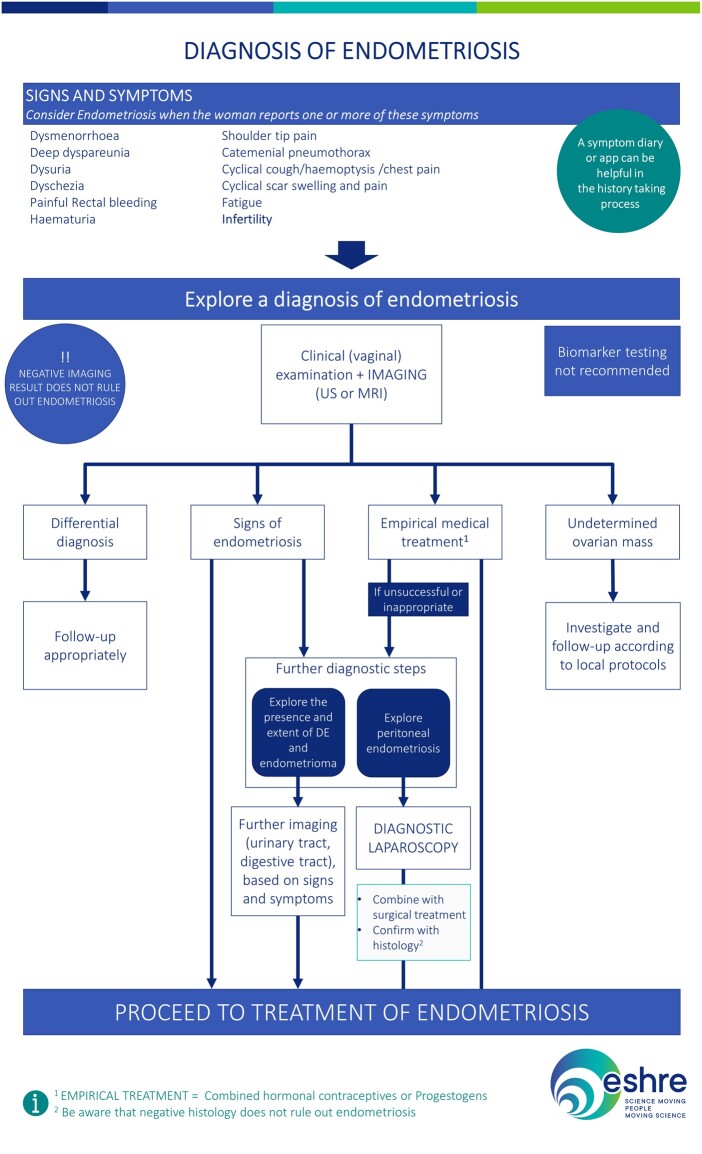
- The diagnostic process challenges laparoscopy and histology as gold standard tests; it recommends imaging (ultrasound or MRI) in the diagnostic work-up, advises against biomarkers for diagnosis, and reserves laparoscopy for patients with negative imaging or unsuccessful/inappropriate empirical treatment.
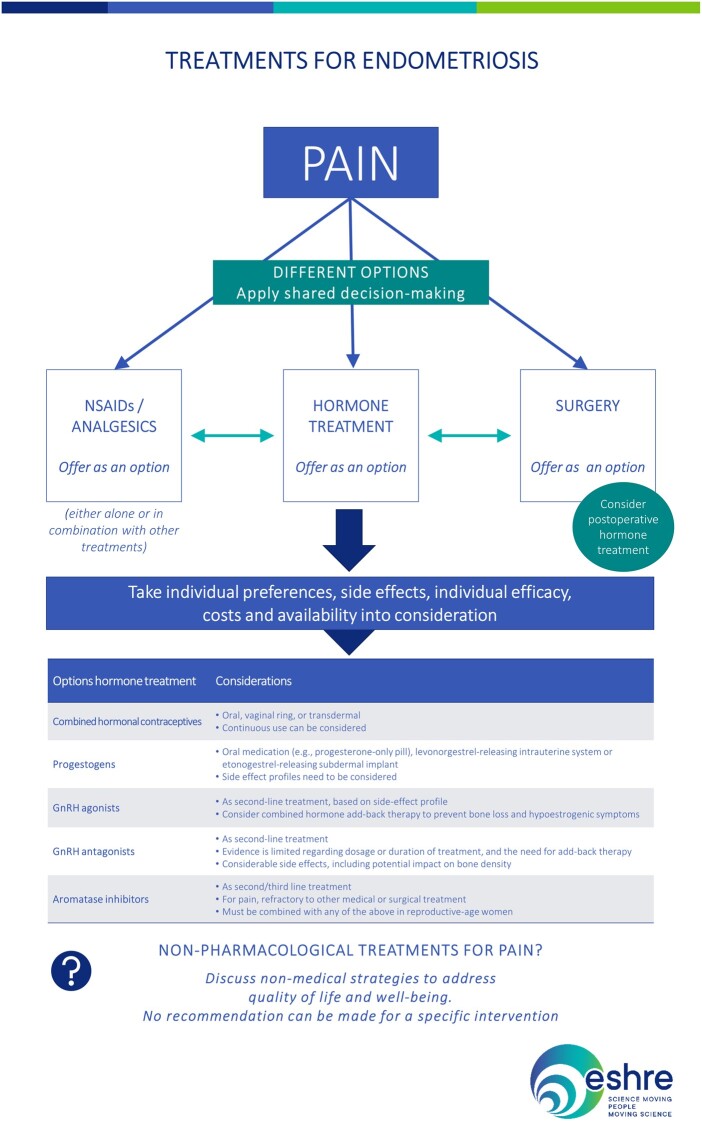
- Treatment options for endometriosis-associated pain include analgesics/NSAIDs, hormonal treatments (combined hormonal contraceptives, progestogens, GnRH agonists or antagonists, aromatase inhibitors), and surgery; five topics with significant changes include the diagnostic process, GnRH antagonists as second-line, postoperative medical treatment for pain, no extended GnRH agonist before ART, and use of the endometriosis fertility index (EFI).
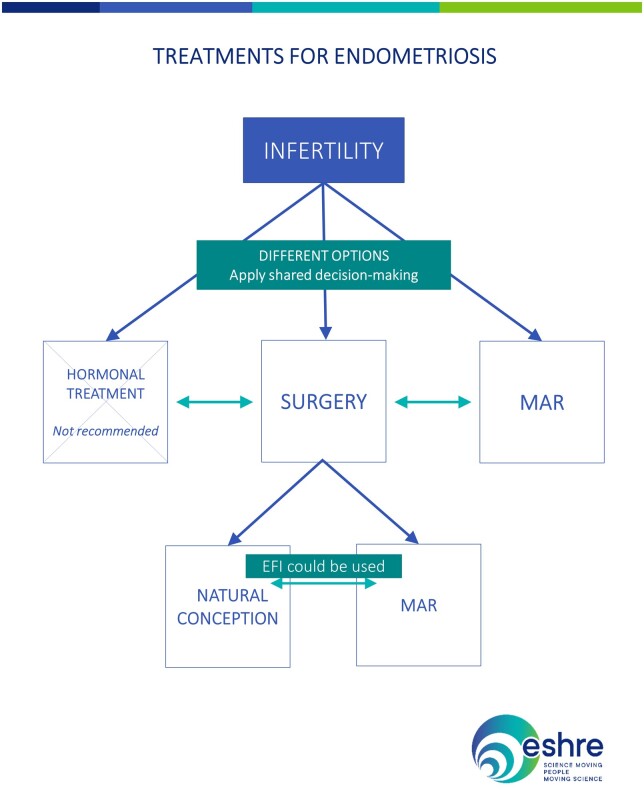
- For endometriosis-associated infertility, surgery and/or medically assisted reproduction are feasible; ovarian suppression, pentoxifylline/anti-inflammatory drugs/letrozole outside ovulation induction, and routine surgery before ART for rASRM stage I/II or endometrioma are not recommended.
Methods
- The guideline was developed according to ESHRE’s structured methodology; 42 key questions were formulated (7 narrative, 35 PICO), with PubMed/MEDLINE and Cochrane searches from inception to 1 December 2020, limited to English-language studies.
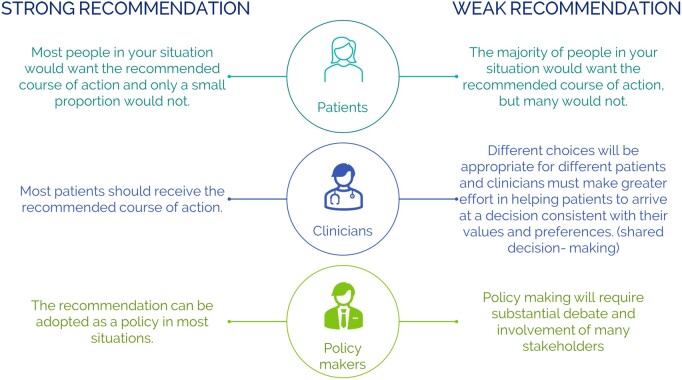
- Evidence was assessed and summarized in evidence tables; recommendations were drafted by specialist subgroups, discussed in core guideline development group meetings until consensus, labelled strong or weak, and graded High, Moderate, Low, or Very low; GPPs were added where relevant.
- A stakeholder review ran from 24 June to 15 August 2021; 56.5% of the 253 comments resulted in an adaptation or correction. The guideline will be considered for update 4 years after publication, with an intermediate assessment at 2 years.
Limitations
- Stated: the guideline describes different management options but, based on existing evidence, no firm recommendations could be formulated on the most appropriate treatments; for specific clinical issues such as asymptomatic endometriosis or extrapelvic endometriosis, evidence is too scarce to make evidence-based recommendations.
- Stated: there is an urgent need for more research on the most appropriate diagnostic and treatment options and on the natural course of the disease.
- Evident from the text: many recommendations are weak or based on low/very low-quality evidence or GPPs; no prognostic markers exist to select patients who would benefit from surgery; no specific non-medical intervention can be recommended; and heterogeneity prevented conclusions on surgical techniques for deep endometriosis-associated pain.
Model-written summary. Check it against the paper before relying on it.
Integrity signals
Registry
Cites
Statistics
Figures
Verification
Claims the paper makes
30 Valid · 5 Not valid · 26 Not checked · 25 Own results and interpretations
At least one cited source doesn’t support this claim or points to a different paper, and none confirmed it — see the verdicts below.
In the paper
“Clinicians may consider operative laparoscopy for the treatment of endometrioma-associated infertility as it may increase their chance of natural pregnancy, although no data from comparative studies exist (Dan and Limin, 2013; Alborzi et al., 2019; Candiani et al., 2020).”
§ ESHRE guideline: endometriosis† > Results > Treatment of endometriosis-associated infertility
What the sources say
- Not checked — no full text of the sourcecites Dan and Limin, 2013 matched to “Laparoscopic ovarian cystectomy versus fenestration/coagulation or laser vaporization for the treatment of endometriomas: a meta-analysis of randomized controlled trials” (2013) source
- Disputedcites Alborzi et al., 2019 matched to “The success of various endometrioma treatments in infertility: a systematic review and meta-analysis of prospective studies” (2019) sourceExperimental — accuracy not yet measured
The Results describe a prospective randomized trial comparing two laparoscopic treatments for endometriomas and reporting pregnancy rates after treatment without medication. That contradicts the categorical claim that no comparative-study data exist for operative laparoscopy and natural pregnancy. The trial compares two operations, however, not surgery against no surgery. (LLM, conf=0.83)
Checked by a reasoning model — may be wrong.
- Not checked — no full text of the sourcecites Candiani et al., 2020 matched to “Recurrence Rate after “One-Step” CO2 Fiber Laser Vaporization versus Cystectomy for Ovarian Endometrioma: A 3-Year Follow-up Study” (2020) source
hedged- Asserted: passes — The authors put it forward as true.
- Checkable: passes — It can be checked against evidence.
- Load-bearing: passes — The paper’s conclusions depend on it.
- Based: passes — The paper gives a reason why it holds.
The cited sources support only part of this claim — read each source’s verdict below.
In the paper
“Both GnRH antagonist and agonist protocols can be offered based on patients’ and physicians’ preferences as no difference in pregnancy or live birth rate has been demonstrated (Pabuccu et al., 2007; Rodriguez-Purata et al., 2013; Bastu et al., 2014; Kolanska et al., 2017; Drakopoulos et al., 2018).”
§ ESHRE guideline: endometriosis† > Results > Treatment of endometriosis-associated infertility
What the sources say
- Not checked — no full text of the sourcecites Pabuccu et al., 2007 matched to “GnRH agonist and antagonist protocols for stage I-II endometriosis and endometrioma in in vitro fertilization/intracytoplasmic sperm injection cycles” (2007) source
- Not checked — no full text of the sourcecites Rodriguez-Purata et al., 2013 matched to “Endometriosis and IVF: are agonists really better? Analysis of 1180 cycles with the propensity score matching” (2013) source
- Partly supportedcites Bastu et al., 2014 matched to “Comparison of ovulation induction protocols after endometrioma resection” (2014) sourceExperimental — accuracy not yet measured
The Results (Table 2; page not provided) show no significant difference in pregnancy or ongoing-pregnancy rates between protocols among IVF patients who had undergone endometrioma resection. The Conclusions (page not provided) call for further studies evaluating live birth rates, so this paper does not establish that live birth rates are similar. Its study population is also narrower than women with endometriosis generally. (LLM, conf=0.91)
boosted- Asserted: passes — The authors put it forward as true.
- Checkable: passes — It can be checked against evidence.
- Load-bearing: passes — The paper’s conclusions depend on it.
- Based: passes — The paper gives a reason why it holds.
The cited sources support only part of this claim — read each source’s verdict below.
In the paper
“Women with endometriosis can be reassured regarding the safety of ART since the recurrence rates are not increased compared to those women not undergoing ART (Benaglia et al., 2008; Somigliana et al., 2019).”
§ ESHRE guideline: endometriosis† > Results > Treatment of endometriosis-associated infertility
What the sources say
- Could not verifycites Benaglia et al., 2008 matched to “Endometrioma and oocyte retrieval-induced pelvic abscess: a clinical concern or an exceptional complication?” (2008) sourceExperimental — accuracy not yet measured
The Abstract (page unavailable) says the study estimated pelvic-abscess frequency after oocyte retrieval in women with endometriomas. Searches for endometriosis recurrence after IVF and a comparison with women not undergoing IVF found no passage addressing either point. (LLM, conf=0.76)
- Partly supportedcites Somigliana et al., 2019 matched to “Ovarian stimulation and endometriosis progression or recurrence: a systematic review” (2019) sourceExperimental — accuracy not yet measured
The Discussion (page unavailable) describes moderately supported, reassuring evidence that IVF has a limited impact on endometriosis recurrence. But the claim extends that reassurance to ART generally: the review's discussion of IUI (page unavailable) identifies a possible increased recurrence risk, and the Discussion says the evidence is incomplete. (LLM, conf=0.88)
plain- Asserted: passes — The authors put it forward as true.
- Checkable: passes — It can be checked against evidence.
- Load-bearing: passes — The paper’s conclusions depend on it.
- Based: passes — The paper gives a reason why it holds.
- Could not verify
The cited sources support only part of this claim — read each source’s verdict below.
In the paper
“The extended administration of GnRH agonist prior to ART treatment to improve live birth rate in infertile women with endometriosis is not recommended, as the benefit is uncertain (Georgiou et al., 2019; Cao et al., 2020; Kaponis et al., 2020).”
§ ESHRE guideline: endometriosis† > Results > Treatment of endometriosis-associated infertility
What the sources say
- Not checked — no full text of the sourcecites Georgiou et al., 2019 matched to “Long-term GnRH agonist therapy before in vitro fertilisation (IVF) for improving fertility outcomes in women with endometriosis” (2019) source
- Partly supportedcites Cao et al., 2020 matched to “The effectiveness of different down-regulating protocols on in vitro fertilization-embryo transfer in endometriosis: a meta-analysis” (2020) sourceExperimental — accuracy not yet measured
The Discussion reports that a Cochrane review found uncertain effects of long-term GnRH agonist therapy on pregnancy outcomes in infertile patients with endometriosis. Cao et al. do not establish uncertainty specifically for live birth rate or recommend against extended treatment; their own analysis reports improved clinical pregnancy rates in some groups. (LLM, conf=0.82)
- Not checked — no full text of the sourcecites Kaponis et al., 2020 matched to “Ultralong administration of gonadotropin-releasing hormone agonists before in vitro fertilization improves fertilization rate but not clinical pregnancy rate in women with mild endometriosis: a prospective, randomized, controlled trial” (2020) source
plain- Asserted: passes — The authors put it forward as true.
- Checkable: passes — It can be checked against evidence.
- Load-bearing: passes — The paper’s conclusions depend on it.
- Based: passes — The paper gives a reason why it holds.
The cited sources support only part of this claim — read each source’s verdict below.
In the paper
“Presacral neurectomy (PSN) is beneficial for treatment of endometriosis-associated midline pain as an adjunct to conventional laparoscopic surgery, but it should be stressed that PSN requires a high degree of skill and is associated with an increased risk of adverse effects such as intraoperative bleeding, and postoperative constipation, urinary urgency and painless first stage of labour (Miller e”
§ ESHRE guideline: endometriosis† > Results > Treatment of endometriosis-associated pain
What the sources say
- Partly supportedcites Miller et al., 2020 matched to “Clinical utility of presacral neurectomy as an adjunct to conservative endometriosis surgery: systematic review and meta-analysis of controlled studies” (2020) sourceExperimental — accuracy not yet measured
The Discussion reports that adjunctive presacral neurectomy reduced treatment failure for endometriosis-related midline pain. However, the Conclusion limits the finding to well-selected patients and says it *may* provide greater relief; the Results include both laparoscopic and open surgery, rather than establishing the benefit specifically for conventional laparoscopic surgery. (LLM, conf=0.84)
plainstates a cause- Asserted: passes — The authors put it forward as true.
- Checkable: passes — It can be checked against evidence.
- Load-bearing: passes — The paper’s conclusions depend on it.
- Based: passes — The paper gives a reason why it holds.
- Partly supported
54 more claims · 22 with their cited sources checked
Create a free account to see all 86 claims and every source verdict.
- Probably not a substantial claim. 26
- It may state two separate claims as one. 3
Claims other papers make about this one
Each is checked against this paper’s own text: does it say what the citing paper says it does?
The source backs part of the claim, not all of it — or backs it for a different population, condition or comparison.
In the citing paper
“although the major associations have difficulty siding sharply in favour of one treatment over another”
From IVF/ICSI or surgery as first approach for the treatment of infertility associated with ovarian and deep infiltrating endometriosis? A systematic review and meta-analysis. (2026) · cites this paper as Becker et al., 2022
Experimental — accuracy not yet measuredThe source backs part of the claim, not all of it — or backs it for a different population, condition or comparison.
In the citing paper
“it appears that, for some of them, patients with ovarian endometriomas (OMA) should not be referred for surgery, except in cases of pelvic pain”
From IVF/ICSI or surgery as first approach for the treatment of infertility associated with ovarian and deep infiltrating endometriosis? A systematic review and meta-analysis. (2026) · cites this paper as Becker et al., 2022
Experimental — accuracy not yet measuredThe source backs part of the claim, not all of it — or backs it for a different population, condition or comparison.
In the citing paper
“Therefore, optimal HRT in young women who have undergone pelvic clearance for endometriosis remains uncertain.”
From HRT in Women Undergoing Pelvic Clearance for Endometriosis—A Case Report and a National Survey (2023) · cites this paper as [10]
Experimental — accuracy not yet measuredThe source backs part of the claim, not all of it — or backs it for a different population, condition or comparison.
In the citing paper
“This has led the British Menopause Society (BMS) and European Society of Human Reproduction and Embryology (ESHRE) to recommend continuous C-HRT and avoidance of EO-HRT in this group of women at least until age of natural menopause [9,10].”
From HRT in Women Undergoing Pelvic Clearance for Endometriosis—A Case Report and a National Survey (2023) · cites this paper as [10]
Experimental — accuracy not yet measuredThe source backs part of the claim, not all of it — or backs it for a different population, condition or comparison.
In the citing paper
“Danazol is no longer recommended as a first-line therapy due to its bothersome side effect profile, such as acne, edema, vaginal spotting, weight gain, muscle cramps, deepening of voice, and increase in facial hair [ 79 ].”
From Thoracic Endometriosis Syndrome: A Comprehensive Review and Multidisciplinary Approach to Management (2024) · cites this paper as [79]
Experimental — accuracy not yet measured
3 more claims about this paper
Create a free account to see every claim other papers make about this one.
Citations
Cites
Zondervan, K. T., Becker, C. M., & Missmer, S. A. (2020) · New England Journal of Medicine · doi:10.1056/nejmra1810764 · Cited by 2,249
Self-citationESHRE guideline: management of women with endometriosis
Dunselman, G. A. J., Vermeulen, N., Becker, C., Calhaz-Jorge, C., D'Hooghe, T., De Bie, B., Heikinheimo, O., Horne, A. W., Kiesel, L., Nap, A., et al. (2014) · Human Reproduction · doi:10.1093/humrep/det457 · Cited by 2,211 · cited 2×
“The current guideline and recommendations are an update of the ESHRE endometriosis guidelines published in 2013 and 2005 (Kennedy et al. , 2005; Dunselman et al. , 2014).”
Self-citationEskenazi, B., & Warner, M. L. (1997) · Obstetrics and Gynecology Clinics of North America · doi:10.1016/s0889-8545(05)70302-8 · Cited by 1,617
ESHRE guideline for the diagnosis and treatment of endometriosis
Kennedy, S., Bergqvist, A., Chapron, C., D’Hooghe, T., Dunselman, G., Greb, R., Hummelshoj, L., Prentice, A., & Saridogan, E. (2005) · Human Reproduction · doi:10.1093/humrep/dei135 · Cited by 1,584
Pearce, C. L., Templeman, C., Rossing, M. A., Lee, A., Near, A. M., Webb, P. M., Nagle, C. M., Doherty, J. A., Cushing-Haugen, K. L., Wicklund, K. G., et al. (2012) · The Lancet Oncology · doi:10.1016/s1470-2045(11)70404-1 · Cited by 939 · cited 1×
“Routine US monitoring of asymptomatic endometriosis can be considered (Maouris, 1991; Alca´zar et al. , 2005; Pearce et al. , 2012; Serati et al. , 2013).”
High prevalence of endometriosis in infertile women with normal ovulation and normospermic partners
Meuleman, C., Vandenabeele, B., Fieuws, S., Spiessens, C., Timmerman, D., & D'Hooghe, T. (2009) · Fertility and Sterility · doi:10.1016/j.fertnstert.2008.04.056 · Cited by 606
Cervical cancer and use of hormonal contraceptives: a systematic review
Smith, J. S., Green, J., de Gonzalez, A. B., Appleby, P., Peto, J., Plummer, M., Franceschi, S., & Beral, V. (2003) · The Lancet · doi:10.1016/s0140-6736(03)12949-2 · Cited by 544
Imaging modalities for the non-invasive diagnosis of endometriosis
Nisenblat, V., Bossuyt, P. M., Farquhar, C., Johnson, N., & Hull, M. L. (2016) · Cochrane Database of Systematic Reviews · doi:10.1002/14651858.cd009591.pub2 · Cited by 538 · cited 2×
“…in endometrial tissue, blood, menstrual or uterine fluids to diagnose endometriosis (Mol et al. , 1998; May et al. , 2010; May et al. , 2011; Liu et al. , 2015; Cosar et al. , 2016; Gupta et al. , 2016; Hirsch et al. , 2016; Nisenblat et al. , 2016a; Vanhie et al. , 2019; Moustafa et al. , 2020).”
Sutton, C. J. G., Ewen, S. P., Whitelaw, N., & Haines, P. (1994) · Fertility and Sterility · doi:10.1016/s0015-0282(16)56990-8 · Cited by 525
Wentzensen, N., Poole, E. M., Trabert, B., White, E., Arslan, A. A., Patel, A. V., Setiawan, V. W., Visvanathan, K., Weiderpass, E., Adami, H.-O., et al. (2016) · Journal of Clinical Oncology · doi:10.1200/jco.2016.66.8178 · Cited by 514 · cited 1×
“…about the risk of malignancy associated with the use of hormonal contraceptives (Smith et al. , 2003; Zucchetto et al. , 2009; Gierisch et al. , 2013; Havrilesky et al. , 2013; Braganza et al. , 2014; Berlanda et al. , 2016; Wentzensen et al. , 2016; Butt et al. , 2018; Michels et al. , 2018).”
Cited by
Items 301–400 of 1,654
What is the impact of endometriosis and the AFS stage on cumulative pregnancy rates in IVF programs?
Morcel, K., Merviel, P., Bouée, S., Guillou, M. L., Carlier, M., James, P., Drapier, H., & Beauvillard, D. (2024) · Reproductive Health · doi:10.1186/s12978-024-01747-8 · Cited by 17
ATR‐IR Spectroscopy Application to Diagnostic Screening of Advanced Endometriosis
Kokot, I., Mazurek, S., Piwowar, A., Szostak, R., Jędryka, M., & Kratz, E. M. (2022) · Oxidative Medicine and Cellular Longevity · doi:10.1155/2022/4777434 · Cited by 12
“However, members of the Endometriosis Guideline Core Group emphasize that there is still an urgent need for more research to gain more clarity on the most appropriate diagnostics, including laboratory diagnostics [4].”
BackgroundPain Phenotypes in Endometriosis: A Population‐Based Study Using Latent Class Analysis
Kanti, F. S., Allard, V., Métivier, A., Lemyre, M., Arendas, K., & Maheux‐Lacroix, S. (2024) · BJOG An International Journal of Obstetrics & Gynaecology · doi:10.1111/1471-0528.18021 · Cited by 15
Snyder, D. L., Sidhom, S., Chatham, C. E., Tillotson, S. G., Zapata, R., Modave, F. P., Solly, M., Quevedo, A., & Moawad, N. S. (2025) · Journal of Minimally Invasive Gynecology · doi:10.1016/j.jmig.2025.05.003 · Cited by 15
Endometriosis of the skeletal muscular system (ESMS): a systematic review
Ye, H., Shen, C., Quan, Q., Xi, M., & Li, L. (2023) · BMC Women s Health · doi:10.1186/s12905-023-02184-8 · Cited by 18
Use of the Drospirenone-Only Contraceptive Pill in Adolescents with Endometriosis
Shim, J. Y., Garborcauskas, G., Grimstad, F. W., Scatoni, A., Barrera, E. P., & Boskey, E. R. (2024) · Journal of Pediatric and Adolescent Gynecology · doi:10.1016/j.jpag.2024.02.003 · Cited by 15
Sinclair, J., Abbott, J. A., Mikocka‐Walus, A. A., Ng, C. H. M., Sarris, J. J., Evans, S., & Armour, M. (2023) · Reproduction and Fertility · doi:10.1530/raf-23-0049 · Cited by 19
Tennfjord, M. K., Gabrielsen, R., Bø, K., Engh, M. E., & Molin, M. (2024) · BMC Women s Health · doi:10.1186/s12905-024-03356-w · Cited by 23
“However, pain with intercourse (dyspareunia), chronic pelvic pain, fatigue, and loss of quality of life are also symptoms often found among women with endometriosis [1].”
BackgroundMethodInfluentialXie, L., Zhong, Y., Chen, Y., Wang, Y., Xian, P., Liu, S., Xin, X., Chen, Y., Guan, Y., & Li, K. (2024) · Phytomedicine · doi:10.1016/j.phymed.2024.156227 · Cited by 14
Bowel Endometriosis: Systematic Approach to Diagnosis with US and MRI
Dave, H. B., Chamié, L. P., Young, S. W., Sakala, M. D., VanBuren, W. M., Jha, P., Shen, L., Pectasides, M., Movilla, P. R., Laifer‐Narin, S., et al. (2025) · Radiographics · doi:10.1148/rg.240102 · Cited by 18
Global and regional trends in the burden of surgically confirmed endometriosis from 1990 to 2021
Li, R., Zhang, L., & Liu, Y. (2025) · Reproductive Biology and Endocrinology · doi:10.1186/s12958-025-01421-z · Cited by 19
“Sometimes doctors tend to give a “working diagnosis” of probable endometriosis and prompt early drug treat-ment without waiting for a more definitive diagnosis, which makes accurate assessment difficult [8–10].”
Maignien, C., Bourdon, M., Parpex, G., Ferreux, L., Patrat, C., Bordonné, C., Marcellin, L., Chapron, C., & Santulli, P. (2023) · Human Reproduction · doi:10.1093/humrep/dead252 · Cited by 13
Zhang, C., Li, X., Dai, Y. Q., Gu, Z., Wu, Y., Yan, H., Li, Q., Shi, J., & Leng, J. (2024) · Frontiers in Endocrinology · doi:10.3389/fendo.2024.1359649 · Cited by 20
The Impact of Endometrioma on Embryo Quality in In Vitro Fertilization: A Retrospective Cohort Study
Dongye, H., Tian, Y., Qi, D., Du, Y., & Yan, L. (2023) · Journal of Clinical Medicine · doi:10.3390/jcm12062416 · Cited by 12
“The latest guideline on endometriosis developed by the European Society of Human Reproduction and Embryology (ESHRE) does not recommend the routine performance of surgery for endometrioma prior to IVF/ICSI, considering its negative impact on ovarian reserve, but it can be performed to improve the accessibility of foll…”
BackgroundRisk of endometriosis progression in infertile women trying to conceive naturally or using IVF
Somigliana, E., Viganò, P., Invernici, D., Fornelli, G., Merli, C. E. M., & Vercellini, P. (2025) · Human Reproduction · doi:10.1093/humrep/deaf090 · Cited by 14
Crestani, A., Gac, M. L., de Labrouhe, É., Touboul, C., Bendifallah, S., Ferrier, C., Dabi, Y., & Daraï, É. (2024) · Journal of Robotic Surgery · doi:10.1007/s11701-024-01854-5 · Cited by 12
Correlation Between Surgical Phenotype and Pain Improvement After Endometriosis Surgery
Bafort, C., Dancet, E. A. F., Mellaerts, J., Meuleman, C., & Tomassetti, C. (2024) · Journal of Minimally Invasive Gynecology · doi:10.1016/j.jmig.2024.02.012 · Cited by 11
Self-citationEndometriosis: disease mechanisms and health disparities
Rahmioğlu, N., & Zondervan, K. T. (2024) · Bulletin of the World Health Organization · doi:10.2471/blt.24.292660 · Cited by 23
Twenty-five years of research in endometriosis
García-Velasco, J. A., Viganò, P., & Somigliana, E. (2025) · Reproductive BioMedicine Online · doi:10.1016/j.rbmo.2025.104830 · Cited by 11
Towards reducing diagnostic delay in endometriosis in primary care: a qualitative study
de Kok, L., Schers, H., Boersen, Z., Braat, D. D. M., Teunissen, D. A. M., & Nap, A. W. (2024) · BJGP Open · doi:10.3399/bjgpo.2024.0019 · Cited by 19
Self-citationComputer-Aided Histopathological Characterisation of Endometriosis Lesions
McKinnon, B. D., Nirgianakis, K., Ma, L., Wotzkow, C., Steiner, S., Blank, F., & Mueller, M. D. (2022) · Journal of Personalized Medicine · doi:10.3390/jpm12091519 · Cited by 12
“Laparoscopic excision and histopathological confirmation of endometrial tissue remains the gold standard for endometriosis diagnosis and treatment [4].”
BackgroundObstetric outcomes in women with pelvic endometriosis: a prospective cohort study
Bean, E., Knez, J., Thanatsis, N., Braud, L. V. D., Taki, F., Hirsch, M., David, A. L., & Jurkovic, D. (2024) · Fertility and Sterility · doi:10.1016/j.fertnstert.2024.05.162 · Cited by 15
Türkoğlu, İ., Saçıntı, K. G., Panattoni, A., Namazov, A., Şanlıer, N. T., Şanlıer, N., & Cela, V. (2024) · Nutrition Reviews · doi:10.1093/nutrit/nuae120 · Cited by 16
Endometriosis in later life: an intersectional analysis from the perspective of epistemic injustice
Langmann, E., Kainradl, A.-C., Weßel, M., & Rokvity, A. (2024) · Medicine Health Care and Philosophy · doi:10.1007/s11019-024-10245-4 · Cited by 20
“…intercourse, chronic pelvic pain, ovula - tion pain, infertility, bowel and urinary disorders, chronic fatigue, cyclical cough and chest pain, and nerve pain in lower extremities (Becker et al. 2022 ; National Institute for Health and Care Excellence 2017; Endometriosis Founda - tion of America).”
Stefanovic, S., Sütterlin, M., Gaiser, T., SCHARFF, C., NEUMANN, M., Berger, L., FROEMMEL, N., Tuschy, B., & Berlit, S. (2023) · In Vivo · doi:10.21873/invivo.13111 · Cited by 11
Short review on adverse childhood experiences, pelvic pain and endometriosis
Moussaoui, D., Joseph, K. E., & Grover, S. R. (2023) · Journal of Gynecology Obstetrics and Human Reproduction · doi:10.1016/j.jogoh.2023.102603 · Cited by 13
ESHRE’s key research priorities in infertility: maximizing impact on science, people and society
Tassot, J., Ahlström, A., Capalbo, A., Cheong, Y. C., Coticchio, G., Delbaere, I., Fadler, C., Gameiro, S., Goddijn, M., Kirkman‐Brown, J., et al. (2025) · Human Reproduction · doi:10.1093/humrep/deaf150 · Cited by 14
Self-citationVercellini, P., Bandini, V., Buggio, L., Barbàra, G., Berlanda, N., Dridi, D., Frattaruolo, M. P., & Somigliana, E. (2023) · Human Reproduction Open · doi:10.1093/hropen/hoad008 · Cited by 15
Evangelisti, G., Barra, F., Perrone, U., Donato, N. D., Bogliolo, S., Ceccaroni, M., & Ferrero, S. (2022) · Expert Opinion on Drug Metabolism & Toxicology · doi:10.1080/17425255.2022.2113381 · Cited by 12
Self-citationFemale fertility preservation: 25 years of progress, expanding indications and future prospects
Sönmezer, M., Saçıntı, K. G., & Oktay, K. (2025) · Human Reproduction Update · doi:10.1093/humupd/dmaf026 · Cited by 20
Transgender and gender diverse individuals embodying endometriosis: a systematic review
Giacomozzi, M., Bouwens, J., Aubin, S. G., Pastoor, H., Verdonk, P., & Nap, A. W. (2024) · Frontiers in Medicine · doi:10.3389/fmed.2024.1430154 · Cited by 18
Self-citationEl-Hadad, S., Lässer, D., Sachs, M., Schwartz, A. K., Haeberlin, F., von Orelli, S., Eberhard, M., & Leeners, B. (2023) · Frontiers in Reproductive Health · doi:10.3389/frph.2023.1121515 · Cited by 20
The endocrine aspects of endometriosis
Petraglia, F., Vannuccini, S., Dolmans, M., Speciale, A. R., Bourdon, M., Marcellin, L., Donnez, J., & Chapron, C. (2025) · European Journal of Endocrinology · doi:10.1093/ejendo/lvaf192 · Cited by 18
Keckstein, J., & Hoopmann, M. (2023) · Ultraschall in der Medizin - European Journal of Ultrasound · doi:10.1055/a-2055-6712 · Cited by 13
“Die neueste Endometriose-Leitlinie der ESHRE („European Society of Human Reproduction and Embryology“) relativiert die Forderung nach einer histologischen (chirurgischen) Bestätigung der Endometriose-Diagnose [39].”
BackgroundFu, Z., Liu, H., Kuang, Y., Yang, J., Luo, M., Cao, L., & Zheng, W. (2025) · Journal of Ethnopharmacology · doi:10.1016/j.jep.2025.119344 · Cited by 15
Viganò, P., Vercellini, P., Somigliana, E., Chapron, C., Petraglia, F., Griffith, L. G., Mueller, M. D., Martin, D. C., Nap, A. W., Romano, A., et al. (2023) · Journal of Endometriosis and Uterine Disorders · doi:10.1016/j.jeud.2023.100031 · Cited by 11
Self-citationBrauer, L., de Cruppé, W., & Geraedts, M. (2025) · PLoS ONE · doi:10.1371/journal.pone.0323883 · Cited by 17
Endometriosis: patient–doctor communication and psychological counselling
Wischmann, T., & Ditzen, B. (2023) · Archives of Gynecology and Obstetrics · doi:10.1007/s00404-023-07292-2 · Cited by 11
Oocyte Cryopreservation in Women with Ovarian Endometriosis
Mifsud, J.-M., Pellegrini, L., & Cozzolino, M. (2023) · Journal of Clinical Medicine · doi:10.3390/jcm12216767 · Cited by 12
“The updated European Society for Human Reproduction and Endocrinology (ESHRE) guideline on endometriosis and its management claims that the cost-effectiveness of fertility preservation and whether this procedure should be offered to all women with endometriosis remains unclear [37].”
BackgroundEpidemiology of Endometriosis Awareness in Turkey
Ozgor, B. Y., Azamat, S., Berkay, E. G., Türeli, D., Özdemir, İ. İ., Topaloğlu, S., & Kocatürk, A. (2023) · Cureus · doi:10.7759/cureus.37536 · Cited by 18
“Around 10% of women will develop it at some point in their lives, and it typically affects them from menarche through menopause [2].”
BackgroundSimulation training for pelvic examination: A systematic review
Lous, M. L., Dion, L., & Ray, C. L. (2023) · Journal of Gynecology Obstetrics and Human Reproduction · doi:10.1016/j.jogoh.2023.102666 · Cited by 11
Michele, S. D., Bramante, S., Angioni, S. L., Bernassola, M., Vita, T. D., Iaccarino, D. A., Giannoni, L., & Rosati, M. (2024) · Journal of Clinical Medicine · doi:10.3390/jcm13061722 · Cited by 12
“There is insufficient evidence to substantiate the effectiveness of current endometriosis guidelines in determining whether surgical removal of isolated SPE enhances or deteriorates symptoms and quality of life [17,18].”
BackgroundThe Multifactorial Burden of Endometriosis: Predictors of Quality of Life
Kupec, T., Kennes, L. N., Senger, R., Meyer-Wilmes, P., Najjari, L., Stickeler, E., & Wittenborn, J. (2025) · Journal of Clinical Medicine · doi:10.3390/jcm14020323 · Cited by 20
“The diagnosis of endometriosis was made according to the current ESHRE guidelines [17] after a gynecological examination and ultrasound; these were performed by a senior consultant with extensive experience at a specialized endometriosis centre.”
Is endometriosis due to evolutionary maladaptation?
Mümüşoğlu, S., & Hsueh, A. J. W. (2023) · Reproductive BioMedicine Online · doi:10.1016/j.rbmo.2023.103695 · Cited by 14
Minimally invasive surgery for deep endometriosis
Cho, A., & Park, C. M. (2023) · Obstetrics & Gynecology Science · doi:10.5468/ogs.23176 · Cited by 15
“If deep endometriotic implants remain after shaving, the rectal wall appears hollow, rigid, and thickened when palpated using a laparoscopic probe [8].”
BackgroundMethodInfluentialThe Impact of Laparoscopic Surgery on Fertility Outcomes in Patients with Minimal/Mild Endometriosis
Grigoriadis, G., & Daniilidis, A. (2024) · doi:10.20944/preprints202407.0446.v1 · Cited by 10
Self-citationCicinelli, E., de Ziegler, D., & Vitagliano, A. (2024) · Fertility and Sterility · doi:10.1016/j.fertnstert.2024.02.041 · Cited by 10
Rare Clinical Presentation of Postmenopausal Endometriosis: A New Perspective
Rzewuska, N., Kunicki, M., Mechsner, S., & Kordowitzki, P. (2023) · Aging and Disease · doi:10.14336/ad.2023.1022 · Cited by 14
Korošec, S., Riemma, G., Šalamun, V., Rutar, A. F., Laganà, A. S., Chiantera, V., FRANCISCIS, P. D., & Frangež, H. B. (2024) · Gynecologic and Obstetric Investigation · doi:10.1159/000539265 · Cited by 13
“According to estimates, it affects more than 10 – 20% of reproductive-age women and causes lesions in the peritoneum and ovaries, leading to dysmenorrhea, persistent pelvic discomfort, dyspareunia, and infertility [2].”
Self-citationSystemic Oxidative Stress in Women with Ovarian and Pelvic Endometriosis: Role of Hormonal Therapy
Biasioli, A., Xholli, A., Previtera, F., Balzano, A., Capodicasa, V., Tassi, A., Londero, A. P., & Cagnacci, A. (2022) · Journal of Clinical Medicine · doi:10.3390/jcm11247460 · Cited by 13
“DIE is associated with a reduced capability of spon‐ taneous conception, and endometrioma with a reduced oocyte quality from the same ovary [16].”
BackgroundInfluentialDivergent Immune–Metabolic Profiles in Endometriosis and Ovarian Cancer: A Cross-Sectional Analysis
Neri, M., Sanna, E., Ferrari, P. A., Madeddu, C., Lai, E., Vallerino, V., & Macciò, A. (2025) · Cancers · doi:10.3390/cancers17142325 · Cited by 14
“In accordance with the 2022 ESHRE guidelines [24], patients who had completed child-bearing and exhibited resistance to conservative management underwent hysterectomy with bilateral salpingo-oophorectomy and resection of all visible endometriotic lesions.”
Surgical treatment of colorectal endometriosis: an updated review
Schneyer, R. J., Hamilton, K. M., Meyer, R., Nasseri, Y. Y., & Siedhoff, M. T. (2024) · Current Opinion in Obstetrics & Gynecology · doi:10.1097/gco.0000000000000960 · Cited by 11
The Sphingosine 1-Phosphate Axis: an Emerging Therapeutic Opportunity for Endometriosis
Zhang, F., & Lu, Y. (2023) · Reproductive Sciences · doi:10.1007/s43032-023-01167-2 · Cited by 14
“The most routinely prescribed treatment to endometriosis patients in clinical practice is hormonal therapies, because of their effectiveness in pain symptom control [209].”
BackgroundThe Impact of Laparoscopic Surgery on Fertility Outcomes in Patients with Minimal/Mild Endometriosis
Grigoriadis, G., Roman, H., Gkrozou, F., & Daniilidis, A. (2024) · Journal of Clinical Medicine · doi:10.3390/jcm13164817 · Cited by 10
“…can be considered for rASRM stage I/II endometriosis as it improves the rate of natural, ongoing pregnancy, although the Guideline Development Group (GDG) acknowledges the lack of data on live birth rates, as well as the lack of a comparison with medically assisted reproduction (MAR) outcomes [22].”
BackgroundMethodInfluentialSelf-citationClinical efficacy of dienogest against endometriomas with a maximum diameter of ≥4 cm
Huang, Y. Q., Zhang, D., Zhang, L., Zhou, Y., & Peng, C. (2024) · Annals of Medicine · doi:10.1080/07853890.2024.2402942 · Cited by 13
Nerve-sparing surgery in deep endometriosis: Has its time come?
Choi, S., Roviglione, G., Chou, D., D’Ancona, G., & Ceccaroni, M. (2024) · Best Practice & Research Clinical Obstetrics & Gynaecology · doi:10.1016/j.bpobgyn.2024.102506 · Cited by 11
Gastrointestinal Myoelectrical Activity (GIMA) Biomarker for Noninvasive Diagnosis of Endometriosis
Noar, M. D., Mathias, J. R., & Kolatkar, A. S. (2024) · Journal of Clinical Medicine · doi:10.3390/jcm13102866 · Cited by 13
“Concerns regarding the accuracy and expense of surgery, the current diagnostic standard, have led to guideline changes, suggesting the use of non-invasive technology, such as MRI and ultrasound as a diagnostic equivalent [15].”
BackgroundCentini, G., Labanca, L., Giorgi, M., Martire, F. G., Catania, F., Zupi, E., & Lazzeri, L. (2023) · Clinical Anatomy · doi:10.1002/ca.24059 · Cited by 12
“A starting point can be considered the nerve-sparing approach that is generally recommended for the treatment of endometriosis, especially when the posterior compartment is involved (Becker et al., 2022; Uccella et al., 2018).”
BackgroundTalebloo, N., Ochoa-Bernal, M. A., Kenyon, E., Mallett, C. L., Fazleabas, A. T., & Moore, A. V. (2023) · Molecular Imaging and Biology · doi:10.1007/s11307-023-01833-6 · Cited by 11
“However, since this procedure is invasive, and if there is no intention to remove lesions surgically, other non-invasive diagnostic methods in conjunction with physical examination and assessment of patient’s medical history are preferable [16, 17].”
BackgroundCondous, G. S., Gerges, B., Thomassin‐Naggara, I., Becker, C. M., Tomassetti, C., Krentel, H., van Herendael, B. J., Malzoni, M., Abrão, M. S., Sarıdoğan, E., et al. (2024) · Facts Views and Vision in ObGyn · doi:10.52054/fvvo.16.2.012 · Cited by 14
“…supported by the recently published updated version of the European Society of Human Reproduction and Embryology (ESHRE) Endometriosis Guideline (Becker et al., 2022), which states that the requirement for histological endometriosis, adhesions, biomarkers, economic analysis of these techniques…”
Self-citationInflammatory Bowel Disease and Endometriosis: Diagnosis and Clinical Characteristics
Fiorillo, M., Neri, B., Mancone, R., Russo, C., Iacobini, F., Schiavone, S. C., Cristofaro, E. D., Migliozzi, S., Exacoustós, C., & Biancone, L. (2024) · Biomedicines · doi:10.3390/biomedicines12112521 · Cited by 16
“Indeed, the onset of endometriosis-associated pain symptoms is most often reported during adolescence and young adulthood [84,85].”
Sharifipour, F., Mohaghegh, Z., Javanbakht, Z., Siahkal, S. F., & Azizi, F. (2024) · Reproductive Health · doi:10.1186/s12978-024-01833-x · Cited by 14
“…based on ESHER guidelines, the presence of clinical symptoms, along with symptoms detected in clinical examinations and imaging (MRI and ultrasound) are used, and in case of suspicion of peritoneal endometriosis, laparoscopy is used for definitive diagnosis along with histological examination [3].”
MethodWróbel, M., Zuzanna, Z., Ołdak, Ł., Kalicka, A., Mańka, G., Kiecka, M., Spaczyński, R., Piekarski, P., Banaszewska, B., Jakimiuk, A. J., et al. (2023) · International Journal of Molecular Sciences · doi:10.3390/ijms241814363 · Cited by 12
“Clinicians are recommended to use imaging techniques (ultrasound or magnetic resonance imaging) in the diagnostic scheme, but a negative finding does not exclude endometriosis [10].”
BackgroundRasp, E., Saavalainen, L., But, A., Gissler, M., Härkki, P., Heikinheimo, O., & Rönö, K. (2022) · Acta Obstetricia Et Gynecologica Scandinavica · doi:10.1111/aogs.14419 · Cited by 11
Self-citationImpact of Adenomyosis on Infertile Patients—Therapy Options and Reproductive Outcomes
Günther, V., Allahqoli, L., Gitas, G., Maass, N., Tesch, K., Ackermann, J., Rosam, P., Mettler, L., von Otte, S., & Alkatout, İ. (2022) · Biomedicines · doi:10.3390/biomedicines10123245 · Cited by 12
“The ESHRE guideline for endometriosis and infertility does not recommend any treatment leading to ovarian suppression after surgery and/or before ART with the aim of improving fertility [45].”
BackgroundYang, Y., Li, J., Chen, H., & Feng, W. (2022) · Diagnostics · doi:10.3390/diagnostics12102348 · Cited by 11
“These tissues occur outside the endometrium and myometrium and lead to pain, infertility, and nodules or masses [1].”
BackgroundMühlrad, H., Olovsson, M., Linnros, E., Haraldson, P., & Bohm‐Starke, N. (2024) · PLoS ONE · doi:10.1371/journal.pone.0307412 · Cited by 13
“The diagnosis of endometriosis is based on physical examination, imaging technologies such as ultrasound and magnetic resonance imaging (MRI) and laparoscopy [33].”
MethodHRT in Women Undergoing Pelvic Clearance for Endometriosis—A Case Report and a National Survey
Amer, S., & Bazmi, S. (2023) · Journal of Clinical Medicine · doi:10.3390/jcm12010336 · Cited by 11
“Although there is currently limited evidence for the duration of the progestogen component of HRT, both BMS and ESHRE guidelines recommend C-HRT until natural age of menopause [9.10].”
BackgroundMethodInfluentialAlborzi, S., Poordast, T., Askary, E., Javedanmehr, M., Shahraki, M. H., Alborzi, S., & Abadi, A. K. H. (2022) · International Journal of Gynecology & Obstetrics · doi:10.1002/ijgo.14554 · Cited by 12
Lewin, J., Vashisht, A., Hirsch, M., Wattar, B. H. A., & Sarıdoğan, E. (2024) · BJOG An International Journal of Obstetrics & Gynaecology · doi:10.1111/1471-0528.17910 · Cited by 15
“37,38 In keeping with this, recent ESHRE guidelines recommend treatment of endometriosis patients after bilateral oophorectomy with combined HRT. 1 It remains unclear to what extent the effect of bilateral oophorectomy can be reproduced by long-term hormonal suppression, and this is an important area for further resea…”
Self-citationHorizons in Endometriosis: Proceedings of the Montreux Reproductive Summit, 14-15 July 2023
Vallée, A., Sarıdoğan, E., Petraglia, F., Keckstein, J., Polyzos, N. P., Wyns, C., Gianaroli, L., Tarlatzis, B. C., Ayoubi, J. M., & Féki, A. (2024) · Facts Views and Vision in ObGyn · doi:10.52054/fvvo.16.s1.011 · Cited by 11
“Instead, emphasis should be placed on removing all detected endometriotic lesions during surgery to reduce the risk of recurrence and malignant transformation and obtain a histological diagnosis (Becker et al., 2022).”
BackgroundInfluentialBenaglia, L., Fornelli, G., Vecchia, I. L., Sterpi, V., Basili, L., Viganò, P., & Somigliana, E. (2023) · Journal of Endometriosis and Uterine Disorders · doi:10.1016/j.jeud.2023.100017 · Cited by 12
Giese, N., & Heirs, M. K. (2023) · Journal of Integrative and Complementary Medicine · doi:10.1089/jicm.2022.0659 · Cited by 12
“5 Ongoing pain symptoms, significant side effects, or recurrence of symptoms after discontinuation of therapy limit treatment success, 5 and these suggest that further treatment options are required.”
The Role of Lifestyle and Diet in the Treatment of Endometriosis: A Review
Boroncsok, D., Filó, A., Török, M., Vágó, H., Ács, N., & Sobel, G. (2026) · Nutrients · doi:10.3390/nu18010142 · Cited by 21
“…of therapeutic strategy largely depends on the patient’s leading symptoms, including pain, impaired daily functioning or infertility, in accordance with the most recent European Society of Human Reproduction and Embryology (ESHRE) guideline on endometriosis and with further recent studies [12,13].”
Investigational drugs for the treatment of dysmenorrhea
Mardon, A. K., Whitaker, L. H. R., Farooqi, T., Girling, J. E., Henry, C. E., Ee, C., Tewhaiti-Smith, J., & Armour, M. (2024) · Expert Opinion on Investigational Drugs · doi:10.1080/13543784.2024.2326627 · Cited by 15
Goździewicz, T., Jarząbek‐Bielecka, G., Luwański, D., Wójcik, M., Plagens-Rotman, K., Mizgier, M., Pisarska-Krawczyk, M., & Kędzia, W. (2022) · Journal of Clinical Medicine · doi:10.3390/jcm11195825 · Cited by 13
“Moreover, advances in the quality and availability of imaging modalities for at least some forms of endometriosis may reliably detect or exclude endometriosis [22].”
BackgroundChaggar, P., Tellum, T., Cohen, A., & Jurkovic, D. (2023) · Acta Obstetricia Et Gynecologica Scandinavica · doi:10.1111/aogs.14660 · Cited by 11
Burla, L., Kalaitzopoulos, D. R., Samartzis, N., Khazali, S., Bokor, A., Renner, S. P., Hudelist, G., Constantin, A., Schäfer, S. D., Nassif, J., et al. (2024) · Facts Views and Vision in ObGyn · doi:10.52054/fvvo.16.3.038 · Cited by 11
Self-citationThe role of gut dysbiosis in endometriosis’ diagnosis and treatment approaches – case report
Bauşic, A. I. G., Creţoiu, S. M., Bauşic, V., Matasariu, D. R., Stănculescu, R. V., & Brătilă, E. (2023) · Romanian Journal of Morphology and Embryology · doi:10.47162/rjme.64.2.17 · Cited by 10
Liu, X., Ding, D., Shen, M., Yan, D., & Guo, S. (2023) · Biomedicines · doi:10.3390/biomedicines11102618 · Cited by 13
“While this may still cause misclassification, we point out that it is generally accepted that imaging alone can satisfactorily diagnose endometriosis, adenomyosis, and UL [73–75].”
BackgroundPickup, B., Sharpe, L., & Todd, J. (2025) · British Journal of Health Psychology · doi:10.1111/bjhp.12794 · Cited by 11
“While hormonal medications are enshrined within ESHRE (Becker et al., 2022), American College of Obstetricians and Gynecologists (2010) and NICE (2024) endometriosis guidelines, more accessible and less invasive management options are clearly needed.”
A Multimodal Approach to Symptomatic Endometriosis: A Proposed Algorithm for Clinical Management
Cetera, G. E., Merli, C. E. M., & Vercellini, P. (2025) · Reproductive Sciences · doi:10.1007/s43032-024-01763-w · Cited by 11
Ding, D., Liu, S., Liu, F., Hao, S., Zhang, C., Shen, Y. H., Wei, W., Chen, Q., & Han, F. (2024) · Frontiers in Pharmacology · doi:10.3389/fphar.2024.1376037 · Cited by 13
Sierra, S., Min, J. K., Saumet, J., Shapiro, H. M., Sylvestre, C. V., Roberts, J., Liu, K. E., Buckett, W. M., Vélez, M. P., & MAHUTTE, N. G. (2024) · Reproductive BioMedicine Online · doi:10.1016/j.rbmo.2024.104456 · Cited by 16
Central sensitization in women with endometriosis: a cross-sectional study
Biasioli, A., Previtera, F., Mazzera, I., Degano, M., Zermano, S., Tius, V., Piacenti, I., Seracchioli, R., Raimondo, D., Martina, M. D., et al. (2026) · BMC Women s Health · doi:10.1186/s12905-026-04348-8 · Cited by 10
Self-citationNot All Bad Comes to Harm: Enhanced Recovery After Surgery for Rectosigmoid Endometriosis
Arena, A., Esposti, E. D., Pazzaglia, E., Orsini, B., Cau, I., Govoni, F., Raimondo, D., Palermo, R., Lenzi, J., Casadio, P., et al. (2023) · Journal of Minimally Invasive Gynecology · doi:10.1016/j.jmig.2023.10.011 · Cited by 10
Self-citationKupec, T., Wittenborn, J., Kuo, C., Najjari, L., Senger, R., Meyer-Wilmes, P., Stickeler, E., & Maurer, J. (2025) · Journal of Clinical Medicine · doi:10.3390/jcm14145154 · Cited by 10
“The diagnosis of endometriosis was made according to the current ESHRE guidelines [9] after a gyne-cological examination and ultrasound, performed by a senior consultant with extensive experience at a specialized Endometriosis Centre.”
Han, Y., Liu, C., Liu, D., Wu, L., & Huang, W. M. (2025) · Frontiers in Endocrinology · doi:10.3389/fendo.2025.1507252 · Cited by 19
“In vitro fertilization (IVF) or intracytoplasmic sperm injection (ICSI) and embryo transfer is a valid option for infertile women with EMS and adenomyosis (6, 7).”
Lee, H. J., Lee, B., Choi, H., Lee, M., Lee, K., Lee, T. K., Hwang, S. O., & Kim, Y. B. (2024) · Cancers · doi:10.3390/cancers16040809 · Cited by 11
“On the other hand, based on low-quality evidence, combined estrogen and progesterone are currently recommended to improve menopausal symptoms in postmenopausal women with a history of endometriosis [9,17].”
BackgroundFalcone, F., Laganà, A. S., Casarin, J., Chiofalo, B., Barra, F., Garzon, S., Ghezzi, F., Vizza, E., & Malzoni, M. (2023) · Journal of Minimally Invasive Gynecology · doi:10.1016/j.jmig.2023.01.020 · Cited by 10
Self-citationEffects of a low-FODMAP diet on patients with endometriosis, a prospective cohort study
Keukens, A., Veth, V. B., van de Kar, M. M., Bongers, M. Y., Coppus, S. F. P. J., & Maas, J. W. M. (2025) · BMC Women s Health · doi:10.1186/s12905-025-03715-1 · Cited by 20
“In conclusion, although the potential benefits and harms are still unclear, non-medical management strategies are widely used by patients with endometriosis [24].”
Self-citationProposed simplified protocol for initial assessment of endometriosis with transvaginal ultrasound
Deslandes, A., & Leonardi, M. (2024) · Ultrasound in Obstetrics and Gynecology · doi:10.1002/uog.29115 · Cited by 13
“The 2022 update of the European Society of Human Reproduction and Embryology (ESHRE) guidelines for diagnosis and management of endometriosis 1 suggests that laparoscopy should no longer be considered the gold standard in diagnosis, favoring imaging as the first-line investigation.”
Expression of miR-21 & IL-4 in endometriosis
Sandoghsaz, R. S., Montazeri, F., Shafienia, H., Kalantar, S. M., Javaheri, A., & Samadi, M. (2023) · Human Immunology · doi:10.1016/j.humimm.2023.110746 · Cited by 10
Primary spontaneous inguinal endometriosis: Two cases with emphasis on the diagnostic approach
Chou, C.-W., Lai, P.-T., Huang, C.-C., Hong, J., & Tai, Y. (2023) · Taiwanese Journal of Obstetrics and Gynecology · doi:10.1016/j.tjog.2023.02.003 · Cited by 11
The Role of MRI in Diagnosis and Pre‐Surgical Mapping of Endometriosis
Shenoy‐Bhangle, A. S., Movilla, P. R., Joyce, S., Ghosh, S., Goldstone, R. N., Kilcoyne, A., Kambadakone, A. R., Morris, S., & Harisinghani, M. G. (2025) · Journal of Magnetic Resonance Imaging · doi:10.1002/jmri.70039 · Cited by 11
Alson, S., Stenqvist, A., & Sladkevicius, P. (2025) · Human Reproduction · doi:10.1093/humrep/deaf184 · Cited by 13
Yang, F.-C., Zhou, Y., Zhang, S., & Ma, R. (2025) · World Journal of Psychiatry · doi:10.5498/wjp.v15.i10.107147 · Cited by 9
Are sonographers the future ‘gold standard’ in the diagnosis of endometriosis?
Deslandes, A., Panuccio, C., Avery, J., Condous, G. S., Leonardi, M., Knox, S., Chen, H., & Hull, M. L. (2024) · Sonography · doi:10.1002/sono.12402 · Cited by 13
“…substantial change in diagnostic algorithms for endometriosis occurred in 2022 when the European Society for Human Reproduction and Endocrinology (ESHRE) endometriosis guideline 29 was updated to state that laparoscopy is no longer considered the ‘ gold standard ’ in the diagnosis of endometriosis.”
Al Hussaini, H. A. D., Alatawi, E. S. E., Shabani, J. A. J., Edhrabooh, M. I. H., Alhawaj, S. A. A., Almahfoodh, M. S., Alsamiri, H. Y., AlMaatoug, A. R., Hayderali, M. I. M., & Almousa, M. R. (2024) · Cureus · doi:10.7759/cureus.75590 · Cited by 9
Mazur-Biały, A. I., Tim, S., Pępek, A., Skotniczna, K., & Naprawa, G. (2024) · Reproductive Sciences · doi:10.1007/s43032-024-01660-2 · Cited by 26
Metadata
- Authors
- Becker, C. M., Bokor, A., Heikinheimo, O., Horne, A., Jansen, F., Kiesel, L., King, K., Kvaskoff, M., Nap, A., Petersen, K., Saridogan, E., Tomassetti, C., van Hanegem, N., Vulliemoz, N., Vermeulen, N., ESHRE Endometriosis Guideline Group, Altmäe, S., Ata, B., Ball, E., Barra, F., Bastu, E., Bianco-Anil, A., Knudsen, U. B., Brubel, R., Cambitzi, J., Cantineau, A., Cheong, Y., Daniilidis, A., De Bie, B., Exacoustos, C., Ferrero, S., Gelbaya, T., Goetz-Collinet, J., Hudelist, G., Hussain, M., Indrielle-Kelly, T., Khazali, S., Kumar, S. L., Leone Roberti Maggiore, U., Maas, J. W. M., McLaughlin, H., Metello, J., Mijatovic, V., Miremadi, Y., Muteshi, C., Nisolle, M., Oral, E., Pados, G., Parades, D., Pluchino, N., Supramaniam, P. R., Schick, M., Seeber, B., Seracchioli, R., Laganà, A. S., Stavroulis, A., Tebache, L., Uncu, G., Van den Broeck, U., van Peperstraten, A., Vereczkey, A., Wolthuis, A., Bahat, P. Y., & Yazbeck, C.
- Affiliations
- University of Oxford (GB)
- Semmelweis University (HU)
- University of Helsinki (FI)
- MRC Centre for Reproductive Health (GB)
- EndoHome—Endometriosis Association Belgium , Belgium
- University Hospital Münster (DE)
- Individual Endometriosis Advocate , Ireland
- Inserm (FR)
- Radboud University Nijmegen (NL)
- University College London Hospitals NHS Foundation Trust (GB)
- Department of Obstetrics and Gynaecology, University College London Hospital , London, UK
- Universitair Ziekenhuis Leuven (BE)
- Department of Reproductive Medicine and Gynecology, University Medical Center Utrecht , Utrecht, The Netherlands
- Department of Woman Mother Child, Fertility Medicine and Gynaecological Endocrinology, Lausanne University Hospital , Lausanne, Switzerland
- European Society of Human Reproduction and Embryology (BE)
- Aarhus University (DK)
- Centre Hospitalier Universitaire Vaudois (CH)
- Bursa Uludağ Üni̇versi̇tesi̇ (TR)
- Corresponding author
- Becker, Christian M
- ORCID
- Becker, Christian M
- Bokor, Attila
- Heikinheimo, Oskari
- Horne, Andrew
- Kiesel, Ludwig
- King, Kathleen
- Kvaskoff, Marina
- Nap, Annemiek
- Tomassetti, Carla
- Vermeulen, Nathalie
- Altmäe, Signe
- Ball, Elizabeth
- Barra, Fabio
- Knudsen, Ulla Breth
- Cantineau, Astrid
- Cheong, Ying
- Daniilidis, Angelos
- Hudelist, Gernot
- Indrielle-Kelly, Tereza
- Khazali, Shaheen
- Maas, Jacques W M
- Metello, José
- Mijatovic, Velja
- Muteshi, Charles
- Nisolle, Michelle
- Oral, Engin
- Pados, George
- Pluchino, Nicola
- Supramaniam, Prasanna Raj
- Schick, Maren
- Seeber, Beata
- Seracchioli, Renato
- Laganà, Antonio Simone
- Uncu, Gürkan
- Wolthuis, Albert
- Bahat, Pınar Yalçın
- Yazbeck, Chadi
- Venue
- Human Reproduction Open
- Publisher
- Oxford University Press (OUP)
- Published
- 2022-01-01
- Volume
- 2022
- Issue
- 2
- Pages
- hoac009-hoac009
- ISSN
- 2399-3529 (ISSN-L)
- PMC
- PMC8951218
- OpenAlex
- W4214754424
- Semantic Scholar
- 9b3b56ba47277eeae136f9c369e90b91f4b39fc2
- Cited by
- 1,712
- References
- 250
- Citations by year
- 2026: 482 · 2025: 452 · 2024: 401 · 2023: 278 · 2022: 97
- FWCI
- 258.47
- Type
- journal article
- Language
- en
- Open access
- gold
- doi.org
- Licence
- Locations
- Human Reproduction Open (publishedVersion, cc-by-nc)
- PubMed Central (publishedVersion, cc-by-nc)
- PubMed (publishedVersion)
- Cineca Institutional Research Information System (Tor Vergata University) (publishedVersion, other-oa)
- Research Publications (Maastricht University) (publishedVersion, cc-by-nc)
- Pure Amsterdam UMC (publishedVersion, cc-by)
- SERVAL (Université de Lausanne) (publishedVersion, cc-by-nc)
- Repository of the Academy's Library (Library of the Hungarian Academy of Sciences) (acceptedVersion)
- ePrints Soton (University of Southampton) (acceptedVersion)
- IRIS (submittedVersion, cc-by-nc)
- Lirias (submittedVersion, cc-by)
- Archivio istituzionale della ricerca (Alma Mater Studiorum Università di Bologna) (submittedVersion, cc-by-nc)
- Työväentutkimus Vuosikirja (submittedVersion)
- ORBi (University of Liège) (submittedVersion, other-oa)
- Edinburgh Research Explorer (University of Edinburgh) (submittedVersion, cc-by-nc)
- Radboud Repository (Radboud University) (submittedVersion)
- Radboud Repository (Radboud University) (submittedVersion, other-oa)
- Funders
- ESHRE
- Topics
- Health Sciences › Medicine › Reproductive Medicine › Endometriosis Research and Treatment
- Health Sciences › Medicine › Obstetrics and Gynecology › Gynecological conditions and treatments
- Health Sciences › Medicine › Obstetrics and Gynecology › Ectopic Pregnancy Diagnosis and Management
- Keywords
- endometriosis, endometriosis diagnosis, endometriosis-associated pain, endometriosis-associated infertility, asymptomatic endometriosis, extrapelvic endometriosis, endometriosis prevention, medical treatment
About these checks
Registry, retraction, Cites and statistics results are computed, not judged, with one exception: a printed reference that no index lists is read once by a model before it counts as a citation error. Claims are extracted by a model and kept only when their quote appears verbatim in the text; each cited source is then checked, with a model’s help, for whether it says what the claim relies on. Those verdicts can be wrong — read the claim’s quote and the cited source before relying on one.
The claim verdicts this report counts are experimental: their accuracy is not yet measured.
A language model drew the claims from the paper on 2026-10-12, under version 3 of the claim definition (model deepseek-v4.1-flash, prompt extract-v3).
A second model labelled each claim on 2026-10-12 (model jev-1.13-20260917, definition revision gold-guideline-v0.2).
Cited sources are checked with a language model’s help (gpt-6-sol).
Statistics and arithmetic are recomputed, not judged.
Confidence bands are shown only for fields calibrated on our annotated test set. None is calibrated yet, so no band is shown.
What counts as a claim ›How we measure confidence ›How we check this ›
Are you an author, or do you see a problem with this page? Request a review
Data sources
Bibliographic data: Semantic Scholar, OpenAlex, Crossref.
Contains information from the Semantic Scholar Academic Graph Datasets, made available under the ODC Attribution License (ODC-BY 1.0).
Semantic Scholar’s data is described in: Kinney, R., et al. (2023). The Semantic Scholar Open Data Platform. arXiv:2301.10140.
