

ESHRE guideline: endometriosis
Open accessThe DOI matches its Crossref record; 231 of the 250 references it cites were found in a registry or an index; 42 of the 130 sources its claims cite were checked for support.
Abstract
European Society of Human Reproduction and Embryology (ESHRE) clinical guideline on diagnosis and management of endometriosis. Focuses on recommendations for surgical and medical management of pain and infertility. Provides guidance on when to perform surgery for deep infiltrating endometriosis.
Overview
CoChat Summary
TL;DR
This 2022 ESHRE guideline provides 109 recommendations on the diagnosis and management of endometriosis, covering pain, infertility, recurrence, adolescents, menopause, extrapelvic and asymptomatic disease, prevention, and cancer. It updates prior ESHRE guidelines, with five topics where significant changes in clinical practice are expected.
Key findings
- The guideline contains 109 recommendations: 79 supported by research data and 30 good practice points (GPPs), plus 30 research recommendations.
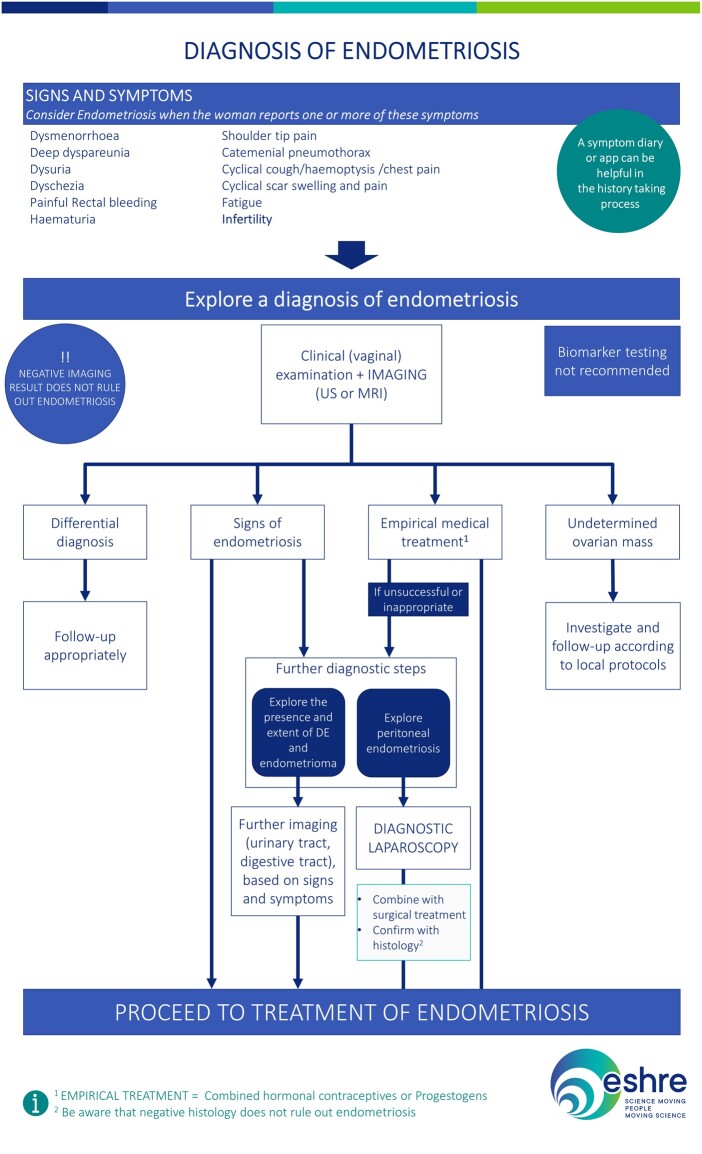
- The diagnostic process challenges laparoscopy and histology as gold standard tests; it recommends imaging (ultrasound or MRI) in the diagnostic work-up, advises against biomarkers for diagnosis, and reserves laparoscopy for patients with negative imaging or unsuccessful/inappropriate empirical treatment.
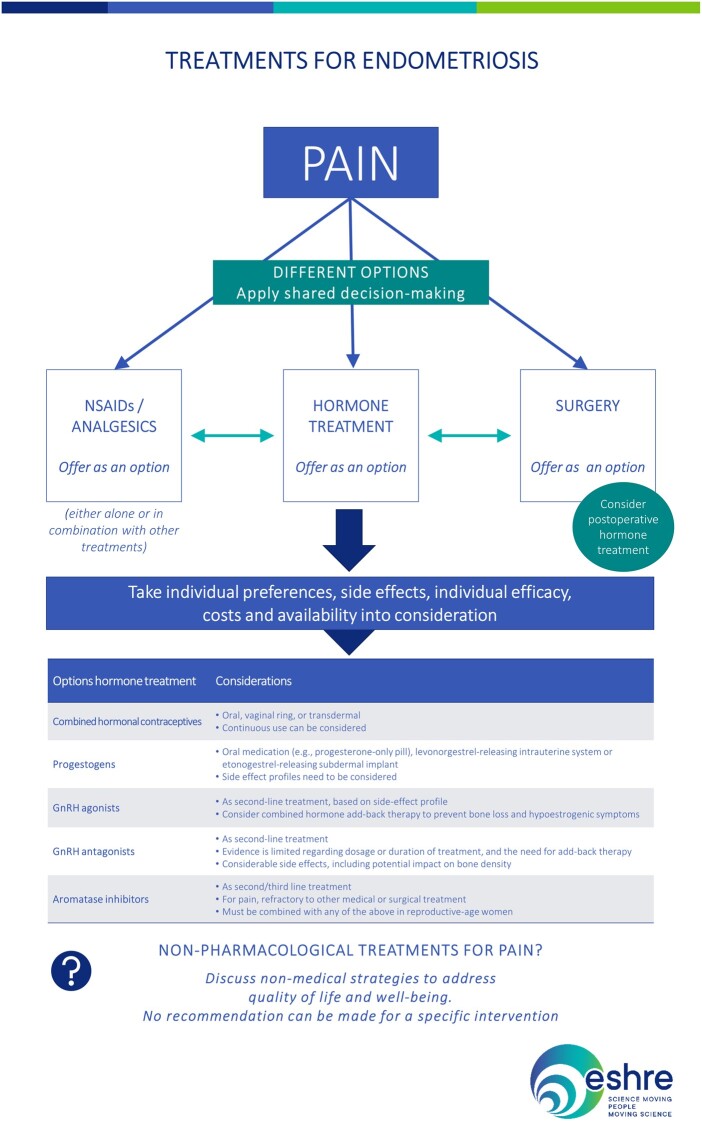
- Treatment options for endometriosis-associated pain include analgesics/NSAIDs, hormonal treatments (combined hormonal contraceptives, progestogens, GnRH agonists or antagonists, aromatase inhibitors), and surgery; five topics with significant changes include the diagnostic process, GnRH antagonists as second-line, postoperative medical treatment for pain, no extended GnRH agonist before ART, and use of the endometriosis fertility index (EFI).
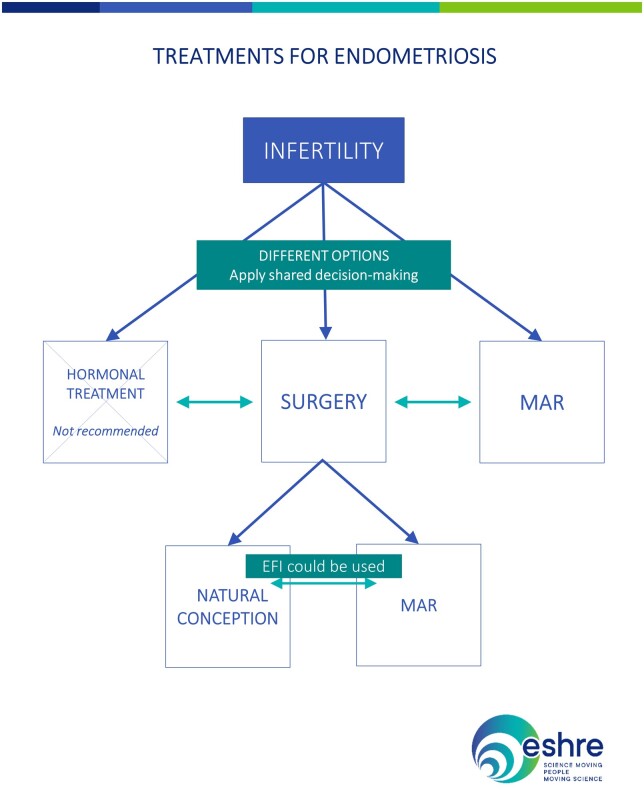
- For endometriosis-associated infertility, surgery and/or medically assisted reproduction are feasible; ovarian suppression, pentoxifylline/anti-inflammatory drugs/letrozole outside ovulation induction, and routine surgery before ART for rASRM stage I/II or endometrioma are not recommended.
Methods
- The guideline was developed according to ESHRE’s structured methodology; 42 key questions were formulated (7 narrative, 35 PICO), with PubMed/MEDLINE and Cochrane searches from inception to 1 December 2020, limited to English-language studies.
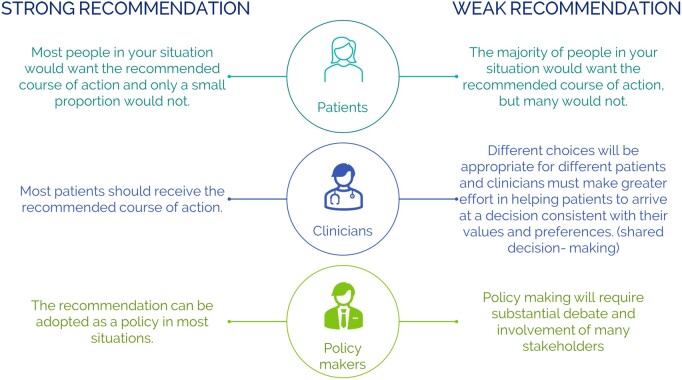
- Evidence was assessed and summarized in evidence tables; recommendations were drafted by specialist subgroups, discussed in core guideline development group meetings until consensus, labelled strong or weak, and graded High, Moderate, Low, or Very low; GPPs were added where relevant.
- A stakeholder review ran from 24 June to 15 August 2021; 56.5% of the 253 comments resulted in an adaptation or correction. The guideline will be considered for update 4 years after publication, with an intermediate assessment at 2 years.
Limitations
- Stated: the guideline describes different management options but, based on existing evidence, no firm recommendations could be formulated on the most appropriate treatments; for specific clinical issues such as asymptomatic endometriosis or extrapelvic endometriosis, evidence is too scarce to make evidence-based recommendations.
- Stated: there is an urgent need for more research on the most appropriate diagnostic and treatment options and on the natural course of the disease.
- Evident from the text: many recommendations are weak or based on low/very low-quality evidence or GPPs; no prognostic markers exist to select patients who would benefit from surgery; no specific non-medical intervention can be recommended; and heterogeneity prevented conclusions on surgical techniques for deep endometriosis-associated pain.
Model-written summary. Check it against the paper before relying on it.
Integrity signals
Registry
Cites
Statistics
Figures
Verification
Claims the paper makes
30 Valid · 5 Not valid · 26 Not checked · 25 Own results and interpretations
At least one cited source doesn’t support this claim or points to a different paper, and none confirmed it — see the verdicts below.
In the paper
“Clinicians may consider operative laparoscopy for the treatment of endometrioma-associated infertility as it may increase their chance of natural pregnancy, although no data from comparative studies exist (Dan and Limin, 2013; Alborzi et al., 2019; Candiani et al., 2020).”
§ ESHRE guideline: endometriosis† > Results > Treatment of endometriosis-associated infertility
What the sources say
- Not checked — no full text of the sourcecites Dan and Limin, 2013 matched to “Laparoscopic ovarian cystectomy versus fenestration/coagulation or laser vaporization for the treatment of endometriomas: a meta-analysis of randomized controlled trials” (2013) source
- Disputedcites Alborzi et al., 2019 matched to “The success of various endometrioma treatments in infertility: a systematic review and meta-analysis of prospective studies” (2019) sourceExperimental — accuracy not yet measured
The Results describe a prospective randomized trial comparing two laparoscopic treatments for endometriomas and reporting pregnancy rates after treatment without medication. That contradicts the categorical claim that no comparative-study data exist for operative laparoscopy and natural pregnancy. The trial compares two operations, however, not surgery against no surgery. (LLM, conf=0.83)
Checked by a reasoning model — may be wrong.
- Not checked — no full text of the sourcecites Candiani et al., 2020 matched to “Recurrence Rate after “One-Step” CO2 Fiber Laser Vaporization versus Cystectomy for Ovarian Endometrioma: A 3-Year Follow-up Study” (2020) source
hedged- Asserted: passes — The authors put it forward as true.
- Checkable: passes — It can be checked against evidence.
- Load-bearing: passes — The paper’s conclusions depend on it.
- Based: passes — The paper gives a reason why it holds.
The cited sources support only part of this claim — read each source’s verdict below.
In the paper
“Both GnRH antagonist and agonist protocols can be offered based on patients’ and physicians’ preferences as no difference in pregnancy or live birth rate has been demonstrated (Pabuccu et al., 2007; Rodriguez-Purata et al., 2013; Bastu et al., 2014; Kolanska et al., 2017; Drakopoulos et al., 2018).”
§ ESHRE guideline: endometriosis† > Results > Treatment of endometriosis-associated infertility
What the sources say
- Not checked — no full text of the sourcecites Pabuccu et al., 2007 matched to “GnRH agonist and antagonist protocols for stage I-II endometriosis and endometrioma in in vitro fertilization/intracytoplasmic sperm injection cycles” (2007) source
- Not checked — no full text of the sourcecites Rodriguez-Purata et al., 2013 matched to “Endometriosis and IVF: are agonists really better? Analysis of 1180 cycles with the propensity score matching” (2013) source
- Partly supportedcites Bastu et al., 2014 matched to “Comparison of ovulation induction protocols after endometrioma resection” (2014) sourceExperimental — accuracy not yet measured
The Results (Table 2; page not provided) show no significant difference in pregnancy or ongoing-pregnancy rates between protocols among IVF patients who had undergone endometrioma resection. The Conclusions (page not provided) call for further studies evaluating live birth rates, so this paper does not establish that live birth rates are similar. Its study population is also narrower than women with endometriosis generally. (LLM, conf=0.91)
boosted- Asserted: passes — The authors put it forward as true.
- Checkable: passes — It can be checked against evidence.
- Load-bearing: passes — The paper’s conclusions depend on it.
- Based: passes — The paper gives a reason why it holds.
The cited sources support only part of this claim — read each source’s verdict below.
In the paper
“Women with endometriosis can be reassured regarding the safety of ART since the recurrence rates are not increased compared to those women not undergoing ART (Benaglia et al., 2008; Somigliana et al., 2019).”
§ ESHRE guideline: endometriosis† > Results > Treatment of endometriosis-associated infertility
What the sources say
- Could not verifycites Benaglia et al., 2008 matched to “Endometrioma and oocyte retrieval-induced pelvic abscess: a clinical concern or an exceptional complication?” (2008) sourceExperimental — accuracy not yet measured
The Abstract (page unavailable) says the study estimated pelvic-abscess frequency after oocyte retrieval in women with endometriomas. Searches for endometriosis recurrence after IVF and a comparison with women not undergoing IVF found no passage addressing either point. (LLM, conf=0.76)
- Partly supportedcites Somigliana et al., 2019 matched to “Ovarian stimulation and endometriosis progression or recurrence: a systematic review” (2019) sourceExperimental — accuracy not yet measured
The Discussion (page unavailable) describes moderately supported, reassuring evidence that IVF has a limited impact on endometriosis recurrence. But the claim extends that reassurance to ART generally: the review's discussion of IUI (page unavailable) identifies a possible increased recurrence risk, and the Discussion says the evidence is incomplete. (LLM, conf=0.88)
plain- Asserted: passes — The authors put it forward as true.
- Checkable: passes — It can be checked against evidence.
- Load-bearing: passes — The paper’s conclusions depend on it.
- Based: passes — The paper gives a reason why it holds.
- Could not verify
The cited sources support only part of this claim — read each source’s verdict below.
In the paper
“The extended administration of GnRH agonist prior to ART treatment to improve live birth rate in infertile women with endometriosis is not recommended, as the benefit is uncertain (Georgiou et al., 2019; Cao et al., 2020; Kaponis et al., 2020).”
§ ESHRE guideline: endometriosis† > Results > Treatment of endometriosis-associated infertility
What the sources say
- Not checked — no full text of the sourcecites Georgiou et al., 2019 matched to “Long-term GnRH agonist therapy before in vitro fertilisation (IVF) for improving fertility outcomes in women with endometriosis” (2019) source
- Partly supportedcites Cao et al., 2020 matched to “The effectiveness of different down-regulating protocols on in vitro fertilization-embryo transfer in endometriosis: a meta-analysis” (2020) sourceExperimental — accuracy not yet measured
The Discussion reports that a Cochrane review found uncertain effects of long-term GnRH agonist therapy on pregnancy outcomes in infertile patients with endometriosis. Cao et al. do not establish uncertainty specifically for live birth rate or recommend against extended treatment; their own analysis reports improved clinical pregnancy rates in some groups. (LLM, conf=0.82)
- Not checked — no full text of the sourcecites Kaponis et al., 2020 matched to “Ultralong administration of gonadotropin-releasing hormone agonists before in vitro fertilization improves fertilization rate but not clinical pregnancy rate in women with mild endometriosis: a prospective, randomized, controlled trial” (2020) source
plain- Asserted: passes — The authors put it forward as true.
- Checkable: passes — It can be checked against evidence.
- Load-bearing: passes — The paper’s conclusions depend on it.
- Based: passes — The paper gives a reason why it holds.
The cited sources support only part of this claim — read each source’s verdict below.
In the paper
“Presacral neurectomy (PSN) is beneficial for treatment of endometriosis-associated midline pain as an adjunct to conventional laparoscopic surgery, but it should be stressed that PSN requires a high degree of skill and is associated with an increased risk of adverse effects such as intraoperative bleeding, and postoperative constipation, urinary urgency and painless first stage of labour (Miller e”
§ ESHRE guideline: endometriosis† > Results > Treatment of endometriosis-associated pain
What the sources say
- Partly supportedcites Miller et al., 2020 matched to “Clinical utility of presacral neurectomy as an adjunct to conservative endometriosis surgery: systematic review and meta-analysis of controlled studies” (2020) sourceExperimental — accuracy not yet measured
The Discussion reports that adjunctive presacral neurectomy reduced treatment failure for endometriosis-related midline pain. However, the Conclusion limits the finding to well-selected patients and says it *may* provide greater relief; the Results include both laparoscopic and open surgery, rather than establishing the benefit specifically for conventional laparoscopic surgery. (LLM, conf=0.84)
plainstates a cause- Asserted: passes — The authors put it forward as true.
- Checkable: passes — It can be checked against evidence.
- Load-bearing: passes — The paper’s conclusions depend on it.
- Based: passes — The paper gives a reason why it holds.
- Partly supported
54 more claims · 22 with their cited sources checked
Create a free account to see all 86 claims and every source verdict.
- Probably not a substantial claim. 26
- It may state two separate claims as one. 3
Claims other papers make about this one
Each is checked against this paper’s own text: does it say what the citing paper says it does?
The source backs part of the claim, not all of it — or backs it for a different population, condition or comparison.
In the citing paper
“although the major associations have difficulty siding sharply in favour of one treatment over another”
From IVF/ICSI or surgery as first approach for the treatment of infertility associated with ovarian and deep infiltrating endometriosis? A systematic review and meta-analysis. (2026) · cites this paper as Becker et al., 2022
Experimental — accuracy not yet measuredThe source backs part of the claim, not all of it — or backs it for a different population, condition or comparison.
In the citing paper
“it appears that, for some of them, patients with ovarian endometriomas (OMA) should not be referred for surgery, except in cases of pelvic pain”
From IVF/ICSI or surgery as first approach for the treatment of infertility associated with ovarian and deep infiltrating endometriosis? A systematic review and meta-analysis. (2026) · cites this paper as Becker et al., 2022
Experimental — accuracy not yet measuredThe source backs part of the claim, not all of it — or backs it for a different population, condition or comparison.
In the citing paper
“Therefore, optimal HRT in young women who have undergone pelvic clearance for endometriosis remains uncertain.”
From HRT in Women Undergoing Pelvic Clearance for Endometriosis—A Case Report and a National Survey (2023) · cites this paper as [10]
Experimental — accuracy not yet measuredThe source backs part of the claim, not all of it — or backs it for a different population, condition or comparison.
In the citing paper
“This has led the British Menopause Society (BMS) and European Society of Human Reproduction and Embryology (ESHRE) to recommend continuous C-HRT and avoidance of EO-HRT in this group of women at least until age of natural menopause [9,10].”
From HRT in Women Undergoing Pelvic Clearance for Endometriosis—A Case Report and a National Survey (2023) · cites this paper as [10]
Experimental — accuracy not yet measuredThe source backs part of the claim, not all of it — or backs it for a different population, condition or comparison.
In the citing paper
“Danazol is no longer recommended as a first-line therapy due to its bothersome side effect profile, such as acne, edema, vaginal spotting, weight gain, muscle cramps, deepening of voice, and increase in facial hair [ 79 ].”
From Thoracic Endometriosis Syndrome: A Comprehensive Review and Multidisciplinary Approach to Management (2024) · cites this paper as [79]
Experimental — accuracy not yet measured
3 more claims about this paper
Create a free account to see every claim other papers make about this one.
Citations
Cites
Zondervan, K. T., Becker, C. M., & Missmer, S. A. (2020) · New England Journal of Medicine · doi:10.1056/nejmra1810764 · Cited by 2,249
Self-citationESHRE guideline: management of women with endometriosis
Dunselman, G. A. J., Vermeulen, N., Becker, C., Calhaz-Jorge, C., D'Hooghe, T., De Bie, B., Heikinheimo, O., Horne, A. W., Kiesel, L., Nap, A., et al. (2014) · Human Reproduction · doi:10.1093/humrep/det457 · Cited by 2,211 · cited 2×
“The current guideline and recommendations are an update of the ESHRE endometriosis guidelines published in 2013 and 2005 (Kennedy et al. , 2005; Dunselman et al. , 2014).”
Self-citationEskenazi, B., & Warner, M. L. (1997) · Obstetrics and Gynecology Clinics of North America · doi:10.1016/s0889-8545(05)70302-8 · Cited by 1,617
ESHRE guideline for the diagnosis and treatment of endometriosis
Kennedy, S., Bergqvist, A., Chapron, C., D’Hooghe, T., Dunselman, G., Greb, R., Hummelshoj, L., Prentice, A., & Saridogan, E. (2005) · Human Reproduction · doi:10.1093/humrep/dei135 · Cited by 1,584
Pearce, C. L., Templeman, C., Rossing, M. A., Lee, A., Near, A. M., Webb, P. M., Nagle, C. M., Doherty, J. A., Cushing-Haugen, K. L., Wicklund, K. G., et al. (2012) · The Lancet Oncology · doi:10.1016/s1470-2045(11)70404-1 · Cited by 939 · cited 1×
“Routine US monitoring of asymptomatic endometriosis can be considered (Maouris, 1991; Alca´zar et al. , 2005; Pearce et al. , 2012; Serati et al. , 2013).”
High prevalence of endometriosis in infertile women with normal ovulation and normospermic partners
Meuleman, C., Vandenabeele, B., Fieuws, S., Spiessens, C., Timmerman, D., & D'Hooghe, T. (2009) · Fertility and Sterility · doi:10.1016/j.fertnstert.2008.04.056 · Cited by 606
Cervical cancer and use of hormonal contraceptives: a systematic review
Smith, J. S., Green, J., de Gonzalez, A. B., Appleby, P., Peto, J., Plummer, M., Franceschi, S., & Beral, V. (2003) · The Lancet · doi:10.1016/s0140-6736(03)12949-2 · Cited by 544
Imaging modalities for the non-invasive diagnosis of endometriosis
Nisenblat, V., Bossuyt, P. M., Farquhar, C., Johnson, N., & Hull, M. L. (2016) · Cochrane Database of Systematic Reviews · doi:10.1002/14651858.cd009591.pub2 · Cited by 538 · cited 2×
“…in endometrial tissue, blood, menstrual or uterine fluids to diagnose endometriosis (Mol et al. , 1998; May et al. , 2010; May et al. , 2011; Liu et al. , 2015; Cosar et al. , 2016; Gupta et al. , 2016; Hirsch et al. , 2016; Nisenblat et al. , 2016a; Vanhie et al. , 2019; Moustafa et al. , 2020).”
Sutton, C. J. G., Ewen, S. P., Whitelaw, N., & Haines, P. (1994) · Fertility and Sterility · doi:10.1016/s0015-0282(16)56990-8 · Cited by 525
Wentzensen, N., Poole, E. M., Trabert, B., White, E., Arslan, A. A., Patel, A. V., Setiawan, V. W., Visvanathan, K., Weiderpass, E., Adami, H.-O., et al. (2016) · Journal of Clinical Oncology · doi:10.1200/jco.2016.66.8178 · Cited by 514 · cited 1×
“…about the risk of malignancy associated with the use of hormonal contraceptives (Smith et al. , 2003; Zucchetto et al. , 2009; Gierisch et al. , 2013; Havrilesky et al. , 2013; Braganza et al. , 2014; Berlanda et al. , 2016; Wentzensen et al. , 2016; Butt et al. , 2018; Michels et al. , 2018).”
Cited by
Items 601–700 of 1,654
Meinhold-Heerlein, I. M., Zeppernick, M. M., Wölfler, M. M., Janschek, E., Bornemann, S., Holtmann, L., Oehmke, F., Salehin, D., Scheible, C. M., Brandes, I., et al. (2023) · Geburtshilfe und Frauenheilkunde · doi:10.1055/a-2061-6845 · Cited by 5
Martínez‐Zamora, M. Á., Feixas, G., Gràcia, M., Rius, M., Quintas, L., de Guirior, C., & Carmona, F. (2023) · Women s Health · doi:10.1177/17455057231176751 · Cited by 7
Postmenopausal Endometriosis: Clinical Insights and Imaging Considerations
Chamié, L. P., VanBuren, W. M., Li, X., Franco, I. P., Feldman, M., Andrieu, P. C., Shenoy‐Bhangle, A. S., Jha, P., & Young, S. W. (2024) · Radiographics · doi:10.1148/rg.240046 · Cited by 12
Adamyan, L. V., Pivazyan, L. G., Yurkanova, M., Zarova, E., Kuznetsova, M. V., Mailova, K. S., Trofimov, D. Y., & Stepanian, A. A. (2025) · F&S Reviews · doi:10.1016/j.xfnr.2025.100098 · Cited by 9
Can Laparoscopic Surgery Reduce Fatigue in Women with Endometriosis?—A Pilot Study
Reischer, T., Sklenar, C., Perricos, A., Husslein, H., Kuessel, L., Wenzl, R. J., & Bekos, C. (2024) · Journal of Clinical Medicine · doi:10.3390/jcm13113150 · Cited by 5
“While the current treatment and management of the disease focuses more on classic symptoms [38], it is important to also address fatigue when treating patients with endometriosis.”
BackgroundZeng, Y., Liu, Y., Nie, Y., Shen, X. P., Wang, T., Kuang, Y., & Wang, L. (2024) · Human Reproduction Open · doi:10.1093/hropen/hoae063 · Cited by 6
Marca, A. L., & Selmi, C. (2025) · Human Reproduction · doi:10.1093/humrep/deaf063 · Cited by 5
Biasioli, A., Zermano, S., Previtera, F., Arcieri, M., Martina, M. D., Raimondo, D., Raffone, A., Restaino, S., Vizzielli, G., & Driul, L. (2023) · Journal of Personalized Medicine · doi:10.3390/jpm13121646 · Cited by 7
“Endometriosis was diagnosed in these patients by ultrasound imaging [19], magnetic resonance [20,21], or surgery [22].”
BackgroundPrediction of genomic biomarkers for endometriosis using the transcriptomic dataset
Kucukakcali, Z., Akbulut, S., & Çolak, C. (2025) · World Journal of Clinical Cases · doi:10.12998/wjcc.v13.i20.104556 · Cited by 6
Krentel, H., Samartzis, N., Kalaitzopoulos, D. R., Constantin, A., Schweppe, K.-W., Metzler, J. M., Andrikos, D., Witzel, I., Wilde, R. L. D., Keckstein, J., et al. (2025) · Archives of Gynecology and Obstetrics · doi:10.1007/s00404-025-08081-9 · Cited by 8
Long-term dienogest treatment in endometriosis: Consensus from Taiwanese experts
Liu, J., Sheu, B., Chang, C. Y.-Y., Yen, C., Wu, M., Chen, Y.-J., Lai, T., Lan, K., Cheng, Y.-M., Tsai, Y.-C., et al. (2024) · Taiwanese Journal of Obstetrics and Gynecology · doi:10.1016/j.tjog.2024.07.015 · Cited by 6
Rethinking endometriosis recurrence: from clinical challenge to biological opportunity
Masferrer-Ferragutcasas, C., Delgado-Gil, R., & Colás, E. (2026) · npj Women s Health · doi:10.1038/s44294-026-00128-9 · Cited by 8
Menstrual Effluent in the Pathogenesis and Diagnosis of Endometriosis—A Systematic Review
Watrowski, R., Kostov, S. G., Tsoneva, E., Schäfer, S. D., Sparić, R., Palumbo, M., Günther, V., Akšam, S. S., Yordanov, A. D., Chieppa, P., et al. (2026) · Diagnostics · doi:10.3390/diagnostics16050677 · Cited by 7
“However, current diagnostic strategies increasingly prioritize non-invasive assessment, favoring transvaginal sonography (TVS) and magnetic resonance imaging (MRI) [26–29].”
Dumančić, S., Jakovac, M. B., Mimica, M. D., Tomaš, S. Z., & Marušić, J. (2025) · Life · doi:10.3390/life15020240 · Cited by 4
Validation of the revised MUSA criteria for sonographic detection of adenomyosis
Dosunmu, S. D., Sarno, A. J., Lee, E. Y., et al. (2025) · Abdominal Radiology · doi:10.1007/s00261-025-05039-y · Cited by 4
Clues to revising the conventional diagnostic algorithm for endometriosis
Spiers, A., Roman, H., Wasson, M., Chapron, C., Rousset, P., Golfier, F., Fauvet, R., Delbos, L., Poilblanc, M., Lavoué, V., et al. (2024) · International Journal of Gynecology & Obstetrics · doi:10.1002/ijgo.15840 · Cited by 7
“Moreover, using ML, Bendifallah et al. 3 reported a data-driven approach to solve issues of endometriosis diagnosis.”
Endometrioma patients are under-treated with endocrine endometriosis therapy
Cirkel, C., Göbel, H., Göbel, C. H., Alkatout, İ., Khalil, A., Brüggemann, N., Rody, A., & Cirkel, A. (2024) · Human Reproduction · doi:10.1093/humrep/deae257 · Cited by 6
Spontaneous recurrent menstrual pneumothorax: a case report
Hirono, T., Feng, Y., Wang, W., & Yu, H. (2023) · Annals of Medicine and Surgery · doi:10.1097/ms9.0000000000001592 · Cited by 5
Multidisciplinary surgical management of severe posterior compartment endometriosis
Mueller, C., Russo, M. L., Schabl, L., & Kessler, H. P. (2024) · Surgical Endoscopy · doi:10.1007/s00464-024-10969-7 · Cited by 4
Abd‐Elmawla, M. A., Ghaiad, H. R., Elbaqy, Y. M. A., Zaki, M. B., Abdelhamid, R., El‐Shiekh, R. A., & Gad, E. S. (2026) · Beni-Suef University Journal of Basic and Applied Sciences · doi:10.1186/s43088-026-00736-z · Cited by 6
Availability of region-specific endometriosis care guidance: a global scoping review
Evans, D. L., Gibbons, T., Skidmore, B., Zondervan, K. T., Adamson, G. D., Giudice, L. C., Missmer, S. A., Abbott, J. A., Abrão, M. S., Becker, C. M., et al. (2025) · The Lancet Obstetrics Gynaecology & Women s Health · doi:10.1016/j.lanogw.2025.100004 · Cited by 7
Self-citationGomes, F. H., Fonseca, M. D. F., Favorito, L. A., Gasparoni, M. P., Filho, F. S. D. S., Diniz, A. L. L., & Júnior, J. A. D. D. R. (2024) · Neurourology and Urodynamics · doi:10.1002/nau.25414 · Cited by 5
Predictors of anxiety in endometriosis patients
Kupec, T., Wagels, L., Caspers, R., Meyer-Wilmes, P., Najjari, L., Stickeler, E., & Wittenborn, J. (2024) · Archives of Gynecology and Obstetrics · doi:10.1007/s00404-024-07878-4 · Cited by 5
“Endometriosis was diagnosed and localized according to current ESHRE guidelines [4] after a gynaecological examination and ultrasound by a specialized consultant with many years of experience at the endometriosis centre.”
InfluentialLiu, W., Zhao, T., Zheng, Z., Huang, J. X., & Tan, J. (2025) · International Journal of Gynecology & Obstetrics · doi:10.1002/ijgo.16147 · Cited by 9
Lamersdorf, L., Rad, M. T., Karn, T., Gasimli, B., Bachmann, A., Becker, S., & Gasimli, K. (2024) · Facts Views and Vision in ObGyn · doi:10.52054/fvvo.16.2.020 · Cited by 7
Prevalence of Temporomandibular Disorders in Adult Women with Endometriosis
Marciniak, T., Walewska, N., Skoworodko, A., Bobowik, P. Ż., & Kruk-Majtyka, W. (2024) · Journal of Clinical Medicine · doi:10.3390/jcm13247615 · Cited by 9
“Even though the ESHRE guidelines on diagnosing endometriosis do not mention orofacial pain or headaches (but only shoulder pain) as potential indicators for a diagnosis of endometriosis, the presented links seem to play an important role [44].”
Marchetti, M., Noventa, M., Panizzolo, E., Pianon, V., Tamagnini, M., Bigardi, S., Saccardi, C., Tozzi, R., & Spagnol, G. (2024) · Journal of Clinical Medicine · doi:10.3390/jcm13051488 · Cited by 7
“The AFS Endometriosis Score and AFS Total Score were instead calculated according to the original model developed by Adamson and Pasta [6] based on the revised classification of the ASRM.”
BackgroundMethodResultInfluentialModern view on the experimental creation of endometriosis in animal models (own data)
Adamyan, L. V., Михалева, Л. М., Сереженков, В. А., Tkachev, N. А., Pivazyan, L. G., Mailova, K. S., Avetisyan, J. S., & Stepanian, A. A. (2024) · Russian Journal of Human Reproduction · doi:10.17116/repro20243006155 · Cited by 6
Crestani, A., Merlot, B., Goualard, P., Huet, C., Husson, Z., Dennis, T., Chanavaz‐Lacheray, I., & Roman, H. (2025) · International Journal of Gynecology & Obstetrics · doi:10.1002/ijgo.70201 · Cited by 7
Endometriose – mehr als „nur“ Dysmenorrhö!
Willer, D., Peters, G., Tesch, K., Maass, N., & Alkatout, İ. (2023) · Die Gynäkologie · doi:10.1007/s00129-023-05101-0 · Cited by 4
Britton, V., Sohn, A., Ansani, N. T., Hauber, B., Cole, M. R., Maculaitis, M. C., & Kim, R. (2025) · Women s Health · doi:10.1177/17455057241311765 · Cited by 6
Bekiesińska‐Figatowska, M., Pietura, R., Mądzik, J., Cnota, W., & Jaczyńska, R. (2026) · American Journal of Obstetrics and Gynecology · doi:10.1016/j.ajog.2025.08.092 · Cited by 6
Younis, J. S., & Nelson, S. M. (2022) · Frontiers in Endocrinology · doi:10.3389/fendo.2022.1005597 · Cited by 7
Maple, S., Bezak, E., Chalmers, J., & Parange, N. (2024) · Journal of Clinical Medicine · doi:10.3390/jcm13226901 · Cited by 5
“…and with the current recognition of diagnostic delays, as well as the invasiveness, cost, and post-surgical recovery time of surgery, the European Society of Human Reproduction and Embryology (2022) guidelines [7] now recommend the use of TVS as the first-line imaging tool for endometriosis.”
Li, H., Zhu, C., Gu, Y., Wei, X., Wang, X., Yang, X., & Zhang, H. (2025) · Frontiers in Endocrinology · doi:10.3389/fendo.2025.1490746 · Cited by 6
“For women with combined infertility and EMs, Assisted Reproductive Technology (ART) appears to be a promising option (4, 5).”
Oliveira, J. A., Neves, G. L., Pinhati, M. E. S., de Oliveira, F. R., & Filho, A. L. D. S. (2025) · Archives of Gynecology and Obstetrics · doi:10.1007/s00404-025-07943-6 · Cited by 5
Progestins and combined oral contraceptives in the hormonal treatment of endometriosis – a review
Rojek, K. (2023) · European Journal of Clinical and Experimental Medicine · doi:10.15584/ejcem.2023.2.21 · Cited by 6
Weighing up GnRH agonist therapy for endometriosis: outcomes and the treatment paradigm
Carneiro, M. M. (2025) · Expert Opinion on Pharmacotherapy · doi:10.1080/14656566.2025.2459783 · Cited by 4
“The surgical treatment of endometriosis with complete excision of lesions, especially in cases of deep endometriosis, may result in good long-term symptomatic relief and improved quality of life in women with severe or debilitating symptoms [10,23].”
InfluentialHealth literacy of patients consulting in an expert gynecological tertiary center: A pilot study
Petit, C., Dabi, Y., Bendifallah, S., Touboul, C., Daraï, É., & Crestani, A. (2024) · Journal of Gynecology Obstetrics and Human Reproduction · doi:10.1016/j.jogoh.2024.102832 · Cited by 6
Rubod, C., de Prémare, C., Kerbage, Y., Kyheng, M., Plouvier, P., Chossegros, C., & Robin, G. (2023) · Reproductive BioMedicine Online · doi:10.1016/j.rbmo.2023.103649 · Cited by 5
Aseptic inflammation as the essential link in the pathogenesis of endometrioid disease
Orlova, Y. A., Hromova, A. M., Ketova, O. M., Ляховська, Т. Ю., Martynenko, V. B., & Крутікова, Е. І. (2023) · Medicni perspektivi · doi:10.26641/2307-0404.2023.3.288961 · Cited by 4
Endometriosis and eating disorders: epidemiology, shared neurobiology, and clinical implications
Michele, S. D., Camoglio, C., Chieppa, P., Incognito, G. G., Caiazzo, A., Cabras, A., Picci, F., & Angioni, S. L. (2026) · Archives of Gynecology and Obstetrics · doi:10.1007/s00404-026-08325-2 · Cited by 5
“Practical safeguards include: graded plans co-designed with the patient, explicit non-weight-centric goals (pain, function, mood), scheduled rest days, and routine checks for guilt/distress when sessions are missed, signals of unhealthy exercise [31, 33].”
Dai, Y., Liu, L., Yu, G., Peng, Y., Chen, N., Gao, J., Shi, Q., & Jin, P. (2024) · International Journal of Hyperthermia · doi:10.1080/02656736.2024.2384471 · Cited by 4
Messingschlager, C., Ferrando, C. A., & Chang, O. H. (2023) · European Journal of Obstetrics & Gynecology and Reproductive Biology · doi:10.1016/j.ejogrb.2023.01.033 · Cited by 4
Primary umbilical endometriosis in a nulliparous woman: A rare case report
Lugata, J., Lyamuya, T., Makower, L. L., Salum, I., Mjema, R. N., Mremi, A., & Kakumbi, T. (2025) · International Journal of Surgery Case Reports · doi:10.1016/j.ijscr.2025.111259 · Cited by 4
“[31,32].”
Editorial: The impact of endometriosis
Invitti, A. L., & Demetriou, L. (2023) · Frontiers in Global Women s Health · doi:10.3389/fgwh.2023.1190974 · Cited by 4
Takahashi, N., Kawahara, Y., Harada, M., Makabe, T., Izumi, G., Wada‐Hiraike, O., Hirota, Y., & Osuga, Y. (2025) · Reproductive Medicine and Biology · doi:10.1002/rmb2.12654 · Cited by 4
“10 Systematic reviews and meta-analyses have not demonstrated a significant beneficial effect of surgery for endometrioma on live birth rates.”
Recent advancements of artificial intelligence in minimally invasive surgery for endometriosis
Zhao, T., Liu, Y., Wei, Z., & Yi, X. (2025) · Intelligent Surgery · doi:10.1016/j.isurg.2025.10.001 · Cited by 6
Raimondo, D., Ianieri, M. M., Raffone, A., Ferla, S., Raspollini, A., Virgilio, A., Govoni, F., Pavone, M., Neola, D., Guida, M., et al. (2024) · Journal of Minimally Invasive Gynecology · doi:10.1016/j.jmig.2024.05.004 · Cited by 5
Self-citationPossible Correlation between Urocortin 1 (Ucn1) and Immune Parameters in Patients with Endometriosis
Abramiuk, M., Frankowska, K., Kułak, K., Tarkowski, R., Mertowska, P., Mertowski, S., & Grywalska, E. (2023) · International Journal of Molecular Sciences · doi:10.3390/ijms24097787 · Cited by 6
“imaging) without mandatory diagnostic laparoscopy (LPS), which is another diagnostic option [13].”
Meidyana, S., Isfandiary, S., & Primariawan, R. Y. (2024) · European Journal of Obstetrics & Gynecology and Reproductive Biology · doi:10.1016/j.ejogrb.2024.01.038 · Cited by 6
Semenyna, H., Hrytsko, M. I., Doroshenko-Kravchyk, M. V., Коrytko, О. О., & Fartushok, T. V. (2024) · INTERNATIONAL JOURNAL OF ENDOCRINOLOGY (Ukraine) · doi:10.22141/2224-0721.20.1.2024.1356 · Cited by 5
Peter, M., Venkatesan, P., Nellickal, A. J., Mahalakshmi, C. N. D., Thomas, A. J., Balaji, M., Bhargavi, A. S., Muthukumar, K., Christudass, C. S., Kunjummen, A. T., et al. (2025) · Scientific Reports · doi:10.1038/s41598-025-20319-9 · Cited by 7
“However, the exact impact of surgical excision on oocyte quality remains a topic of significant debate, with existing literature presenting mixed evidence 32 .”
Daoud, E., Archer, D. F., Parazzini, F., & Herranz‐Blanco, B. (2024) · International Journal of Molecular Sciences · doi:10.3390/ijms25147667 · Cited by 5
“Instead, laparoscopy should be considered for the diagnosis and treatment of endometriosis for patients with negative imaging results or where empirical treatment was unsuccessful [9].”
BackgroundScarella-Chamy, A., & Miranda-Mendoza, I. (2023) · Revista chilena de obstetricia y ginecología · doi:10.24875/rechog.m23000058 · Cited by 10
Kupec, T., Wittenborn, J., Kuo, C.-C., Najjari, L., Senger, R., Meyer-Wilmes, P., Stickeler, E., & Maurer, J. (2026) · Reproductive Biology and Endocrinology · doi:10.1186/s12958-025-01517-6 · Cited by 10
“The diagnosis of endometriosis was established in accordance with the current ESHRE guidelines [5], based on a structured gynaecological examination and transvaginal ultrasound, both conducted by a senior consultant specialized in endometriosis care.”
Evidence on Serum Anti-Müllerian Hormone Levels and Endometriosis Surgery
Grigoriadis, G., Daniilidis, A., Pitsillidi, A., Bıyık, İ., Crestani, A., Merlot, B., & Roman, H. (2025) · Journal of Clinical Medicine · doi:10.3390/jcm14113772 · Cited by 9
“Cystectomy has been linked to reduced risks of OMA recurrence and endometriosis-associated pain [45], as well as increased chances of spontaneous conception [46].”
Self-citationExercise and endometriosis—is there a promising future? A narrative review
McKnight, K., Omotosho, O., Jassim, S., & Cotter, A. M. (2024) · Irish Journal of Medical Science (1971 -) · doi:10.1007/s11845-024-03733-2 · Cited by 13
Shim, J. Y., Scatoni, A., Laufer, M. R., & Boskey, E. R. (2025) · Fertility and Sterility · doi:10.1016/j.fertnstert.2025.07.020 · Cited by 6
Invernici, D., Fornelli, G., Reschini, M., Vecchia, I. L., Viganò, P., Somigliana, E., Vercellini, P., & Benaglia, L. (2025) · Archives of Gynecology and Obstetrics · doi:10.1007/s00404-025-08039-x · Cited by 6
Mohamed, Y., Kol, S. Q., Stoker, J., & Bipat, S. (2025) · European Radiology · doi:10.1007/s00330-025-12154-3 · Cited by 10
Impact of endometriosis on oocyte quality in women undergoing assisted reproduction
Chinta, P., Joseph, T., Imam, N., GUPTA, N., MOHAN, H., & Kamath, M. S. (2024) · Minerva Obstetrics and Gynecology · doi:10.23736/s2724-606x.24.05552-0 · Cited by 4
Xiong, Y., Huang, W., Wang, C., Ma, W., Jin, S., Lin, J., Deng, X., Peng, Y., Huang, Y., Du, X., et al. (2025) · BJOG An International Journal of Obstetrics & Gynaecology · doi:10.1111/1471-0528.70016 · Cited by 4
“This underscores a persistent gap in standardised postoperative medical management [6].”
Advances in approaches to diagnose endometriosis
Giudice, L. C. (2024) · Global Reproductive Health · doi:10.1097/grh.0000000000000074 · Cited by 11
CAR/CSAR Practice Statement on Pelvic MRI for Endometriosis
Pang, E., Shergill, A. K., Chang, S. D., Crivellaro, P. S., Duigenan, S., Green, C. R., Hamel, C., Holmes, S., Kielar, A. Z., Rehman, I., et al. (2025) · Canadian Association of Radiologists Journal · doi:10.1177/08465371241306658 · Cited by 4
Gouesbet, S., Cheyron, J. D., Amazouz, H., Breton, Z., Pane, I., Toko-Kamga, L., Tran, V.-T., & Kvaskoff, M. (2025) · Human Reproduction · doi:10.1093/humrep/deaf160 · Cited by 5
Self-citationLow risk of endometrioma infection after oocyte retrieval
Parpex, G., Bourdon, M., Marcellin, L., Sorel, M., Maignien, C., Bordonné, C., Charlier, C., Patrat, C., Santulli, P., & Chapron, C. (2025) · Reproductive BioMedicine Online · doi:10.1016/j.rbmo.2025.105344 · Cited by 5
Martini, A. E., Beall, S. A., Ball, G. D., Hayward, B., D’Hooghe, T., Mahony, M. C., Collares, F. M., & Catherino, A. B. (2023) · Frontiers in Endocrinology · doi:10.3389/fendo.2023.1195632 · Cited by 3
Graham, A., Nickel, B., McCaffery, K. J., Doust, J. A., Cvejic, E., & Copp, T. (2026) · Medical Decision Making · doi:10.1177/0272989x261436847 · Cited by 4
“Further, given the recent shift away from laparoscopy in international guidelines due to uncertain evidence of benefit, 10,15 this study also aimed to investigate whether intentions change when informed of new guidelines recommending laparoscopy only when pain medication and hormonal treatments…”
Šalamun, V., Riemma, G., Sirc, T., Bokal, E. V., & Frangež, H. B. (2024) · Journal of Clinical Medicine · doi:10.3390/jcm13195956 · Cited by 5
“…Reproduction and Embryology (ESHRE) guidelines recommend that operative laparoscopy for DIE may be a therapy option for symptomatic individuals who want to get pregnant despite the lack of convincing evidence and despite the potential risk of complications and post-operative adverse effects [5–8].”
BackgroundDEEP ENDOMETRIOSIS: OVERWIEW OF CURRENT RECOMMENDATIONS AND OWN DATA
ZAPOROGAN, V., GLADCHUK, I., Rozhkovska, N. М., & HAIDARZHI, K. D. (2022) · Scientific digest of association of obstetricians and gynecologists of Ukraine · doi:10.35278/2664-0767.2(50).2023.274979 · Cited by 10
Que, X., Ren, L., Yang, L., Wang, L., Li, J., Wu, R., & Chen, Q. (2024) · The FASEB Journal · doi:10.1096/fj.202302195r · Cited by 3
Pliszkiewicz, M., Czystowska, M., Soroczyńska, K., Siekierski, B. P., & Safranow, K. (2024) · Journal of Clinical Medicine · doi:10.3390/jcm13051489 · Cited by 3
Avery, J., Fragkoudi, A., Deslandes, A., Nelson, S. M., Henry, L., Bhardwaj, A., Topçu, E. G., Tulandi, T., Malhotra, J., Feldberg, D., et al. (2025) · International Journal of Gynecology & Obstetrics · doi:10.1002/ijgo.70666 · Cited by 4
Ovarian Cancer and Its Association with Endometriosis: A Narrative Review
Kyriacou, I., Vaidakis, D., & Constantinou, C. (2025) · Oncology Research and Treatment · doi:10.1159/000548022 · Cited by 5
“Three major clinical guidelines include dedicated sections on EAOC: the European Society of Human Reproduction and Embryology (ESHRE) Guideline 2022 [33], the National Institute for Health and Care Excellence (NICE) Guideline 2024 [34], and the AWMF S2k Guideline 2020 [35].”
InfluentialClinical characterization of endometriosis phenotypes
Hofbeck, L., Au, K., Blum, S., Sipulina, N., Lotz, L., Lermann, J., Renner, S. P., Fasching, P. A., Beckmann, M. W., & Burghaus, S. (2025) · Archives of Gynecology and Obstetrics · doi:10.1007/s00404-025-08191-4 · Cited by 4
Amanda, C. R., Fadilah, F., Hestiantoro, A., Muharam, R., Suryandari, D. A., Tulandi, T., & Asmarinah, A. (2024) · European Journal of Obstetrics & Gynecology and Reproductive Biology · doi:10.1016/j.ejogrb.2024.09.026 · Cited by 4
Evidence-based and experience-based medicine, which comes first: the chicken or the egg?
Ata, B., & Saridogan, E. (2023) · Facts Views and Vision in ObGyn · doi:10.52054/fvvo.15.3.090 · Cited by 3
Self-citationDumančić, S., Pehlić, M., Mijić, P., Mimica, M. D., Tomaš, S. Z., & Marušić, J. (2024) · The Journal of Maternal-Fetal & Neonatal Medicine · doi:10.1080/14767058.2024.2385451 · Cited by 3
“However, our Department follows the current European Society of Human Reproduction and Embryology (ESHRE) guidelines for endometriosis in which patients with diagnosed endometriomas with diameters less than 5 cm do not benefit from surgery in terms of fertility treatment [37].”
Li, J. L., Yong-Hing, C. J., Jessup, J., Kielar, A. Z., & Pang, E. (2025) · Abdominal Radiology · doi:10.1007/s00261-025-04906-y · Cited by 4
Obesity and oxidative stress: potential mechanisms in endometrial disorders
Wang, Y., Chen, Z., Wang, R., Song, A., & Zhang, Y. (2026) · Frontiers in Endocrinology · doi:10.3389/fendo.2026.1709556 · Cited by 7
“EMS is a pathological condition characterized by the presence of functional endometrioid glands and stroma outside the uterine cavity (94).”
Omenge, H., Kempa, P. A., Jeong, J.-W., So, K. A., & Kim, T. H. (2026) · Endocrine Reviews · doi:10.1210/endrev/bnag019 · Cited by 8
An opinion on H1-antihistamines as a potential avenue for endometriosis management
Mantha, K. B. (2023) · AJOG Global Reports · doi:10.1016/j.xagr.2023.100274 · Cited by 6
Bezhenar, V. F., Kruglov, S. Y., Kuzmina, N. S., Constandenkova, A. S., Gramatikova, A. G., Izorkina, V. A., Grigoryan, A. E., Fedosova, D. V., & Ismogulova, A. B. (2024) · Russian Journal of Human Reproduction · doi:10.17116/repro202430021102 · Cited by 4
Robin, M., Durand, C., Roux, L., Berkelmans, I., Peyronnet, B., Brochard, C., Dion, L., Lavoué, V., Lévêque, J., Lous, M. L., et al. (2026) · Journal of Gynecology Obstetrics and Human Reproduction · doi:10.1016/j.jogoh.2026.103130 · Cited by 3
Consul, N., Haber, H. R., Movilla, P. R., Harisinghani, M. G., Kambadakone, A. R., Kilcoyne, A., & Shenoy‐Bhangle, A. S. (2024) · Current Problems in Diagnostic Radiology · doi:10.1067/j.cpradiol.2024.08.001 · Cited by 3
Endometrioma: Contemporary Approach to Diagnosis and Management
Billow, M. R., Sridhar, S., & Mintz, G. (2025) · Seminars in Reproductive Medicine · doi:10.1055/s-0045-1810430 · Cited by 8
Deng, T., Lin, Y., Chen, L., & Jiang, J. (2023) · International Journal of General Medicine · doi:10.2147/ijgm.s429953 · Cited by 3
“Postoperative administration of GnRH-a therapy atrophies the residual lesions and reduces the risk of recurrence of endometriosis-related pain and improves the patient’s quality of life.(1,3) However, it should be noted that these protocols do not improve endometriosis-related infertility.”
BackgroundJeong, H. G., Jeon, M., Ryu, K.-J., Kim, J., Choe, B. Y., Joo, Y. Y., & Park, H. (2024) · Journal of Korean Medical Science · doi:10.3346/jkms.2024.39.e284 · Cited by 5
Chakraborty, S., Crawford, S. B., Moradi, M., Hui, A., Rowe, C., & Mazza, D. (2026) · Women s Reproductive Health · doi:10.1080/23293691.2025.2601061 · Cited by 3
Kacperczyk-Bartnik, J. P., Żeber‐Lubecka, N., Feduniw, S., Bartnik, P., Włodarczyk, M., Abramiuk, M., & Ciebiera, M. (2023) · Journal of Endometriosis and Pelvic Pain Disorders · doi:10.1177/22840265231210903 · Cited by 4
“6 This is mainly due to the risk of surgical complications and the fact that long-term outcomes are uncertain.”
BackgroundFacchin, F., Grosso, F., Saita, E., Vercellini, P., & Pagnini, F. (2025) · BMC Women s Health · doi:10.1186/s12905-025-03852-7 · Cited by 20
Bafort, C., Fong, S. L., Fieuws, S., Geysenbergh, B., Nisolle, M., Squifflet, J.-L., Tebache, L., Wyns, C., Meuleman, C., & Tomassetti, C. (2025) · PLoS ONE · doi:10.1371/journal.pone.0315709 · Cited by 3
“Laparoscopic surgery is a well-established treatment of endometrioma(s) however caution is required to minimize ovarian damage [3].”
InfluentialSelf-citationKüpker, W., Aizpurúa, J., Felberbaum, R. E., & Diedrich, K. (2024) · Die Gynäkologie · doi:10.1007/s00129-024-05203-3 · Cited by 3
Endometriosis-associated pain and adhesions — new pathogenetic aspects and therapeutic approach
Yarmolinskaya, M. I., & Adamyan, L. V. (2023) · Russian Journal of Human Reproduction · doi:10.17116/repro20232902193 · Cited by 6
Maple, S., Bezak, E., Chalmers, J., & Parange, N. (2025) · Australasian Journal of Ultrasound in Medicine · doi:10.1002/ajum.12420 · Cited by 4
“10 As a result, clear and reproducible ultrasound criteria are becoming increasingly important for diagnosing DE. 10 The International Deep Endo-metriosis Analysis (IDEA) 9 consensus statement outlines the best ultrasound practices for evaluating pelvic endometriosis, with a systematic approach to…”
Nowak, I., & Bochen, P. (2024) · Archivum Immunologiae et Therapiae Experimentalis · doi:10.2478/aite-2024-0008 · Cited by 4
Metadata
- Authors
- Becker, C. M., Bokor, A., Heikinheimo, O., Horne, A., Jansen, F., Kiesel, L., King, K., Kvaskoff, M., Nap, A., Petersen, K., Saridogan, E., Tomassetti, C., van Hanegem, N., Vulliemoz, N., Vermeulen, N., ESHRE Endometriosis Guideline Group, Altmäe, S., Ata, B., Ball, E., Barra, F., Bastu, E., Bianco-Anil, A., Knudsen, U. B., Brubel, R., Cambitzi, J., Cantineau, A., Cheong, Y., Daniilidis, A., De Bie, B., Exacoustos, C., Ferrero, S., Gelbaya, T., Goetz-Collinet, J., Hudelist, G., Hussain, M., Indrielle-Kelly, T., Khazali, S., Kumar, S. L., Leone Roberti Maggiore, U., Maas, J. W. M., McLaughlin, H., Metello, J., Mijatovic, V., Miremadi, Y., Muteshi, C., Nisolle, M., Oral, E., Pados, G., Parades, D., Pluchino, N., Supramaniam, P. R., Schick, M., Seeber, B., Seracchioli, R., Laganà, A. S., Stavroulis, A., Tebache, L., Uncu, G., Van den Broeck, U., van Peperstraten, A., Vereczkey, A., Wolthuis, A., Bahat, P. Y., & Yazbeck, C.
- Affiliations
- University of Oxford (GB)
- Semmelweis University (HU)
- University of Helsinki (FI)
- MRC Centre for Reproductive Health (GB)
- EndoHome—Endometriosis Association Belgium , Belgium
- University Hospital Münster (DE)
- Individual Endometriosis Advocate , Ireland
- Inserm (FR)
- Radboud University Nijmegen (NL)
- University College London Hospitals NHS Foundation Trust (GB)
- Department of Obstetrics and Gynaecology, University College London Hospital , London, UK
- Universitair Ziekenhuis Leuven (BE)
- Department of Reproductive Medicine and Gynecology, University Medical Center Utrecht , Utrecht, The Netherlands
- Department of Woman Mother Child, Fertility Medicine and Gynaecological Endocrinology, Lausanne University Hospital , Lausanne, Switzerland
- European Society of Human Reproduction and Embryology (BE)
- Aarhus University (DK)
- Centre Hospitalier Universitaire Vaudois (CH)
- Bursa Uludağ Üni̇versi̇tesi̇ (TR)
- Corresponding author
- Becker, Christian M
- ORCID
- Becker, Christian M
- Bokor, Attila
- Heikinheimo, Oskari
- Horne, Andrew
- Kiesel, Ludwig
- King, Kathleen
- Kvaskoff, Marina
- Nap, Annemiek
- Tomassetti, Carla
- Vermeulen, Nathalie
- Altmäe, Signe
- Ball, Elizabeth
- Barra, Fabio
- Knudsen, Ulla Breth
- Cantineau, Astrid
- Cheong, Ying
- Daniilidis, Angelos
- Hudelist, Gernot
- Indrielle-Kelly, Tereza
- Khazali, Shaheen
- Maas, Jacques W M
- Metello, José
- Mijatovic, Velja
- Muteshi, Charles
- Nisolle, Michelle
- Oral, Engin
- Pados, George
- Pluchino, Nicola
- Supramaniam, Prasanna Raj
- Schick, Maren
- Seeber, Beata
- Seracchioli, Renato
- Laganà, Antonio Simone
- Uncu, Gürkan
- Wolthuis, Albert
- Bahat, Pınar Yalçın
- Yazbeck, Chadi
- Venue
- Human Reproduction Open
- Publisher
- Oxford University Press (OUP)
- Published
- 2022-01-01
- Volume
- 2022
- Issue
- 2
- Pages
- hoac009-hoac009
- ISSN
- 2399-3529 (ISSN-L)
- PMC
- PMC8951218
- OpenAlex
- W4214754424
- Semantic Scholar
- 9b3b56ba47277eeae136f9c369e90b91f4b39fc2
- Cited by
- 1,712
- References
- 250
- Citations by year
- 2026: 482 · 2025: 452 · 2024: 401 · 2023: 278 · 2022: 97
- FWCI
- 258.47
- Type
- journal article
- Language
- en
- Open access
- gold
- doi.org
- Licence
- Locations
- Human Reproduction Open (publishedVersion, cc-by-nc)
- PubMed Central (publishedVersion, cc-by-nc)
- PubMed (publishedVersion)
- Cineca Institutional Research Information System (Tor Vergata University) (publishedVersion, other-oa)
- Research Publications (Maastricht University) (publishedVersion, cc-by-nc)
- Pure Amsterdam UMC (publishedVersion, cc-by)
- SERVAL (Université de Lausanne) (publishedVersion, cc-by-nc)
- Repository of the Academy's Library (Library of the Hungarian Academy of Sciences) (acceptedVersion)
- ePrints Soton (University of Southampton) (acceptedVersion)
- IRIS (submittedVersion, cc-by-nc)
- Lirias (submittedVersion, cc-by)
- Archivio istituzionale della ricerca (Alma Mater Studiorum Università di Bologna) (submittedVersion, cc-by-nc)
- Työväentutkimus Vuosikirja (submittedVersion)
- ORBi (University of Liège) (submittedVersion, other-oa)
- Edinburgh Research Explorer (University of Edinburgh) (submittedVersion, cc-by-nc)
- Radboud Repository (Radboud University) (submittedVersion)
- Radboud Repository (Radboud University) (submittedVersion, other-oa)
- Funders
- ESHRE
- Topics
- Health Sciences › Medicine › Reproductive Medicine › Endometriosis Research and Treatment
- Health Sciences › Medicine › Obstetrics and Gynecology › Gynecological conditions and treatments
- Health Sciences › Medicine › Obstetrics and Gynecology › Ectopic Pregnancy Diagnosis and Management
- Keywords
- endometriosis, endometriosis diagnosis, endometriosis-associated pain, endometriosis-associated infertility, asymptomatic endometriosis, extrapelvic endometriosis, endometriosis prevention, medical treatment
About these checks
Registry, retraction, Cites and statistics results are computed, not judged, with one exception: a printed reference that no index lists is read once by a model before it counts as a citation error. Claims are extracted by a model and kept only when their quote appears verbatim in the text; each cited source is then checked, with a model’s help, for whether it says what the claim relies on. Those verdicts can be wrong — read the claim’s quote and the cited source before relying on one.
The claim verdicts this report counts are experimental: their accuracy is not yet measured.
A language model drew the claims from the paper on 2026-10-12, under version 3 of the claim definition (model deepseek-v4.1-flash, prompt extract-v3).
A second model labelled each claim on 2026-10-12 (model jev-1.13-20260917, definition revision gold-guideline-v0.2).
Cited sources are checked with a language model’s help (gpt-6-sol).
Statistics and arithmetic are recomputed, not judged.
Confidence bands are shown only for fields calibrated on our annotated test set. None is calibrated yet, so no band is shown.
What counts as a claim ›How we measure confidence ›How we check this ›
Are you an author, or do you see a problem with this page? Request a review
Data sources
Bibliographic data: Semantic Scholar, OpenAlex, Crossref.
Contains information from the Semantic Scholar Academic Graph Datasets, made available under the ODC Attribution License (ODC-BY 1.0).
Semantic Scholar’s data is described in: Kinney, R., et al. (2023). The Semantic Scholar Open Data Platform. arXiv:2301.10140.
