

Anhedonia, Apathy, Pleasure, and Effort-Based Decision-Making in Adult and Adolescent Cannabis Users and Controls
Open accessThe DOI matches its Crossref record; 76 of the 76 references it cites were found in a registry or an index.
Abstract
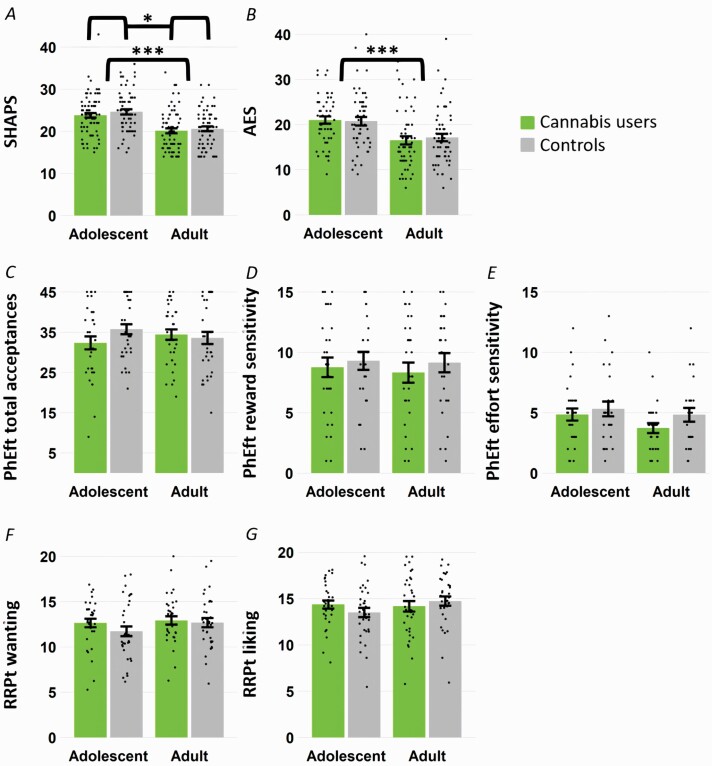
Background: Cannabis use may be linked with anhedonia and apathy. However, previous studies have shown mixed results, and few have examined the association between cannabis use and specific reward sub-processes. Adolescents may be more vulnerable than adults to harmful effects of cannabis. This study investigated (1) the association between non-acute cannabis use and apathy, anhedonia, pleasure, and effort-based decision-making for reward; and (2) whether these relationships were moderated by age group. Methods: We used data from the “CannTeen” study. Participants were 274 adult (26–29 years) and adolescent (16–17 years) cannabis users (1–7 d/wk use in the past 3 months) and gender- and age-matched controls. Anhedonia was measured with the Snaith-Hamilton Pleasure Scale (n = 274), and apathy was measured with the Apathy Evaluation Scale (n = 215). Effort-based decision-making for reward was measured with the Physical Effort task (n = 139), and subjective wanting and liking of rewards was measured with the novel Real Reward Pleasure task (n = 137). Results: Controls had higher levels of anhedonia than cannabis users (F1,258 = 5.35, P = .02, η p2 = .02). There were no other significant effects of user-group and no significant user-group*age-group interactions. Null findings were supported by post hoc Bayesian analyses. Conclusion: Our results suggest that cannabis use at a frequency of 3 to 4 d/wk is not associated with apathy, effort-based decision-making for reward, reward wanting, or reward liking in adults or adolescents. Cannabis users had lower anhedonia than controls, albeit at a small effect size. These findings are not consistent with the hypothesis that non-acute cannabis use is associated with amotivation.
Overview
The claims and statistics of this paper haven’t been checked yet.
Free: it reads the open-access text and checks the first 5 claims that cite a source we can check. Create a free account to check every claim.
Integrity signals
Registry
Cites
Statistics
Figures
Verification
Claims the paper makes
The claims and statistics of this paper haven’t been checked yet.
Free: it reads the open-access text and checks the first 5 claims that cite a source we can check. Create a free account to check every claim.
Claims other papers make about this one
Each is checked against this paper’s own text: does it say what the citing paper says it does?
The source backs part of the claim, not all of it — or backs it for a different population, condition or comparison.
In the citing paper
“In humans, moderate adolescent cannabis users have reported less anhedonia than nonusers [165].”
From Consequences of adolescent drug use (2023) · cites this paper as [165]
Experimental — accuracy not yet measured
Self-check
Percentages, sums and reported differences re-computed from the paper’s own numbers.
The self-check needs the paper’s full text.
Citations
Cites
R: A Language and Environment for Statistical Computing
R Core Team (2025) · doi:10.32614/r.manuals · Cited by 352,181
Brain development during childhood and adolescence: a longitudinal MRI study
Giedd, J. N., Blumenthal, J., Jeffries, N. O., Castellanos, F. X., Liu, H., Zijdenbos, A., Paus, T., Evans, A. C., & Rapoport, J. L. (1999) · Nature Neuroscience · doi:10.1038/13158 · Cited by 5,552 · cited 1×
“…period of socio-emotional, cognitive, and brain development, during which external factors such as cannabis and other substance use may be particularly influential in shaping the brain and cognition (Giedd et al., 1999; Giedd, 2004; Schneider, 2008; Bossong and Niesink, 2010; Lubman et al., 2015).”
Casey, B. J., Jones, R. M., & Hare, T. A. (2008) · Annals of the New York Academy of Sciences · doi:10.1196/annals.1440.010 · Cited by 3,345
Cannabis use and risk of psychotic or affective mental health outcomes: a systematic review.
Moore, T. H., Zammit, S., Lingford-Hughes, A., Barnes, T. R., Jones, P. B., Burke, M., & Lewis, G. (2007) · The Lancet · doi:10.1016/s0140-6736(07)61162-3 · Cited by 2,224 · cited 1×
“Additionally, cannabis might have indirect effects on apathy and anhedonia by increasing the risk of psychosis and depression (Moore et al., 2007; Lev-Ran et al., 2014).”
BackgroundDissecting components of reward: ‘liking’, ‘wanting’, and learning
Berridge, K. C., Robinson, T. E., & Aldridge, J. W. (2009) · Current Opinion in Pharmacology · doi:10.1016/j.coph.2008.12.014 · Cited by 1,942 · cited 2×
“The RRPt was developed in previous studies (Lawn et al., 2015, 2018) and mimics existing reward liking tasks that have been validated in cannabis users and other populations (Berridge et al., 2009; Ford et al., 2014; de Bruijn et al., 2017; Freeman et al., 2018).”
Reliability and validity of the apathy evaluation scale
Marin, R. S., Biedrzycki, R. C., & Firinciogullari, S. (1991) · Psychiatry Research · doi:10.1016/0165-1781(91)90040-v · Cited by 1,805 · cited 1×
“Questionnaire Measures — Anhedonia was assessed with the SHAPS (Snaith et al., 1995), and apathy was assessed with the AES (Marin et al., 1991).”
A scale for the assessment of hedonic tone the Snaith-Hamilton pleasure scale
Snaith, R. P., Hamilton, M., Morley, S., Humayan, A., Hargreaves, D., & Trigwell, P. (1995) · British Journal of Psychiatry · doi:10.1192/bjp.167.1.99 · Cited by 1,778 · cited 12×
“However, the mean difference between cannabis users and controls was 1 point on the SHAPS, corresponding to a small effect size ( η p2 = .02).”
InfluentialStructural magnetic resonance imaging of the adolescent brain
GIEDD, J. N. (2004) · Annals of the New York Academy of Sciences · doi:10.1196/annals.1308.009 · Cited by 1,610 · cited 1×
“…period of socio-emotional, cognitive, and brain development, during which external factors such as cannabis and other substance use may be particularly influential in shaping the brain and cognition (Giedd et al., 1999; Giedd, 2004; Schneider, 2008; Bossong and Niesink, 2010; Lubman et al., 2015).”
Reconsidering anhedonia in depression: Lessons from translational neuroscience
Treadway, M. T., & Zald, D. H. (2011) · Neuroscience & Biobehavioral Reviews · doi:10.1016/j.neubiorev.2010.06.006 · Cited by 1,579 · cited 1×
“Syndromes of disrupted reward processing include apathy, defined as a loss of or reduction in motivation (Robert et al., 2009), and anhedonia, defined as a loss of interest in or pleasure from previously rewarding activities (Treadway and Zald, 2011).”
Liking, wanting, and the incentive-sensitization theory of addiction
Berridge, K. C., & Robinson, T. E. (2016) · American Psychologist · doi:10.1037/amp0000059 · Cited by 1,440 · cited 1×
“Reward processing refers to any process that underpins the seeking and consumption of rewards (Berridge and Robinson, 2016) and encompasses several reward sub-processes (Berridge et al., 2009; Husain and Roiser, 2018).”
Research works printed but not linked: 1
- Wechsler D (2001) Wechsler Test of Adult Reading (WTAR), San Antonio, TX: The Psychological Corporation.
Cited by
Consequences of adolescent drug use
Steinfeld, M. R., & Torregrossa, M. M. (2023) · Translational Psychiatry · doi:10.1038/s41398-023-02590-4 · Cited by 237
“In humans, moderate adolescent cannabis users have reported less anhedonia than nonusers [165].”
BackgroundThe effects of recreational marijuana legalization on employment and earnings
Dave, D., Yang, L., Muratori, C., & Sabia, J. J. (2025) · Journal of Population Economics · doi:10.1007/s00148-025-01100-8 · Cited by 25
“…syndrome in relation to cannabis use was McGlothlin and West in 1968 (McGlothlin and West, 1968) who characterized it as apathy—that is, a loss of, or reduction in, motivation (Skumlien et al. 2022)—and diminished ability to concentrate, follow routines, or successfully master new material.”
Skumlien, M., Freeman, T. P., Hall, D., Mokrysz, C., Wall, M. B., Ofori, S., Petrilli, K., Trinci, K., Borissova, A., Fernandez‐Vinson, N., et al. (2022) · Biological Psychiatry Cognitive Neuroscience and Neuroimaging · doi:10.1016/j.bpsc.2022.10.004 · Cited by 15
Self-citationLaraki, Y., Bayard, S., Décombe, A., Capdevielle, D., & Raffard, S. (2023) · Frontiers in Psychiatry · doi:10.3389/fpsyt.2023.1098932 · Cited by 15
“Currently there are mixed results suggesting links between symptoms of anhedonia and cannabis use in non-schizophrenic populations (76, 77).”
BackgroundInzlicht, M., Sparrow-Mungal, T. B., & Depow, G. J. (2024) · Social Psychological and Personality Science · doi:10.1177/19485506241245744 · Cited by 13
Metadata
- Authors
- Skumlien, M., Mokrysz, C., Freeman, T. P., Valton, V., Wall, M. B., Bloomfield, M., Lees, R., Borissova, A., Petrilli, K., Giugliano, M., Clisu, D., Langley, C., Sahakian, B. J., Curran, H. V., & Lawn, W.
- Affiliations
- University of Cambridge (GB)
- University College London (GB)
- Invicro (United Kingdom) (GB)
- King's College London (GB)
- Corresponding author
- Skumlien, Martine
- ORCID
- Venue
- International Journal of Neuropsychopharmacology
- Publisher
- Oxford University Press (OUP)
- Published
- 2022-08-24
- Volume
- 26
- Issue
- 1
- Pages
- 9-19
- ISSN
- 1461-1457 (ISSN-L)
- 1469-5111
- PMC
- PMC9850660
- OpenAlex
- W4293027866
- Cited by
- 20
- References
- 76
- Citations by year
- 2026: 3 · 2025: 5 · 2024: 5 · 2023: 6 · 2022: 1
- FWCI
- 2.54
- Type
- journal article
- Language
- en
- Open access
- gold
- doi.org
- Licence
- Locations
- The International Journal of Neuropsychopharmacology (publishedVersion, cc-by)
- PubMed Central (publishedVersion, cc-by)
- PubMed (publishedVersion)
- Research Portal (King's College London) (submittedVersion, cc-by)
- UCL Discovery (University College London) (submittedVersion)
- Funders
- Medical Research Council (MR/P012728/1)
- Aker Foundation
- National Institute for Health Research
- Wallitt Foundation
- Wellcome Trust (200181/Z//15/Z, MR/P012728/1)
- UK Department of Health
- Topics
- Health Sciences › Medicine › Pharmacology (medical) › Cannabis and Cannabinoid Research
- Life Sciences › Neuroscience › Cellular and Molecular Neuroscience › Neurotransmitter Receptor Influence on Behavior
- Health Sciences › Medicine › Epidemiology › Substance Abuse Treatment and Outcomes
- Keywords
- cannabis use, anhedonia, apathy, amotivation, effort-based decision making, reward processing, adolescents, adults, age differences
- MeSH terms
- Adolescent, Adult, Bayes Theorem, Cannabis, Decision Making, Hallucinogens, Humans, Motivation, Reward, Pleasure, Apathy, Anhedonia, Cannabinoid Receptor Agonists
About these checks
Registry, retraction, Cites and statistics results are computed, not judged, with one exception: a printed reference that no index lists is read once by a model before it counts as a citation error. Claims are extracted by a model and kept only when their quote appears verbatim in the text; each cited source is then checked, with a model’s help, for whether it says what the claim relies on. Those verdicts can be wrong — read the claim’s quote and the cited source before relying on one.
Statistics and arithmetic are recomputed, not judged.
Confidence bands are shown only for fields calibrated on our annotated test set. None is calibrated yet, so no band is shown.
What counts as a claim ›How we measure confidence ›How we check this ›
Are you an author, or do you see a problem with this page? Request a review
Data sources
Bibliographic data: Semantic Scholar, OpenAlex, Crossref.
Contains information from the Semantic Scholar Academic Graph Datasets, made available under the ODC Attribution License (ODC-BY 1.0).
Semantic Scholar’s data is described in: Kinney, R., et al. (2023). The Semantic Scholar Open Data Platform. arXiv:2301.10140.
