

Enhancing clinical documentation with ambient artificial intelligence: a quality improvement survey assessing clinician perspectives on work burden, burnout, and job satisfaction
Open accessThe DOI matches its Crossref record; 13 of the 13 references it cites were found in a registry or an index.
Abstract
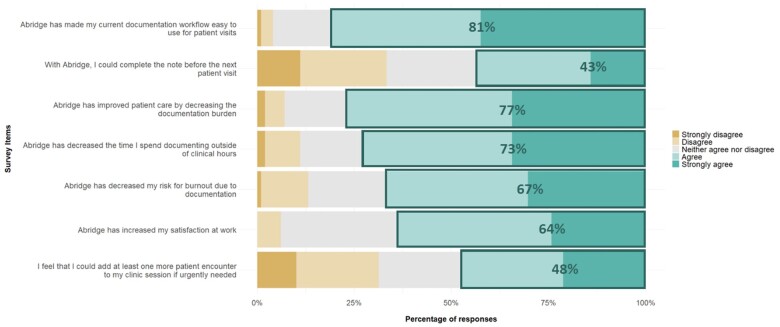
Objective: This study evaluates the impact of an ambient artificial intelligence (AI) documentation platform on clinicians' perceptions of documentation workflow. Materials and Methods: An anonymous pre- and non-anonymous post-implementation survey evaluated ambulatory clinician perceptions on impact of Abridge, an ambient AI documentation platform. Outcomes included clinical documentation burden, work after-hours, clinician burnout, and work satisfaction. Data were analyzed using descriptive statistics and proportional odds logistic regression to compare changes for concordant questions across pre- and post-surveys. Covariate analysis examined effect of specialty type and duration of AI tool usage. Results: <.001) was significantly improved. Most respondents agreed that the AI tool decreased documentation burden, decreased the time spent documenting outside clinical hours, reduced burnout risk, and increased job satisfaction, with 48% agreeing that an additional patient could be seen if needed. Clinician specialty type and number of days using the AI tool did not significantly affect survey responses. Discussion: Clinician experience and efficiency was improved with use of Abridge across a breadth of specialties. Conclusion: An ambient AI documentation platform had tremendous impact on improving clinician experience within a short time frame. Future studies should utilize validated instruments for clinician efficiency and burnout and compare impact across AI platforms.
Overview
The claims and statistics of this paper haven’t been checked yet.
Free: it reads the open-access text and checks the first 5 claims that cite a source we can check. Create a free account to check every claim.
Integrity signals
Registry
Cites
Statistics
Figures
Verification
Claims the paper makes
The claims and statistics of this paper haven’t been checked yet.
Free: it reads the open-access text and checks the first 5 claims that cite a source we can check. Create a free account to check every claim.
Claims other papers make about this one
Each is checked against this paper’s own text: does it say what the citing paper says it does?
The source backs part of the claim, not all of it — or backs it for a different population, condition or comparison.
In the citing paper
“To date, fully autonomous, EHR-integrated scribes have been used primarily in the ambulatory outpatient setting, with improvements in physician task load, burnout, and usability [10-12].”
From Clinician Perspectives on Ambient AI Scribes in the Intensive Care Unit: Qualitative Interview Study (2026) · cites this paper as [12]
Experimental — accuracy not yet measuredThe cited source says what the claim attributes to it.
In the citing paper
“While prior work has explored the impact of this technology on patient-provider interactions primarily in ambulatory settings”
From Clinician Perspectives on Ambient AI Scribes in the Intensive Care Unit: Qualitative Interview Study (2026) · cites this paper as [12]
The check wasn’t confident either way, so it gives no verdict — never disputed.
In the citing paper
“a major limitation of these communication workflows is that what is verbally discussed may not be comprehensively or even formally documented in the electronic health record (EHR) [12].”
From Clinician Perspectives on Ambient AI Scribes in the Intensive Care Unit: Qualitative Interview Study (2026) · cites this paper as [12]
Experimental — accuracy not yet measured
Self-check
Percentages, sums and reported differences re-computed from the paper’s own numbers.
The self-check needs the paper’s full text.
Citations
Cites
Allocation of Physician Time in Ambulatory Practice: A Time and Motion Study in 4 Specialties
Sinsky, C., Colligan, L., Li, L., Prgomet, M., Reynolds, S., Goeders, L., Westbrook, J., Tutty, M., & Blike, G. (2016) · Annals of Internal Medicine · doi:10.7326/m16-0961 · Cited by 1,494
Physician stress and burnout: the impact of health information technology
Gardner, R. L., Cooper, E., Haskell, J., Harris, D. A., Poplau, S., Kroth, P. J., & Linzer, M. (2019) · Journal of the American Medical Informatics Association · doi:10.1093/jamia/ocy145 · Cited by 566
Melnick, E. R., Dyrbye, L. N., Sinsky, C. A., Trockel, M., West, C. P., Nedelec, L., Tutty, M. A., & Shanafelt, T. (2020) · Mayo Clinic Proceedings · doi:10.1016/j.mayocp.2019.09.024 · Cited by 413
Electronic medical records and physician stress in primary care: results from the MEMO Study
Babbott, S., Manwell, L. B., Brown, R., Montague, E., Williams, E., Schwartz, M., Hess, E., & Linzer, M. (2014) · Journal of the American Medical Informatics Association · doi:10.1136/amiajnl-2013-001875 · Cited by 366
Overhage, J. M., & McCallie, D. (2020) · Annals of Internal Medicine · doi:10.7326/m18-3684 · Cited by 238
Gidwani, R., Nguyen, C., Kofoed, A., Carragee, C., Rydel, T., Nelligan, I., Sattler, A., Mahoney, M., & Lin, S. (2017) · The Annals of Family Medicine · doi:10.1370/afm.2122 · Cited by 202
The impact of nuance DAX ambient listening AI documentation: a cohort study.
Haberle, T., Cleveland, C., Snow, G. L., Barber, C., Stookey, N., Thornock, C., Younger, L., Mullahkhel, B., & Ize-Ludlow, D. (2024) · Journal of the American Medical Informatics Association · doi:10.1093/jamia/ocae022 · Cited by 171 · cited 1×
“14 In that study, while there was an association with improved provider engagement, in work relative value units generated by providers, there was also and an increase in the after-hours time spent in the EHR in the intervention group, in contrast to our study which demonstrated decreased time…”
Robertson, S. L., Robinson, M. D., & Reid, A. (2017) · Journal of Graduate Medical Education · doi:10.4300/jgme-d-16-00123.1 · Cited by 170
The digital scribe in clinical practice: a scoping review and research agenda
van Buchem, M. M., Boosman, H., Bauer, M. P., Kant, I. M. J., Cammel, S. A., & Steyerberg, E. W. (2021) · npj Digital Medicine · doi:10.1038/s41746-021-00432-5 · Cited by 152
Owens, L. M., Wilda, J. J., Hahn, P. Y., Koehler, T., & Fletcher, J. J. (2024) · Family Practice · doi:10.1093/fampra/cmad092 · Cited by 86
Cited by
Evaluation of an Ambient Artificial Intelligence Documentation Platform for Clinicians
Stults, C. D., Deng, S., Martinez, M. C., Wilcox, J., Szwerinski, N., Chen, K. H., Driscoll, S., Washburn, J., & Jones, V. G. (2025) · JAMA Network Open · doi:10.1001/jamanetworkopen.2025.8614 · Cited by 147
Assessment of Large Language Models in Clinical Reasoning: A Novel Benchmarking Study
McCoy, L. G., Swamy, R., Sagar, N., Wang, M., Bacchi, S., Fong, J. M. N., Tan, N. C., Tan, K., Buckley, T. A., Brodeur, P. G., et al. (2025) · NEJM AI · doi:10.1056/aidbp2500120 · Cited by 125
Beyond human ears: navigating the uncharted risks of AI scribes in clinical practice
Topaz, M., Peltonen, L., & Zhang, Z. (2025) · npj Digital Medicine · doi:10.1038/s41746-025-01895-6 · Cited by 109
Clinical Implementation of Artificial Intelligence Scribes in Health Care: A Systematic Review
Hassan, H., Zipursky, A. R., Rabbani, N., You, J. G.-T., Tse, G., Orenstein, E. W., Ray, M., Parsons, C. R., Shin, S., Lawton, G., et al. (2025) · Applied Clinical Informatics · doi:10.1055/a-2597-2017 · Cited by 81
Afshar, M., Ryan Baumann, M., Resnik, F., Hintzke, J., Gravel Sullivan, A., Wills, G., Lemmon, K., Dambach, J., Mrotek, L. A., Quinn, M., et al. (2025) · NEJM AI · doi:10.1056/aioa2500945 · Cited by 59
Metadata
- Authors
- Albrecht, M., Shanks, D., Shah, T., Hudson, T., Thompson, J., Filardi, T., Wright, K., Ator, G. A., & Smith, T. R.
- Affiliations
- University of Kansas Medical Center (US)
- Abridge , Philadelphia, PA 19102,
- The University of Kansas Health System (US)
- Corresponding author
- Albrecht, Michael
- Venue
- JAMIA Open
- Publisher
- Oxford University Press (OUP)
- Published
- 2024-12-26
- Volume
- 8
- Issue
- 1
- Pages
- ooaf013-ooaf013
- ISSN
- 2574-2531 (ISSN-L)
- PMC
- PMC11843214
- OpenAlex
- W4407853749
- Cited by
- 103
- References
- 13
- Citations by year
- 2026: 63 · 2025: 40
- FWCI
- 31.47
- Type
- journal article
- Language
- en
- Open access
- gold
- doi.org
- Licence
- Locations
- JAMIA Open (publishedVersion, cc-by)
- PubMed Central (publishedVersion, cc-by)
- PubMed (publishedVersion)
- Topics
- Health Sciences › Health Professions › Health Information Management › Electronic Health Records Systems
- Health Sciences › Medicine › Health Informatics › Artificial Intelligence in Healthcare and Education
- Health Sciences › Nursing › Research and Theory › Nursing Diagnosis and Documentation
- Keywords
- clinical documentation, documentation burden, clinician burnout, job satisfaction, outpatient care, clinician perceptions, AI-assisted documentation
About these checks
Registry, retraction, Cites and statistics results are computed, not judged, with one exception: a printed reference that no index lists is read once by a model before it counts as a citation error. Claims are extracted by a model and kept only when their quote appears verbatim in the text; each cited source is then checked, with a model’s help, for whether it says what the claim relies on. Those verdicts can be wrong — read the claim’s quote and the cited source before relying on one.
Statistics and arithmetic are recomputed, not judged.
Confidence bands are shown only for fields calibrated on our annotated test set. None is calibrated yet, so no band is shown.
What counts as a claim ›How we measure confidence ›How we check this ›
Are you an author, or do you see a problem with this page? Request a review
How to cite
Cite CoChat for the checks on this page, and the paper for its own findings.
- This page
- CoChat. (2026). Citation check: Enhancing clinical documentation with ambient artificial intelligence: a quality improvement survey assessing clinician perspectives on work burden, burnout, and job satisfaction. https://app.cochat.ai/papers/10.1093/jamiaopen/ooaf013
- The paper
- Albrecht, M., Shanks, D., Shah, T., Hudson, T., Thompson, J., Filardi, T., Wright, K., Ator, G. A., & Smith, T. R. (2024). Enhancing clinical documentation with ambient artificial intelligence: a quality improvement survey assessing clinician perspectives on work burden, burnout, and job satisfaction. JAMIA Open. https://doi.org/10.1093/jamiaopen/ooaf013
Data sources
Bibliographic data: Semantic Scholar, OpenAlex, Crossref.
Contains information from the Semantic Scholar Academic Graph Datasets, made available under the ODC Attribution License (ODC-BY 1.0).
Semantic Scholar’s data is described in: Kinney, R., et al. (2023). The Semantic Scholar Open Data Platform. arXiv:2301.10140.
