

Enhancing clinical documentation with ambient artificial intelligence: a quality improvement survey assessing clinician perspectives on work burden, burnout, and job satisfaction
Open accessThe DOI matches its Crossref record; 13 of the 13 references it cites were found in a registry or an index.
Abstract
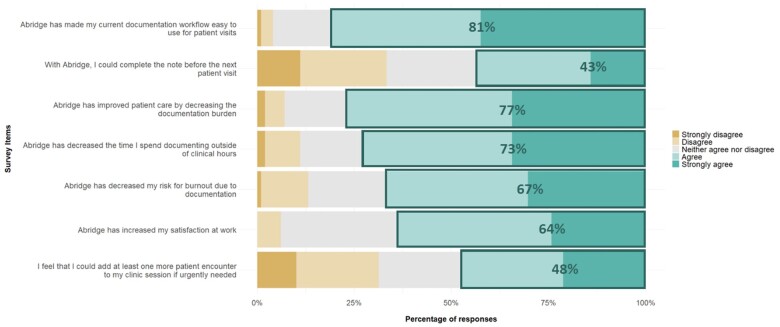
Objective: This study evaluates the impact of an ambient artificial intelligence (AI) documentation platform on clinicians' perceptions of documentation workflow. Materials and Methods: An anonymous pre- and non-anonymous post-implementation survey evaluated ambulatory clinician perceptions on impact of Abridge, an ambient AI documentation platform. Outcomes included clinical documentation burden, work after-hours, clinician burnout, and work satisfaction. Data were analyzed using descriptive statistics and proportional odds logistic regression to compare changes for concordant questions across pre- and post-surveys. Covariate analysis examined effect of specialty type and duration of AI tool usage. Results: <.001) was significantly improved. Most respondents agreed that the AI tool decreased documentation burden, decreased the time spent documenting outside clinical hours, reduced burnout risk, and increased job satisfaction, with 48% agreeing that an additional patient could be seen if needed. Clinician specialty type and number of days using the AI tool did not significantly affect survey responses. Discussion: Clinician experience and efficiency was improved with use of Abridge across a breadth of specialties. Conclusion: An ambient AI documentation platform had tremendous impact on improving clinician experience within a short time frame. Future studies should utilize validated instruments for clinician efficiency and burnout and compare impact across AI platforms.
Overview
The claims and statistics of this paper haven’t been checked yet.
Free: it reads the open-access text and checks the first 5 claims that cite a source we can check. Create a free account to check every claim.
Integrity signals
Registry
Cites
Statistics
Figures
Verification
Claims the paper makes
The claims and statistics of this paper haven’t been checked yet.
Free: it reads the open-access text and checks the first 5 claims that cite a source we can check. Create a free account to check every claim.
Claims other papers make about this one
Each is checked against this paper’s own text: does it say what the citing paper says it does?
The source backs part of the claim, not all of it — or backs it for a different population, condition or comparison.
In the citing paper
“To date, fully autonomous, EHR-integrated scribes have been used primarily in the ambulatory outpatient setting, with improvements in physician task load, burnout, and usability [10-12].”
From Clinician Perspectives on Ambient AI Scribes in the Intensive Care Unit: Qualitative Interview Study (2026) · cites this paper as [12]
Experimental — accuracy not yet measuredThe cited source says what the claim attributes to it.
In the citing paper
“While prior work has explored the impact of this technology on patient-provider interactions primarily in ambulatory settings”
From Clinician Perspectives on Ambient AI Scribes in the Intensive Care Unit: Qualitative Interview Study (2026) · cites this paper as [12]
The check wasn’t confident either way, so it gives no verdict — never disputed.
In the citing paper
“a major limitation of these communication workflows is that what is verbally discussed may not be comprehensively or even formally documented in the electronic health record (EHR) [12].”
From Clinician Perspectives on Ambient AI Scribes in the Intensive Care Unit: Qualitative Interview Study (2026) · cites this paper as [12]
Experimental — accuracy not yet measured
Self-check
Percentages, sums and reported differences re-computed from the paper’s own numbers.
The self-check needs the paper’s full text.
Citations
Cites
Allocation of Physician Time in Ambulatory Practice: A Time and Motion Study in 4 Specialties
Sinsky, C., Colligan, L., Li, L., Prgomet, M., Reynolds, S., Goeders, L., Westbrook, J., Tutty, M., & Blike, G. (2016) · Annals of Internal Medicine · doi:10.7326/m16-0961 · Cited by 1,494
Physician stress and burnout: the impact of health information technology
Gardner, R. L., Cooper, E., Haskell, J., Harris, D. A., Poplau, S., Kroth, P. J., & Linzer, M. (2019) · Journal of the American Medical Informatics Association · doi:10.1093/jamia/ocy145 · Cited by 566
Melnick, E. R., Dyrbye, L. N., Sinsky, C. A., Trockel, M., West, C. P., Nedelec, L., Tutty, M. A., & Shanafelt, T. (2020) · Mayo Clinic Proceedings · doi:10.1016/j.mayocp.2019.09.024 · Cited by 413
Electronic medical records and physician stress in primary care: results from the MEMO Study
Babbott, S., Manwell, L. B., Brown, R., Montague, E., Williams, E., Schwartz, M., Hess, E., & Linzer, M. (2014) · Journal of the American Medical Informatics Association · doi:10.1136/amiajnl-2013-001875 · Cited by 366
Overhage, J. M., & McCallie, D. (2020) · Annals of Internal Medicine · doi:10.7326/m18-3684 · Cited by 238
Gidwani, R., Nguyen, C., Kofoed, A., Carragee, C., Rydel, T., Nelligan, I., Sattler, A., Mahoney, M., & Lin, S. (2017) · The Annals of Family Medicine · doi:10.1370/afm.2122 · Cited by 202
The impact of nuance DAX ambient listening AI documentation: a cohort study.
Haberle, T., Cleveland, C., Snow, G. L., Barber, C., Stookey, N., Thornock, C., Younger, L., Mullahkhel, B., & Ize-Ludlow, D. (2024) · Journal of the American Medical Informatics Association · doi:10.1093/jamia/ocae022 · Cited by 171 · cited 1×
“14 In that study, while there was an association with improved provider engagement, in work relative value units generated by providers, there was also and an increase in the after-hours time spent in the EHR in the intervention group, in contrast to our study which demonstrated decreased time…”
Robertson, S. L., Robinson, M. D., & Reid, A. (2017) · Journal of Graduate Medical Education · doi:10.4300/jgme-d-16-00123.1 · Cited by 170
The digital scribe in clinical practice: a scoping review and research agenda
van Buchem, M. M., Boosman, H., Bauer, M. P., Kant, I. M. J., Cammel, S. A., & Steyerberg, E. W. (2021) · npj Digital Medicine · doi:10.1038/s41746-021-00432-5 · Cited by 152
Owens, L. M., Wilda, J. J., Hahn, P. Y., Koehler, T., & Fletcher, J. J. (2024) · Family Practice · doi:10.1093/fampra/cmad092 · Cited by 86
Cited by
Evaluation of an Ambient Artificial Intelligence Documentation Platform for Clinicians
Stults, C. D., Deng, S., Martinez, M. C., Wilcox, J., Szwerinski, N., Chen, K. H., Driscoll, S., Washburn, J., & Jones, V. G. (2025) · JAMA Network Open · doi:10.1001/jamanetworkopen.2025.8614 · Cited by 147
Assessment of Large Language Models in Clinical Reasoning: A Novel Benchmarking Study
McCoy, L. G., Swamy, R., Sagar, N., Wang, M., Bacchi, S., Fong, J. M. N., Tan, N. C., Tan, K., Buckley, T. A., Brodeur, P. G., et al. (2025) · NEJM AI · doi:10.1056/aidbp2500120 · Cited by 125
Beyond human ears: navigating the uncharted risks of AI scribes in clinical practice
Topaz, M., Peltonen, L., & Zhang, Z. (2025) · npj Digital Medicine · doi:10.1038/s41746-025-01895-6 · Cited by 109
Clinical Implementation of Artificial Intelligence Scribes in Health Care: A Systematic Review
Hassan, H., Zipursky, A. R., Rabbani, N., You, J. G.-T., Tse, G., Orenstein, E. W., Ray, M., Parsons, C. R., Shin, S., Lawton, G., et al. (2025) · Applied Clinical Informatics · doi:10.1055/a-2597-2017 · Cited by 81
Afshar, M., Ryan Baumann, M., Resnik, F., Hintzke, J., Gravel Sullivan, A., Wills, G., Lemmon, K., Dambach, J., Mrotek, L. A., Quinn, M., et al. (2025) · NEJM AI · doi:10.1056/aioa2500945 · Cited by 59
Kanaparthy, N. S., Villuendas-Rey, Y., Bakare, T., Diao, Z., Iscoe, M., Loza, A., Wright, D., Safranek, C., Faustino, I. V., Brackett, A., et al. (2025) · JMIR AI · doi:10.2196/76743 · Cited by 57
Artificial intelligence across the cancer care continuum
Riaz, I. B., Khan, M. A., & Osterman, T. J. (2025) · Cancer · doi:10.1002/cncr.70050 · Cited by 40
Sarraf, B., & Ghasempour, A. (2025) · Frontiers in Public Health · doi:10.3389/fpubh.2025.1628831 · Cited by 40
Razaghi, M., Hafez, A. H., Farina, J., Scalia, I. G., Pereyra, M., Abdelfattah, F. E., Sheashaa, H., Awad, K., Lester, S. J., Ayoub, C., et al. (2026) · Cardiovascular Diagnosis and Therapy · doi:10.21037/cdt-2025-454 · Cited by 39
Tiem, J. M. V., Cramer, E., Iverson, C., Kennelty, K. A., Andrys, N. R. R., Lee, J., Knake, L. A., Misurac, J. M., Blum, J. M., & Reisinger, H. S. (2025) · Journal of the American Medical Informatics Association · doi:10.1093/jamia/ocaf214 · Cited by 36
Zhao, J., Liu, H., Chen, Y., & Song, F. (2025) · BMC Medical Informatics and Decision Making · doi:10.1186/s12911-025-03324-w · Cited by 34
“The median number of study participants was 40, ranged greatly across studies from 4 resident physicians at a psychiatric clinic [33] to approximately 10,000 clinicians in an integrated health care delivery system [25, 33].”
Haider, S. A., Prabha, S., Gomez-Cabello, C. A., Borna, S., Genovese, A., Trabilsy, M., Collaço, B. G., Wood, N. G., Bagaria, S. P., Tao, C., et al. (2025) · Sensors · doi:10.3390/s25144305 · Cited by 31
“While patient–physician interactions are increasingly being recorded using ambient sensing tools such as Abridge, access to the resulting transcripts remains tightly restricted due to privacy concerns and the need to protect sensitive patient information [18].”
Psychiatric Documentation and Management in Primary Care With Artificial Intelligence Scribe Use
Castro, V., McCoy, T. H., Verhaak, P. F., Ramachandiran, A. K., & Perlis, R. H. (2026) · JAMA Psychiatry · doi:10.1001/jamapsychiatry.2025.4303 · Cited by 33
Shin, H. S., Williams, H., Braykov, N. P., Jahan, A., Meller, J., & Orenstein, E. W. (2025) · Applied Clinical Informatics · doi:10.1055/a-2657-8087 · Cited by 27
Boussi Rahmouni, H., Hassine, N. B. E. H., Chouchen, M., Ceylan, H. İ., Muntean, R. I., Bragazzi, N. L., & Dergaa, I. (2025) · Healthcare · doi:10.3390/healthcare13202553 · Cited by 25
“Decision support systems provide relevant information at the point of care, thereby reducing the time spent searching for information [139].”
InfluentialDave, B., Martin, P., David, S. S., Kumar, S., & Chakraborty, T. (2025) · International Journal of Medical Informatics · doi:10.1016/j.ijmedinf.2025.106122 · Cited by 25
Guo, Y., Hu, D., Yang, Z., Chow, E., Tam, S., Perret, D., Pandita, D., & Zheng, K. (2026) · Journal of the American Medical Informatics Association · doi:10.1093/jamia/ocag059 · Cited by 21
Chandrasekaran, R., & Moustakas, E. (2025) · Journal of the American Medical Informatics Association · doi:10.1093/jamia/ocaf218 · Cited by 20
From de‐skilling to up‐skilling: How artificial intelligence will augment the modern physician
Oettl, F. C., Pruneski, J. A., Zsidai, B., Yu, Y., Fendrich, D., Tischer, T., Hirschmann, M. T., Zaffagnini, S., Samuelsson, K., & ESSKA Artificial Intelligence Working Group (2026) · Journal of Experimental Orthopaedics · doi:10.1002/jeo2.70677 · Cited by 20
Cain, C. H., Davis, A. C., Broder, B., Chu, E., DeHaven, A. H., Domenigoni, A., Gin, N., Kapoor, A., Liu, V., MacLean, A., et al. (2025) · NEJM AI · doi:10.1056/aics2400977 · Cited by 19
Surgeon, Trainee, or GPT ? A Blinded Multicentric Study of AI ‐Augmented Operative Notes
Hack, S., Attal, R., Locatelli, G., Scottà, G., Maniaci, A., Parisi, F. M., van der Poel, N. A., Daele, M. V., García‐Lliberós, A., Rodriguez‐Prado, C., et al. (2025) · The Laryngoscope · doi:10.1002/lary.70063 · Cited by 19
What do clinicians edit in ambient AI-drafted clinical documentation? A qualitative content analysis
Guo, Y., Hu, D., Yang, Z., Kim, S., Tran, B. D., Lee, J., Vallabhaneni, S., Zehrung, R., Sutari, S., Tam, S., et al. (2026) · Journal of the American Medical Informatics Association · doi:10.1093/jamia/ocag073 · Cited by 20
Chowdhury, A., Casey, M., Wilson, J. A., Pollak, K. I., Goldstein, B. A., Bedoya, A., & Poon, E. G. (2026) · Journal of the American Medical Informatics Association · doi:10.1093/jamia/ocag018 · Cited by 19
Taylor, S. L., Jost, M., MacDonald, S. T., Ren, Y., Hilton, S. A., Davenport, S., Aizenberg, D. A., Hall, B. L., Lyles, C. R., & Adams, J. Y. (2026) · JMIR Medical Informatics · doi:10.2196/86474 · Cited by 18
“To date, the literature related to AI scribes has signaled improvements in time per note for physicians, with a potential for reducing workload and burnout [4,5].”
Anderson, T. N., Mohan, V., Dorr, D. A., Ratwani, R. M., Biro, J. M., & Gold, J. A. (2025) · Mayo Clinic proceedings. Digital health · doi:10.1016/j.mcpdig.2025.100292 · Cited by 17
“8, 22 — 24 However , objective evaluation of Although physicians are ultimately responsible for the content of their clinical documentation, previous work utilizing other clinician-in-the-loop methods of documentation suggests that provider proofreading is both inconsistent and imperfect.”
Recent approaches of artificial intelligence in intensive care unit: A review
Havelikar, U. A., Bembde, A., Patil, D., Shinde, A., Sharma, R. K., Patel, V. P., & Chaudhari, N. B. (2025) · Intelligent Hospital · doi:10.1016/j.inhs.2025.100030 · Cited by 18
van Zyl, L. E. (2026) · AI & Society · doi:10.1007/s00146-025-02814-9 · Cited by 17
Ethical considerations for clinical adoption of ambient digital scribe technology
Anderson, T. N., Mohan, V., & Gold, J. A. (2025) · Journal of the American Medical Informatics Association · doi:10.1093/jamia/ocaf227 · Cited by 15
Bias and Oversight in Clinical AI: A Review of Decision Support Tools and Equity Frameworks
Adegunle, F., Chhatwal, K., Arab, S., Alabdaljabar, M. S., Raslan, M. A., Sayed, O., & Goldsweig, A. M. (2026) · Journal of General Internal Medicine · doi:10.1007/s11606-026-10229-5 · Cited by 16
“Natural language processing applications 18–21 aim to improve clinician workload and documentation accuracy, which transcribe real-time information in patient consultations to generate reports and letters, reducing administrative burden.”
van Linschoten, R. C. A., van Loon, C. M., Joanknecht, L., & Bischoff, E. W. M. A. (2026) · npj Digital Medicine · doi:10.1038/s41746-026-02454-3 · Cited by 17
“These observations are consistent with previous research showing that ambient scribes can reduce burnout, cognitive burden, and task load 12,14 – 16, 20, 21, 23, Ourstudy indicates that the use of an ambient scribe can have both positive and negative effects on patient – doctor communication.”
Moura, L. M. V. R., Mishuris, R. G., Metlay, J. P., Habib, M., Ting, D., Gallagher, K. L., Brodney, S., Rieu‐Werden, M. L., & Haas, J. S. (2025) · Journal of General Internal Medicine · doi:10.1007/s11606-025-09979-5 · Cited by 15
The comfort of automation: why cognitive sovereignty matters in AI-driven life sciences
Branda, F., & Ciccozzi, M. (2026) · Artificial Intelligence in the Life Sciences · doi:10.1016/j.ailsci.2026.100158 · Cited by 14
Woo, B., Song, J., Middleton, E., Fijačko, N., & Cato, K. (2025) · International Nursing Review · doi:10.1111/inr.70102 · Cited by 14
The unintended negative consequences of artificial intelligence use for psychologists
van Zyl, L. E. (2026) · Frontiers in Psychology · doi:10.3389/fpsyg.2026.1729050 · Cited by 13
“While AI promises efficiency gains, research reveals that practitioners spend considerable time learning new systems, troubleshooting technical problems, correcting AI errors, and managing the increased documentation that AI systems generate (Albrecht et al., 2025; Olson et al., 2025).”
Hundal, J., Jain, M., & McCollom, J. (2025) · AI in Precision Oncology · doi:10.1177/2993091x251384313 · Cited by 11
MedMobile: a mobile-sized language model with clinical capabilities
Vishwanath, K., Stryker, J., Alyakin, A., Alber, D. A., & Oermann, E. K. (2025) · BMJ Digital Health & AI · doi:10.1136/bmjdhai-2025-000068 · Cited by 11
Liu, D., Lin, Y., Yan, R., Wang, Z., Bold, D., & Hu, X. (2025) · JMIR Cancer · doi:10.2196/68516 · Cited by 10
Rahrisch, A., Braun, J., Ganter, M. T., Roche, T. R., Spahn, D. R., Tscholl, D. W., & Kaserer, A. (2026) · Journal of Clinical Anesthesia · doi:10.1016/j.jclinane.2026.112163 · Cited by 10
Vishwanath, K., Alyakin, A., Ghosh, M., Lee, J. V., Alber, D. A., Sangwon, K. L., Kondziolka, D. S., & Oermann, E. K. (2025) · Neurosurgery · doi:10.1227/neu.0000000000003878 · Cited by 9
Hamamoto, R., Koyama, T., Takahashi, S., Yasuda, T., Kobayashi, K., Akagi, Y., Kouno, N., Sudo, K., Hirata, M., Sunami, K., et al. (2026) · Journal of Hematology & Oncology · doi:10.1186/s13045-026-01781-y · Cited by 8
Crossover Evaluation of Two Ambient AI Scribe Tools in the Emergency Department
Webb, J., Chu, L., Turer, R. W., Chen, C., Rousseau, J. F., Salter, A. R., Courtney, D. M., Higashi, R. T., Guzman, N., Chapman, W. W., et al. (2026) · Applied Clinical Informatics · doi:10.1055/a-2818-1706 · Cited by 8
Gün, M., & Aktaş, Y. (2025) · American Journal of Hospice and Palliative Medicine® · doi:10.1177/10499091251352100 · Cited by 8
Atiku, S. O., Owolanke, K., & Olakotan, O. O. (2026) · Journal of Evaluation in Clinical Practice · doi:10.1111/jep.70460 · Cited by 7
“Human oversight remains essential when using AI tools to ensure clinical accuracy [22, 40].”
InfluentialLiu, C., Ta, C., DiMaria, E. S., Shelton, R. C., Natarajan, K., Sengupta, S., Cimino, J. J., & Weng, C. (2025) · npj Health Systems · doi:10.1038/s44401-025-00031-6 · Cited by 6
Kamphorst, K., de Jong, J., Rider, N. L., & Portnoy, J. M. (2025) · The Journal of Allergy and Clinical Immunology In Practice · doi:10.1016/j.jaip.2025.09.011 · Cited by 6
Al-Kahtani, N. K., Subbarayalu, A. V., Raman, V., Jamjoom, M. M., Al-Ansary, N. F. S., Alakrawi, Z., AL-Ibrahim, R. J., & Al-Zaki, W. A. (2025) · Informatics in Medicine Unlocked · doi:10.1016/j.imu.2025.101710 · Cited by 7
Interviews with clinicians about an ambient artificial intelligence documentation platform
Stults, C. D., Martinez, M., Szwerinski, N., Rabbani, N., & Jones, V. G. (2026) · Journal of the American Medical Informatics Association · doi:10.1093/jamia/ocag021 · Cited by 6
Menz, B. D., Scarfo, N. L., Modi, N. D., Cornelisse, E., Li, L. X., Tan, E., Gandhi, J., Maher, D., Kousa, D., Daniel, K., et al. (2026) · npj Digital Medicine · doi:10.1038/s41746-026-02494-9 · Cited by 6
“These tools promise to substantiallyreduceadministrativeburden,standardisedocumentation andenhancebothclinicianef fi ciency and the time available for patient engagement 10,12 – 16 .”
Patterson, J., Kovacs, M., & Lees, C. (2025) · Healthcare · doi:10.3390/healthcare13172118 · Cited by 5
“While the documentation time varies among individual clinicians within each specialty, those practicing in primary care and medical specialties spend more than twice as much time on notes as surgical colleagues [6].”
Wolfe, J., & Welsh, S. (2026) · Cureus · doi:10.7759/cureus.106643 · Cited by 5
“Albrecht et al. further found that among post-survey respondents, 77% agreed the tool improved patient care by decreasing documentation burden, 73% agreed that after-hours documentation decreased, 67% agreed that burnout risk was reduced, and 64% agreed that job satisfaction increased [15].”
From Conversation to Chart: An Analysis of Clinician Edits to Ambient AI Draft NotesPreprint
Guo, Y., Hu, D., Zhou, Y., Lyu, T., Sutari, S., Tam, S. P., Chow, E., Perret, D., Pandita, D., & Zheng, K. (2026) · medRxiv · doi:10.64898/2026.01.05.26343471 · Cited by 5
Paging the algorithm: applying the Best Available Human principle to graduate medical education
Stamos, D. B., & Dharod, A. (2026) · Academic Medicine · doi:10.1093/acamed/wvag119 · Cited by 4
Tracing the Pen: Electronic Health Records Amid the Rise of Generative AI
Nargesi, A. A., You, J. G.-T., Bitterman, D. S., Succi, M. D., Mishuris, R. G., Poon, E. G., & Landman, A. (2026) · npj Digital Medicine · doi:10.1038/s41746-026-02508-6 · Cited by 4
Kapoor, V., Skellern, C., McGrath, P., Brosnan, S., Gofer, Y., & Thorburn, L. (2026) · Journal of Paediatrics and Child Health · doi:10.1111/jpc.70419 · Cited by 4
The ethics of listening walls: patient autonomy and consent in the age of ambient clinical AI
Kumah, E., Antwi, J., Boakye, D. S., Botchwey, C. O., & Anyimadu, E. A. (2026) · npj Digital Medicine · doi:10.1038/s41746-026-02973-z · Cited by 4
Dutta, S., You, J. G.-T., Dunham, L. N., Cash, R. E., Meeker, M. A., White, B. A., & Joseph, J. W. (2026) · Annals of Emergency Medicine · doi:10.1016/j.annemergmed.2026.04.022 · Cited by 5
VanHara, A., & Hage, D. S. (2025) · Journal of Evidence-Based Social Work · doi:10.1080/26408066.2025.2571439 · Cited by 4
Validating Digital Scribes: A Scoping Review of Evaluation Practices and Clinical Use
Kerimoğlu, E., Notermans, F. V., Silkens, M., de Mul, M., Ahaus, K., & van der Boon, R. M. A. (2026) · Journal of Medical Systems · doi:10.1007/s10916-026-02392-3 · Cited by 3
Ambient Artificial Intelligence Scribes: A Scoping Review With Implications for Otolaryngology
Nallapaneni, S., Crafton, C. L., Cabrera, C. I., Mosca, C., Rodriguez, K., Rangarajan, S. V., & D’Anza, B. (2026) · The Laryngoscope · doi:10.1002/lary.70625 · Cited by 3
“Specifically, improvements in workflow resulting from reduced documentation burden were reported in several articles, while one article did not report improvements [13, 14, 19, 21].”
InfluentialClinical implementation of artificial intelligence in adolescent mental healthcare
Bischops, A., Kavanaugh, J. R., & Bickham, D. S. (2026) · Current Opinion in Pediatrics · doi:10.1097/mop.0000000000001584 · Cited by 3
Taylor, S. L., Aizenberg, D. A., Jost, M., Ren, Y., Lyles, C. A., & Adams, J. Y. (2026) · Journal of the American Medical Informatics Association · doi:10.1093/jamia/ocag103 · Cited by 3
Gong, E. J., Bang, C. S., & Lee, J. J. (2026) · Journal of Medical Internet Research · doi:10.2196/93618 · Cited by 3
“Specifically, Tierney et al [5] (n=7260) used custom satisfaction surveys without NASA-TLX or standardized burnout measures, and Albrecht et al [6] (n=181) relied on a custom quality improvement survey without validated workload assessments.”
InfluentialWaken, R. J., Lou, S. S., Hofford, M. R., Eiden, E., Burk, C., Kim, S., Esker, J., Zhang, L., Maddox, T. M., Abraham, J., et al. (2026) · Journal of the American Medical Informatics Association · doi:10.1093/jamia/ocag151 · Cited by 4
Linguistic Effects of Ambient AI on Clinical Documentation: A Matched Pre-Post StudyPreprint
Li, Y., Zhou, H., Blackley, S. V., Plasek, J. M., Lyu, Z., Zhang, W., You, J. G.-T., Centi, A. J., Mishuris, R. G., Yang, J., et al. (2026) · medRxiv · doi:10.64898/2026.02.16.26346370 · Cited by 3
Future of home-based care with the integration of technology into policy and practice
McBride, M. (2025) · British Journal of Community Nursing · doi:10.12968/bjcn.2025.0169 · Cited by 2
Harrington, L. (2025) · Critical Care Nursing Clinics of North America · doi:10.1016/j.cnc.2025.07.003 · Cited by 2
Mahajan, U. D., Parpia, S., Khan, M., Gupta, R., Spurrier, E., Akhtar, M., & Gupta, V. (2025) · Cureus · doi:10.38192/1.10.1.ac25.ab.063 · Cited by 2
Artificial Intelligence and Machine Learning in Health Care
Liebovitz, D., Wu, A. Y., Reamer, C. B., & Vadasz, B. (2025) · Medical Clinics of North America · doi:10.1016/j.mcna.2025.07.011 · Cited by 2
Lingam, V., Lee, J., & Perkins, R. M. (2025) · Medical Clinics of North America · doi:10.1016/j.mcna.2025.07.006 · Cited by 2
Bouterse, A., Pruneski, J. A., Oettl, F. C., Zsidai, B., Tischer, T., Longo, U. G., Seil, R., Hirschmann, M. T., & Samuelsson, K. (2026) · Knee Surgery Sports Traumatology Arthroscopy · doi:10.1002/ksa.70339 · Cited by 2
“…ef fi ciency with several platforms yielding reductions to note ‐ writing time, after ‐ hours documentation, and overall encounters times — all of which have correlated with improved job satisfaction, decreased mental demand, and declining metrics of burnout amongst clinicians [2, 7, 28, 68].”
Xiao, N., Li, H., Chen, L., Liu, S., Xiang, Q., & Wang, P. (2026) · Frontiers in Psychology · doi:10.3389/fpsyg.2026.1840884 · Cited by 3
Adoption and utility of digital scribes in clinical practice – A scoping review
Yu, S. H. T., Li, J., Carland, J. E., Ritchie, A., Dunn, A., & Baysari, M. T. (2026) · International Journal of Medical Informatics · doi:10.1016/j.ijmedinf.2026.106630 · Cited by 2
Atiku, S. O., Owolanke, K., & Olakotan, O. O. (2026) · Journal of Evaluation in Clinical Practice · doi:10.1111/jep.70554 · Cited by 2
“Early evaluations report perceived workflow benefits, including improved perceived ease of documentation, higher likelihood of completing notes during or shortly after encounters, and reductions in documentation burden and after‐ hours work [6, 7, 9, 10].”
FactsR: A Safer Method for Producing High Quality Healthcare DocumentationPreprint
Hansen, V. P. B., Krogsbøll, L., Lyngsø, J., Baltzersen, M., Motzfeldt, A. G., Pelgrims, K., & Maaløe, L. (2025) · arXiv (Cornell University) · doi:10.48550/arxiv.2505.10360 · Cited by 2
“These systems promise to reduce administrative overhead while maintaining or even enhancing the clarity and utility of clinical documentation[Tierney et al., 2024, Albrecht et al., 2025].”
Hundal, J., Veettil, A. A. V., Chung, C., & Hosseini, M. (2026) · American Society of Clinical Oncology Educational Book · doi:10.1200/edbk-26-517280 · Cited by 1
Ferrara, S. A., & Topaz, M. (2026) · Journal of Pediatric Health Care · doi:10.1016/j.pedhc.2025.12.014 · Cited by 1
Large language model applications for pediatric psychology
Robbertz, A. S., Harrison, L. E., & Crosby, L. E. (2026) · Journal of Pediatric Psychology · doi:10.1093/jpepsy/jsaf112 · Cited by 1
Wu, N., Whitelaw, H., Wang, Q., Phelps, A., Sivanesanathan, T., DeMaio, P., Ali, A., Chen, K., Dass, R., Grewal, E., et al. (2025) · MacSphere (McMaster University) · doi:10.71548/3068 · Cited by 1
Agkatsev, S., Templeton, M. D., Lazaridis, L., Nowak, H., Kebir, S., & Seliger, C. (2026) · Neuro-Oncology Advances · doi:10.1093/noajnl/vdag083 · Cited by 1
Durak, G., Medetalibeyoğlu, A., Çiçek, V., Keleş, E., & Bağcı, U. (2026) · Diagnostic and Interventional Radiology · doi:10.4274/dir.2026.263928 · Cited by 1
Transforming Rheumatology Practice
García-Agúndez, A., Creasman, M., Schmajuk, G., & Yazdany, J. (2026) · Rheumatic Disease Clinics of North America · doi:10.1016/j.rdc.2026.04.002 · Cited by 1
Patient and caregiver perspectives on AI scribes: An evidence synthesis
Kumah, E. (2026) · Health Policy and Technology · doi:10.1016/j.hlpt.2026.101273 · Cited by 1
Ambient AI Scribes as Emerging Infrastructure in the Learning Health System
Togunwa, T. O., & Platt, J. E. (2026) · Learning Health Systems · doi:10.1002/lrh2.70115 · Cited by 1
Dhamsania, I. R., Zhou, A. E., Khalilzadeh, D. M., Vidal, N. Y., Ferris, L. K., & Grant-Kels, J. M. (2026) · Clinics in Dermatology · doi:10.1016/j.clindermatol.2026.09.012 · Cited by 1
́Kane, R. O., Stonehouse‐Smith, D., Shirazi, M., Hutchinson, R., Seehra, J., & Cobourne, M. T. (2026) · BDJ · doi:10.1038/s41415-026-9951-9 · Cited by 1
Bires, J. L., Franklin, E. F., Nelson, K., Bonesteel, K., & Flora, D. B. (2025) · AI in Precision Oncology · doi:10.1089/aipo.2025.0007 · Cited by 1
“9 These examples underscore the need for continued research and robust regulatory standards to safely integrate AI into clinical practice, ensuring it complements rather than compromises patient care.”
Davis, D., Wray, J., Oldham, G., Elkeles, D., Borham, T., Gough, P., Tomlinson, M., James, N., Hill, A., Sullivan, E., et al. (2025) · medRxiv · doi:10.64898/2025.11.27.25340564 · Cited by 1
Zhou, Y., Guo, Y., Sutari, S., Dhillon, J., Beck, A., Chow, E., Tam, S., Perret, D., Pandita, D., Sadigh, G., et al. (2026) · arXiv (Cornell University) · doi:10.48550/arxiv.2606.00019 · Cited by 1
“…patients and clinicians 2–4,8 Building on the foundation of widespread EHR adoption, ambient artificial intelligence (AI) documentation tools have emerged as using automatic speech recognition (ASR) and generative AI (GenAI) to convert patient–clinician conversations into clinical notes 25–28 .”
Clinician Perspectives on Ambient AI Scribes in the Intensive Care Unit: Qualitative Interview Study
Jalilian, L., Manafi, N., Vandiver, M. S., Lukac, P., & Kadambi, A. (2026) · JMIR Medical Informatics · doi:10.2196/81445
“To date, fully autonomous, EHR-inte-grated scribes have been used primarily in the ambulatory outpatient setting, with improvements in physician task load, burnout, and usability [10-12].”
Winger, R. (2025) · Emergency Medicine News · doi:10.1097/01.eem.0000000000000093
Zuckerman, M., Eyal, G., Magen, R., Lewis, N., Harnof, O., Shifman, S., Avraham, Z., Joffe, L., Gallagher, K., & Lewis, Y. E. (2025) · medRxiv · doi:10.1101/2025.11.07.25339620
“Early evaluations suggest that AI-generated notes capture more detailed histories of present illness and may include clinical information that physicians might otherwise omit for brevity[7].”
Frost, B. K., Collier, V. E., Sturgill, F., Polson, J., & Jones, J. (2026) · JMIR Medical Informatics · doi:10.2196/87450
“Ambient artificial intelligence (AI) solutions have the potential to reduce documentation burden, improve physician and patient satisfaction, and increase revenue capture—all of which are critical to the sustainability of health systems delivering most US health care [2-5].”
Downes, M., Erekat, A. N., & Kummer, B. R. (2025) · Seminars in Neurology · doi:10.1055/a-2769-6703
Örgütsel Davranışta Yapay Zeka
Tınaz, Z. D. (2025) · Özgür Yayınları eBooks · doi:10.58830/ozgur.pub1135.c4672
de Andrade, J. B. C., Gomes, R. P., Robles, A. C., Mendes, G. N. N., Fagundes, T. P., & Carneiro, T. S. (2026) · Einstein (São Paulo) · doi:10.31744/einstein_journal/2026rw2050
“(61,62)”
Guo, Y., Zhou, Y., Hu, D., Sutari, S., Chow, E., Tam, S. P., Perret, D., Pandita, D., & Zheng, K. (2026) · medRxiv · doi:10.64898/2026.02.27.26347290
Burstein, D. S., Schwartz, N., Ganguly, A., Hanak, M. A., Zimmermann, L. J., & Keshavarzian, A. (2026) · Diagnosis · doi:10.1515/dx-2025-0088
“Several studies have investigated the e ff ectiveness and impact of AI scribe software on clinical documentation and clinician well-being [33 – 36].”
Kohti tekoälyavusteisen kirjaamisen integroimista kliinisiin työnkulkuihin
Klemetti, L. (2026) · Aaltodoc (Aalto University)
Healthcare Administration and AI: Enhancing Personalized Care and Workforce Sustainability
Nicholas, A. J. (2026) · Digital Commons - Salve Regina (Salve Regina University)
From Big Data to Smart Health: Machine Learning Approaches Shaping the Future of Biomedicine
Manoharan, J., Srinivasan, V., & Plunkett, C. M. (2026) · Journal of Medico Informatics · doi:10.64659/jomi/215258
Metadata
- Authors
- Albrecht, M., Shanks, D., Shah, T., Hudson, T., Thompson, J., Filardi, T., Wright, K., Ator, G. A., & Smith, T. R.
- Affiliations
- University of Kansas Medical Center (US)
- Abridge , Philadelphia, PA 19102,
- The University of Kansas Health System (US)
- Corresponding author
- Albrecht, Michael
- Venue
- JAMIA Open
- Publisher
- Oxford University Press (OUP)
- Published
- 2024-12-26
- Volume
- 8
- Issue
- 1
- Pages
- ooaf013-ooaf013
- ISSN
- 2574-2531 (ISSN-L)
- PMC
- PMC11843214
- OpenAlex
- W4407853749
- Cited by
- 103
- References
- 13
- Citations by year
- 2026: 63 · 2025: 40
- FWCI
- 31.47
- Type
- journal article
- Language
- en
- Open access
- gold
- doi.org
- Licence
- Locations
- JAMIA Open (publishedVersion, cc-by)
- PubMed Central (publishedVersion, cc-by)
- PubMed (publishedVersion)
- Topics
- Health Sciences › Health Professions › Health Information Management › Electronic Health Records Systems
- Health Sciences › Medicine › Health Informatics › Artificial Intelligence in Healthcare and Education
- Health Sciences › Nursing › Research and Theory › Nursing Diagnosis and Documentation
- Keywords
- clinical documentation, documentation burden, clinician burnout, job satisfaction, outpatient care, clinician perceptions, AI-assisted documentation
About these checks
Registry, retraction, Cites and statistics results are computed, not judged, with one exception: a printed reference that no index lists is read once by a model before it counts as a citation error. Claims are extracted by a model and kept only when their quote appears verbatim in the text; each cited source is then checked, with a model’s help, for whether it says what the claim relies on. Those verdicts can be wrong — read the claim’s quote and the cited source before relying on one.
Statistics and arithmetic are recomputed, not judged.
Confidence bands are shown only for fields calibrated on our annotated test set. None is calibrated yet, so no band is shown.
What counts as a claim ›How we measure confidence ›How we check this ›
Are you an author, or do you see a problem with this page? Request a review
Data sources
Bibliographic data: Semantic Scholar, OpenAlex, Crossref.
Contains information from the Semantic Scholar Academic Graph Datasets, made available under the ODC Attribution License (ODC-BY 1.0).
Semantic Scholar’s data is described in: Kinney, R., et al. (2023). The Semantic Scholar Open Data Platform. arXiv:2301.10140.
