

Effects of vitamin D3, omega-3s, and a simple strength training exercise program on bone health: the DO-HEALTH randomized controlled trial
Open accessThe DOI matches its Crossref record; 45 of the 45 references it cites were found in a registry or an index.
Abstract
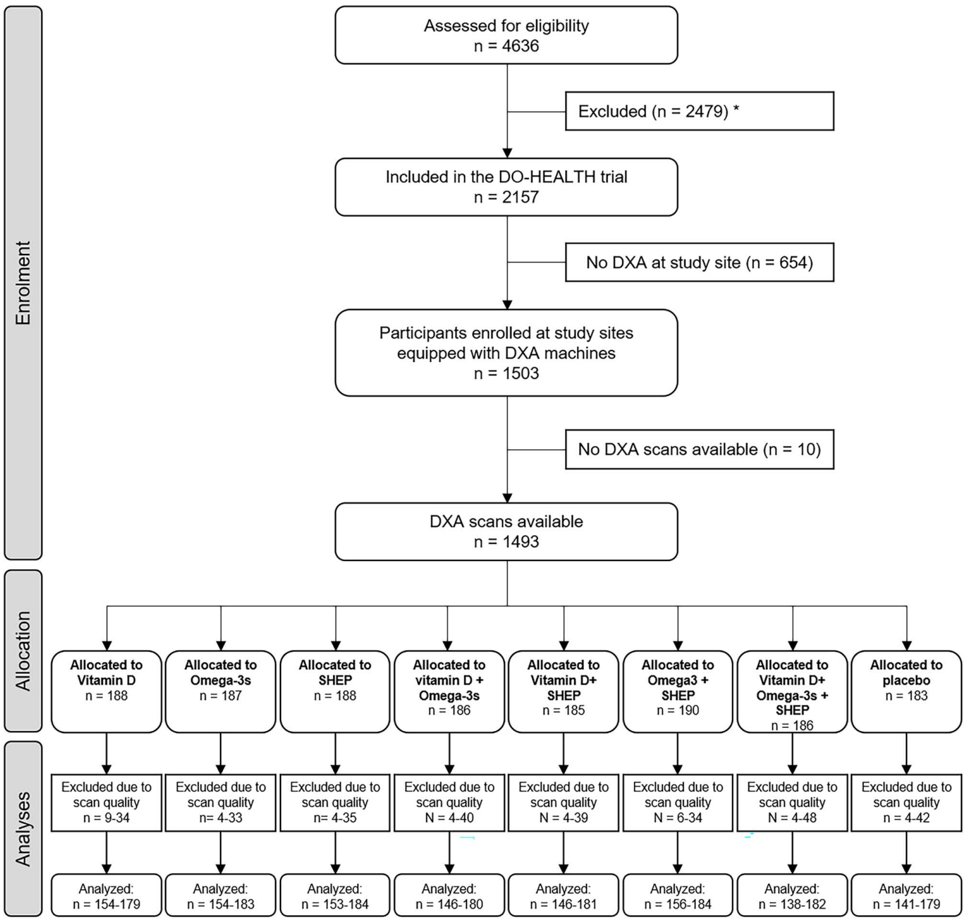
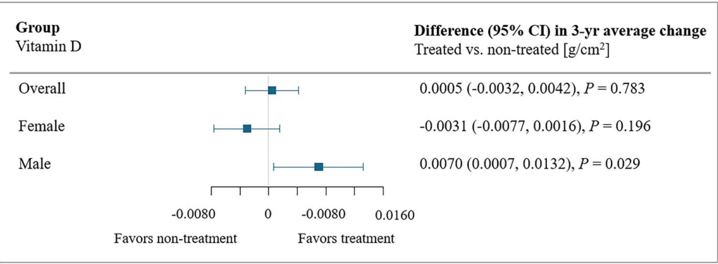
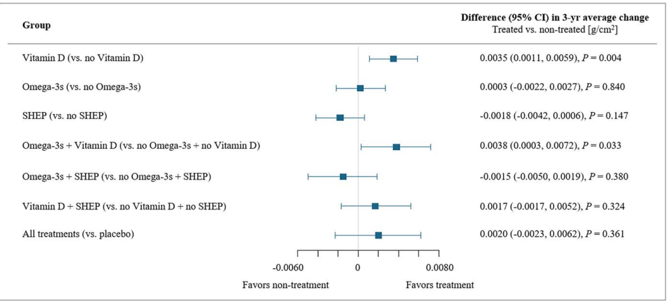
Evidence on the effects of Vitamin D, omega-3s, and exercise on areal bone mineral density (aBMD) in healthy older adults is limited. We examined whether vitamin D3, omega-3s, or a simple home-based exercise program (SHEP), alone or in combination, over 3 years, improve lumbar spine (LS), femoral neck (FN), or total hip (TH) aBMD assessed by DXA. Areal BMD was a secondary outcome in DO-HEALTH, a 3-year, multicenter, double-blind, randomized 2 × 2 × 2 factorial design trial in generally healthy older adults age ≥ 70 years. The study interventions were vitamin D3 (2000IU/d), omega-3s (1 g/d), and SHEP (3 × 30 min/wk), applied alone or in combination in eight treatment arms. Mixed effects models were used, adjusting for age, sex, BMI, prior fall, study site, and baseline level of the outcome. Main effects were assessed in the absence of an interaction between the interventions. Subgroup analyses by age, sex, physical activity level, dietary calcium intake, serum 25(OH)D levels, and fracture history were conducted. DXA scans were available for 1493 participants (mean age 75 years; 80.4% were physically active, 44% had 25(OH)D levels <20 ng/mL). At the LS and FN sites, none of the treatments showed a benefit. At the TH, vitamin D versus no vitamin D treatment showed a significant benefit across 3 years (difference in adjusted means [AM]: 0.0035 [95% CI, 0.0011, 0.0059] g/cm). Furthermore, there was a benefit for vitamin D versus no vitamin D treatment on LS aBMD in the male subgroup (interaction P = .003; ∆AM: 0.0070 [95% CI, 0.0007, 0.0132] g/cm). Omega-3s and SHEP had no benefit on aBMD in healthy, active, and largely vitamin D replete older adults. Our study suggests a small benefit of 2000 IU vitamin D daily on TH aBMD overall and LS aBMD among men; however, effect sizes were very modest and the clinical impact of these findings is unclear.
Overview
The claims and statistics of this paper haven’t been checked yet.
Free: it reads the open-access text and checks the first 5 claims that cite a source we can check. Create a free account to check every claim.
Integrity signals
Registry
Cites
Statistics
Figures
Verification
Claims the paper makes
The claims and statistics of this paper haven’t been checked yet.
Free: it reads the open-access text and checks the first 5 claims that cite a source we can check. Create a free account to check every claim.
Claims other papers make about this one
Each is checked against this paper’s own text: does it say what the citing paper says it does?
The cited source says what the claim attributes to it.
In the citing paper
“found no benefit of the exercise program on fracture reduction [312] or BMD [313] over a 3-year follow-up.”
From Global consensus on optimal exercise recommendations for enhancing healthy longevity in older adults (ICFSR) (2025) · cites this paper as [313]
In the citing paper
“in a 5-country European healthy longevity trial, DO-HEALTH, testing a simple low intensity, home-based, body weight/elastic band exercise program in 2157 generally healthy and active adults age 70 and older compared with a control exercise of seated stretching, found no benefit of the exercise program on fracture reduction [312] or BMD [313] over a 3-year follow-up.”
From Global consensus on optimal exercise recommendations for enhancing healthy longevity in older adults (ICFSR) (2025) · cites this paper as [313]
Self-check
Percentages, sums and reported differences re-computed from the paper’s own numbers.
The self-check needs the paper’s full text.
Citations
Cites
Osteoporosis Prevention, Diagnosis, and Therapy
NIH Consensus Development Panel on Osteoporosis Prevention, D. (2001) · JAMA: The Journal of the American Medical Association · doi:10.1001/jama.285.6.785 · Cited by 5,529 · cited 1×
“Osteoporosis is a progressive age-related condition characterized by loss of bone mass and deterioration of tissue microarchitecture, 1,2 resulting in an increased risk of fractures and associated personal, societal, and economic burden.”
(1994) · PubMed · Cited by 5,117
Epidemiology and outcomes of osteoporotic fractures
Cummings, S. R., & Melton, L. J. (2002) · The Lancet · doi:10.1016/s0140-6736(02)08657-9 · Cited by 3,821
Normal Bone Anatomy and Physiology
Clarke, B. (2008) · Clinical Journal of the American Society of Nephrology · doi:10.2215/cjn.04151206 · Cited by 2,192
Meta-analysis: Excess Mortality After Hip Fracture Among Older Women and Men
Haentjens, P., Magaziner, J., Colón-Emeric, C. S., Vanderschueren, D., Milisen, K., Velkeniers, B., & Boonen, S. (2010) · Annals of Internal Medicine · doi:10.7326/0003-4819-152-6-201003160-00008 · Cited by 1,398
Bischoff-Ferrari, H. A., Dawson-Hughes, B., Staehelin, H. B., Orav, J. E., Stuck, A. E., Theiler, R., Wong, J. B., Egli, A., Kiel, D. P., & Henschkowski, J. (2009) · BMJ · doi:10.1136/bmj.b3692 · Cited by 1,280 · cited 1×
“12,13,14,15 Furthermore, inconsistent findings have been attributed to variation in dosing regimens (eg, daily vs. bolus dosing, 16 high vs. standard dose), co-administration of calcium supplements, 17,18 and limitations in trial designs (eg, short follow-up, small sample size).”
Self-citationA Pooled Analysis of Vitamin D Dose Requirements for Fracture Prevention
Bischoff-Ferrari, H. A., Willett, W. C., Orav, E. J., Lips, P., Meunier, P. J., Lyons, R. A., Flicker, L., Wark, J., Jackson, R. D., Cauley, J. A., et al. (2012) · New England Journal of Medicine · doi:10.1056/nejmoa1109617 · Cited by 808 · cited 1×
“12,13,14,15 Furthermore, inconsistent findings have been attributed to variation in dosing regimens (eg, daily vs. bolus dosing, 16 high vs. standard dose), co-administration of calcium supplements, 17,18 and limitations in trial designs (eg, short follow-up, small sample size).”
Self-citationBone strength and its determinants
Ammann, P., & Rizzoli, R. (2003) · Osteoporosis International · doi:10.1007/s00198-002-1345-4 · Cited by 761 · cited 1×
“8,9 Supplementation with vitamin D or omega-3 fatty acids (omega-3s), and exercise have been suggested as public health strategies to increase bone health and consequently reduce fracture risk.”
Self-citationSCOPE 2021: a new scorecard for osteoporosis in Europe
Kanis, J. A., Norton, N., Harvey, N. C., Jacobson, T., Johansson, H., Lorentzon, M., McCloskey, E. V., Willers, C., & Borgström, F. (2021) · Archives of Osteoporosis · doi:10.1007/s11657-020-00871-9 · Cited by 714
Self-citationHarvey, N. C., Glüer, C. C., Binkley, N., McCloskey, E. V., Brandi, M.-L., Cooper, C., Kendler, D., Lamy, O., Laslop, A., Camargos, B. M., et al. (2015) · Bone · doi:10.1016/j.bone.2015.05.016 · Cited by 486 · cited 1×
“30,38 Few trials to date have used TBS to evaluate effects of vitamin D, 38–41 omega-3 s, 43 or exercise, 44 and the majority of those trials are limited by small sample sizes (eg, ≤ 200 participants) 39,40,41–43 and short follow-up durations 45 ( ≤ 6 months).”
Self-citationBolland, M. J., Grey, A., & Avenell, A. (2018) · The Lancet Diabetes & Endocrinology · doi:10.1016/s2213-8587(18)30265-1 · Cited by 436 · cited 1×
“%) is consistent with a large meta-analysis of 41 clinical trials (0.34%, 95% CI, 0.13–0.55) 31,32 but was not confirmed in an ancillary study of the VITAL trial among 771 older adults (mean age 64 years).”
InfluentialBischoff-Ferrari, H. A., Vellas, B., Rizzoli, R., Kressig, R. W., da Silva, J. A. P., Blauth, M., Felson, D. T., McCloskey, E. V., Watzl, B., Hofbauer, L. C., et al. (2020) · JAMA · doi:10.1001/jama.2020.16909 · Cited by 353 · cited 2×
“27 As suggested by the literature, in order to have an osteogenic effect, an exercise intervention needs to exceed habitual bone loading.”
Self-citationVitamin D and Calcium for the Prevention of Fracture: A Systematic Review and Meta-analysis
Yao, P., Bennett, D., Mafham, M., Lin, X., Chen, Z., Armitage, J., & Clarke, R. (2019) · JAMA Network Open · doi:10.1001/jamanetworkopen.2019.17789 · Cited by 347
Vitamin D and intestinal calcium absorption
Christakos, S., Dhawan, P., Porta, A., Mady, L. J., & Seth, T. (2011) · Molecular and Cellular Endocrinology · doi:10.1016/j.mce.2011.05.038 · Cited by 341 · cited 1×
“11 The evidence on the effects of Vitamin D supplements in primary osteoporosis prevention is controversial.”
Supplemental Vitamin D and Incident Fractures in Midlife and Older Adults
LeBoff, M. S., Chou, S. H., Ratliff, K. A., Cook, N. R., Khurana, B., Kim, E., Cawthon, P. M., Bauer, D. C., Black, D., Gallagher, J. C., et al. (2022) · New England Journal of Medicine · doi:10.1056/nejmoa2202106 · Cited by 305 · cited 1×
“28,29 In this analysis, we examine the individual and combined effects of vitamin D, omega-3s, and a simple home strength exercise program on aBMD, a predefined secondary outcome in DO-HEALTH, assessed in 1493 of 1503 DO-HEALTH participants recruited at four of seven recruitment sites.”
Black, D. M., Bauer, D. C., Vittinghoff, E., Lui, L.-Y., Grauer, A., Marin, F., Khosla, S., de Papp, A., Mitlak, B., Cauley, J. A., et al. (2020) · The Lancet Diabetes & Endocrinology · doi:10.1016/s2213-8587(20)30159-5 · Cited by 228 · cited 1×
“Furthermore, effects on both, TH and LS aBMD, are considerably smaller than the suggested aBMD difference required to show a fracture risk reduction (1.4% for vertebral and 3.2% for hip fractures), 34 and thus, clinical impact of our findings may be limited.”
InfluentialBischoff-Ferrari, H. A. (2010) · Archives of Internal Medicine · doi:10.1001/archinternmed.2010.67 · Cited by 210 · cited 1×
“37 As an exploratory outcome, we also assessed TBS, which is still a relatively novel analytical tool in the evaluation of trabecular microstructure, osteoporosis, and fracture risk.”
Self-citationTreatment of Vitamin D Insufficiency in Postmenopausal Women: A Randomized Clinical Trial
Hansen, K. E., Johnson, R. E., Chambers, K. R., Johnson, M. G., Lemon, C. C., Vo, T. N. T., & Marvdashti, S. (2015) · JAMA Internal Medicine · doi:10.1001/jamainternmed.2015.3874 · Cited by 171 · cited 1×
“30,38 Few trials to date have used TBS to evaluate effects of vitamin D, 38–41 omega-3 s, 43 or exercise, 44 and the majority of those trials are limited by small sample sizes (eg, ≤ 200 participants) 39,40,41–43 and short follow-up durations 45 ( ≤ 6 months).”
Farina, E. K., Kiel, D. P., Roubenoff, R., Schaefer, E. J., Cupples, L. A., & Tucker, K. L. (2011) · American Journal of Clinical Nutrition · doi:10.3945/ajcn.110.005926 · Cited by 159 · cited 1×
“20 Data from observational studies suggest an association between higher omega-3s intake and maintenance of femoral neck aBMD 21 and 45% reduced hip fracture risk, 20 compared with low intake.”
The effect of exercise intensity on bone in postmenopausal women (part 2): A meta-analysis
Kistler-Fischbacher, M., Weeks, B. K., & Beck, B. R. (2021) · Bone · doi:10.1016/j.bone.2020.115697 · Cited by 142 · cited 2×
“26,35 There are two main reasons that may explain the lack of benefit of the DO-HEALTH exercise program on aBMD.”
Self-citationHillier, T. A. (2007) · Archives of Internal Medicine · doi:10.1001/archinte.167.2.155 · Cited by 139 · cited 2×
“6 Areal BMD is a useful measure to monitor treatment response and assess fracture risk, 7,8 accounting for 60–70% of bone strength.”
The Clinical Relevance of Hyperkyphosis: A Narrative Review
Koelé, M. C., Lems, W. F., & Willems, H. C. (2020) · Frontiers in Endocrinology · doi:10.3389/fendo.2020.00005 · Cited by 136
Regulation of bone health through physical exercise: Mechanisms and types
Chang, X., Xu, S., & Zhang, H. (2022) · Frontiers in Endocrinology · doi:10.3389/fendo.2022.1029475 · Cited by 127 · cited 2×
“24 In addition, exercise can exert beneficial effects on bone through indirect pathways, for example through cytokines (eg,anti-inflammatory) or myokines.”
LeBoff, M. S., Chou, S. H., Murata, E. M., Donlon, C. M., Cook, N. R., Mora, S., Lee, I.-M., Kotler, G., Bubes, V., Buring, J. E., et al. (2020) · Journal of Bone and Mineral Research · doi:10.1002/jbmr.3958 · Cited by 120 · cited 1×
“33 The difference in findings between VITAL and DO-HEALTH for the same daily dose of 2000 IU vitamin D may be explained by the larger sample size in DO-HEALTH for this outcome, the older age group enrolled in DO-HEALTH (mean age 74 years in DO-HEALTH vs. 64 years in VITAL) and possibly by the lower…”
A systematic review of omega-3 fatty acids and osteoporosis
Orchard, T. S., Pan, X., Cheek, F., Ing, S. W., & Jackson, R. D. (2012) · British Journal of Nutrition · doi:10.1017/s0007114512001638 · Cited by 114 · cited 1×
“20 Data from observational studies suggest an association between higher omega-3s intake and maintenance of femoral neck aBMD 21 and 45% reduced hip fracture risk, 20 compared with low intake.”
Dual-energy X-ray Absorptiometry Monitoring with Trabecular Bone Score: 2019 ISCD Official Position
Krohn, K., Schwartz, E. N., Chung, Y., & Lewiecki, E. M. (2019) · Journal of Clinical Densitometry · doi:10.1016/j.jocd.2019.07.006 · Cited by 107
Association Between Change in BMD and Fragility Fracture in Women and Men
Berger, C., Langsetmo, L., Joseph, L., Hanley, D. A., Davison, K. S., Josse, R. G., Prior, J. C., Kreiger, N., Tenenhouse, A., & Goltzman, D. (2009) · Journal of Bone and Mineral Research · doi:10.1359/jbmr.081004 · Cited by 103
Chakhtoura, M., Bacha, D. S., Gharios, C., Ajjour, S., Assaad, M. A., Jabbour, Y., Kahale, F., Bassatne, A., Antoun, S., Akl, E. A., et al. (2021) · The Journal of Clinical Endocrinology & Metabolism · doi:10.1210/clinem/dgab742 · Cited by 100 · cited 1×
“12,13,14,15 Furthermore, inconsistent findings have been attributed to variation in dosing regimens (eg, daily vs. bolus dosing, 16 high vs. standard dose), co-administration of calcium supplements, 17,18 and limitations in trial designs (eg, short follow-up, small sample size).”
Nakamichi, Y., Udagawa, N., Horibe, K., Mizoguchi, T., Yamamoto, Y., Nakamura, T., Hosoya, A., Kato, S., Suda, T., & Takahashi, N. (2017) · Journal of Bone and Mineral Research · doi:10.1002/jbmr.3096 · Cited by 92 · cited 1×
“Vitamin D exerts its effects on bone through the vitamin D receptor, which is expressed in osteoblasts, 10 and through intestinal calcium absorption.”
The effect of exercise intensity on bone in postmenopausal women (part 1): A systematic review
Kistler-Fischbacher, M., Weeks, B. K., & Beck, B. R. (2020) · Bone · doi:10.1016/j.bone.2020.115696 · Cited by 88 · cited 1×
“26,35 There are two main reasons that may explain the lack of benefit of the DO-HEALTH exercise program on aBMD.”
Self-citationGregorio, S. D., del Río, L., Tolrà, J. R., Bonel, E., García, M., & Winzenrieth, R. (2015) · Bone · doi:10.1016/j.bone.2014.12.062 · Cited by 87
Vitamin D: Bolus Is Bogus—A Narrative Review
Mazess, R. B., Bischoff‐Ferrari, H. A., & Dawson‐Hughes, B. (2021) · JBMR Plus · doi:10.1002/jbm4.10567 · Cited by 87 · cited 1×
“12,13,14,15 Furthermore, inconsistent findings have been attributed to variation in dosing regimens (eg, daily vs. bolus dosing, 16 high vs. standard dose), co-administration of calcium supplements, 17,18 and limitations in trial designs (eg, short follow-up, small sample size).”
Self-citationthe PUFAH Group, Abdelhamid, A., Hooper, L., Sivakaran, R., Hayhoe, R. P. G., & Welch, A. (2019) · Calcified Tissue International · doi:10.1007/s00223-019-00584-3 · Cited by 68 · cited 2×
“22 In contrast, a recent meta-analysis of RCTs among middle-aged adults ( ≥ 50 years) reported a small benefit of any type of omega-3s supplementation (0.005 g/cm 2 , 95% CI, 0.000–0.010; 7 interventions), most pronounced for EPA and DHA combined (0.026 g/cm 2 , 95% CI, 0.022–0.030).”
InfluentialBischoff-Ferrari, H. A., de Godoi Rezende Costa Molino, C., Rival, S., Vellas, B., Rizzoli, R., Kressig, R. W., Kanis, J. A., Manson, J. E., Dawson-Hughes, B., Orav, E. J., et al. (2021) · Contemporary Clinical Trials · doi:10.1016/j.cct.2020.106124 · Cited by 55 · cited 3×
“14 The DO-HEALTH trial was specifically designed as a primary prevention trial 19 to contribute evidence on the effect of vitamin D on bone in generally healthy and active older adults, unselected for risk of vitamin D deficiency or osteoporosis.”
Self-citationThe Effects of Vitamin D Supplementation on Musculoskeletal Health: The VITAL and DO-Health Trials
LeBoff, M. S., & Bischoff-Ferrari, H. A. (2023) · The Journals of Gerontology Series A · doi:10.1093/gerona/glad073 · Cited by 45 · cited 2×
“14 The DO-HEALTH trial was specifically designed as a primary prevention trial 19 to contribute evidence on the effect of vitamin D on bone in generally healthy and active older adults, unselected for risk of vitamin D deficiency or osteoporosis.”
Self-citationVitamin D supplementation and musculoskeletal health
Bischoff-Ferrari, H. A., Orav, E. J., Abderhalden, L. A., Dawson-Hughes, B. F., & Willett, W. C. (2019) · The Lancet Diabetes & Endocrinology · doi:10.1016/s2213-8587(18)30347-4 · Cited by 44
Self-citationDou, Y., Wang, Y., Chen, Z., Yu, X., & Ma, D. (2021) · Food Science & Nutrition · doi:10.1002/fsn3.2655 · Cited by 44
Bone Microstructure in Response to Vitamin D3 Supplementation: A Randomized Placebo-Controlled Trial
Bislev, L. S., Rødbro, L. L., Rolighed, L., Sikjær, T., & Rejnmark, L. (2018) · Calcified Tissue International · doi:10.1007/s00223-018-0481-6 · Cited by 38 · cited 2×
“30,38 Few trials to date have used TBS to evaluate effects of vitamin D, 38–41 omega-3 s, 43 or exercise, 44 and the majority of those trials are limited by small sample sizes (eg, ≤ 200 participants) 39,40,41–43 and short follow-up durations 45 ( ≤ 6 months).”
Exercise Prescription for Osteoporosis: Back to Basics
Beck, B. R. (2022) · Exercise and Sport Sciences Reviews · doi:10.1249/jes.0000000000000281 · Cited by 30 · cited 2×
“36 It is important to note that our findings do neither invalidate the benefits of exercise for bone health and healthy aging, nor do they invalidate previous beneficial effects of SHEP for fall and fracture prevention in frail older adults with acute hip fracture.”
Exercise Effects on Bone Mineral Density in Men
Mages, M., Shojaa, M., Kohl, M., von Stengel, S., Becker, C., Gosch, M., Jakob, F., Kerschan-Schindl, K., Kladny, B., Klöckner, N., et al. (2021) · Nutrients · doi:10.3390/nu13124244 · Cited by 28 · cited 1×
“25,26 Given the distinct mechanistic pathways and relevance of vitamin D, omega-3s, and exercise for bone health, we hypothesized that the combination of these interventions may exhibit greater benefits than either alone.”
Lerchbaum, E., Trummer, C., Theiler‐Schwetz, V., Kollmann, M., Wölfler, M. M., Pilz, S., & Obermayer-Pietsch, B. M. (2019) · Nutrients · doi:10.3390/nu11040731 · Cited by 27 · cited 2×
“30,38 Few trials to date have used TBS to evaluate effects of vitamin D, 38–41 omega-3 s, 43 or exercise, 44 and the majority of those trials are limited by small sample sizes (eg, ≤ 200 participants) 39,40,41–43 and short follow-up durations 45 ( ≤ 6 months).”
Shepherd, J. (2023) · Journal of Clinical Densitometry · doi:10.1016/j.jocd.2023.101369 · Cited by 27
Pinho, J. P., Forner‐Cordero, A., Pereira, R. M. R., Hernandez, A. J., Dórea, E. L., Mezêncio, B., Takayama, L., Alvarenga, J. C., Serrão, J. C., & Amadio, A. C. (2020) · IEEE Journal of Translational Engineering in Health and Medicine · doi:10.1109/jtehm.2019.2963189 · Cited by 21 · cited 2×
“30,38 Few trials to date have used TBS to evaluate effects of vitamin D, 38–41 omega-3 s, 43 or exercise, 44 and the majority of those trials are limited by small sample sizes (eg, ≤ 200 participants) 39,40,41–43 and short follow-up durations 45 ( ≤ 6 months).”
Hype um die Vitamin-D-Substitution: Was bleibt?
Bischoff-Ferrari, H. A. (2020) · Der Internist · doi:10.1007/s00108-020-00869-y · Cited by 11 · cited 1×
“12,13,14,15 Furthermore, inconsistent findings have been attributed to variation in dosing regimens (eg, daily vs. bolus dosing, 16 high vs. standard dose), co-administration of calcium supplements, 17,18 and limitations in trial designs (eg, short follow-up, small sample size).”
Self-citationJørgensen, H. S., Eide, I. A., Jenssen, T. G., Åsberg, A., Bollerslev, J., Godang, K., Hartmann, A., Schmidt, E. B., & Svensson, M. H. S. (2021) · Nutrients · doi:10.3390/nu13072361 · Cited by 11 · cited 1×
“30,38 Few trials to date have used TBS to evaluate effects of vitamin D, 38–41 omega-3 s, 43 or exercise, 44 and the majority of those trials are limited by small sample sizes (eg, ≤ 200 participants) 39,40,41–43 and short follow-up durations 45 ( ≤ 6 months).”
Research works printed but not linked: 1
- Le Boff MS, Sharon HC, Kristin AR, et al. Effects of Omega-3 fatty acid supplementation on incident fractures in midlife and older adults enrolled in VITamin D and OmegA-3 TriaL (VITAL). J Bone Miner Res. 2022;38, Suppl 1). Available at. https://www.asbmr.org/ meetings/2022-abstracts Accessed July 5, 2023.
Cited by
Izquierdo, M., de Souto Barreto, P., Arai, H., Bischoff-Ferrari, H. A., Cadore, E. L., Cesari, M., Chen, L.-K., Coen, P. M., Courneya, K. S., Duque, G., et al. (2025) · The Journal of nutrition, health and aging · doi:10.1016/j.jnha.2024.100401 · Cited by 273
Self-citationExercise for Postmenopausal Bone Health – Can We Raise the Bar?
Kumar, S., Smith, C., Clifton-Bligh, R. J., Beck, B. R., & Girgis, C. M. (2025) · Current Osteoporosis Reports · doi:10.1007/s11914-025-00912-7 · Cited by 21
“However, this study included a low-intensity exercise intervention without progressive resistance, i.e. with insufficient osteogenic load stimulus [84].”
Ali, Z., Al-Ghouti, M. A., Abou-Saleh, H., & Rahman, M. M. (2024) · Marine Drugs · doi:10.3390/md22100446 · Cited by 23
“They found no significant benefits of ω -3 PUFAs or home-based exercise on lumbar spine, femoral neck, or total hip BMD [91].”
BackgroundAlbrecht, A., Kistler-Fischbacher, M., Molino, C. D. G. R. C., Armbrecht, G., Freystaetter, G., Theiler, R., Kressig, R. W., da Silva, J. A. P., Rizzoli, R., Wanner, G. A., et al. (2025) · Osteoporosis International · doi:10.1007/s00198-025-07489-y · Cited by 12
Self-citationTsourdi, E. A., Gängler, S., Kistler-Fischbacher, M., Rauner, M., Dawson-Hughes, B. F., Orav, E. J., Tsai, L.-T., Lang, W., Kanis, J. А., Theiler, R., et al. (2024) · The Journal of Clinical Endocrinology & Metabolism · doi:10.1210/clinem/dgae859 · Cited by 8
Self-citation
Metadata
- Authors
- Kistler-Fischbacher, M., Armbrecht, G., Gängler, S., Theiler, R., Rizzoli, R., Dawson-Hughes, B., Kanis, J. A., Hofbauer, L. C., Schimmer, R. C., Vellas, B., Da Silva, J. A. P., John, O. E., Kressig, R. W., Andreas, E., Lang, W., Wanner, G. A., Bischoff-Ferrari, H. A., DO-HEALTH Research Group, Bischoff-Ferrari, H. A., Egli, A., Rival, S., Wanner, G. A., Vellas, B., Guyonnet, S., Rizzoli, R., Biver, E., Merminod, F., Kressig, R. W., Bridenbaugh, S., Suhm, N., Da Silva, J. A. P., Duarte Cátia, C. M., Pinto Filipa, A., Felsenberg, D., Börst, H., A, G., Blauth, M., Spicher, A., Felson, D. T., Eugene, V. M., Johansson, E., Watzl, B., Gomez, R. M., Hofbauer, L., Tsourdi, E., Rauner, M., Siebert, U., Kanis, J. A., Halbout, P., M Ferrari, S., Gut, B., Ba, M., Wittwer Schegg, J., Etheve, S., Eggersdorfer, M., Delannoy Carla, S., Reuschling, M., Orav, E. J., Willett, W. C., JoAnn, E. M., Dawson-Hughes, B., Staehelin, H. B., Walter, P. W., Dick, W., Fried, M., lvon Eckardstein, A., Theiler, R., Simmen, H.-P., Langhans, W., Zinkernagel, A., Mueller, N., Distler, O., Graetz, K., Nitschke, I., Dietrich, T., Baer, W., Landau, K., Ruschitzka, F., Manz, M., & Burckhardt, P.
- Affiliations
- University of Zurich (CH)
- Humboldt-Universität zu Berlin (DE)
- Centre for Healthy Aging , Department of Medicine III, , Dresden 01307, Germany
- Department of Biostatistics, Harvard T.H. Chan School of Public Health , Boston, MA 02120, United States
- Department of Geriatric Medicine and Aging Research, University of Zurich , Zurich 8037, Switzerland
- Technische Universität Dresden (DE)
- ORCID
- Kistler-Fischbacher, Melanie
- Armbrecht, Gabriele
- Gängler, Stephanie
- Schimmer, Ralph C
- Guyonnet, Sophie
- Biver, Emmanuel
- Bridenbaugh, Stephanie
- Suhm, Norbert
- Blauth, Michael
- Spicher, Anna
- Felson, David T
- Watzl, Bernhard
- Tsourdi, Elena
- Rauner, Martina
- Siebert, Uwe
- Halbout, Philippe
- Eggersdorfer, Manfred
- Willett, Walter C
- Simmen, Hans-Peter
- Langhans, Wolfgang
- Zinkernagel, Annelies
- Mueller, Nicolas
- Distler, Oliver
- Nitschke, Ina
- Dietrich, Thomas
- Ruschitzka, Frank
- Manz, Markus
- Burckhardt, Peter
- Venue
- Journal of Bone and Mineral Research
- Publisher
- Oxford University Press (OUP)
- Published
- 2024-04-13
- Volume
- 39
- Issue
- 6
- Pages
- 661-671
- ISSN
- 0884-0431 (ISSN-L)
- 1523-4681
- OpenAlex
- W4394785515
- Cited by
- 15
- References
- 44
- Citations by year
- 2026: 6 · 2025: 6 · 2024: 3
- FWCI
- 6.72
- Type
- journal article
- Language
- en
- Open access
- hybrid
- doi.org
- Licence
- Locations
- Journal of Bone and Mineral Research (publishedVersion, cc-by-nc)
- PubMed (publishedVersion)
- White Rose Research Online (University of Leeds, The University of Sheffield, University of York) (acceptedVersion)
- Zurich Open Repository and Archive (University of Zurich) (acceptedVersion, cc-by-nc-nd)
- Zurich Open Repository and Archive (University of Zurich) (submittedVersion, cc-by-nc)
- Zurich Open Repository and Archive (University of Zurich)
- Funders
- European Union (278588)
- University of Zurich
- Topics
- Health Sciences › Medicine › Orthopedics and Sports Medicine › Bone health and osteoporosis research
- Health Sciences › Medicine › Endocrinology, Diabetes and Metabolism › Vitamin D Research Studies
- Health Sciences › Medicine › Physiology (medical) › Nutrition and Health in Aging
- Keywords
- vitamin D3 supplementation, omega-3 fatty acids, resistance training, home-based exercise, bone mineral density, hip bone density, lumbar spine bone mineral density, femoral neck bone mineral density, older adults, vitamin D deficiency, dietary calcium, fracture history, sex differences, osteoporosis prevention, physical activity, dietary supplementation, exercise intervention, factorial trial
- MeSH terms
- Aged, Aged, 80 and over, Bone and Bones, Cholecalciferol, Double-Blind Method, Female, Humans, Male, Exercise, Bone Density, Fatty Acids, Omega-3, Resistance Training
About these checks
Registry, retraction, Cites and statistics results are computed, not judged, with one exception: a printed reference that no index lists is read once by a model before it counts as a citation error. Claims are extracted by a model and kept only when their quote appears verbatim in the text; each cited source is then checked, with a model’s help, for whether it says what the claim relies on. Those verdicts can be wrong — read the claim’s quote and the cited source before relying on one.
Statistics and arithmetic are recomputed, not judged.
Confidence bands are shown only for fields calibrated on our annotated test set. None is calibrated yet, so no band is shown.
What counts as a claim ›How we measure confidence ›How we check this ›
Are you an author, or do you see a problem with this page? Request a review
Data sources
Bibliographic data: Semantic Scholar, OpenAlex, Crossref.
Contains information from the Semantic Scholar Academic Graph Datasets, made available under the ODC Attribution License (ODC-BY 1.0).
Semantic Scholar’s data is described in: Kinney, R., et al. (2023). The Semantic Scholar Open Data Platform. arXiv:2301.10140.
