

Social Media Browsing and Adolescent Well-Being: Challenging the “Passive Social Media Use Hypothesis”
Open accessThe DOI matches its Crossref record; 59 of the 59 references it cites were found in a registry or an index.
Abstract
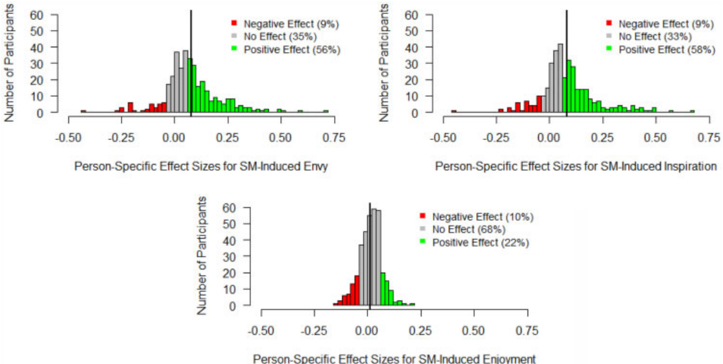
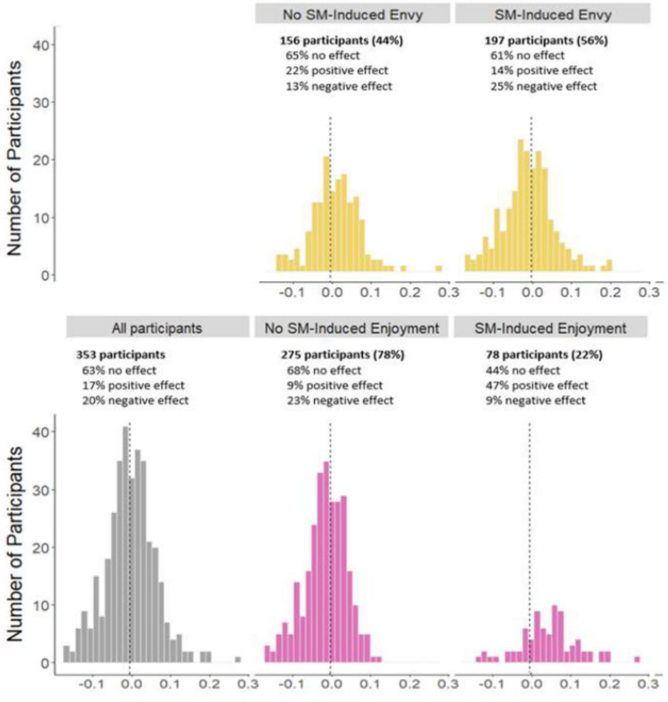
A recurring hypothesis in the literature is that “passive” social media use (browsing) leads to negative effects on well-being. This preregistered study investigated a rival hypothesis, which states that the effects of browsing on well-being depend on person-specific susceptibilities to envy, inspiration, and enjoyment. We conducted a three-week experience sampling study among 353 adolescents (13–15 years, 126 assessments per adolescent). Using an advanced N = 1 method of analysis, we found sizeable heterogeneity in the associations of browsing with envy, inspiration, and enjoyment (e.g., for envy ranging from β = −.44 to β = +.71). The Passive Social Media Use Hypothesis was confirmed for 20% of adolescents and rejected for 80%. More adolescents with browsing-induced envy experienced negative effects on affective well-being (25%) than adolescents with no browsing-induced envy (13%). Conversely, more adolescents with browsing-induced enjoyment experienced positive effects on affective well-being (47%) than adolescents with no browsing-induced enjoyment (9%).
Overview
The claims and statistics of this paper haven’t been checked yet.
Free: it reads the open-access text and checks the first 5 claims that cite a source we can check. Create a free account to check every claim.
Integrity signals
Registry
Cites
Statistics
Figures

Verification
Claims the paper makes
The claims and statistics of this paper haven’t been checked yet.
Free: it reads the open-access text and checks the first 5 claims that cite a source we can check. Create a free account to check every claim.
Claims other papers make about this one
Each is checked against this paper’s own text: does it say what the citing paper says it does?
The source backs part of the claim, not all of it — or backs it for a different population, condition or comparison.
In the citing paper
“For instance, some teens with more passive social media use actually experience more positive effects on well-being compared with those with more active social media use.149”
From Digital Ecosystems, Children, and Adolescents: Technical Report (2026) · cites this paper as [149]
Experimental — accuracy not yet measuredThe cited source says what the claim attributes to it.
In the citing paper
“In fact, recent studies that have adopted an idiographic (i.e.N = 1 or person-specific) media effects paradigm [56] have found that a small group of adolescents experienced negative effects of SMU on wellbeing (around 10e15%) and another small group experienced positive effects (also around 10%e15%).Reassuringly though, most adolescents experienced no or negligible effects [57].”
From Social media use and its impact on adolescent mental health: An umbrella review of the evidence. (2022) · cites this paper as [57]
Self-check
Percentages, sums and reported differences re-computed from the paper’s own numbers.
The self-check needs the paper’s full text.
Citations
Cites
1 retracted
Retracted: Digital Communication Media Use and Psychological Well-Being: A Meta-Analysis
Liu, D., Baumeister, R. F., Yang, C.-C., & Hu, B. (2019) · Journal of Computer-Mediated Communication · doi:10.1093/jcmc/zmz013 · Cited by 260
RetractedDevelopment and validation of brief measures of positive and negative affect: The PANAS scales.
Watson, D., Clark, L. A., & Tellegen, A. (1988) · Journal of Personality and Social Psychology · doi:10.1037/0022-3514.54.6.1063 · Cited by 32,433
An argument for basic emotions
Ekman, P. (1992) · Cognition and Emotion · doi:10.1080/02699939208411068 · Cited by 9,646
Molenaar, P. C. M. (2004) · Measurement: Interdisciplinary Research & Perspective · doi:10.1207/s15366359mea0204_1 · Cited by 1,943
Culture, Media, Language: Working Papers in Cultural Studies, 1972-79
(2003) · Routledge eBooks · doi:10.4324/9780203381182 · Cited by 1,728
The association between adolescent well-being and digital technology use
Orben, A., & Przybylski, A. K. (2019) · Nature Human Behaviour · doi:10.1038/s41562-018-0506-1 · Cited by 1,500
Fleeson, W. (2001) · Journal of Personality and Social Psychology · doi:10.1037/0022-3514.80.6.1011 · Cited by 1,436
Do social network sites enhance or undermine subjective well-being? A critical review
Verduyn, P., Ybarra, O., Résibois, M., Jonides, J., & Kross, E. (2017) · Social Issues and Policy Review · doi:10.1111/sipr.12033 · Cited by 1,209
The new person-specific paradigm in psychology
Molenaar, P. C. M., & Campbell, C. G. (2009) · Current Directions in Psychological Science · doi:10.1111/j.1467-8721.2009.01619.x · Cited by 1,088
(2001) · PubMed · Cited by 1,034
Research works printed but not linked: 1
- 45. Tov, W. (2018). Well-being concepts and components. In E. Diener, S. Oishi, & L. Tay (Eds.), Handbook of well-being. DEF Publishers. nobascholar.com
Cited by
Items 101–123 of 123
Supplemental Material for Anxiety Talking: Does Anxiety Predict Sharing Information About COVID-19?
(2021) · Technology Mind and Behavior · doi:10.1037/tmb0000057.supp
Gugushvili, N. (2023) · Research Publications (Maastricht University) · doi:10.26481/dis.20230320ng · Cited by 7
The Influence of User-Generated Eudaimonic YouTube Videos on Well-Being
Kang, S., Villarreal, B., & Morales, S. (2023) · International Journal of Social Media and Online Communities · doi:10.4018/ijsmoc.323859
Samek, D. R., Akua, B. A., & Crumly, B. (2023) · Elsevier eBooks · doi:10.1016/b978-0-323-96023-6.00048-8
14. Person-Specific Media Effects
Valkenburg, P. M., Beyens, I., de Vaate, N. A. J. D. B., Janssen, L., & van der Wal, A. (2024) · Amsterdam University Press eBooks · doi:10.2307/jj.11895525.17 · Cited by 6
Self-citationSzymkowiak, A., Nurse, J. R. C., Brauner, P., Ziefle, M., & Shepherd, L. A. (2024) · Frontiers research topics · doi:10.3389/978-2-8325-4819-6
Fitriana, M., Savitri, S. I., Ahmad, J. B., Ali, R. S., & Lathifah, Z. K. (2024) · Islamic Guidance and Counseling Journal · doi:10.25217/0020247450500 · Cited by 3
Knežević, L., & Erceg, I. (2024) · Psihologijske teme · doi:10.31820/pt.33.1.3 · Cited by 1
The Role of Mindfulness and Patience on Social Anxiety in Using Social Media in Emerging Adulthood
Aryandari, D., & Nashori, F. (2024) · Journal An-Nafs Kajian Penelitian Psikologi · doi:10.33367/psi.v9i1.4530 · Cited by 4
Stević, A., Lee, A., Liu, X., & Hancock, J. T. (2024) · SSRN Electronic Journal · doi:10.2139/ssrn.4885413
(2024) · International Journal of Science and Engineering Applications · doi:10.7753/ijsea1308.1022
Brimmel, N., Kurten, S., Eggermont, S., & Bijttebier, P. (2025) · Mass Communication & Society · doi:10.1080/15205436.2025.2469742 · Cited by 1
Howard, A., Gmiro, Y., Gunnell, K. E., & Tamminen, K. A. (2025) · doi:10.71240/lcyc.168925
King, J. V. (2025) · Screen Bodies · doi:10.3167/screen.2025.100102
Loneliness and Solitude in the Digital Age
Tsang, Y., & Ho, S. (2025) · IntechOpen eBooks · doi:10.5772/intechopen.1012738 · Cited by 2
37 Media Psychology Methods: Current and Innovations
Wojdynski, B. W. (2025) · De Gruyter eBooks · doi:10.1515/9783111292144-045
Vanherle, R., & Beullens, K. (2025) · Journal of Computer-Mediated Communication · doi:10.1093/jcmc/zmaf015 · Cited by 1
Yin, X.-Q., Wang, J., Niu, X., Scherr, S., Gaskin, J. E., & McDonnell, D. (2026) · Cyberpsychology Journal of Psychosocial Research on Cyberspace · doi:10.5817/cp2026-1-8
Knežević, N. K., Kondić, L., & Ljiljak, P. (2026) · doi:10.20867/cromar.29.5
Digital parenting and psychosocial well-being in middle childhood: Evidence from urban Indonesia
Lolowang, R. M., Siby, P. S., Franky, F., Kampilong, J. K., Sondakh, D. S. I., & Sanggelorang, E. P. (2026) · South African Journal of Childhood Education · doi:10.4102/sajce.v16i1.1896
SOCOL, A., Andrei, L. E., Dijmarescu, C. M., Dragomir, D., Iotu, A., Mihăilescu, I., & Rad, F. (2026) · Children · doi:10.3390/children13070872 · Cited by 2
Li, W. O., Fung, C.-M., Chow, T. S., Leung, K. I. D., & Cheung, Y.-W. (2026) · Cyberpsychology Journal of Psychosocial Research on Cyberspace · doi:10.5817/cp2026-3-6
Franzen, A. B., & Oostindie, J. (2026) · Sociological Forum · doi:10.1111/socf.70093
Metadata
- Authors
- Valkenburg, P. M., Beyens, I., Pouwels, J. L., van Driel, I. I., & Keijsers, L.
- Affiliations
- University of Amsterdam (NL)
- Amsterdam School of Communication Research, University of Amsterdam, The Netherlands
- Erasmus University Rotterdam (NL)
- Corresponding author
- Valkenburg, Patti M
- Venue
- Journal of Computer-Mediated Communication
- Publisher
- Oxford University Press (OUP)
- Published
- 2021-10-28
- ISSN
- 1083-6101 (ISSN-L)
- OpenAlex
- W3162297618
- Semantic Scholar
- 19eb59c6d7f61b2c975cbfcebb51964929ed0ea0
- Cited by
- 123
- References
- 59
- Citations by year
- 2026: 11 · 2025: 24 · 2024: 38 · 2023: 24 · 2022: 19 · 2021: 7
- FWCI
- 30.49
- Type
- journal article
- Language
- en
- Open access
- diamond
- doi.org
- Licence
- Locations
- Journal of Computer-Mediated Communication (publishedVersion, cc-by-nc)
- EUR Research Repository (Erasmus University Rotterdam) (publishedVersion, cc-by)
- EUR Research Repository (Erasmus University Rotterdam) (submittedVersion, other-oa)
- UvA-DARE (University of Amsterdam) (submittedVersion, cc-by)
- Radboud Repository (Radboud University) (submittedVersion)
- OSF Preprints (OSF Preprints) (submittedVersion)
- Radboud Repository (Radboud University) (submittedVersion, other-oa)
- Data Archiving and Networked Services (DANS) (submittedVersion, other-oa)
- Funders
- Nederlandse Organisatie voor Wetenschappelijk Onderzoek (024‐001‐003)
- Topics
- Social Sciences › Sociology and Political Science › Impact of Technology on Adolescents
- Social Sciences › Psychology › Social Psychology › Mental Health via Writing
- Social Sciences › Communication › Media and Digital Communication
- Keywords
- passive social media use, youth welfare, envy, inspiration, enjoyment, emotional well-being, ecological momentary assessment
About these checks
Registry, retraction, Cites and statistics results are computed, not judged, with one exception: a printed reference that no index lists is read once by a model before it counts as a citation error. Claims are extracted by a model and kept only when their quote appears verbatim in the text; each cited source is then checked, with a model’s help, for whether it says what the claim relies on. Those verdicts can be wrong — read the claim’s quote and the cited source before relying on one.
Statistics and arithmetic are recomputed, not judged.
Confidence bands are shown only for fields calibrated on our annotated test set. None is calibrated yet, so no band is shown.
What counts as a claim ›How we measure confidence ›How we check this ›
Are you an author, or do you see a problem with this page? Request a review
Data sources
Bibliographic data: Semantic Scholar, OpenAlex, Crossref.
Contains information from the Semantic Scholar Academic Graph Datasets, made available under the ODC Attribution License (ODC-BY 1.0).
Semantic Scholar’s data is described in: Kinney, R., et al. (2023). The Semantic Scholar Open Data Platform. arXiv:2301.10140.
