

Social Media Browsing and Adolescent Well-Being: Challenging the “Passive Social Media Use Hypothesis”
Open accessThe DOI matches its Crossref record; 59 of the 59 references it cites were found in a registry or an index.
Abstract
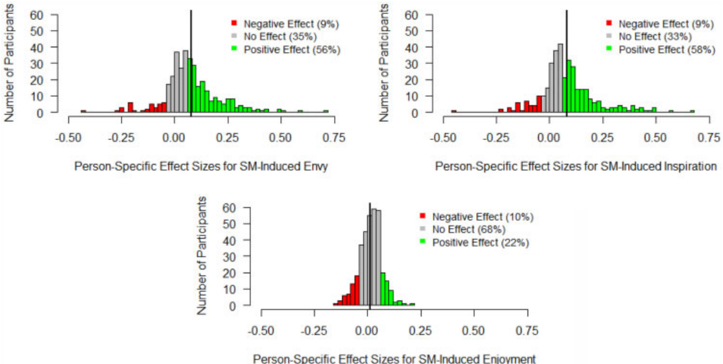
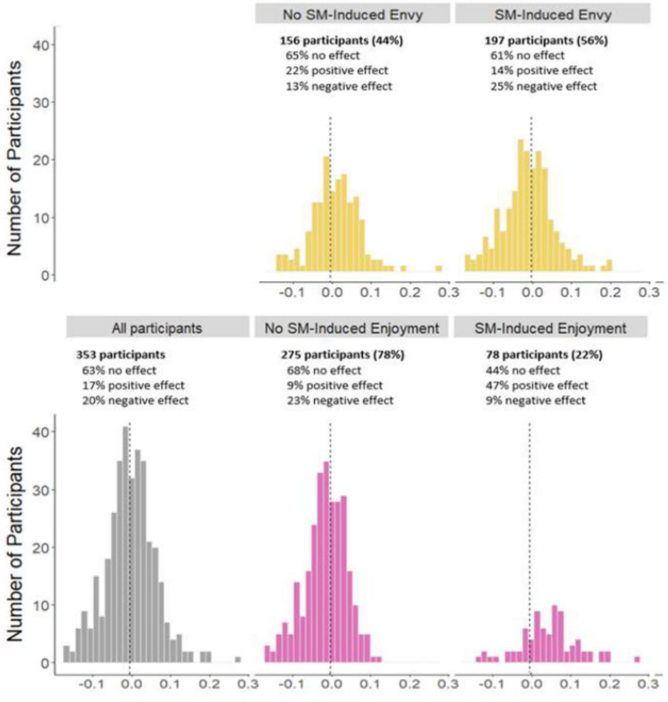
A recurring hypothesis in the literature is that “passive” social media use (browsing) leads to negative effects on well-being. This preregistered study investigated a rival hypothesis, which states that the effects of browsing on well-being depend on person-specific susceptibilities to envy, inspiration, and enjoyment. We conducted a three-week experience sampling study among 353 adolescents (13–15 years, 126 assessments per adolescent). Using an advanced N = 1 method of analysis, we found sizeable heterogeneity in the associations of browsing with envy, inspiration, and enjoyment (e.g., for envy ranging from β = −.44 to β = +.71). The Passive Social Media Use Hypothesis was confirmed for 20% of adolescents and rejected for 80%. More adolescents with browsing-induced envy experienced negative effects on affective well-being (25%) than adolescents with no browsing-induced envy (13%). Conversely, more adolescents with browsing-induced enjoyment experienced positive effects on affective well-being (47%) than adolescents with no browsing-induced enjoyment (9%).
Overview
The claims and statistics of this paper haven’t been checked yet.
Free: it reads the open-access text and checks the first 5 claims that cite a source we can check. Create a free account to check every claim.
Integrity signals
Registry
Cites
Statistics
Figures

Verification
Claims the paper makes
The claims and statistics of this paper haven’t been checked yet.
Free: it reads the open-access text and checks the first 5 claims that cite a source we can check. Create a free account to check every claim.
Claims other papers make about this one
Each is checked against this paper’s own text: does it say what the citing paper says it does?
The source backs part of the claim, not all of it — or backs it for a different population, condition or comparison.
In the citing paper
“For instance, some teens with more passive social media use actually experience more positive effects on well-being compared with those with more active social media use.149”
From Digital Ecosystems, Children, and Adolescents: Technical Report (2026) · cites this paper as [149]
Experimental — accuracy not yet measuredThe cited source says what the claim attributes to it.
In the citing paper
“In fact, recent studies that have adopted an idiographic (i.e.N = 1 or person-specific) media effects paradigm [56] have found that a small group of adolescents experienced negative effects of SMU on wellbeing (around 10e15%) and another small group experienced positive effects (also around 10%e15%).Reassuringly though, most adolescents experienced no or negligible effects [57].”
From Social media use and its impact on adolescent mental health: An umbrella review of the evidence. (2022) · cites this paper as [57]
Self-check
Percentages, sums and reported differences re-computed from the paper’s own numbers.
The self-check needs the paper’s full text.
Citations
Cites
1 retracted
Retracted: Digital Communication Media Use and Psychological Well-Being: A Meta-Analysis
Liu, D., Baumeister, R. F., Yang, C.-C., & Hu, B. (2019) · Journal of Computer-Mediated Communication · doi:10.1093/jcmc/zmz013 · Cited by 260
RetractedDevelopment and validation of brief measures of positive and negative affect: The PANAS scales.
Watson, D., Clark, L. A., & Tellegen, A. (1988) · Journal of Personality and Social Psychology · doi:10.1037/0022-3514.54.6.1063 · Cited by 32,433
An argument for basic emotions
Ekman, P. (1992) · Cognition and Emotion · doi:10.1080/02699939208411068 · Cited by 9,646
Molenaar, P. C. M. (2004) · Measurement: Interdisciplinary Research & Perspective · doi:10.1207/s15366359mea0204_1 · Cited by 1,943
Culture, Media, Language: Working Papers in Cultural Studies, 1972-79
(2003) · Routledge eBooks · doi:10.4324/9780203381182 · Cited by 1,728
The association between adolescent well-being and digital technology use
Orben, A., & Przybylski, A. K. (2019) · Nature Human Behaviour · doi:10.1038/s41562-018-0506-1 · Cited by 1,500
Fleeson, W. (2001) · Journal of Personality and Social Psychology · doi:10.1037/0022-3514.80.6.1011 · Cited by 1,436
Do social network sites enhance or undermine subjective well-being? A critical review
Verduyn, P., Ybarra, O., Résibois, M., Jonides, J., & Kross, E. (2017) · Social Issues and Policy Review · doi:10.1111/sipr.12033 · Cited by 1,209
The new person-specific paradigm in psychology
Molenaar, P. C. M., & Campbell, C. G. (2009) · Current Directions in Psychological Science · doi:10.1111/j.1467-8721.2009.01619.x · Cited by 1,088
(2001) · PubMed · Cited by 1,034
Research works printed but not linked: 1
- 45. Tov, W. (2018). Well-being concepts and components. In E. Diener, S. Oishi, & L. Tay (Eds.), Handbook of well-being. DEF Publishers. nobascholar.com
Cited by
Social media use and its impact on adolescent mental health: An umbrella review of the evidence.
Valkenburg, P. M., Meier, A., & Beyens, I. (2022) · Current opinion in psychology · doi:10.1016/j.copsyc.2021.08.017 · Cited by 767
Self-citationSocial media use and well-being: What we know and what we need to know
Valkenburg, P. M. (2022) · Current Opinion in Psychology · doi:10.1016/j.copsyc.2021.12.006 · Cited by 373
Self-citationMechanisms linking social media use to adolescent mental health vulnerability
Orben, A., Meier, A., Dalgleish, T., & Blakemore, S.-J. (2024) · Nature Reviews Psychology · doi:10.1038/s44159-024-00307-y · Cited by 220
“…experiences are not a niche phenomenon on social media: an experience sampling study of 353 Dutch adolescents (mean age 13–15 years) found that participants reported some level of social media-induced inspiration in 33% of the times they were asked to report on this over the course of 3 weeks 168 .”
Social comparison and envy on social media: a critical review
Meier, A., & Johnson, B. K. (2022) · Current Opinion in Psychology · doi:10.1016/j.copsyc.2022.101302 · Cited by 176
Sweet escape: The role of empathy in social media engagement with human versus virtual influencers
Mirowska, A., & Arsenyan, J. (2023) · International Journal of Human-Computer Studies · doi:10.1016/j.ijhcs.2023.103008 · Cited by 154
Yue, Z., Zhang, R., & Xiao, J. (2022) · Computers in Human Behavior · doi:10.1016/j.chb.2021.107050 · Cited by 139
Cingel, D. P., Carter, M. C., & Krause, H.-V. (2022) · Current Opinion in Psychology · doi:10.1016/j.copsyc.2022.101304 · Cited by 109
Abeele, M. V., Halfmann, A., & Lee, E. W. J. (2022) · Current Opinion in Psychology · doi:10.1016/j.copsyc.2021.12.007 · Cited by 136
Does Passive Social Media Use Harm Well-Being?: An Adversarial Review
Meier, A., & Krause, H.-V. (2023) · Journal of Media Psychology · doi:10.1027/1864-1105/a000358 · Cited by 89
Social media mindsets: a new approach to understanding social media use and psychological well-being
Lee, A. Y., & Hancock, J. T. (2023) · Journal of Computer-Mediated Communication · doi:10.1093/jcmc/zmad048 · Cited by 82
Verbeij, T., Pouwels, J. L., Beyens, I., & Valkenburg, P. M. (2022) · Scientific Reports · doi:10.1038/s41598-022-11510-3 · Cited by 47
Self-citationAdvancing our understanding of the associations between social media use and well-being
Valkenburg, P. M., Beyens, I., Meier, A., & Abeele, M. V. (2022) · Current Opinion in Psychology · doi:10.1016/j.copsyc.2022.101357 · Cited by 105
Self-citationKhetawat, D., & Steele, R. G. (2023) · Clinical Child and Family Psychology Review · doi:10.1007/s10567-023-00440-9 · Cited by 85
Valkenburg, P. M., Pouwels, J. L., Beyens, I., van Driel, I. I., & Keijsers, L. (2021) · Technology Mind and Behavior · doi:10.1037/tmb0000037 · Cited by 80
Self-citationSchreurs, L., Meier, A., & Vandenbosch, L. (2023) · Current Psychology · doi:10.1007/s12144-022-03893-3 · Cited by 55
Influence by osmosis: Social media green communities and pro-environmental behavior
Shen, J., Liang, H., Zafar, A. U., Shahzad, M., Akram, U., & Ashfaq, M. (2023) · Computers in Human Behavior · doi:10.1016/j.chb.2023.107706 · Cited by 66
The Social Media Use Scale: Development and Validation
Tuck, A. B., & Thompson, R. J. (2023) · Assessment (Odessa, Fla.) · doi:10.1177/10731911231173080 · Cited by 52
Chen, S., Zhi, K., & Chen, Y. (2022) · Frontiers in Psychology · doi:10.3389/fpsyg.2022.1011337 · Cited by 103
In Their Own Words: How Adolescents Use Social Media and How It Affects Them
van der Wal, A., Valkenburg, P. M., & van Driel, I. I. (2024) · Social Media + Society · doi:10.1177/20563051241248591 · Cited by 117
Self-citation(2022) · doi:10.1002/jcv2.12071 · Cited by 44
Skogen, J. C., Bøe, T., Finserås, T. R., Sivertsen, B., Hella, R. T., & Hjetland, G. J. (2022) · Frontiers in Public Health · doi:10.3389/fpubh.2022.873463 · Cited by 58
Dong, Z., & Xie, T. (2024) · Current Psychology · doi:10.1007/s12144-024-05927-4 · Cited by 42
“They found that people could experience positive affective well-being when they passively browse social media if they enjoy the content (Valkenburg et al., 2021 ).”
The role of well‐being in consumer's responses to personalized advertising on social media
Keyzer, F. D., Buzeta, C., & Lopes, A. I. (2024) · Psychology and Marketing · doi:10.1002/mar.21977 · Cited by 63
de Segovia Vicente, D., Van Gaeveren, K., Murphy, S. L., & Vanden Abeele, M. M. P. (2023) · Journal of Computer-Mediated Communication · doi:10.1093/jcmc/zmad056 · Cited by 38
Social media use, loneliness and psychological distress in emerging adults
Taylor, Z., Yankouskaya, A., & Panourgia, C. (2023) · Behaviour and Information Technology · doi:10.1080/0144929x.2023.2209797 · Cited by 45
The “Vicious Circle of addictive Social Media Use and Mental Health” Model
Brailovskaia, J. (2024) · Acta Psychologica · doi:10.1016/j.actpsy.2024.104306 · Cited by 50
Tandon, A., Laato, S., Islam, A. K. M. N., & Dhir, A. (2024) · Internet Research · doi:10.1108/intr-10-2022-0770 · Cited by 51
Idiographic Network Models of Social Media Use and Depression Symptoms
Rodriguez, M., Aalbers, G., & McNally, R. J. (2021) · Cognitive Therapy and Research · doi:10.1007/s10608-021-10236-2 · Cited by 34
To use or be used? The role of agency in social media use and well-being
Lee, A. Y., Ellison, N. B., & Hancock, J. T. (2023) · Frontiers in Computer Science · doi:10.3389/fcomp.2023.1123323 · Cited by 42
Kaye, L. K., Rousaki, A., Joyner, L. C., Barrett, L. A. F., & Orchard, L. J. (2022) · Computers in Human Behavior · doi:10.1016/j.chb.2022.107443 · Cited by 41
Astleitner, H., & Schlick, S. (2024) · Active Learning in Higher Education · doi:10.1177/14697874241233605 · Cited by 69
Scholarship on well-being and social media: A sociotechnical perspective
Ellison, N. B., Pyle, C., & Vitak, J. (2022) · Current Opinion in Psychology · doi:10.1016/j.copsyc.2022.101340 · Cited by 40
Siebers, T., Beyens, I., Pouwels, J. L., & Valkenburg, P. M. (2023) · Current Psychology · doi:10.1007/s12144-022-03844-y · Cited by 24
Self-citationBonsaksen, T., Thygesen, H., Leung, J., Lamph, G., Kabelenga, I., & Geirdal, A. Ø. (2024) · Social Sciences · doi:10.3390/socsci13040194 · Cited by 31
A Manifesto for More Productive Psychological Games Research
Ballou, N. (2023) · Games Research and Practice · doi:10.1145/3582929 · Cited by 35
Rosič, J., Carbone, L., Abeele, M. V., Lobe, B., & Vandenbosch, L. (2023) · Journal of Children and Media · doi:10.1080/17482798.2023.2272651 · Cited by 39
Distinguishing Person-Specific from Situation-Specific Variation in Media Use: A Meta-Analysis
Schnauber-Stockmann, A., Scharkow, M., Karnowski, V., Naab, T. K., Schlütz, D., & Pressmann, P. (2024) · Communication Research · doi:10.1177/00936502241262664 · Cited by 33
Mertz, B. A., Hass, A., Anderson, K. C., Kaskela, T., & Zmich, L. J. (2023) · Journal of Consumer Behaviour · doi:10.1002/cb.2179 · Cited by 27
Cooking using social media: young Brazilian adults’ interaction and practices
de Camargo, A. M., Botelho, A. M., Dean, M., & Fiates, G. M. R. (2024) · British Food Journal · doi:10.1108/bfj-07-2023-0607 · Cited by 22
Schreurs, L., Lee, A. Y., Liu, X. “., & Hancock, J. T. (2024) · Communication Research · doi:10.1177/00936502241233787 · Cited by 16
“…to the possible effects of social media use, it is informative as it indicates that adolescents differ in the extent to which they derive their self-worth dependency from social media feedback as well as in depressive symptoms, and that these differences are correlated (Valkenburg et al., 2021).”
Exploring the Relations of Subjective and Objective Instagram Use on Young Adults' Mental Health
Zhao, Y., Cingel, D. P., Xie, L., & Yu, M. (2022) · Telematics and Informatics · doi:10.1016/j.tele.2022.101921 · Cited by 27
Investigating Heterogeneity in (Social) Media Effects: Experience-Based Recommendations
Valkenburg, P. M., Beyens, I., & Keijsers, L. (2024) · Meta-Psychology · doi:10.15626/mp.2022.3649 · Cited by 24
Self-citationDesjarlais, M. (2024) · Journal of Computer-Mediated Communication · doi:10.1093/jcmc/zmae004 · Cited by 25
Bidirectional Associations of Adolescents’ Momentary Social Media Use and Negative Emotions
Colasante, T., Faulkner, K., Kharbotli, D., Malti, T., & Hollenstein, T. (2024) · Affective Science · doi:10.1007/s42761-024-00244-2 · Cited by 18
Douglass, C. H., Borthwick, A., Lim, M. S. C., Erbas, B., Eren, S., & Higgs, P. (2022) · JMIR Pediatrics and Parenting · doi:10.2196/36858 · Cited by 41
Hamilton, J. L., Dreier, M. J., Caproni, B., Fedor, J., Durica, K. C., & Low, C. A. (2024) · Journal of Technology in Behavioral Science · doi:10.1007/s41347-024-00443-5 · Cited by 24
In Their Own Words: How Adolescents Differ in Their Social Media Use and How it Affects ThemPreprint
van der Wal, A., Valkenburg, P. M., & van Driel, I. I. (2022) · doi:10.31234/osf.io/mvrpn · Cited by 13
Self-citationDigital Ecosystems, Children, and Adolescents: Technical Report
Munzer, T., Milkovich, L. M., Madigan, S., Tomopoulos, S., Parga-Belinkie, J., Ajumobi, T., Cross, C., Gerwin, R., Council on Communications and Media, Radesky, J., et al. (2026) · Pediatrics · doi:10.1542/peds.2025-075321 · Cited by 14
Zhang, L., Yang, X., & Jung, E. H. (2022) · Social Science Computer Review · doi:10.1177/08944393221103498 · Cited by 14
Wang, R., Cong, S., Sha, L., Sun, X., Zhu, R., Feng, J., Wang, J., Tang, X., Zhao, D., Zhu, Q. S., et al. (2023) · Journal of Medical Internet Research · doi:10.2196/41793 · Cited by 16
Lohmann, S., & Zagheni, E. (2023) · PLOS Digital Health · doi:10.1371/journal.pdig.0000292 · Cited by 15
Yang, H., & 一洋, 風. (2023) · Social Media + Society · doi:10.1177/20563051231203680 · Cited by 21
Salinas, A. C., Hernández, S. O., & de Escoriaza, J. C. (2024) · Cyberpsychology Journal of Psychosocial Research on Cyberspace · doi:10.5817/cp2024-2-2 · Cited by 14
Social media use and loneliness among adolescents: the moderating role of media literacy
Kim, Y., & Lee, M. (2024) · Online Information Review · doi:10.1108/oir-12-2023-0664 · Cited by 13
Social platform use and psychological well‐being
Crolic, C., Zubcsek, P. P., Stephen, A. T., & Brooks, G. (2024) · Journal of Consumer Psychology · doi:10.1002/jcpy.1437 · Cited by 14
Stević, A., Lee, A. Y., Liu, X., & Hancock, J. T. (2025) · Social Media + Society · doi:10.1177/20563051251346888 · Cited by 14
Should I post? The relationships among social media use, emotion recognition, and mental health
Scarpulla, E., Stosic, M. D., Weaver, A. E., & Ruben, M. A. (2023) · Frontiers in Psychology · doi:10.3389/fpsyg.2023.1161300 · Cited by 10
Pitiruţ, I.-B., Swami, V., Poamă‐Neagră, T., & Enea, V. (2023) · Scandinavian Journal of Psychology · doi:10.1111/sjop.12973 · Cited by 12
Coenen, L. (2024) · Communication Research · doi:10.1177/00936502241287018 · Cited by 8
Beltrán, J., Jacob, Y., Mehta, M., Hossain, M. T., Adams, A., Fontaine, S., Torous, J. B., McDonough, C., Johnson, M., Delgado, A. D., et al. (2024) · medRxiv · doi:10.1101/2024.08.06.24311477 · Cited by 10
Reeling in Stories: An Investigation of Creative Behaviors and Creativity‐Support on Instagram
Ceh, S. M., & Benedek, M. (2024) · The Journal of Creative Behavior · doi:10.1002/jocb.653 · Cited by 8
Problematic Online Dating: Systematic Review of Definitions, Correlates, and Study Designs
Thomas, M. F., Dörfler, S., Mittmann, G., & Steiner‐Hofbauer, V. (2025) · Journal of Medical Internet Research · doi:10.2196/72850 · Cited by 13
Parry, D. A., & Coetzee, B. (2025) · Journal of Computer-Mediated Communication · doi:10.1093/jcmc/zmaf011 · Cited by 13
The development and validation of the extended active-passive social media use scale
Niu, X., Verduyn, P., Gaskin, J. E., Scherr, S., McDonnell, D., & Wang, J. (2025) · Cyberpsychology Journal of Psychosocial Research on Cyberspace · doi:10.5817/cp2025-3-1 · Cited by 9
Hygen, B. W., Skalická, V., Coplan, R. J., von Soest, T., Fredriksen, E., & Bekkhus, M. (2024) · Journal of Media Psychology Theories Methods and Applications · doi:10.1027/1864-1105/a000401 · Cited by 6
Dreier, M. J., Low, C. A., Fedor, J., Durica, K. C., & Hamilton, J. L. (2024) · Journal of Technology in Behavioral Science · doi:10.1007/s41347-024-00465-z · Cited by 16
Anxiety talking: Does anxiety predict sharing information about COVID-19?
Cantwell, O., & Kushlev, K. (2021) · Technology Mind and Behavior · doi:10.1037/tmb0000057 · Cited by 7
Verbeij, T., Beyens, I., Keijsers, L., & Valkenburg, P. M. (2023) · PsyArXiv (OSF Preprints) · doi:10.31234/osf.io/a9ksb · Cited by 6
Self-citationKuhney, F. S., Strauss, G. P., Walker, E. F., James, S. H., & Mittal, V. A. (2025) · Schizophrenia Bulletin · doi:10.1093/schbul/sbaf032 · Cited by 7
Duradoni, M., Colombini, G., Battistoni, V., Zagaglia, V., & Guazzini, A. (2025) · Human Behavior and Emerging Technologies · doi:10.1155/hbe2/6211572 · Cited by 7
Song, Y., Liang, Q., & Wang, W. (2025) · Asia Pacific Business Review · doi:10.1080/13602381.2025.2521065 · Cited by 5
Hui, B. P. H., Au, A. K. Y., Ng, J. C. K., & Song, X. (2022) · International Journal of Environmental Research and Public Health · doi:10.3390/ijerph20010100 · Cited by 5
Dreier, M. J., Horne, S. J., Kleiman, E. M., & Hamilton, J. L. (2025) · Journal of Clinical Child & Adolescent Psychology · doi:10.1080/15374416.2025.2509225 · Cited by 5
Wawrzynski, S. E., Cloyes, K. G., Arasteh, K., Guo, J., Linder, L. A., Reblin, M., & Alderfer, M. A. (2023) · Cancer Nursing · doi:10.1097/ncc.0000000000001284 · Cited by 5
Emerging adults' use of social media and adjustment during the pandemic
Schwartz, D., Taylor, L. M., Troop‐Gordon, W., Omary, A., Ryjova, Y., Zhang, M., & Chung, J. (2024) · Journal of Applied Developmental Psychology · doi:10.1016/j.appdev.2024.101643 · Cited by 6
The impact of social media on mental health
Ndindeng, A. (2025) · Mental Health and Digital Technologies · doi:10.1108/mhdt-12-2024-0038 · Cited by 8
Vendemia, M. A., Goodboy, A. K., Chiasson, R. M., & Dillow, M. R. (2025) · Human Communication Research · doi:10.1093/hcr/hqaf001 · Cited by 8
Beyond Active-Passive: Towards the Next Stage of Social Media and Mental Health ResearchPreprint
Meier, A., Ellison, N. B., Reinecke, L., & Valkenburg, P. M. (2024) · PsyArXiv (OSF Preprints) · doi:10.31234/osf.io/ydm9s · Cited by 10
Self-citationRoberts, S. G. B., Malcolm, C., McCarty, K., & Pollet, T. V. (2024) · Cyberpsychology Journal of Psychosocial Research on Cyberspace · doi:10.5817/cp2024-1-3 · Cited by 2
Tibber, M. S., Wang, M., & Zhang, C. (2024) · International Journal of Human-Computer Interaction · doi:10.1080/10447318.2024.2356358 · Cited by 4
Understanding Interpersonal Goal Adoption and Pursuit on Social Media: A Qualitative Investigation
Villoresi, D., Tobin, S. J., & Obst, P. L. (2025) · International Journal of Human-Computer Interaction · doi:10.1080/10447318.2025.2508309 · Cited by 3
Araujo, T., & Neijens, P. C. (2024) · Amsterdam University Press eBooks · doi:10.1515/9789048560608 · Cited by 9
Unravelling passive social media use through screenomesPreprint
Yee, A. Z. H., Krause, H.-V., Meier, A., Ng, L. Y., & Loy, G. P. (2024) · PsyArXiv (OSF Preprints) · doi:10.31234/osf.io/9uywm · Cited by 4
Leiva Soto, R. A., Benavides Almarza, C. F., & Riveros Martínez, A. (2024) · Revista de Comunicación · doi:10.26441/rc23.1-2024-3334 · Cited by 1
Goh, Z. H., & Zhang, X. (2025) · Behaviour and Information Technology · doi:10.1080/0144929x.2025.2450008 · Cited by 2
Cyberbullying and bystanders: A bibliometric analysis
Chen, H., & Zolkepli, I. A. (2025) · Online Journal of Communication and Media Technologies · doi:10.30935/ojcmt/15951 · Cited by 4
Takamasa, E. J., Fraser, A. M., Coyne, S. M., & Rogers, A. A. (2025) · Journal of Social and Personal Relationships · doi:10.1177/02654075251326754 · Cited by 4
Effects of SNSs use and social intelligence on users’ subjective well-being
Dang, V. T., Wong, W. M., & Vu, T. T. (2025) · Journal of Trade Science · doi:10.1108/jts-12-2024-0070 · Cited by 1
Sramek, Z., Lokuge, S., Sternat, T., Katzman, M. A., & Yatani, K. (2025) · Proceedings of the ACM on Interactive Mobile Wearable and Ubiquitous Technologies · doi:10.1145/3770713 · Cited by 1
Adolescent technology use and affective well-being: Taking a more nuanced look
Godard, R., France, K. D., Ng, Z. J., & Hoffmann, J. D. (2026) · Current Psychology · doi:10.1007/s12144-025-08977-4 · Cited by 2
Lao, C. H., Skandalakis, A., & Marshall, T. C. (2026) · Media Psychology · doi:10.1080/15213269.2026.2626701 · Cited by 2
Exploring personal digital media environments: a configural approach to digital stress
Zhang, C. X., Rice, R. E., & Fang, C. (2026) · Frontiers in Psychology · doi:10.3389/fpsyg.2026.1867928 · Cited by 1
Yee, A. Z. H., Lim, S. S., Chandrasekaran, S., & Low, S. (2026) · Journal of Children and Media · doi:10.1080/17482798.2026.2706040 · Cited by 1
Používanie sociálnej siete Instagram a psychologická pohoda u adolescentov
Šeboková, G., Fačara, V., & Širka, A. (2022) · Pomáhajúce profesie · doi:10.17846/pp.2022.5.2.13-27 · Cited by 1
Mayen, S., Reinhardt, A., & Wilhelm, C. (2024) · MedienPädagogik Zeitschrift für Theorie und Praxis der Medienbildung · doi:10.21240/mpaed/60/2024.04.25.x · Cited by 1
Kakonge, L., Boamah, H., Scratch, S. E., Utomi, N., Hayee, A., Wolfe, D., Tomarchio, J., Gravel, K., Phoenix, M. P., Rezze, B. D., et al. (2025) · Brain Impairment · doi:10.1071/ib25005 · Cited by 1
Schreurs, L., Lee, A. Y., Liu, X., & Hancock, J. T. (2023) · doi:10.31219/osf.io/yznu4 · Cited by 1
The Social Media Use Scale: Development and ValidationPreprint
Tuck, A. B., & Thompson, R. J. (2023) · doi:10.31234/osf.io/9g6ua · Cited by 1
Reeling in Stories: An Investigation of Creative Behaviors and Creativity-Support on InstagramPreprint
Ceh, S. M., & Benedek, M. (2023) · doi:10.31234/osf.io/qfdvz · Cited by 1
Three objections to a novel paradigm in social media effects researchPreprint
Vuorre, M., Johannes, N., & Przybylski, A. K. (2025) · PsyArXiv (OSF Preprints) · doi:10.31234/osf.io/dpuya_v2 · Cited by 1
Metadata
- Authors
- Valkenburg, P. M., Beyens, I., Pouwels, J. L., van Driel, I. I., & Keijsers, L.
- Affiliations
- University of Amsterdam (NL)
- Amsterdam School of Communication Research, University of Amsterdam, The Netherlands
- Erasmus University Rotterdam (NL)
- Corresponding author
- Valkenburg, Patti M
- Venue
- Journal of Computer-Mediated Communication
- Publisher
- Oxford University Press (OUP)
- Published
- 2021-10-28
- ISSN
- 1083-6101 (ISSN-L)
- OpenAlex
- W3162297618
- Semantic Scholar
- 19eb59c6d7f61b2c975cbfcebb51964929ed0ea0
- Cited by
- 123
- References
- 59
- Citations by year
- 2026: 11 · 2025: 24 · 2024: 38 · 2023: 24 · 2022: 19 · 2021: 7
- FWCI
- 30.49
- Type
- journal article
- Language
- en
- Open access
- diamond
- doi.org
- Licence
- Locations
- Journal of Computer-Mediated Communication (publishedVersion, cc-by-nc)
- EUR Research Repository (Erasmus University Rotterdam) (publishedVersion, cc-by)
- EUR Research Repository (Erasmus University Rotterdam) (submittedVersion, other-oa)
- UvA-DARE (University of Amsterdam) (submittedVersion, cc-by)
- Radboud Repository (Radboud University) (submittedVersion)
- OSF Preprints (OSF Preprints) (submittedVersion)
- Radboud Repository (Radboud University) (submittedVersion, other-oa)
- Data Archiving and Networked Services (DANS) (submittedVersion, other-oa)
- Funders
- Nederlandse Organisatie voor Wetenschappelijk Onderzoek (024‐001‐003)
- Topics
- Social Sciences › Sociology and Political Science › Impact of Technology on Adolescents
- Social Sciences › Psychology › Social Psychology › Mental Health via Writing
- Social Sciences › Communication › Media and Digital Communication
- Keywords
- passive social media use, youth welfare, envy, inspiration, enjoyment, emotional well-being, ecological momentary assessment
About these checks
Registry, retraction, Cites and statistics results are computed, not judged, with one exception: a printed reference that no index lists is read once by a model before it counts as a citation error. Claims are extracted by a model and kept only when their quote appears verbatim in the text; each cited source is then checked, with a model’s help, for whether it says what the claim relies on. Those verdicts can be wrong — read the claim’s quote and the cited source before relying on one.
Statistics and arithmetic are recomputed, not judged.
Confidence bands are shown only for fields calibrated on our annotated test set. None is calibrated yet, so no band is shown.
What counts as a claim ›How we measure confidence ›How we check this ›
Are you an author, or do you see a problem with this page? Request a review
Data sources
Bibliographic data: Semantic Scholar, OpenAlex, Crossref.
Contains information from the Semantic Scholar Academic Graph Datasets, made available under the ODC Attribution License (ODC-BY 1.0).
Semantic Scholar’s data is described in: Kinney, R., et al. (2023). The Semantic Scholar Open Data Platform. arXiv:2301.10140.
