

Targeting the Myofibroblastic Cancer-Associated Fibroblast Phenotype Through Inhibition of NOX4
Open accessThe DOI matches its Crossref record; 66 of the 68 references it cites were found in a registry or an index.
Abstract
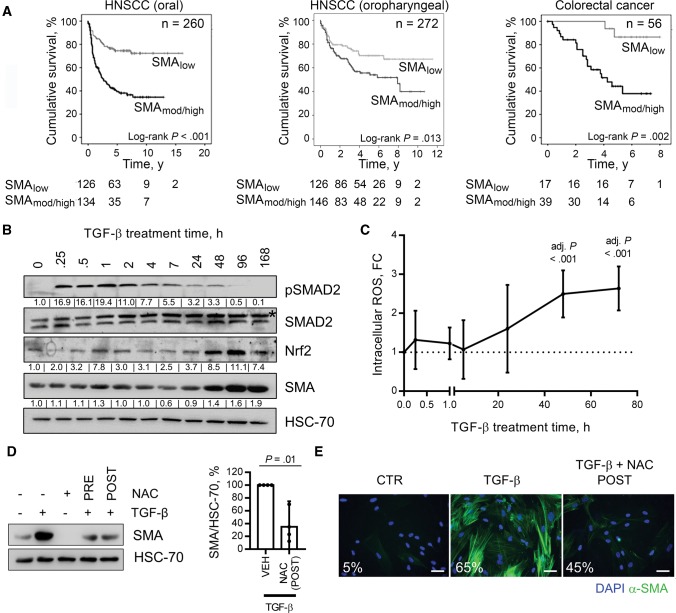
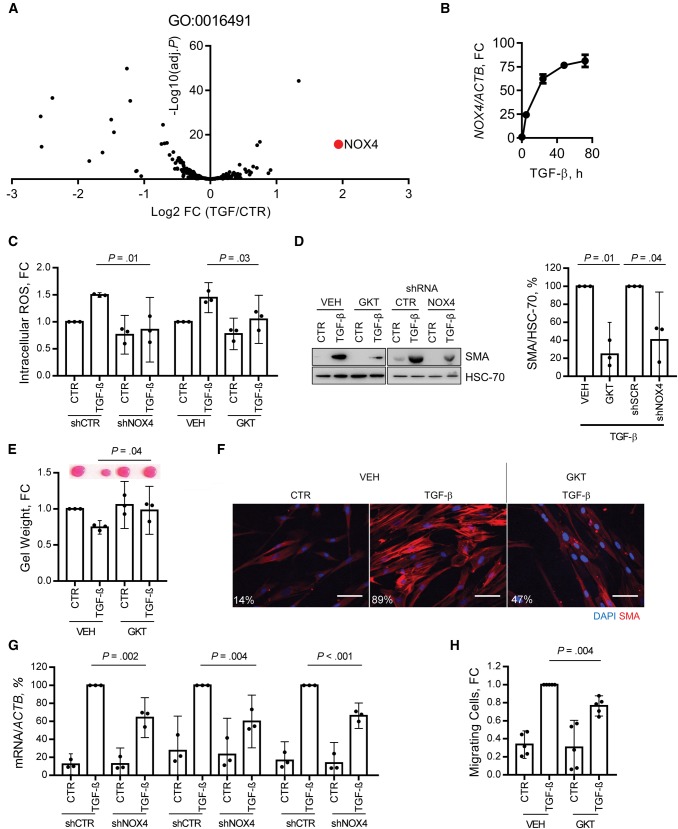
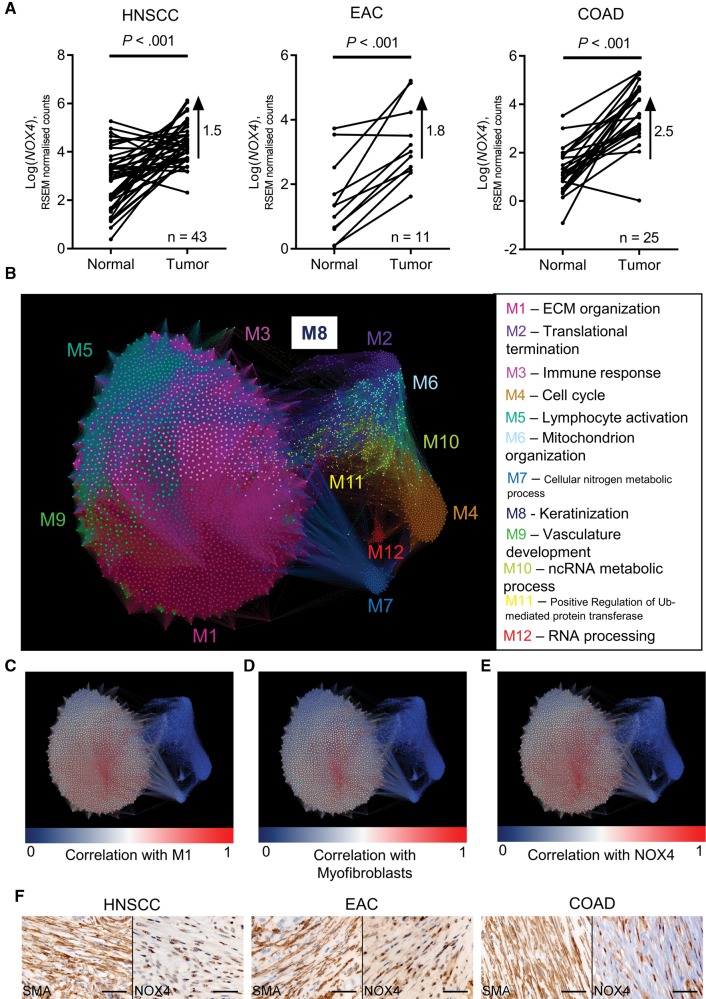
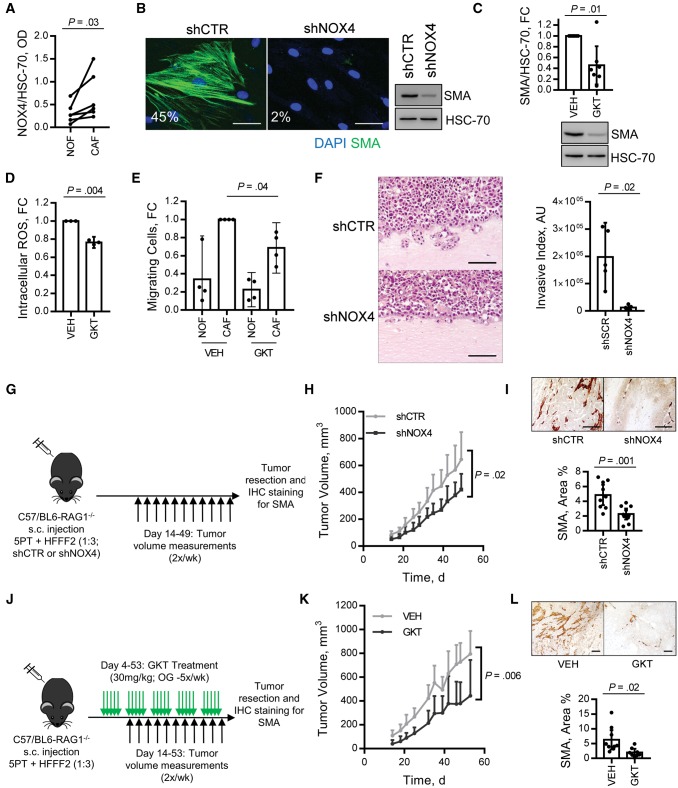
Background: Cancer-associated fibroblasts (CAFs) are tumor-promoting and correlate with poor survival in many cancers, which has led to their emergence as potential therapeutic targets. However, effective methods to manipulate these cells clinically have yet to be developed. Methods: CAF accumulation and prognostic significance in head and neck cancer (oral, n = 260; oropharyngeal, n = 271), and colorectal cancer (n = 56) was analyzed using immunohistochemistry. Mechanisms regulating fibroblast-to-myofibroblast transdifferentiation were investigated in vitro using RNA interference/pharmacological inhibitors followed by polymerase chain reaction (PCR), immunoblotting, immunofluorescence, and functional assays. RNA sequencing/bioinformatics and immunohistochemistry were used to analyze NAD(P)H Oxidase-4 (NOX4) expression in different human tumors. NOX4's role in CAF-mediated tumor progression was assessed in vitro, using CAFs from multiple tissues in Transwell and organotypic culture assays, and in vivo, using xenograft (n = 9-15 per group) and isograft (n = 6 per group) tumor models. All statistical tests were two-sided. Results: Patients with moderate/high levels of myofibroblastic-CAF had a statistically significant decrease in cancer-specific survival rates in each cancer type analyzed (hazard ratios [HRs] = 1.69-7.25, 95% confidence intervals [CIs] = 1.11 to 31.30, log-rank P ≤ .01). Fibroblast-to-myofibroblast transdifferentiation was dependent on a delayed phase of intracellular reactive oxygen species, generated by NOX4, across different anatomical sites and differentiation stimuli. A statistically significant upregulation of NOX4 expression was found in multiple human cancers (P < .001), strongly correlating with myofibroblastic-CAFs (r = 0.65-0.91, adjusted P < .001). Genetic/pharmacological inhibition of NOX4 was found to revert the myofibroblastic-CAF phenotype ex vivo (54.3% decrease in α-smooth muscle actin [α-SMA], 95% CI = 10.6% to 80.9%, P = .009), prevent myofibroblastic-CAF accumulation in vivo (53.2%-79.0% decrease in α-SMA across different models, P ≤ .02) and slow tumor growth (30.6%-64.0% decrease across different models, P ≤ .04). Conclusions: These data suggest that pharmacological inhibition of NOX4 may have broad applicability for stromal targeting across cancer types.
Overview
The claims and statistics of this paper haven’t been checked yet.
Free: it reads the open-access text and checks the first 5 claims that cite a source we can check. Create a free account to check every claim.
Integrity signals
Registry
Cites
Statistics
Figures
Verification
Claims the paper makes
The claims and statistics of this paper haven’t been checked yet.
Free: it reads the open-access text and checks the first 5 claims that cite a source we can check. Create a free account to check every claim.
Claims other papers make about this one
Each is checked against this paper’s own text: does it say what the citing paper says it does?
The cited source says what the claim attributes to it.
In the citing paper
“NOX4 expression is closely related to CAF accumulation in myofibroblasts in patients with CRC, which may be attributed to the fact that NOX4 regulates the transdifferentiation from fibroblasts to myofibroblasts through the delayed period of intracellular ROS production, and the inhibition of NOX4 can effectively reduce the accumulation of CAF [53].”
From Drug Resistance in Colorectal Cancer: From Mechanism to Clinic (2022) · cites this paper as [53]
Self-check
Percentages, sums and reported differences re-computed from the paper’s own numbers.
The self-check needs the paper’s full text.
Citations
Cites
Hallmarks of Cancer: The Next Generation
Hanahan, D., & Weinberg, R. A. (2011) · Cell · doi:10.1016/j.cell.2011.02.013 · Cited by 66,590 · cited 2×
“Over recent years, research has highlighted the contribution of the microenvironment to tumor progression (1), and numerous studies have documented the tumor-promoting role of cancerassociated fibroblasts (CAFs) (2–5).”
BackgroundWGCNA: an R package for weighted correlation network analysis
Langfelder, P., & Horvath, S. (2008) · BMC Bioinformatics · doi:10.1186/1471-2105-9-559 · Cited by 27,252
Increased Survival in Pancreatic Cancer with nab-Paclitaxel plus Gemcitabine
Von Hoff, D. D., Ervin, T., Arena, F. P., Chiorean, E. G., Infante, J., Moore, M., Seay, T., Tjulandin, S. A., Ma, W. W., Saleh, M. N., et al. (2013) · New England Journal of Medicine · doi:10.1056/nejmoa1304369 · Cited by 6,712
Dissecting the multicellular ecosystem of metastatic melanoma by single-cell RNA-seq
Tirosh, I., Izar, B., Prakadan, S. M., Wadsworth, M. H., Treacy, D., Trombetta, J. J., Rotem, A., Rodman, C., Lian, C., Murphy, G., et al. (2016) · Science · doi:10.1126/science.aad0501 · Cited by 4,944 · cited 1×
“(29) using single-cell RNA sequencing (FAP, THY1, DCN, COL1A1/2, and COL6A1/2/3; NOX4 correlation meta values 1⁄4 25.”
MethodOrimo, A., Gupta, P. B., Sgroi, D. C., Arenzana-Seisdedos, F., Delaunay, T., Naeem, R., Carey, V. J., Richardson, A. L., & Weinberg, R. A. (2005) · Cell · doi:10.1016/j.cell.2005.02.034 · Cited by 3,759
Olive, K. P., Jacobetz, M. A., Davidson, C. J., Gopinathan, A., McIntyre, D., Honess, D., Madhu, B., Goldgraben, M. A., Caldwell, M. E., Allard, D., et al. (2009) · Science · doi:10.1126/science.1171362 · Cited by 3,170
Özdemir, B. C., Pentcheva-Hoang, T., Carstens, J. L., Zheng, X., Wu, C.-C., Simpson, T. R., Laklai, H., Sugimoto, H., Kahlert, C., Novitskiy, S. V., et al. (2014) · Cancer Cell · doi:10.1016/j.ccr.2014.04.005 · Cited by 2,681
Desmoulière, A., Geinoz, A., Gabbiani, F., & Gabbiani, G. (1993) · The Journal of cell biology · doi:10.1083/jcb.122.1.103 · Cited by 2,243
Feig, C., Jones, J. O., Kraman, M., Wells, R. J. B., Deonarine, A., Chan, D. S., Connell, C. M., Roberts, E. W., Zhao, Q., Caballero, O. L., et al. (2013) · Proceedings of the National Academy of Sciences · doi:10.1073/pnas.1320318110 · Cited by 2,100 · cited 1×
“Given the previously described roles for CAFs in promoting resistance to chemotherapy (64,65) and adaptive antitumor immunity (4,66), stromal depletion through NOX4 inhibition may be a useful adjunct to improve response to current chemoand immunotherapeutics in patients with a-SMA-positive CAFrich tumors.”
BackgroundStromal Elements Act to Restrain, Rather Than Support, Pancreatic Ductal Adenocarcinoma
Rhim, A. D., Oberstein, P. E., Thomas, D. H., Mirek, E. T., Palermo, C. F., Sastra, S. A., Dekleva, E. N., Saunders, T., Becerra, C. P., Tattersall, I. W., et al. (2014) · Cancer Cell · doi:10.1016/j.ccr.2014.04.021 · Cited by 2,085
Cited by
Items 101–198 of 198
The recent advances of cancer associated fibroblasts in cancer progression and therapy
Wu, C., Gu, J., Gu, H., Zhang, X.-X., Zhang, X., & Ji, R. (2022) · Frontiers in Oncology · doi:10.3389/fonc.2022.1008843 · Cited by 25
“The ROS-producing enzyme NOX4 was upregulated by CAFs in many human cancers, and gene inhibitors convert fibroblasts to CAFs, preventing CAF accumulation and slowing tumor growth (98).”
BackgroundBonneaud, T. L., Lefebvre, C. C., Nocquet, L., Basseville, A., Roul, J., Weber, H., Campone, M., Juin, P. P., & Souazé, F. (2022) · Cell Death and Disease · doi:10.1038/s41419-022-05214-9 · Cited by 26
“Myo fi broblastic CAFs are indeed key mediators of fi brotic tumor stroma, which is characterized by accumulation of extracellular matrix (ECM), increased tissue stiffness and breast cancer risk [5 – 7].”
BackgroundFibroblasts in cancer: Defining target structures for therapeutic intervention
Boesch, M., Baty, F., Rumpold, H. F., Sopper, S., Wolf, D. G. F., & Brutsche, M. H. (2019) · Biochimica et Biophysica Acta (BBA) - Reviews on Cancer · doi:10.1016/j.bbcan.2019.06.003 · Cited by 20
Venkatachalapathy, S., Jokhun, D. S., & Shivashankar, G. V. (2020) · Molecular Biology of the Cell · doi:10.1091/mbc.e19-08-0420 · Cited by 20
CXCL12 alone is enough to Reprogram Normal Fibroblasts into Cancer-Associated Fibroblasts
Ma, Z., Yu, D., Tan, S., Li, H., Zhou, F., Qiu, L., Xie, X., & Wu, X. (2025) · Cell Death Discovery · doi:10.1038/s41420-025-02420-0 · Cited by 25
“CAFs are abundant fi broblasts that acquire α -smooth muscle actin ( α -SMA)-positive, activated myo fi broblast phenotype [4].”
Ji, X., Wu, X., Sun, W., & Zhang, H. (2025) · Cellular Oncology · doi:10.1007/s13402-025-01108-y · Cited by 29
“As activated fibroblasts, CAFs are a major stromal component in malignant solid tumors, contributing to TME remodeling, inflammatory cell activation [ 2, 30], and poor prognosis across various cancer types [ 31 ].”
van der Heijden, M., Essers, P., Verhagen, C. V. M., Willems, S. M., Sanders, J., de Roest, R. H., Vossen, D. M., Leemans, C. R., Verheij, M., Brakenhoff, R. H., et al. (2020) · Radiotherapy and Oncology · doi:10.1016/j.radonc.2020.05.013 · Cited by 19
NOX Family: Regulators of Reactive Oxygen Species Balance in Tumor Cells
Xiong, B., Zhang, Y., Liu, S., Liao, S., Zhou, Z., He, Q., & Zhou, Y. (2025) · The FASEB Journal · doi:10.1096/fj.202500238rrr · Cited by 24
“Furthermore, a study exploring the relationship between NOX4 expression and immune checkpoint genes in 40 different cancer types demonstrated a close association with common immune checkpoints such as PD-L1 and CTLA-4 [123].”
Herch, I. E., Tornaas, S., Dongre, H., & Costea, D. E. (2024) · Frontiers in Molecular Biosciences · doi:10.3389/fmolb.2024.1340024 · Cited by 23
NADPH oxidase 4 is correlated with gastric cancer progression and predicts a poor prognosis.
Du, S., Miao, J., Lu, X., Shi, L., Sun, J., Xu, E., Wang, X., Zhao, M., Chen, H., Wang, F., et al. (2019) · PubMed · Cited by 16
An Optimized Method to Isolate Human Fibroblasts from Tissue for Ex Vivo Analysis
Waise, S., Parker, R., Rose-Zerilli, M. J. J., Layfield, D., Wood, O., West, J. J., Ottensmeier, C. H. H., Thomas, G. J., & Hanley, C. J. (2019) · BIO-PROTOCOL · doi:10.21769/bioprotoc.3440 · Cited by 16
“CAFs are associated with multiple hallmarks of malignancy (Ishii et al., 2016; Tao et al., 2017) and correlate with poor prognosis in multiple solid tumors (Hanley et al., 2018).”
BackgroundSelf-citationThe landscape of chimeric antigen receptor T cell therapy in breast cancer: Perspectives and outlook
Zhang, H., Zhu, S., Deng, W., Li, R., Zhou, H., & Xiong, H. (2022) · Frontiers in Immunology · doi:10.3389/fimmu.2022.887471 · Cited by 22
Cancer-associated fibroblasts: heterogeneity and their role in the tumor immune response
Xiao, Y., Wang, Z., Gu, M., Wei, P., Wang, X., & Li, W. (2024) · Clinical and Experimental Medicine · doi:10.1007/s10238-024-01375-3 · Cited by 18
“Notably, a strong correlation between the expression level of NADPH oxidase subunit 4 (NOX4) and the number of CAFs in tumor tissues has been observed in a variety of tumor cells, which suggests that the conversion of NFs to CAFs is dependent on the NOX4 enzyme [22, 23].”
BackgroundImmunohistochemical analysis of cancer-associated fibroblasts and podoplanin in head and neck cancer
Ramos-Vega, V., Rojas, B. V., & Torres, W. D. (2020) · Medicina oral, patología oral y cirugía bucal · doi:10.4317/medoral.23335 · Cited by 15
“Moreover, CAFs has been outlined as a possible prognostic factor, considering that the inhibition of its activity has been shown to limit the progression of SCC in vitro and in vivo (24,25).”
BackgroundBhome, R., Peppa, N., Karar, S., McDonnell, D., Mirnezami, A. H., & Hamady, Z. Z. R. (2021) · European Journal of Surgical Oncology · doi:10.1016/j.ejso.2020.12.016 · Cited by 15
Self-citationAmengual, J., Gonzalez‐Sanchez, E., Yáñez-Bartolomé, M., Sererols-Viñas, L., Ravichandra, A., Guiton, C., Fusté, N. P., Alay, A., Hijazo‐Pechero, S., Martín‐Mur, B., et al. (2025) · Signal Transduction and Targeted Therapy · doi:10.1038/s41392-025-02347-z · Cited by 16
Jiang, Z., Xu, Y., Wang, Y., Dong, Z., Hu, W., Su, J., Wu, L., He, Y., Zhu, L., Jian, D., et al. (2025) · Journal of Advanced Research · doi:10.1016/j.jare.2025.10.041 · Cited by 22
Sung, Y., Kim, D. K., Kim, J. S., Kim, S.-J., Kim, J. H., & Han, J. M. (2026) · Experimental & Molecular Medicine · doi:10.1038/s12276-026-01697-0 · Cited by 22
“Myo fi broblast-like CAFs (myCAFs) remo-del the ECM, increase stromal stiffness and restrict immune in fi ltration, thereby fostering M2 macrophage polarization and regulatory T cell (T reg ) expansion 12,13 .”
Han, L., Guo, X., Du, R., Guo, K., Qi, P., & Bian, H. (2022) · Journal of Ovarian Research · doi:10.1186/s13048-022-01003-2 · Cited by 15
“In many cancers, CAFs promote tumor growth and are associated with low survival rates, which makes them potential therapeutic targets [9].”
BackgroundThe origins, roles and therapies of cancer associated fibroblast in liver cancer
Zulaziz, N., Chai, S. J., & Lim, K. P. (2023) · Frontiers in Oncology · doi:10.3389/fonc.2023.1151373 · Cited by 18
“Importantly, the use of anti-NOX4 has successfully controlled tumor growth in vivo (115).”
BackgroundInfluentialZhang, J., Qi, J., Wei, H., Lei, Y., Yu, H., Liu, N., Zhao, L., & Wang, P. (2021) · Frontiers in Cell and Developmental Biology · doi:10.3389/fcell.2021.667645 · Cited by 17
The Distinctive Features behind the Aggressiveness of Oral and Cutaneous Squamous Cell Carcinomas
Alonso-Juarranz, M., Mascaraque, M., Carrasco, E., Gracia‐Cazaña, T., Corcuera, Ó. D. L. S., Gilaberte, Y., González, S., Juarranz, Á., & Falahat, F. (2023) · Cancers · doi:10.3390/cancers15123227 · Cited by 22
Oxidative Stress in the Tumor Immune Microenvironment: Mechanisms and Therapeutic Perspectives
Wang, Z., Li, B., Tang, P., Yan, F., Wang, S., Leng, G., Dawa, P., Chen, Y., Guo, Y., Yang, P., et al. (2026) · MedComm – Oncology · doi:10.1002/mog2.70068 · Cited by 18
Zhang, L., Liu, T., Chen, M., Gao, S., Staley, C. A., Yang, L. P. H., & Zhu, L. (2025) · Biomaterials · doi:10.1016/j.biomaterials.2025.123437 · Cited by 17
Irvine, A. F., Waise, S., Green, E. W., & Stuart, B. L. (2020) · BMC Medical Research Methodology · doi:10.1186/s12874-020-01092-x · Cited by 14
Spatially discrete signalling niches regulate fibroblast heterogeneity in human lung cancerPreprint
Hanley, C. J., Waise, S., Parker, R. G., Lopez, M., Taylor, J., Kimbley, L., West, J. J., Ottensmeier, C. H. H., Rose-Zerilli, M. J. J., & Thomas, G. J. (2020) · bioRxiv (Cold Spring Harbor Laboratory) · doi:10.1101/2020.06.08.134270 · Cited by 14
Self-citationWu, Z., Lin, X., Yao, Y., Fan, G., Shi, J., Zheng, X., Hu, B., Che, H., Chen, H., Yang, W., et al. (2025) · Bioactive Materials · doi:10.1016/j.bioactmat.2025.05.025 · Cited by 28
“Emerging evidence suggests that NOX4 facilitates the activation of CAFs by upregulating the pro-fibrotic factor TGF-β , thereby promoting a tumor-supportive microenvironment [53].”
Current Status of Research on Losartan in Tumour Therapy
Wang, H., Yuan, S., & Wang, H. (2026) · Journal of Cellular and Molecular Medicine · doi:10.1111/jcmm.70985 · Cited by 11
“In addition, CAFs secrete immunomodulatory cytokines, including TGF-β and IL-6, and proangiogenic factors such as VEGF and bFGF, thereby fostering a tumour-supportive microenvironment [60, 61].”
Cancer-associated fibroblasts in breast cancer in the single-cell era: Opportunities and challenges
Yang, J., Xin, B., Wang, X., & Wan, Y. (2025) · Biochimica et Biophysica Acta (BBA) - Reviews on Cancer · doi:10.1016/j.bbcan.2025.189291 · Cited by 18
Huang, L., Liao, C., Wu, H., & Huang, P. (2022) · Bosnian Journal of Basic Medical Sciences · doi:10.17305/bjbms.2022.7416 · Cited by 10
“In addition to the currently used anti-PD-1/PD-L1 or anti-CTLA-4 therapeutic drugs, cancer-associated fibroblasts, and tumor-associated macrophages (TAM) in the microenvironment are also considered potential targets for cancer treatment [5, 6].”
BackgroundFeng, W., Boudreau, H. E., & Leto, T. L. (2021) · Antioxidants · doi:10.3390/antiox10020235 · Cited by 13
“For example, two recent reports noted relatively higher stromal NOX4 expression in myofibroblasts and fibroblasts adjacent to cancer cells in several types of solid tumors and suggested therapies targeting stromal NOX4 could reduce tumor growth [46,47].”
BackgroundChen, Y., Chien, C., Fang, F., Huang, T., Su, Y.-Y., Luo, S., Huang, C., Lin, W.-C., & Li, S.-H. (2018) · Journal of Clinical Medicine · doi:10.3390/jcm7120497 · Cited by 11
“Suppression of Nox4 was found to revert the myofibroblastic-CAF phenotype, prevent myofibroblastic-CAF accumulation and slower tumor proliferation [31].”
BackgroundImpact of the Microenvironment on Tumour Budding in Colorectal Cancer
Georges, L. M. C., Verset, L., Zlobec, I., Demetter, P., & Wever, O. D. (2018) · Advances in experimental medicine and biology · doi:10.1007/978-3-030-02771-1_7 · Cited by 10
Venkatkumar, S., Narayan, M., & Krishnan, R. (2022) · Cancer Research Statistics and Treatment · doi:10.4103/crst.crst_182_22 · Cited by 9
Tornaas, S., Kleftogiannis, D., Fromreide, S., Smeland, H. Y., Aarstad, H. J., Vintermyr, O. K., Akslen, L. A., Costea, D. E., & Dongre, H. (2024) · Heliyon · doi:10.1016/j.heliyon.2024.e31191 · Cited by 11
Wang, Q., Sun, Y., Li, J., Li, Z., Yuan, F., Xia, Z., Meng, F., Shen, Z., Shen, Y., Xu, L., et al. (2025) · Cell Death and Disease · doi:10.1038/s41419-025-07974-6 · Cited by 17
“However, many phase I and phase II clinical trials resulted in failure due to low af fi nity, poor speci fi city, and adverse side effects [17, 32 – 35].”
Tumor Microenvironment‐Related Sonodynamic Therapy Mediates Tumor Therapy
Wang, X., Wang, C., Tian, H., Wu, B., & Cheng, W. (2023) · Advanced Therapeutics · doi:10.1002/adtp.202300265 · Cited by 9
Wang, T., & Xu, H. (2022) · Exploration of Medicine · doi:10.37349/emed.2022.00076 · Cited by 11
“Setanaxib, a small molecule NOX4 inhibitor, inhibited ROS generation in TAFs, promoted intratumoral CD8+ T cell infiltration in TAF-rich tumors, therefore repressing tumor growth of TC-1 and MC-38 subcutaneously implanted mice [44, 117].”
BackgroundInfluentialFan, T., Lü, J., Niu, D., Zhang, Y., Wang, B., Zhang, B., Zhang, Z., He, X., Peng, N., Li, B., et al. (2022) · Frontiers in Immunology · doi:10.3389/fimmu.2022.1046121 · Cited by 9
Liu, Q., Yao, F., Wu, L., Xu, T., Na, J., Shen, Z., Liu, X., Shi, W., Zhao, Y., & Liao, Y. (2024) · Clinical & Translational Oncology · doi:10.1007/s12094-024-03492-7 · Cited by 9
“…[ 120 ] A c ti v a t o r s : P F O S [ 117 ] ; T R P M 2 c h a nn e l ac ti v a t o r s AD P R 和 hyd r og e n p e r ox i d e [ 121 ] ; S I R T 1 [ 119 ] [ 122 ] the Endo180 (Mrc2) positive CAFs subgroup promotes the establishment of a tumor-promoting TME by facilitating CD8 + T cell exclusion.”
Khalid, A., Siddiqui, S., Faizi, N., Hassan, J., Nehal, N., & Siddiqui, A. (2019) · Indian Journal of Medical and Paediatric Oncology · doi:10.4103/ijmpo.ijmpo_121_18 · Cited by 10
“[28,29] Pharmacological inhibition of NOX4 may have broad applicability for stromal targeting across cancer types.[30]”
BackgroundShi, A., Yan, M., Pang, B., Pang, L., Wang, Y., Lan, Y., Zhang, X., Xu, J., Ping, Y., & Hu, J. R. (2023) · BMC Immunology · doi:10.1186/s12865-023-00587-8 · Cited by 8
“TMIP 1 (low CA-1/high CA-2, “immune cold-suppressive”) was mainly characterized by higher CAF, Endo and a lower B_Non-regulatory, which showed a suppressive immune response dominated by CAF [40, 41].”
BackgroundGu, J., Wang, C., Xu, X., Zhao, L., Zhou, J., Bai, C., & Sun, Z. (2020) · Translational Cancer Research · doi:10.21037/tcr-20-2365 · Cited by 7
“Eventually, 21 studies (21-41) were enrolled in this meta-analysis.”
BackgroundMutant p53 and NOX4 are modulators of a CCL5-driven pro-migratory secretome
Boudreau, H. E., Korzeniowska, A., & Leto, T. L. (2023) · Free Radical Biology and Medicine · doi:10.1016/j.freeradbiomed.2023.02.012 · Cited by 5
Zhao, X., He, Y., Pan, Y., Ye, L., Liu, L., Mou, X., & Fu, L. (2023) · Frontiers in Oncology · doi:10.3389/fonc.2023.1044526 · Cited by 5
“At the same time, NOX4, as a ROS producing enzyme, is the downstream target of TGF-b1 and the regulatory center of cancer-associated fibroblast phenotype in many cancers, and promotes cancerassociated fibroblast (CAF) activation in tumors, with strong CAF specificity (20).”
BackgroundThe role and mechanism of NADPH oxidase in the development and progression of thyroid carcinoma.
Dang, H., Sheng, J., Tang, P., Peng, X., Zhang, R., Zhao, X., Hu, J., & Xu, T. (2023) · PubMed Central · Cited by 6
Bingham, V., Harewood, L., McQuaid, S., Craig, S. G., Revolta, J. F., Kim, C. S., Srivastava, S., Quezada-Marín, J. I., Humphries, M. P., & Salto‐Tellez, M. (2024) · Scientific Reports · doi:10.1038/s41598-024-62031-0 · Cited by 5
“That being said, TMAs have been used extensively to successfully interrogate many aspects of the tumour microenvironment for patient prognostication, by ourselves and others 16,40,41 .”
MethodMusa, M., Ouaret, D., & Bodmer, W. F. (2020) · Anticancer Research · doi:10.21873/anticanres.14627 · Cited by 5
Khalid, A., Siddiqui, S., Bordoloi, B., Faizi, N., Samadi, F. M., & Saeed, N. (2018) · Journal of Pathology and Translational Medicine · doi:10.4132/jptm.2018.07.17 · Cited by 4
“It was recently reported that pharmacological inhibition of NOX4 slows tumor growth in vivo by targeting myofibroblasts.(44) Lysyl oxidase-like 2 (LOXL2) antibodies disrupt the orientation and width of collagen fibers, ultimately resulting in decreased tumor growth.”
BackgroundQuenching thirst with poison? Paradoxical effect of anticancer drugs
Chai, K., Wang, C., Zhou, J., Mu, W., Gao, M., Fan, Z., & Lv, G. (2023) · Pharmacological Research · doi:10.1016/j.phrs.2023.106987 · Cited by 11
Wang, D., & Chen, Z. (2025) · Visualized Cancer Medicine · doi:10.1051/vcm/2025005 · Cited by 5
Gandhi, V., Mahajan, A., & Kansal, Y. P. (2023) · Advanced Biomedical Research · doi:10.4103/abr.abr_160_21 · Cited by 5
Role of antioxidants in modulating anti-tumor T cell immune resposne
Oberholtzer, N. P., Mills, S. A., Mehta, S., Chakraborty, P., & Mehrotra, S. (2024) · Advances in cancer research · doi:10.1016/bs.acr.2024.05.003 · Cited by 3
Ma, N., Li, J., Lv, L., Li, C., Li, K., & Wang, B. (2022) · PubMed Central · Cited by 3
The role of the fibroblast in Barrett's esophagus and esophageal adenocarcinoma
Zhu, H., & Jin, R. U. (2024) · Current Opinion in Gastroenterology · doi:10.1097/mog.0000000000001032 · Cited by 3
Zu, P., & Yu, Z. (2026) · Frontiers in Cell and Developmental Biology · doi:10.3389/fcell.2026.1761070 · Cited by 3
“The ROS-producing enzyme NADPH oxidase-4 (NOX4) regulates the differentiation of myofibroblast CAFs in a variety of cancers, and NOX4 inhibition can restore activated CAFs to a quiescent state (Hanley et al., 2018).”
Liu, Y., Huang, H., Yang, X., Huang, D., Wang, X., Yuan, M., & Hong, L. (2024) · Aging · doi:10.18632/aging.205769 · Cited by 3
Zhi, F., Liu, W., Yang, H., Luo, H., Feng, Y., & Lei, Y.-Y. (2024) · Discover Oncology · doi:10.1007/s12672-024-01325-1 · Cited by 2
“Numerous studies have postulated that fibroblasts play a role in promoting immune evasion and driving the development of cancer [41–43].”
BackgroundCancer-associated fibroblasts as a potential target in oncology therapy
Dominiak, A., Nowicki, T. J., Łacheta, D., & Nowicka, G. (2019) · Postępy Higieny i Medycyny Doświadczalnej · doi:10.5604/01.3001.0013.5379 · Cited by 3
Basic and clinical studies of AMD in future: questions more than answers
Li, W. (2021) · Elsevier eBooks · doi:10.1016/b978-0-12-822061-0.00008-6 · Cited by 2
Hayden, A. L., Manousopoulou, A., Cowie, A., Walker, R., Sharpe, B. P., Harrington, J., Izadi, F., Kyle, E., Saunders, J. H., Parsons, S. L., et al. (2020) · bioRxiv (Cold Spring Harbor Laboratory) · doi:10.1101/2020.04.21.052647 · Cited by 2
Self-citationWu, G., Guo, W., Zhu, S., & Fan, G. (2021) · bioRxiv (Cold Spring Harbor Laboratory) · doi:10.1101/2021.10.15.464475 · Cited by 2
“In addition to anti-PD-1/PD-L1 or anti-CTLA-4 treatment strategies, tumour-associated macrophages (TAMs) [10] and cancer-associated fibroblasts (CAFs) [11] have also been previously reported as potential strategies for cancer treatment research.”
BackgroundHarnessing reactive oxygen species for precision medicine: ROS-Activatable PROTACs for lung Cancer
Olazábal-Morán, M., Blázquez-Barbadillo, C., Pérez-Izquierdo, E., Muñoz-Silva, M., & Garrido, A. (2026) · Advanced Drug Delivery Reviews · doi:10.1016/j.addr.2026.115840 · Cited by 3
Hong, W.-Z., Huang, G., Qi-ping, L., & Lu, B.-Q. (2026) · Frontiers in Immunology · doi:10.3389/fimmu.2026.1848015 · Cited by 2
“…robust myCAF/iCAF/ecmCAF state architecture, TGF-b - and CXCL12-driven immune exclusion, Gal9-associated immune-trapping fi broblast programs, IL-6/JAK/STAT3-and GDF15-related myeloid remodeling, and NOX4 inhibition as a CAF-normalizing strategy (11 – 19, 34, 42, 43, 46, 47, 49, 50, 55, 62).”
InfluentialAnimal study of a newly designed metal airway brachytherapy stent loaded with radioactive 125I seeds
Jiao, D., Lei, Q., Xu, K., Liu, Y., & Han, X. (2022) · Journal of Cancer Research and Clinical Oncology · doi:10.1007/s00432-021-03904-z · Cited by 1
MicroRNA‐200c overexpression in cancer‐associated fibroblasts decreases interleukin‐2 secretion
Shariati, L., Vaseghi, G., Vaziri, N., Shenavar, N., Zarrabi, A., & Javanmard, S. H. (2022) · Clinical and Translational Discovery · doi:10.1002/ctd2.90 · Cited by 1
Palliyage, G. H. (2023) · The Research Repository @ WVU (West Virginia University) · doi:10.33915/etd.12138 · Cited by 1
Presentation, Diagnosis and Prognosis of Squamous Cell Carcinomas of the Oral Mucosa and Oropharynx
Thavaraj, S., & Jones, A. V. (2024) · Wiley eBooks · doi:10.1002/9781119989233.ch29 · Cited by 3
The role of peroxisome proliferator-activated receptor β/δ in colorectal cancer
Tan, E. H. P. (2018) · DR-NTU (Nanyang Technological University) · doi:10.32657/10356/74230
Hayden, A. L., Manousopoulou, A., Sharpe, B. P., Cowie, A., Walker, R., Harrington, J., Izadi, F., Breininger, S. P., Kyle, E., Saunders, J. H., et al. (2021) · SSRN Electronic Journal · doi:10.2139/ssrn.3924599
Self-citationOvercoming resistance to cancer immunotherapy
(2020) · Research outreach · doi:10.32907/ro-117-5457
Novel CAF-identifiers via transcriptomic analysis in oral cancer patientsPreprint
Dwivedi, N., Shukla, N., Das, M., & Dhar, S. K. (2023) · bioRxiv (Cold Spring Harbor Laboratory) · doi:10.1101/2023.01.10.523511
“Interestingly, the production 106 of intracellular ROS, specifically NADPH oxidase 4 (NOX4), is crucial to the development 107 of CAF as well as myofibroblast (37,38).”
BackgroundWu, G., Guo, W., Zhu, S., & Fan, G. (2023) · Journal of Oncology · doi:10.1155/2023/5355269 · Cited by 1
“In addition to anti-PD-1/PD-L1 or anti-CTLA-4 treatment strategies, tumour-associated macrophages (TAMs) [10] and cancer-associated fbroblasts (CAFs) [11] have also been previously reported as potential strategies for cancer treatment research.”
BackgroundMellone, M., Piotrowska, K., Venturi, G., James, L., Bzura, A., Lopez, M. A., James, S., Wang, C., Ellis, M. J., Hanley, C. J., et al. (2023) · doi:10.1158/0008-5472.c.6514176.v1
Self-citationShi, A., Yan, M., Pang, B., Pang, L., Wang, Y., Lan, Y., Zhang, X., Xu, J., Ping, Y., & Hu, J. R. (2023) · Figshare · doi:10.6084/m9.figshare.24792276
O’Fee, K., Burley, A., & Wilkins, A. C. (2024) · Elsevier eBooks · doi:10.1016/b978-0-443-14064-8.00005-9
O’Fee, K., Burley, A., & Wilkins, A. C. (2024) · Elsevier eBooks · doi:10.1016/b978-0-443-14064-8.90005-5
IGFBPs define distinct pro-tumorigenic CAF subtypes in lung cancer tumour-microenvironmentPreprint
Yengkhom, G., Nandgaonkar, K. K., Ramanathan, S., Schlegel, J. A., Dong, M., Thorat, R. A., Kumar, R., Yadav, S. C., Prabhash, K., & Arandkar, S. (2025) · bioRxiv (Cold Spring Harbor Laboratory) · doi:10.64898/2025.12.03.692056 · Cited by 1
Irvine, A. F., Waise, S., Green, E. W., & Stuart, B. (2020) · Figshare · doi:10.6084/m9.figshare.13173060
Shi, A., Yan, M., Pang, B., Pang, L., Wang, Y., Lan, Y., Zhang, X., Xu, J., Ping, Y., & Hu, J. (2024) · Figshare · doi:10.6084/m9.figshare.24792441
Irvine, A. F., Waise, S., Green, E. W., & Stuart, B. (2020) · Figshare · doi:10.6084/m9.figshare.13173069
Irvine, A. F., Waise, S., Green, E. W., & Stuart, B. (2020) · Figshare · doi:10.6084/m9.figshare.13173072
Shi, A., Yan, M., Pang, B., Pang, L., Wang, Y., Lan, Y., Zhang, X., Xu, J., Ping, Y., & Hu, J. (2024) · Figshare · doi:10.6084/m9.figshare.26652312
Irvine, A. F., Waise, S., Green, E. W., & Stuart, B. (2020) · Figshare · doi:10.6084/m9.figshare.13173066
Irvine, A. F., Waise, S., Green, E. W., & Stuart, B. (2020) · Figshare · doi:10.6084/m9.figshare.13173063
Molecular features and clinical significance of cancer-associated fibroblasts in colorectal cancer
Yin, Y., Liu, H., Wu, S., Fu, Y., & Peng, S. (2026) · Molecular Biology of the Cell · doi:10.1091/mbc.e25-10-0476 · Cited by 1
Oravetzova, A., Dvořáková, M., Mihai, A.-I., Andrš, M., Sobol, M. A., Zuev, A. P., Shukla, K., Boleslavska, B., Rosano, V., König, C., et al. (2026) · Nature Communications · doi:10.1038/s41467-026-71353-8 · Cited by 2
“Moreover, HRASV12-induced DNA damage and subsequent senescence can be suppressed byNOX4depletion 44 .”
InfluentialLouault, K. (2018) · theses.fr (ABES) · doi:10.70675/0aef1137z5689z4922z8455zdbe4b757612c
Ma, H., Zheng, Y., Pei, M., Zeng, Y., Zhang, Z. J., Xu, Y., Wang, X., Zhang, W., Li, N., & Wang, S. (2026) · Medical Oncology · doi:10.1007/s12032-026-03346-y · Cited by 1
Thakur, M., Mutyala, D., Amoliga, A., Ortega, M. C., & Batra, S. (2026) · Cellular and Molecular Immunology · doi:10.1038/s41423-026-01447-2 · Cited by 1
Wang, X., Wang, Q., Wang, J., Ding, G., Huang, Y., Feng, Y., & Zou, B. (2026) · Materials Today Advances · doi:10.1016/j.mtadv.2026.100976
Lee, C.-M., Telkar, N., Wadsworth, B. J., Cederberg, R. A., Shi, R., Zhan, L., Sekhon, P., Clark, M. A., Hall, M. G., Thomas, K. N., et al. (2026) · bioRxiv (Cold Spring Harbor Laboratory) · doi:10.64898/2026.09.12.751091
“Fibrosis or desmoplasia in solid tumours is caused by the deposition and remodeling of dense collagen matrices that are associated with diminished responses to many types of cancer therapies 1–3 , and ultimately poor patient outcomes 4,5 .”
Zhang, X. (2026) · Frontiers in Cell and Developmental Biology · doi:10.3389/fcell.2026.1927031
“NOX4 inhibition reversed myofibroblast phenotypes and restored immune infiltration in preclinical models, including head-and-neck-tumour tissue analyses (Ford et al., 2020; Hanley et al., 2018).”
Ortiz, F. D. L. J., Cimmino, C., Grech, K., Huynen, M. A., van Leeuwen, F., van Zwam, M. C., van den Dries, K., Ventre, M., & Cambi, A. (2026) · Cellular and Molecular Bioengineering · doi:10.1007/s12195-026-00945-7
Gan, L., Liu, Z., Cao, L., Meng, X., Liu, X., Wang, X., & He, Y. (2026) · Experimental Hematology and Oncology · doi:10.1186/s40164-026-00837-6
“Patient selection should also incorporate CAF subtypes, metabolic biomarkers, and immune phenotypes.”
Ullah, A., Ali, M. M., Alatawi, F. S., Hamdi, N., & Al‐Rasheed, M. (2026) · Medical Oncology · doi:10.1007/s12032-026-03469-2
Metadata
- Authors
- Hanley, C. J., Mellone, M., Ford, K., Thirdborough, S. M., Mellows, T., Frampton, S. J., Smith, D. M., Harden, E., Szyndralewiez, C., Bullock, M., Noble, F., Moutasim, K. A., King, E. V., Vijayanand, P., Mirnezami, A. H., Underwood, T. J., Ottensmeier, C. H., & Thomas, G. J.
- Affiliations
- University of Southampton (GB)
- Genkyotex SA, Plan-les-Ouates, Switzerland
- La Jolla Institute for Immunology (US)
- Cancer Sciences Unit, University of Southampton Faculty of Medicine, Southampton, UK
- Corresponding author
- Thomas, Gareth J
- ORCID
- Venue
- JNCI: Journal of the National Cancer Institute
- Publisher
- Oxford University Press (OUP)
- Published
- 2017-08-03
- Volume
- 110
- Issue
- 1
- Pages
- 109-120
- ISSN
- 0027-8874 (ISSN-L)
- 1460-2105
- PMC
- PMC5903651
- OpenAlex
- W2739944480
- Cited by
- 195
- References
- 68
- Citations by year
- 2026: 16 · 2025: 14 · 2024: 20 · 2023: 28 · 2022: 31 · 2021: 28 · 2020: 25 · 2019: 15 · 2018: 17 · 2017: 1
- FWCI
- 6.99
- Type
- journal article
- Language
- en
- Open access
- hybrid
- doi.org
- Licence
- Locations
- JNCI Journal of the National Cancer Institute (publishedVersion, cc-by)
- Europe PMC (PubMed Central) (publishedVersion, cc-by)
- PubMed Central (publishedVersion, cc-by)
- PubMed (publishedVersion)
- ePrints Soton (University of Southampton) (acceptedVersion)
- Funders
- Cancer Research UK (C21825/A13315, C115121/A20256)
- National Cancer Institute (C21825/A13315, C115121/A20256)
- Topics
- Health Sciences › Medicine › Oncology › Cancer Cells and Metastasis
- Life Sciences › Biochemistry, Genetics and Molecular Biology › Molecular Biology › TGF-β signaling in diseases
- Health Sciences › Medicine › Oncology › Pancreatic and Hepatic Oncology Research
- Keywords
- cancer-associated fibroblasts, myofibroblastic phenotype, NOX4, fibroblast-to-myofibroblast transdifferentiation, reactive oxygen species, head and neck cancer, oral cancer, oropharyngeal cancer, colorectal cancer, cancer-specific survival, tumor microenvironment, alpha-smooth muscle actin
- MeSH terms
- Cancer-Associated Fibroblasts, NADPH Oxidase 4, Actins, Adenocarcinoma, Adult, Aged, Aged, 80 and over, Animals, Carcinoma, Non-Small-Cell Lung, Carcinoma, Squamous Cell, Cell Count, Esophageal Neoplasms, Female, Head and Neck Neoplasms, Humans, Lung Neoplasms, Male, Middle Aged, Mouth Neoplasms, Neoplasm Transplantation, Oropharyngeal Neoplasms, Phenotype, Pyrazoles, Pyridines, Pyridones, Colorectal Neoplasms, Up-Regulation, Survival Rate, Reactive Oxygen Species, Disease Progression, NADPH Oxidases, RNA Interference, Pyrazolones, Mice, Cell Transdifferentiation, Myofibroblasts
About these checks
Registry, retraction, Cites and statistics results are computed, not judged, with one exception: a printed reference that no index lists is read once by a model before it counts as a citation error. Claims are extracted by a model and kept only when their quote appears verbatim in the text; each cited source is then checked, with a model’s help, for whether it says what the claim relies on. Those verdicts can be wrong — read the claim’s quote and the cited source before relying on one.
Statistics and arithmetic are recomputed, not judged.
Confidence bands are shown only for fields calibrated on our annotated test set. None is calibrated yet, so no band is shown.
What counts as a claim ›How we measure confidence ›How we check this ›
Are you an author, or do you see a problem with this page? Request a review
Data sources
Bibliographic data: Semantic Scholar, OpenAlex, Crossref.
Contains information from the Semantic Scholar Academic Graph Datasets, made available under the ODC Attribution License (ODC-BY 1.0).
Semantic Scholar’s data is described in: Kinney, R., et al. (2023). The Semantic Scholar Open Data Platform. arXiv:2301.10140.
