

Targeting the Myofibroblastic Cancer-Associated Fibroblast Phenotype Through Inhibition of NOX4
Open accessThe DOI matches its Crossref record; 66 of the 68 references it cites were found in a registry or an index.
Abstract
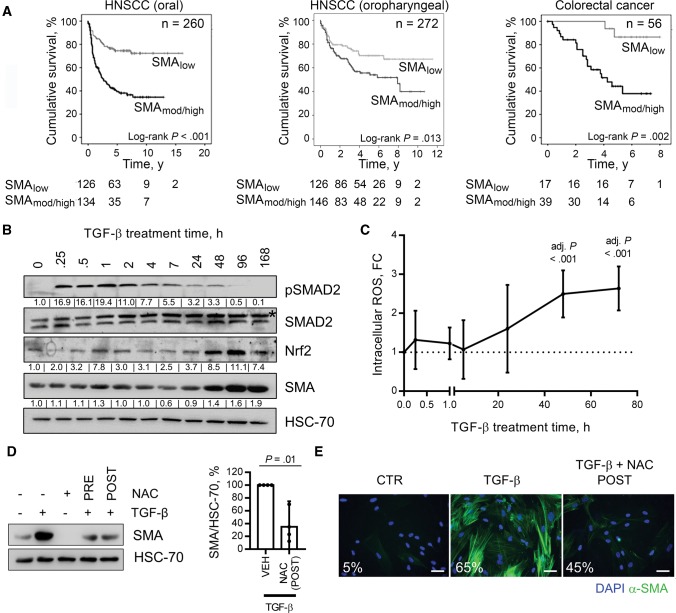
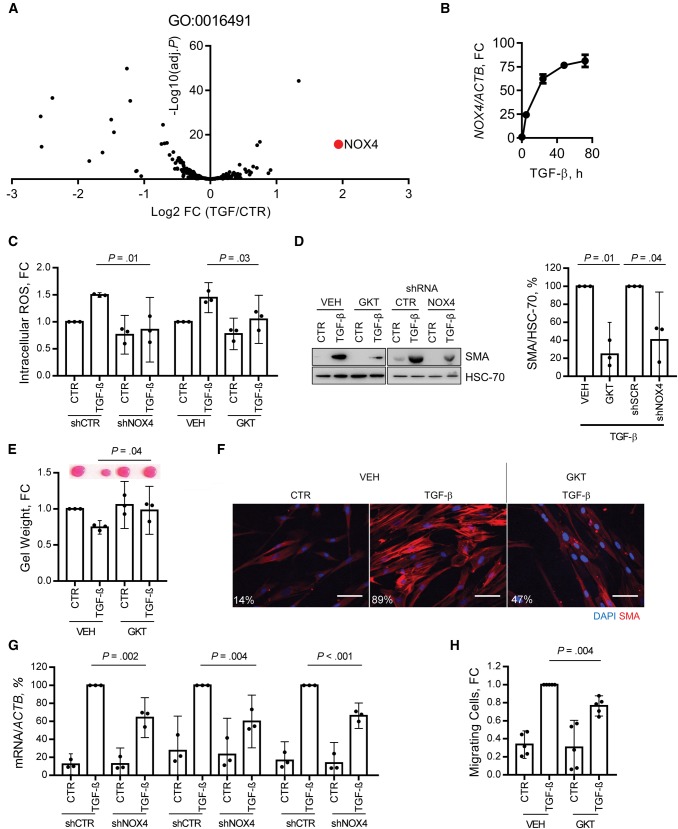
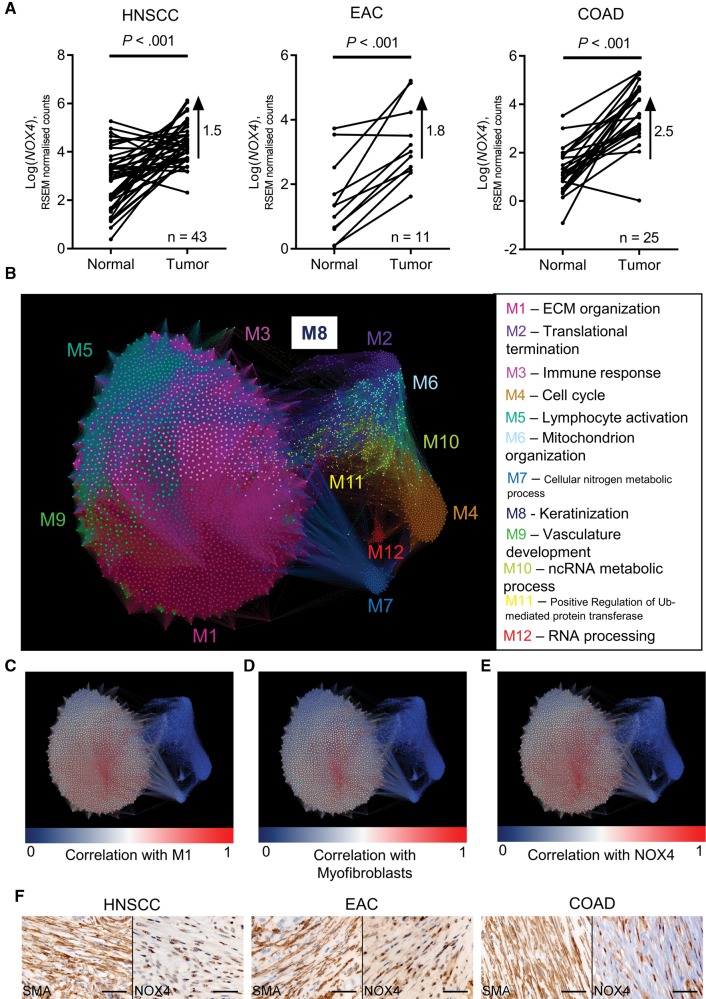
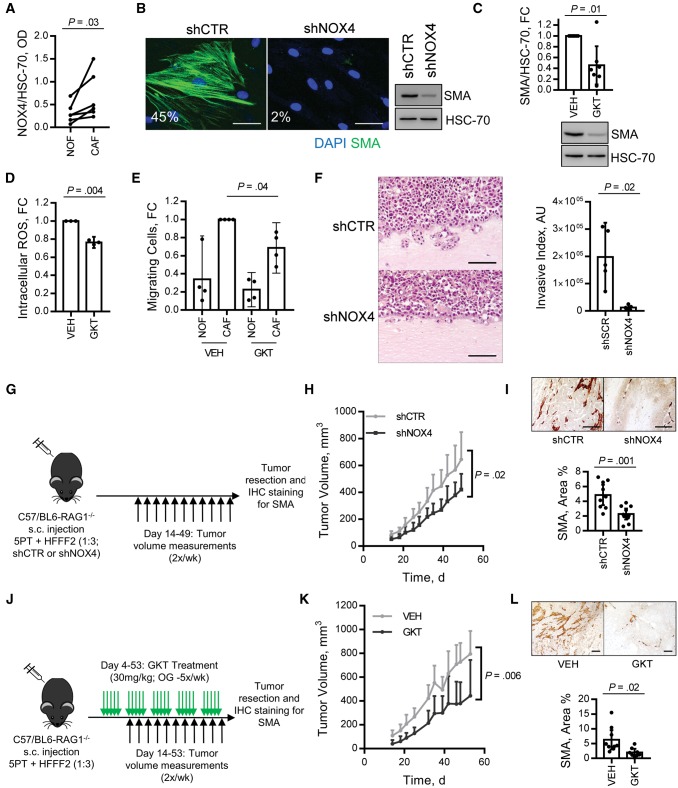
Background: Cancer-associated fibroblasts (CAFs) are tumor-promoting and correlate with poor survival in many cancers, which has led to their emergence as potential therapeutic targets. However, effective methods to manipulate these cells clinically have yet to be developed. Methods: CAF accumulation and prognostic significance in head and neck cancer (oral, n = 260; oropharyngeal, n = 271), and colorectal cancer (n = 56) was analyzed using immunohistochemistry. Mechanisms regulating fibroblast-to-myofibroblast transdifferentiation were investigated in vitro using RNA interference/pharmacological inhibitors followed by polymerase chain reaction (PCR), immunoblotting, immunofluorescence, and functional assays. RNA sequencing/bioinformatics and immunohistochemistry were used to analyze NAD(P)H Oxidase-4 (NOX4) expression in different human tumors. NOX4's role in CAF-mediated tumor progression was assessed in vitro, using CAFs from multiple tissues in Transwell and organotypic culture assays, and in vivo, using xenograft (n = 9-15 per group) and isograft (n = 6 per group) tumor models. All statistical tests were two-sided. Results: Patients with moderate/high levels of myofibroblastic-CAF had a statistically significant decrease in cancer-specific survival rates in each cancer type analyzed (hazard ratios [HRs] = 1.69-7.25, 95% confidence intervals [CIs] = 1.11 to 31.30, log-rank P ≤ .01). Fibroblast-to-myofibroblast transdifferentiation was dependent on a delayed phase of intracellular reactive oxygen species, generated by NOX4, across different anatomical sites and differentiation stimuli. A statistically significant upregulation of NOX4 expression was found in multiple human cancers (P < .001), strongly correlating with myofibroblastic-CAFs (r = 0.65-0.91, adjusted P < .001). Genetic/pharmacological inhibition of NOX4 was found to revert the myofibroblastic-CAF phenotype ex vivo (54.3% decrease in α-smooth muscle actin [α-SMA], 95% CI = 10.6% to 80.9%, P = .009), prevent myofibroblastic-CAF accumulation in vivo (53.2%-79.0% decrease in α-SMA across different models, P ≤ .02) and slow tumor growth (30.6%-64.0% decrease across different models, P ≤ .04). Conclusions: These data suggest that pharmacological inhibition of NOX4 may have broad applicability for stromal targeting across cancer types.
Overview
The claims and statistics of this paper haven’t been checked yet.
Free: it reads the open-access text and checks the first 5 claims that cite a source we can check. Create a free account to check every claim.
Integrity signals
Registry
Cites
Statistics
Figures
Verification
Claims the paper makes
The claims and statistics of this paper haven’t been checked yet.
Free: it reads the open-access text and checks the first 5 claims that cite a source we can check. Create a free account to check every claim.
Claims other papers make about this one
Each is checked against this paper’s own text: does it say what the citing paper says it does?
The cited source says what the claim attributes to it.
In the citing paper
“NOX4 expression is closely related to CAF accumulation in myofibroblasts in patients with CRC, which may be attributed to the fact that NOX4 regulates the transdifferentiation from fibroblasts to myofibroblasts through the delayed period of intracellular ROS production, and the inhibition of NOX4 can effectively reduce the accumulation of CAF [53].”
From Drug Resistance in Colorectal Cancer: From Mechanism to Clinic (2022) · cites this paper as [53]
Self-check
Percentages, sums and reported differences re-computed from the paper’s own numbers.
The self-check needs the paper’s full text.
Citations
Cites
Hallmarks of Cancer: The Next Generation
Hanahan, D., & Weinberg, R. A. (2011) · Cell · doi:10.1016/j.cell.2011.02.013 · Cited by 66,590 · cited 2×
“Over recent years, research has highlighted the contribution of the microenvironment to tumor progression (1), and numerous studies have documented the tumor-promoting role of cancerassociated fibroblasts (CAFs) (2–5).”
BackgroundWGCNA: an R package for weighted correlation network analysis
Langfelder, P., & Horvath, S. (2008) · BMC Bioinformatics · doi:10.1186/1471-2105-9-559 · Cited by 27,252
Increased Survival in Pancreatic Cancer with nab-Paclitaxel plus Gemcitabine
Von Hoff, D. D., Ervin, T., Arena, F. P., Chiorean, E. G., Infante, J., Moore, M., Seay, T., Tjulandin, S. A., Ma, W. W., Saleh, M. N., et al. (2013) · New England Journal of Medicine · doi:10.1056/nejmoa1304369 · Cited by 6,712
Dissecting the multicellular ecosystem of metastatic melanoma by single-cell RNA-seq
Tirosh, I., Izar, B., Prakadan, S. M., Wadsworth, M. H., Treacy, D., Trombetta, J. J., Rotem, A., Rodman, C., Lian, C., Murphy, G., et al. (2016) · Science · doi:10.1126/science.aad0501 · Cited by 4,944 · cited 1×
“(29) using single-cell RNA sequencing (FAP, THY1, DCN, COL1A1/2, and COL6A1/2/3; NOX4 correlation meta values 1⁄4 25.”
MethodOrimo, A., Gupta, P. B., Sgroi, D. C., Arenzana-Seisdedos, F., Delaunay, T., Naeem, R., Carey, V. J., Richardson, A. L., & Weinberg, R. A. (2005) · Cell · doi:10.1016/j.cell.2005.02.034 · Cited by 3,759
Olive, K. P., Jacobetz, M. A., Davidson, C. J., Gopinathan, A., McIntyre, D., Honess, D., Madhu, B., Goldgraben, M. A., Caldwell, M. E., Allard, D., et al. (2009) · Science · doi:10.1126/science.1171362 · Cited by 3,170
Özdemir, B. C., Pentcheva-Hoang, T., Carstens, J. L., Zheng, X., Wu, C.-C., Simpson, T. R., Laklai, H., Sugimoto, H., Kahlert, C., Novitskiy, S. V., et al. (2014) · Cancer Cell · doi:10.1016/j.ccr.2014.04.005 · Cited by 2,681
Desmoulière, A., Geinoz, A., Gabbiani, F., & Gabbiani, G. (1993) · The Journal of cell biology · doi:10.1083/jcb.122.1.103 · Cited by 2,243
Feig, C., Jones, J. O., Kraman, M., Wells, R. J. B., Deonarine, A., Chan, D. S., Connell, C. M., Roberts, E. W., Zhao, Q., Caballero, O. L., et al. (2013) · Proceedings of the National Academy of Sciences · doi:10.1073/pnas.1320318110 · Cited by 2,100 · cited 1×
“Given the previously described roles for CAFs in promoting resistance to chemotherapy (64,65) and adaptive antitumor immunity (4,66), stromal depletion through NOX4 inhibition may be a useful adjunct to improve response to current chemoand immunotherapeutics in patients with a-SMA-positive CAFrich tumors.”
BackgroundStromal Elements Act to Restrain, Rather Than Support, Pancreatic Ductal Adenocarcinoma
Rhim, A. D., Oberstein, P. E., Thomas, D. H., Mirek, E. T., Palermo, C. F., Sastra, S. A., Dekleva, E. N., Saunders, T., Becerra, C. P., Tattersall, I. W., et al. (2014) · Cancer Cell · doi:10.1016/j.ccr.2014.04.021 · Cited by 2,085
Cited by
Signaling pathways in cancer-associated fibroblasts and targeted therapy for cancer
Wu, F., Yang, J., Liu, J., Wang, Y., Mu, J., Zeng, Q., Deng, S., & Zhou, H. (2021) · Signal Transduction and Targeted Therapy · doi:10.1038/s41392-021-00641-0 · Cited by 773
Targeting ROS in cancer: rationale and strategies
Glorieux, C., Liu, S., Trachootham, D., & Huang, P. (2024) · Nature Reviews Drug Discovery · doi:10.1038/s41573-024-00979-4 · Cited by 651
Navigating CAR-T cells through the solid-tumour microenvironment
Hou, A. J., Chen, L. C., & Chen, Y. Y. (2021) · Nature Reviews Drug Discovery · doi:10.1038/s41573-021-00189-2 · Cited by 551
Fibroblasts in cancer: Unity in heterogeneity
Chhabra, Y., & Weeraratna, A. T. (2023) · Cell · doi:10.1016/j.cell.2023.03.016 · Cited by 474
Ford, K., Hanley, C. J., Mellone, M., Szyndralewiez, C., Heitz, F., Wiesel, P., Wood, O., Machado, M., Lopez, M.-A., Ganesan, A.-P., et al. (2020) · Cancer Research · doi:10.1158/0008-5472.can-19-3158 · Cited by 411
“A significant proportion of most solid cancers are CAF-rich (including metastasis); for example, over 50% of cases of head and neck, esophageal, colorectal, and pancreatic cancers are dominated by the presence of CAFs, and these are associated with poor prognosis (21).”
BackgroundInfluentialSelf-citationPan-cancer deconvolution of tumour composition using DNA methylation
Chakravarthy, A., Furness, A., Joshi, K., Ghorani, E., Ford, K., Ward, M. J., King, E. V., Lechner, M., Marafioti, T., Quezada, S. A., et al. (2018) · Nature Communications · doi:10.1038/s41467-018-05570-1 · Cited by 327
Self-citationCancer-associated fibroblasts: overview, progress, challenges, and directions
Ping, Q., Yan, R., Cheng, X., Wang, W., Zhong, Y., Hou, Z., Shi, Y., Wang, C., & Li, R. (2021) · Cancer Gene Therapy · doi:10.1038/s41417-021-00318-4 · Cited by 285
Kundu, M., Butti, R., Panda, V. K., Malhotra, D., Das, S., Mitra, T., Kapse, P., Gosavi, S. W., & Kundu, G. C. (2024) · Molecular Cancer · doi:10.1186/s12943-024-01990-4 · Cited by 250
“GKT137831 is a NOX4/1 inhibitor reported to repress CAF-mediated immune tolerance [275, 276].”
BackgroundMhaidly, R., & Mechta‐Grigoriou, F. (2021) · Immunological Reviews · doi:10.1111/imr.12978 · Cited by 231
Reactive oxygen species and cancer: A complex interaction
Saikolappan, S., Kumar, B., Shishodia, G., Koul, S., & Koul, H. K. (2019) · Cancer Letters · doi:10.1016/j.canlet.2019.03.020 · Cited by 247
Cancer associated fibroblasts in cancer development and therapy
Jia, H., Chen, X., Zhang, L., & Chen, M. (2025) · Journal of Hematology & Oncology · doi:10.1186/s13045-025-01688-0 · Cited by 224
The Immune Subtypes and Landscape of Squamous Cell Carcinoma
Li, B., Cui, Y., Nambiar, D. K., Sunwoo, J. B., & Li, R. (2019) · Clinical Cancer Research · doi:10.1158/1078-0432.ccr-18-4085 · Cited by 197
“For the remaining patients in subtypes 1, 2, and 5, 340 depending on their specific immune and stromal microenvironment, macrophage (44) or NK cell 341 targeted (45,46) therapies, CAF-targeted therapy (47), anti-TGF-β (48) or anti-angiogenic (49) 342 therapies might be used together with ICB to revert the ineffective…”
BackgroundEbbing, E. A., van der Zalm, A. P., Steins, A., Creemers, A., Hermsen, S., Rentenaar, R., Klein, M., Waasdorp, C., Hooijer, G. K. J., Meijer, S. L., et al. (2019) · Proceedings of the National Academy of Sciences · doi:10.1073/pnas.1820459116 · Cited by 182
“This could also be of use for specific stroma-targeting strategies, including the direct targeting of CAFs (52).”
BackgroundHu, J., Chen, Z., Bao, L., Zhou, L., Hou, Y., Liu, L., Xiong, M., Zhang, Y., Wang, B., Tao, Z., et al. (2020) · Molecular Therapy · doi:10.1016/j.ymthe.2020.04.023 · Cited by 179
Song, J., He, G.-N., & Dai, L. (2023) · Biomedicine & Pharmacotherapy · doi:10.1016/j.biopha.2023.114705 · Cited by 162
Wang, D., Wang, X., Song, Y., Si, M., Sun, Y., Liu, X., Cui, S., Qu, X., & Yu, X. (2022) · Cell Death & Disease · doi:10.1038/s41419-022-04825-6 · Cited by 158
“CAFs are abundant fibroblasts that acquire α-smooth muscle actin (α-SMA)-positive, activated myofibroblast phenotype [4].”
BackgroundDrug Resistance in Colorectal Cancer: From Mechanism to Clinic
Wang, Q., Shen, X., Chen, G., & Du, J. (2022) · Cancers · doi:10.3390/cancers14122928 · Cited by 160
Genomics and emerging biomarkers for immunotherapy of colorectal cancer
Kather, J. N., Halama, N., & Jaeger, D. (2018) · Seminars in Cancer Biology · doi:10.1016/j.semcancer.2018.02.010 · Cited by 150
“(92, 93) They orchestrate a broad panel of other cells and thereby push the tumor ecosystem towards malignant initiation and progression of the disease.”
BackgroundThe Tumor Microenvironment in Tumorigenesis and Therapy Resistance Revisited
Dzobo, K., Senthebane, D. A., & Dandara, C. (2023) · Cancers · doi:10.3390/cancers15020376 · Cited by 146
“Initially, fibroblasts are anti-tumorigenic as they are involved in the synthesis of the ECM, which surrounds and isolates tumor cells from normal tissue during the early stages of tumorigenesis [5,6,22].”
BackgroundThe remodelling of actin composition as a hallmark of cancer
Suresh, R., & Diaz, R. J. (2021) · Translational Oncology · doi:10.1016/j.tranon.2021.101051 · Cited by 160
Cancer-associated fibroblasts: The chief architect in the tumor microenvironment
Sarkar, M., Nguyen, T., Gundre, E., Ogunlusi, O., El-Sobky, M. H., Giri, B., & Sarkar, T. R. (2023) · Frontiers in Cell and Developmental Biology · doi:10.3389/fcell.2023.1089068 · Cited by 166
“This illustration includes CAF-targeting approaches, including suppression of CAF transition from inactive to active states (Hanley et al., 2017); CAF reprogramming by targeting Vitamin A&D receptors to revert to the quiescent state (Sherman et al.”
BackgroundXi, L., Peng, M., Liu, S., Liu, Y., Wan, X., Hou, Y., Qin, Y., Yang, L., Chen, S.-C., Zeng, H., et al. (2021) · Journal of Extracellular Vesicles · doi:10.1002/jev2.12146 · Cited by 133
“, 2013) (data not shown) and the CAFs expressed the well-established biomarker alpha-SMA (α-SMA) (Hanley et al., 2018) (Figure 1a).”
BackgroundGuo, T., & Xu, J. (2024) · Cancer and Metastasis Reviews · doi:10.1007/s10555-024-10186-7 · Cited by 159
“In the realm of CAF-targeted cancer therapy, NOX4 inhibition has emerged as a promising strategy, given its demonstrated efficacy in reversing the myCAF phenotype and facilitating intratumoral CD8 + T-cell infiltration in mouse models [179, 180].”
BackgroundHanley, C. J., Waise, S., Ellis, M. J., Lopez, M. A., Pun, W. Y., Taylor, J., Parker, R., Kimbley, L., Chee, S., Shaw, E. C., et al. (2023) · Nature Communications · doi:10.1038/s41467-023-35832-6 · Cited by 155
Self-citationParascandolo, A., & Laukkanen, M. O. (2019) · Antioxidants & Redox Signaling · doi:10.1089/ars.2017.7268 · Cited by 116
“As reported previously, upregulation of the NADPH oxidase NOX4 contributes to myofibroblast activation and has a statistically significant correlation to patient survival (119).”
BackgroundCancer‐associated fibroblasts: Secretions, interactions, and therapy
Farhood, B., Najafi, M., & Mortezaee, K. (2019) · Journal of Cellular Biochemistry · doi:10.1002/jcb.27703 · Cited by 112
“NOX4 can also do such work independent on sustained canonical TGF‐β signaling.(14) Epigenetic alteration is also an important player for shaping the cells into CAFs.”
BackgroundTumor microenvironment in head and neck squamous cell carcinoma: Functions and regulatory mechanisms
Wang, G., Zhang, M., Cheng, M., Wang, X., Li, K., Chen, J., Chen, Z., Chen, S., Chen, J., Xiong, G., et al. (2021) · Cancer Letters · doi:10.1016/j.canlet.2021.03.009 · Cited by 123
Nguyen, E. V., Pereira, B. A., Lawrence, M. G., Ma, X., Rebello, R. J., Chan, H., Niranjan, B., Wu, Y., Ellem, S., Guan, X., et al. (2019) · Molecular & Cellular Proteomics · doi:10.1074/mcp.ra119.001496 · Cited by 107
“CAF-derived ECM plays a critical role in promoting cancer dissemination (57) and represents an emerging therapeutic target in solid tumors (58).”
BackgroundZhou, X., Ni, Y., Liang, X., Lin, Y., An, B., He, X., & Zhao, X. (2022) · Frontiers in Immunology · doi:10.3389/fimmu.2022.915094 · Cited by 145
Mao, X., Tey, S. K., Yeung, C. L. S., Kwong, E. M. L., Fung, Y. M. E., Chung, C. Y., Mak, L., Wong, D. K.-H., Yuen, M., Ho, J., et al. (2020) · Advanced Science · doi:10.1002/advs.202002157 · Cited by 109
Freeman, P., & Mielgo, A. (2020) · Cancers · doi:10.3390/cancers12092687 · Cited by 102
“Similarly, a recent study revealed that the pharmacological blockade of NOX4, a ROS-producing enzyme with established roles in CAF activation [99], sensitised murine models of lung, breast and colorectal cancer to both anticancer vaccination and anti-PD-1 checkpoint inhibition through enhanced CD8+ T cell infiltration…”
Backgroundden Bossche, V. V., Zaryouh, H., Vara-Messler, M., Vignau, J., Machiels, J., Wouters, A., Schmitz, S., & Corbet, C. (2022) · Drug Resistance Updates · doi:10.1016/j.drup.2022.100806 · Cited by 119
The Role of Cancer-Associated Fibroblasts and Extracellular Vesicles in Tumorigenesis
Shoucair, I., Mello, F. W., Jabalee, J., Maleki, S., & Garnis, C. (2020) · International Journal of Molecular Sciences · doi:10.3390/ijms21186837 · Cited by 97
H2O2 Metabolism in Normal Thyroid Cells and in Thyroid Tumorigenesis: Focus on NADPH Oxidases
Szántó, I., Pusztaszeri, M. P., & Mavromati, M. (2019) · Antioxidants · doi:10.3390/antiox8050126 · Cited by 106
“In this respect, diverse cell type-specific intracellular signaling pathways related to the carcinogenic effect of NOX4-derived ROS have been identified [110,111].”
BackgroundCancer-associated fibroblasts in colorectal cancer
Zonouzi, S. K., Pezeshki, P. S., Razi, S., & Rezaei, N. (2021) · Clinical & Translational Oncology · doi:10.1007/s12094-021-02734-2 · Cited by 93
Chen, B., Liu, X., Yu, P., Xie, F., Kwan, J. S. H., Chan, W. N., Fang, C., Zhang, J., Cheung, A. H. K., Chow, C., et al. (2023) · Clinical and Translational Medicine · doi:10.1002/ctm2.1481 · Cited by 103
Cancer-associated fibroblasts in non-small cell lung cancer: Recent advances and future perspectives
Zhang, H., Jiang, H., Zhu, L., Li, J., & Ma, S. (2021) · Cancer Letters · doi:10.1016/j.canlet.2021.05.009 · Cited by 94
Nilendu, P., Sarode, S. C., Jahagirdar, D., Tandon, I., Patil, S. V., Sarode, G. S., Pal, J. K., & Sharma, N. K. (2018) · Cellular Oncology · doi:10.1007/s13402-018-0388-2 · Cited by 85
Chen, B., Song, Y., Zhan, Y., Zhou, S., Ke, J., Ao, W., Zhang, Y., Liang, Q., He, M., Li, S., et al. (2022) · Cancer Letters · doi:10.1016/j.canlet.2022.215783 · Cited by 89
Wang, H., Chen, Y., Wei, R., Zhang, J., Zhu, J., Wang, W., Wang, Z., Wupur, Z., Li, Y., & Meng, H. (2023) · Advanced Materials · doi:10.1002/adma.202309591 · Cited by 98
Farhood, B., Najafi, M., Salehi, E., Goradel, N. H., Nashtaei, M. S., Khanlarkhani, N., & Mortezaee, K. (2018) · Journal of Cellular Biochemistry · doi:10.1002/jcb.27594 · Cited by 73
“NOX4 has been attested to play roles for transdifferentiation of fibroblasts into their activated CAF phenotypes.(27) 72 | FARHOOD ET AL.”
BackgroundCancer-associated fibroblasts, tumor and radiotherapy: interactions in the tumor micro-environment
Raaijmakers, K., Adema, G. J., Bussink, J., & Ansems, M. (2024) · Journal of Experimental & Clinical Cancer Research · doi:10.1186/s13046-024-03251-0 · Cited by 88
Liu, W., Wang, L., Zhou, F.-M., Liu, S., Wang, W., Zhao, E., Yao, Q.-J., Li, W., Zhao, Y., Shi, Z., et al. (2023) · Drug Resistance Updates · doi:10.1016/j.drup.2023.100987 · Cited by 78
Waise, S., Parker, R., Rose-Zerilli, M. J. J., Layfield, D. M., Wood, O., West, J., Ottensmeier, C. H., Thomas, G. J., & Hanley, C. J. (2019) · Scientific Reports · doi:10.1038/s41598-019-45842-4 · Cited by 70
Self-citationBienkowska, K., Hanley, C. J., & Thomas, G. J. (2021) · Frontiers in Oral Health · doi:10.3389/froh.2021.686337 · Cited by 77
“[22] identified NOX4 as a critical regulator of myCAF activation in multiple tumour types, including HNSCC, and found that inhibiting NOX4 using Setanaxib (GKT137831), a drug developed to treat organ fibrosis, suppressed myCAF activation and also “normalized” established myCAF.”
BackgroundSelf-citationTakeda, S., Shigeyasu, K., Okugawa, Y., Yoshida, K., Mori, Y., Yano, S., Noma, K., Umeda, Y., Kondo, Y., Kishimoto, H., et al. (2018) · Cancer Letters · doi:10.1016/j.canlet.2018.12.009 · Cited by 79
Cancer Associated Fibroblasts - An Impediment to Effective Anti-Cancer T Cell Immunity
Koppensteiner, L., Mathieson, L., O’Connor, R. A., & Akram, A. R. (2022) · Frontiers in Immunology · doi:10.3389/fimmu.2022.887380 · Cited by 76
“They previously reported that the downstream target of TGF-b1, NADPH oxidase 4 (NOX4), which generates reactive oxygen species (ROS), can regulate fibroblast differentiation into myofibroblasts (42).”
BackgroundPeng, H., Wu, X., Zhong, R., Tao, Y., Cai, X., Liu, J., Wen, Y., Ao, Y., Chen, J., Li, Y., et al. (2021) · Frontiers in Immunology · doi:10.3389/fimmu.2021.750046 · Cited by 66
“For patients with intracluster heterogeneity, therapeutic selections should depend on the specific TIME and usage of targeting carcinoma-associated fibroblast therapies (52) or anti-angiogenic therapies (53), plus ICB may work.”
BackgroundCancer-Associated Fibroblasts: Accomplices in the Tumor Immune Evasion
Hilmi, M., Nicolle, R., Bousquet, C., & Neuzillet, C. (2020) · Cancers · doi:10.3390/cancers12102969 · Cited by 69
“Moreover, inhibition of NAD(P)H Oxidase-4 (NOX4) was able to revert protumoral CAF subsets such as myofibroblastic [157] and immune-suppressive CAFs [158] in preclinical models making its clinical development promising.”
BackgroundDomen, A., Quatannens, D., Zanivan, S. R., Deben, C., Audenaerde, J. R. M. V., Smits, E., Wouters, A., Lardon, F., Roeyen, G., Verhoeven, Y., et al. (2021) · Cancers · doi:10.3390/cancers13050987 · Cited by 68
“Suppressing alpha-smooth muscle actin (α-SMA) myofibroblastic CAFs—which share the phenotypic traits of fibroblasts and smooth muscle cells, secrete ECM, and generate mechanical tension within tissue through cell contraction [46]—through the inhibition of plasminogen activator inhibitor-1 (PAI-1) limits resistance to…”
BackgroundYu, S., Wang, S., Wang, X., & Xu, X. (2024) · Cancer Cell International · doi:10.1186/s12935-024-03518-8 · Cited by 80
“…LY2157299 [286, 287] Head and neck cancer, lung cancer, breast cancer CAF Ruxolitinib [288] Head and neck cancer, colorectal cancer CAF GKT137831 [289] Gastric cancer CAF AMD3100 [290] Pancreatic cancer CAF Calcipotriol [291] Pancreatic cancer CAF ATRA [292] PDAC CAF Y-27632, Fasudil (HA-1077)…”
BackgroundZhu, L., Zhao, Y., Liu, T., Chen, M., Qian, W. P., Jiang, B., Barwick, B. G., Zhang, L., Styblo, T. M., Li, X., et al. (2022) · ACS Nano · doi:10.1021/acsnano.2c07440 · Cited by 65
Mezawa, Y., & Orimo, A. (2021) · FEBS Journal · doi:10.1111/febs.15851 · Cited by 61
Crosstalk between CAFs and tumour cells in head and neck cancer
Li, X., González-Maroto, C., & Tavassoli, M. (2024) · Cell Death Discovery · doi:10.1038/s41420-024-02053-9 · Cited by 74
Portrait of a CAF: The story of cancer-associated fibroblasts in head and neck cancer
Custódio, M., Biddle, A., & Tavassoli, M. (2020) · Oral Oncology · doi:10.1016/j.oraloncology.2020.104972 · Cited by 68
Hanley, C. J., Henriet, E., Sirka, O. K., Thomas, G. J., & Ewald, A. J. (2020) · Molecular Cancer Research · doi:10.1158/1541-7786.mcr-20-0334 · Cited by 58
“Furthermore, the module contained numerous previously describedCAFmarkers [ACTA2 (19),FAP (20),NOX4 (21), LOX (22)].”
BackgroundSelf-citationPossible Beneficial Effects of N-Acetylcysteine for Treatment of Triple-Negative Breast Cancer
Kwon, Y. (2021) · Antioxidants · doi:10.3390/antiox10020169 · Cited by 65
“In this respect, ROS play fundamental roles in the activation and conversion of fibroblasts into CAFs [141,146,150,151].”
BackgroundMethodInfluentialTargeting cancer-associated fibroblasts: Challenges, opportunities and future directions
Jenkins, B. H., Buckingham, J. F., Hanley, C. J., & Thomas, G. J. (2022) · Pharmacology & Therapeutics · doi:10.1016/j.pharmthera.2022.108231 · Cited by 57
Self-citationT-cell tumour exclusion and immunotherapy resistance: a role for CAF targeting
Hanley, C. J., & Thomas, G. J. (2020) · British Journal of Cancer · doi:10.1038/s41416-020-1020-6 · Cited by 64
Self-citationColocalized targeting of TGF-β and PD-L1 by bintrafusp alfa elicits distinct antitumor responses
Lan, Y., Yeung, T.-L., Huang, H., Wegener, A. A., Saha, S., Toister‐Achituv, M., Jenkins, M. H., Chiu, L.-Y., Lazorchak, A. S., Tarcic, O., et al. (2022) · Journal for ImmunoTherapy of Cancer · doi:10.1136/jitc-2021-004122 · Cited by 57
Irvine, A. F., Waise, S., Green, E. W., Stuart, B. L., & Thomas, G. J. (2021) · Scientific Reports · doi:10.1038/s41598-021-81796-2 · Cited by 55
Self-citationTargeting Head and Neck Cancer by Vaccination
Wang, C., Dickie, J., Sutavani, R. V., Pointer, C., Thomas, G. J., & Savelyeva, N. (2018) · Frontiers in Immunology · doi:10.3389/fimmu.2018.00830 · Cited by 60
“Tumours with this type of stromal response may not be effectively targeted by vaccination; it is possible, however, that such evasion mechanisms could be targeted as part of a vaccination strategy; for example, we have shown recently that CAFs can be specifically targeted by inhibiting the NADPH oxidase, NOX4 (146).”
BackgroundSelf-citationComprehensive review of the resistance mechanisms of colorectal cancer classified by therapy type
Oh, J. M., Kim, S. W., Tsung, C., Kent, E. W., Jain, A., Ruff, S. M., & Zhang, H. (2025) · Frontiers in Immunology · doi:10.3389/fimmu.2025.1571731 · Cited by 56
Masuda, T., Nakashima, T., Namba, M., Yamaguchi, K., Sakamoto, S., Horimasu, Y., Miyamoto, S., Iwamoto, H., Fujitaka, K., Miyata, Y., et al. (2019) · Journal of Cellular and Molecular Medicine · doi:10.1111/jcmm.14205 · Cited by 56
Charytonowicz, D., Brody, R., & Sebra, R. (2023) · Nature Communications · doi:10.1038/s41467-023-36961-8 · Cited by 45
“Changes seen in prostate stromal tissue induced by carcinogenesis are mediated by cancer-activated fi broblasts (CAFs) adopting a myo fi broblast-like phenotype 48 .”
BackgroundTherapeutic Potential of Tumor Metabolic Reprogramming in Triple-Negative Breast Cancer
Munkácsy, G., Santarpia, L., & Győrffy, B. (2023) · International Journal of Molecular Sciences · doi:10.3390/ijms24086945 · Cited by 52
“Potential CAFs linked targets [122] could be included on the inhibition of CAF transition from inactive to active form [123]; the utilization of vitamin D to revert CAFs to an inactive state, as has been shown in colorectal cancer and pancreatic cancer [124,125]; the reduction of CAFs by CAR-T cell therapy [126], canc…”
BackgroundArima, Y., Matsueda, S., & Saya, H. (2023) · Cancers · doi:10.3390/cancers15092536 · Cited by 49
Guo, L., Li, B., Yang, J., Shen, J., Ji, J., & Miao, M. (2020) · International Journal of Molecular Medicine · doi:10.3892/ijmm.2020.4614 · Cited by 46
Dong, R., Guo, J., Zhang, Z., Zhou, Y., & Hua, Y. (2018) · Biochemical and Biophysical Research Communications · doi:10.1016/j.bbrc.2018.02.193 · Cited by 43
Tumor Microenvironment of Esophageal Cancer
Schiffmann, L. M., Plum, P. S., Fuchs, H. F., Babic, B., Bruns, C. J., & Schmidt, T. (2021) · Cancers · doi:10.3390/cancers13184678 · Cited by 46
NADPH Oxidase 4: A Potential Therapeutic Target of Malignancy
Gong, S., Wang, S., & Shao, M. (2022) · Frontiers in Cell and Developmental Biology · doi:10.3389/fcell.2022.884412 · Cited by 43
“Besides, the anti-tumor effect of silver nanoparticles (AgNP) has also been investigated in CRC tumors.”
BackgroundInfluentialHou, W. (2025) · Frontiers in Oncology · doi:10.3389/fonc.2025.1602452 · Cited by 45
“Pharmacological inhibition of NOX4 using GKT137831, an oral drug developed as an anti-fi brotic agent, abrogated TGF b -dependent ROS production, myo fi broblast transdifferentiation, and slow tumor growth (70).”
Manousopoulou, A., Hayden, A. L., Mellone, M., Garay‐Baquero, D. J., White, C., Noble, F., López, M. E. P., Thomas, G. J., Underwood, T., & Garbis, S. D. (2018) · British Journal of Cancer · doi:10.1038/s41416-018-0042-9 · Cited by 38
“This may necessitate the combined use of immunotherapy and CAF permeability modifiers.(53) At the same token, CAFs have been reported to promote angiogenesis through different mechanisms, including ECM remodelling, recruitment of epithelial progenitor cells, and increased leucocyte infiltration through chemokine secre…”
MethodSelf-citationMir, S. U. R., Ormsbee, B. D., Griess, B., Vengoji, R., Tom, E. C., Kosmacek, E. A., Oberley‐Deegan, R. E., Talmon, G. A., Band, V., & Teoh-Fitzgerald, M. L. T. (2022) · Breast Cancer Research · doi:10.1186/s13058-022-01548-6 · Cited by 50
“Hanley et al. [32] have suggested Nox4 as a potentially promising CAF target based on Nox4 and αSMA IHC staining in stromal regions of human samples (head and neck squamous cell carcinoma, esophageal adenocarcinoma, and colon adenocarcinoma), as well as in vivo findings using TGFβ-activated skin…”
ResultHuang, J., Tsang, W. Y., Li, Z., & Guan, X. (2023) · Cellular and Molecular Gastroenterology and Hepatology · doi:10.1016/j.jcmgh.2023.07.001 · Cited by 44
“Moreover, NADPH oxidase 4 (NOX4) has been implicated in the CAF differentiation in colorectal cancer.(29) Conceivably, the process of CAF differentiation is a potentially attractive therapeutic target in the future.”
BackgroundHu, J., Lazar, A. J., Ingram, D. R., Wang, W., Zhang, W., Jia, Z., Ragoonanan, D. S., Wang, J., Xia, X., Mahadeo, K. M., et al. (2024) · Journal for ImmunoTherapy of Cancer · doi:10.1136/jitc-2023-006991 · Cited by 43
“15 16 In contrast to the success of immunotherapy in treating blood cancers, the use of immunotherapy to treat solid tumors has encountered several obstacles.”
BackgroundOral cancer‐associated fibroblasts predict poor survival: Systematic review and meta‐analysis
Graizel, D., Zlotogorski‐Hurvitz, A., Tsesis, I., Rosen, E., Kedem, R., & Vered, M. (2019) · Oral Diseases · doi:10.1111/odi.13140 · Cited by 40
Mellone, M., Piotrowska, K., Venturi, G., James, L., Bzura, A., Lopez, M. A., James, S., Wang, C., Ellis, M. J., Hanley, C. J., et al. (2022) · Cancer Research · doi:10.1158/0008-5472.can-22-0435 · Cited by 39
“The remainder was performed as previously described (28).”
BackgroundMethodSelf-citationBa, P., Xu, M., Yu, M., Li, L., Duan, X., Lv, S., Fu, G., Yang, J., Yang, P., Yang, C., et al. (2020) · Oral Diseases · doi:10.1111/odi.13306 · Cited by 39
Cancer-associated fibroblasts: Mediators of head and neck tumor microenvironment remodeling
Raudenská, M., Balvan, J., Hánělová, K., Bugajová, M., & Masařík, M. (2023) · Biochimica et Biophysica Acta (BBA) - Reviews on Cancer · doi:10.1016/j.bbcan.2023.188940 · Cited by 42
Chen, C., Hou, J., Yu, S., Li, W., Wang, X., Sun, H., Qin, T., Claret, F. X., Guo, H., & Liu, Z. (2021) · Oncology Letters · doi:10.3892/ol.2021.12674 · Cited by 40
“the occurrence of NSCLC drug resistance (111).”
Malchiodi, Z. X., & Weiner, L. M. (2021) · Cancers · doi:10.3390/cancers13030405 · Cited by 37
“Patients with lower expression of αSMA within the TME of solid tumors, such as in PDAC, HNSCC, and CRC [63,64], tend to have worse prognosis, further supporting the interpretation that αSMA+ CAFs restrict tumor growth.”
BackgroundHanley, C. J., & Thomas, G. J. (2021) · Oncotarget · doi:10.18632/oncotarget.27936 · Cited by 35
“In contrast to TGF-β receptor inhibition, which was highly effective at preventing TGF-β mediated activation but not capable of reverting an established myofibroblast phenotype [1, 13].”
BackgroundSelf-citationCancer‐associated fibroblasts: Is it a key to an intricate lock of tumorigenesis?
Aden, D., Zaheer, S., Ahluwalia, H., & Ranga, S. (2023) · Cell Biology International · doi:10.1002/cbin.12004 · Cited by 33
Long non-coding RNAs within the tumour microenvironment and their role in tumour-stroma cross-talk
Vecchio, F. D., Lee, G. H., Hawezi, J., Bhome, R., Pugh, S. A., Sayan, E., Thomas, G. J., Packham, G. K., Primrose, J. M., Pichler, M., et al. (2018) · Cancer Letters · doi:10.1016/j.canlet.2018.02.022 · Cited by 38
Self-citationGeng, Y., Feng, J. X., Huang, H., Wang, Y., Yi, X., Wei, S., Zhang, M., Li, Z., Wang, W., & Hu, W. (2022) · Annals of Translational Medicine · doi:10.21037/atm-22-5270 · Cited by 33
“Recently, in addition to immunotherapeutic strategies targeting PD-1/PD-1 ligand (PD-L1) or cytotoxic T-lymphocyte-associated protein 4 (CTLA-4), TAMs and cancer-associated fibroblasts (CAFs) have also been found to be therapeutic targets (19,20).”
NOX4, a new genetic target for anti‐cancer therapy in digestive system cancer
Tang, C., Gao, Y. J., & Ge, Z. Z. (2018) · Journal of Digestive Diseases · doi:10.1111/1751-2980.12651 · Cited by 35
Pizurica, M., Larmuseau, M., der Eecken, K. V., van Brienen, L. D. S., Carrillo‐Pérez, F., Isphording, S., Lumen, N., Dorpe, J. V., Ost, P., Verbeke, S., et al. (2023) · Cancer Research · doi:10.1158/0008-5472.can-22-3113 · Cited by 34
“Speci fi cally, NOX4 was associated with fi broblast to myo fi broblast differentiation (49, 50) and was shown to be critical for maintaining immune-suppressive CAF phenotype in tumors (50).”
Bête Noire of Chemotherapy and Targeted Therapy: CAF-Mediated Resistance
De, P. K., Aske, J. C., Sulaiman, R. A., & Dey, N. (2022) · Cancers · doi:10.3390/cancers14061519 · Cited by 34
“CAFs are responsible for metabolic reprogramming in the TME, involving ROS in certain solid tumors [123,158].”
BackgroundShi, K., Li, Y., Yang, L., Zhang, Z., Guo, D., Zhang, J., & Lu, Y. (2022) · The FASEB Journal · doi:10.1096/fj.202200898r · Cited by 38
Thiery, J. (2022) · Exploration of Targeted Anti-tumor Therapy · doi:10.37349/etat.2022.00103 · Cited by 33
“For example, pharmacological inhibition of nicotinamide adenine dinucleotide phosphate oxidase 4 (NOX4) using GKT137831, a small organic molecule of the pyrazolopyridine dione chemical class, prevents and reverses ROS-dependent myofibroblast activation [263].”
BackgroundReactive Oxygen Species in Acute Lymphoblastic Leukaemia: Reducing Radicals to Refine Responses
Mannan, A., Germon, Z. P., Chamberlain, J., Sillar, J. R., Nixon, B., & Dun, M. D. (2021) · Antioxidants · doi:10.3390/antiox10101616 · Cited by 31
“Genetic or pharmacological (GKT137831) inhibition of NOX4 reduced cancer associated fibroblasts growth and survival [243] and metastasis of non–small cell lung cancer cells in vivo and in vitro [266], and potentiated sensitivity to immunotherapy in murine lung cancer models [265].”
BackgroundAhuja, S., Sureka, N., & Zaheer, S. (2024) · Apmis · doi:10.1111/apm.13447 · Cited by 30
“TGF b is responsible for CAF differentiation through NOX-4 activation and ROS generation (67).”
Sharpe, B. P., Hayden, A. L., Manousopoulou, A., Cowie, A., Walker, R., Harrington, J., Izadi, F., Breininger, S. P., Gibson, J., Pickering, O. J., et al. (2022) · Cell Reports Medicine · doi:10.1016/j.xcrm.2022.100541 · Cited by 31
“This activated,myofibroblastic state in cancer is believed to be driven by cancer cell signaling and can be recapitulated by treating normal fibroblasts with TGF-b1 in vitro.(38) Importantly, when one is considering any future clinical application of PDE5i in cancer treatment, it would be vital to demonstrate that not…”
Self-citationLi, C., Qiu, Y., & Zhang, Y. (2022) · Pharmaceuticals · doi:10.3390/ph15111411 · Cited by 27
Zhou, J., Schwenk‐Zieger, S., Kranz, G., Walz, C., Klauschen, F., Dhawan, S., Canis, M., Gires, O., Haubner, F., Baumeister, P., et al. (2022) · Frontiers in Oncology · doi:10.3389/fonc.2022.984138 · Cited by 26
“This indicates that the disease-specific mortality of patients is correlated with CAFs harboring various amounts of a-SMA expression (44) The analysis of a-SMA in HNSCC-derived PtFs and CAFs in our study did not disclose any significant differences across all patients on average, but two patients showed higher a-SMA e…”
ResultTargeted Therapy for Cancer-Associated Fibroblasts: Are We There Yet?
Barnett, R. M., & Vilar, E. (2017) · JNCI Journal of the National Cancer Institute · doi:10.1093/jnci/djx131 · Cited by 24
Engineering Multidimensional Evolutionary Forces to Combat Cancer
McCoach, C. E., & Bivona, T. G. (2019) · Cancer Discovery · doi:10.1158/2159-8290.cd-18-1196 · Cited by 25
Single‐cell advances in stromal‐leukocyte interactions in cancer
Wu, S. Z., & Swarbrick, A. (2021) · Immunological Reviews · doi:10.1111/imr.12976 · Cited by 22
Chen, W., Cao, H., Cao, J., Zuo, L., Qu, F., Xu, D., Zhang, H., Gong, H., Chen, J., Ye, J., et al. (2022) · Cell Death and Disease · doi:10.1038/s41419-022-04501-9 · Cited by 28
“exhaustion, immune checkpoints, tumor-associated macrophages (TAMs) [13] and cancer-associated fibroblasts (CAFs) [14] are critical therapeutic targets.”
Background
Metadata
- Authors
- Hanley, C. J., Mellone, M., Ford, K., Thirdborough, S. M., Mellows, T., Frampton, S. J., Smith, D. M., Harden, E., Szyndralewiez, C., Bullock, M., Noble, F., Moutasim, K. A., King, E. V., Vijayanand, P., Mirnezami, A. H., Underwood, T. J., Ottensmeier, C. H., & Thomas, G. J.
- Affiliations
- University of Southampton (GB)
- Genkyotex SA, Plan-les-Ouates, Switzerland
- La Jolla Institute for Immunology (US)
- Cancer Sciences Unit, University of Southampton Faculty of Medicine, Southampton, UK
- Corresponding author
- Thomas, Gareth J
- ORCID
- Venue
- JNCI: Journal of the National Cancer Institute
- Publisher
- Oxford University Press (OUP)
- Published
- 2017-08-03
- Volume
- 110
- Issue
- 1
- Pages
- 109-120
- ISSN
- 0027-8874 (ISSN-L)
- 1460-2105
- PMC
- PMC5903651
- OpenAlex
- W2739944480
- Cited by
- 195
- References
- 68
- Citations by year
- 2026: 16 · 2025: 14 · 2024: 20 · 2023: 28 · 2022: 31 · 2021: 28 · 2020: 25 · 2019: 15 · 2018: 17 · 2017: 1
- FWCI
- 6.99
- Type
- journal article
- Language
- en
- Open access
- hybrid
- doi.org
- Licence
- Locations
- JNCI Journal of the National Cancer Institute (publishedVersion, cc-by)
- Europe PMC (PubMed Central) (publishedVersion, cc-by)
- PubMed Central (publishedVersion, cc-by)
- PubMed (publishedVersion)
- ePrints Soton (University of Southampton) (acceptedVersion)
- Funders
- Cancer Research UK (C21825/A13315, C115121/A20256)
- National Cancer Institute (C21825/A13315, C115121/A20256)
- Topics
- Health Sciences › Medicine › Oncology › Cancer Cells and Metastasis
- Life Sciences › Biochemistry, Genetics and Molecular Biology › Molecular Biology › TGF-β signaling in diseases
- Health Sciences › Medicine › Oncology › Pancreatic and Hepatic Oncology Research
- Keywords
- cancer-associated fibroblasts, myofibroblastic phenotype, NOX4, fibroblast-to-myofibroblast transdifferentiation, reactive oxygen species, head and neck cancer, oral cancer, oropharyngeal cancer, colorectal cancer, cancer-specific survival, tumor microenvironment, alpha-smooth muscle actin
- MeSH terms
- Cancer-Associated Fibroblasts, NADPH Oxidase 4, Actins, Adenocarcinoma, Adult, Aged, Aged, 80 and over, Animals, Carcinoma, Non-Small-Cell Lung, Carcinoma, Squamous Cell, Cell Count, Esophageal Neoplasms, Female, Head and Neck Neoplasms, Humans, Lung Neoplasms, Male, Middle Aged, Mouth Neoplasms, Neoplasm Transplantation, Oropharyngeal Neoplasms, Phenotype, Pyrazoles, Pyridines, Pyridones, Colorectal Neoplasms, Up-Regulation, Survival Rate, Reactive Oxygen Species, Disease Progression, NADPH Oxidases, RNA Interference, Pyrazolones, Mice, Cell Transdifferentiation, Myofibroblasts
About these checks
Registry, retraction, Cites and statistics results are computed, not judged, with one exception: a printed reference that no index lists is read once by a model before it counts as a citation error. Claims are extracted by a model and kept only when their quote appears verbatim in the text; each cited source is then checked, with a model’s help, for whether it says what the claim relies on. Those verdicts can be wrong — read the claim’s quote and the cited source before relying on one.
Statistics and arithmetic are recomputed, not judged.
Confidence bands are shown only for fields calibrated on our annotated test set. None is calibrated yet, so no band is shown.
What counts as a claim ›How we measure confidence ›How we check this ›
Are you an author, or do you see a problem with this page? Request a review
Data sources
Bibliographic data: Semantic Scholar, OpenAlex, Crossref.
Contains information from the Semantic Scholar Academic Graph Datasets, made available under the ODC Attribution License (ODC-BY 1.0).
Semantic Scholar’s data is described in: Kinney, R., et al. (2023). The Semantic Scholar Open Data Platform. arXiv:2301.10140.
