

Targeting the Myofibroblastic Cancer-Associated Fibroblast Phenotype Through Inhibition of NOX4
Open accessThe DOI matches its Crossref record; 66 of the 68 references it cites were found in a registry or an index.
Abstract
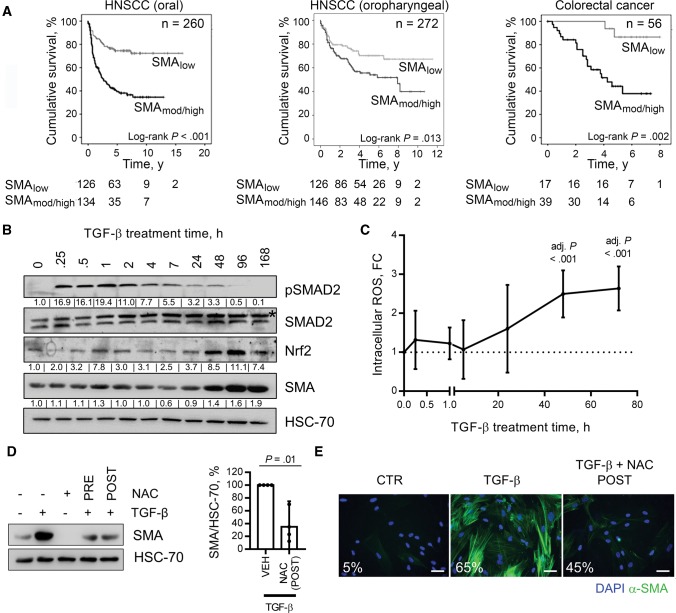
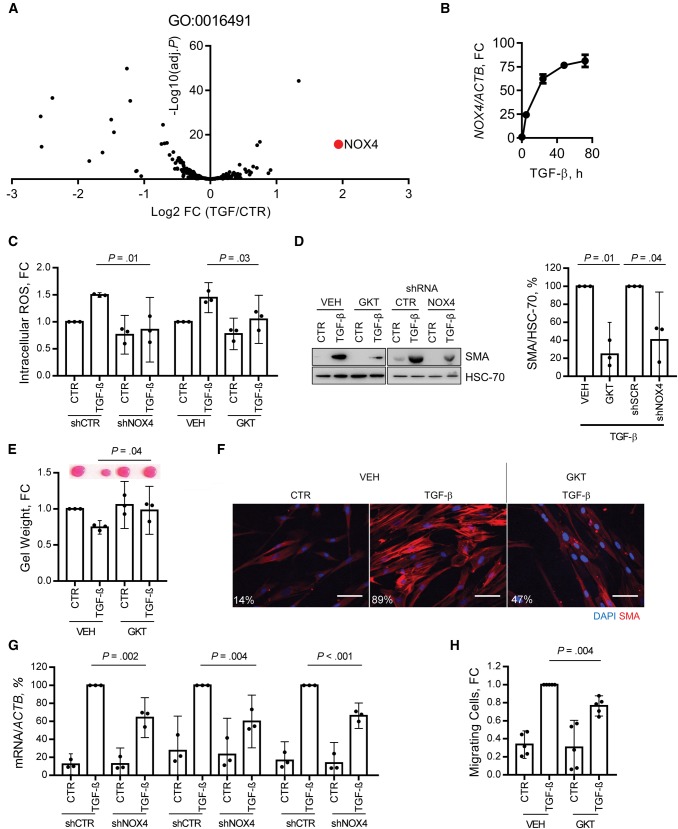
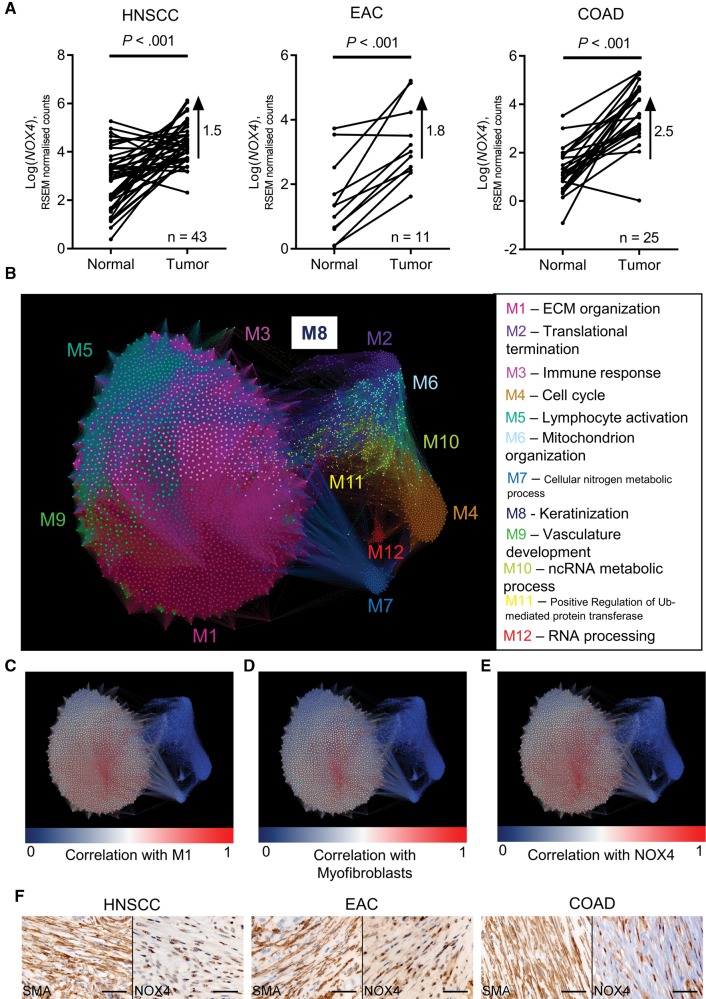
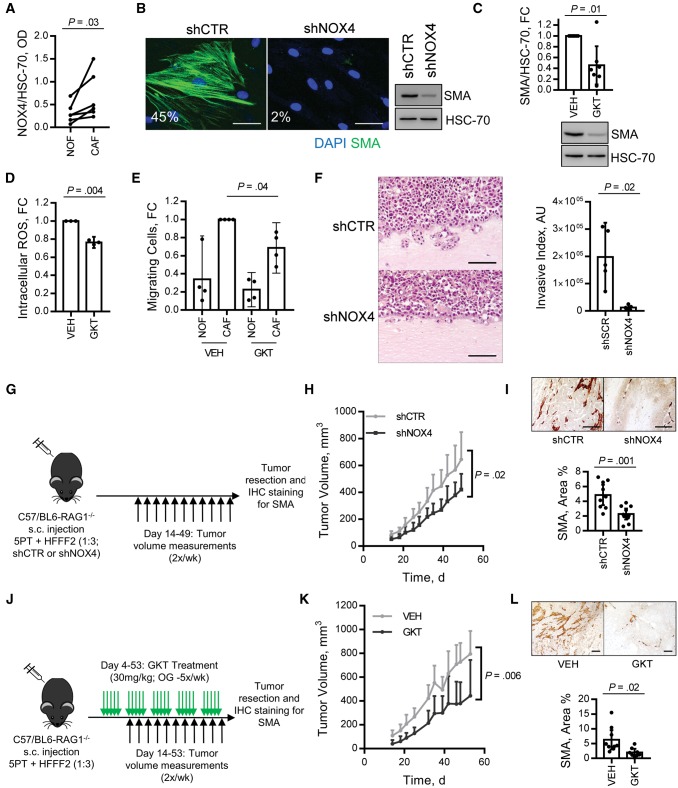
Background: Cancer-associated fibroblasts (CAFs) are tumor-promoting and correlate with poor survival in many cancers, which has led to their emergence as potential therapeutic targets. However, effective methods to manipulate these cells clinically have yet to be developed. Methods: CAF accumulation and prognostic significance in head and neck cancer (oral, n = 260; oropharyngeal, n = 271), and colorectal cancer (n = 56) was analyzed using immunohistochemistry. Mechanisms regulating fibroblast-to-myofibroblast transdifferentiation were investigated in vitro using RNA interference/pharmacological inhibitors followed by polymerase chain reaction (PCR), immunoblotting, immunofluorescence, and functional assays. RNA sequencing/bioinformatics and immunohistochemistry were used to analyze NAD(P)H Oxidase-4 (NOX4) expression in different human tumors. NOX4's role in CAF-mediated tumor progression was assessed in vitro, using CAFs from multiple tissues in Transwell and organotypic culture assays, and in vivo, using xenograft (n = 9-15 per group) and isograft (n = 6 per group) tumor models. All statistical tests were two-sided. Results: Patients with moderate/high levels of myofibroblastic-CAF had a statistically significant decrease in cancer-specific survival rates in each cancer type analyzed (hazard ratios [HRs] = 1.69-7.25, 95% confidence intervals [CIs] = 1.11 to 31.30, log-rank P ≤ .01). Fibroblast-to-myofibroblast transdifferentiation was dependent on a delayed phase of intracellular reactive oxygen species, generated by NOX4, across different anatomical sites and differentiation stimuli. A statistically significant upregulation of NOX4 expression was found in multiple human cancers (P < .001), strongly correlating with myofibroblastic-CAFs (r = 0.65-0.91, adjusted P < .001). Genetic/pharmacological inhibition of NOX4 was found to revert the myofibroblastic-CAF phenotype ex vivo (54.3% decrease in α-smooth muscle actin [α-SMA], 95% CI = 10.6% to 80.9%, P = .009), prevent myofibroblastic-CAF accumulation in vivo (53.2%-79.0% decrease in α-SMA across different models, P ≤ .02) and slow tumor growth (30.6%-64.0% decrease across different models, P ≤ .04). Conclusions: These data suggest that pharmacological inhibition of NOX4 may have broad applicability for stromal targeting across cancer types.
Overview
The claims and statistics of this paper haven’t been checked yet.
Free: it reads the open-access text and checks the first 5 claims that cite a source we can check. Create a free account to check every claim.
Integrity signals
Registry
Cites
Statistics
Figures
Verification
Claims the paper makes
The claims and statistics of this paper haven’t been checked yet.
Free: it reads the open-access text and checks the first 5 claims that cite a source we can check. Create a free account to check every claim.
Claims other papers make about this one
Each is checked against this paper’s own text: does it say what the citing paper says it does?
The cited source says what the claim attributes to it.
In the citing paper
“NOX4 expression is closely related to CAF accumulation in myofibroblasts in patients with CRC, which may be attributed to the fact that NOX4 regulates the transdifferentiation from fibroblasts to myofibroblasts through the delayed period of intracellular ROS production, and the inhibition of NOX4 can effectively reduce the accumulation of CAF [53].”
From Drug Resistance in Colorectal Cancer: From Mechanism to Clinic (2022) · cites this paper as [53]
Self-check
Percentages, sums and reported differences re-computed from the paper’s own numbers.
The self-check needs the paper’s full text.
Citations
Cites
Hallmarks of Cancer: The Next Generation
Hanahan, D., & Weinberg, R. A. (2011) · Cell · doi:10.1016/j.cell.2011.02.013 · Cited by 66,590 · cited 2×
“Over recent years, research has highlighted the contribution of the microenvironment to tumor progression (1), and numerous studies have documented the tumor-promoting role of cancerassociated fibroblasts (CAFs) (2–5).”
BackgroundWGCNA: an R package for weighted correlation network analysis
Langfelder, P., & Horvath, S. (2008) · BMC Bioinformatics · doi:10.1186/1471-2105-9-559 · Cited by 27,252
Increased Survival in Pancreatic Cancer with nab-Paclitaxel plus Gemcitabine
Von Hoff, D. D., Ervin, T., Arena, F. P., Chiorean, E. G., Infante, J., Moore, M., Seay, T., Tjulandin, S. A., Ma, W. W., Saleh, M. N., et al. (2013) · New England Journal of Medicine · doi:10.1056/nejmoa1304369 · Cited by 6,712
Dissecting the multicellular ecosystem of metastatic melanoma by single-cell RNA-seq
Tirosh, I., Izar, B., Prakadan, S. M., Wadsworth, M. H., Treacy, D., Trombetta, J. J., Rotem, A., Rodman, C., Lian, C., Murphy, G., et al. (2016) · Science · doi:10.1126/science.aad0501 · Cited by 4,944 · cited 1×
“(29) using single-cell RNA sequencing (FAP, THY1, DCN, COL1A1/2, and COL6A1/2/3; NOX4 correlation meta values 1⁄4 25.”
MethodOrimo, A., Gupta, P. B., Sgroi, D. C., Arenzana-Seisdedos, F., Delaunay, T., Naeem, R., Carey, V. J., Richardson, A. L., & Weinberg, R. A. (2005) · Cell · doi:10.1016/j.cell.2005.02.034 · Cited by 3,759
Olive, K. P., Jacobetz, M. A., Davidson, C. J., Gopinathan, A., McIntyre, D., Honess, D., Madhu, B., Goldgraben, M. A., Caldwell, M. E., Allard, D., et al. (2009) · Science · doi:10.1126/science.1171362 · Cited by 3,170
Özdemir, B. C., Pentcheva-Hoang, T., Carstens, J. L., Zheng, X., Wu, C.-C., Simpson, T. R., Laklai, H., Sugimoto, H., Kahlert, C., Novitskiy, S. V., et al. (2014) · Cancer Cell · doi:10.1016/j.ccr.2014.04.005 · Cited by 2,681
Desmoulière, A., Geinoz, A., Gabbiani, F., & Gabbiani, G. (1993) · The Journal of cell biology · doi:10.1083/jcb.122.1.103 · Cited by 2,243
Feig, C., Jones, J. O., Kraman, M., Wells, R. J. B., Deonarine, A., Chan, D. S., Connell, C. M., Roberts, E. W., Zhao, Q., Caballero, O. L., et al. (2013) · Proceedings of the National Academy of Sciences · doi:10.1073/pnas.1320318110 · Cited by 2,100 · cited 1×
“Given the previously described roles for CAFs in promoting resistance to chemotherapy (64,65) and adaptive antitumor immunity (4,66), stromal depletion through NOX4 inhibition may be a useful adjunct to improve response to current chemoand immunotherapeutics in patients with a-SMA-positive CAFrich tumors.”
BackgroundStromal Elements Act to Restrain, Rather Than Support, Pancreatic Ductal Adenocarcinoma
Rhim, A. D., Oberstein, P. E., Thomas, D. H., Mirek, E. T., Palermo, C. F., Sastra, S. A., Dekleva, E. N., Saunders, T., Becerra, C. P., Tattersall, I. W., et al. (2014) · Cancer Cell · doi:10.1016/j.ccr.2014.04.021 · Cited by 2,085
Hinz, B., Phan, S. H., Thannickal, V. J., Galli, A., Bochaton-Piallat, M.-L., & Gabbiani, G. (2007) · The American Journal of Pathology · doi:10.2353/ajpath.2007.070112 · Cited by 2,068
Prednisone, Azathioprine, and N -Acetylcysteine for Pulmonary Fibrosis
The Idiopathic Pulmonary Fibrosis Clinical Research Network (2012) · New England Journal of Medicine · doi:10.1056/nejmoa1113354 · Cited by 1,621 · cited 1×
“Similarly, the broad tyrosine kinase inhibitor nintedanib (anti-VEGFR, -FGFR, PDGFR), developed as an angiogenesis inhibitor, increases responses to docetaxel in non–small cell lung cancer patients (47) and has also shown some efficacy in the treatment of idiopathic pulmonary fibrosis (48).”
BackgroundErez, N., Truitt, M., Olson, P., & Hanahan, D. (2010) · Cancer Cell · doi:10.1016/j.ccr.2009.12.041 · Cited by 1,515
Efficacy of a Tyrosine Kinase Inhibitor in Idiopathic Pulmonary Fibrosis
Richeldi, L., Costabel, U., Selman, M., Kim, D. S., Hansell, D. M., Nicholson, A. G., Brown, K. K., Flaherty, K. R., Noble, P. W., Raghu, G., et al. (2011) · New England Journal of Medicine · doi:10.1056/nejmoa1103690 · Cited by 1,157
Suppression of Antitumor Immunity by Stromal Cells Expressing Fibroblast Activation Protein–α
Kraman, M., Bambrough, P. J., Arnold, J. N., Roberts, E. W., Magiera, L., Jones, J. O., Gopinathan, A., Tuveson, D. A., & Fearon, D. T. (2010) · Science · doi:10.1126/science.1195300 · Cited by 1,134 · cited 6×
“Given the previously described roles for CAFs in promoting resistance to chemotherapy (64,65) and adaptive antitumor immunity (4,66), stromal depletion through NOX4 inhibition may be a useful adjunct to improve response to current chemoand immunotherapeutics in patients with a-SMA-positive CAFrich tumors.”
BackgroundInfluentialCarcinoma-associated fibroblast-like differentiation of human mesenchymal stem cells
Mishra, P. J., Mishra, P. J., Humeniuk, R., Medina, D. J., Alexe, G., Mesirov, J. P., Ganesan, S., Glod, J. W., & Banerjee, D. (2008) · Cancer Research · doi:10.1158/0008-5472.can-08-0943 · Cited by 912 · cited 1×
“The presence of TGF-b-activated fibroblasts/myofibroblasts or CAFs was measured using principal component analysis (PCA) to summarize the expression of two independent gene expression profiling data sets from TGF-b-treated fibroblasts (from our own data and (30)) and a previously described CAF gene expression signatur…”
MethodNADPH oxidase-4 mediates myofibroblast activation and fibrogenic responses to lung injury
Hecker, L., Vittal, R., Jones, T., Jagirdar, R., Luckhardt, T. R., Horowitz, J. C., Pennathur, S., Martinez, F. J., & Thannickal, V. J. (2009) · Nature Medicine · doi:10.1038/nm.2005 · Cited by 852 · cited 1×
“(27,38–40), and its inhibition has been shown to attenuate pulmonary and liver fibrosis in preclinical mouse models (27,38,41).”
BackgroundCucoranu, I., Clempus, R., Dikalova, A., Phelan, P. J., Ariyan, S., Dikalov, S., & Sorescu, D. (2005) · Circulation Research · doi:10.1161/01.res.0000187457.24338.3d · Cited by 786
Au Yeung, C. L., Co, N.-N., Tsuruga, T., Yeung, T.-L., Kwan, S.-Y., Leung, C. S., Li, Y., Lu, E. S., Kwan, K., Wong, K.-K., et al. (2016) · Nature Communications · doi:10.1038/ncomms11150 · Cited by 774 · cited 1×
“Given the previously described roles for CAFs in promoting resistance to chemotherapy (64,65) and adaptive antitumor immunity (4,66), stromal depletion through NOX4 inhibition may be a useful adjunct to improve response to current chemoand immunotherapeutics in patients with a-SMA-positive CAFrich tumors.”
BackgroundStromal myofibroblasts are drivers of invasive cancer growth
De Wever, O., Demetter, P., Mareel, M., & Bracke, M. (2008) · International Journal of Cancer · doi:10.1002/ijc.23925 · Cited by 722 · cited 1×
“Myofibroblasts share the phenotypic traits of fibroblasts and smooth muscle cells, secreting extracellular matrix (ECM) and generating mechanical tension within tissue through cell contraction (9,10).”
BackgroundGoetz, J. G., Minguet, S., Navarro-Lérida, I., Lazcano, J. J., Samaniego, R., Calvo, E., Tello, M., Osteso-Ibáñez, T., Pellinen, T., Echarri, A., et al. (2011) · Cell · doi:10.1016/j.cell.2011.05.040 · Cited by 720
Identification of fibroblast heterogeneity in the tumor microenvironment
Sugimoto, H., Mundel, T. M., Kieran, M. W., & Kalluri, R. (2006) · Cancer Biology & Therapy · doi:10.4161/cbt.5.12.3354 · Cited by 699 · cited 1×
“This, in part, is due to CAF heterogeneity, which possibly reflects their cell(s) of origin, the tissue in which they develop, and their activation state (6).”
BackgroundReversal of persistent fibrosis in aging by targeting Nox4-Nrf2 redox imbalance
Hecker, L., Logsdon, N. J., Kurundkar, D., Kurundkar, A., Bernard, K., Hock, T., Meldrum, E., Sanders, Y. Y., & Thannickal, V. J. (2014) · Science Translational Medicine · doi:10.1126/scitranslmed.3008182 · Cited by 686 · cited 1×
“(27,38–40), and its inhibition has been shown to attenuate pulmonary and liver fibrosis in preclinical mouse models (27,38,41).”
BackgroundVerrecchia, F., Chu, M.-L., & Mauviel, A. (2001) · Journal of Biological Chemistry · doi:10.1074/jbc.m100754200 · Cited by 664 · cited 1×
“The presence of TGF-b-activated fibroblasts/myofibroblasts or CAFs was measured using principal component analysis (PCA) to summarize the expression of two independent gene expression profiling data sets from TGF-b-treated fibroblasts (from our own data and (30)) and a previously described CAF gene expression signatur…”
MethodAntioxidants can increase melanoma metastasis in mice
Le Gal, K., Ibrahim, M. X., Wiel, C., Sayin, V. I., Akula, M. K., Karlsson, C., Dalin, M. G., Akyürek, L. M., Lindahl, P., Nilsson, J., et al. (2015) · Science Translational Medicine · doi:10.1126/scitranslmed.aad3740 · Cited by 632 · cited 1×
“Inhibition of hedgehog signalling and depletion of FAP-positive CAFs have been shown to enhance chemotherapy delivery (49) and antitumor immunity (4) in murine models.”
BackgroundHost Responses in Tissue Repair and Fibrosis
Duffield, J. S., Lupher, M., Thannickal, V. J., & Wynn, T. A. (2013) · Annual Review of Pathology: Mechanisms of Disease · doi:10.1146/annurev-pathol-020712-163930 · Cited by 624
Catenacci, D. V. T., Junttila, M. R., Karrison, T., Bahary, N., Horiba, M. N., Nattam, S. R., Marsh, R., Wallace, J., Kozloff, M., Rajdev, L., et al. (2015) · Journal of Clinical Oncology · doi:10.1200/jco.2015.62.8719 · Cited by 561 · cited 1×
“pletion of FAP-positive cells results in cachexia and anemia due to loss of bone marrow–derived stem cells (56,57).”
BackgroundThe stroma reaction myofibroblast: a key player in the control of tumor cell behavior
Desmouliere, A., Guyot, C., & Gabbiani, G. (2004) · The International Journal of Developmental Biology · doi:10.1387/ijdb.041802ad · Cited by 551 · cited 1×
“Myofibroblasts play a key transient role in wound healing but persist in pathological fibrosis and cancer (11), where they contribute to multiple “hallmarks of malignancy” (4,5,12,13).”
BackgroundOxidative stress and pulmonary fibrosis
Cheresh, P., Kim, S.-J., Tulasiram, S., & Kamp, D. W. (2013) · Biochimica et Biophysica Acta (BBA) - Molecular Basis of Disease · doi:10.1016/j.bbadis.2012.11.021 · Cited by 530 · cited 1×
“For example, albumin-bound (nab)-paclitaxel (designed for effective drug delivery of highly lipophilic agents) has been shown to lead to CAF reduction and stromal disruption in PDAC, increasing the efficacy of gemcitabine and improving patient survival rates (45,46).”
BackgroundRandomized Trial of Acetylcysteine in Idiopathic Pulmonary Fibrosis
The Idiopathic Pulmonary Fibrosis Clinical Research Network (2014) · New England Journal of Medicine · doi:10.1056/nejmoa1401739 · Cited by 505
Stromal response to Hedgehog signaling restrains pancreatic cancer progression
Lee, J. J., Perera, R. M., Wang, H., Wu, D.-C., Liu, X. S., Han, S., Fitamant, J., Jones, P. D., Ghanta, K. S., Kawano, S., et al. (2014) · Proceedings of the National Academy of Sciences · doi:10.1073/pnas.1411679111 · Cited by 502 · cited 1×
“myofibroblast differentiation, both in tumors and fibrosis (58,59).”
BackgroundMorris, J. C., Tan, A. R., Olencki, T. E., Shapiro, G. I., Dezube, B. J., Reiss, M., Hsu, F. J., Berzofsky, J. A., & Lawrence, D. P. (2014) · PLoS ONE · doi:10.1371/journal.pone.0090353 · Cited by 487 · cited 1×
“While TGF-b signaling is known to promote myofibroblast differentiation, targeting this pathway in cancer is problematic because it also regulates tumor-suppressive functions, and ubiquitous inhibition has been shown to result in the development of cutaneous keratoacanthomas/squamous cell carcinomas (43,44).”
BackgroundTran, E., Chinnasamy, D., Yu, Z., Morgan, R. A., Lee, C.-C. R., Restifo, N. P., & Rosenberg, S. A. (2013) · Journal of Experimental Medicine · doi:10.1084/jem.20130110 · Cited by 463 · cited 1×
“However, the use of various anti-oxidants to target these effects clinically has proven similarly unsuccessful (60–62) and has even been shown to increase the risk of metastatic spread in a murine melanoma model (63).”
BackgroundEffector T Cells Abrogate Stroma-Mediated Chemoresistance in Ovarian Cancer
Wang, W., Kryczek, I., Dostál, L., Lin, H., Tan, L., Zhao, L., Lu, F., Wei, S., Maj, T., Peng, D., et al. (2016) · Cell · doi:10.1016/j.cell.2016.04.009 · Cited by 422 · cited 1×
“Given the previously described roles for CAFs in promoting resistance to chemotherapy (64,65) and adaptive antitumor immunity (4,66), stromal depletion through NOX4 inhibition may be a useful adjunct to improve response to current chemoand immunotherapeutics in patients with a-SMA-positive CAFrich tumors.”
BackgroundRoberts, E. W., Deonarine, A., Jones, J. O., Denton, A. E., Feig, C., Lyons, S. K., Espeli, M., Kraman, M., McKenna, B., Wells, R. J. B., et al. (2013) · Journal of Experimental Medicine · doi:10.1084/jem.20122344 · Cited by 414
Tumour-infiltrating lymphocytes predict for outcome in HPV-positive oropharyngeal cancer
Ward, M. J., Thirdborough, S. M., Mellows, T., Riley, C., Harris, S., Suchak, K., Webb, A., Hampton, C., Patel, N. N., Randall, C. J., et al. (2014) · British Journal of Cancer · doi:10.1038/bjc.2013.639 · Cited by 391 · cited 1×
“colorectal cancer (CRC) patients (5,12,15,16), composed of triplicate 1 mm cores from randomly selected tumor regions (MiniCore 3, Alphelys - Plaisir, France).”
BackgroundSelf-citationHofheinz, R.-D., al-Batran, S.-E., Hartmann, F., Hartung, G., Jäger, D., Renner, C., Tanswell, P., Kunz, U., Amelsberg, A., Kuthan, H., et al. (2003) · Oncology Research and Treatment · doi:10.1159/000069863 · Cited by 374
Oxidative stress promotes myofibroblast differentiation and tumour spreading
Toullec, A., Gerald, D., Despouy, G., Bourachot, B., Cardon, M., Lefort, S., Richardson, M., Rigaill, G., Parrini, M., Lucchesi, C., et al. (2010) · EMBO Molecular Medicine · doi:10.1002/emmm.201000073 · Cited by 339 · cited 1×
“While TGF-b signaling is known to promote myofibroblast differentiation, targeting this pathway in cancer is problematic because it also regulates tumor-suppressive functions, and ubiquitous inhibition has been shown to result in the development of cutaneous keratoacanthomas/squamous cell carcinomas (43,44).”
BackgroundAoyama, T., Paik, Y.-H., Watanabe, S., Laleu, B., Gaggini, F., Fioraso-Cartier, L., Molango, S., Heitz, F., Merlot, C., Szyndralewiez, C., et al. (2012) · Hepatology · doi:10.1002/hep.25938 · Cited by 336
Self-citationStromal features are predictive of disease mortality in oral cancer patients
Marsh, D., Suchak, K., Moutasim, K. A., Vallath, S., Hopper, C., Jerjes, W., Upile, T., Kalavrezos, N., Violette, S. M., Weinreb, P. H., et al. (2011) · The Journal of Pathology · doi:10.1002/path.2830 · Cited by 333 · cited 8×
“As a result of this heterogeneity, a single CAF marker is yet to be identified, although several have been proposed in different studies, including a-smooth muscle actin (SMA) (5), fibroblast activation protein-a (FAP) (4), podoplanin (7), and plateletderived growth factor receptor (PDGFR)-a (8).”
BackgroundMethodSelf-citationStromal disrupting effects of nab-paclitaxel in pancreatic cancer
Alvarez, R., Musteanu, M., Garcia-Garcia, E., Lopez-Casas, P. P., Megias, D., Guerra, C., Muñoz, M., Quijano, Y., Cubillo, A., Rodriguez-Pascual, J., et al. (2013) · British Journal of Cancer · doi:10.1038/bjc.2013.415 · Cited by 293
Narra, K., Mullins, S. R., Lee, H.-O., Strzemkowski-Brun, B., Magalong, K., Christiansen, V. J., McKee, P. A., Egleston, B., Cohen, S. J., Weiner, L. M., et al. (2007) · Cancer Biology & Therapy · doi:10.4161/cbt.6.11.4874 · Cited by 275 · cited 1×
“myofibroblast differentiation, both in tumors and fibrosis (58,59).”
BackgroundLewis, M. P., Lygoe, K. A., Nystrom, M. L., Anderson, W. P., Speight, P. M., Marshall, J. F., & Thomas, G. J. (2004) · British Journal of Cancer · doi:10.1038/sj.bjc.6601611 · Cited by 262
Self-citationClinical trials of antioxidants as cancer prevention agents: Past, present, and future
Goodman, M., Bostick, R. M., Kucuk, O., & Jones, D. P. (2011) · Free Radical Biology and Medicine · doi:10.1016/j.freeradbiomed.2011.05.018 · Cited by 255 · cited 1×
“For example, albumin-bound (nab)-paclitaxel (designed for effective drug delivery of highly lipophilic agents) has been shown to lead to CAF reduction and stromal disruption in PDAC, increasing the efficacy of gemcitabine and improving patient survival rates (45,46).”
BackgroundHanley, C. J., Noble, F., Ward, M., Bullock, M., Drifka, C., Mellone, M., Manousopoulou, A., Johnston, H. E., Hayden, A., Thirdborough, S., et al. (2016) · Oncotarget · doi:10.18632/oncotarget.6740 · Cited by 205 · cited 2×
“The heterogeneous CAF population remains poorly defined; however, our data show that across several human tumor types, the presence of an a-SMA-positive stroma identifies patients with poor survival (5,13,18).”
BackgroundMethodSelf-citationUnderwood, T. J., Hayden, A. L., Derouet, M., Garcia, E., Noble, F., White, M. J., Thirdborough, S., Mead, A., Clemons, N., Mellone, M., et al. (2015) · The Journal of Pathology · doi:10.1002/path.4467 · Cited by 186 · cited 4×
“Previously we have described the tumor-promoting effects of a-SMA-positive myofibroblastic CAF and shown that tumors rich in these cells are associated with poor survival (5,13).”
BackgroundMethodSelf-citationSampson, N., Koziel, R., Zenzmaier, C., Bubendorf, L., Plas, E., Jansen-Dürr, P., & Berger, P. (2011) · Molecular Endocrinology · doi:10.1210/me.2010-0340 · Cited by 157
Carcinoma-Associated Fibroblasts Are a Promising Therapeutic Target
Togo, S., Polanska, U., Horimoto, Y., & Orimo, A. (2013) · Cancers · doi:10.3390/cancers5010149 · Cited by 156 · cited 2×
“CAFs are becoming increasingly recognized as potential therapeutic targets because of their multifaceted role in tumor progression, and it is hypothesized that their genetic stability makes them vulnerable to targeted therapies (14,42).”
BackgroundBocchino, M., Agnese, S., Fagone, E., Svegliati, S., Grieco, D., Vancheri, C., Gabrielli, A., Sanduzzi, A., & Avvedimento, E. V. (2010) · PLoS ONE · doi:10.1371/journal.pone.0014003 · Cited by 146
Lacouture, M. E., Morris, J. C., Lawrence, D. P., Tan, A. R., Olencki, T. E., Shapiro, G. I., Dezube, B. J., Berzofsky, J. A., Hsu, F. J., & Guitart, J. (2015) · Cancer Immunology, Immunotherapy · doi:10.1007/s00262-015-1653-0 · Cited by 145 · cited 1×
“CAFs are becoming increasingly recognized as potential therapeutic targets because of their multifaceted role in tumor progression, and it is hypothesized that their genetic stability makes them vulnerable to targeted therapies (14,42).”
BackgroundNeri, S., Ishii, G., Hashimoto, H., Kuwata, T., Nagai, K., Date, H., & Ochiai, A. (2015) · International Journal of Cancer · doi:10.1002/ijc.29464 · Cited by 130 · cited 1×
“As a result of this heterogeneity, a single CAF marker is yet to be identified, although several have been proposed in different studies, including a-smooth muscle actin (SMA) (5), fibroblast activation protein-a (FAP) (4), podoplanin (7), and plateletderived growth factor receptor (PDGFR)-a (8).”
BackgroundZhang, C., Lan, T., Hou, J., Li, J., Fang, R., Yang, Z., Zhang, M., Liu, J., & Liu, B. (2014) · Oncotarget · doi:10.18632/oncotarget.2025 · Cited by 125
Moutasim, K. A., Jenei, V., Sapienza, K., Marsh, D. J., Weinreb, P. H., Violette, S. M., Lewis, M. P., Marshall, J. F., Fortune, F., Tilakaratne, W. M., et al. (2010) · The Journal of Pathology · doi:10.1002/path.2786 · Cited by 118
Self-citationMellone, M., Hanley, C. J., Thirdborough, S., Mellows, T., Garcia, E., Woo, J., Tod, J., Frampton, S., Jenei, V., Moutasim, K. A., et al. (2016) · Aging · doi:10.18632/aging.101127 · Cited by 114 · cited 3×
“upregulated genes in TGF-b-treated HFFF2s, identified by RNA sequencing (Mellone_TGF_UR) (Supplementary Table 1, available online) (24); the distribution of these genes within the network was then summarized by the first principal component.”
BackgroundMethodSelf-citationBullock, M. D., Bruce, A., Sreekumar, R., Curtis, N., Cheung, T., Reading, I., Primrose, J. N., Ottensmeier, C., Packham, G. K., Thomas, G., et al. (2013) · British Journal of Cancer · doi:10.1038/bjc.2013.355 · Cited by 86 · cited 1×
“colorectal cancer (CRC) patients (5,12,15,16), composed of triplicate 1 mm cores from randomly selected tumor regions (MiniCore 3, Alphelys - Plaisir, France).”
BackgroundSelf-citationErlotinib-Mediated Inhibition of EGFR Signaling Induces Metabolic Oxidative Stress through NOX4
Orcutt, K. P., Parsons, A. D., Sibenaller, Z. A., Scarbrough, P. M., Zhu, Y., Sobhakumari, A., Wilke, W. W., Kalen, A. L., Goswami, P. C., Miller, F. J., et al. (2011) · Cancer Research · doi:10.1158/0008-5472.can-10-3425 · Cited by 86
Sharon, Y., Alon, L., Glanz, S., Servais, C., & Erez, N. (2013) · Journal of Visualized Experiments · doi:10.3791/4425 · Cited by 75 · cited 1×
“As a result of this heterogeneity, a single CAF marker is yet to be identified, although several have been proposed in different studies, including a-smooth muscle actin (SMA) (5), fibroblast activation protein-a (FAP) (4), podoplanin (7), and plateletderived growth factor receptor (PDGFR)-a (8).”
BackgroundNOX4-dependent ROS production by stromal mammary cells modulates epithelial MCF-7 cell migration
Tobar, N., Guerrero, J., Smith, P. C., & Martínez, J. (2010) · British Journal of Cancer · doi:10.1038/sj.bjc.6605847 · Cited by 70 · cited 1×
“Tumor cells have been shown to induce TGF-b 1-dependent upregulation of NOX4 in breast stromal cells in vitro (32); however, to date, investigation of the role of NOX4 in cancer has predominantly focused on the tumor cell, where a variety of functional effects have been described (33–37).”
BackgroundIonizing radiation induces myofibroblast differentiation via lactate dehydrogenase
Judge, J., Owens, K. M., Pollock, S. J., Woeller, C. F., Thatcher, T. H., Williams, J. P., Phipps, R. P., Sime, P. J., & Kottmann, R. M. (2015) · American Journal of Physiology-Lung Cellular and Molecular Physiology · doi:10.1152/ajplung.00153.2015 · Cited by 59 · cited 1×
“Similarly, a delayed phase of intracellular ROS production was observed following other stimuli that promote myofibroblast transdifferentiation (ionizing radiation [IR]) (Supplementary Figure 1G, available online) (24,25).”
BackgroundEGFR Inhibition Induces Proinflammatory Cytokines via NOX4 in HNSCC
Fletcher, E. V. M., Love-Homan, L., Sobhakumari, A., Feddersen, C. R., Koch, A. T., Goel, A., & Simons, A. L. (2013) · Molecular Cancer Research · doi:10.1158/1541-7786.mcr-13-0187 · Cited by 59
Cancer-associated fibroblasts as target and tool in cancer therapeutics and diagnostics
Vlieghere, E. D., Verset, L., Demetter, P., Bracke, M., & Wever, O. D. (2015) · Archiv für Pathologische Anatomie und Physiologie und für Klinische Medicin · doi:10.1007/s00428-015-1818-4 · Cited by 57
Eyden, B. P. (2005) · PubMed · Cited by 46
Kim, H. J., Magesh, V., Lee, J.-J., Kim, S., Knaus, U. G., & Lee, K.-J. (2015) · Oncotarget · doi:10.18632/oncotarget.3843 · Cited by 43
Popat, S., Mellemgaard, A., Fahrbach, K. R., Martin, A. L., Rizzo, M., Kaiser, R., Griebsch, I., & Reck, M. (2014) · Future Oncology · doi:10.2217/fon.14.290 · Cited by 37
Redox Modulation of FAK Controls Melanoma Survival - Role of NOX4
Ribeiro-Pereira, C., Moraes, J. A., Souza, M. D. J., Laurindo, F. R., Arruda, M. A., & Barja-Fidalgo, C. (2014) · PLoS ONE · doi:10.1371/journal.pone.0099481 · Cited by 35
Measuring Invasion in an Organotypic Model
Jenei, V., Nystrom, M. L., & Thomas, G. J. (2011) · Methods in molecular biology · doi:10.1007/978-1-61779-207-6_15 · Cited by 22
Self-citation
Cited by
Signaling pathways in cancer-associated fibroblasts and targeted therapy for cancer
Wu, F., Yang, J., Liu, J., Wang, Y., Mu, J., Zeng, Q., Deng, S., & Zhou, H. (2021) · Signal Transduction and Targeted Therapy · doi:10.1038/s41392-021-00641-0 · Cited by 773
Targeting ROS in cancer: rationale and strategies
Glorieux, C., Liu, S., Trachootham, D., & Huang, P. (2024) · Nature Reviews Drug Discovery · doi:10.1038/s41573-024-00979-4 · Cited by 651
Navigating CAR-T cells through the solid-tumour microenvironment
Hou, A. J., Chen, L. C., & Chen, Y. Y. (2021) · Nature Reviews Drug Discovery · doi:10.1038/s41573-021-00189-2 · Cited by 551
Fibroblasts in cancer: Unity in heterogeneity
Chhabra, Y., & Weeraratna, A. T. (2023) · Cell · doi:10.1016/j.cell.2023.03.016 · Cited by 474
Ford, K., Hanley, C. J., Mellone, M., Szyndralewiez, C., Heitz, F., Wiesel, P., Wood, O., Machado, M., Lopez, M.-A., Ganesan, A.-P., et al. (2020) · Cancer Research · doi:10.1158/0008-5472.can-19-3158 · Cited by 411
“A significant proportion of most solid cancers are CAF-rich (including metastasis); for example, over 50% of cases of head and neck, esophageal, colorectal, and pancreatic cancers are dominated by the presence of CAFs, and these are associated with poor prognosis (21).”
BackgroundInfluentialSelf-citation
Metadata
- Authors
- Hanley, C. J., Mellone, M., Ford, K., Thirdborough, S. M., Mellows, T., Frampton, S. J., Smith, D. M., Harden, E., Szyndralewiez, C., Bullock, M., Noble, F., Moutasim, K. A., King, E. V., Vijayanand, P., Mirnezami, A. H., Underwood, T. J., Ottensmeier, C. H., & Thomas, G. J.
- Affiliations
- University of Southampton (GB)
- Genkyotex SA, Plan-les-Ouates, Switzerland
- La Jolla Institute for Immunology (US)
- Cancer Sciences Unit, University of Southampton Faculty of Medicine, Southampton, UK
- Corresponding author
- Thomas, Gareth J
- ORCID
- Venue
- JNCI: Journal of the National Cancer Institute
- Publisher
- Oxford University Press (OUP)
- Published
- 2017-08-03
- Volume
- 110
- Issue
- 1
- Pages
- 109-120
- ISSN
- 0027-8874 (ISSN-L)
- 1460-2105
- PMC
- PMC5903651
- OpenAlex
- W2739944480
- Cited by
- 195
- References
- 68
- Citations by year
- 2026: 16 · 2025: 14 · 2024: 20 · 2023: 28 · 2022: 31 · 2021: 28 · 2020: 25 · 2019: 15 · 2018: 17 · 2017: 1
- FWCI
- 6.99
- Type
- journal article
- Language
- en
- Open access
- hybrid
- doi.org
- Licence
- Locations
- JNCI Journal of the National Cancer Institute (publishedVersion, cc-by)
- Europe PMC (PubMed Central) (publishedVersion, cc-by)
- PubMed Central (publishedVersion, cc-by)
- PubMed (publishedVersion)
- ePrints Soton (University of Southampton) (acceptedVersion)
- Funders
- Cancer Research UK (C21825/A13315, C115121/A20256)
- National Cancer Institute (C21825/A13315, C115121/A20256)
- Topics
- Health Sciences › Medicine › Oncology › Cancer Cells and Metastasis
- Life Sciences › Biochemistry, Genetics and Molecular Biology › Molecular Biology › TGF-β signaling in diseases
- Health Sciences › Medicine › Oncology › Pancreatic and Hepatic Oncology Research
- Keywords
- cancer-associated fibroblasts, myofibroblastic phenotype, NOX4, fibroblast-to-myofibroblast transdifferentiation, reactive oxygen species, head and neck cancer, oral cancer, oropharyngeal cancer, colorectal cancer, cancer-specific survival, tumor microenvironment, alpha-smooth muscle actin
- MeSH terms
- Cancer-Associated Fibroblasts, NADPH Oxidase 4, Actins, Adenocarcinoma, Adult, Aged, Aged, 80 and over, Animals, Carcinoma, Non-Small-Cell Lung, Carcinoma, Squamous Cell, Cell Count, Esophageal Neoplasms, Female, Head and Neck Neoplasms, Humans, Lung Neoplasms, Male, Middle Aged, Mouth Neoplasms, Neoplasm Transplantation, Oropharyngeal Neoplasms, Phenotype, Pyrazoles, Pyridines, Pyridones, Colorectal Neoplasms, Up-Regulation, Survival Rate, Reactive Oxygen Species, Disease Progression, NADPH Oxidases, RNA Interference, Pyrazolones, Mice, Cell Transdifferentiation, Myofibroblasts
About these checks
Registry, retraction, Cites and statistics results are computed, not judged, with one exception: a printed reference that no index lists is read once by a model before it counts as a citation error. Claims are extracted by a model and kept only when their quote appears verbatim in the text; each cited source is then checked, with a model’s help, for whether it says what the claim relies on. Those verdicts can be wrong — read the claim’s quote and the cited source before relying on one.
Statistics and arithmetic are recomputed, not judged.
Confidence bands are shown only for fields calibrated on our annotated test set. None is calibrated yet, so no band is shown.
What counts as a claim ›How we measure confidence ›How we check this ›
Are you an author, or do you see a problem with this page? Request a review
Data sources
Bibliographic data: Semantic Scholar, OpenAlex, Crossref.
Contains information from the Semantic Scholar Academic Graph Datasets, made available under the ODC Attribution License (ODC-BY 1.0).
Semantic Scholar’s data is described in: Kinney, R., et al. (2023). The Semantic Scholar Open Data Platform. arXiv:2301.10140.
