

The DOI matches its Crossref record; 54 of the 55 references it cites were found in a registry or an index.
Impact of Overweight and Obesity on US Papillary Thyroid Cancer Incidence Trends (1995–2015)
Open accessAbstract
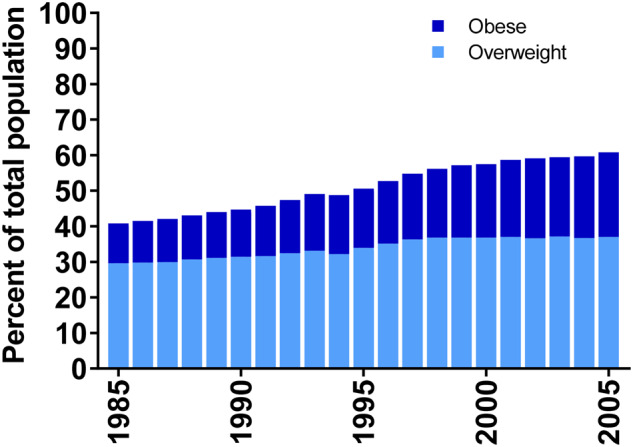
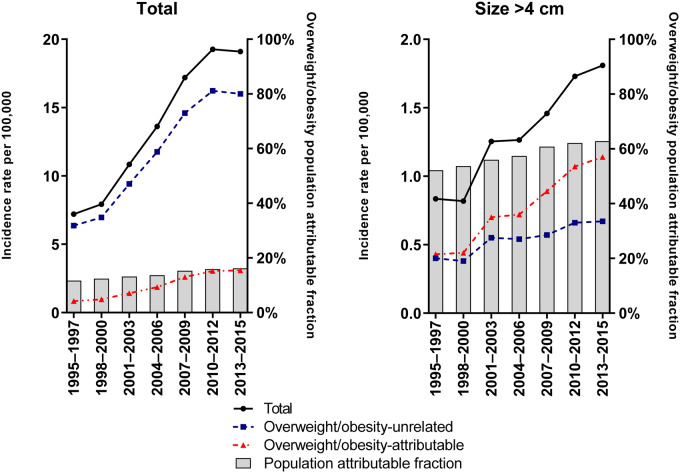
Background: Since the early 1980s, papillary thyroid cancer (PTC) incidence rates and the prevalence of obesity, a risk factor for PTC, have increased substantially in the United States. We estimated the proportion of PTC incidence in the United States attributable to overweight and obesity during 1995–2015. Methods: National Institutes of Health-AARP Diet and Health Study cohort data (n = 457 331 participants, 50–71 years and cancer-free at baseline) were used to estimate multivariable-adjusted hazard ratios (HRs) for PTC across body mass index categories. Population attributable fractions (PAFs) were calculated using estimated hazard ratios and annual overweight and obesity prevalence estimates from the National Health Interview Survey. PAF estimates were combined with Surveillance, Epidemiology, and End Results-13 data to calculate annual percent changes in PTC incidence rates attributable (and unrelated) to overweight and obesity. Results: Overweight (25.0–29.0 kg/m2) and obesity (≥30.0 kg/m2) were associated with 1.26-fold (95% confidence interval [CI] = 1.05- to 1.52-fold) and 1.30-fold (95% CI = 1.05- to 1.62-fold) increased risks of PTC, respectively, and nearly threefold (HR = 2.93, 95% CI = 1.25 to 6.87) and greater than fivefold (HR = 5.42, 95% CI = 2.24 to 13.1) increased risks of large (>4 cm) PTCs compared with normal weight (18.5–24.9 kg/m2). During 1995–2015, PAF estimates for overweight and obesity increased from 11.4% to 16.2% for all PTCs and from 51.4% to 63.2% for large PTCs. Overweight or obesity accounted for 13.6% and 57.8% of the annual percent changes in total (5.9%/y) and large (4.5%/y) PTC incidence rates, respectively, during 1995–2015. Conclusions: Overweight and obesity may have contributed importantly to the rapid rise in PTC incidence during 1995–2015. By 2015, we estimate that one of every six PTCs diagnosed among adults 60 years or older, including nearly two-thirds of large PTCs, were attributable to overweight and obesity.
Overview
The claims and statistics of this paper haven’t been checked yet.
Run the check — free, no account needed. It reads the open-access text and checks the sources it cites.
Integrity signals
Registry
Cites
Statistics
Figures
Verification
Claims the paper makes
The claims and statistics of this paper haven’t been checked yet.
Run the check — free, no account needed. It reads the open-access text and checks the sources it cites.
Claims other papers make about this one
Each is checked against this paper’s own text: does it say what the citing paper says it does?
The source backs part of the claim, not all of it — or backs it for a different population, condition or comparison.
In the citing paper
“a recent study estimated that 16% of the cancers overall and 63% of large tumors in the United States were attributable to obesity, 157”
From Global cancer statistics 2022: GLOBOCAN estimates of incidence and mortality worldwide for 36 cancers in 185 countries. (2024) · cites this paper as [157]
Experimental — accuracy not yet measuredThe cited source says what the claim attributes to it.
In the citing paper
“the relatively high proportion of obese patients among those receiving treatment could produce a bias, since excess weight is a risk factor for thyroid malignancies.22,63”
From Glucagon‐like peptide‐1 receptor agonists and risk of thyroid cancer: A systematic review and meta‐analysis of randomized controlled trials (2024) · cites this paper as [63]
Self-check
Percentages, sums and reported differences re-computed from the paper’s own numbers.
The self-check needs the paper’s full text.
Citations
Cites
Haugen, B. R., Alexander, E. K., Bible, K. C., Doherty, G. M., Mandel, S. J., Nikiforov, Y. E., Pacini, F., Randolph, G. W., Sawka, A. M., Schlumberger, M., et al. (2016) · Thyroid® · doi:10.1089/thy.2015.0020 · Cited by 16,535 · cited 2×
“Several clinical recommendations recently have been introduced or changed in response to concerns about thyroid cancer overdiagnosis and overtreatment (30,52), which may have contributed to the plateauing of PTC incidence rates since 2009 (1).”
Self-citationCooper, D. S., Doherty, G. M., Haugen, B. R., Kloos, R. T., Lee, S. L., Mandel, S. J., Mazzaferri, E. L., McIver, B., Pacini, F., Schlumberger, M., et al. (2009) · Thyroid · doi:10.1089/thy.2009.0110 · Cited by 6,707
Prevalence of Obesity Among Adults and Youth: United States, 2015-2016.
Hales, C. M., Carroll, M. D., Fryar, C. D., & Ogden, C. L. (2017) · PubMed · Cited by 3,889
Body Fatness and Cancer — Viewpoint of the IARC Working Group
Lauby-Secretan, B., Scoccianti, C., Loomis, D., Grosse, Y., Bianchini, F., & Straif, K. (2016) · New England Journal of Medicine · doi:10.1056/nejmsr1606602 · Cited by 3,596
Increasing Incidence of Thyroid Cancer in the United States, 1973-2002
Davies, L., & Welch, H. G. (2006) · JAMA · doi:10.1001/jama.295.18.2164 · Cited by 3,379
Cancer Epidemiology and Prevention
Schottenfeld, D. (2006) · doi:10.1093/acprof:oso/9780195149616.001.0001 · Cited by 3,376
Trends in Thyroid Cancer Incidence and Mortality in the United States, 1974-2013
Lim, H., Devesa, S. S., Sosa, J. A., Check, D., & Kitahara, C. M. (2017) · JAMA · doi:10.1001/jama.2017.2719 · Cited by 2,159
Self-citationOgden, C. L., Yanovski, S. Z., Carroll, M. D., & Flegal, K. M. (2007) · Gastroenterology · doi:10.1053/j.gastro.2007.03.052 · Cited by 1,561 · cited 1×
“Considering the tremendous increase in obesity prevalence among US adults since the early 1980s (from 15% in 1980 to nearly 40% in 2015–2016) (18,19), excess adiposity could have contributed appreciably to the observed temporal increases in US PTC incidence rates.”
Worldwide Thyroid-Cancer Epidemic? The Increasing Impact of Overdiagnosis
Vaccarella, S., Franceschi, S., Bray, F., Wild, C. P., Plummer, M., & Dal Maso, L. (2016) · New England Journal of Medicine · doi:10.1056/nejmp1604412 · Cited by 1,145
The changing incidence of thyroid cancer
Kitahara, C. M., & Sosa, J. A. (2016) · Nature Reviews Endocrinology · doi:10.1038/nrendo.2016.110 · Cited by 1,061 · cited 3×
“In the current study, we did not attempt to quantify the impact on PTC incidence trends of changes in medical practice, which appear to affect mostly small localized PTCs (29,31), or other environmental and lifestyle factors for PTC (4).”
Self-citation
Cited by
Sorted by citations
Sung, H., Ferlay, J., Siegel, R. L., Laversanne, M., Soerjomataram, I., Jemal, A., & Bray, F. (2021) · CA: A Cancer Journal for Clinicians · doi:10.3322/caac.21660 · Cited by 108,699
Bray, F., Laversanne, M., Sung, H., Ferlay, J., Siegel, R. L., Soerjomataram, I., & Jemal, A. (2024) · CA: a cancer journal for clinicians · doi:10.3322/caac.21834 · Cited by 27,064
Ringel, M. D., Sosa, J. A., Baloch, Z. W., Bischoff, L. A., Bloom, G., Brent, G. A., Brock, P. L., Chou, R., Flavell, R. R., Goldner, W. S., et al. (2025) · Thyroid · doi:10.1177/10507256251363120 · Cited by 891
Self-citationPizzato, M., Li, M., Vignat, J., Laversanne, M., Singh, D., Vecchia, C. L., & Vaccarella, S. (2022) · The Lancet Diabetes & Endocrinology · doi:10.1016/s2213-8587(22)00035-3 · Cited by 744
Annual report to the nation on the status of cancer, part 1: National cancer statistics
Cronin, K. A., Scott, S., Firth, A. U., Sung, H., Henley, S. J., Sherman, R., Siegel, R. L., Anderson, R. N., Kohler, B., Benard, V. B., et al. (2022) · Cancer · doi:10.1002/cncr.34479 · Cited by 577
“Prior studies have shown increases in both incidence and death rates of distant‐stage thyroid cancer from the 1990s to the early 2010s,(86,87) suggesting that there is a genuine increase in the risk of thyroid cancer that likely reflects changes in the prevalence of underlying risk factors, such as excess body weight.…”
Metadata
- Authors
- Kitahara, C. M., Pfeiffer, R. M., Sosa, J. A., & Shiels, M. S.
- Affiliations
- Division of Cancer Epidemiology and Genetics (US)
- University of California, San Francisco (US)
- Corresponding author
- Kitahara, Cari M
- Venue
- JNCI: Journal of the National Cancer Institute
- Publisher
- Oxford University Press (OUP)
- Published
- 2019-12-05
- Volume
- 112
- Issue
- 8
- Pages
- 810-817
- ISSN
- 0027-8874 (ISSN-L)
- 1460-2105
- PMC
- PMC7825478
- OpenAlex
- W2981876570
- Cited by
- 142
- References
- 55
- Citations by year
- 2026: 11 · 2025: 18 · 2024: 22 · 2023: 25 · 2022: 32 · 2021: 20 · 2020: 13
- FWCI
- 13.59
- Type
- journal article
- Language
- en
- Open access
- hybrid
- doi.org
- Licence
- Locations
- JNCI Journal of the National Cancer Institute (publishedVersion, cc-by-nc)
- Europe PMC (PubMed Central) (publishedVersion, cc-by-nc)
- PubMed Central (publishedVersion, cc-by-nc)
- PubMed (publishedVersion)
- eScholarship (California Digital Library) (submittedVersion)
- eScholarship (California Digital Library) (submittedVersion, cc-by-nc)
- Funders
- Intramural Research Program of the National Cancer Institute at the National Institutes of Health
- NIH
- Topics
- Health Sciences › Medicine › Endocrinology, Diabetes and Metabolism › Thyroid Cancer Diagnosis and Treatment
- Health Sciences › Medicine › Oncology › Cancer Risks and Factors
- Health Sciences › Medicine › Oncology › Global Cancer Incidence and Screening
- Keywords
- papillary thyroid carcinoma, overweight, obesity, body mass index, cancer incidence trends, population attributable fraction, obesity as cancer risk factor, AARP Diet and Health Study
- MeSH terms
- Thyroid Cancer, Papillary, Aged, Female, Humans, Male, Middle Aged, Obesity, Risk Factors, Thyroid Neoplasms, United States, Cohort Studies, Body Mass Index, Incidence, Prevalence, SEER Program, Overweight
About these checks
Registry, retraction, Cites and statistics results are computed, not judged, with one exception: a printed reference that no index lists is read once by a model before it counts as a citation error. Claims are extracted by a model and kept only when their quote appears verbatim in the text; each cited source is then checked, with a model’s help, for whether it says what the claim relies on. Those verdicts can be wrong — read the claim’s quote and the cited source before relying on one.
Statistics and arithmetic are recomputed, not judged.
Confidence bands are shown only for fields calibrated on our annotated test set. None is calibrated yet, so no band is shown.
What counts as a claim ›How we measure confidence ›How we check this ›
Are you an author, or do you see a problem with this page? Request a review
