

The DOI matches its Crossref record; 346 of the 346 references it cites were found in a registry or an index.
Myokines: metabolic regulation in obesity and type 2 diabetes
Open accessAbstract
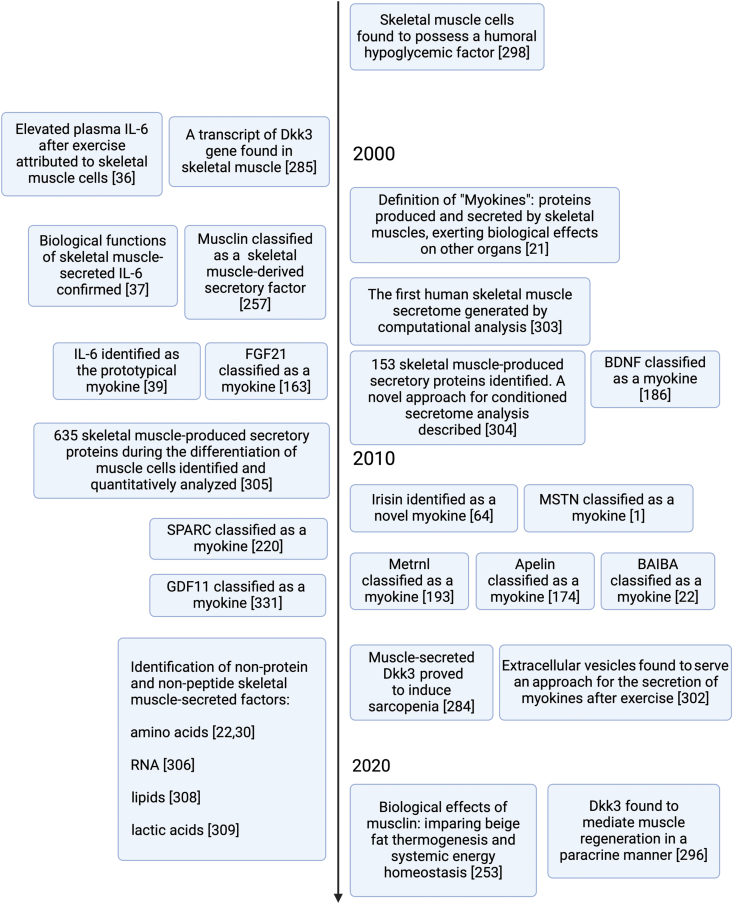
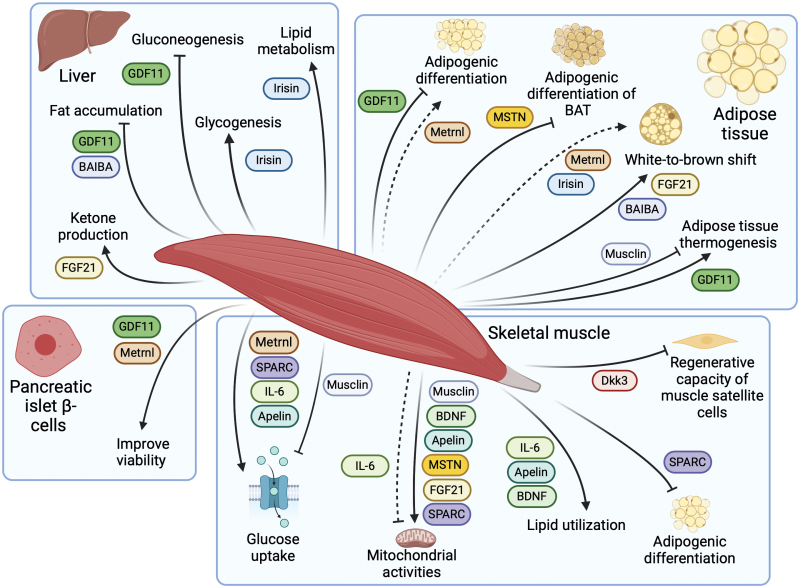
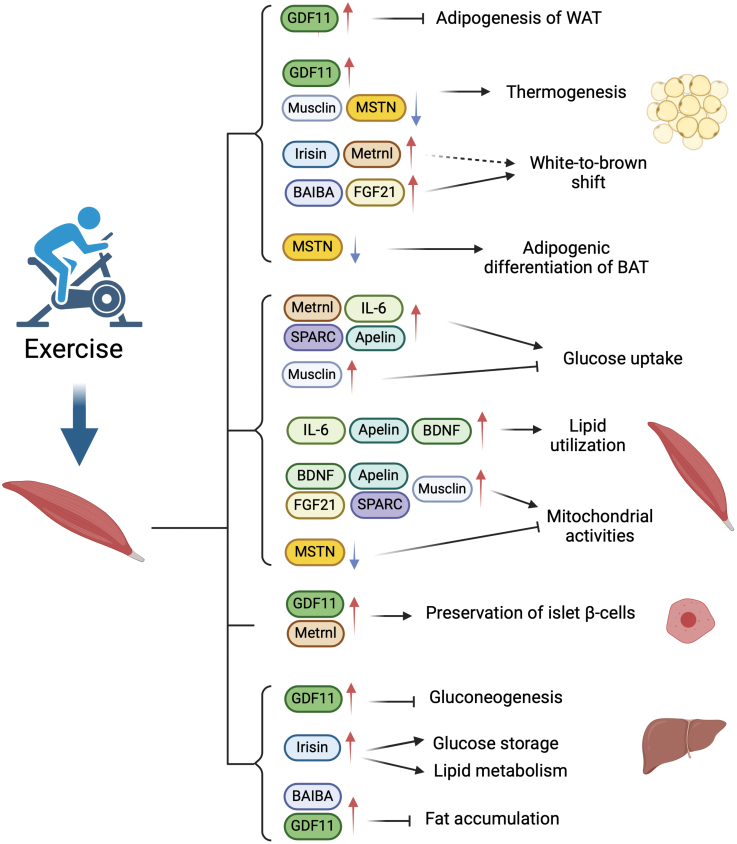
Skeletal muscle plays a vital role in the regulation of systemic metabolism, partly through its secretion of endocrine factors which are collectively known as myokines. Altered myokine levels are associated with metabolic diseases, such as type 2 diabetes (T2D). The significance of interorgan crosstalk, particularly through myokines, has emerged as a fundamental aspect of nutrient and energy homeostasis. However, a comprehensive understanding of myokine biology in the setting of obesity and T2D remains a major challenge. In this review, we discuss the regulation and biological functions of key myokines that have been extensively studied during the past two decades, namely interleukin 6 (IL-6), irisin, myostatin (MSTN), growth differentiation factor 11 (GDF11), fibroblast growth factor 21 (FGF21), apelin, brain-derived neurotrophic factor (BDNF), meteorin-like (Metrnl), secreted protein acidic and rich in cysteine (SPARC), β-aminoisobutyric acid (BAIBA), Musclin, and Dickkopf 3 (Dkk3). Related to these, we detail the role of exercise in myokine expression and secretion together with their contributions to metabolic physiology and disease. Despite significant advancements in myokine research, many myokines remain challenging to measure accurately and investigate thoroughly. Hence, new research techniques and detection methods should be developed and rigorously tested. Therefore, developing a comprehensive perspective on myokine biology is crucial, as this will likely offer new insights into the pathophysiological mechanisms underlying obesity and T2D and may reveal novel targets for therapeutic interventions.
Overview
The claims and statistics of this paper haven’t been checked yet.
Run the check — free, no account needed. It reads the open-access text and checks the sources it cites.
Integrity signals
Registry
Cites
Statistics
Figures
Verification
Claims the paper makes
The claims and statistics of this paper haven’t been checked yet.
Run the check — free, no account needed. It reads the open-access text and checks the sources it cites.
Claims other papers make about this one
Each is checked against this paper’s own text: does it say what the citing paper says it does?
The source backs part of the claim, not all of it — or backs it for a different population, condition or comparison.
In the citing paper
“PT, by involving intense and repeated contractions of large muscle groups, may amplify this myokine response, contributing to the observed reductions in body fat and improvements in body composition [37,38].”
From Efficacy of Power Training on Sarcopenic Obesity in Community-Dwelling Older Women: A 32-Week Randomized Clinical Trial (2025) · cites this paper as [38]
Experimental — accuracy not yet measuredThe cited source says what the claim attributes to it.
In the citing paper
“Skeletal muscles function as an endocrine organ by releasing myokines in response to contraction, which can influence fat metabolism, reduce inflammation, and improve insulin sensitivity.”
From Efficacy of Power Training on Sarcopenic Obesity in Community-Dwelling Older Women: A 32-Week Randomized Clinical Trial (2025) · cites this paper as [38]
Self-check
Percentages, sums and reported differences re-computed from the paper’s own numbers.
The self-check needs the paper’s full text.
Citations
Cites
A PGC1-α-dependent myokine that drives brown-fat-like development of white fat and thermogenesis
Boström, P., Wu, J., Jedrychowski, M. P., Korde, A., Ye, L., Lo, J. C., Rasbach, K. A., Boström, E. A., Choi, J. H., Long, J. Z., et al. (2012) · Nature · doi:10.1038/nature10777 · Cited by 4,810
Regulation of skeletal muscle mass in mice by a new TGF-p superfamily member
McPherron, A. C., Lawler, A. M., & Lee, S.-J. (1997) · Nature · doi:10.1038/387083a0 · Cited by 4,013
Muscles, exercise and obesity: skeletal muscle as a secretory organ
Pedersen, B. K., & Febbraio, M. A. (2012) · Nature Reviews Endocrinology · doi:10.1038/nrendo.2012.49 · Cited by 2,909
Chatterjee, S., Khunti, K., & Davies, M. J. (2017) · The Lancet · doi:10.1016/s0140-6736(17)30058-2 · Cited by 2,577
Transcriptional co-activator PGC-1α drives the formation of slow-twitch muscle fibres
Lin, J., Wu, H., Tarr, P. T., Zhang, C.-Y., Wu, Z., Boss, O., Michael, L. F., Puigserver, P., Isotani, E., Olson, E. N., et al. (2002) · Nature · doi:10.1038/nature00904 · Cited by 2,546
Self-citationAMP-activated protein kinase (AMPK) action in skeletal muscle via direct phosphorylation of PGC-1α
Jäger, S., Handschin, C., St.-Pierre, J., & Spiegelman, B. M. (2007) · Proceedings of the National Academy of Sciences · doi:10.1073/pnas.0705070104 · Cited by 2,491
Muscle as an Endocrine Organ: Focus on Muscle-Derived Interleukin-6
Pedersen, B. K., & Febbraio, M. A. (2008) · Physiological Reviews · doi:10.1152/physrev.90100.2007 · Cited by 2,388
Satellite Cells and the Muscle Stem Cell Niche
Yin, H., Price, F., & Rudnicki, M. A. (2013) · Physiological Reviews · doi:10.1152/physrev.00043.2011 · Cited by 2,166
Double muscling in cattle due to mutations in the myostatin gene
McPherron, A. C., & Lee, S.-J. (1997) · Proceedings of the National Academy of Sciences · doi:10.1073/pnas.94.23.12457 · Cited by 2,039
Isolation and Characterization of a Novel Endogenous Peptide Ligand for the Human APJ Receptor
Tatemoto, K., Hosoya, M., Habata, Y., Fujii, R., Kakegawa, T., Zou, M.-X., Kawamata, Y., Fukusumi, S., Hinuma, S., Kitada, C., et al. (1998) · Biochemical and Biophysical Research Communications · doi:10.1006/bbrc.1998.9489 · Cited by 1,684
Cited by
Sorted by citations
Obesity and Exercise: New Insights and Perspectives
James, N. M., & Stanford, K. I. (2025) · Endocrine Reviews · doi:10.1210/endrev/bnaf017 · Cited by 20
Polo-Ferrero, L., Martin, M. J., Puente-González, A. S., Barbero-Iglesias, F. J., González-Manzano, S., & Méndez-Sánchez, R. (2025) · Nutrients · doi:10.3390/nu17111822 · Cited by 21
Metadata
- Authors
- Chen, Z.-T., Weng, Z.-X., Lin, J. D., & Meng, Z.-X.
- Affiliations
- Second Affiliated Hospital of Zhejiang University (CN)
- University of Michigan (US)
- Affiliated Hangzhou First People's Hospital, Westlake University, School of Medicine (CN)
- Corresponding author
- Lin, Jiandie D
- Meng, Zhuo-Xian
- Venue
- Life Metabolism
- Publisher
- Oxford University Press (OUP)
- Published
- 2024-03-02
- Volume
- 3
- Issue
- 3
- Pages
- loae006-loae006
- ISSN
- 2755-0230 (ISSN-L)
- PMC
- PMC11749576
- OpenAlex
- W4392351638
- Cited by
- 58
- References
- 346
- Citations by year
- 2026: 29 · 2025: 27 · 2024: 2
- FWCI
- 3.82
- Type
- journal article
- Language
- en
- Open access
- diamond
- doi.org
- Licence
- Locations
- Life Metabolism (publishedVersion, cc-by)
- PubMed Central (publishedVersion, cc-by)
- PubMed (publishedVersion)
- Funders
- National Key Research and Development Program of China (2018YFA0800403, 2021YFC2701903)
- National Natural Science Foundation of China (91857110, 81670740, 32000817, 82100904, 82300910)
- National Outstanding Youth Science Fund Project of National Natural Science Foundation of China (81722012)
- Zhejiang Provincial Natural Science Foundation of China (LZ21H070001, LHDMD22H02001, LHDMD24H030001)
- Innovative Institute of Basic Medical Sciences of Zhejiang University
- Fundamental Research Funds
- Topics
- Health Sciences › Medicine › Endocrinology, Diabetes and Metabolism › Adipokines, Inflammation, and Metabolic Diseases
- Health Sciences › Medicine › Physiology (medical) › Exercise and Physiological Responses
- Life Sciences › Biochemistry, Genetics and Molecular Biology › Molecular Biology › Muscle Physiology and Disorders
- Keywords
- myokines, skeletal muscle, obesity, type 2 diabetes, interleukin-6, irisin, myostatin, GDF11, FGF21, apelin, brain-derived neurotrophic factor, Metrnl, SPARC, musclin, Dickkopf-3, physical activity, organ crosstalk, energy homeostasis, metabolic regulation
About these checks
Registry, retraction, Cites and statistics results are computed, not judged, with one exception: a printed reference that no index lists is read once by a model before it counts as a citation error. Claims are extracted by a model and kept only when their quote appears verbatim in the text; each cited source is then checked, with a model’s help, for whether it says what the claim relies on. Those verdicts can be wrong — read the claim’s quote and the cited source before relying on one.
Statistics and arithmetic are recomputed, not judged.
Confidence bands are shown only for fields calibrated on our annotated test set. None is calibrated yet, so no band is shown.
What counts as a claim ›How we measure confidence ›How we check this ›
Are you an author, or do you see a problem with this page? Request a review
