

The DOI matches its Crossref record; 53 of the 53 references it cites were found in a registry or an index.
Ultrafast Approximation for Phylogenetic Bootstrap
Open accessAbstract
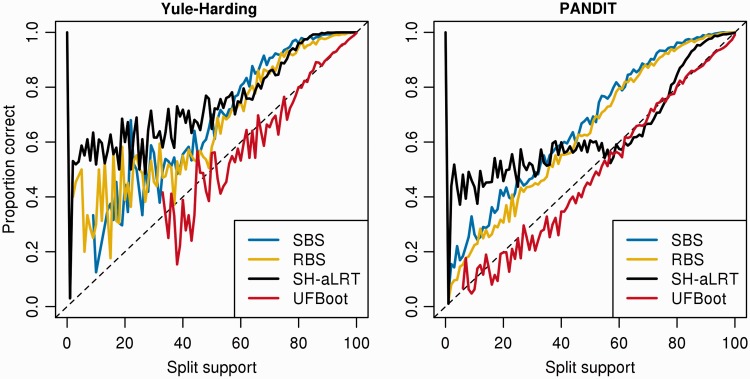
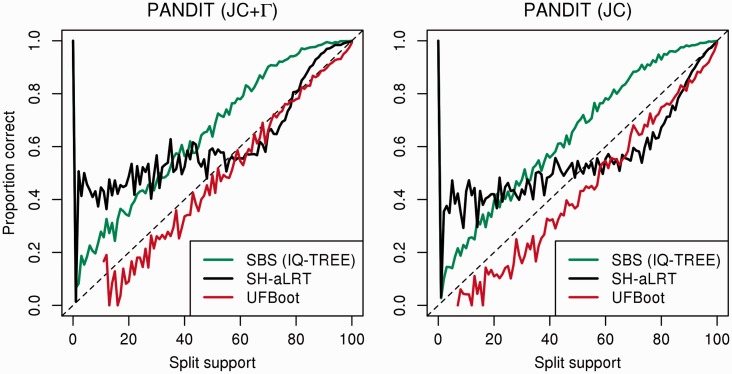
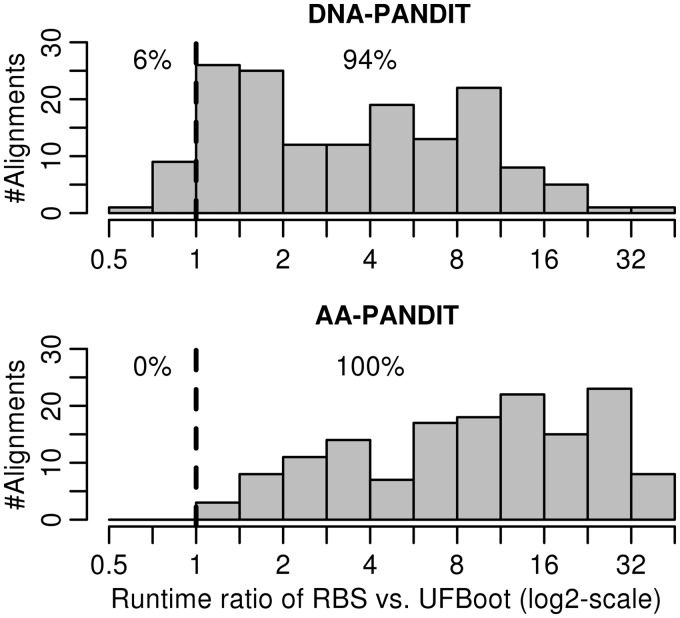
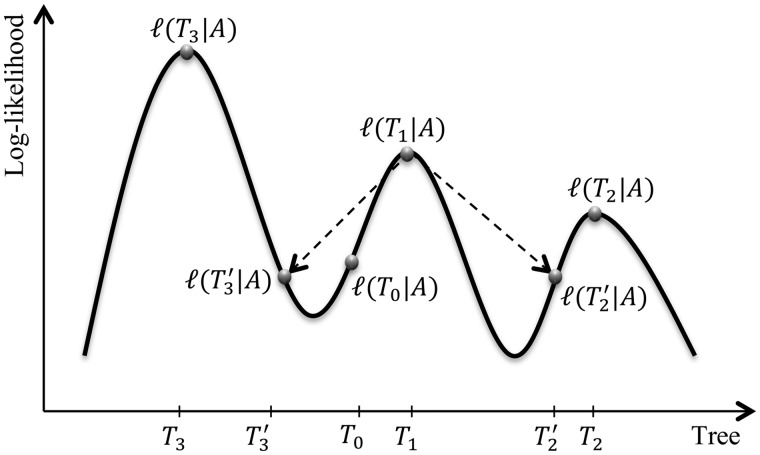
Nonparametric bootstrap has been a widely used tool in phylogenetic analysis to assess the clade support of phylogenetic trees. However, with the rapidly growing amount of data, this task remains a computational bottleneck. Recently, approximation methods such as the RAxML rapid bootstrap (RBS) and the Shimodaira-Hasegawa-like approximate likelihood ratio test have been introduced to speed up the bootstrap. Here, we suggest an ultrafast bootstrap approximation approach (UFBoot) to compute the support of phylogenetic groups in maximum likelihood (ML) based trees. To achieve this, we combine the resampling estimated log-likelihood method with a simple but effective collection scheme of candidate trees. We also propose a stopping rule that assesses the convergence of branch support values to automatically determine when to stop collecting candidate trees. UFBoot achieves a median speed up of 3.1 (range: 0.66-33.3) to 10.2 (range: 1.32-41.4) compared with RAxML RBS for real DNA and amino acid alignments, respectively. Moreover, our extensive simulations show that UFBoot is robust against moderate model violations and the support values obtained appear to be relatively unbiased compared with the conservative standard bootstrap. This provides a more direct interpretation of the bootstrap support. We offer an efficient and easy-to-use software (available at http://www.cibiv.at/software/iqtree) to perform the UFBoot analysis with ML tree inference.
Overview
The claims and statistics of this paper haven’t been checked yet.
Free: it reads the open-access text and checks the first 5 claims that cite a source we can check. Create a free account to check every claim.
Integrity signals
Registry
Cites
Statistics
Figures
Verification
Claims the paper makes
The claims and statistics of this paper haven’t been checked yet.
Free: it reads the open-access text and checks the first 5 claims that cite a source we can check. Create a free account to check every claim.
Claims other papers make about this one
Each is checked against this paper’s own text: does it say what the citing paper says it does?
The cited source says what the claim attributes to it.
In the citing paper
“Ultrafast bootstrap is less conservatively biased than standard bootstrap, providing support percentages that are more directly interpretable87, and as such we interpret values ≥95% as providing strong support.”
From Evidence for sponges as sister to all other animals from partitioned phylogenomics with mixture models and recoding (2021) · cites this paper as [87]
In the citing paper
“Other studies also reported small reduction of neutralization against the B.1.1.7 variant against sera from individuals vaccinated with two doses of BNT162b242 and mRNA-127343.”
From Sensitivity of SARS-CoV-2 B.1.1.7 to mRNA vaccine-elicited antibodies (2021) · cites this paper as [42]
In the citing paper
“The high performance of IQ-TREE results from the efficient integration of novel phylogenetic methods that improve the three key steps in phylogenetic analysis: fast model selection via ModelFinder (Kalyaanamoorthy et al. 2017), an effective tree search algorithm (Nguyen et al. 2015), and a novel ultrafast bootstrap approximation (Minh et al. 2013; Hoang et al. 2018).”
From IQ-TREE 2: New Models and Efficient Methods for Phylogenetic Inference in the Genomic Era (2020) · cites this paper as Minh et al. 2013
Self-check
Percentages, sums and reported differences re-computed from the paper’s own numbers.
The self-check needs the paper’s full text.
Citations
Cites
CONFIDENCE LIMITS ON PHYLOGENIES: AN APPROACH USING THE BOOTSTRAP
Felsenstein, J. (1985) · Evolution · doi:10.1111/j.1558-5646.1985.tb00420.x · Cited by 44,647
MrBayes 3.2: Efficient Bayesian Phylogenetic Inference and Model Choice Across a Large Model Space
Ronquist, F., Teslenko, M., van der Mark, P., Ayres, D. L., Darling, A., Höhna, S., Larget, B., Liu, L., Suchard, M. A., & Huelsenbeck, J. P. (2012) · Systematic Biology · doi:10.1093/sysbio/sys029 · Cited by 27,843
MRBAYES: Bayesian inference of phylogenetic trees.
Huelsenbeck, J. P., & Ronquist, F. (2001) · Bioinformatics · doi:10.1093/bioinformatics/17.8.754 · Cited by 21,937
MODELTEST: testing the model of DNA substitution.
Posada, D., & Crandall, K. A. (1998) · Bioinformatics · doi:10.1093/bioinformatics/14.9.817 · Cited by 19,820
Confidence Limits on Phylogenies: An Approach Using the Bootstrap
Felsenstein, J. (1985) · Evolution · doi:10.2307/2408678 · Cited by 19,371
Guindon, S., Dufayard, J.-F., Lefort, V., Anisimova, M., Hordijk, W., & Gascuel, O. (2010) · Systematic Biology · doi:10.1093/sysbio/syq010 · Cited by 18,376
Bootstrap methods: another look at the jackknife
Efron, B. (1979) · The Annals of Statistics · doi:10.1214/aos/1176344552 · Cited by 17,602
RAxML-VI-HPC: maximum likelihood-based phylogenetic analyses with thousands of taxa and mixed models
Stamatakis, A. (2006) · Bioinformatics · doi:10.1093/bioinformatics/btl446 · Cited by 15,582
Evolutionary trees from DNA sequences: A maximum likelihood approach.
Felsenstein, J. (1981) · Journal of Molecular Evolution · doi:10.1007/bf01734359 · Cited by 14,571 · cited 1×
“For every replicate, one applies a method of interest such as maximum likelihood (ML; Felsenstein 1981) to reconstruct a bootstrap tree.”
MethodEvolution of Protein Molecules
JUKES, T. H., & CANTOR, C. R. (1969) · Mammalian Protein Metabolism · doi:10.1016/b978-1-4832-3211-9.50009-7 · Cited by 11,032
Bayesian Phylogenetics with BEAUti and the BEAST 1.7
Drummond, A. J., Suchard, M. A., Xie, D., & Rambaut, A. (2012) · Molecular Biology and Evolution · doi:10.1093/molbev/mss075 · Cited by 10,063
A Rapid Bootstrap Algorithm for the RAxML Web Servers
Stamatakis, A., Hoover, P., & Rougemont, J. (2008) · Systematic Biology · doi:10.1080/10635150802429642 · Cited by 7,028
Multiple Comparisons of Log-Likelihoods with Applications to Phylogenetic Inference
Shimodaira, H., & Hasegawa, M. (1999) · Molecular Biology and Evolution · doi:10.1093/oxfordjournals.molbev.a026201 · Cited by 4,237
Zwickl, D. J. (2006) · Texas ScholarWorks (Texas Digital Library) · Cited by 3,530
An Empirical Test of Bootstrapping as a Method for Assessing Confidence in Phylogenetic Analysis
Hillis, D. M., & Bull, J. J. (1993) · Systematic Biology · doi:10.2307/2992540 · Cited by 3,423
Yang, Z. (1994) · Journal of Molecular Evolution · doi:10.1007/bf00160154 · Cited by 2,960
Whelan, S., & Goldman, N. (2001) · Molecular Biology and Evolution · doi:10.1093/oxfordjournals.molbev.a003851 · Cited by 2,849 · cited 1×
“Seq-Gen (Rambaut and Grassly 1997) was used to evolve the DNA or protein sequences along the tree under the + (cid:2) (Lanave et al. 1984; Yang 1994) and WAG + (cid:2) (Yang 1994; Whelan and Goldman 2001) model, respectively.”
MethodApproximate likelihood-ratio test for branches: A fast, accurate, and powerful alternative
Anisimova, M., & Gascuel, O. (2006) · Systematic Biology · doi:10.1080/10635150600755453 · Cited by 2,693
ProtTest 3: fast selection of best-fit models of protein evolution
Darriba, D., Taboada, G. L., Doallo, R., & Posada, D. (2011) · Bioinformatics · doi:10.1093/bioinformatics/btr088 · Cited by 2,672
TREE-PUZZLE: maximum likelihood phylogenetic analysis using quartets and parallel computing
Schmidt, H. A., Strimmer, K., Vingron, M., & von Haeseler, A. (2002) · Bioinformatics · doi:10.1093/bioinformatics/18.3.502 · Cited by 2,532
Self-citationQuartet Puzzling: A Quartet Maximum-Likelihood Method for Reconstructing Tree Topologies
Strimmer, K., & von Haeseler, A. (1996) · Molecular Biology and Evolution · doi:10.1093/oxfordjournals.molbev.a025664 · Cited by 2,531
BIONJ: an improved version of the NJ algorithm based on a simple model of sequence data
Gascuel, O. (1997) · Molecular Biology and Evolution · doi:10.1093/oxfordjournals.molbev.a025808 · Cited by 1,836
Rambaut, A., & Grass, N. C. (1997) · Bioinformatics · doi:10.1093/bioinformatics/13.3.235 · Cited by 1,574
An index of substitution saturation and its application
Xia, X., Xie, Z., Salemi, M., Chen, L., & Wang, Y. (2003) · Molecular Phylogenetics and Evolution · doi:10.1016/s1055-7903(02)00326-3 · Cited by 1,542
A new method for calculating evolutionary substitution rates
Lanave, C., Preparata, G., Sacone, C., & Serio, G. (1984) · Journal of Molecular Evolution · doi:10.1007/bf02101990 · Cited by 1,415
Anisimova, M., Gil, M., Dufayard, J.-F., Dessimoz, C., & Gascuel, O. (2011) · Systematic Biology · doi:10.1093/sysbio/syr041 · Cited by 1,291
Bayesian phylogenetic inference using DNA sequences: a Markov Chain Monte Carlo Method
Yang, Z., & Rannala, B. (1997) · Molecular Biology and Evolution · doi:10.1093/oxfordjournals.molbev.a025811 · Cited by 1,274 · cited 1×
“Other methods include quartet puzzling (Strimmer and von Haeseler 1996; Schmidt et al. 2002) and Bayesian Markov chain Monte Carlo (MCMC) analysis (Yang and Rannala 1997; Huelsenbeck and Ronquist 2001).”
MethodHow Many Bootstrap Replicates Are Necessary?
Pattengale, N. D., Alipour, M., Bininda-Emonds, O. R. P., Moret, B. M. E., & Stamatakis, A. (2010) · Journal of Computational Biology · doi:10.1089/cmb.2009.0179 · Cited by 958
Likelihood-mapping: A simple method to visualize phylogenetic content of a sequence alignment
Strimmer, K., & von Haeseler, A. (1997) · Proceedings of the National Academy of Sciences · doi:10.1073/pnas.94.13.6815 · Cited by 941
Self-citationMaximum likelihood inference of protein phylogeny and the origin of chloroplasts
Kishino, H., Miyata, T., & Hasegawa, M. (1990) · Journal of Molecular Evolution · doi:10.1007/bf02109483 · Cited by 883
Statistical tests of models of DNA substitution
Goldman, N. (1993) · Journal of Molecular Evolution · doi:10.1007/bf00166252 · Cited by 736 · cited 1×
“Here, methods to detect model violations (Goldman 1993; Weiss and von Haeseler 2003; Nguyen et al. 2011) should be applied before the UFBoot analysis (or any other analysis).”
MethodBootstrap confidence levels for phylogenetic trees.
Efron, B., Halloran, E., & Holmes, S. (1996) · Proceedings of the National Academy of Sciences · doi:10.1073/pnas.93.14.7085 · Cited by 696
Overcredibility of molecular phylogenies obtained by Bayesian phylogenetics
Suzuki, Y., Glazko, G. V., & Nei, M. (2002) · Proceedings of the National Academy of Sciences · doi:10.1073/pnas.212646199 · Cited by 647
Performance of maximum parsimony and likelihood phylogenetics when evolution is heterogeneous
Kolaczkowski, B., & Thornton, J. W. (2004) · Nature · doi:10.1038/nature02917 · Cited by 615
MOLPHY version 2.3 : programs for molecular phylogenetics based on maximum likelihood
Adachi, J. (1996) · Cited by 604
Bootstrap confidence levels for phylogenetic trees
Efron, B., Halloran, E., & Holmes, S. (1996) · Proceedings of the National Academy of Sciences · doi:10.1073/pnas.93.23.13429 · Cited by 548
Comparison of Bayesian and Maximum Likelihood Bootstrap Measures of Phylogenetic Reliability
Douady, C. J. (2003) · Molecular Biology and Evolution · doi:10.1093/molbev/msg042 · Cited by 512
Is there Something Wrong with the Bootstrap on Phylogenies? A Reply to Hillis and Bull
Felsenstein, J., & Kishino, H. (1993) · Systematic Biology · doi:10.1093/sysbio/42.2.193 · Cited by 369
Heterotachy, an Important Process of Protein Evolution
Lopez, P., Casane, D., & Philippe, H. (2002) · Molecular Biology and Evolution · doi:10.1093/oxfordjournals.molbev.a003973 · Cited by 350
Polytomies and Bayesian Phylogenetic Inference
Lewis, P. O., Holder, M. T., & Holsinger, K. E. (2005) · Systematic Biology · doi:10.1080/10635150590924208 · Cited by 318
The probabilities of rooted tree-shapes generated by random bifurcation
Harding, E. (1971) · Advances in Applied Probability · doi:10.1017/s0001867800037587 · Cited by 317
(1994) · Molecular Biology and Evolution · doi:10.1093/oxfordjournals.molbev.a040097 · Cited by 213
Sullivan, J., & Swofford, D. L. (2001) · Systematic Biology · doi:10.1080/106351501753328848 · Cited by 184
IQPNNI: Moving Fast Through Tree Space and Stopping in Time
Vinh, L. S. (2004) · Molecular Biology and Evolution · doi:10.1093/molbev/msh176 · Cited by 165
pIQPNNI: parallel reconstruction of large maximum likelihood phylogenies
Minh, B. Q., Le, V. S., von Haeseler, A., & Schmidt, H. A. (2005) · Computer applications in the biosciences · doi:10.1093/bioinformatics/bti594 · Cited by 83
Self-citationWhelan, S., de Bakker, P. I. W., Quevillon, E., Rodriguez, N., & Goldman, N. (2005) · Nucleic Acids Research · doi:10.1093/nar/gkj087 · Cited by 82
de Peer, Y. V., Frickey, T., Taylor, J. S., & Meyer, A. (2002) · Gene · doi:10.1016/s0378-1119(02)00689-3 · Cited by 67
Waddell, P. J., Kishino, H., & Ota, R. (2002) · PubMed · Cited by 44
Characterizing the Phylogenetic Tree-Search Problem
Money, D., & Whelan, S. (2011) · Systematic Biology · doi:10.1093/sysbio/syr097 · Cited by 28
Testing Substitution Models Within a Phylogenetic Tree
Weiss, G. (2003) · Molecular Biology and Evolution · doi:10.1093/molbev/msg073 · Cited by 23
The Prevalence of Multifurcations in Tree-space and Their Implications for Tree-search
Whelan, S., & Money, D. (2010) · Molecular Biology and Evolution · doi:10.1093/molbev/msq163 · Cited by 16
MISFITS: Evaluating the Goodness of Fit between a Phylogenetic Model and an Alignment
Nguyen, M. A., Klaere, S., & von Haeseler, A. (2010) · Molecular Biology and Evolution · doi:10.1093/molbev/msq180 · Cited by 15
Self-citationImOSM: Intermittent Evolution and Robustness of Phylogenetic Methods
Nguyen, M. A., Gesell, T., & von Haeseler, A. (2011) · Molecular Biology and Evolution · doi:10.1093/molbev/msr220 · Cited by 14
Self-citation
Research works printed but not linked: 3
- 1971, ADV APPL PROB, 3, 44, 10.2307/1426329 · doi:10.2307/1426329 · Paper page
- Hasegawa, 1994, Molecular Biology and Evolution, 11, 142
- 2002, GENOME INFORM, 13, 82
Cited by
RAxML version 8: a tool for phylogenetic analysis and post-analysis of large phylogenies
Stamatakis, A. (2014) · Bioinformatics · doi:10.1093/bioinformatics/btu033 · Cited by 32,291
IQ-TREE: A Fast and Effective Stochastic Algorithm for Estimating Maximum-Likelihood Phylogenies
Nguyen, L.-T., Schmidt, H. A., von Haeseler, A., & Minh, B. Q. (2015) · Molecular Biology and Evolution · doi:10.1093/molbev/msu300 · Cited by 26,046
Self-citationIQ-TREE 2: New Models and Efficient Methods for Phylogenetic Inference in the Genomic Era
Minh, B. Q., Schmidt, H. A., Chernomor, O., Schrempf, D., Woodhams, M. D., von Haeseler, A., & Lanfear, R. (2020) · Molecular Biology and Evolution · doi:10.1093/molbev/msaa015 · Cited by 16,873
Self-citationUFBoot2: Improving the Ultrafast Bootstrap Approximation
Hoang, D. T., Chernomor, O., von Haeseler, A., Minh, B. Q., & Vinh, L. S. (2018) · Molecular Biology and Evolution · doi:10.1093/molbev/msx281 · Cited by 10,881
Self-citationW-IQ-TREE: a fast online phylogenetic tool for maximum likelihood analysis
Trifinopoulos, J., Nguyen, L.-T., von Haeseler, A., & Minh, B. Q. (2016) · Nucleic Acids Research · doi:10.1093/nar/gkw256 · Cited by 5,504
Self-citation
Metadata
- Authors
- Minh, B. Q., Nguyen, M. A. T., & von Haeseler, A.
- Affiliations
- University of Vienna (AT)
- University of Groningen (NL)
- Corresponding author
- Minh, B. Q.
- Venue
- Molecular Biology and Evolution
- Publisher
- Oxford University Press (OUP)
- Published
- 2013-02-15
- Volume
- 30
- Issue
- 5
- Pages
- 1188-1195
- ISSN
- 0737-4038 (ISSN-L)
- 1537-1719
- PMC
- PMC3670741
- OpenAlex
- W1983102293
- Cited by
- 4,844
- References
- 53
- Citations by year
- 2026: 536 · 2025: 739 · 2024: 705 · 2023: 579 · 2022: 610 · 2021: 489 · 2020: 363 · 2019: 299 · 2018: 239 · 2017: 151 · 2016: 85 · 2015: 32 · 2014: 11 · 2013: 2
- FWCI
- 19.39
- Type
- journal article
- Language
- en
- Open access
- hybrid
- doi.org
- Licence
- cc-by-nc
- Locations
- Molecular Biology and Evolution (publishedVersion, cc-by-nc)
- Europe PMC (PubMed Central) (publishedVersion, cc-by-nc)
- PubMed Central (publishedVersion, cc-by-nc)
- PubMed (publishedVersion)
- University of Groningen research database (University of Groningen / Centre for Information Technology) (publishedVersion, cc-by-nc)
- University of Groningen research database (University of Groningen / Centre for Information Technology) (submittedVersion, cc-by-nc)
- Funders
- European Commission (241504)
- Austrian Science Fund
- Topics
- Life Sciences › Biochemistry, Genetics and Molecular Biology › Molecular Biology › Genomics and Phylogenetic Studies
- Life Sciences › Biochemistry, Genetics and Molecular Biology › Molecular Biology › RNA and protein synthesis mechanisms
- Physical Sciences › Earth and Planetary Sciences › Paleontology › Evolution and Paleontology Studies
- Keywords
- clade support, maximum likelihood tree, stopping rules, IQ-TREE
- MeSH terms
- Computer Simulation, Phylogeny, Likelihood Functions
About these checks
Registry, retraction, Cites and statistics results are computed, not judged, with one exception: a printed reference that no index lists is read once by a model before it counts as a citation error. Claims are extracted by a model and kept only when their quote appears verbatim in the text; each cited source is then checked, with a model’s help, for whether it says what the claim relies on. Those verdicts can be wrong — read the claim’s quote and the cited source before relying on one.
Statistics and arithmetic are recomputed, not judged.
Confidence bands are shown only for fields calibrated on our annotated test set. None is calibrated yet, so no band is shown.
What counts as a claim ›How we measure confidence ›How we check this ›
Are you an author, or do you see a problem with this page? Request a review
Data sources
Bibliographic data: Semantic Scholar, OpenAlex, Crossref.
Contains information from the Semantic Scholar Academic Graph Datasets, made available under the ODC Attribution License (ODC-BY 1.0).
Semantic Scholar’s data is described in: Kinney, R., et al. (2023). The Semantic Scholar Open Data Platform. arXiv:2301.10140.
