

DISCO: a database of Deeply Integrated human Single-Cell Omics data
Open accessThe DOI matches its Crossref record; 22 of the 22 references it cites were found in a registry or an index.
Abstract
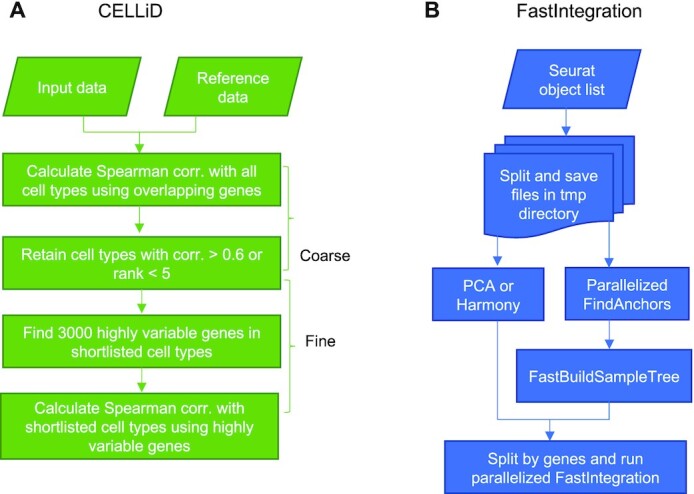
The ability to study cellular heterogeneity at single cell resolution is making single-cell sequencing increasingly popular. However, there is no publicly available resource that offers an integrated cell atlas with harmonized metadata that users can integrate new data with. Here, we present DISCO (https://www.immunesinglecell.org/), a database of Deeply Integrated Single-Cell Omics data. The current release of DISCO integrates more than 18 million cells from 4593 samples, covering 107 tissues/cell lines/organoids, 158 diseases, and 20 platforms. We standardized the associated metadata with a controlled vocabulary and ontology system. To allow large scale integration of single-cell data, we developed FastIntegration, a fast and high-capacity version of Seurat Integration. We also developed CELLiD, an atlas guided automatic cell type identification tool. Employing these two tools on the assembled data, we constructed one global atlas and 27 sub-atlases for different tissues, diseases, and cell types. DISCO provides three online tools, namely Online FastIntegration, Online CELLiD, and CellMapper, for users to integrate, annotate, and project uploaded single-cell RNA-seq data onto a selected atlas. Collectively, DISCO is a versatile platform for users to explore published single-cell data and efficiently perform integrated analysis with their own data.
Overview
The claims and statistics of this paper haven’t been checked yet.
Free: it reads the open-access text and checks the first 5 claims that cite a source we can check. Create a free account to check every claim.
Integrity signals
Registry
Cites
Statistics
Figures


Verification
Claims the paper makes
The claims and statistics of this paper haven’t been checked yet.
Free: it reads the open-access text and checks the first 5 claims that cite a source we can check. Create a free account to check every claim.
Self-check
Percentages, sums and reported differences re-computed from the paper’s own numbers.
The self-check needs the paper’s full text.
Citations
Cites
STAR: ultrafast universal RNA-seq aligner
Dobin, A., Davis, C. A., Schlesinger, F., Drenkow, J., Zaleski, C., Jha, S., Batut, P., Chaisson, M., & Gingeras, T. R. (2013) · Bioinformatics · doi:10.1093/bioinformatics/bts635 · Cited by 51,709
featureCounts: an efficient general purpose program for assigning sequence reads to genomic features
Liao, Y., Smyth, G. K., & Shi, W. (2014) · Bioinformatics · doi:10.1093/bioinformatics/btt656 · Cited by 27,219
Integrated analysis of multimodal single-cell data
Hao, Y., Hao, S., Andersen-Nissen, E., Mauck, W. M., Zheng, S., Butler, A., Lee, M. J., Wilk, A. J., Darby, C., Zagar, M., et al. (2020) · doi:10.1101/2020.10.12.335331 · Cited by 15,508
Fast, sensitive and accurate integration of single-cell data with Harmony
Korsunsky, I., Millard, N., Fan, J., Slowikowski, K., Zhang, F., Wei, K., Baglaenko, Y., Brenner, M., Loh, P.-R., & Raychaudhuri, S. (2019) · Nature Methods · doi:10.1038/s41592-019-0619-0 · Cited by 10,488 · cited 1×
“While Harmony was ranked higher overall than Seurat, it does not provide batch corrected gene expression values (20), which hinders downstream analysis, including the identification of differentially expressed genes and inference of regulatory networks.”
NCBI GEO: archive for functional genomics data sets—update
Barrett, T., Wilhite, S. E., Ledoux, P., Evangelista, C., Kim, I. F., Tomashevsky, M., Marshall, K. A., Phillippy, K. H., Sherman, P. M., Holko, M., et al. (2012) · Nucleic Acids Research · doi:10.1093/nar/gks1193 · Cited by 10,418
Massively parallel digital transcriptional profiling of single cells
Zheng, G. X. Y., Terry, J. M., Belgrader, P., Ryvkin, P., Bent, Z. W., Wilson, R., Ziraldo, S. B., Wheeler, T. D., McDermott, G. P., Zhu, J., et al. (2017) · Nature Communications · doi:10.1038/ncomms14049 · Cited by 7,353
UMAP: Uniform Manifold Approximation and Projection for Dimension Reduction
McInnes, L., Healy, J., & Melville, J. (2018) · arXiv · doi:10.48550/arxiv.1802.03426 · Cited by 7,101
Full-length RNA-seq from single cells using Smart-seq2
Picelli, S., Faridani, O. R., Björklund, Å. K., Winberg, G., Sagasser, S., & Sandberg, R. (2014) · Nature Protocols · doi:10.1038/nprot.2014.006 · Cited by 4,137
Smith, T., Heger, A., & Sudbery, I. (2017) · Genome Research · doi:10.1101/gr.209601.116 · Cited by 2,143
Single-cell RNA sequencing technologies and bioinformatics pipelines
Hwang, B., Lee, J. H., & Bang, D. (2018) · Experimental & Molecular Medicine · doi:10.1038/s12276-018-0071-8 · Cited by 1,781
Cited by
An integrated cell atlas of the lung in health and disease
Sikkema, L., Ramírez-Suástegui, C., Strobl, D. C., Gillett, T. E., Zappia, L., Madissoon, E., Markov, N. S., Zaragosi, L.-E., Ji, Y., Ansari, M., et al. (2023) · Nature Medicine · doi:10.1038/s41591-023-02327-2 · Cited by 854
Long, Y., Ang, K. S., Li, M., Chong, K. L. K., Sethi, R., Zhong, C., Xu, H., Ong, Z., Sachaphibulkij, K., Chen, A., et al. (2023) · Nature Communications · doi:10.1038/s41467-023-36796-3 · Cited by 700
“We next applied GraphST to deconvolute the cell types present in each spot by mapping cells from the DISCO scRNA-Seq human breast tissue atlas 47 onto the breast cancer ST dataset (Fig.”
Self-citationHan, Y., Wang, Y., Dong, X., Sun, D., Liu, Z., Yue, J., Wang, H., Li, T., & Wang, C. (2023) · Nucleic Acids Research · doi:10.1093/nar/gkac959 · Cited by 630
Large-scale foundation model on single-cell transcriptomics
Hao, M., Gong, J., Zeng, X., Liu, C., Guo, Y., Cheng, X., Wang, T., Ma, J., Zhang, X., & Song, L. (2024) · Nature Methods · doi:10.1038/s41592-024-02305-7 · Cited by 628
Self-citationAutomatic cell-type harmonization and integration across Human Cell Atlas datasets
Xu, C., Prete, M., Webb, S., Jardine, L., Stewart, B. J., Hoo, R., He, P., Meyer, K. B., & Teichmann, S. A. (2023) · Cell · doi:10.1016/j.cell.2023.11.026 · Cited by 284
Metadata
- Authors
- Li, M., Zhang, X., Ang, K. S., Ling, J., Sethi, R., Lee, N. Y. S., Ginhoux, F., & Chen, J.
- Affiliations
- Agency for Science, Technology and Research (SG)
- Corresponding author
- Chen, Jinmiao
- ORCID
- Venue
- Nucleic Acids Research
- Publisher
- Oxford University Press (OUP)
- Published
- 2021-11-17
- Volume
- 50
- Issue
- D1
- Pages
- D596-D602
- ISSN
- 0305-1048 (ISSN-L)
- 1362-4962
- PMC
- PMC8728243
- OpenAlex
- W3211595762
- Cited by
- 205
- References
- 22
- Citations by year
- 2026: 47 · 2025: 61 · 2024: 57 · 2023: 26 · 2022: 14
- FWCI
- 7.76
- Type
- journal article
- Language
- en
- Open access
- gold
- doi.org
- Licence
- Locations
- Nucleic Acids Research (publishedVersion, cc-by-nc)
- PubMed Central (publishedVersion, cc-by-nc)
- PubMed (publishedVersion)
- Funders
- Open Fund Individual Research (MOH-OFIRG18nov-2013)
- Topics
- Life Sciences › Biochemistry, Genetics and Molecular Biology › Molecular Biology › Single-cell and spatial transcriptomics
- Life Sciences › Biochemistry, Genetics and Molecular Biology › Molecular Biology › Bioinformatics and Genomic Networks
- Life Sciences › Biochemistry, Genetics and Molecular Biology › Molecular Biology › Genomics and Phylogenetic Studies
- Keywords
- single-cell omics, single-cell RNA sequencing, single-cell data integration, cell atlas, metadata harmonization, controlled vocabulary, ontology (information science), cell type annotation, cellular heterogeneity
- MeSH terms
- RNA-Seq, Humans, Organ Specificity, Software, Cell Lineage, Genetic Diseases, Inborn, Databases, Genetic, Single-Cell Analysis
About these checks
Registry, retraction, Cites and statistics results are computed, not judged, with one exception: a printed reference that no index lists is read once by a model before it counts as a citation error. Claims are extracted by a model and kept only when their quote appears verbatim in the text; each cited source is then checked, with a model’s help, for whether it says what the claim relies on. Those verdicts can be wrong — read the claim’s quote and the cited source before relying on one.
Statistics and arithmetic are recomputed, not judged.
Confidence bands are shown only for fields calibrated on our annotated test set. None is calibrated yet, so no band is shown.
What counts as a claim ›How we measure confidence ›How we check this ›
Are you an author, or do you see a problem with this page? Request a review
How to cite
Cite CoChat for the checks on this page, and the paper for its own findings.
- This page
- CoChat. (2026). Citation check: DISCO: a database of Deeply Integrated human Single-Cell Omics data. https://app.cochat.ai/papers/10.1093/nar/gkab1020
- The paper
- Li, M., Zhang, X., Ang, K. S., Ling, J., Sethi, R., Lee, N. Y. S., Ginhoux, F., & Chen, J. (2022). DISCO: a database of Deeply Integrated human Single-Cell Omics data. Nucleic Acids Research. https://doi.org/10.1093/nar/gkab1020
Data sources
Bibliographic data: Semantic Scholar, OpenAlex, Crossref.
Contains information from the Semantic Scholar Academic Graph Datasets, made available under the ODC Attribution License (ODC-BY 1.0).
Semantic Scholar’s data is described in: Kinney, R., et al. (2023). The Semantic Scholar Open Data Platform. arXiv:2301.10140.
