

The DOI matches its Crossref record; 40 of the 41 references it cites were found in a registry or an index.
UniProt: the Universal Protein Knowledgebase in 2023
Open accessAbstract
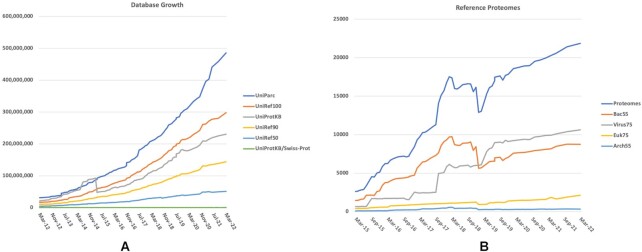
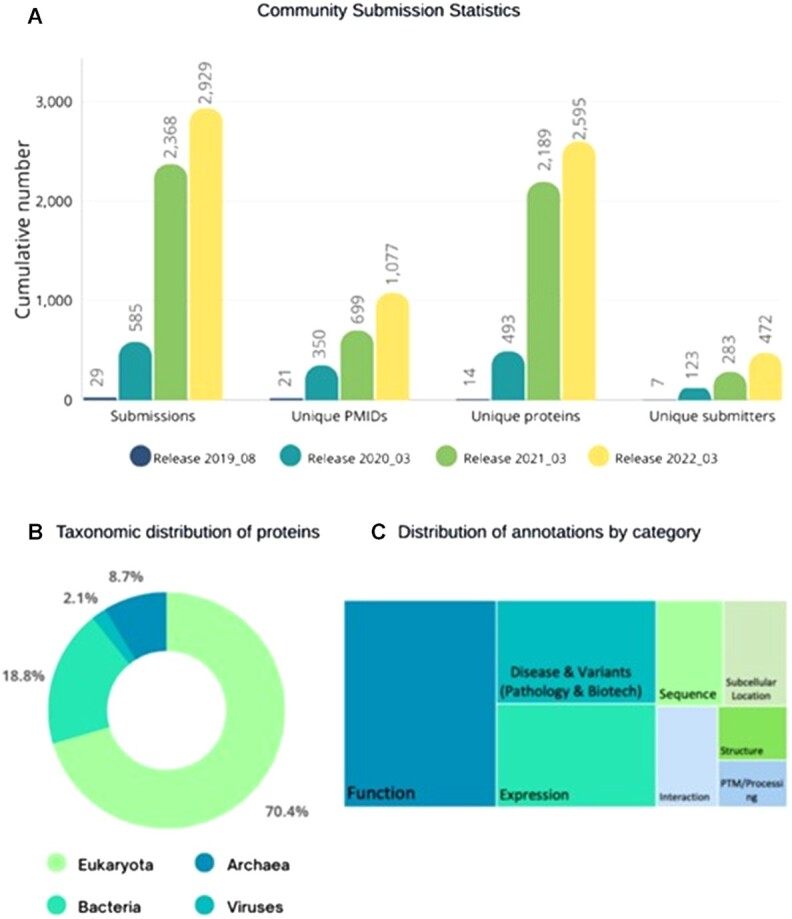
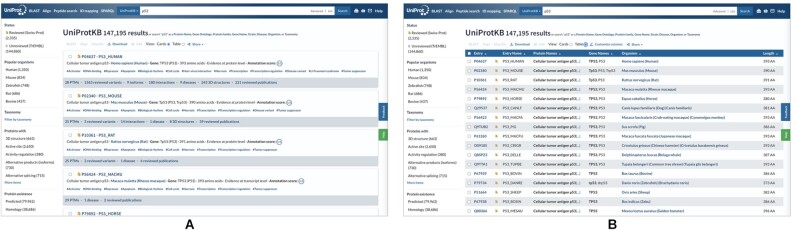
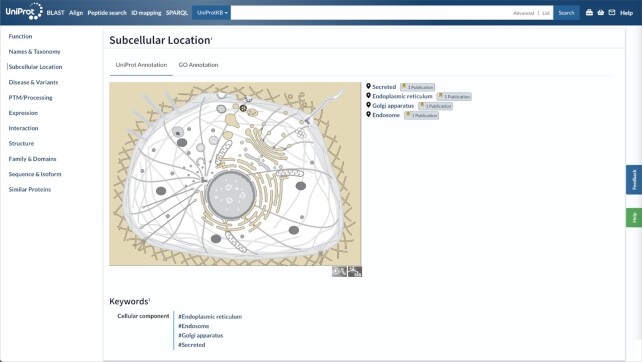
The aim of the UniProt Knowledgebase is to provide users with a comprehensive, high-quality and freely accessible set of protein sequences annotated with functional information. In this publication we describe enhancements made to our data processing pipeline and to our website to adapt to an ever-increasing information content. The number of sequences in UniProtKB has risen to over 227 million and we are working towards including a reference proteome for each taxonomic group. We continue to extract detailed annotations from the literature to update or create reviewed entries, while unreviewed entries are supplemented with annotations provided by automated systems using a variety of machine-learning techniques. In addition, the scientific community continues their contributions of publications and annotations to UniProt entries of their interest. Finally, we describe our new website (https://www.uniprot.org/), designed to enhance our users' experience and make our data easily accessible to the research community. This interface includes access to AlphaFold structures for more than 85% of all entries as well as improved visualisations for subcellular localisation of proteins.
Overview
The claims and statistics of this paper haven’t been checked yet.
Run the check — free, no account needed. It reads the open-access text and checks the sources it cites.
Integrity signals
Registry
Cites
Statistics
Figures
Verification
Claims the paper makes
The claims and statistics of this paper haven’t been checked yet.
Run the check — free, no account needed. It reads the open-access text and checks the sources it cites.
Claims other papers make about this one
Each is checked against this paper’s own text: does it say what the citing paper says it does?
The cited source says what the claim attributes to it.
In the citing paper
“The impact of the predicted structures is further enhanced by their seamless integration into several core data resources, including PDBe-KB (17), UniProt (6), Ensembl (16), InterPro (15), Genecards (24) and MobiDB (25), among others.”
From AlphaFold Protein Structure Database in 2024: providing structure coverage for over 214 million protein sequences (2024) · cites this paper as [6]
The check wasn’t confident either way, so it gives no verdict — never disputed.
In the citing paper
“of the 51 human PX domain-containing proteins, 26 possess a serine or threonine at positions corresponding to SNX17 S38 or SNX3 S72 (38, 42)”
From Phosphorylation of SNX17 impedes activation of Retriever-mediated sorting (2025) · cites this paper as [42]
Experimental — accuracy not yet measured
Self-check
Percentages, sums and reported differences re-computed from the paper’s own numbers.
The self-check needs the paper’s full text.
Citations
Cites
Database resources of the National Center for Biotechnology Information: update
Wheeler, D. L. (2003) · Nucleic Acids Research · doi:10.1093/nar/gkh073 · Cited by 10,695
Varadi, M., Anyango, S., Deshpande, M., Nair, S., Natassia, C., Yordanova, G., Yuan, D., Stroe, O., Wood, G., Laydon, A., et al. (2022) · Nucleic Acids Research · doi:10.1093/nar/gkab1061 · Cited by 7,850 · cited 1×
“Over 85% of UniProt entries now contain a predicted protein structure, provided by AlphaFold, an artificial intelligence system developed by DeepMind that makes predictions of protein structures from their amino-acid sequences (1).”
BackgroundUniProt: the universal protein knowledgebase in 2021
The UniProt Consortium, Bateman, A., Martin, M.-J., Orchard, S., Magrane, M., Agivetova, R., Ahmad, S., Alpi, E., Bowler-Barnett, E. H., Britto, R., et al. (2021) · Nucleic Acids Research · doi:10.1093/nar/gkaa1100 · Cited by 6,372
Self-citationDatabase resources of the national center for biotechnology information
Sayers, E. W., Bolton, E. E., Brister, J. R., Canese, K., Chan, J., Comeau, D. C., Connor, R., Funk, K., Kelly, C., Kim, S., et al. (2022) · Nucleic Acids Research · doi:10.1093/nar/gkab1112 · Cited by 2,812
Paysan‐Lafosse, T., Blum, M., Chuguransky, S., Grego, T., Pinto, B. L., Salazar, G. A., Bileschi, M. L., Bork, P., Bridge, A. J., Colwell, L. J., et al. (2022) · Nucleic Acids Research · doi:10.1093/nar/gkac993 · Cited by 2,457
Self-citationCunningham, F., Allen, J. E., Allen, J., Alvarez-Jarreta, J., Amode, M. R., Armean, I. M., Austine-Orimoloye, O., Azov, A. G., Barnes, I., Bennett, R., et al. (2022) · Nucleic Acids Research · doi:10.1093/nar/gkab1049 · Cited by 1,923
Burley, S. K., Bhikadiya, C., Bi, C., Bittrich, S., Chen, L., Crichlow, G. V., Christie, C. H., Dalenberg, K., Di Costanzo, L., Duarte, J. M., et al. (2021) · Nucleic Acids Research · doi:10.1093/nar/gkaa1038 · Cited by 1,581
ChEBI in 2016: Improved services and an expanding collection of metabolites
Hastings, J., Owen, G., Dekker, A., Ennis, M., Kale, N., Muthukrishnan, V., Turner, S., Swainston, N., Mendes, P., & Steinbeck, C. (2016) · Nucleic Acids Research · doi:10.1093/nar/gkv1031 · Cited by 1,083
Self-citationMetabolomics: A New Tool to Reveal the Nature of Diabetic Kidney Disease
Huang, G., Li, M., Li, Y. J., & Mao, Y. (2022) · Laboratory Medicine · doi:10.1093/labmed/lmac041 · Cited by 933
BioLiP: a semi-manually curated database for biologically relevant ligand–protein interactions
Yang, J., Roy, A., & Zhang, Y. (2012) · Nucleic Acids Research · doi:10.1093/nar/gks966 · Cited by 749
Research works printed but not linked: 1
- Paysan-Lafosse, 2022, InterProin 2022, Nucleic Acids Res.
Cited by
Sorted by citations
UCSF ChimeraX : Tools for structure building and analysis
Meng, E. C., Goddard, T. D., Pettersen, E. F., Couch, G. S., Pearson, Z., Morris, J. H., & Ferrin, T. E. (2023) · Protein Science · doi:10.1002/pro.4792 · Cited by 4,706
UniProt: the Universal Protein Knowledgebase in 2025
The UniProt Consortium, Bateman, A., Martin, M.-J., Orchard, S., Magrane, M., Adesina, A., Ahmad, S., Bowler-Barnett, E. H., Bye-A-Jee, H., Carpentier, D., et al. (2025) · Nucleic Acids Research · doi:10.1093/nar/gkae1010 · Cited by 2,537
Self-citationVaradi, M., Bertoni, D., Magana, P., Paramval, U., Pidruchna, I., Radhakrishnan, M., Tsenkov, M., Nair, S., Mirdita, M., Yeo, J., et al. (2024) · Nucleic Acids Research · doi:10.1093/nar/gkad1011 · Cited by 2,052
The PRIDE database at 20 years: 2025 update
Pérez‐Riverol, Y., Bandla, C., Kundu, D. J., Kamatchinathan, S., Bai, J., Hewapathirana, S., John, N. S., Prakash, A., Walzer, M., Wang, S., et al. (2024) · Nucleic Acids Research · doi:10.1093/nar/gkae1011 · Cited by 2,140
The EMBL-EBI Job Dispatcher sequence analysis tools framework in 2024
Madeira, F., Madhusoodanan, N., Lee, J., Eusebi, A., Niewielska, A., Tivey, A. R., López, R., & Butcher, S. (2024) · Nucleic Acids Research · doi:10.1093/nar/gkae241 · Cited by 1,871
Self-citation
Metadata
- Authors
- The UniProt Consortium, Bateman, A., Martin, M.-J., Orchard, S., Magrane, M., Ahmad, S., Alpi, E., Bowler-Barnett, E. H., Britto, R., Bye-A-Jee, H., Cukura, A., Denny, P., Dogan, T., Ebenezer, T., Fan, J., Garmiri, P., da Costa Gonzales, L. J., Hatton-Ellis, E., Hussein, A., Ignatchenko, A., Insana, G., Ishtiaq, R., Joshi, V., Jyothi, D., Kandasaamy, S., Lock, A., Luciani, A., Lugaric, M., Luo, J., Lussi, Y., MacDougall, A., Madeira, F., Mahmoudy, M., Mishra, A., Moulang, K., Nightingale, A., Pundir, S., Qi, G., Raj, S., Raposo, P., Rice, D. L., Saidi, R., Santos, R., Speretta, E., Stephenson, J., Totoo, P., Turner, E., Tyagi, N., Vasudev, P., Warner, K., Watkins, X., Zaru, R., Zellner, H., Bridge, A. J., Aimo, L., Argoud-Puy, G., Auchincloss, A. H., Axelsen, K. B., Bansal, P., Baratin, D., Batista Neto, T. M., Blatter, M.-C., Bolleman, J. T., Boutet, E., Breuza, L., Gil, B. C., Casals-Casas, C., Echioukh, K. C., Coudert, E., Cuche, B., de Castro, E., Estreicher, A., Famiglietti, M. L., Feuermann, M., Gasteiger, E., Gaudet, P., Gehant, S., Gerritsen, V., Gos, A., Gruaz, N., Hulo, C., Hyka-Nouspikel, N., Jungo, F., Kerhornou, A., Le Mercier, P., Lieberherr, D., Masson, P., Morgat, A., Muthukrishnan, V., Paesano, S., Pedruzzi, I., Pilbout, S., Pourcel, L., Poux, S., Pozzato, M., Pruess, M., Redaschi, N., Rivoire, C., Sigrist, C. J. A., Sonesson, K., Sundaram, S., Wu, C. H., Arighi, C. N., Arminski, L., Chen, C., Chen, Y., Huang, H., Laiho, K., McGarvey, P., Natale, D. A., Ross, K., Vinayaka, C. R., Wang, Q., Wang, Y., & Zhang, J.
- ORCID
- Bateman, Alex
- Martin, Maria-Jesus
- Orchard, Sandra
- Magrane, Michele
- Ahmad, Shadab
- Alpi, Emanuele
- Bowler-Barnett, Emily H
- Britto, Ramona
- Denny, Paul
- Ebenezer, ThankGod
- Fan, Jun
- Garmiri, Penelope
- Hatton-Ellis, Emma
- Hussein, Abdulrahman
- Ignatchenko, Alexandr
- Insana, Giuseppe
- Ishtiaq, Rizwan
- Joshi, Vishal
- Jyothi, Dushyanth
- Kandasaamy, Swaathi
- Lock, Antonia
- Luo, Jie
- Lussi, Yvonne
- Nightingale, Andrew
- Pundir, Sangya
- Qi, Guoying
- Raj, Shriya
- Raposo, Pedro
- Rice, Daniel L
- Saidi, Rabie
- Santos, Rafael
- Speretta, Elena
- Stephenson, James
- Totoo, Prabhat
- Tyagi, Nidhi
- Warner, Kate
- Watkins, Xavier
- Zaru, Rossana
- Bridge, Alan J
- Aimo, Lucila
- Auchincloss, Andrea H
- Axelsen, Kristian B
- Bansal, Parit
- Baratin, Delphine
- Blatter, Marie-Claude
- Bolleman, Jerven T
- Boutet, Emmanuel
- Breuza, Lionel
- Gil, Blanca Cabrera
- Coudert, Elisabeth
- Cuche, Beatrice
- de Castro, Edouard
- Estreicher, Anne
- Famiglietti, Maria L
- Feuermann, Marc
- Gasteiger, Elisabeth
- Gaudet, Pascale
- Gos, Arnaud
- Hulo, Chantal
- Jungo, Florence
- Kerhornou, Arnaud
- Lieberherr, Damien
- Masson, Patrick
- Morgat, Anne
- Muthukrishnan, Venkatesh
- Pedruzzi, Ivo
- Pourcel, Lucille
- Poux, Sylvain
- Pozzato, Monica
- Redaschi, Nicole
- Rivoire, Catherine
- Sigrist, Christian J A
- Sundaram, Shyamala
- Wu, Cathy H
- Arighi, Cecilia N
- Chen, Chuming
- Huang, Hongzhan
- McGarvey, Peter
- Natale, Darren A
- Ross, Karen
- Wang, Qinghua
- Wang, Yuqi
- Zhang, Jian
- Venue
- Nucleic Acids Research
- Publisher
- Oxford University Press (OUP)
- Published
- 2022-11-21
- Volume
- 51
- Issue
- D1
- Pages
- D523-D531
- ISSN
- 0305-1048 (ISSN-L)
- 1362-4962
- PMC
- PMC9825514
- OpenAlex
- W4309506674
- Cited by
- 7,210
- References
- 41
- Citations by year
- 2026: 1511 · 2025: 2294 · 2024: 2343 · 2023: 887 · 2022: 78
- FWCI
- 464.54
- Type
- journal article
- Language
- en
- Open access
- gold
- doi.org
- Licence
- Locations
- Nucleic Acids Research (publishedVersion, cc-by)
- PubMed Central (publishedVersion, cc-by)
- PubMed (publishedVersion)
- Funders
- National Human Genome Research Institute (OD/DPCPSI/ODSS)
- National Institute of Allergy and Infectious Diseases
- National Institute on Aging
- National Institute of General Medical Sciences
- National Institute of Diabetes and Digestive and Kidney Diseases
- National Eye Institute
- National Cancer Institute
- National Heart, Lung, and Blood Institute
- National Institutes of Health (U24HG007822)
- NHGRI NIH (HG002273)
- Biotechnology and Biological Sciences Research Council (BB/T010541/1, BB/S01781X/1)
- Open Targets
- SERI
- European Molecular Biology Laboratory
- Topics
- Life Sciences › Biochemistry, Genetics and Molecular Biology › Molecular Biology › Genomics and Phylogenetic Studies
- Life Sciences › Biochemistry, Genetics and Molecular Biology › Molecular Biology › Bioinformatics and Genomic Networks
- Life Sciences › Biochemistry, Genetics and Molecular Biology › Molecular Biology › Machine Learning in Bioinformatics
- Keywords
- protein sequence annotation, reference proteomes, machine learning annotation, AlphaFold protein structure, subcellular localization, data pipelines
- MeSH terms
- Machine Learning, Amino Acid Sequence, Proteome, Databases, Protein, Knowledge Bases
About these checks
Registry, retraction, Cites and statistics results are computed, not judged, with one exception: a printed reference that no index lists is read once by a model before it counts as a citation error. Claims are extracted by a model and kept only when their quote appears verbatim in the text; each cited source is then checked, with a model’s help, for whether it says what the claim relies on. Those verdicts can be wrong — read the claim’s quote and the cited source before relying on one.
Statistics and arithmetic are recomputed, not judged.
Confidence bands are shown only for fields calibrated on our annotated test set. None is calibrated yet, so no band is shown.
What counts as a claim ›How we measure confidence ›How we check this ›
Are you an author, or do you see a problem with this page? Request a review
