

Long-range activation of FKBP51 transcription by the androgen receptor via distal intronic enhancers
Open accessThe DOI matches its Crossref record; 57 of the 57 references it cites were found in a registry or an index.
Abstract
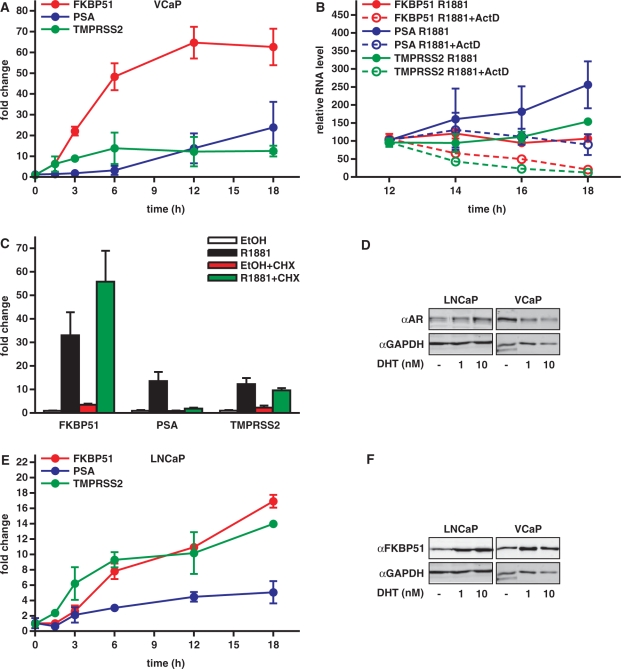
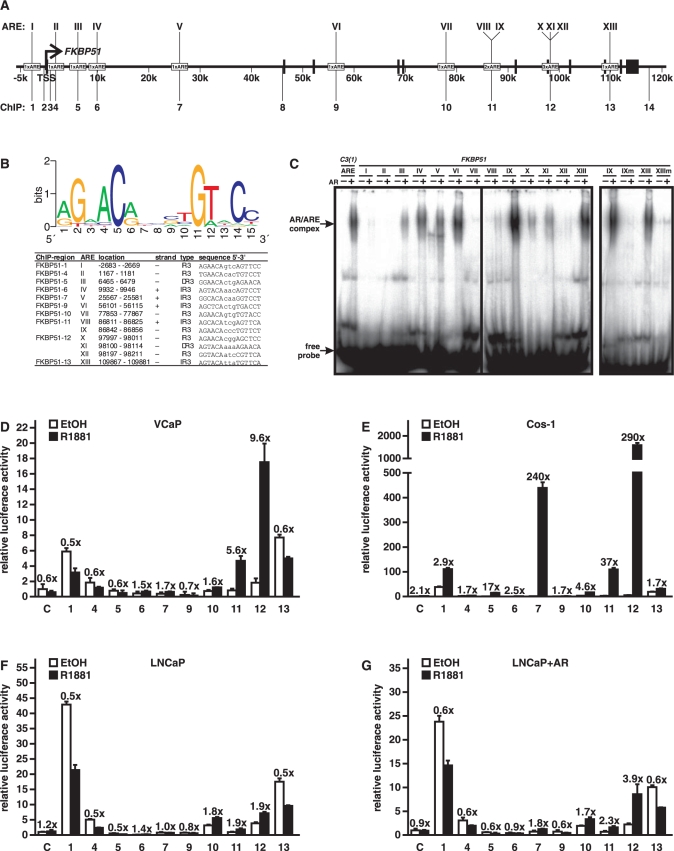
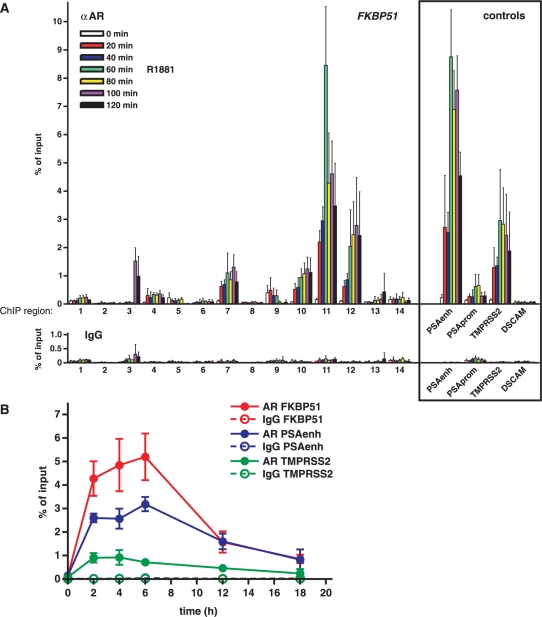
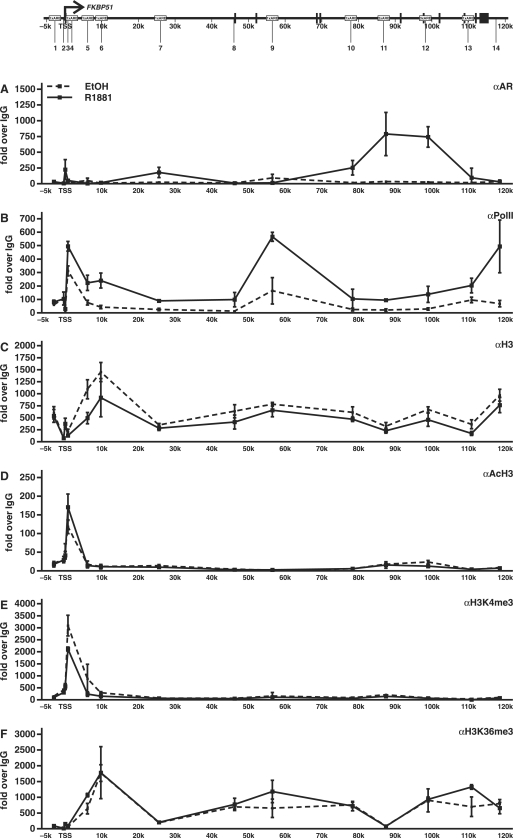
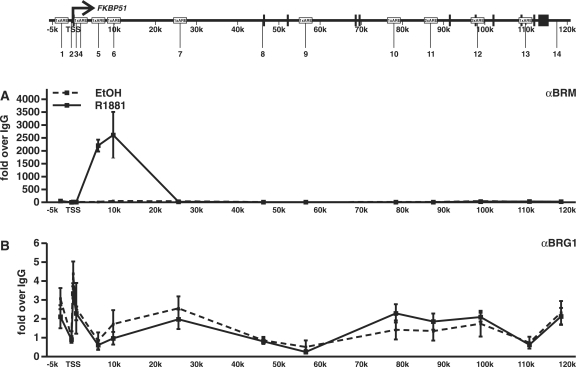
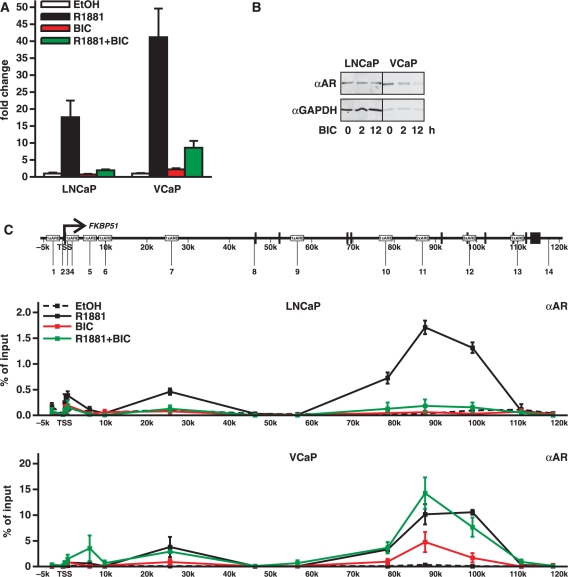
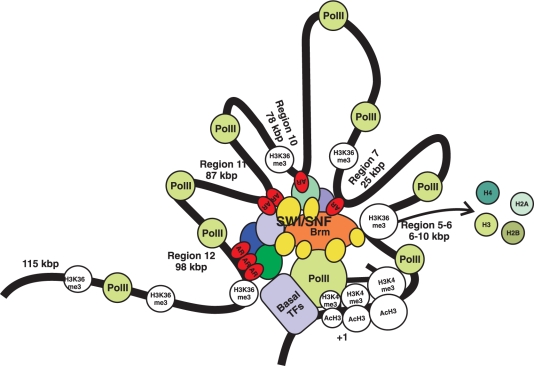
Androgen receptor (AR) is a ligand-controlled transcription factor frequently deregulated in prostate carcinomas. Since there is scarce information on the action of AR on the chromatin level, we have elucidated the molecular mechanisms underlying the androgen-dependent regulation of immunophilin FKBP51 in prostate cancer cells. In comparison to the canonical AR target PSA, FKBP51 is more rapidly and strongly induced by androgen, with the regulation occurring merely at the transcriptional level. FKBP51 locus harbors 13 in silico-predicted androgen response elements (AREs), with most of them located downstream from transcription start site (TSS) and capable of binding AR in vitro. Chromatin immunoprecipitation assays in VCaP and LNCaP prostate cancer cells indicate that activation of the locus by the AR relies on four major intronic sites, with the compound ARE-containing sites >or=90 kb downstream from the TSS playing critical roles. Binding of agonist-loaded AR onto these sites in vivo was accompanied with significant recruitment of RNA polymerase II and BRM-containing chromatin remodeling complexes to the FKBP51 locus, which resulted in changes in the histone density of the locus. Our results indicate that very distal AREs act as genuine and robust enhancers, highlighting the importance of long-range regulation of transcription by the AR.
Overview
The claims and statistics of this paper haven’t been checked yet.
Free: it reads the open-access text and checks the first 5 claims that cite a source we can check. Create a free account to check every claim.
Integrity signals
Registry
Cites
Statistics
Figures
Verification
Claims the paper makes
The claims and statistics of this paper haven’t been checked yet.
Free: it reads the open-access text and checks the first 5 claims that cite a source we can check. Create a free account to check every claim.
Claims other papers make about this one
Each is checked against this paper’s own text: does it say what the citing paper says it does?
The cited source says what the claim attributes to it.
In the citing paper
“both natural androgens (dihydrotestosterone) and synthetic analogs (R1881) cause upregulation of FKBP51 expression [20, 52-56] by a direct binding of AR to enhancer elements in the FKBP51 (fkbp5) gene [57, 58]”
From FKBP51 – a selective modulator of glucocorticoid and androgen sensitivity (2011) · cites this paper as [58]
Self-check
Percentages, sums and reported differences re-computed from the paper’s own numbers.
The self-check needs the paper’s full text.
Citations
Cites
Chromatin modifications and their function
Kouzarides, T. (2007) · Cell · doi:10.1016/j.cell.2007.02.005 · Cited by 10,883
The Role of Chromatin during Transcription
Li, B., Carey, M., & Workman, J. L. (2007) · Cell · doi:10.1016/j.cell.2007.01.015 · Cited by 3,533 · cited 3×
“Major epigenetic mechanisms that regulate chromatin structure include modifications of nucleosomes and DNA methylation (6,7).”
BackgroundMolecular determinants of resistance to antiandrogen therapy
Chen, C. D., Welsbie, D. S., Tran, C., Baek, S. H., Chen, R., Vessella, R., Rosenfeld, M. G., & Sawyers, C. L. (2004) · Nature Medicine · doi:10.1038/nm972 · Cited by 2,278 · cited 1×
“Since increased AR protein levels have been reported to convert antiandrogens, such as bicalutamide, to agonists (35), it was of interest to investigate whether the difference in the amount of AR between VCaP and LNCaP cells is manifested in a differential response to the pure antagonist bicalutamide (BIC).”
BackgroundActive Genes Are Tri-Methylated at K4 of Histone H3
Santos-Rosa, H., Schneider, R., Bannister, A. J., Sherriff, J., Bernstein, B. E., Emre, N. C. T., Schreiber, S. L., Mellor, J., & Kouzarides, T. (2002) · Nature · doi:10.1038/nature01080 · Cited by 2,138
Steroid Receptor Interactions with Heat Shock Protein and Immunophilin Chaperones*
Pratt, W. B., & Toft, D. O. (1997) · Endocrine Reviews · doi:10.1210/edrv.18.3.0303 · Cited by 1,791 · cited 2×
“FKBP51 (FKBP5) encodes a 51 kDa FK506-binding protein that belongs to the immunophilin protein family (41).”
BackgroundAndrogen Receptor in Prostate Cancer
Heinlein, C. A., & Chang, C. (2004) · Endocrine Reviews · doi:10.1210/er.2002-0032 · Cited by 1,780
Métivier, R., Penot, G., Hübner, M. R., Reid, G., Brand, H., Koš, M., & Gannon, F. (2003) · Cell · doi:10.1016/s0092-8674(03)00934-6 · Cited by 1,431
Genome-wide analysis of estrogen receptor binding sites
Carroll, J. S., Meyer, C. A., Song, J., Li, W., Geistlinger, T. R., Eeckhoute, J., Brodsky, A. S., Keeton, E. K., Fertuck, K. C., Hall, G. F., et al. (2006) · Nature Genetics · doi:10.1038/ng1901 · Cited by 1,377 · cited 1×
“For example, genome-wide screening of estrogen receptor binding sites by ChIP combined with tiled microarray analysis indicated that only a minority of estrogen receptor-binding sites localize within 1 kb promoter-proximal regions (52).”
BackgroundFoxA1 Translates Epigenetic Signatures into Enhancer-Driven Lineage-Specific Transcription
Lupien, M., Eeckhoute, J., Meyer, C. A., Wang, Q., Zhang, Y., Li, W., Carroll, J. S., Liu, X. S., & Brown, M. (2008) · Cell · doi:10.1016/j.cell.2008.01.018 · Cited by 983 · cited 1×
“The role of other ‘pioneering’ transcription factors binding close to steroid receptor-occupied sites may also be important (20,47), as GATA2 was shown to cooperate with the PR in the regulation of Fkbp51 (46).”
BackgroundRosenfeld, M. G., Lunyak, V. V., & Glass, C. K. (2006) · Genes & Development · doi:10.1101/gad.1424806 · Cited by 952
Cited by
The effects of early life stress on the epigenome: From the womb to adulthood and even before
Provençal, N., & Binder, E. B. (2015) · Experimental Neurology · doi:10.1016/j.expneurol.2014.09.001 · Cited by 255
Discovery of non-ETS gene fusions in human prostate cancer using next-generation RNA sequencing
Pflueger, D., Terry, S., Sboner, A., Habegger, L., Esgueva, R., Lin, P.-C., Svensson, M. A., Kitabayashi, N., Moss, B. J., MacDonald, T. Y., et al. (2011) · Genome Research · doi:10.1101/gr.110684.110 · Cited by 201
“Both of these 59 partners are known androgen-regulated genes (Makkonen et al. 2009), and KLK2 has been reported as a 59 gene fusion partner to ETV4 (Hermans et al. 2008).”
BackgroundSteroid up-regulation of FKBP51 and its role in hormone signaling
Jääskeläinen, T., Makkonen, H., & Palvimo, J. J. (2011) · Current Opinion in Pharmacology · doi:10.1016/j.coph.2011.04.006 · Cited by 167
Self-citationDeterminants of Receptor- and Tissue-Specific Actions in Androgen Signaling
Pihlajamaa, P., Sahu, B., & Jänne, O. A. (2015) · Endocrine Reviews · doi:10.1210/er.2015-1034 · Cited by 141
The role of FKBP5 in cancer aetiology and chemoresistance
Li, L., Lou, Z., & Wang, L. (2010) · British Journal of Cancer · doi:10.1038/sj.bjc.6606014 · Cited by 145
“…Febbo et al (2005) had identified FKBP5 as an androgen-inducible gene, and demonstrated a physical interaction between FKBP5 and AR. Recent studies have identified a long-range activation of FKBP5 transcription in prostate cancer cells by the AR via distal intronic enhancers (Makkonen et al, 2009).”
BackgroundInfluential
Metadata
- Authors
- Makkonen, H., Kauhanen, M., Paakinaho, V., Jääskeläinen, T., & Palvimo, J. J.
- Affiliations
- University of Eastern Finland (FI)
- Corresponding author
- Palvimo, Jorma J.
- Venue
- Nucleic Acids Research
- Publisher
- Oxford University Press (OUP)
- Published
- 2009-05-11
- Volume
- 37
- Issue
- 12
- Pages
- 4135-4148
- ISSN
- 0305-1048 (ISSN-L)
- 1362-4962
- PMC
- PMC2709584
- OpenAlex
- W2160770622
- Cited by
- 97
- References
- 57
- Citations by year
- 2026: 1 · 2025: 2 · 2024: 3 · 2023: 3 · 2022: 4 · 2021: 3 · 2020: 3 · 2019: 3 · 2018: 3 · 2017: 3 · 2016: 7 · 2015: 9 · 2014: 10 · 2013: 10 · 2012: 7
- FWCI
- 9.29
- Type
- journal article
- Language
- en
- Open access
- gold
- doi.org
- Licence
- Locations
- Nucleic Acids Research (publishedVersion, cc-by-nc)
- PubMed Central (publishedVersion, cc-by-nc)
- PubMed (publishedVersion)
- Topics
- Life Sciences › Biochemistry, Genetics and Molecular Biology › Cancer Research › Prostate Cancer Treatment and Research
- Life Sciences › Biochemistry, Genetics and Molecular Biology › Molecular Biology › Genomics and Chromatin Dynamics
- Life Sciences › Biochemistry, Genetics and Molecular Biology › Molecular Biology › Chromatin Remodeling and Cancer
- Keywords
- androgen receptor, FKBP51, immunophilins, long-range transcriptional regulation, androgen response element, prostate cancer, chromatin remodeling, BRM, RNA polymerase II recruitment, androgen-dependent gene expression
- MeSH terms
- Tacrolimus Binding Protein 5, Androgen Antagonists, Anilides, Binding Sites, Chromatin, Enhancer Elements, Genetic, Histones, Humans, Introns, Male, Nitriles, Prostatic Neoplasms, Receptors, Androgen, Tosyl Compounds, Transcription, Genetic, Transcriptional Activation, Metribolone, Gene Expression Regulation, Neoplastic, Tacrolimus Binding Proteins, Chromatin Assembly and Disassembly, Testosterone Congeners, Cell Line, Tumor
About these checks
Registry, retraction, Cites and statistics results are computed, not judged, with one exception: a printed reference that no index lists is read once by a model before it counts as a citation error. Claims are extracted by a model and kept only when their quote appears verbatim in the text; each cited source is then checked, with a model’s help, for whether it says what the claim relies on. Those verdicts can be wrong — read the claim’s quote and the cited source before relying on one.
Statistics and arithmetic are recomputed, not judged.
Confidence bands are shown only for fields calibrated on our annotated test set. None is calibrated yet, so no band is shown.
What counts as a claim ›How we measure confidence ›How we check this ›
Are you an author, or do you see a problem with this page? Request a review
Data sources
Bibliographic data: Semantic Scholar, OpenAlex, Crossref.
Contains information from the Semantic Scholar Academic Graph Datasets, made available under the ODC Attribution License (ODC-BY 1.0).
Semantic Scholar’s data is described in: Kinney, R., et al. (2023). The Semantic Scholar Open Data Platform. arXiv:2301.10140.
