

The DOI matches its Crossref record; 66 of the 66 references it cites were found in a registry or an index.
Neuron-specific ELAV/Hu proteins suppress HuR mRNA during neuronal differentiation by alternative polyadenylation
Open accessAbstract
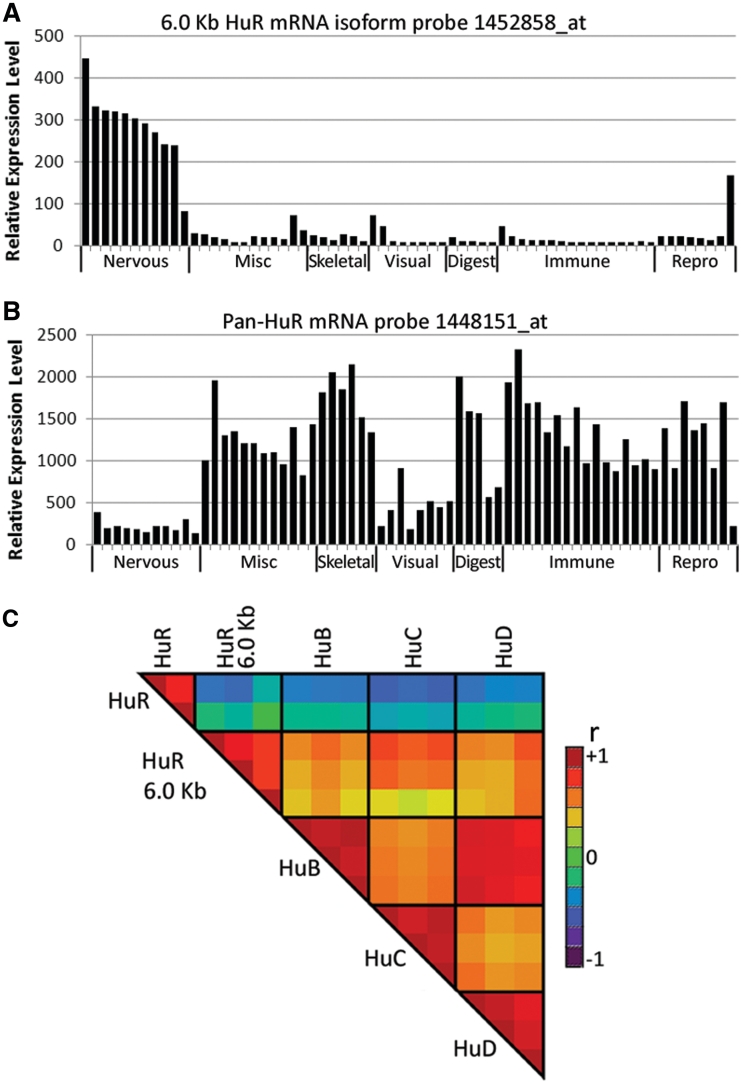
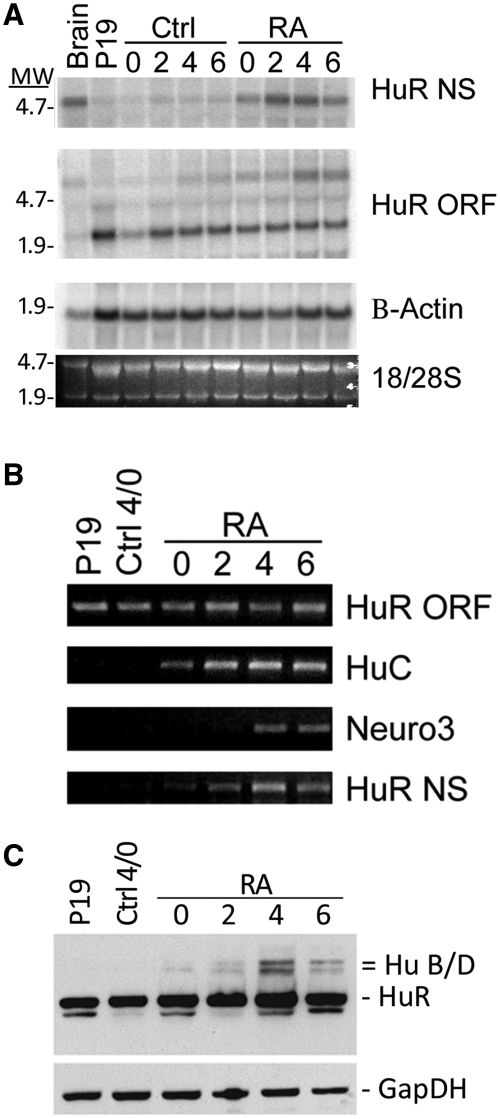
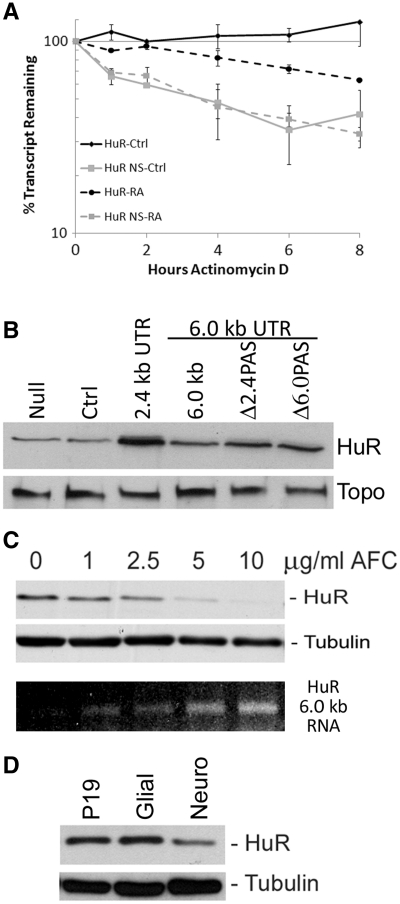
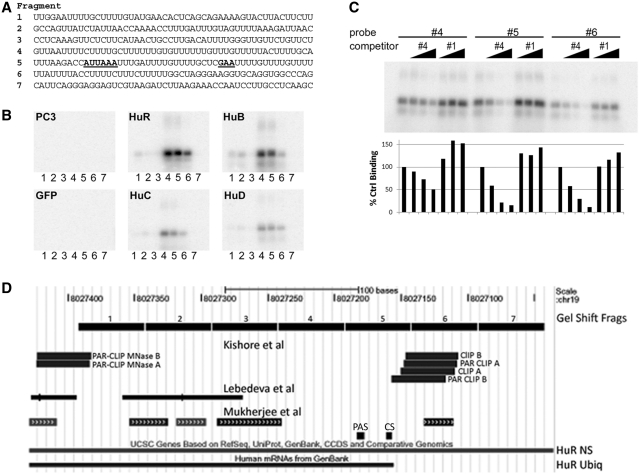
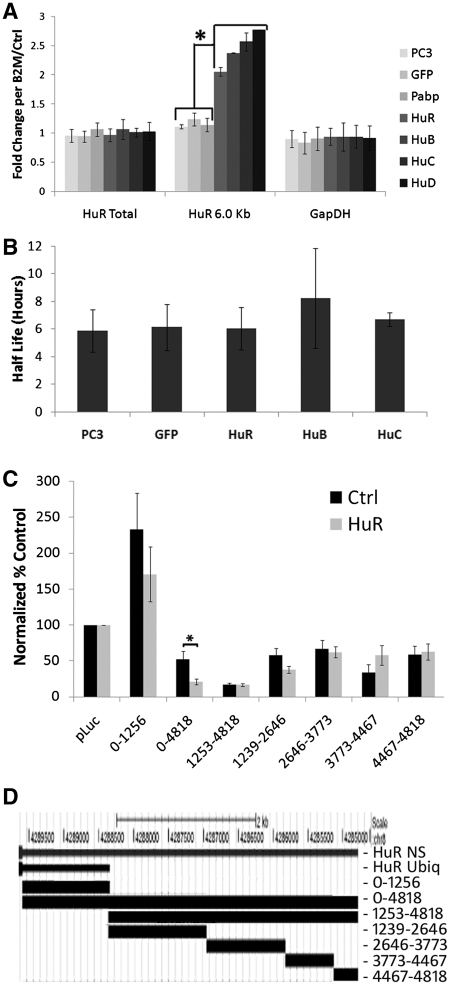
The ubiquitously expressed RNA-binding protein HuR increases the stability and translation of mRNAs encoding growth regulatory proteins that promote proliferation in a variety of cell types. However, the three neuron-specific ELAV/Hu proteins, HuB, HuC and HuD, while binding to the same types of mRNAs, are required instead for neuronal differentiation, and it becomes difficult to reconcile these contrary functions when all four Hu proteins are expressed in the same neuron. HuR mRNA exists as three alternatively polyadenylated variants, a 1.5-kb testes-specific mRNA isoform, a ubiquitous 2.4-kb isoform and a 6.0-kb isoform that we now show is induced during neuronal differentiation and appears to be neuron-specific. This 6.0-kb neuron-specific mRNA isoform is inherently less stable and produces less HuR protein than the ubiquitous 2.4-kb mRNA. Furthermore, we show that neuronal HuB, HuC and HuD, as well as HuR itself, can bind at the 2.4-kb mRNA polyadenylation site, and when overexpressed can affect alternative polyadenylation to generate an extended HuR 3'-UTR that is translationally suppressed. We propose that the regulation of HuR protein expression by alternative polyadenylation allows neurons to post-transcriptionally regulate mRNAs-encoding factors required for proliferation versus differentiation to facilitate neuronal differentiation.
Overview
The claims and statistics of this paper haven’t been checked yet.
Run the check — free, no account needed. It reads the open-access text and checks the sources it cites.
Integrity signals
Registry
Cites
Statistics
Figures
Verification
Claims the paper makes
The claims and statistics of this paper haven’t been checked yet.
Run the check — free, no account needed. It reads the open-access text and checks the sources it cites.
Claims other papers make about this one
Each is checked against this paper’s own text: does it say what the citing paper says it does?
The source backs part of the claim, not all of it — or backs it for a different population, condition or comparison.
In the citing paper
“All four Hu members were found to bind and block U-rich sequences near the 2.4-kb polyadenylation site and thereby promote expression of the 6.0-kb transcript.”
From Emerging complexity of the HuD/ELAVl4 gene; implications for neuronal development, function, and dysfunction (2013) · cites this paper as Mansfield and Keene 2011
Experimental — accuracy not yet measuredThe source backs part of the claim, not all of it — or backs it for a different population, condition or comparison.
In the citing paper
“Moreover, all four Hu proteins were recently demonstrated to differentially regulate alternative polyadenylation of HuR in neurons (Mansfield and Keene 2011; also see Dai et al. 2012).”
From Emerging complexity of the HuD/ELAVl4 gene; implications for neuronal development, function, and dysfunction (2013) · cites this paper as Mansfield and Keene 2011
Experimental — accuracy not yet measuredThe cited source says what the claim attributes to it.
In the citing paper
“Mansfield and Keene showed that there are three different HuR mRNA polyadenylation variants (1.5, 2.4, and 6.0 kb), which differ in 3′ UTR length.”
From Emerging complexity of the HuD/ELAVl4 gene; implications for neuronal development, function, and dysfunction (2013) · cites this paper as Mansfield and Keene 2011
The cited source says what the claim attributes to it.
In the citing paper
“Since the 6.0-kb variant is less stable and not as efficiently translated as the 2.4-kb transcript, the authors postulated that the reduction of HuR expression prevents HuR’s ability to promote proliferation and thereby permits neurons to terminally differentiate (Mansfield and Keene 2011).”
From Emerging complexity of the HuD/ELAVl4 gene; implications for neuronal development, function, and dysfunction (2013) · cites this paper as Mansfield and Keene 2011
Self-check
Percentages, sums and reported differences re-computed from the paper’s own numbers.
The self-check needs the paper’s full text.
Citations
Cites
BioGPS: an extensible and customizable portal for querying and organizing gene annotation resources
Wu, C., Orozco, C., Boyer, J., Leglise, M., Goodale, J., Batalov, S., Hodge, C. L., Haase, J., Janes, J. O., Huss, J. W., et al. (2009) · Genome biology · doi:10.1186/gb-2009-10-11-r130 · Cited by 1,392
An extensive network of coupling among gene expression machines
Maniatis, T., & Reed, R. (2002) · Nature · doi:10.1038/416499a · Cited by 1,148
Brennan, C. M., & Steitz*, J. A. (2001) · Cellular and Molecular Life Sciences · doi:10.1007/pl00000854 · Cited by 1,095
A large-scale analysis of mRNA polyadenylation of human and mouse genes
Tian, B. (2005) · Nucleic Acids Research · doi:10.1093/nar/gki158 · Cited by 970
RNA stabilization by the AU‐rich element binding protein, HuR, an ELAV protein
Peng, S., Chen, C. A., Xu, N., & Shyu, A. (1998) · The EMBO Journal · doi:10.1093/emboj/17.12.3461 · Cited by 739
Transcriptome-wide Analysis of Regulatory Interactions of the RNA-Binding Protein HuR
Lebedeva, S., Jens, M., Theil, K., Schwanhäusser, B., Selbach, M., Landthaler, M., & Rajewsky, N. (2011) · Molecular Cell · doi:10.1016/j.molcel.2011.06.008 · Cited by 716
Mukherjee, N., Corcoran, D. L., Nusbaum, J. D., Reid, D. W., Georgiev, S., Hafner, M., Ascano, M., Tuschl, T., Ohler, U., & Keene, J. D. (2011) · Molecular Cell · doi:10.1016/j.molcel.2011.06.007 · Cited by 654
Self-citationJi, Z., Lee, J. Y., Pan, Z., Jiang, B., & Tian, B. (2009) · Proceedings of the National Academy of Sciences · doi:10.1073/pnas.0900028106 · Cited by 609
Diverse molecular functions of Hu proteins
Hinman, M. N., & Lou, H. (2008) · Cellular and Molecular Life Sciences · doi:10.1007/s00018-008-8252-6 · Cited by 587
HuR recruits let-7/RISC to repress c-Myc expressionPreprint
Kim, H. H., Kuwano, Y., Srikantan, S., Lee, E. K., Martindale, J. L., & Gorospe, M. (2009) · Genes & Development · doi:10.1101/gad.1812509 · Cited by 570
Cited by
Sorted by citations
Alternative polyadenylation of mRNA precursors
Tian, B., & Manley, J. L. (2017) · Nature Reviews Molecular Cell Biology · doi:10.1038/nrm.2016.116 · Cited by 1,179
Alternative cleavage and polyadenylation: extent, regulation and function
Elkon, R., Ugalde, A. P., & Agami, R. (2013) · Nature Reviews Genetics · doi:10.1038/nrg3482 · Cited by 816
Alternative cleavage and polyadenylation: the long and short of it
Tian, B., & Manley, J. L. (2013) · Trends in Biochemical Sciences · doi:10.1016/j.tibs.2013.03.005 · Cited by 319
Wang, J., Guo, Y., Chu, H., Guan, Y., Bi, J., & Wang, B. (2013) · International Journal of Molecular Sciences · doi:10.3390/ijms140510015 · Cited by 290
Human-Specific Transcriptional Networks in the Brain
Konopka, G., Friedrich, T., Davis‐Turak, J., Winden, K. D., Oldham, M. C., Gao, F., Chen, L., Wang, G.-Z., Luo, R., Preuss, T. M., et al. (2012) · Neuron · doi:10.1016/j.neuron.2012.05.034 · Cited by 268
Metadata
- Authors
- Mansfield, K. D., & Keene, J. D.
- Affiliations
- Duke University (US)
- Corresponding author
- Mansfield, Kyle D.
- ORCID
- Mansfield, Kyle D.
- Venue
- Nucleic Acids Research
- Publisher
- Oxford University Press (OUP)
- Published
- 2011-12-01
- Volume
- 40
- Issue
- 6
- Pages
- 2734-2746
- ISSN
- 0305-1048 (ISSN-L)
- 1362-4962
- PMC
- PMC3315332
- OpenAlex
- W2091095457
- Cited by
- 112
- References
- 66
- Citations by year
- 2026: 5 · 2025: 4 · 2024: 6 · 2023: 8 · 2022: 8 · 2021: 8 · 2020: 6 · 2019: 8 · 2018: 4 · 2017: 10 · 2016: 7 · 2015: 5 · 2014: 13 · 2013: 15 · 2012: 5
- FWCI
- 4.29
- Type
- journal article
- Language
- en
- Open access
- gold
- doi.org
- Licence
- Locations
- Nucleic Acids Research (publishedVersion, cc-by-nc)
- Europe PMC (PubMed Central) (publishedVersion, cc-by-nc)
- PubMed Central (publishedVersion, cc-by-nc)
- PubMed (publishedVersion)
- Funders
- National Science Foundation (0842621)
- National Institutes of Health (5f32ns059100-02)
- National Cancer Institute (R01CA157268)
- National Institute of Neurological Disorders and Stroke (5F32NS059100-02)
- Topics
- Life Sciences › Biochemistry, Genetics and Molecular Biology › Molecular Biology › RNA Research and Splicing
- Life Sciences › Biochemistry, Genetics and Molecular Biology › Molecular Biology › RNA regulation and disease
- Life Sciences › Biochemistry, Genetics and Molecular Biology › Molecular Biology › Developmental Biology and Gene Regulation
- Keywords
- HuR, hubs, HuC, HUD, alternative polyadenylation, neuronal differentiation, mRNA stability, 3' untranslated region, post-transcriptional regulation, RNA-binding proteins, mRNA isoforms, translation suppression
- MeSH terms
- Cell Line, Gene Expression Regulation, Humans, Neurons, Protein Biosynthesis, 3' Untranslated Regions, RNA Stability, Polyadenylation, ELAV Proteins, Neurogenesis, RNA Isoforms
About these checks
Registry, retraction, Cites and statistics results are computed, not judged, with one exception: a printed reference that no index lists is read once by a model before it counts as a citation error. Claims are extracted by a model and kept only when their quote appears verbatim in the text; each cited source is then checked, with a model’s help, for whether it says what the claim relies on. Those verdicts can be wrong — read the claim’s quote and the cited source before relying on one.
Statistics and arithmetic are recomputed, not judged.
Confidence bands are shown only for fields calibrated on our annotated test set. None is calibrated yet, so no band is shown.
What counts as a claim ›How we measure confidence ›How we check this ›
Are you an author, or do you see a problem with this page? Request a review
