

Integration of DNA into bacterial chromosomes from plasmids without a counter-selection marker
Open accessThe DOI matches its Crossref record; 31 of the 31 references it cites were found in a registry or an index.
Abstract
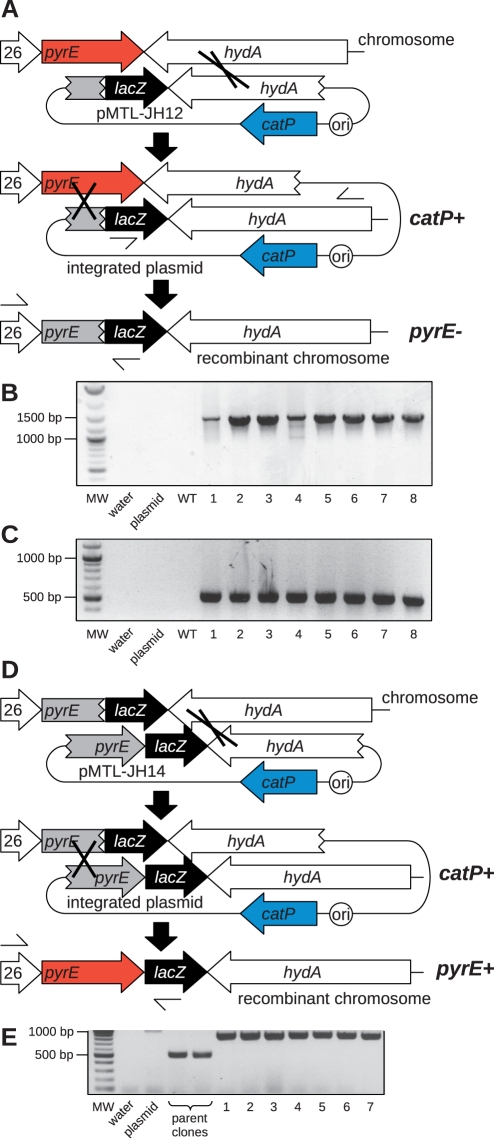
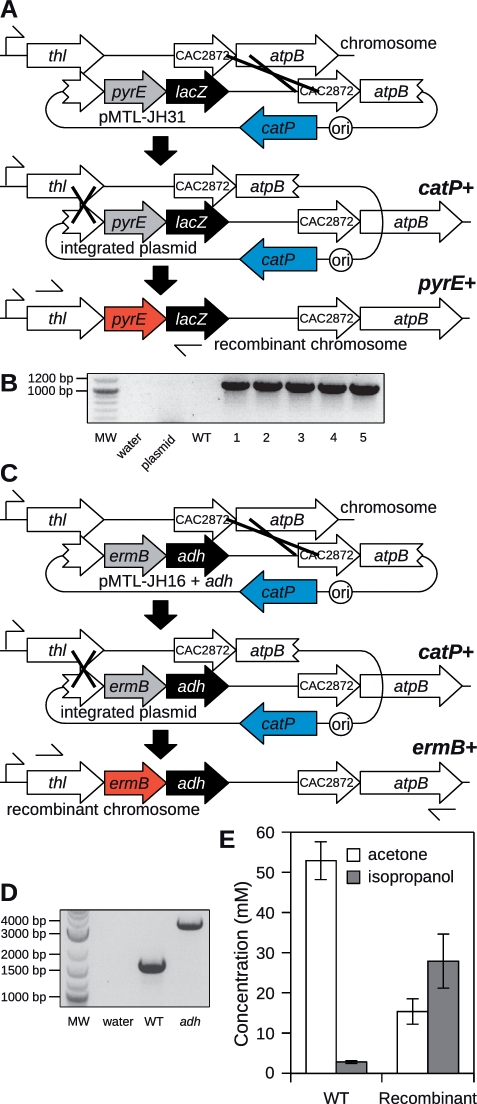
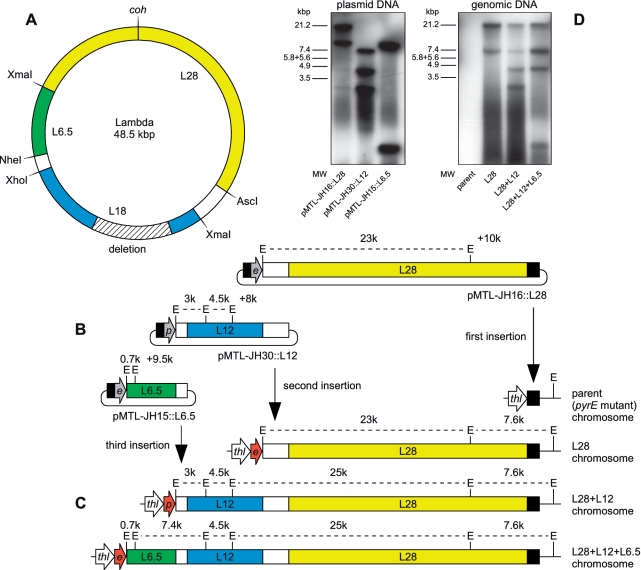
Most bacteria can only be transformed with circular plasmids, so robust DNA integration methods for these rely upon selection of single-crossover clones followed by counter-selection of double-crossover clones. To overcome the limited availability of heterologous counter-selection markers, here we explore novel DNA integration strategies that do not employ them, and instead exploit (i) activation or inactivation of genes leading to a selectable phenotype, and (ii) asymmetrical regions of homology to control the order of recombination events. We focus here on the industrial biofuel-producing bacterium Clostridium acetobutylicum, which previously lacked robust integration tools, but the approach we have developed is broadly applicable. Large sequences can be delivered in a series of steps, as we demonstrate by inserting the chromosome of phage lambda (minus a region apparently unstable in Escherichia coli in our cloning context) into the chromosome of C. acetobutylicum in three steps. This work should open the way to reliable integration of DNA including large synthetic constructs in diverse microorganisms.
Overview
The claims and statistics of this paper haven’t been checked yet.
Free: it reads the open-access text and checks the first 5 claims that cite a source we can check. Create a free account to check every claim.
Integrity signals
Registry
Cites
Statistics
Figures
Verification
Claims the paper makes
The claims and statistics of this paper haven’t been checked yet.
Free: it reads the open-access text and checks the first 5 claims that cite a source we can check. Create a free account to check every claim.
Claims other papers make about this one
Each is checked against this paper’s own text: does it say what the citing paper says it does?
The cited source says what the claim attributes to it.
In the citing paper
“For example, a promoterless primary/secondary adh from C. beijerinckii coupled to the ermB gene was introduced into the downstream region of the thlA gene in the genome of C. acetobutylicum. The native promoter of thlA drives the expression of ermB and adh, allowing selection for the second recombination event using erythromycin or acid-stable analog clarithromycin, and also creation of a”
From Gas Fermentation—A Flexible Platform for Commercial Scale Production of Low-Carbon-Fuels and Chemicals from Waste and Renewable Feedstocks (2016) · cites this paper as Heap et al., 2012
The check wasn’t confident either way, so it gives no verdict — never disputed.
In the citing paper
“We used the FgH1tUT vectors, which enable the sgRNA expression under the control of doxycycline and harbour the miRFP670 fluorescent reporter driven by the Ubiquitin promoter [21] (Figure 1B).”
From Rapid and Robust Generation of Homozygous Fluorescent Reporter Knock-In Cell Pools by CRISPR-Cas9 (2025) · cites this paper as [21]
Experimental — accuracy not yet measuredIn the citing paper
“Instead, it utilizes the activation or inactivation of gene(s) that result in a selectable phenotype, and asymmetrical homology arms to direct the order of recombination events (Heap et al., 2012).”
From Gas Fermentation—A Flexible Platform for Commercial Scale Production of Low-Carbon-Fuels and Chemicals from Waste and Renewable Feedstocks (2016) · cites this paper as Heap et al., 2012
In the citing paper
“Recently, a novel genetic tool that allows stable genome insertion via homologous recombination was developed. Termed Allele-Coupled Exchange (ACE), this approach does not employ a counter selective marker to select for the rare second recombination event.”
From Gas Fermentation—A Flexible Platform for Commercial Scale Production of Low-Carbon-Fuels and Chemicals from Waste and Renewable Feedstocks (2016) · cites this paper as Heap et al., 2012
In the citing paper
“Remarkably, the whole genome of phage lambda (48.5 kb minus a 6 kb region) was successfully inserted into the genome of C. acetobutylicum in three successive steps using this genetic tool.”
From Gas Fermentation—A Flexible Platform for Commercial Scale Production of Low-Carbon-Fuels and Chemicals from Waste and Renewable Feedstocks (2016) · cites this paper as Heap et al., 2012
1 more claim about this paper
Create a free account to see every claim other papers make about this one.
Self-check
Percentages, sums and reported differences re-computed from the paper’s own numbers.
The self-check needs the paper’s full text.
Citations
Cites
Boeke, J. D., La Croute, F., & Fink, G. R. (1984) · Molecular and General Genetics MGG · doi:10.1007/bf00330984 · Cited by 2,318
Acetone-butanol fermentation revisited
Jones, D. T., & Woods, D. (1986) · Microbiological Reviews · doi:10.1128/mmbr.50.4.484-524.1986 · Cited by 1,990
The ClosTron: a universal gene knock-out system for the genus Clostridium
Heap, J. T., Pennington, O. J., Cartman, S. T., Carter, G. P., & Minton, N. P. (2007) · Journal of Microbiological Methods · doi:10.1016/j.mimet.2007.05.021 · Cited by 663 · cited 2×
“coli strain TOP10 (Invitrogen) was used for plasmid cloning and storage, strain CA434 (5) was used as a conjugation donor, and TOP10 containing pAN2 (6) was used for in vivo methylation of plasmid DNA prior to transformation of C.”
MethodSelf-citationA modular system for Clostridium shuttle plasmids
Heap, J. T., Pennington, O. J., Cartman, S. T., & Minton, N. P. (2009) · Journal of Microbiological Methods · doi:10.1016/j.mimet.2009.05.004 · Cited by 489 · cited 4×
“coli shuttle plasmids pMTL85141, pMTL85151 and pMTL83151, respectively (7), and differ to those parental plasmids only between the SbfI and AscI sites.”
BackgroundMethodInfluentialSelf-citationThe ClosTron: mutagenesis in Clostridium refined and streamlined
Heap, J. T., Kuehne, S. A., Ehsaan, M., Cartman, S. T., Cooksley, C. M., Scott, J. C., & Minton, N. P. (2010) · Journal of Microbiological Methods · doi:10.1016/j.mimet.2009.10.018 · Cited by 418
Self-citationEngineering solventogenic clostridia
Papoutsakis, E. T. (2008) · Current Opinion in Biotechnology · doi:10.1016/j.copbio.2008.08.003 · Cited by 332
Clewell, D. B., Yagi, Y., Dunny, G. M., & Schultz, S. K. (1974) · Journal of Bacteriology · doi:10.1128/jb.117.1.283-289.1974 · Cited by 324
Sato, T., Fukui, T., Atomi, H., & Imanaka, T. (2003) · Journal of Bacteriology · doi:10.1128/jb.185.1.210-220.2003 · Cited by 294
Oxygen and the Growth and Metabolism of Clostridium acetobutylicum
O'BRIEN, R. W., & MORRIS, J. G. (1971) · Journal of General Microbiology · doi:10.1099/00221287-68-3-307 · Cited by 286
Counterselectable Markers: Untapped Tools for Bacterial Genetics and Pathogenesis
Reyrat, J., Pelicic, V., Gicquel, B., & Rappuoli, R. (1998) · Infection and Immunity · doi:10.1128/.66.9.4011-4017.1998 · Cited by 282
Cited by
Items 201–265 of 265
Advancing the clinical implementation of Clostridial cancer therapies
Zygouropoulou, M. (2019) · Nottingham ePrints (University of Nottingham) · Cited by 1
Bashir, Z. (2018) · Nottingham ePrints (University of Nottingham) · Cited by 1
Budd, P. (2017) · Nottingham ePrints (University of Nottingham) · Cited by 1
Developments in genetic engineering of novel acetogens
Mansfield, R. P. W. (2018) · Nottingham ePrints (University of Nottingham) · Cited by 1
Clostridial strain degeneration : new approaches to an old problem
Humphreys, J. R. (2019) · Nottingham ePrints (University of Nottingham) · Cited by 1
A catalog of proteins released from Asaia bogorensis under two growth conditions
Manges, A. B., & Lampe, D. J. (2025) · Microbiology Spectrum · doi:10.1128/spectrum.01506-25 · Cited by 1
(2019) · Journal of Chemical Biological and Physical Sciences · doi:10.24214/jcbps.b.9.3.141931 · Cited by 1
Development and optimization of Lysis gene E as a counter‐selection marker with high stringency
Chen, W., Chen, R., He, L., & Wu, X. (2022) · Biotechnology Journal · doi:10.1002/biot.202100423 · Cited by 1
Bajpai, P. (2026) · Elsevier eBooks · doi:10.1016/b978-0-443-44839-3.00001-x
Discovery and biosynthesis of specialized metabolites produced by an indigenous streptomyces strain
Candra, H. (2022) · DR-NTU (Nanyang Technological University) · doi:10.32657/10356/161065
Moreira, J. P. C., Heap, J. T., Alves, J. I., & Domingues, L. (2024) · Figshare · doi:10.6084/m9.figshare.26568691
Self-citationClostridial Genetics: Genetic Manipulation of the Pathogenic Clostridia
Kuehne, S. A., Rood, J. I., & Lyras, D. (2019) · ASM Press eBooks · doi:10.1128/9781683670131.ch57
Novel tools for constructing markerless deletions in Clostridium saccharobutylicum NCP262
Huang, C.-N. (2019) · mediaTUM (Technical University of Munich)
Metabolic engineering of Clostridium acetobutylicum for gene essentiality studies
Akaluka, C. (2022) · Nottingham ePrints (University of Nottingham)
Raman Chemometrics and Application to Enzyme Kinetics and Urinalysis
Fisher, A. K. (2018) · VTechWorks (Virginia Tech)
Bilverstone, T. W. (2025) · Letters in Applied Microbiology · doi:10.1093/lambio/ovaf034
The Effect of Genetic Background and Environment on Plasmid Fitness and Persistence
Carroll, A. (2021) · Carleton University's Institutional Repository (MacOdrum Library, Carleton University) · doi:10.22215/etd/2021-14588
Mordaka, P. M., Williamson, J. J., & Heap, J. T. (2026) · Synthetic Biology · doi:10.1093/synbio/ysag008
Self-citation9 Natural and Synthetic Gas for Productions of Liquid Fuels and Their Additives
Shah, Y. T. (2017) · CRC Press eBooks · doi:10.1201/9781315302355-10
Neisseria subflava Type 6 Secretion System competition with bacterial and fungal species
Calder, A., & Snyder, L. A. S. (2026) · Applied Microbiology and Biotechnology · doi:10.1007/s00253-026-13870-6
Shaw, H. A. (2013) · Spiral (Imperial College London) · doi:10.25560/12875
A Reproducible Plasmid Platform for Sporomusa sphaeroides to Support Bioelectrochemical Studies
Iwasaki, Y., Yuto, M. I. N. E., & Kimura, Z. (2026) · Fermentation · doi:10.3390/fermentation12040196
Chebly, H. (2022) · theses.fr (ABES) · doi:10.70675/5781ec34ze463z498cza414z0d3a4e3c2a22
The role of Agr quorum sensing on sporulation and solvent formation in Clostridium beijerinckii
Boak, L. (2024) · Nottingham ePrints (University of Nottingham)
Rational and evolution-based engineering of Clostridium phytofermentans
Cerisy, T. (2017) · theses.fr (ABES) · doi:10.70675/ba4ffb3dz82f1z43fez8109zfb8d38661aaf
Gomaa, B., Tekedar, H. C., Abdelhamed, H., Karsi, A., & Lawrence, M. L. (2026) · Frontiers in Bacteriology · doi:10.3389/fbrio.2026.1720345
Storey, M. A. (2014) · Open Access Victoria University of Wellington | Te Herenga Waka (Figshare) · doi:10.26686/wgtn.17148032
Metabolic engineering of the cellulolytic bacterium Clostridium cellulovorans 743B
Mendonça de Almeida, L. M., Liebl, W., & München, T. U. (2024)
Identification and characterisation of novel bacteriocins active against Clostridioides difficile
Chapman, S. M. O. (2020) · Nottingham ePrints (University of Nottingham)
Optimisation de la fermentation de la biomasse végétale par Lachnoclostridium phytofermentans
Zaplana, T. (2024) · theses.fr (ABES) · doi:10.70675/41e351e0z0ff9z4432zb6cdz17cb0e593450
Metabolic engineering of clostridium acetobutylicum for the production of fuels and chemicals
Nguyen, N.-P.-T. (2016) · theses.fr (ABES) · doi:10.70675/1a1f2767z0bebz4a6ez9c70zdd9a3b463ce3
Phosphoglycerate kinase and phosphoenolpyruvate synthase of the enteric pathogen Helicobacter pylori
AL-Ethari, A. Y. (2018) · Figshare
SBRC-Nottingham: sustainable routes to platform chemicals from C1 waste gases
Burbidge, A., & Minton, N. P. (2016) · Biochemical Society Transactions · doi:10.1042/bst20160010
Self-citationSpore germination and recurrence of clostridioides difficile infection
Finch, L. S. (2020) · Nottingham ePrints (University of Nottingham)
SF-112-6 腹腔鏡下胃切除時のリンパ節郭清を安全に行うための術前3D-CTの有用性(SF-112 サージカルフォーラム(112)胃 手術手技,第112回日本外科学会定期学術集会)
吉成, 大., 戸塚, 統., 戸谷, 裕., 小川, 博., 塚越, 浩., 高橋, 研., 須納瀬, 豊., 平井, 圭., 宮前, 洋., 高橋, 憲., et al. (2012) · 日本外科学会雑誌
Mechanisms of vancomycin resistance in Clostridioides difficile
Valente, M. C. (2022) · Portuguese National Funding Agency for Science, Research and Technology (RCAAP Project by FCT)
Ramalhete, S. D. C. G. (2015) · Portuguese National Funding Agency for Science, Research and Technology (RCAAP Project by FCT)
Wu, W., Zhou, J., Chen, F., Liu, S., Xie, Y., Cui, G., Guan, Z., Zhao, Y. J., & Hong, W. (2026) · Frontiers in Microbiology · doi:10.3389/fmicb.2026.1817884
Evolution of Bacteria: The Subsequent Relationships between Different Species and Their Hosts
Appleberry, H. (2025) · Loyola eCommons (Loyola University of Chicago)
Lipid Membrane Engineering for Biotechnology
Gomes Almeida, A. C. (2023) · Aston Publications Explorer (Aston University) · doi:10.48780/publications.aston.ac.uk.00046663
An integrated workflow for the multi-omic characterization of microorganisms
Latif, H. (2015) · eScholarship (California Digital Library)
Engineering bacterial CO2 fixation to enhance biofuel and biochemical yields
Fast, A. G. (2017) · Library, Museums and Press - UDSpace (University of Delaware) · doi:10.58088/xyyf-bw13
Development of forward and reverse genetic tools forEubacterium limosum
Millard, C. J. (2018) · Nottingham ePrints (University of Nottingham)
A new approach to mutagenesis in Clostridium acetobutylicum
Furness, L. M. (2017) · Nottingham ePrints (University of Nottingham)
Reductions using Clostridium sporogenes
Mordaka, P. M. (2014) · Nottingham ePrints (University of Nottingham)
Yu, L. (2015) · OhioLink ETD Center (Ohio Library and Information Network)
Rekombinante clostridielle Endosporen als Therapieansatz zur Behandlung solider Tumore
Riegel, K. (2014) · OPen Access Repositorium der Universität Ulm (OPARU) (Ulm University) · doi:10.18725/oparu-3311
Inserting a Mutation into the Putative Clostridium difficile Bile Salt Hydrolase-Encoding Gene
Satterfield, N. E. (2015) · OakTrust (Texas A&M University Libraries)
Wong, S. S. (2016) · eScholarship (California Digital Library)
CdtR-mediated regulation of toxin production in Clostridium difficile
Bilverstone, T. W. (2019) · Nottingham ePrints (University of Nottingham)
Omorotionmwan, B. B., Wang, H., Baker, J. P., Gizynski, K., Yoo, M., Akaluka, C., Zhang, Y., & Minton, N. P. (2023) · doi:10.3389/fbioe.2023.1218099.s001
Self-citationExpression and characterization of a human sodium glucose transporter (hSGLT1) in Pichia pastoris
Suades, A., & Molecular, U. A. D. B. D. D. B. I. D. B. (2017) · LA Referencia (Red Federada de Repositorios Institucionales de Publicaciones Científicas)
The shared evolutionary capacities of plasmids and extrachromosomal DNA
Shaw, L. P., & Henssen, A. G. (2026) · Nature Reviews Genetics · doi:10.1038/s41576-026-01012-7
Investigation of orally administrable bacteria for cancer therapy
Hogan, G. E. (2021) · Cork Open Research Archive (University College Cork, Ireland)
Lautenschläger, N., Schmidt, K., Schiffer, C., Wulff, T. F., Hahnke, K., Finstermeier, K., Mansour, M., Elsholz, A. K. W., & Charpentier, E. (2024) · doi:10.3389/fbioe.2024.1395659.s001
Novel microbe-based technologies for bioelectricity and biofuel production
Pentassuglia, S. (2019) · PORTO@Iris
Probiotic and Gastrointestinal Microbiology in the Broiler Chicken
Askelson, T. E. (2017) · OakTrust (Texas A&M University Libraries)
Madika, A. (2023) · Nottingham ePrints (University of Nottingham)
Rodríguez-Navarro, J. (2020) · Tesis Doctorals en Xarxa (Consorci de Serveis Universitaris de Catalunya)
Nguyen, N. N. Y., Duong, L. N., Nguyen, A. K., Dinh, T. M., Phan, T. T., & Nguyen, H. D. (2025) · Biomedical Research and Therapy · doi:10.15419/bmrat.v12i4.970
Lopputuoteinhibition ja prosessiparametrien vaihtelun vaikutukset bakteerien stressivasteisiin
Wallenius, J. (2017) · Aaltodoc (Aalto University)
Towards phage therapy against Clostridioides difficile
Grmanova, Z. (2022) · Nottingham ePrints (University of Nottingham)
Metadata
- Authors
- Heap, J. T., Ehsaan, M., Cooksley, C. M., Ng, Y.-K., Cartman, S. T., Winzer, K., & Minton, N. P.
- Affiliations
- University of Nottingham (GB)
- Corresponding author
- Minton, Nigel P.
- Venue
- Nucleic Acids Research
- Publisher
- Oxford University Press (OUP)
- Published
- 2012-01-18
- Volume
- 40
- Issue
- 8
- Pages
- e59-e59
- ISSN
- 0305-1048 (ISSN-L)
- 1362-4962
- PMC
- PMC3333862
- OpenAlex
- W2158849520
- Cited by
- 201
- References
- 31
- Citations by year
- 2026: 8 · 2025: 15 · 2024: 7 · 2023: 8 · 2022: 8 · 2021: 13 · 2020: 5 · 2019: 24 · 2018: 16 · 2017: 17 · 2016: 24 · 2015: 19 · 2014: 16 · 2013: 10 · 2012: 10
- FWCI
- 7.07
- Type
- journal article
- Language
- en
- Open access
- gold
- doi.org
- Licence
- Locations
- Nucleic Acids Research (publishedVersion, cc-by-nc)
- Europe PMC (PubMed Central) (publishedVersion, cc-by-nc)
- PubMed Central (publishedVersion, cc-by-nc)
- PubMed (publishedVersion)
- Repository@Nottingham (University of Nottingham) (submittedVersion, cc-by)
- Repository@Nottingham (University of Nottingham) (submittedVersion, other-oa)
- Funders
- European Commission (223585)
- Directorate for Biological Sciences
- Medical Research Council (G0601176)
- Biotechnology and Biological Sciences Research Council (BB/G016224/1, BB/F003390/1, BB/E021271/1)
- Topics
- Life Sciences › Biochemistry, Genetics and Molecular Biology › Molecular Biology › Microbial Metabolic Engineering and Bioproduction
- Life Sciences › Biochemistry, Genetics and Molecular Biology › Genetics › Bacterial Genetics and Biotechnology
- Life Sciences › Biochemistry, Genetics and Molecular Biology › Molecular Biology › CRISPR and Genetic Engineering
- Keywords
- homology-directed recombination, Clostridium acetobutylicum
- MeSH terms
- Alcohol Dehydrogenase, Base Sequence, Chromosomes, Bacterial, DNA, Genetic Markers, Molecular Sequence Data, Orotate Phosphoribosyltransferase, Bacteriophage lambda, Plasmids, Promoter Regions, Genetic, Transformation, Bacterial, Genome, Viral, Clostridium acetobutylicum
About these checks
Registry, retraction, Cites and statistics results are computed, not judged, with one exception: a printed reference that no index lists is read once by a model before it counts as a citation error. Claims are extracted by a model and kept only when their quote appears verbatim in the text; each cited source is then checked, with a model’s help, for whether it says what the claim relies on. Those verdicts can be wrong — read the claim’s quote and the cited source before relying on one.
Statistics and arithmetic are recomputed, not judged.
Confidence bands are shown only for fields calibrated on our annotated test set. None is calibrated yet, so no band is shown.
What counts as a claim ›How we measure confidence ›How we check this ›
Are you an author, or do you see a problem with this page? Request a review
Data sources
Bibliographic data: Semantic Scholar, OpenAlex, Crossref.
Contains information from the Semantic Scholar Academic Graph Datasets, made available under the ODC Attribution License (ODC-BY 1.0).
Semantic Scholar’s data is described in: Kinney, R., et al. (2023). The Semantic Scholar Open Data Platform. arXiv:2301.10140.
