

3DSNP: a database for linking human noncoding SNPs to their three-dimensional interacting genes
Open accessThe DOI matches its Crossref record; 44 of the 44 references it cites were found in a registry or an index.
Abstract
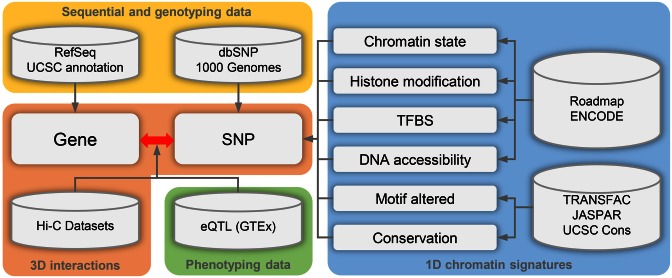
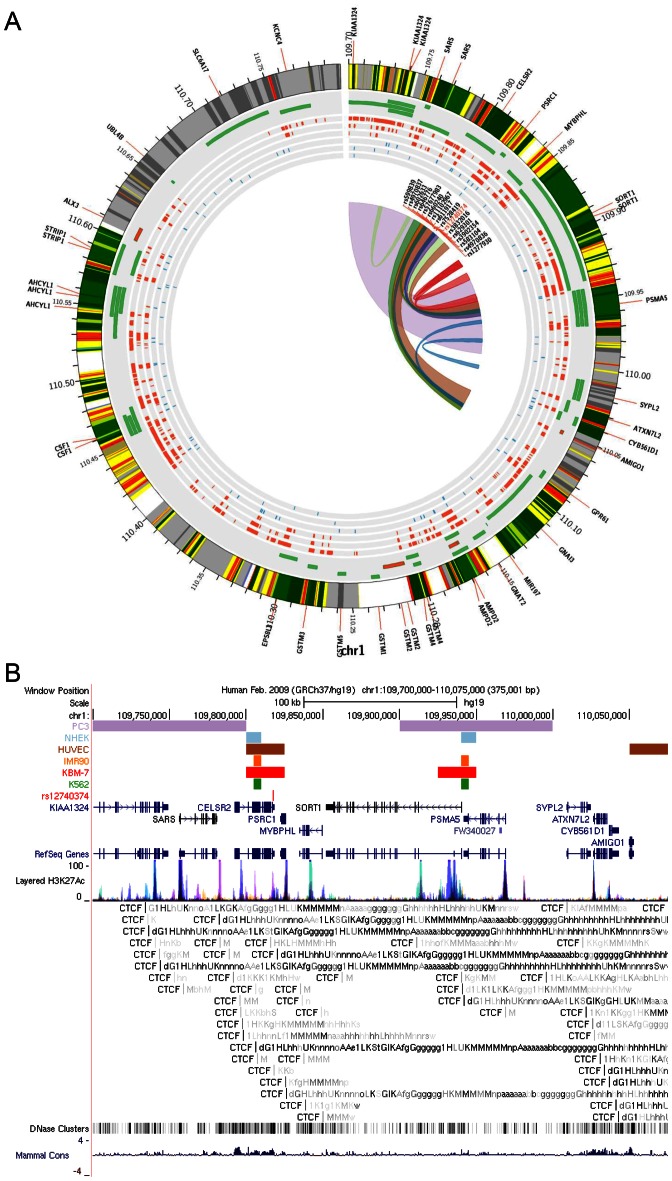
The vast noncoding portion of the human genome harbors a rich array of functional elements and disease-causing regulatory variants. Recent high-throughput chromosome conformation capture studies have outlined the principles of these elements interacting and regulating the expression of distal target genes through three-dimensional (3D) chromatin looping. Here we present 3DSNP, an integrated database for annotating human noncoding variants by exploring their roles in the distal interactions between genes and regulatory elements. 3DSNP integrates 3D chromatin interactions, local chromatin signatures in different cell types and linkage disequilibrium (LD) information from the 1000 Genomes Project. 3DSNP provides informative visualization tools to display the integrated local and 3D chromatin signatures and the genetic associations among variants. Data from different functional categories are integrated in a scoring system that quantitatively measures the functionality of SNPs to help select important variants from a large pool. 3DSNP is a valuable resource for the annotation of human noncoding genome sequence and investigating the impact of noncoding variants on clinical phenotypes. The 3DSNP database is available at http://biotech.bmi.ac.cn/3dsnp/.
Overview
The claims and statistics of this paper haven’t been checked yet.
Free: it reads the open-access text and checks the first 5 claims that cite a source we can check. Create a free account to check every claim.
Integrity signals
Registry
Cites
Statistics
Figures

Verification
Claims the paper makes
The claims and statistics of this paper haven’t been checked yet.
Free: it reads the open-access text and checks the first 5 claims that cite a source we can check. Create a free account to check every claim.
Claims other papers make about this one
Each is checked against this paper’s own text: does it say what the citing paper says it does?
The cited source says what the claim attributes to it.
In the citing paper
“The majority of the lead SNPs (10/16) showed evidence of regulatory activity in the 3DSNP database [33] (S9 Table).”
From Combined genome-wide association study of 136 quantitative ear morphology traits in multiple populations reveal 8 novel loci (2023) · cites this paper as [33]
Self-check
Percentages, sums and reported differences re-computed from the paper’s own numbers.
The self-check needs the paper’s full text.
Citations
Cites
PLINK: a tool set for whole-genome association and population-based linkage analyses.
Purcell, S., Neale, B., Todd-Brown, K., Thomas, L., Ferreira, M. A. R., Bender, D., Maller, J., Sklar, P., de Bakker, P. I. W., Daly, M. J., et al. (2007) · The American Journal of Human Genetics · doi:10.1086/519795 · Cited by 34,089
BEDTools: a flexible suite of utilities for comparing genomic features
Quinlan, A. R., & Hall, I. M. (2010) · Bioinformatics · doi:10.1093/bioinformatics/btq033 · Cited by 27,437
The variant call format and VCFtools
Danecek, P., Auton, A., Abecasis, G., Albers, C. A., Banks, E., DePristo, M. A., Handsaker, R. E., Lunter, G., Marth, G. T., Sherry, S. T., et al. (2011) · Bioinformatics · doi:10.1093/bioinformatics/btr330 · Cited by 16,200
Heinz, S., Benner, C., Spann, N., Bertolino, E., Lin, Y. C., Laslo, P., Cheng, J. X., Murre, C., Singh, H., & Glass, C. K. (2010) · Molecular Cell · doi:10.1016/j.molcel.2010.05.004 · Cited by 13,382
Circos: An information aesthetic for comparative genomics
Krzywinski, M., Schein, J., Birol, İ., Connors, J., Gascoyne, R., Horsman, D., Jones, S. J., & Marra, M. A. (2009) · Genome Research · doi:10.1101/gr.092759.109 · Cited by 10,964
A 3D Map of the Human Genome at Kilobase Resolution Reveals Principles of Chromatin Looping
Rao, S. S. P., Huntley, M. H., Durand, N. C., Stamenova, E. K., Bochkov, I. D., Robinson, J. T., Sanborn, A. L., Machol, I., Omer, A. D., Lander, E. S., et al. (2014) · Cell · doi:10.1016/j.cell.2014.11.021 · Cited by 9,212
Comprehensive Mapping of Long-Range Interactions Reveals Folding Principles of the Human Genome
Lieberman-Aiden, E., van Berkum, N. L., Williams, L., Imakaev, M., Ragoczy, T., Telling, A., Amit, I., Lajoie, B. R., Sabo, P. J., Dorschner, M. O., et al. (2009) · Science · doi:10.1126/science.1181369 · Cited by 8,898
Topological domains in mammalian genomes identified by analysis of chromatin interactions
Dixon, J. R., Selvaraj, S., Yue, F., Kim, A., Li, Y., Shen, Y., Hu, M., Liu, J. S., & Ren, B. (2012) · Nature · doi:10.1038/nature11082 · Cited by 6,829 · cited 2×
“We collected and curated Hi-C datasets from several genome-wide chromosome conformation studies (12,13,31,32).”
MethodHindorff, L. A., Sethupathy, P., Junkins, H. A., Ramos, E. M., Mehta, J. P., Collins, F. S., & Manolio, T. A. (2009) · Proceedings of the National Academy of Sciences · doi:10.1073/pnas.0903103106 · Cited by 4,013
Evolutionarily conserved elements in vertebrate, insect, worm, and yeast genomes
Siepel, A., Bejerano, G., Pedersen, J. S., Hinrichs, A. S., Hou, M., Rosenbloom, K., Clawson, H., Spieth, J., Hillier, L. W., Richards, S., et al. (2005) · Genome Research · doi:10.1101/gr.3715005 · Cited by 3,971 · cited 1×
“The conservation of SNPs was measured by two PhyloP scores (37) obtained from the UCSC Genome Browser.”
MethodSystematic Localization of Common Disease-Associated Variation in Regulatory DNA
Maurano, M. T., Humbert, R., Rynes, E., Thurman, R. E., Haugen, E., Wang, H., Reynolds, A. P., Sandstrom, R., Qu, H., Brody, J., et al. (2012) · Science · doi:10.1126/science.1222794 · Cited by 3,716 · cited 1×
“The vast majority of sequence variants in the genome occur outside of coding regions (1,2).”
BackgroundHeintzman, N. D., Stuart, R. K., Hon, G., Fu, Y., Ching, C. W., Hawkins, R. D., Barrera, L. O., Van Calcar, S., Qu, C., Ching, K. A., et al. (2007) · Nature Genetics · doi:10.1038/ng1966 · Cited by 3,398
Mapping and analysis of chromatin state dynamics in nine human cell types
Ernst, J., Kheradpour, P., Mikkelsen, T. S., Shoresh, N., Ward, L. D., Epstein, C. B., Zhang, X., Wang, L., Issner, R., Coyne, M., et al. (2011) · Nature · doi:10.1038/nature09906 · Cited by 2,898
Annotation of functional variation in personal genomes using RegulomeDB
Boyle, A. P., Hong, E. L., Hariharan, M., Cheng, Y., Schaub, M. A., Kasowski, M., Karczewski, K. J., Park, J., Hitz, B. C., Weng, S., et al. (2012) · Genome Research · doi:10.1101/gr.137323.112 · Cited by 2,722 · cited 1×
“RegulomeDB (20) database focuses on interpreting the one-dimensional (1D) chromatin signatures, including predicted chromatin states (21), histone modifications, DNase I hypersensitive sites (DHSs) and transcription factor binding sites (TFBSs).”
BackgroundHistone modifications at human enhancers reflect global cell-type-specific gene expression
Heintzman, N. D., Hon, G. C., Hawkins, R. D., Kheradpour, P., Stark, A., Harp, L. F., Ye, Z., Lee, L. K., Stuart, R. K., Ching, C. W., et al. (2009) · Nature · doi:10.1038/nature07829 · Cited by 2,533
ChromHMM: automating chromatin-state discovery and characterization
Ernst, J., & Kellis, M. (2012) · Nature Methods · doi:10.1038/nmeth.1906 · Cited by 2,475
The ENCODE (ENCyclopedia Of DNA Elements) Project
(2004) · Science · doi:10.1126/science.1105136 · Cited by 2,390
Ward, L. D., & Kellis, M. (2012) · Nucleic Acids Research · doi:10.1093/nar/gkr917 · Cited by 2,229
TRANSFAC(R): transcriptional regulation, from patterns to profiles
Matys, V. (2003) · Nucleic Acids Research · doi:10.1093/nar/gkg108 · Cited by 1,985
The NIH Roadmap Epigenomics Mapping Consortium
Bernstein, B. E., Stamatoyannopoulos, J. A., Costello, J. F., Ren, B., Milosavljevic, A., Meissner, A., Kellis, M., Marra, M. A., Beaudet, A. L., Ecker, J. R., et al. (2010) · Nature Biotechnology · doi:10.1038/nbt1010-1045 · Cited by 1,892 · cited 3×
“The mapping data of chromatin states, DHS and six important histone modifications (H3K4me1, H3K4me3, H3K9me3, H3K27ac, H3K27me3 and H3K36me3) in 127 cell types obtained from the Roadmap Epigenomics project and the binding sites of 153 TFs in 91 cell lines obtained from the ENCODE project are available for visualizing…”
BackgroundInfluentialSanborn, A. L., Rao, S. S. P., Huang, S.-C., Durand, N. C., Huntley, M. H., Jewett, A. I., Bochkov, I. D., Chinnappan, D., Cutkosky, A., Li, J., et al. (2015) · Proceedings of the National Academy of Sciences · doi:10.1073/pnas.1518552112 · Cited by 1,730 · cited 1×
“We collected and curated Hi-C datasets from several genome-wide chromosome conformation studies (12,13,31,32).”
MethodChIP-seq accurately predicts tissue-specific activity of enhancers
Visel, A., Blow, M. J., Li, Z., Zhang, T., Akiyama, J. A., Holt, A., Plajzer-Frick, I., Shoukry, M., Wright, C., Chen, F., et al. (2009) · Nature · doi:10.1038/nature07730 · Cited by 1,639
The long-range interaction landscape of gene promoters
Sanyal, A., Lajoie, B. R., Jain, G., & Dekker, J. (2012) · Nature · doi:10.1038/nature11279 · Cited by 1,489 · cited 1×
“The rapid advances of chromosome conformation capture (3C)-based technologies such as 5C (10), Hi-C (11– 13) and ChIA-PET (14,15) are providing increasing data on the 3D architecture of the genomes.”
BackgroundFrom noncoding variant to phenotype via SORT1 at the 1p13 cholesterol locus
Musunuru, K., Strong, A., Frank-Kamenetsky, M., Lee, N. E., Ahfeldt, T., Sachs, K. V., Li, X., Li, H., Kuperwasser, N., Ruda, V. M., et al. (2010) · Nature · doi:10.1038/nature09266 · Cited by 1,140
Mapping long-range promoter contacts in human cells with high-resolution capture Hi-C
Mifsud, B., Tavares-Cadete, F., Young, A. N., Sugar, R., Schoenfelder, S., Ferreira, L., Wingett, S. W., Andrews, S., Grey, W., Ewels, P. A., et al. (2015) · Nature Genetics · doi:10.1038/ng.3286 · Cited by 990
CRISPR Inversion of CTCF Sites Alters Genome Topology and Enhancer/Promoter Function
Guo, Y., Xu, Q., Canzio, D., Shou, J., Li, J., Gorkin, D. U., Jung, I., Wu, H., Zhai, Y., Tang, Y., et al. (2015) · Cell · doi:10.1016/j.cell.2015.07.038 · Cited by 958
Self-citationMathelier, A., Fornes, O., Arenillas, D. J., Chen, C.-Y., Denay, G., Lee, J., Shi, W., Shyr, C., Tan, G., Worsley-Hunt, R., et al. (2016) · Nucleic Acids Research · doi:10.1093/nar/gkv1176 · Cited by 937 · cited 1×
“To annotate SNPs by their effects on TF binding motifs, we collected a total of 1207 position weight matrices (PWMs) of TFs from the TRANSFAC (34) and JASPAR (35) databases and used the TFM-Scan software (36) to locate the putative binding motifs of TFs by scanning the two strands of the genomic DNA with these PWMs.”
MethodWard, L. D., & Kellis, M. (2016) · Nucleic Acids Research · doi:10.1093/nar/gkv1340 · Cited by 927
CTCF-mediated functional chromatin interactome in pluripotent cells
Handoko, L., Xu, H., Li, G., Ngan, C. Y., Chew, E., Schnapp, M., Lee, C. W. H., Ye, C., Ping, J. L. H., Mulawadi, F., et al. (2011) · Nature Genetics · doi:10.1038/ng.857 · Cited by 622
The UCSC Genome Browser database: 2016 update
Speir, M. L., Zweig, A. S., Rosenbloom, K. R., Raney, B. J., Paten, B., Nejad, P., Lee, B. T., Learned, K., Karolchik, D., Hinrichs, A. S., et al. (2016) · Nucleic Acids Research · doi:10.1093/nar/gkv1275 · Cited by 451
Next-generation DNA sequencing of paired-end tags (PET) for transcriptome and genome analyses
Fullwood, M. J., Wei, C.-L., Liu, E. T., & Ruan, Y. (2009) · Genome Research · doi:10.1101/gr.074906.107 · Cited by 365
FunSeq2: A framework for prioritizing noncoding regulatory variants in cancer
Fu, Y., Liu, Z., Lou, S., Bedford, J., Mu, X., Yip, K. Y., Khurana, E., & Gerstein, M. (2014) · Genome Biology · doi:10.1186/preaccept-1739683221127290 · Cited by 352
Taberlay, P. C., Achinger-Kawecka, J., Lun, A. T. L., Buske, F. A., Sabir, K., Gould, C. M., Zotenko, E., Bert, S. A., Giles, K. A., Bauer, D. C., et al. (2016) · Genome Research · doi:10.1101/gr.201517.115 · Cited by 333
The Genotype-Tissue Expression (GTEx) project
Lonsdale, J., Thomas, J., Salvatore, M., Phillips, R., Lo, E., Shad, S., Hasz, R., Walters, G., Garcia, F., Young, N., et al. (2013) · Nature Genetics · doi:10.1038/ng.2653 · Cited by 263
ChIP‐based methods for the identification of long‐range chromatin interactions
Fullwood, M. J., & Ruan, Y. (2009) · Journal of Cellular Biochemistry · doi:10.1002/jcb.22116 · Cited by 247
Constructing 3D interaction maps from 1D epigenomes
Zhu, Y., Chen, Z., Zhang, K., Wang, M., Medovoy, D., Whitaker, J. W., Ding, B., Li, N., Zheng, L., & Wang, W. (2016) · Nature Communications · doi:10.1038/ncomms10812 · Cited by 149
Li, M. J., Wang, L. Y., Xia, Z., Sham, P. C., & Wang, J. (2013) · Nucleic Acids Research · doi:10.1093/nar/gkt456 · Cited by 109
Predicting chromatin organization using histone marks
Huang, J., Marco, E., Pinello, L., & Yuan, G.-C. (2015) · Genome Biology · doi:10.1186/s13059-015-0740-z · Cited by 108
Lu, Y., Qu, W., Shan, G., & Zhang, C. (2015) · PLOS ONE · doi:10.1371/journal.pone.0130622 · Cited by 52
Self-citationChen, Y., Wang, Y., Xuan, Z., Chen, M., & Zhang, M. Q. (2016) · Nucleic Acids Research · doi:10.1093/nar/gkw225 · Cited by 41
Large Scale Matching for Position Weight Matrices
Liefooghe, A., Touzet, H., & Varré, J. (2006) · Lecture notes in computer science · doi:10.1007/11780441_36 · Cited by 29
Lu, Y., Shan, G., Xue, J., Chen, C., & Zhang, C. (2016) · Nucleic Acids Research · doi:10.1093/nar/gkw249 · Cited by 19
Self-citationPredicting the spatial organization of chromosomes using epigenetic data
Mourad, R., & Cuvier, O. (2015) · Genome biology · doi:10.1186/s13059-015-0752-8 · Cited by 18
CCSI: a database providing chromatin–chromatin spatial interaction information
Xie, X., Ma, W., Songyang, Z., Luo, Z., Huang, J., Dai, Z., & Xiong, Y. (2016) · Database · doi:10.1093/database/bav124 · Cited by 15
Research works printed but not linked: 1
- 10.1186/s13059-014-0480-5 · doi:10.1186/s13059-014-0480-5 · Paper page
Cited by
Prokopenko, D., Morgan, S. L., Mullin, K., Hofmann, O., Chapman, B., Kirchner, R., (ADNI), A. D. N. I., Amberkar, S., Wohlers, I., Lange, C., et al. (2021) · Alzheimer's & Dementia · doi:10.1002/alz.12319 · Cited by 105
Huang, D., Yi, X., Zhang, S., Zheng, Z., Wang, P., Xuan, C., Sham, P. C., Wang, J., & Li, M. J. (2018) · Nucleic Acids Research · doi:10.1093/nar/gky407 · Cited by 83
“Compared with the available features among several new or commonly used online resources, including HaploReg (19), RegulomeDB (20), rSNPBase (21), 3DSNP (23) and PINES (https://doi.”
BackgroundMethodLi, Y., Xiong, Z., Zhang, M., Hysi, P. G., Qian, Y., Adhikari, K., Weng, J., Wu, S., Du, S., Gonzalez-Jose, R., et al. (2023) · PLOS Genetics · doi:10.1371/journal.pgen.1010786 · Cited by 9
Metadata
- Authors
- Lu, Y., Quan, C., Chen, H., Bo, X., & Zhang, C.
- Affiliations
- State Key Laboratory of Proteomics (CN)
- Corresponding author
- Zhang, Chenggang
- Venue
- Nucleic Acids Research
- Publisher
- Oxford University Press (OUP)
- Published
- 2016-10-26
- Volume
- 45
- Issue
- D1
- Pages
- D643-D649
- ISSN
- 0305-1048 (ISSN-L)
- 1362-4962
- PMC
- PMC5210526
- OpenAlex
- W2539721631
- Cited by
- 133
- References
- 44
- Citations by year
- 2026: 10 · 2025: 14 · 2024: 31 · 2023: 11 · 2022: 11 · 2021: 24 · 2020: 11 · 2019: 6 · 2018: 9 · 2017: 6
- FWCI
- 3.64
- Type
- journal article
- Language
- en
- Open access
- gold
- doi.org
- Licence
- Locations
- Nucleic Acids Research (publishedVersion, cc-by-nc)
- PubMed Central (publishedVersion, cc-by-nc)
- PubMed (publishedVersion)
- HighWire Press Open Archive (submittedVersion)
- Funders
- National Natural Science Foundation of China (2012CB518200, U1435222, 2014DFB30020, 81573251, 2015AA020108)
- National Key Research and Development Program of China (2012CB518200, 2014DFB30020, 2015AA020108)
- Topics
- Life Sciences › Biochemistry, Genetics and Molecular Biology › Molecular Biology › Genomics and Chromatin Dynamics
- Life Sciences › Biochemistry, Genetics and Molecular Biology › Genetics › Genetic Associations and Epidemiology
- Life Sciences › Biochemistry, Genetics and Molecular Biology › Genetics › Genomics and Rare Diseases
- Keywords
- 3D chromatin interactions, chromosome conformation capture, regulatory variants, chromatin looping, linkage disequilibrium, 1000 Genomes Project, variant annotation
- MeSH terms
- Chromatin, Epistasis, Genetic, Gene Expression Regulation, Humans, User-Computer Interface, Genome, Human, Computational Biology, Untranslated Regions, Polymorphism, Single Nucleotide, Genomics, Databases, Nucleic Acid, Quantitative Trait Loci, Genome-Wide Association Study, Web Browser
About these checks
Registry, retraction, Cites and statistics results are computed, not judged, with one exception: a printed reference that no index lists is read once by a model before it counts as a citation error. Claims are extracted by a model and kept only when their quote appears verbatim in the text; each cited source is then checked, with a model’s help, for whether it says what the claim relies on. Those verdicts can be wrong — read the claim’s quote and the cited source before relying on one.
Statistics and arithmetic are recomputed, not judged.
Confidence bands are shown only for fields calibrated on our annotated test set. None is calibrated yet, so no band is shown.
What counts as a claim ›How we measure confidence ›How we check this ›
Are you an author, or do you see a problem with this page? Request a review
Data sources
Bibliographic data: Semantic Scholar, OpenAlex, Crossref.
Contains information from the Semantic Scholar Academic Graph Datasets, made available under the ODC Attribution License (ODC-BY 1.0).
Semantic Scholar’s data is described in: Kinney, R., et al. (2023). The Semantic Scholar Open Data Platform. arXiv:2301.10140.
