

Mouse Genome Database (MGD)-2018: knowledgebase for the laboratory mouse
Open accessThe DOI matches its Crossref record; 21 of the 21 references it cites were found in a registry or an index.
Abstract
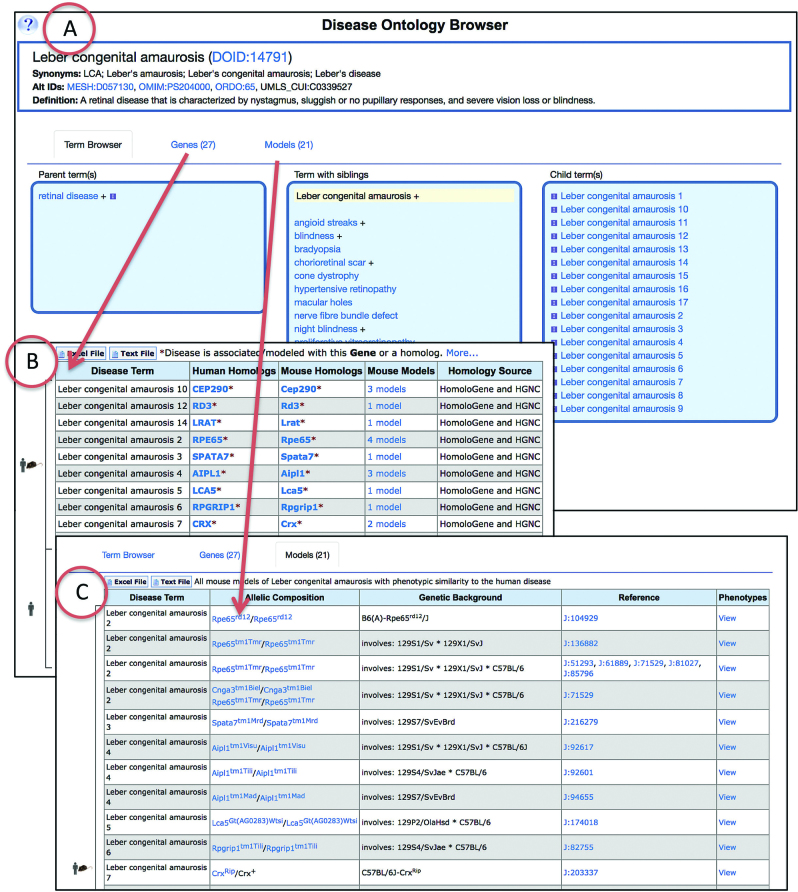
The Mouse Genome Database (MGD; http://www.informatics.jax.org) is the key community mouse database which supports basic, translational and computational research by providing integrated data on the genetics, genomics, and biology of the laboratory mouse. MGD serves as the source for biological reference data sets related to mouse genes, gene functions, phenotypes and disease models with an increasing emphasis on the association of these data to human biology and disease. We report here on recent enhancements to this resource, including improved access to mouse disease model and human phenotype data and enhanced relationships of mouse models to human disease.
Overview
The claims and statistics of this paper haven’t been checked yet.
Free: it reads the open-access text and checks the first 5 claims that cite a source we can check. Create a free account to check every claim.
Integrity signals
Registry
Cites
Statistics
Figures
Verification
Claims the paper makes
The claims and statistics of this paper haven’t been checked yet.
Free: it reads the open-access text and checks the first 5 claims that cite a source we can check. Create a free account to check every claim.
Claims other papers make about this one
Each is checked against this paper’s own text: does it say what the citing paper says it does?
In the citing paper
“Analysis of the osteocyte transcriptome signature showed it was enriched with genes associated with skeletal biological processes in the GO database40 (4.5-fold-enrichment (FE), P = 1.0 × 10−67), and with skeletal phenotypes in the Mouse Genome Informatics database41 (MGI, 2.7 FE, P = 4.7 × 10⁻³⁵).”
From Osteocyte transcriptome mapping identifies a molecular landscape controlling skeletal homeostasis and susceptibility to skeletal disease (2021) · cites this paper as [41]
Self-check
Percentages, sums and reported differences re-computed from the paper’s own numbers.
The self-check needs the paper’s full text.
Citations
Cites
Gene Ontology Consortium: going forward
The Gene Ontology Consortium (2015) · Nucleic Acids Research · doi:10.1093/nar/gku1179 · Cited by 3,492
Amberger, J. S., Bocchini, C. A., Schiettecatte, F., Scott, A. F., & Hamosh, A. (2015) · Nucleic Acids Research · doi:10.1093/nar/gku1205 · Cited by 2,691
The Human Phenotype Ontology in 2017
Köhler, S., Vasilevsky, N. A., Engelstad, M., Foster, E., McMurry, J., Aymé, S., Baynam, G., Bello, S. M., Boerkoel, C. F., Boycott, K. M., et al. (2017) · Nucleic Acids Research · doi:10.1093/nar/gkw1039 · Cited by 754
Self-citationThe diversity outbred mouse population
Churchill, G. A., Gatti, D. M., Munger, S. C., & Svenson, K. L. (2012) · Mammalian Genome · doi:10.1007/s00335-012-9414-2 · Cited by 458
Global genetic analysis in mice unveils central role for cilia in congenital heart disease
Li, Y., Klena, N. T., Gabriel, G. C., Liu, X., Kim, A. J., Lemke, K., Chen, Y., Chatterjee, B., Devine, W., Damerla, R. R., et al. (2015) · Nature · doi:10.1038/nature14269 · Cited by 432
Self-citationThe Mouse Genome Database (MGD): facilitating mouse as a model for human biology and disease
Eppig, J. T., Blake, J. A., Bult, C. J., Kadin, J. A., Richardson, J. E., & The Mouse Genome Database Group (2015) · Nucleic Acids Research · doi:10.1093/nar/gku967 · Cited by 357
Self-citationThe mammalian gene function resource: the international knockout mouse consortium
Bradley, A., Anastassiadis, K., Ayadi, A., Battey, J. F., Bell, C., Birling, M.-C., Bottomley, J., Brown, S. D., Bürger, A., Bult, C. J., et al. (2012) · Mammalian Genome · doi:10.1007/s00335-012-9422-2 · Cited by 312
Self-citationMouse Genome Database (MGD)-2017: community knowledge resource for the laboratory mouse
Blake, J. A., Eppig, J. T., Kadin, J. A., Richardson, J. E., Smith, C. L., Bult, C. J., & the Mouse Genome Database Group (2017) · Nucleic Acids Research · doi:10.1093/nar/gkw1040 · Cited by 262
Self-citationTen Years of the Collaborative Cross
Threadgill, D. W., & Churchill, G. A. (2012) · Genetics · doi:10.1534/genetics.111.138032 · Cited by 186
Smith, C. L., & Eppig, J. T. (2012) · Mammalian Genome · doi:10.1007/s00335-012-9421-3 · Cited by 174
Self-citation
Cited by
The Gene Ontology Resource: 20 years and still GOing strong
The Gene Ontology Consortium (2019) · Nucleic Acids Research · doi:10.1093/nar/gky1055 · Cited by 4,747
“The GO ribbon visualization metaphor borrows from a viewer originally developed by the Mouse Genome Database team (28), but in contrast, the GO ribbon was developed as a lightweight, reusable widget that can be embedded in any website, and retrieves data directly from the GO resource via API.”
MethodThe BioGRID interaction database: 2019 update
Oughtred, R., Stark, C., Breitkreutz, B.-J., Rust, J., Boucher, L., Chang, C., Kolas, N., O’Donnell, L., Leung, G., McAdam, R., et al. (2019) · Nucleic Acids Research · doi:10.1093/nar/gky1079 · Cited by 1,473
A reference map of the human binary protein interactome
Luck, K., Kim, D.-K., Lambourne, L., Spirohn, K., Begg, B. E., Bian, W., Brignall, R., Cafarelli, T., Campos-Laborie, F. J., Charloteaux, B., et al. (2020) · Nature · doi:10.1038/s41586-020-2188-x · Cited by 1,197
The NASA Twins Study: A multidimensional analysis of a year-long human spaceflight
Garrett-Bakelman, F. E., Darshi, M., Green, S. J., Gur, R. C., Lin, L., Macias, B. R., McKenna, M. J., Meydan, C., Mishra, T., Nasrini, J., et al. (2019) · Science · doi:10.1126/science.aau8650 · Cited by 1,128
The UCSC Genome Browser database: 2019 update
Haeussler, M., Zweig, A. S., Tyner, C., Speir, M. L., Rosenbloom, K. R., Raney, B. J., Lee, C. M., Lee, B. T., Hinrichs, A. S., Gonzalez, J. N., et al. (2019) · Nucleic Acids Research · doi:10.1093/nar/gky1095 · Cited by 877
Metadata
- Authors
- Smith, C. L., Blake, J. A., Kadin, J. A., Richardson, J. E., Bult, C. J., & the Mouse Genome Database Group
- Affiliations
- Jackson Laboratory (US)
- Corresponding author
- Smith, Cynthia L
- Venue
- Nucleic Acids Research
- Publisher
- Oxford University Press (OUP)
- Published
- 2017-10-30
- Volume
- 46
- Issue
- D1
- Pages
- D836-D842
- ISSN
- 0305-1048 (ISSN-L)
- 1362-4962
- PMC
- PMC5753350
- OpenAlex
- W2786189816
- Cited by
- 219
- References
- 21
- Citations by year
- 2026: 2 · 2025: 7 · 2024: 9 · 2023: 9 · 2022: 6 · 2021: 17 · 2020: 62 · 2019: 75 · 2018: 30
- FWCI
- 18.89
- Type
- journal article
- Language
- en
- Open access
- gold
- doi.org
- Licence
- Locations
- Nucleic Acids Research (publishedVersion, cc-by)
- PubMed Central (publishedVersion, cc-by)
- PubMed (publishedVersion)
- The Mouseion at the JAXlibrary (Jackson Laboratory) (submittedVersion, cc-by)
- Funders
- National Institutes of Health (HG000330)
- National Human Genome Research Institute (HG000330, U41HG002223, R25HG007053, U41HG000330, HG002223, HG007053)
- National Cancer Institute (P30CA034196)
- Topics
- Health Sciences › Medicine › Health Informatics › Biomedical Text Mining and Ontologies
- Life Sciences › Biochemistry, Genetics and Molecular Biology › Molecular Biology › Bioinformatics and Genomic Networks
- Life Sciences › Biochemistry, Genetics and Molecular Biology › Molecular Biology › Genomics and Phylogenetic Studies
- Keywords
- Mouse Genome Database, laboratory mice, mouse genetics, mouse genomics, mouse phenotypes, mouse models of human disease, human disease models, gene function, knowledge base
- MeSH terms
- Animals, Disease Models, Animal, Humans, Software, Species Specificity, User-Computer Interface, Information Storage and Retrieval, Genome, Access to Information, Genomics, Databases, Genetic, Mice, Web Browser, Data Curation
About these checks
Registry, retraction, Cites and statistics results are computed, not judged, with one exception: a printed reference that no index lists is read once by a model before it counts as a citation error. Claims are extracted by a model and kept only when their quote appears verbatim in the text; each cited source is then checked, with a model’s help, for whether it says what the claim relies on. Those verdicts can be wrong — read the claim’s quote and the cited source before relying on one.
Statistics and arithmetic are recomputed, not judged.
Confidence bands are shown only for fields calibrated on our annotated test set. None is calibrated yet, so no band is shown.
What counts as a claim ›How we measure confidence ›How we check this ›
Are you an author, or do you see a problem with this page? Request a review
How to cite
Cite CoChat for the checks on this page, and the paper for its own findings.
- This page
- CoChat. (2026). Citation check: Mouse Genome Database (MGD)-2018: knowledgebase for the laboratory mouse. https://app.cochat.ai/papers/10.1093/nar/gkx1006
- The paper
- Smith, C. L., Blake, J. A., Kadin, J. A., Richardson, J. E., Bult, C. J., & the Mouse Genome Database Group. (2018). Mouse Genome Database (MGD)-2018: knowledgebase for the laboratory mouse. Nucleic Acids Research. https://doi.org/10.1093/nar/gkx1006
Data sources
Bibliographic data: Semantic Scholar, OpenAlex, Crossref.
Contains information from the Semantic Scholar Academic Graph Datasets, made available under the ODC Attribution License (ODC-BY 1.0).
Semantic Scholar’s data is described in: Kinney, R., et al. (2023). The Semantic Scholar Open Data Platform. arXiv:2301.10140.
