

Abasic and oxidized ribonucleotides embedded in DNA are processed by human APE1 and not by RNase H2
Open accessThe DOI matches its Crossref record; 93 of the 93 references it cites were found in a registry or an index.
Abstract
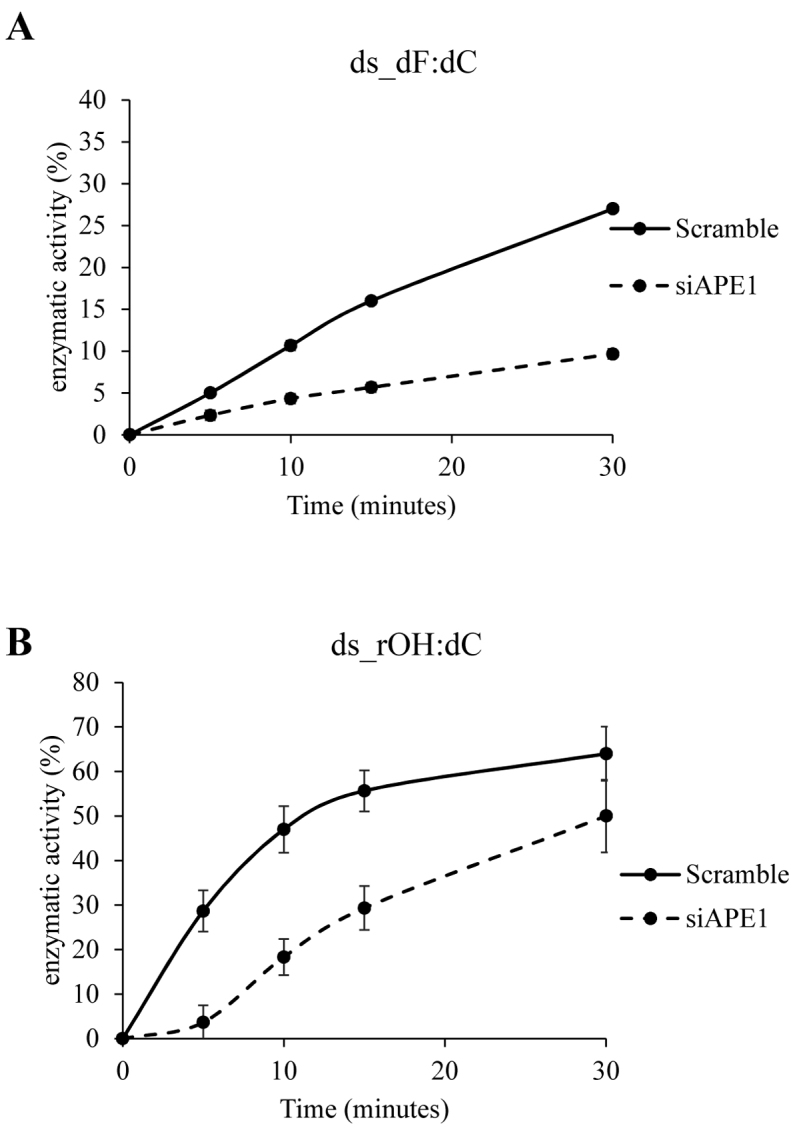
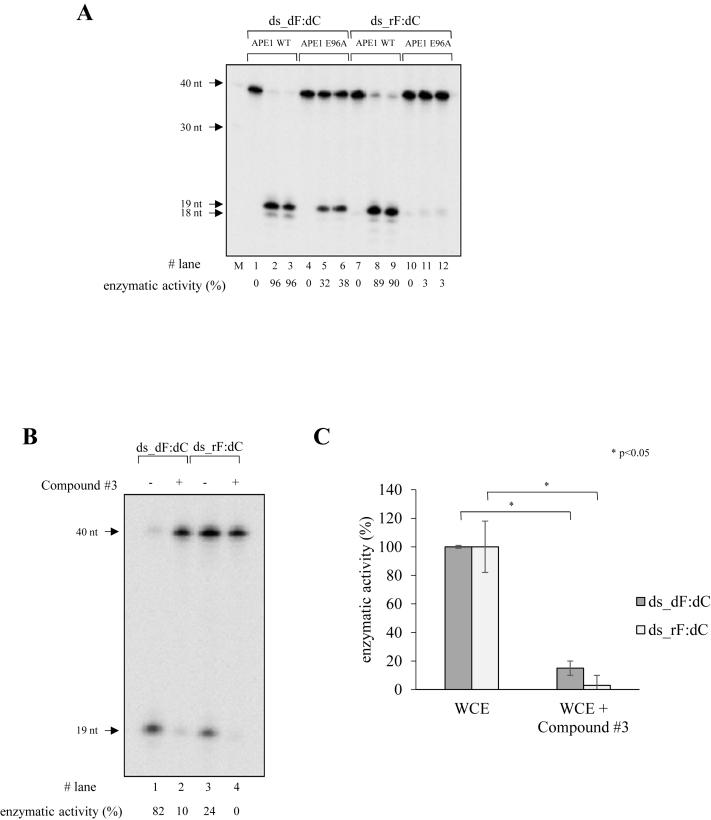
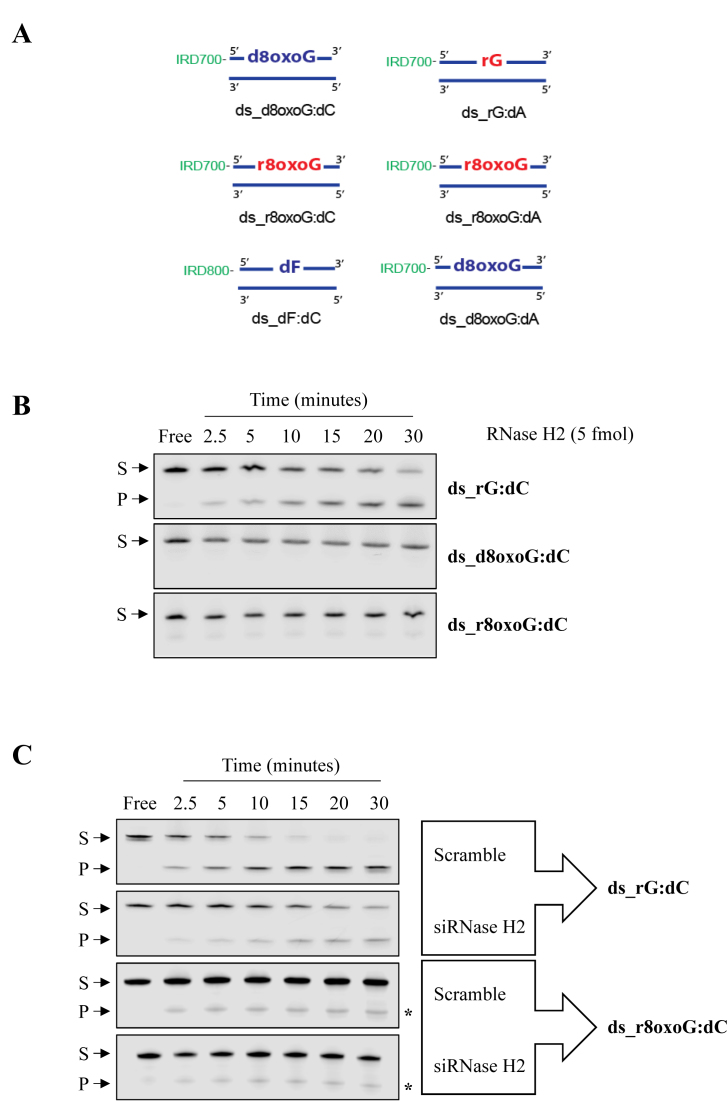
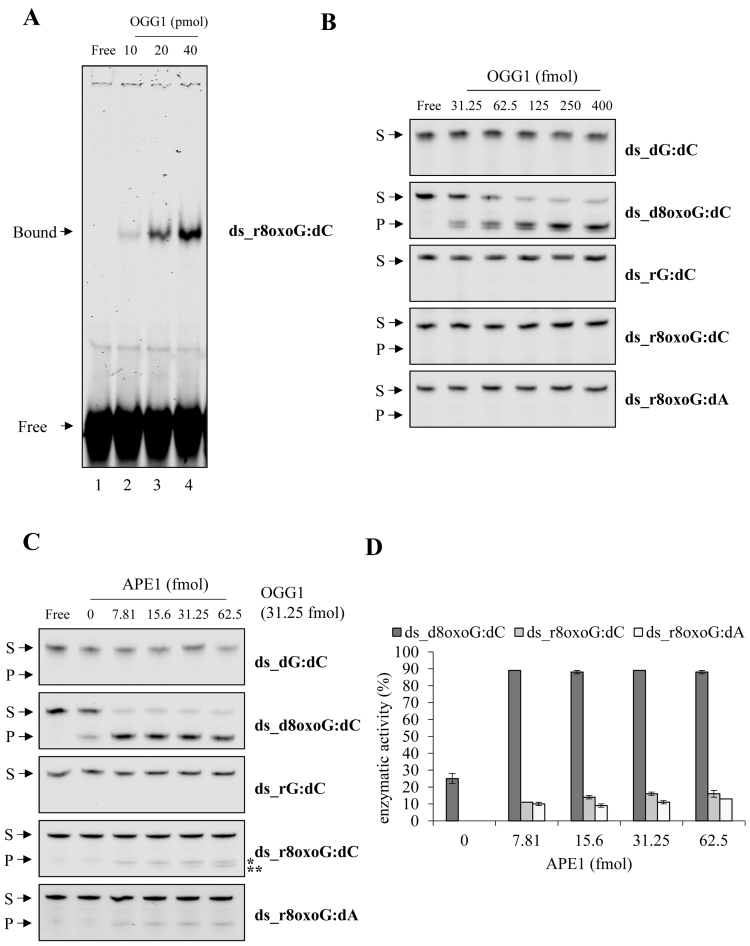
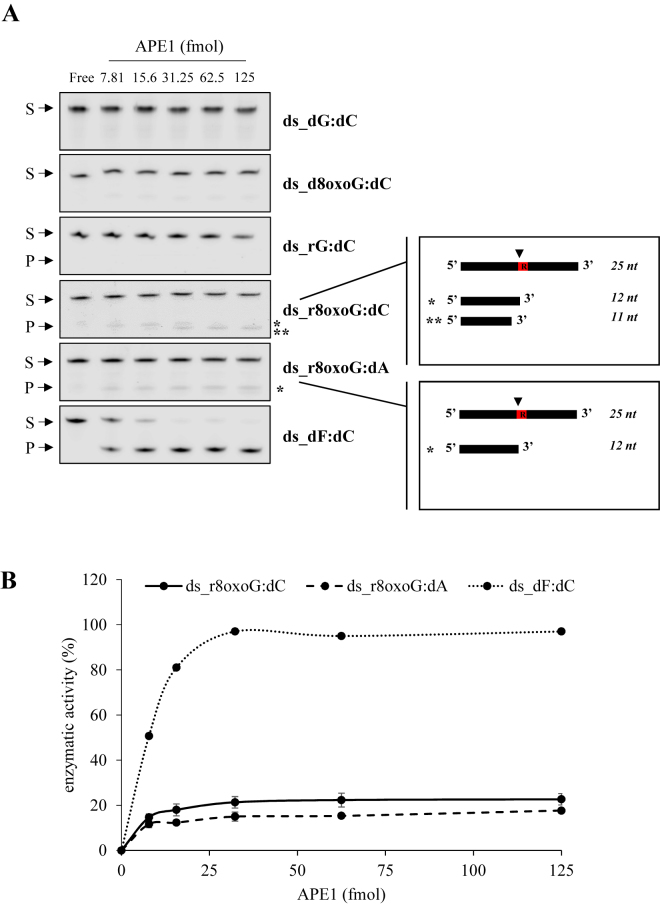
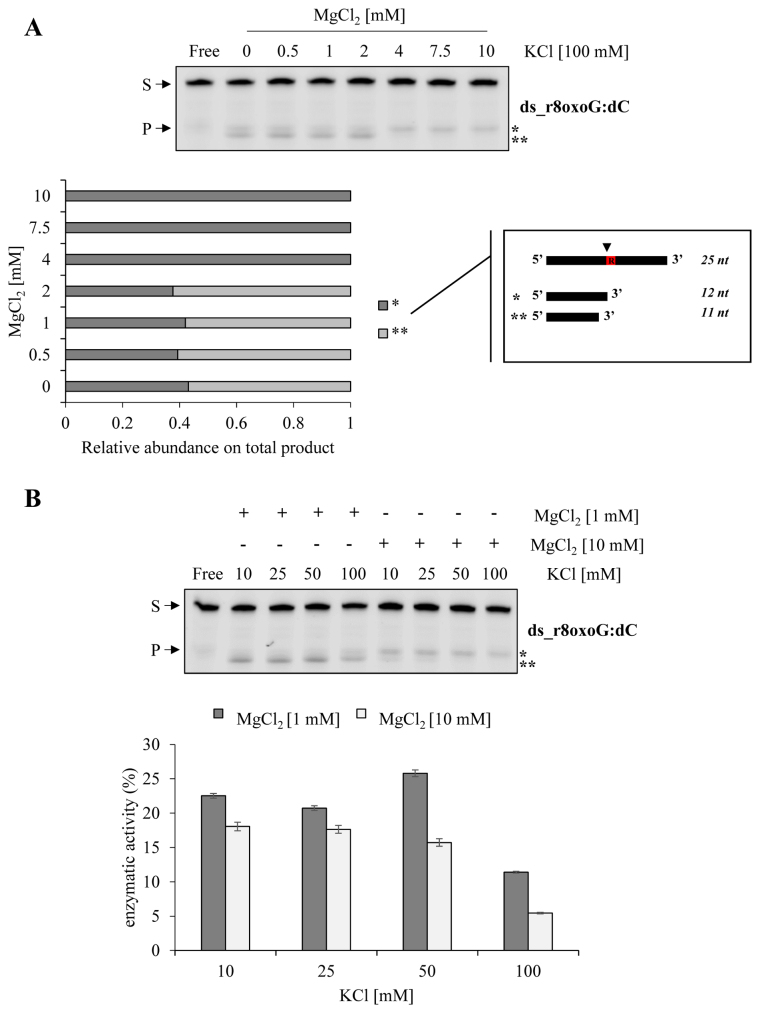
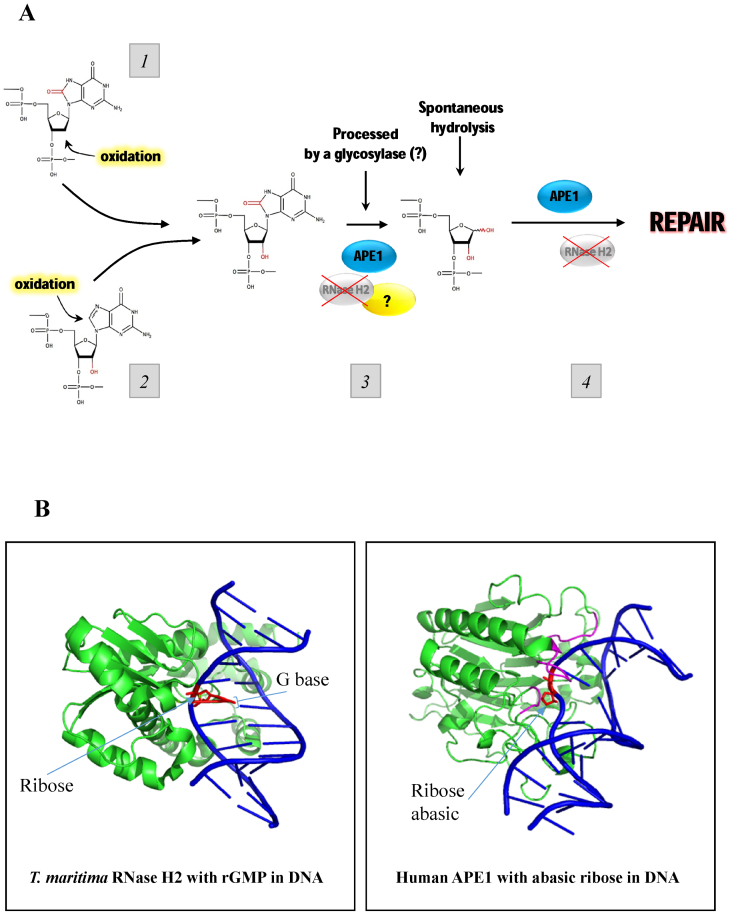
Ribonucleoside 5'-monophosphates (rNMPs) are the most common non-standard nucleotides found in DNA of eukaryotic cells, with over 100 million rNMPs transiently incorporated in the mammalian genome per cell cycle. Human ribonuclease (RNase) H2 is the principal enzyme able to cleave rNMPs in DNA. Whether RNase H2 may process abasic or oxidized rNMPs incorporated in DNA is unknown. The base excision repair (BER) pathway is mainly responsible for repairing oxidized and abasic sites into DNA. Here we show that human RNase H2 is unable to process an abasic rNMP (rAP site) or a ribose 8oxoG (r8oxoG) site embedded in DNA. On the contrary, we found that recombinant purified human apurinic/apyrimidinic endonuclease-1 (APE1) and APE1 from human cell extracts efficiently process an rAP site in DNA and have weak endoribonuclease and 3'-exonuclease activities on r8oxoG substrate. Using biochemical assays, our results provide evidence of a human enzyme able to recognize and process abasic and oxidized ribonucleotides embedded in DNA.
Overview
The claims and statistics of this paper haven’t been checked yet.
Free: it reads the open-access text and checks the first 5 claims that cite a source we can check. Create a free account to check every claim.
Integrity signals
Registry
Cites
Statistics
Figures
Verification
Claims the paper makes
The claims and statistics of this paper haven’t been checked yet.
Free: it reads the open-access text and checks the first 5 claims that cite a source we can check. Create a free account to check every claim.
Claims other papers make about this one
Each is checked against this paper’s own text: does it say what the citing paper says it does?
The source backs part of the claim, not all of it — or backs it for a different population, condition or comparison.
In the citing paper
“rNMPs have the propensity to form mismatches and are likely to become damaged, resulting in ribonucleotide lesions”
From Ribonucleotide errors, RNase HII, and ribonucleotide excision repair (2026) · cites this paper as Malfatti et al. 2017
Experimental — accuracy not yet measuredThe source backs part of the claim, not all of it — or backs it for a different population, condition or comparison.
In the citing paper
“Instead, in humans, AP endonuclease 1 (APE1) was shown to be able to incise ribonucleotide lesions both in vitro and in vivo by making an incision on the 5′ end of the oxidized or AP rNMP (Malfatti et al. 2017).”
From Ribonucleotide errors, RNase HII, and ribonucleotide excision repair (2026) · cites this paper as Malfatti et al. 2017
Experimental — accuracy not yet measuredThe source backs part of the claim, not all of it — or backs it for a different population, condition or comparison.
In the citing paper
“Interestingly, human APE1 has demonstrated activity on incising damaged rNMPs in vitro and in vivo, suggesting the involvement of APE1 in an additional pathway dedicated to the repair of a subset of single rNMP lesions which differs from its role in canonical BER (Figure 3B) (Malfatti et al. 2017).”
From Ribonucleotide errors, RNase HII, and ribonucleotide excision repair (2026) · cites this paper as Malfatti et al. 2017
Experimental — accuracy not yet measured
Self-check
Percentages, sums and reported differences re-computed from the paper’s own numbers.
The self-check needs the paper’s full text.
Citations
Cites
Instability and decay of the primary structure of DNA
Lindahl, T. (1993) · Nature · doi:10.1038/362709a0 · Cited by 5,679
Physiological concentrations of purines and pyrimidines
Traut, T. W. (1994) · Molecular and Cellular Biochemistry · doi:10.1007/bf00928361 · Cited by 1,867
Rate of depurination of native deoxyribonucleic acid
Lindahl, T., & Nyberg, B. (1972) · Biochemistry · doi:10.1021/bi00769a018 · Cited by 1,556 · cited 1×
“This rate gives 10 000 abasic sites per day in human cells (74).”
BackgroundKrokan, H. E., & Bjoras, M. (2013) · Cold Spring Harbor Perspectives in Biology · doi:10.1101/cshperspect.a012583 · Cited by 1,322
Base-excision repair of oxidative DNA damage
David, S. S., O'Shea, V. L., & Kundu, S. (2007) · Nature · doi:10.1038/nature05978 · Cited by 1,238 · cited 1×
“Since OGG1 is the major glycosylase enzyme in the BER pathway, coordinating with the downstream endonuclease APE1, which is able to recognize and process the abasic site generated by the glycosylase activity of OGG1 (28,58,59), we measured its glycosylase activity on the same substrates using recombinant purified APE1…”
MethodAicardi–Goutières syndrome and the type I interferonopathies
Crow, Y. J., & Manel, N. (2015) · Nature Reviews Immunology · doi:10.1038/nri3850 · Cited by 925
MUTAGENESIS BY APURINIC/APYRIMIDINIC SITES
Loeb, L. A., & Preston, B. D. (1986) · Annual Review of Genetics · doi:10.1146/annurev.ge.20.120186.001221 · Cited by 901 · cited 2×
“Indeed, like deoxyribonucleotides, rNMPs are also susceptible to oxidative insults (5,70), and a significant generation of abasic sites formation has been demonstrated upon RNA oxidation and alkylation (71).”
BackgroundRibonuclease H: the enzymes in eukaryotes
Cerritelli, S. M., & Crouch, R. J. (2009) · The FEBS Journal · doi:10.1111/j.1742-4658.2009.06908.x · Cited by 814 · cited 2×
“RNase H2-null murine embryonic fibroblasts (MEFs) activate a p53-dependent damage response, whereas null-RNase H2 are embryonic lethal (15).”
BackgroundSelf-citationDNA-bound structures and mutants reveal abasic DNA binding by APE1 DNA repair and coordination
Mol, C. D., Izumi, T., Mitra, S., & Tainer, J. A. (2000) · Nature · doi:10.1038/35000249 · Cited by 755
Crow, Y. J., Leitch, A., Hayward, B. E., Garner, A., Parmar, R., Griffith, E., Ali, M., Semple, C., Aicardi, J., Babul-Hirji, R., et al. (2006) · Nature Genetics · doi:10.1038/ng1842 · Cited by 675
Cited by
Hallmarks of DNA replication stress
Saxena, S., & Zou, L. (2022) · Molecular Cell · doi:10.1016/j.molcel.2022.05.004 · Cited by 439
8-Oxoguanine: from oxidative damage to epigenetic and epitranscriptional modification
Hahm, J. Y., Park, J., Jang, E.-S., & Chi, S. W. (2022) · Experimental & Molecular Medicine · doi:10.1038/s12276-022-00822-z · Cited by 317
Revisiting Two Decades of Research Focused on Targeting APE1 for Cancer Therapy: The Pros and Cons
Malfatti, M. C., Bellina, A., Antoniali, G., & Tell, G. (2023) · Cells · doi:10.3390/cells12141895 · Cited by 76
“Specifically, APE1 has been demonstrated to be able to cleave abasic RNA [15] and damaged ribonucleotides embedded in DNA [17,18], revealing it as an efficient endoribonuclease.”
BackgroundSelf-citationWulfridge, P., & Sarma, K. (2024) · Nature Cell Biology · doi:10.1038/s41556-024-01437-4 · Cited by 80
“In addition, as RNaseH2 is unable to remove abasic ribonucleotides embedded in dsDNA 93 , its activity may be similarly inhibited in the context of DNA:RNA hybrids.”
RNA: a double-edged sword in genome maintenance
Zong, D., Oberdoerffer, P., Batista, P. J., & Nussenzweig, A. (2020) · Nature Reviews Genetics · doi:10.1038/s41576-020-0263-7 · Cited by 63
Metadata
- Authors
- Malfatti, M. C., Balachander, S., Antoniali, G., Koh, K. D., Saint-Pierre, C., Gasparutto, D., Chon, H., Crouch, R. J., Storici, F., & Tell, G.
- Affiliations
- University of Udine (IT)
- Georgia Institute of Technology (US)
- Centre National de la Recherche Scientifique (FR)
- National Institutes of Health (US)
- Corresponding author
- Storici, Francesca
- Tell, Gianluca
- ORCID
- Venue
- Nucleic Acids Research
- Publisher
- Oxford University Press (OUP)
- Published
- 2017-08-18
- Volume
- 45
- Issue
- 19
- Pages
- 11193-11212
- ISSN
- 0305-1048 (ISSN-L)
- 1362-4962
- PMC
- PMC5737539
- OpenAlex
- W2750389306
- Semantic Scholar
- 598b71b2e36ca49876f1f9da3670f6ffe1e8ce18
- Cited by
- 59
- References
- 93
- Citations by year
- 2026: 5 · 2025: 5 · 2024: 4 · 2023: 6 · 2022: 7 · 2021: 9 · 2020: 9 · 2019: 9 · 2018: 5
- FWCI
- 2.57
- Type
- journal article
- Language
- en
- Open access
- gold
- doi.org
- Licence
- Locations
- Nucleic Acids Research (publishedVersion, cc-by-nc)
- Europe PMC (PubMed Central) (publishedVersion, cc-by-nc)
- PubMed Central (publishedVersion, cc-by-nc)
- PubMed (publishedVersion)
- HAL (submittedVersion)
- Institutional Research Information System (University of Udine) (submittedVersion, cc-by-nc-nd)
- Funders
- Associazione Italiana per la Ricerca sul Cancro (IG 2013, IG2013-14038)
- Università degli Studi di Udine
- National Institutes of Health
- National Institute of Environmental Health Sciences (R01ES026243)
- National Institute of Child Health and Human Development
- Topics
- Life Sciences › Biochemistry, Genetics and Molecular Biology › Molecular Biology › DNA Repair Mechanisms
- Life Sciences › Biochemistry, Genetics and Molecular Biology › Molecular Biology › DNA and Nucleic Acid Chemistry
- Life Sciences › Biochemistry, Genetics and Molecular Biology › Molecular Biology › RNA regulation and disease
- Keywords
- abasic sites, APE1, apurinic/apyrimidinic endonuclease 1, RNase H2, base excision repair, 8-oxoguanine, endoribonuclease activity, 3' exonuclease activity, DNA repair
- MeSH terms
- Binding Sites, DNA, DNA Repair, HeLa Cells, Humans, Kinetics, Models, Genetic, Oxidation-Reduction, Protein Binding, Recombinant Proteins, Ribonucleotides, Substrate Specificity, Ribonuclease H, DNA-(Apurinic or Apyrimidinic Site) Lyase
About these checks
Registry, retraction, Cites and statistics results are computed, not judged, with one exception: a printed reference that no index lists is read once by a model before it counts as a citation error. Claims are extracted by a model and kept only when their quote appears verbatim in the text; each cited source is then checked, with a model’s help, for whether it says what the claim relies on. Those verdicts can be wrong — read the claim’s quote and the cited source before relying on one.
Statistics and arithmetic are recomputed, not judged.
Confidence bands are shown only for fields calibrated on our annotated test set. None is calibrated yet, so no band is shown.
What counts as a claim ›How we measure confidence ›How we check this ›
Are you an author, or do you see a problem with this page? Request a review
Data sources
Bibliographic data: Semantic Scholar, OpenAlex, Crossref.
Contains information from the Semantic Scholar Academic Graph Datasets, made available under the ODC Attribution License (ODC-BY 1.0).
Semantic Scholar’s data is described in: Kinney, R., et al. (2023). The Semantic Scholar Open Data Platform. arXiv:2301.10140.
