

Apical amplification—a cellular mechanism of conscious perception?
Open accessPublished version of a preprint
The DOI matches its Crossref record; 194 of the 196 references it cites were found in a registry or an index.
Abstract
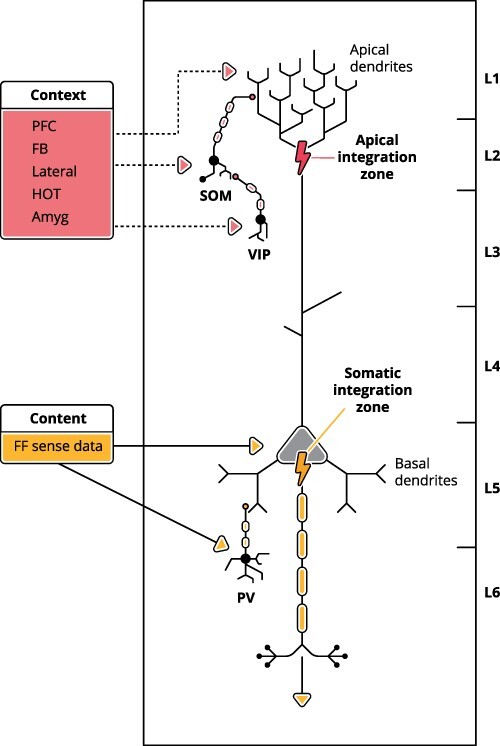
We present a theoretical view of the cellular foundations for network-level processes involved in producing our conscious experience. Inputs to apical synapses in layer 1 of a large subset of neocortical cells are summed at an integration zone near the top of their apical trunk. These inputs come from diverse sources and provide a context within which the transmission of information abstracted from sensory input to their basal and perisomatic synapses can be amplified when relevant. We argue that apical amplification enables conscious perceptual experience and makes it more flexible, and thus more adaptive, by being sensitive to context. Apical amplification provides a possible mechanism for recurrent processing theory that avoids strong loops. It makes the broadcasting hypothesized by global neuronal workspace theories feasible while preserving the distinct contributions of the individual cells receiving the broadcast. It also provides mechanisms that contribute to the holistic aspects of integrated information theory. As apical amplification is highly dependent on cholinergic, aminergic, and other neuromodulators, it relates the specific contents of conscious experience to global mental states and to fluctuations in arousal when awake. We conclude that apical dendrites provide a cellular mechanism for the context-sensitive selective amplification that is a cardinal prerequisite of conscious perception.
Overview
The claims and statistics of this paper haven’t been checked yet.
Free: it reads the open-access text and checks the first 5 claims that cite a source we can check. Create a free account to check every claim.
Integrity signals
Registry
Cites
Statistics
Figures
Verification
Claims the paper makes
The claims and statistics of this paper haven’t been checked yet.
Free: it reads the open-access text and checks the first 5 claims that cite a source we can check. Create a free account to check every claim.
Claims other papers make about this one
Each is checked against this paper’s own text: does it say what the citing paper says it does?
The source backs part of the claim, not all of it — or backs it for a different population, condition or comparison.
In the citing paper
“AAT [13] divides the apical trunk into proximal and distal compartments.”
From Testing circuit-level theories of consciousness in humans (2026) · cites this paper as [13]
Experimental — accuracy not yet measuredThe cited source says what the claim attributes to it.
In the citing paper
“This work, which remains critical, has both grounded the study of NCCs in systems physiology and inspired novel, circuit-level theories of consciousness such as apical amplification theory (AAT) [12–14] and dendritic integration theory (DIT) [15–17]”
From Testing circuit-level theories of consciousness in humans (2026) · cites this paper as [13]
Self-check
Percentages, sums and reported differences re-computed from the paper’s own numbers.
The self-check needs the paper’s full text.
Citations
Cites
Advances in neural information processing systems 7
(1996) · Computers & Mathematics with Applications · doi:10.1016/s0898-1221(96)90463-0 · Cited by 14,281
(2005) · Choice Reviews Online · doi:10.5860/choice.43-0626 · Cited by 4,674
The distinct modes of vision offered by feedforward and recurrent processing
Lamme, V. A. F., & Roelfsema, P. R. (2000) · Trends in Neurosciences · doi:10.1016/s0166-2236(00)01657-x · Cited by 2,338
Conscious, preconscious, and subliminal processing: a testable taxonomy
Dehaene, S., Changeux, J.-P., Naccache, L., Sackur, J., & Sergent, C. (2006) · Trends in Cognitive Sciences · doi:10.1016/j.tics.2006.03.007 · Cited by 2,067
Neural correlates of consciousness: progress and problems
Koch, C., Massimini, M., Boly, M., & Tononi, G. (2016) · Nature Reviews Neuroscience · doi:10.1038/nrn.2016.22 · Cited by 1,600 · cited 2×
“In addition, IIT mostly confines the processes implementing visual perceptual experience to the “posterior HOT-zone” comprising temporal, parietal, and occipital areas (Koch et al. 2016).”
BackgroundMethodBreakdown of cortical effective connectivity during sleep
Massimini, M., Ferrarelli, F., Huber, R., Esser, S. K., Singh, H., & Tononi, G. (2005) · Science · doi:10.1126/science.1117256 · Cited by 1,534 · cited 1×
“In consciousness studies, perceptual contents are traditionally distinguished from the global states of consciousness, such as the mutually exclusive states of wakefulness, dreamless sleep, coma, minimal consciousness, dreams, or general anesthesia (Massimini et al. 2005; Owen, Schiff and Laureys 2009; Windt and Norei…”
BackgroundHochstein (2002) · doi:10.1016/s0896-6273(02)01091-7 · Cited by 1,397
The neural circuit of orexin (hypocretin): maintaining sleep and wakefulness
Sakurai, T. (2007) · Nature Reviews Neuroscience · doi:10.1038/nrn2092 · Cited by 1,276 · cited 2×
“Furthermore, the master regulator of the neuromodulators, orexin (aka hypocretin) has a direct effect on pyramidal cells that plays a major role in maintaining wakefulness (Sakurai 2007).”
BackgroundShams, L., Kamitani, Y., & Shimojo, S. (2000) · Nature · doi:10.1038/35048669 · Cited by 1,262
A new cellular mechanism for coupling inputs arriving at different cortical layers
Larkum, M. E., Zhu, J. J., & Sakmann, B. (1999) · Nature · doi:10.1038/18686 · Cited by 1,180
Research works printed but not linked: 2
- Jones EG. The Thalamus. Berlin: Springer Science & Business Media, 2012.
- Sacramento J Costa RP Bengio Y et al. Dendritic cortical microcircuits approximate the backpropagation algorithm. In: Bengio Y, Wallach H, Larochelle H et al. (eds), Advances in Neural Information Processing SystemsVol 31. Red Hook, NY: Curran Associates, Inc, 2018, 8721– 32.
Cited by
Mäki-Marttunen, T., & Mäki-Marttunen, V. (2022) · doi:10.1101/2022.03.30.486368 · Cited by 44
Mäki‐Marttunen, T., & Mäki-Marttunen, V. (2022) · PLoS Computational Biology · doi:10.1371/journal.pcbi.1010506 · Cited by 44
Unlocking the Potential of Two-Point Cells for Energy-Efficient and Resilient Training of Deep Nets
Adeel, A., Adetomi, A., Ahmed, K., Hussain, A., Arslan, T., & Phillips, W. A. (2023) · IEEE Transactions on Emerging Topics in Computational Intelligence · doi:10.1109/tetci.2022.3228537 · Cited by 36
“It is supported by recent neurobiological studies [40][41][48][49][50][51][52][53][54], and is inherently energy-efficient.”
BackgroundSelf-citationThe neural hierarchy of consciousness: A theoretical model and review on neurophysiology and NCCs
Almeida, V. N. (2022) · Neuropsychologia · doi:10.1016/j.neuropsychologia.2022.108202 · Cited by 27
A burst-dependent thalamocortical substrate for perceptual awareness
Whyte, C. J., Müller, E. J., Aru, J., Larkum, M. E., John, Y. J., Munn, B., & Shine, J. M. (2025) · PLoS Computational Biology · doi:10.1371/journal.pcbi.1012951 · Cited by 23
“Given the ubiquity of the thalamocortical circuit architecture across sensory modalities, we [10,11,14,15], along with others [16,17], have proposed that reverberant bursting activity in L5 PT – matrix thalamus loops may be a necessary component part in a domain general mechanism of perceptual…”
Cellular psychology: relating cognition to context-sensitive pyramidal cells
Phillips, W. A., Bachmann, T., Spratling, M. W., Muckli, L., Petro, L. S., & Zolnik, T. (2025) · Trends in Cognitive Sciences · doi:10.1016/j.tics.2024.09.002 · Cited by 18
Self-citationCellular mechanisms of cooperative context-sensitive predictive inference
Marvan, T., & Phillips, W. A. (2024) · Current Research in Neurobiology · doi:10.1016/j.crneur.2024.100129 · Cited by 25
“…on the mode of apical function referred to as ‘apical amplification ’ (AA), which is central to the perspective advocated by Larkum and Phillips (2016, 2017), Phillips et al. (2018), Marvan et al. (2021), and by the Dendritic Integration Theory (Aru et al., 2020a; Bachmann et al., 2020).”
BackgroundSelf-citationLaminar specificity of the auditory perceptual awareness negativity: a biophysical modeling study
Fernandez Pujol, C., Blundon, E. G., & Dykstra, A. R. (2023) · PLOS Computational Biology · doi:10.1371/journal.pcbi.1011003 · Cited by 14
The Cooperative Neuron: Cellular Foundations of Mental Life
Phillips, W. A. (2023) · doi:10.1093/oso/9780198876984.001.0001 · Cited by 13
Self-citationKeppler, J. (2024) · Frontiers in Human Neuroscience · doi:10.3389/fnhum.2024.1379191 · Cited by 17
“…the apical dendrites of pyramidal neurons serve as switches (Aru et al., 2020), and that perceptual inputs that flow into the basal compartments of pyramidal neurons only transcend the threshold of consciousness if apical amplification processes are turned on (Larkum, 2013; Marvan et al., 2021).”
BackgroundGraham, B. P., Kay, J., & Phillips, W. A. (2025) · Neural Computation · doi:10.1162/neco_a_01739 · Cited by 16
Self-citationHierarchy of prediction errors shapes the learning of context-dependent sensory representationsPreprint
Tsai, M. C., Teutsch, J., Wybo, W. A. M., Helmchen, F., Banerjee, A., & Senn, W. (2024) · bioRxiv (Cold Spring Harbor Laboratory) · doi:10.1101/2024.09.30.615819 · Cited by 12
“Therefore, apical dendrites are suspected to selectively amplify neural responses in order to increase the internal salience of task-relevant sensory stimuli [16, 17].”
Dowdle, L. T., Ghose, G. M., Moeller, S., Uǧurbil, K., Yacoub, E. S., & Vizioli, L. (2022) · bioRxiv (Cold Spring Harbor Laboratory) · doi:10.1101/2022.12.03.518973 · Cited by 8
Opposing plasticity mechanisms enhance visual inputs that violate their contextPreprint
Seignette, K., de Kraker, L., Halak, M., Papale, P., Petro, L. S., Petro, L. S., Montijn, J. S., Self, M. W., Wilmes, K. A., Roelfsema, P. R., et al. (2024) · bioRxiv (Cold Spring Harbor Laboratory) · doi:10.1101/2024.06.10.598181 · Cited by 6
How-tests for consciousness and direct neurophenomenal structuralism
Fink, S. B. (2024) · Frontiers in Psychology · doi:10.3389/fpsyg.2024.1352272 · Cited by 6
“…with recursive processing theorists, who do not only focus on the prefrontal cortex but on any neural event involving recursive processing (Lamme, 2004), while apical amplification theorists argue that “apical amplification enables conscious perceptual experience” (Marvan et al., 2021), and so on.”
BackgroundDyakin, V. V., & Dyakina‐Fagnano, N. V. (2024) · Symmetry · doi:10.3390/sym16030355 · Cited by 5
Silverstein, S. M., Zolnik, T. A., Larkum, M. E., & Thompson, J. L. (2026) · Current Research in Neurobiology · doi:10.1016/j.crneur.2026.100165 · Cited by 6
“Activity within apical and basal compartments is also affected by several classes of interneurons, which differentially affect these regions (Phillips, 2023; Marvan and Phillips, 2024; Marvan et al., 2021).”
Context-sensitive conscious interpretation and layer-5 pyramidal neurons in multistable perception
Bachmann, T. (2025) · Brain and Behavior · doi:10.1002/brb3.70393 · Cited by 3
“…research suitable for more precise testing of the neural mechanisms involved in producing a number of consciousness phenomena (Bachmann 2015; Marvan et al. 2021; Phillips 2023); these theories could be resourceful for overcoming mutual inconsistency between different—mostly…”
Self-citationTesting circuit-level theories of consciousness in humans
Dykstra, A. R., Zhu, Y., Fernandez Pujol, C., Zhou, D. W., Jones, S. R., Marvan, T., & Bonaiuto, J. J. (2026) · Trends in Cognitive Sciences · doi:10.1016/j.tics.2025.08.012 · Cited by 3
Self-citationBachmann, T. (2021) · Neuroscience of Consciousness · doi:10.1093/nc/niab045 · Cited by 4
“…postulate of PRT and DIT (Bachmann 1994, 1997; Aru et al. 2019, 2020b; Bachmann et al. 2020) together with the AA theory (Phillips et al. 2016; Marvan et al. 2021) is that in the anesthetic state specific-content-representing processes by the cortical neurons are decoupled from the processes…”
InfluentialSelf-citationMäki-Marttunen, V. (2026) · Communications Biology · doi:10.1038/s42003-026-09912-4 · Cited by 2
Introduction to The Cooperative Neuron
Phillips, W. A. (2023) · Oxford University Press eBooks · doi:10.1093/oso/9780198876984.003.0001 · Cited by 1
Self-citationWang, X., Ma, X., Shen, Z., Jia, Y., Wang, Y., & Zhang, N. (2026) · Frontiers in Neurology · doi:10.3389/fneur.2026.1734294 · Cited by 2
“Network-level analyses further support the view that anesthetic unconsciousness reflects reconfigured connectivity states, a concept that underpins emerging predictive monitoring approaches discussed later (22–25).”
Conscious and unconscious qualities
Polák, M. (2023) · Routledge eBooks · doi:10.4324/9781003409526-3 · Cited by 2
Self-citationStephani, T., Villringer, A., & Nikulin, V. V. (2025) · Journal of Neuroscience · doi:10.1523/jneurosci.2280-24.2025 · Cited by 2
Laminar Specificity of the Auditory Perceptual Awareness Negativity: A Biophysical Modeling StudyPreprint
Pujol, C. F., Blundon, E. G., & Dykstra, A. R. (2023) · bioRxiv (Cold Spring Harbor Laboratory) · doi:10.1101/2023.03.06.531459 · Cited by 1
“…model is consistent with cellular-and circuit-level theories of conscious perception Our modeling results are consistent with recent cellular-and circuit-level theories of consciousness / conscious perception, namely dendritic integration theory (DIT) [6,7] and apical amplification theory (AA) [8] .”
Strong phenomenal intentionality theory and unconscious phenomenality
Polák, M. (2024) · Philosophical Psychology · doi:10.1080/09515089.2024.2413897 · Cited by 1
“But this is not to say that there could not be some, for example, purely neural mechanism (see Marvan et al., 2021 for such an example), or attentional mechanism (as hypothesized in Jorba, 2016), that ensures the shift of this phenomenal content into consciousness.”
Self-citationTressoldi, P. E. (2022) · MindRxiv (OSF Preprints) · doi:10.31231/osf.io/gj2wv
Larkum, M. E. (2023) · Oxford University Press eBooks · doi:10.1093/oso/9780198876984.002.0005
Evolution and Development of Cooperative Neurons
Phillips, W. A. (2023) · Oxford University Press eBooks · doi:10.1093/oso/9780198876984.003.0007
Self-citationAn Information-theoretic View of Context-sensitive Computation
Phillips, W. A. (2023) · Oxford University Press eBooks · doi:10.1093/oso/9780198876984.003.0009
Self-citationLife, Brain, and Mind: Marvels of Cooperation between Diverse Individuals
Phillips, W. A. (2023) · Oxford University Press eBooks · doi:10.1093/oso/9780198876984.003.0002
Self-citationWhat Cooperative Neurons Do for Mental Life
Phillips, W. A. (2023) · Oxford University Press eBooks · doi:10.1093/oso/9780198876984.003.0006
Self-citationNeocortical Pyramidal Cells that Cooperate by Sensitivity to Context
Phillips, W. A. (2023) · Oxford University Press eBooks · doi:10.1093/oso/9780198876984.003.0004
Self-citationPathologies of Cooperative Neuronal Processing
Phillips, W. A. (2023) · Oxford University Press eBooks · doi:10.1093/oso/9780198876984.003.0008
Self-citationPhillips, W. A. (2023) · Oxford University Press eBooks · doi:10.1093/oso/9780198876984.002.0004
Self-citationCooperative Neurons in Various States of Mind and Brain
Phillips, W. A. (2023) · Oxford University Press eBooks · doi:10.1093/oso/9780198876984.003.0005
Self-citationPhillips, W. A. (2023) · Oxford University Press eBooks · doi:10.1093/oso/9780198876984.003.0003
Self-citationPhillips, W. A. (2023) · Oxford University Press eBooks · doi:10.1093/oso/9780198876984.002.0003
Self-citationPhillips, B. (2023) · Oxford University Press eBooks · doi:10.1093/oso/9780198876984.002.0006
Phillips, W. A. (2023) · Oxford University Press eBooks · doi:10.1093/oso/9780198876984.002.0008
Self-citationPhillips, W. A. (2023) · Oxford University Press eBooks · doi:10.1093/oso/9780198876984.003.0011
Self-citationDifficulties and Unresolved Issues
Phillips, W. A. (2023) · Oxford University Press eBooks · doi:10.1093/oso/9780198876984.003.0010
Self-citationDyakin, V. V. (2023) · Preprints.org · doi:10.20944/preprints202306.1885.v1
Advance praise for The Cooperative Neuron
Phillips, W. A. (2023) · Oxford University Press eBooks · doi:10.1093/oso/9780198876984.002.0019 · Cited by 1
Self-citationInsights in Consciousness Research, volume II
(2025) · Frontiers research topics · doi:10.3389/978-2-8325-6379-3
Noradrenergic activity as a key target in modulating consciousness
Karampela, O., Fontan, A., Lindgren, L., Pedale, T., Brorsson, C., Bergström, F., & Eriksson, J. (2026) · Scientific Reports · doi:10.1038/s41598-026-41819-2
“In the awake state, increased arousal leads to higher amplification allowing relevant stimuli to become conscious, while other stimuli remain unconscious unless further amplified 31 .”
Perceptual awareness and visual cortex
Bachmann, T. (2026) · Elsevier eBooks · doi:10.1016/b978-0-443-29258-3.00018-5
Self-citationArendash, G. W. (2026) · International Journal of Molecular Sciences · doi:10.3390/ijms27136090
Psychedelic drug action at dendrites is gated by behavioral state and serotonin receptorsPreprint
Savalia, N. K., Shao, L.-X., Knox, C. A., Gilbert, A.-K., Jiang, Q., & Kwan, A. C. (2026) · bioRxiv (Cold Spring Harbor Laboratory) · doi:10.64898/2026.07.16.738983
Skipper, J. I., Timmermann, C., McAlpine, R. G., Jedlovszky, K., Jaglinska, M., Cooper, G., & Blackburne, G. (2026) · bioRxiv (Cold Spring Harbor Laboratory) · doi:10.64898/2026.09.02.745341
“At the cellular scale, apical amplification offers a context-sensitive gate [23].”
Peer review history of A burst-dependent thalamocortical substrate for perceptual awareness (part 6)
Whyte, C. J., Müller, E. J., Aru, J., Larkum, M., John, Y., Munn, B. R., & Shine, J. M. (2025) · doi:10.1371/journal.pcbi.1012951.r006
Mäki-Marttunen, T., & Mäki-Marttunen, V. (2022) · doi:10.1371/journal.pcbi.1010506.r002
Metadata
- Authors
- Marvan, T., Polák, M., Bachmann, T., & Phillips, W. A.
- Affiliations
- Czech Academy of Sciences (CZ)
- University of West Bohemia in Pilsen (CZ)
- University of Tartu (EE)
- University of Stirling (GB)
- Corresponding author
- Marvan, Tomáš
- Venue
- Neuroscience of Consciousness
- Publisher
- Oxford University Press (OUP)
- Published
- 2021-10-01
- Volume
- 2021
- Issue
- 2
- Pages
- niab036-niab036
- ISSN
- 2057-2107 (ISSN-L)
- PMC
- PMC8511476
- OpenAlex
- W3207587593
- Cited by
- 45
- References
- 196
- Citations by year
- 2026: 4 · 2025: 5 · 2024: 8 · 2023: 23 · 2022: 4 · 2021: 1
- FWCI
- 4.73
- Type
- journal article
- Language
- en
- Open access
- gold
- doi.org
- Licence
- Locations
- Neuroscience of Consciousness (publishedVersion, cc-by)
- PubMed Central (publishedVersion, cc-by)
- PubMed (publishedVersion)
- Stirling Online Research Repository (University of Stirling) (submittedVersion, cc-by)
- Digital Library (University of West Bohemia) (submittedVersion)
- PhilPapers (PhilPapers Foundation) (submittedVersion)
- OSF Preprints (OSF Preprints) (submittedVersion, cc-by)
- OSF Preprints (OSF Preprints) (submittedVersion)
- Funders
- Grantová Agentura Ceské Republiky (20-14445S)
- Topics
- Life Sciences › Neuroscience › Cognitive Neuroscience › Neural dynamics and brain function
- Social Sciences › Arts and Humanities › Philosophy › Philosophy and Theoretical Science
- Life Sciences › Neuroscience › Cellular and Molecular Neuroscience › Neuroscience and Neuropharmacology Research
- Keywords
- apical dendrites, conscious perception, recurrent processing, global neuronal workspace theory, integrated information theory, neuromodulation, cholinergic modulation, arousal
About these checks
Registry, retraction, Cites and statistics results are computed, not judged, with one exception: a printed reference that no index lists is read once by a model before it counts as a citation error. Claims are extracted by a model and kept only when their quote appears verbatim in the text; each cited source is then checked, with a model’s help, for whether it says what the claim relies on. Those verdicts can be wrong — read the claim’s quote and the cited source before relying on one.
Statistics and arithmetic are recomputed, not judged.
Confidence bands are shown only for fields calibrated on our annotated test set. None is calibrated yet, so no band is shown.
What counts as a claim ›How we measure confidence ›How we check this ›
Are you an author, or do you see a problem with this page? Request a review
Data sources
Bibliographic data: Semantic Scholar, OpenAlex, Crossref.
Contains information from the Semantic Scholar Academic Graph Datasets, made available under the ODC Attribution License (ODC-BY 1.0).
Semantic Scholar’s data is described in: Kinney, R., et al. (2023). The Semantic Scholar Open Data Platform. arXiv:2301.10140.
