

Targeted therapy for high-grade glioma with the TGF- 2 inhibitor trabedersen: results of a randomized and controlled phase IIb study
Open accessThe DOI matches its Crossref record; 35 of the 35 references it cites were found in a registry or an index.
Abstract
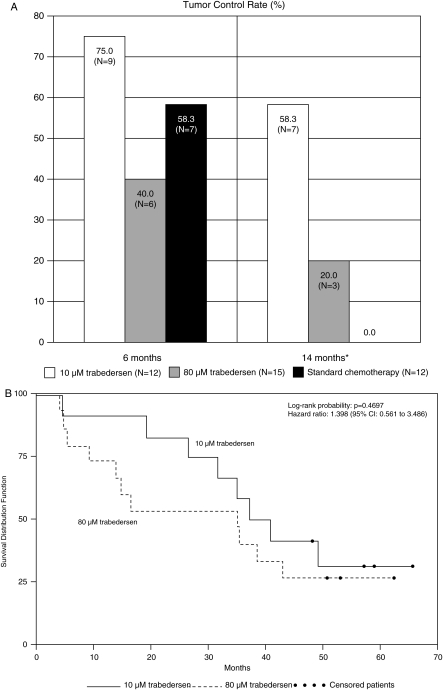
This randomized, open-label, active-controlled, dose-finding phase IIb study evaluated the efficacy and safety of trabedersen (AP 12009) administered intratumorally by convection-enhanced delivery compared with standard chemotherapy in patients with recurrent/refractory high-grade glioma. One hundred and forty-five patients with central reference histopathology of recurrent/refractory glioblastoma multiforme (GBM) or anaplastic astrocytoma (AA) were randomly assigned to receive trabedersen at doses of 10 or 80 µM or standard chemotherapy (temozolomide or procarbazine/lomustine/vincristine). Primary endpoint was 6-month tumor control rate, and secondary endpoints included response at further timepoints, survival, and safety. Six-month tumor control rates were not significantly different in the entire study population (AA and GBM). Prespecified AA subgroup analysis showed a significant benefit regarding the 14-month tumor control rate for 10 µM trabedersen vs chemotherapy (p= .0032). The 2-year survival rate had a trend for superiority for 10 µM trabedersen vs chemotherapy (p = .10). Median survival for 10 µM trabedersen was 39.1 months compared with 35.2 months for 80 µM trabedersen and 21.7 months for chemotherapy (not significant). In GBM patients, response and survival results were comparable among the 3 arms. Exploratory analysis on GBM patients aged ≤55 years with Karnofsky performance status >80% at baseline indicated a 3-fold survival at 2 and 3 years for 10 µM trabedersen vs chemotherapy. The frequency of patients with related or possibly drug-related adverse events was higher with standard chemotherapy (64%) than with 80 µM trabedersen (43%) and 10 µM trabedersen (27%). Superior efficacy and safety for 10 µM trabedersen over 80 µM trabedersen and chemotherapy and positive risk-benefit assessment suggest it as the optimal dose for further clinical development in high-grade glioma.
Overview
The claims and statistics of this paper haven’t been checked yet.
Free: it reads the open-access text and checks the first 5 claims that cite a source we can check. Create a free account to check every claim.
Integrity signals
Registry
Cites
Statistics
Figures
Verification
Claims the paper makes
The claims and statistics of this paper haven’t been checked yet.
Free: it reads the open-access text and checks the first 5 claims that cite a source we can check. Create a free account to check every claim.
Claims other papers make about this one
Each is checked against this paper’s own text: does it say what the citing paper says it does?
The source backs part of the claim, not all of it — or backs it for a different population, condition or comparison.
In the citing paper
“Lastly, phase 1 clinical studies with trabedersen (AP12009), Lucanix (belagenpumatucel‐L), or with ASOs against TGF‐β2 mRNA, showed better survival in glioblastoma, melanoma, pancreatic cancer or colorectal cancer patients [173, 174].”
From Tumor microenvironment signaling and therapeutics in cancer progression (2023) · cites this paper as [174]
Experimental — accuracy not yet measured
Self-check
Percentages, sums and reported differences re-computed from the paper’s own numbers.
The self-check needs the paper’s full text.
Citations
Cites
Radiotherapy Plus Concomitant and Adjuvant Temozolomide for Glioblastoma
Stupp, R., Mason, W. P., van den Bent, M. J., Weller, M., Fisher, B., Taphoorn, M. J. B., Belanger, K., Brandes, A. A., Marosi, C., Bogdahn, U., et al. (2005) · New England Journal of Medicine · doi:10.1056/nejmoa043330 · Cited by 21,807
Self-citationStupp, R., Hegi, M. E., Mason, W. P., van den Bent, M. J., Taphoorn, M. J., Janzer, R. C., Ludwin, S. K., Allgeier, A., Fisher, B., Belanger, K., et al. (2009) · The Lancet Oncology · doi:10.1016/s1470-2045(09)70025-7 · Cited by 7,668 · cited 1×
“9%.(2) However, overall survival (OS) is still poor, especially in patients with recurrent or refractory tumors with a median survival of 11.”
BackgroundSelf-citationMassagué, J. (2008) · Cell · doi:10.1016/j.cell.2008.07.001 · Cited by 3,907
Response criteria for phase II studies of supratentorial malignant glioma.
Macdonald, D. R., Cascino, T. L., Schold, S. C., & Cairncross, J. G. (1990) · Journal of Clinical Oncology · doi:10.1200/jco.1990.8.7.1277 · Cited by 2,409 · cited 1×
“Tumor assessments were done via central, blinded MRI readings of 2 independent radiologists and 1 adjudicator using the classical Macdonald criteria.(17) The tumor control rate was defined as the percentage of patients with complete response (CR) + partial response (PR) + stable disease (SD).”
MethodDAOUD, G. (1965) · Archives of Pediatrics & Adolescent Medicine · doi:10.1001/archpedi.1965.02090030355030 · Cited by 1,171
Outcomes and Prognostic Factors in Recurrent Glioma Patients Enrolled Onto Phase II Clinical Trials
Wong, E. T., Hess, K. R., Gleason, M. J., Jaeckle, K. A., Kyritsis, A. P., Prados, M. D., Levin, V. A., & Yung, W. K. A. (1999) · Journal of Clinical Oncology · doi:10.1200/jco.1999.17.8.2572 · Cited by 902
Brandes, A. A., Franceschi, E., Tosoni, A., Blatt, V., Pession, A., Tallini, G., Bertorelle, R., Bartolini, S., Calbucci, F., Andreoli, A., et al. (2008) · Journal of Clinical Oncology · doi:10.1200/jco.2007.14.8163 · Cited by 840 · cited 2×
“In these patients, pseudoprogression was associated with a favorable survival (manuscript in preparation), as has been reported previously in high-grade glioma patients treated with radiotherapy and TMZ.33 In conclusion, 10 mM trabedersen represents the optimal dose for further clinical development of trabedersen.”
Prognostic factors for survival of patients with glioblastoma: Recursive partitioning analysis
Lamborn, K. R., Chang, S. M., & Prados, M. D. (2004) · Neuro-Oncology · doi:10.1215/s1152851703000620 · Cited by 546
Laske, D. W., Youle, R. J., & Oldfield, E. H. (1997) · Nature Medicine · doi:10.1038/nm1297-1362 · Cited by 525
Taal, W., Brandsma, D., de Bruin, H. G., Bromberg, J. E., Swaak‐Kragten, A. T., Sillevis Smitt, P. A. E., van Es, C. A., & van den Bent, M. J. (2008) · Cancer · doi:10.1002/cncr.23562 · Cited by 465
Research works printed but not linked: 1
- Fontana A Bodmer S Frei K Malipiero U Siepl C Expression of TGF-beta 2 in human glioblastoma: a role in resistance to immune rejection? Ciba Found Symp. 1991 157 232 241 1649035
Cited by
Items 201–300 of 442
Cancer Association Study of Aminoacyl-tRNA Synthetase Signaling Network in Glioblastoma
Kim, Y., Kwon, C., Liu, J.-L., Kim, S. H., & Kim, S. (2012) · PLoS ONE · doi:10.1371/journal.pone.0040960 · Cited by 38
A Review of Therapeutic Agents Given by Convection-Enhanced Delivery for Adult Glioblastoma
Rolfe, N. W., Dadario, N. B., Canoll, P., & Bruce, J. N. (2024) · Pharmaceuticals · doi:10.3390/ph17080973 · Cited by 35
“Also, a large phase IIb trial was conducted by Bogdahn et al. of 145 patients with recurrent high-grade gliomas divided between standard chemotherapy, 10 µ M, and 80 µ M trabedersen [64].”
Corso, C. D., & Bindra, R. S. (2016) · Seminars in Radiation Oncology · doi:10.1016/j.semradonc.2016.06.003 · Cited by 37
Portillo, A. L., Monteiro, J. K., Rojas, E. A. P., Ritchie, T. M., Gillgrass, A. E., & Ashkar, A. A. (2023) · Frontiers in Immunology · doi:10.3389/fimmu.2023.1286750 · Cited by 35
Ghallab, A. M., Eissa, R. A., & Tayebi, H. M. E. (2022) · Frontiers in Pharmacology · doi:10.3389/fphar.2022.862125 · Cited by 36
“Thus, several TGF-β inhibitors are now being evaluated in clinical trials in breast cancer where they generated either disappointing (NCT01401062) or mixed results (Bogdahn et al., 2011; Giaccone et al., 2015).”
Background3D Single‐Molecule Imaging of Transmembrane Signaling by Targeting Nanodiamonds
Liu, W., Yu, F., Yang, J., Xiang, B., Xiao, P., & Wang, L. (2015) · Advanced Functional Materials · doi:10.1002/adfm.201502883 · Cited by 32
Corneal fibrosis: From in vitro models to current and upcoming drug and gene medicines
Cubillo, L. T., Gürdal, M., & Zeugolis, D. I. (2024) · Advanced Drug Delivery Reviews · doi:10.1016/j.addr.2024.115317 · Cited by 33
He, J. N., Gao, Y., Jing, L., Yang, H., & Liu, S. (2025) · Frontiers in Oncology · doi:10.3389/fonc.2025.1489701 · Cited by 33
TGF-β in tumor development and progression: mechanisms and therapeutics
Liu, J., Wang, Y., Tang, C., Zhang, L., Xiong, S., Wang, J., & Dong, C. (2026) · Molecular Biomedicine · doi:10.1186/s43556-026-00403-w · Cited by 31
Concepts for Immunotherapies in Gliomas
Platten, M., & Reardon, D. A. (2018) · Seminars in Neurology · doi:10.1055/s-0037-1620274 · Cited by 35
Microvascular significance of TGF-β axis activation in COVID-19
Arguinchona, L., Zagona‐Prizio, C., Joyce, M. E., Chan, E. D., & Maloney, J. P. (2023) · Frontiers in Cardiovascular Medicine · doi:10.3389/fcvm.2022.1054690 · Cited by 41
Brain cancer immunoediting: novel examples provided by immunotherapy of malignant gliomas
Pellegatta, S., Cuppini, L., & Finocchiaro, G. (2011) · Expert Review of Anticancer Therapy · doi:10.1586/era.11.102 · Cited by 31
Guo, X., Liu, H. N., Song, Y., Wang, J., Liu, D., Zheng, Z., Li, J., Li, B., Song, A., He, W., et al. (2026) · MedComm · doi:10.1002/mco2.70497 · Cited by 32
HPV+ve/−ve oral-tongue cancer stem cells: A potential target for relapse-free therapy
Gupta, S., Kumar, P., & Das, B. C. (2020) · Translational Oncology · doi:10.1016/j.tranon.2020.100919 · Cited by 29
Adjuvant convection-enhanced delivery for the treatment of brain tumors
Kreatsoulas, D. C., Damante, M. A., Cua, S., & Lonser, R. R. (2024) · Journal of Neuro-Oncology · doi:10.1007/s11060-023-04552-8 · Cited by 29
Unraveling the immunosuppressive microenvironment of glioblastoma and advancements in treatment
Jiang, D., & Li, Y. (2025) · Frontiers in Immunology · doi:10.3389/fimmu.2025.1590781 · Cited by 36
Making sense of therapeutics using antisense technology
Malik, R., & Roy, I. (2011) · Expert Opinion on Drug Discovery · doi:10.1517/17460441.2011.565744 · Cited by 33
“Phase I--II Pancreatic carcinoma TGF- b2 [104] Phase I--II High-grade glioma TGF- b2 [105]”
Zhan, W. (2019) · European Journal of Pharmaceutical Sciences · doi:10.1016/j.ejps.2019.105094 · Cited by 29
Fazzari, F. G. T., Rose, F., Pauls, M., Guay, E., Ibrahim, M. F. K., Basulaiman, B. M., Tu, M. M., Hutton, B., Nicholas, G. A., & Ng, T. L. (2021) · Critical Reviews in Oncology/Hematology · doi:10.1016/j.critrevonc.2021.103540 · Cited by 28
Halle, B., Marcusson, E. G., Aaberg-Jessen, C., Jensen, S. S., Meyer, M., Schulz, M. K., Andersen, C. L., & Kristensen, B. W. (2015) · Journal of Neuro-Oncology · doi:10.1007/s11060-015-1947-2 · Cited by 28
Progress and promise of antisense oligonucleotide therapeutics for central nervous system diseases
Bishop, K. M. (2016) · Neuropharmacology · doi:10.1016/j.neuropharm.2016.12.015 · Cited by 31
“In clinical studies conducted to date, this has been achieved through intrathecal bolus injection (Chiriboga et al, 2016; Hache et al, 2016; NCT02623699; NCT02519036), intrathecal continuous infusion (Miller et al., 2015), and intratumoral infusion into gliomas (Bogdahn et al., 2011).”
Convection Enhanced Delivery of Topotecan for Gliomas: A Single-Center Experience
Upadhyayula, P. S., Spinazzi, E. F., Argenziano, M., Canoll, P., & Bruce, J. N. (2020) · Pharmaceutics · doi:10.3390/pharmaceutics13010039 · Cited by 27
“2011 [65] Phase IIB for 145 patients with recurrent GBM/AA Trabedersen (TGF-B2 inhibitor) Subcutaneous port access system with external pump 1 uL/min up, up to 11 treatment cycles Trend towards a survival benefit for CED of 10 uM Trabedersen (39.”
BackgroundMethodMolecular Mechanisms and Clinical Challenges of Glioma Invasion
Oishi, T., Koizumi, S., & Kurozumi, K. (2022) · Brain Sciences · doi:10.3390/brainsci12020291 · Cited by 27
Mikuła‐Pietrasik, J., Rutecki, S., & Książek, K. (2022) · Cellular and Molecular Life Sciences · doi:10.1007/s00018-022-04236-y · Cited by 29
D’Cruz, O. J., Qazi, S., Hwang, L., Ng, K., & Trieu, V. N. (2018) · OncoTargets and Therapy · doi:10.2147/ott.s161905 · Cited by 29
Inhibition of TGFβ1 and TGFβ3 promotes hematopoiesis in Fanconi anemia
Rodríguez, A., Yang, C., Furutani, E., Teresa, B. G., Velázquez, M., Filiatrault, J., Sambel, L. A., Phan, T., Flores-Guzmán, P., Sánchez, S., et al. (2020) · Experimental Hematology · doi:10.1016/j.exphem.2020.11.002 · Cited by 26
The roles and mechanisms of coding and noncoding RNA variations in cancer
Kim, S. Y., Na, M. J., Yoon, S., Shin, E., Ha, J. W., Jeon, S., & Nam, S. W. (2024) · Experimental & Molecular Medicine · doi:10.1038/s12276-024-01307-x · Cited by 28
“Trabedersen (AP 12009), an inhibitor of TGF-beta2, underwent a phase IIb study to assess its ef fi cacy and safety when administered intratumorally in patients with recurrent or refractory high-grade glioma 161 .”
MethodClinical Applications of Antisense Oligonucleotides in Cancer: A Focus on Glioblastoma
Khuu, A., Verreault, M., Colin, P., Tran, H., & Idbaïh, A. (2024) · Cells · doi:10.3390/cells13221869 · Cited by 28
“However, some ASOs have weaker plasma protein bindings (such as ASO-PMO or ASO-PNA) which may favor their combination with other treatments [169].”
Liposomal delivery of nucleic acid-based anticancer therapeutics: BP-100-1.01
Ashizawa, A. T., & Cortes, J. E. (2014) · Expert Opinion on Drug Delivery · doi:10.1517/17425247.2015.996545 · Cited by 28
“Currently drug delivery across the blood--brain barrier has focused on directly bypassing the blood--brain barrier using convection enhanced delivery [106] or intrathecal injections [107].”
BackgroundMethodElectrokinetic Convection-Enhanced Delivery of Solutes to the Brain
Faraji, A. H., Jaquins‐Gerstl, A., Valenta, A. C., Ou, Y., & Weber, S. G. (2020) · ACS Chemical Neuroscience · doi:10.1021/acschemneuro.0c00037 · Cited by 26
DiME: A Scalable Disease Module Identification Algorithm with Application to Glioma Progression
Liu, Y., Tennant, D. A., Zhu, Z., Heath, J. K., Yao, X., & He, S. (2014) · PLoS ONE · doi:10.1371/journal.pone.0086693 · Cited by 28
Carrillo-Gálvez, A. B., Quintero, J. E., Rodríguez, R., Menéndez, S. T., González, M. V., Blanco‐Lorenzo, V., Allonca, E., Farias, V., González-Correa, J. E., Sagalés, N. E., et al. (2020) · Cell Death and Disease · doi:10.1038/s41419-020-03197-z · Cited by 26
The Use of Targeted Cytokines as Cancer Therapeutics in Glioblastoma
Sooreshjani, M., Tripathi, S., Dussold, C., Najem, H., de Groot, J., Lukas, R. V., & Heimberger, A. B. (2023) · Cancers · doi:10.3390/cancers15143739 · Cited by 25
Horie, M., Saito, A., Noguchi, S. F., Yamaguchi, Y., Ohshima, M., Morishita, Y., Suzuki, H. I., Kohyama, T., & Nagase, T. (2014) · BMC Cancer · doi:10.1186/1471-2407-14-580 · Cited by 25
Antisense-Mediated RNA Targeting: Versatile and Expedient Genetic Manipulation in the Brain
Zalachoras, I., Evers, M. M., van Roon-Mom, W. M. C., Aartsma-Rus, A. M., & Meijer, O. C. (2011) · Frontiers in Molecular Neuroscience · doi:10.3389/fnmol.2011.00010 · Cited by 24
“Classic knockdown of expression by mRNA targeting is only one possible application of antisense oligonucleotides (AON) in the control of gene function.”
BackgroundXiong, J., Zhou, X., Su, L., Jiang, L., Ming, Z., Pang, C., Fuller, C., Xu, K., Chi, H., & Zheng, X. (2024) · Discover Oncology · doi:10.1007/s12672-024-01464-5 · Cited by 24
DRR regulates AKT activation to drive brain cancer invasion
Dudley, A., Sater, M., Le, P. U., Trinh, G., Sadr, M. S., Bergeron, J. J. M., Deleavey, G. F., Bedell, B. J., Damha, M. J., & Petrecca, K. (2013) · Oncogene · doi:10.1038/onc.2013.436 · Cited by 27
Elleaume, H., Barth, R. F., Rousseau, J., Bobyk, L., Balosso, J., Yang, W., Huo, T., & Nakkula, R. J. (2020) · Journal of Neuro-Oncology · doi:10.1007/s11060-020-03600-x · Cited by 24
Cellular Conversations in Glioblastoma Progression, Diagnosis and Treatment
Sisakht, A. K., Malekan, M., Ghobadinezhad, F., Firouzabadi, S. N. M., Jafari, A., Mirazimi, S. M. A., Abadi, B., Shafabakhsh, R., & Mirzaei, H. (2022) · Cellular and Molecular Neurobiology · doi:10.1007/s10571-022-01212-9 · Cited by 24
Convection-enhanced Delivery of Therapeutics for Malignant Gliomas
Saito, R., & Tominaga, T. (2016) · Neurologia medico-chirurgica · doi:10.2176/nmc.ra.2016-0071 · Cited by 25
Antisense Oligonucleotides for Rapid Translation of Gene Therapy in Glioblastoma
Desgraves, J., Valdez, M. J. M., Chandar, J. S., Gurses, M. E., Henderson, L. J., Castro, J. R., Seetheram, D., Ivan, M. E., Komotar, R. J., & Shah, A. H. (2024) · Cancers · doi:10.3390/cancers16101944 · Cited by 22
“In addition, the study reported less drug toxicity and increased time to recurrence in those treated with the ASO therapy vs. those given chemotherapeutic agents [26,27,30,31].”
BackgroundResultOligonucleotide Therapeutics in Cancer
Wan, J., Bauman, J. A., Graziewicz, M. A., Sazani, P., & Kole, R. (2013) · Cancer treatment and research · doi:10.1007/978-3-642-31659-3_9 · Cited by 27
Current approaches in glioblastoma multiforme immunotherapy
Aghajani, M., Jalilzadeh, N., Aghebati‐Maleki, A., Yari, A., Tabnak, P., Mardi, A., Saeedi, H., Maleki, L. A., & Baradaran, B. (2024) · Clinical & Translational Oncology · doi:10.1007/s12094-024-03395-7 · Cited by 22
“Numerous studies showed that Trabedersen in patients with advanced glioma is more safe and well tolerated rather than standard treatments [63, 64].”
Al‐Holou, W. N., Wang, H., Ravikumar, V., Shankar, S., Oneka, M. D., Fehmi, Z., Verhaak, R. G. W., Kim, H., Pratt, D. W., Camelo-Piragua, S. I., et al. (2023) · Neoplasia · doi:10.1016/j.neo.2022.100872 · Cited by 21
Bone marrow microenvironment in cancer patients: immunological aspects and clinical implications
Stefanovic, S., Schütz, F., Sohn, C., Beckhove, P., & Domschke, C. (2012) · Cancer and Metastasis Reviews · doi:10.1007/s10555-012-9397-1 · Cited by 22
Surgery of malignant gliomas: advances and perspectives
Carapella, C. M., Telera, S. M., & Oppido, P. A. (2011) · Current Opinion in Oncology · doi:10.1097/cco.0b013e32834ace58 · Cited by 24
Scherer, S. D., Bauer, J., Schmaus, A., Neumaier, C., Herskind, C., Veldwijk, M. R., Wenz, F. K., & Sleeman, J. P. (2016) · PLoS ONE · doi:10.1371/journal.pone.0162221 · Cited by 22
“Trabedersen (AP12009), antisense oligonucleotides that reduce expression of TGF-β2, have been tested in a phase IIb study in glioma patients, and showed promising results concerning efficiency and safety [72].”
BackgroundTGFβ Signaling in the Tumor Microenvironment
Goulet, C. R., & Pouliot, F. (2020) · Advances in experimental medicine and biology · doi:10.1007/978-3-030-47189-7_6 · Cited by 22
The metastatic cascade through the lens of therapeutic inhibition
Miranda, I., Jahan, N., & Shevde, L. A. (2024) · Cell Reports Medicine · doi:10.1016/j.xcrm.2024.101872 · Cited by 22
Hou, D., Castro, B., Dapash, M., Zolp, A., Katz, J., Arrieta, V. A., Vazquez-Cervantes, G. I., Wan, H., Kueckelhaus, J., Benotmane, J., et al. (2025) · Neuro-Oncology · doi:10.1093/neuonc/noaf106 · Cited by 20
“38,39 TGF β has diverse roles in immune regulation, including maintaining naïve lymphocyte populations 45 ; thus, nonspecific inhibition of TGF β may induce undesired immune suppression outside of the TME, weakening anti-tumor effects.”
Sun, M., Białasek, M., Mayoux, M., Lin, M.-S., Buck, A., Marszałek, I., Taciak, B., Bühler, M., Górczak, M., Kucharzewska, P., et al. (2025) · Science Translational Medicine · doi:10.1126/scitranslmed.adr4058 · Cited by 20
Graham-Gurysh, E. G., Woodring, R. N., Simpson, S. R., Mendell, S. E., Lukesh, N. R., Pena, E. S., Moore, K. M., Ontiveros-Padilla, L. A., Hendricksen, A. T., Lopez, A. M., et al. (2025) · Nature Communications · doi:10.1038/s41467-025-63692-9 · Cited by 19
Therapeutic manipulation and bypass of the blood–brain barrier: powerful tools in glioma treatment
Giantini-Larsen, A., Pandey, A., Garton, A. L. A., Rampichini, M., Winston, G. M., Goldberg, J. L., Magge, R., Stieg, P. E., Souweidane, M. M., & Ramakrishna, R. R. (2025) · Neuro-Oncology Advances · doi:10.1093/noajnl/vdae201 · Cited by 24
“12–19, 42 , 43, 45– 50 CED for brain tumors has demonstrated safety while allowing for large volumes of distribution, enhancing CED Trials for DMGs— DMG is an aggressive glial tumor most commonly occurring in the brainstem of children.”
Irradiation to Improve the Response to Immunotherapeutic Agents in Glioblastomas
Nesseler, J. P., Schaue, D., McBride, W. H., Lee, M.-H., Kaprealian, T. B., Niclou, S. P., & Nickers, P. (2018) · Advances in Radiation Oncology · doi:10.1016/j.adro.2018.11.005 · Cited by 21
Gachpazan, M., Kashani, H., Hassanian, S. M., Khazaei, M., Khorrami, S., Ferns, G. A., & Avan, A. (2019) · Current Pharmaceutical Design · doi:10.2174/1381612825666191105114539 · Cited by 19
Tosi, U., Marnell, C. S., Chang, R. Y., Cho, W. C. S., Ting, R., Maachani, U. B., & Souweidane, M. S. (2017) · International Journal of Molecular Sciences · doi:10.3390/ijms18020351 · Cited by 19
Wick, W., & Weller, M. (2011) · Neuro-Oncology · doi:10.1093/neuonc/nor046 · Cited by 19
Sarli, S. L., Fakih, H. H., Kelly, K., Devi, G., Rembetsy-Brown, J. M., McEachern, H. R., Ferguson, C. M., Echeverria, D., Lee, J., Sousa, J., et al. (2024) · Nucleic Acids Research · doi:10.1093/nar/gkae260 · Cited by 18
“For folate-conjugated ASOs, a constrained alkyne functionality, bicyclo[6.1.0]non-4-yne (BCN), was conjugated at the 5 (cid:2) -end of HTT / Htt 5–10-5 MOE-DNA gapmer sequence during solid phase synthesis using a Peg2-BCN-phosphoramidite.”
InfluentialClinical Trials with Immunotherapy for High-Grade Glioma
Ruzevick, J., Jackson, C. M., Phallen, J. A., & Lim, M. K. (2012) · Neurosurgery Clinics of North America · doi:10.1016/j.nec.2012.04.003 · Cited by 19
Structure, unique biological properties, and mechanisms of action of transforming growth factor β
Zelisko, N., Lesyk, R., & Стойка, Р. С. (2024) · Bioorganic Chemistry · doi:10.1016/j.bioorg.2024.107611 · Cited by 19
Rytelewski, M., Ferguson, P. J., Vareki, S. M., Figueredo, R., Vincent, M. D., & Koropatnick, J. D. (2013) · Molecular Therapy — Nucleic Acids · doi:10.1038/mtna.2013.7 · Cited by 18
The role of caveolin-1 in tumors of the brain - functional and clinical implications
Ocak, P. E., Ocak, U., Tang, J., & Zhang, J. H. (2019) · Cellular Oncology · doi:10.1007/s13402-019-00447-x · Cited by 19
Saito, R., Kanamori, M., Sonoda, Y., Yamashita, Y., Nagamatsu, K., Murata, T., Mugikura, S., Kumabe, T., Wembacher-Schroeder, E., Thomson, R., et al. (2020) · Neuro-Oncology Advances · doi:10.1093/noajnl/vdaa033 · Cited by 19
Harter, P. N., Duetzmann, S., Drott, U., Zachskorn, C., Hattingen, E., Capper, D., Gessler, F. A., Senft, C., Seifert, V., Plate, K. H., et al. (2013) · Neuropathology · doi:10.1111/neup.12018 · Cited by 18
Angiogenesis and Its Targeting in Glioblastoma with Focus on Clinical Approaches.
Daneshimehr, F., Barabadi, Z., Abdolahi, S., Soleimani, M., Verdi, J., Ebrahimi‐Barough, S., & Ai, J. (2022) · PubMed Central · doi:10.22074/cellj.2022.8154 · Cited by 18
“Antisense oligonucleotide (AON): in a Phase IIb and III clinical trials the efficiency of an AON called AP12009 (Table 2) to block TGF-β2 mRNA translation has been studied (38).”
BackgroundSaito, R., & Tominaga, T. (2012) · Neurologia medico-chirurgica · doi:10.2176/nmc.52.531 · Cited by 17
Majd, N., & de Groot, J. (2019) · Expert Opinion on Pharmacotherapy · doi:10.1080/14656566.2019.1621840 · Cited by 18
“A recent study on differential expression and clinical significance of TGF-β isoforms in GBM suggests that TGF-β expression and its correlation to survival outcome is more relevant in the newly diagnosed setting and that TGF-βI, and not TGF-βII, is the dominant isoform [103] .”
BackgroundInfluentialTargeting Transforming Growth Factor-β (TGF-β) in Cancer and Non-Neoplastic Diseases
Nacif, M., & Shaker, O. G. (2014) · Journal of Cancer Therapy · doi:10.4236/jct.2014.57082 · Cited by 19
“More recently, the manufacturing company has started developing intravenous delivery approaches for pancreatic cancer, which appear to be effective in mouse models and were recently shown to be safe in humans [10] [37]-[39].”
BackgroundThe promises of immunotherapy in gliomas
Mildenberger, I. C., Bunse, L., Ochs, K., & Platten, M. (2017) · Current Opinion in Neurology · doi:10.1097/wco.0000000000000491 · Cited by 16
Cell‑based immunotherapy of glioblastoma multiforme (Review)
Bryukhovetskiy, I. (2022) · Oncology Letters · doi:10.3892/ol.2022.13253 · Cited by 18
Peschillo, S., Caporlingua, A., Diana, F., Caporlingua, F., & Delfini, R. (2015) · Journal of NeuroInterventional Surgery · doi:10.1136/neurintsurg-2015-012048 · Cited by 16
Overview of the molecular mechanisms of migration and invasion in glioblastoma multiforme
Liu, X., Chen, J., Chien, Y., Yang, Y.-P., Chen, M.-T., & Lin, L. (2021) · Journal of the Chinese Medical Association · doi:10.1097/jcma.0000000000000552 · Cited by 17
Wang, J., Zhang, J., Zhang, Q., Zhang, W., Zhang, Q., Jin, G., & Liu, F. (2023) · Journal of Medical Virology · doi:10.1002/jmv.29335 · Cited by 15
“19,24 Both the Ki67 index and TGF ‐ β 2 explicitly upregulate in GBM, compared to the normal tissues, making them effective targets for GBM therapy.”
BackgroundMethodShimizu, T., Powderly, J. D., Razak, A. A., LoRusso, P. M., Miller, K. D., Kao, S. C.-H., Kongpachith, S., Tribouley, C., Graham, M., Stoll, B. R., et al. (2024) · Frontiers in Oncology · doi:10.3389/fonc.2024.1376551 · Cited by 16
Role of exosomes in transforming growth factor-β-mediated cancer cell plasticity and drug resistance
Ruksha, T. G., & Palkina, N. V. (2025) · Exploration of Targeted Anti-tumor Therapy · doi:10.37349/etat.2025.1002322 · Cited by 16
Mendoza, F. A., & Jiménez, S. A. (2021) · Rheumatology · doi:10.1093/rheumatology/keab762 · Cited by 16
Kardalas, E., Sakkas, E. G., Ruchała, M. A., Μacut, D., & Mastorakos, G. P. (2021) · Reviews in Endocrine and Metabolic Disorders · doi:10.1007/s11154-021-09685-7 · Cited by 14
Bevacizumab in the treatment of high-grade gliomas: an overview
Kunnakkat, S., & Narayana, A. (2011) · Angiogenesis · doi:10.1007/s10456-011-9232-2 · Cited by 14
Induced Pluripotent Stem Cell as a New Source for Cancer Immunotherapy
Rami, F., Mollainezhad, H., & Salehi, M. (2016) · Genetics Research International · doi:10.1155/2016/3451807 · Cited by 14
Immunological Aspects of Malignant Gliomas
Cohen‐Inbar, O., & Zaaroor, M. (2016) · Canadian Journal of Neurological Sciences / Journal Canadien des Sciences Neurologiques · doi:10.1017/cjn.2016.34 · Cited by 15
Self-citationDendritic Cell Vaccination in Pediatric Gliomas: Lessons Learnt and Future Perspectives
Eyrich, M. K., Rachor, J., Schreiber, S. C., Wölfl, M., & Schlegel, P. G. (2013) · Frontiers in Pediatrics · doi:10.3389/fped.2013.00012 · Cited by 13
Immunotherapy for Neuro-Oncology
Majd, N., Dasgupta, P., & de Groot, J. (2020) · Advances in experimental medicine and biology · doi:10.1007/978-3-030-41008-7_8 · Cited by 16
Endoglin and TGF-β signaling in glioblastoma
Burghardt, I., Ventura, E., Weiß, T., Schroeder, J. J., Seystahl, K., Zielasek, C., Gramatzki, D., & Weller, M. (2021) · Cell and Tissue Research · doi:10.1007/s00441-020-03323-5 · Cited by 16
Burzynski, S. R., Janicki, T. J., & Burzynski, G. S. (2015) · Cancer and Clinical Oncology · doi:10.5539/cco.v4n2p13 · Cited by 13
“Seven studies accrued only from 1 to 15 AA patients (Robins et al., 2002; Spence, Peterson, Scharnhorst, Silbergeld, & Rostomily, 2004; Kirby et al., 2005; Neyns et al., 2008; Franceschi et al., 2007; de Groot et al., 2011; Bogdahn et al., 2011).”
Systems engineers’ role in biomedical research. Convection-enhanced drug delivery
Esfahani, D. R., Tangen, K. M., Sadeh, M., Seksenyan, A., Neisewander, B. L., Mehta, A. I., & Linninger, A. A. (2018) · Computer-aided chemical engineering/Computer aided chemical engineering · doi:10.1016/b978-0-444-63964-6.00009-x · Cited by 15
Off-Target Effects and Safety Aspects of Phosphorothioate Oligonucleotides
Stessl, M., Noe, C. R., & Winkler, J. (2012) · RNA technologies · doi:10.1007/978-3-642-27426-8_4 · Cited by 14
Therapeutic Strategies to Target TGF-β in the Treatment of Bone Metastases
Buijs, J. T., Juárez, P., & Guise, T. A. (2011) · Current Pharmaceutical Biotechnology · doi:10.2174/138920111798808293 · Cited by 12
Riemenschneider, M. J., Hirblinger, M., Vollmann‐Zwerenz, A., Hau, P., Proescholdt, M. A., Jaschinski, F., Rothhammer-Hampl, T., Wosikowski, K., Janicot, M., & Leo, E. (2015) · Oncotarget · doi:10.18632/oncotarget.5780 · Cited by 12
“[9] The antisense oligonucleotide trabedersen (AP 12009) that specifically blocks TGF-β2 mRNA was tested in several clinical trials in high-grade glioma patients with recurrent or refractory tumor disease.[10, 11] Intratumoral administration of the drug resulted in responses and promising survival data.”
Self-citationPolymer nanocarriers for targeted local delivery of agents in treating brain tumors
Josowitz, A. D., Bindra, R. S., & Saltzman, W. M. (2022) · Nanotechnology · doi:10.1088/1361-6528/ac9683 · Cited by 12
Surgical Considerations in the Optimal Management of Patients with Malignant Brain Tumors
Renfrow, J. J., Strowd, R. E., III, Laxton, A. W., Tatter, S. B., Geer, C. P., & Lesser, G. J. (2017) · Current Treatment Options in Oncology · doi:10.1007/s11864-017-0487-8 · Cited by 12
Molavand, M., Montazer, M., Ghareghomi, S., Yousefi, B., & Majidinia, M. (2025) · Expert Review of Anticancer Therapy · doi:10.1080/14737140.2025.2519860 · Cited by 13
Arora, M., Kundu, A., Sinha, S., & Chosdol, K. (2025) · Cellular & Molecular Biology Letters · doi:10.1186/s11658-025-00769-9 · Cited by 12
“Agents such as Trabedersen (AP-12009), which targets TGF-β2 mRNA, and galunisertib, a transforming growth factor beta receptor 1 (TGFBR1) inhibitor, have shown benefits in preclinical glioblastoma studies [34, 230–233].”
Application of Convection-Enhanced Drug Delivery in the Treatment of Malignant Gliomas
Tykocki, T., & Miekisiak, G. J. (2016) · World Neurosurgery · doi:10.1016/j.wneu.2016.02.040 · Cited by 11
Immunotherapy for Neuro-oncology
Majd, N., Dasgupta, P., & de Groot, J. (2021) · Advances in experimental medicine and biology · doi:10.1007/978-3-030-79308-1_7 · Cited by 11
Rahavi, H., Alizadeh‐Navaei, R., & Tehrani, M. (2023) · Immunotherapy · doi:10.2217/imt-2022-0079 · Cited by 11
Epithelial–mesenchymal transition in cancer stem cells: Therapeutic implications
Varun, B., Ramani, P., Arya, I., Palani, J., & Joseph, A. P. (2023) · Journal of Oral and Maxillofacial Pathology · doi:10.4103/jomfp.jomfp_308_22 · Cited by 11
Targeting Cytokines and Their Pathways for the Treatment of Cancer
Heimberger, A. B., Tripathi, S., & Platanias, L. C. (2023) · Cancers · doi:10.3390/cancers15215224 · Cited by 12
“However, later-stage clinical trials of 145 high-grade glioma patients indicated that survival and response rates were not significantly different relative to the standard of care [45].”
BackgroundRegulation of cancer stem cells and immunotherapy of glioblastoma (Review)
Kosianova, A. A., Pak, O., & Bryukhovetskiy, I. (2023) · Biomedical Reports · doi:10.3892/br.2023.1712 · Cited by 12
“Suppression of these mechanisms can block the proliferative functions of CSCs, but none of the Notch‑signaling inhibitors has shown any effect in GB (113).”
BackgroundIwami, K., Natsume, A., & Wakabayashi, T. (2018) · Progress in neurological surgery · doi:10.1159/000469682 · Cited by 11
Taslimi, S., Ye, V. C., Wen, P. Y., & Zadeh, G. M. (2021) · Neuro-Oncology Advances · doi:10.1093/noajnl/vdab029 · Cited by 12
Metadata
- Authors
- Bogdahn, U., Hau, P., Stockhammer, G., Venkataramana, N. K., Mahapatra, A. K., Suri, A., Balasubramaniam, A., Nair, S., Oliushine, V., Parfenov, V., Poverennova, I., Zaaroor, M., Jachimczak, P., Ludwig, S., Schmaus, S., Heinrichs, H., Schlingensiepen, K. H., & the Trabedersen Glioma Study Group
- Affiliations
- University of Regensburg (DE)
- Sanjay Gandhi Post Graduate Institute of Medical Sciences (IN)
- Corresponding author
- Bogdahn, U.
- Venue
- Neuro-Oncology
- Publisher
- Oxford University Press (OUP)
- Published
- 2010-10-27
- Volume
- 13
- Issue
- 1
- Pages
- 132-142
- ISSN
- 1522-8517 (ISSN-L)
- 1523-5866
- PMC
- PMC3018908
- OpenAlex
- W2116583846
- Cited by
- 433
- References
- 34
- Citations by year
- 2026: 13 · 2025: 20 · 2024: 28 · 2023: 29 · 2022: 28 · 2021: 21 · 2020: 33 · 2019: 24 · 2018: 24 · 2017: 31 · 2016: 22 · 2015: 39 · 2014: 34 · 2013: 31 · 2012: 33
- FWCI
- 12.38
- Type
- journal article
- Language
- en
- Open access
- hybrid
- doi.org
- Licence
- Locations
- Neuro-Oncology (publishedVersion, cc-by-nc)
- Europe PMC (PubMed Central) (publishedVersion, cc-by-nc)
- PubMed Central (publishedVersion, cc-by-nc)
- PubMed (publishedVersion)
- Topics
- Health Sciences › Medicine › Oncology › Glioma Diagnosis and Treatment
- Health Sciences › Medicine › Oncology › Ovarian cancer diagnosis and treatment
- Health Sciences › Medicine › Oncology › Cancer survivorship and care
- Keywords
- high-grade glioma, anaplastic astrocytoma, temozolomide, procarbazine, lomustine, and vincristine, tumor control rate, survival, dose-finding, adverse events
- MeSH terms
- Adult, Antineoplastic Agents, Brain Neoplasms, Female, Glioblastoma, Humans, International Agencies, Male, Middle Aged, Neoplasm Recurrence, Local, Oligodeoxyribonucleotides, Thionucleotides, Survival Rate, Treatment Outcome, Transforming Growth Factor beta2
About these checks
Registry, retraction, Cites and statistics results are computed, not judged, with one exception: a printed reference that no index lists is read once by a model before it counts as a citation error. Claims are extracted by a model and kept only when their quote appears verbatim in the text; each cited source is then checked, with a model’s help, for whether it says what the claim relies on. Those verdicts can be wrong — read the claim’s quote and the cited source before relying on one.
Statistics and arithmetic are recomputed, not judged.
Confidence bands are shown only for fields calibrated on our annotated test set. None is calibrated yet, so no band is shown.
What counts as a claim ›How we measure confidence ›How we check this ›
Are you an author, or do you see a problem with this page? Request a review
Data sources
Bibliographic data: Semantic Scholar, OpenAlex, Crossref.
Contains information from the Semantic Scholar Academic Graph Datasets, made available under the ODC Attribution License (ODC-BY 1.0).
Semantic Scholar’s data is described in: Kinney, R., et al. (2023). The Semantic Scholar Open Data Platform. arXiv:2301.10140.
