

Targeted therapy for high-grade glioma with the TGF- 2 inhibitor trabedersen: results of a randomized and controlled phase IIb study
Open accessThe DOI matches its Crossref record; 35 of the 35 references it cites were found in a registry or an index.
Abstract
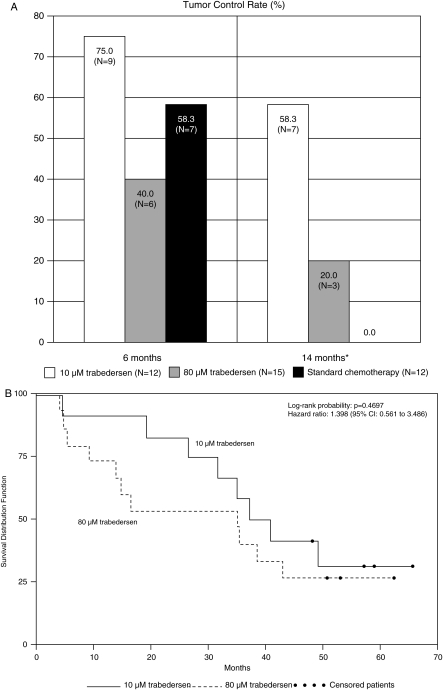
This randomized, open-label, active-controlled, dose-finding phase IIb study evaluated the efficacy and safety of trabedersen (AP 12009) administered intratumorally by convection-enhanced delivery compared with standard chemotherapy in patients with recurrent/refractory high-grade glioma. One hundred and forty-five patients with central reference histopathology of recurrent/refractory glioblastoma multiforme (GBM) or anaplastic astrocytoma (AA) were randomly assigned to receive trabedersen at doses of 10 or 80 µM or standard chemotherapy (temozolomide or procarbazine/lomustine/vincristine). Primary endpoint was 6-month tumor control rate, and secondary endpoints included response at further timepoints, survival, and safety. Six-month tumor control rates were not significantly different in the entire study population (AA and GBM). Prespecified AA subgroup analysis showed a significant benefit regarding the 14-month tumor control rate for 10 µM trabedersen vs chemotherapy (p= .0032). The 2-year survival rate had a trend for superiority for 10 µM trabedersen vs chemotherapy (p = .10). Median survival for 10 µM trabedersen was 39.1 months compared with 35.2 months for 80 µM trabedersen and 21.7 months for chemotherapy (not significant). In GBM patients, response and survival results were comparable among the 3 arms. Exploratory analysis on GBM patients aged ≤55 years with Karnofsky performance status >80% at baseline indicated a 3-fold survival at 2 and 3 years for 10 µM trabedersen vs chemotherapy. The frequency of patients with related or possibly drug-related adverse events was higher with standard chemotherapy (64%) than with 80 µM trabedersen (43%) and 10 µM trabedersen (27%). Superior efficacy and safety for 10 µM trabedersen over 80 µM trabedersen and chemotherapy and positive risk-benefit assessment suggest it as the optimal dose for further clinical development in high-grade glioma.
Overview
The claims and statistics of this paper haven’t been checked yet.
Free: it reads the open-access text and checks the first 5 claims that cite a source we can check. Create a free account to check every claim.
Integrity signals
Registry
Cites
Statistics
Figures
Verification
Claims the paper makes
The claims and statistics of this paper haven’t been checked yet.
Free: it reads the open-access text and checks the first 5 claims that cite a source we can check. Create a free account to check every claim.
Claims other papers make about this one
Each is checked against this paper’s own text: does it say what the citing paper says it does?
The source backs part of the claim, not all of it — or backs it for a different population, condition or comparison.
In the citing paper
“Lastly, phase 1 clinical studies with trabedersen (AP12009), Lucanix (belagenpumatucel‐L), or with ASOs against TGF‐β2 mRNA, showed better survival in glioblastoma, melanoma, pancreatic cancer or colorectal cancer patients [173, 174].”
From Tumor microenvironment signaling and therapeutics in cancer progression (2023) · cites this paper as [174]
Experimental — accuracy not yet measured
Self-check
Percentages, sums and reported differences re-computed from the paper’s own numbers.
The self-check needs the paper’s full text.
Citations
Cites
Radiotherapy Plus Concomitant and Adjuvant Temozolomide for Glioblastoma
Stupp, R., Mason, W. P., van den Bent, M. J., Weller, M., Fisher, B., Taphoorn, M. J. B., Belanger, K., Brandes, A. A., Marosi, C., Bogdahn, U., et al. (2005) · New England Journal of Medicine · doi:10.1056/nejmoa043330 · Cited by 21,807
Self-citationStupp, R., Hegi, M. E., Mason, W. P., van den Bent, M. J., Taphoorn, M. J., Janzer, R. C., Ludwin, S. K., Allgeier, A., Fisher, B., Belanger, K., et al. (2009) · The Lancet Oncology · doi:10.1016/s1470-2045(09)70025-7 · Cited by 7,668 · cited 1×
“9%.(2) However, overall survival (OS) is still poor, especially in patients with recurrent or refractory tumors with a median survival of 11.”
BackgroundSelf-citationMassagué, J. (2008) · Cell · doi:10.1016/j.cell.2008.07.001 · Cited by 3,907
Response criteria for phase II studies of supratentorial malignant glioma.
Macdonald, D. R., Cascino, T. L., Schold, S. C., & Cairncross, J. G. (1990) · Journal of Clinical Oncology · doi:10.1200/jco.1990.8.7.1277 · Cited by 2,409 · cited 1×
“Tumor assessments were done via central, blinded MRI readings of 2 independent radiologists and 1 adjudicator using the classical Macdonald criteria.(17) The tumor control rate was defined as the percentage of patients with complete response (CR) + partial response (PR) + stable disease (SD).”
MethodDAOUD, G. (1965) · Archives of Pediatrics & Adolescent Medicine · doi:10.1001/archpedi.1965.02090030355030 · Cited by 1,171
Outcomes and Prognostic Factors in Recurrent Glioma Patients Enrolled Onto Phase II Clinical Trials
Wong, E. T., Hess, K. R., Gleason, M. J., Jaeckle, K. A., Kyritsis, A. P., Prados, M. D., Levin, V. A., & Yung, W. K. A. (1999) · Journal of Clinical Oncology · doi:10.1200/jco.1999.17.8.2572 · Cited by 902
Brandes, A. A., Franceschi, E., Tosoni, A., Blatt, V., Pession, A., Tallini, G., Bertorelle, R., Bartolini, S., Calbucci, F., Andreoli, A., et al. (2008) · Journal of Clinical Oncology · doi:10.1200/jco.2007.14.8163 · Cited by 840 · cited 2×
“In these patients, pseudoprogression was associated with a favorable survival (manuscript in preparation), as has been reported previously in high-grade glioma patients treated with radiotherapy and TMZ.33 In conclusion, 10 mM trabedersen represents the optimal dose for further clinical development of trabedersen.”
Prognostic factors for survival of patients with glioblastoma: Recursive partitioning analysis
Lamborn, K. R., Chang, S. M., & Prados, M. D. (2004) · Neuro-Oncology · doi:10.1215/s1152851703000620 · Cited by 546
Laske, D. W., Youle, R. J., & Oldfield, E. H. (1997) · Nature Medicine · doi:10.1038/nm1297-1362 · Cited by 525
Taal, W., Brandsma, D., de Bruin, H. G., Bromberg, J. E., Swaak‐Kragten, A. T., Sillevis Smitt, P. A. E., van Es, C. A., & van den Bent, M. J. (2008) · Cancer · doi:10.1002/cncr.23562 · Cited by 465
Research works printed but not linked: 1
- Fontana A Bodmer S Frei K Malipiero U Siepl C Expression of TGF-beta 2 in human glioblastoma: a role in resistance to immune rejection? Ciba Found Symp. 1991 157 232 241 1649035
Cited by
Items 101–200 of 442
Widespread suppression of huntingtin with convection-enhanced delivery of siRNA
Stiles, D. K., Zhang, Z., Ge, P., Nelson, B. D., Grondin, R., Ai, Y., Hardy, P., Nelson, P. T., Guzaev, A. P., Butt, M. T., et al. (2011) · Experimental Neurology · doi:10.1016/j.expneurol.2011.11.020 · Cited by 94
“…of drugs into the brain with CED includes ~3 hour infusion at 0.5–10 μL/min of glucocerebrosidase in a Gaucher's patient (Lonser et al., 2007), and continuous infusion of Trabedersen for up to 22 weeks at 1 and 4 μL/min in patients with glioblastoma or anaplastic astrocytoma (Bogdahn et al., 2011).”
InfluentialTranscription and Translation Inhibitors in Cancer Treatment
Laham-Karam, N., Pinto, G., Poso, A., & Kokkonen, P. (2020) · Frontiers in Chemistry · doi:10.3389/fchem.2020.00276 · Cited by 95
“In a randomized, dose-finding Phase IIb clinical trial, AP 12009 at 10μM was found to be safe and to have superior efficacy over a higher dose of AP 12009 or chemotherapy treatment (Bogdahn et al., 2011).”
BackgroundNucleic Acid Drugs—Current Status, Issues, and Expectations for Exosomes
Yamada, Y. (2021) · Cancers · doi:10.3390/cancers13195002 · Cited by 101
Dunne, A., Marshall, N. A., & Mills, K. H. G. (2011) · Current Opinion in Pharmacology · doi:10.1016/j.coph.2011.03.004 · Cited by 99
Chaichana, K. L., Pinheiro, L., & Brem, H. (2015) · Therapeutic Delivery · doi:10.4155/tde.14.114 · Cited by 91
Convection-Enhanced Delivery of Carboplatin PLGA Nanoparticles for the Treatment of Glioblastoma
Arshad, A., Yang, B., Bienemann, A. S., Barua, N. U., Wyatt, M. J., Woolley, M., Johnson, D. E., Edler, K. J., & Gill, S. S. (2015) · PLoS ONE · doi:10.1371/journal.pone.0132266 · Cited by 91
TGF-β signaling networks in the tumor microenvironment
Chan, M. K.-K., Chung, J. Y.-F., Tang, P. C.-T., Chan, A. S.-W., Ho, J. Y.-Y., Lin, T. P.-T., Chen, J., Leung, K.-T., To, K.-F., Lan, H.-Y., et al. (2022) · Cancer Letters · doi:10.1016/j.canlet.2022.215925 · Cited by 90
Transforming growth factor β signaling pathway: A promising therapeutic target for cancer
Chen, Y., Di, C., Zhang, X., Wang, J., Wang, F., Yan, J., Xu, C., Zhang, J., Zhang, Q., Li, H., et al. (2019) · Journal of Cellular Physiology · doi:10.1002/jcp.29108 · Cited by 93
Advances in immunotherapy for the treatment of glioblastoma
Tivnan, A., Heilinger, T., Lavelle, E. C., & Prehn, J. H. M. (2016) · Journal of Neuro-Oncology · doi:10.1007/s11060-016-2299-2 · Cited by 91
TGF-beta signaling in cancer radiotherapy
Wang, J., Xu, Z., Wang, Z., Du, G., & Lun, L. (2021) · Cytokine · doi:10.1016/j.cyto.2021.155709 · Cited by 92
Treatment of newly diagnosed glioblastoma in the elderly: a network meta-analysis
Hanna, C. R., Lawrie, T. A., Rogozińska, E., Kernohan, A., Jefferies, S., Bulbeck, H., Ali, U. M., Robinson, T., & Grant, R. (2020) · Cochrane Database of Systematic Reviews · doi:10.1002/14651858.cd013261.pub2 · Cited by 90
Glioblastoma cancer stem cells – From concept to clinical application
Stopschinski, B. E., Beier, C. P., & Beier, D. (2012) · Cancer Letters · doi:10.1016/j.canlet.2012.05.033 · Cited by 97
Crawford, L., Rosch, J. G., & Putnam, D. A. (2015) · Journal of Controlled Release · doi:10.1016/j.jconrel.2015.12.041 · Cited by 90
Wong, H. K., Fatimy, R. E., Onodera, C. S., Wei, Z., Yi, M., Mohan, A., Gowrisankaran, S., Karmali, P. P., Marcusson, E. G., Wakimoto, H., et al. (2015) · Molecular Therapy · doi:10.1038/mt.2015.72 · Cited by 82
“We have chosen osmotic del very in order to overcome the dilution of ASO in growing GBM, avoid multiple intracranial injections , and follow a singe clinical trial with similar antisense inhibitors of TGF [44].”
BackgroundSeystahl, K., Tritschler, I., Szabó, E., Tabatabai, G., & Weller, M. (2014) · Neuro-Oncology · doi:10.1093/neuonc/nou218 · Cited by 87
“Various anti–TGF-b strategies have been explored in rodent glioma models(2) – 5 and clinical trials.(6,7) TGF-b signaling is mediated via a heterodimeric receptor complex comprising type I and type II receptors.”
BackgroundTemozolomide and Other Potential Agents for the Treatment of Glioblastoma Multiforme
Nagasawa, D. T., Chow, F. E., Yew, A. Y., Kim, W. B., Cremer, N., & Yang, I. (2012) · Neurosurgery Clinics of North America · doi:10.1016/j.nec.2012.01.007 · Cited by 84
TGFβ signaling networks in ovarian cancer progression and plasticity
Kumari, A., Shonibare, Z., Monavarian, M., Arend, R. C., Lee, N. Y., Inman, G. J., & Mythreye, K. (2021) · Clinical & Experimental Metastasis · doi:10.1007/s10585-021-10077-z · Cited by 81
“Trabedersen (AP12009 or OT-101) Synthetic TGFβ2 antisense oligodeoxynucleotide Glioblastoma multiforme or Anaplastic astrocytoma NCT00431561 No [286]”
BackgroundBarua, N. U., Hopkins, K., Woolley, M., O’Sullivan, S., Harrison, R., Edwards, R. J., Bienemann, A. S., Wyatt, M. J., Arshad, A., & Gill, S. S. (2016) · Drug Delivery · doi:10.3109/10717544.2014.908248 · Cited by 74
“been restricted to either single infusions or continuous slow infusions over a number of days using implantable or ambulatory pumps (Bogdahn et al., 2011; Bruce et al., 2011; Mueller et al., 2011).”
BackgroundTGF-β in the Bone Microenvironment: Role in Breast Cancer Metastases
Buijs, J. T., Stayrook, K. R., & Guise, T. A. (2011) · Cancer Microenvironment · doi:10.1007/s12307-011-0075-6 · Cited by 89
Nucleic Acid-Based Approaches for Tumor Therapy
Hager, S., Fittler, F. J., Wagner, E., & Bros, M. (2020) · Cells · doi:10.3390/cells9092061 · Cited by 81
Paradoxical roles of TGF-β signaling in suppressing and promoting squamous cell carcinoma
Wu, F., Weigel, K. J., Zhou, H., & Wang, X. (2017) · Acta Biochimica et Biophysica Sinica · doi:10.1093/abbs/gmx127 · Cited by 77
Novel clinical therapeutics targeting the epithelial to mesenchymal transition
Kothari, A. N., Mi, Z., Zapf, M. A. C., & Kuo, P. C. (2014) · Clinical and Translational Medicine · doi:10.1186/s40169-014-0035-0 · Cited by 87
Bhatia, S., Monkman, J. H., Toh, A. K. L., Nagaraj, S. H., & Thompson, E. W. (2017) · Biochemical Journal · doi:10.1042/bcj20160782 · Cited by 81
Role of myeloid cells in the immunosuppressive microenvironment in gliomas
Locarno, C. V., Simonelli, M., Carenza, C., Capucetti, A., Stanzani, E., Lorenzi, E., Persico, P., Bella, S. D., Passoni, L., Mavilio, D., et al. (2019) · Immunobiology · doi:10.1016/j.imbio.2019.10.002 · Cited by 80
Review: Targeting the Transforming Growth Factor-Beta Pathway in Ovarian Cancer
Roane, B. M., Arend, R. C., & Birrer, M. J. (2019) · Cancers · doi:10.3390/cancers11050668 · Cited by 74
“7 months, although this difference was not statistically significant [102].”
Phosphorothioate Oligonucleotides: Effectiveness and Toxicity
Iannitti, T., Morales‐Medina, J. C., & Palmieri, B. (2014) · Current Drug Targets · doi:10.2174/1389450115666140321100304 · Cited by 73
Glioblastoma: To Target the Tumor Cell or the Microenvironment?
Vleeschouwer, S. D., & Bergers, G. (2017) · Codon Publications eBooks · doi:10.15586/codon.glioblastoma.2017.ch16 · Cited by 84
“In that regard, xenograft models, even patient-derived (130), are being created in immune-compromised animals, thereby fully neglecting the impact of the immune system, which accounts for the major supplier of nontumoral cells constructing the GBM TME.”
BackgroundInfluentialCTLA-4 blockade and the renaissance of cancer immunotherapy
Mocellin, S., & Nitti, D. (2013) · Biochimica et Biophysica Acta (BBA) - Reviews on Cancer · doi:10.1016/j.bbcan.2013.05.003 · Cited by 80
Targeting Glioblastoma: Advances in Drug Delivery and Novel Therapeutic Approaches
Yeini, E., Ofek, P., Albeck, N., Ajamil, D. R., Neufeld, L., Eldar‐Boock, A., Kleiner, R., Vaskovich‐Koubi, D., Koshrovski‐Michael, S., Dangoor, S. I., et al. (2020) · Advanced Therapeutics · doi:10.1002/adtp.202000124 · Cited by 75
Transforming growth factor-beta and its implication in the malignancy of gliomas
Roy, L.-O., Poirier, M.-B., & Fortin, D. (2014) · Targeted Oncology · doi:10.1007/s11523-014-0308-y · Cited by 71
Snail depletes the tumorigenic potential of glioblastoma
Savary, K., Caglayan, D., Caja, L., Tzavlaki, K., Bin Nayeem, S., Bergström, T., Jiang, Y., Uhrbom, L., Forsberg-Nilsson, K., Westermark, B., et al. (2013) · Oncogene · doi:10.1038/onc.2013.67 · Cited by 67
Immunotherapy of Malignant Tumors in the Brain: How Different from Other Sites?
Dutoit, V., Migliorini, D., Dietrich, P., & Walker, P. R. (2016) · Frontiers in Oncology · doi:10.3389/fonc.2016.00256 · Cited by 67
“The TGF-β mRNA antisense oligonucleotides trabedersen (AP12009) has not shown benefit in patients with grade III or IV glioma and is not being further tested (134).”
BackgroundBiological Role and Therapeutic Targeting of TGF-β3 in Glioblastoma
Seystahl, K., Papachristodoulou, A., Burghardt, I., Schneider, H., Hasenbach, K., Janicot, M., Roth, P., & Weller, M. (2017) · Molecular Cancer Therapeutics · doi:10.1158/1535-7163.mct-16-0465 · Cited by 68
“A ligand-based approach using AP-12009, an antisense oligonucleotide supposed to target TGF-b2, administered intratumorally, suggested non-inferiority to alkylating chemotherapy in a phase II clinical trial, however, interpretation of the trial results remained controversial (35, 36).”
BackgroundTGF-β signaling pathway: Therapeutic targeting and potential for anti-cancer immunity
Ali, S., Rehman, M. U., Yatoo, A. M., Arafah, A. M., Khan, A., Rashid, S., Majid, S., Ali, A., & Ali, M. N. (2023) · European Journal of Pharmacology · doi:10.1016/j.ejphar.2023.175678 · Cited by 64
Danielpour, D. (2024) · Pharmaceuticals · doi:10.3390/ph17040533 · Cited by 65
Nanomedicine to overcome radioresistance in glioblastoma stem-like cells and surviving clones
Séhédic, D., Cikankowitz, A., Hindré, F., Davodeau, F., & Garcion, E. (2015) · Trends in Pharmacological Sciences · doi:10.1016/j.tips.2015.02.002 · Cited by 62
TGF β : A player on multiple fronts in the tumor microenvironment
Čaja, F., & Vannucci, L. E. (2014) · Journal of Immunotoxicology · doi:10.3109/1547691x.2014.945667 · Cited by 62
“Several clinical studies proved that TGF therapy can be safe and effective (Bogdahn et al., 2011; Schlingensiepen et al., 2011).”
BackgroundConvection-Enhanced Delivery in Malignant Gliomas: A Review of Toxicity and Efficacy
Shi, M., & Sanche, L. (2019) · Journal of Oncology · doi:10.1155/2019/9342796 · Cited by 60
Cichon, M. A., & Radisky, D. C. (2014) · Cell Adhesion & Migration · doi:10.4161/19336918.2014.972788 · Cited by 62
Khan, I. N., Ullah, N., Hussein, D. M., & Saini, K. S. (2017) · Seminars in Cancer Biology · doi:10.1016/j.semcancer.2017.07.004 · Cited by 56
Safer approaches to therapeutic modulation of TGF-β signaling for respiratory disease
Lachapelle, P., Li, M., Douglass, J. A., & Stewart, A. G. (2018) · Pharmacology & Therapeutics · doi:10.1016/j.pharmthera.2018.02.010 · Cited by 56
Neurosurgical oncology: advances in operative technologies and adjuncts
D’Amico, R. S., Kennedy, B. C., & Bruce, J. N. (2014) · Journal of Neuro-Oncology · doi:10.1007/s11060-014-1493-3 · Cited by 56
“[148–154].”
Johnson, R. W., Merkel, A. R., Page, J. M., Ruppender, N. S., Guelcher, S. A., & Sterling, J. A. R. (2014) · Clinical & Experimental Metastasis · doi:10.1007/s10585-014-9682-1 · Cited by 55
Targeting the Tumor Stroma as a Novel Therapeutic Approach for Prostate Cancer
Franco, O. E., & Hayward, S. W. (2012) · Advances in pharmacology · doi:10.1016/b978-0-12-397927-8.00009-9 · Cited by 58
“…Phase IV trials (diabetes, hepatitis, metabolic syndrome, and other nonmalignant diseases) Targeting Tum or M icroenvironm ent 297 298 Omar E. Franco and Simon W. Hayward better survival compared to higher dose of AP12009 (80 mM) or standard chemotherapeutic treatment (Bogdahn et al., 2011).”
BackgroundChruścik, A., Gopalan, V., & Lam, A. K.-Y. (2017) · European Journal of Cell Biology · doi:10.1016/j.ejcb.2017.11.001 · Cited by 56
Iwami, K., Natsume, A., & Wakabayashi, T. (2011) · Neurosurgical Review · doi:10.1007/s10143-011-0320-y · Cited by 56
Immunological challenges for peptide-based immunotherapy in glioblastoma
Mohme, M., Neidert, M. C., Regli, L., Weller, M., & Martinꝉ, R. (2013) · Cancer Treatment Reviews · doi:10.1016/j.ctrv.2013.08.008 · Cited by 56
Microenvironmental Clues for Glioma Immunotherapy
Platten, M., Ochs, K., Lemke, D., Opitz, C. A., & Wick, W. (2014) · Current Neurology and Neuroscience Reports · doi:10.1007/s11910-014-0440-1 · Cited by 53
Blockade of TGF-β signaling: a potential target for cancer immunotherapy?
Ungefroren, H. (2019) · Expert Opinion on Therapeutic Targets · doi:10.1080/14728222.2019.1636034 · Cited by 50
Papachristodoulou, A., Silginer, M., Weller, M., Schneider, H., Hasenbach, K., Janicot, M., & Roth, P. (2019) · Clinical Cancer Research · doi:10.1158/1078-0432.ccr-17-3024 · Cited by 54
“Even thoughAP12009wasnot inferior to standard chemotherapy, no convincing efficacy signal was seen (20).”
BackgroundConvection-enhanced drug delivery for gliomas
Vogelbaum, M., & Healy, A. (2015) · Surgical Neurology International · doi:10.4103/2152-7806.151337 · Cited by 55
“CED clinical trials have been carried out with various agents including conventional chemotherapies,[8] cytotoxin‐ligand conjugates targeting cell surface receptors,[27,67‐69] and monoclonal antibodies with[42] or without[70] radioactive isotope conjugates, antisense oligonucleotides,[5] and liposomal vectors engineer…”
MethodRecent Advances in the Development of TGF-β Signaling Inhibitors for Anticancer Therapy
Lee, H.-J. (2020) · Journal of Cancer Prevention · doi:10.15430/jcp.2020.25.4.213 · Cited by 51
“Since it is well established that the TGF-β2 isoform plays a pivotal role in the progression of pancreatic cancer and glioma, Trabedersen effectively inhibited proliferation and migration of cancer cells and reversed TGF-β-mediated immune suppression of cancer cells [50].”
BackgroundThe TGF-β Pathway as an Emerging Target for Chagas Disease Therapy
de Araújo-Jorge, T. C., Waghabi, M. C., Bailly, S., & Feige, J. (2012) · Clinical Pharmacology & Therapeutics · doi:10.1038/clpt.2012.102 · Cited by 58
Garg, M. (2017) · World Journal of Stem Cells · doi:10.4252/wjsc.v9.i8.118 · Cited by 53
Multifaceted transforming growth factor-beta (TGFβ) signalling in glioblastoma
Birch, J. L., Coull, B. J., Spender, L. C., Watt, C., Willison, A., Syed, N., Chalmers, A. J., Hossain-Ibrahim, M. K., & Inman, G. J. (2020) · Cellular Signalling · doi:10.1016/j.cellsig.2020.109638 · Cited by 56
Myeloid derived suppressor cells in inflammatory conditions of the central nervous system
Melero‐Jerez, C., Ortega, M. C., Moliné-Velázquez, V., & Clemente, D. (2015) · Biochimica et Biophysica Acta (BBA) - Molecular Basis of Disease · doi:10.1016/j.bbadis.2015.10.015 · Cited by 51
Strategies to Use Immune Modulators in Therapeutic Vaccines Against Cancer
Berzofsky, J. A., Terabe, M., & Wood, L. V. (2012) · Seminars in Oncology · doi:10.1053/j.seminoncol.2012.02.002 · Cited by 52
Perrot, C. Y., Javelaud, D., & Mauviel, A. (2012) · Pharmacology & Therapeutics · doi:10.1016/j.pharmthera.2012.10.002 · Cited by 61
Krichevsky, A. M., & Uhlmann, E. J. (2019) · Neurotherapeutics · doi:10.1007/s13311-018-00702-3 · Cited by 51
“A benefit of 10 μM trabedersen versus standard chemotherapy for the 14-month tumor control rate and a trend for its superiority for 2-year survival rate of AA (but not GBM) patients was reported [56].”
Anti-seed PNAs targeting multiple oncomiRs for brain tumor therapy
Wang, Y., Malik, S., Suh, H., Xiao, Y., Deng, Y., Fan, R., Huttner, A. J., Bindra, R. S., Singh, V., Saltzman, W. M., et al. (2023) · Science Advances · doi:10.1126/sciadv.abq7459 · Cited by 49
Which drug or drug delivery system can change clinical practice for brain tumor therapy?
Siegal, T. (2013) · Neuro-Oncology · doi:10.1093/neuonc/not016 · Cited by 50
Young, J. S., Bernal, G. M., Polster, S. P., Núñez, L., Larsen, G. F., Mansour, N. M., Podell, M., & Yamini, B. (2018) · World Neurosurgery · doi:10.1016/j.wneu.2018.06.114 · Cited by 47
Inhibition of TGFβ signaling and its implications in anticancer treatments.
Calone, I., & Souchelnytskyi, S. (2012) · PubMed · Cited by 54
Tewari, D., Priya, A., Bishayee, A., & Bishayee, A. (2022) · Clinical and Translational Medicine · doi:10.1002/ctm2.795 · Cited by 46
Transforming growth factor-β in tumour development
Trelford, C. B., Dagnino, L., & Guglielmo, G. M. D. (2022) · Frontiers in Molecular Biosciences · doi:10.3389/fmolb.2022.991612 · Cited by 49
“, 2013), Trabedersen has proven to be safe and effective and is undergoing phase III clinical trials (Bogdahn et al., 2011).”
BackgroundTransforming growth factor-β signaling: from tumor microenvironment to anticancer therapy
Chan, M. K., Chan, E. L.-Y., Ji, Z. Z., Chan, A. S. W., Li, C., Leung, K. T., To, K., & Tang, P. M. (2023) · Exploration of Targeted Anti-tumor Therapy · doi:10.37349/etat.2023.00137 · Cited by 45
Pathophysiological mechanisms regulated by cytokines in gliomas
Christofides, A., Kosmopoulos, M., & Piperi, C. (2014) · Cytokine · doi:10.1016/j.cyto.2014.09.008 · Cited by 47
Roy, L.-O., Poirier, M.-B., & Fortin, D. (2018) · International Journal of Molecular Sciences · doi:10.3390/ijms19041113 · Cited by 47
Arjaans, M., Munnink, T. H. O., Timmer‐Bosscha, H., Reiß, M., Walenkamp, A., Hooge, M. N. L., de Vries, E. G. E., & Schroder, C. P. (2012) · Pharmacology & Therapeutics · doi:10.1016/j.pharmthera.2012.05.001 · Cited by 49
Trempolec, N., Degavre, C., Doix, B., Brusa, D., Corbet, C., & Féron, O. (2020) · Cancers · doi:10.3390/cancers12051284 · Cited by 47
Barua, N. U., Woolley, M., Bienemann, A., Johnson, D. E., Lewis, O. T., Wyatt, M. J., Irving, C., O’Sullivan, S., Murray, G., Fennelly, C., et al. (2013) · Journal of Neuroscience Methods · doi:10.1016/j.jneumeth.2013.02.007 · Cited by 43
Xia, Y., Yang, C., Hu, N., Yang, Z., He, X., Li, T., & Zhang, L. (2017) · BMC Genomics · doi:10.1186/s12864-016-3256-3 · Cited by 43
“TGFbeta pathway inhibitors showed promising results in improving GBM patient survival in clinical trials [48].”
BackgroundHamza, M. A., & Gilbert, M. R. (2014) · Current Oncology Reports · doi:10.1007/s11912-014-0379-z · Cited by 43
Dual Role of Fibroblasts Educated by Tumour in Cancer Behavior and Therapeutic Perspectives
Toledo, B., Picon‐Ruiz, M., Marchal, J. A., & Perán, M. (2022) · International Journal of Molecular Sciences · doi:10.3390/ijms232415576 · Cited by 43
“Preliminary results show a reduction of blood vessels and blood lacunae in tumours, and a decrease in microvessel density together with wet weight of treated tumours [61].”
BackgroundLai, Y., Lu, X., Liao, Y., Ouyang, P., Wang, H., Zhang, X., Huang, G., Qi, S., & Li, Y. (2023) · Genes & Diseases · doi:10.1016/j.gendis.2023.05.025 · Cited by 43
Pinkiewicz, M., Pinkiewicz, M., Walecki, J. M., Zaczyński, A., & Zawadzki, M. (2024) · Cancers · doi:10.3390/cancers16010236 · Cited by 42
Anoikis resistance in diffuse glioma: The potential therapeutic targets in the future
Zhu, Z., Fang, C., Xu, H., Yuan, L., Du, Y., Ni, Y., Xu, Y., Shao, A., Zhang, A., & Lou, M. (2022) · Frontiers in Oncology · doi:10.3389/fonc.2022.976557 · Cited by 41
Targeting transforming growth factor beta signaling in metastatic osteosarcoma
Ge, R., & Huang, G. M. (2023) · Journal of bone oncology · doi:10.1016/j.jbo.2023.100513 · Cited by 40
Shaw, P., Bhowmik, A. D., Pillai, M. S. G., Robbins, N., Dwivedi, S. K. D., & Rao, G. (2025) · Cancer Letters · doi:10.1016/j.canlet.2025.217750 · Cited by 42
Prioritization schema for immunotherapy clinical trials in glioblastoma
Hodges, T. R., Ferguson, S. D., Caruso, H. G., Kohanbash, G., Zhou, S., Cloughesy, T. F., Berger, M. S., Poste, G. H., Khasraw, M., Ba, S., et al. (2016) · OncoImmunology · doi:10.1080/2162402x.2016.1145332 · Cited by 41
Papa, E., Weller, M., Weiß, T., Ventura, E., Burghardt, I., & Szabó, E. (2017) · Cell Death and Disease · doi:10.1038/s41419-017-0051-2 · Cited by 42
TGF-β links glycolysis and immunosuppression in glioblastoma.
Gong, L., Li, J., Xu, D., Wang, J., & Zou, J. (2021) · PubMed · doi:10.14670/hh-18-366 · Cited by 44
Uckun, F. M., Qazi, S., Hwang, L., & Trieu, V. N. (2019) · Cancers · doi:10.3390/cancers11121892 · Cited by 40
“The preliminary findings of the Phase II study NCT00431561 have provided the proof of concept that OT101 can be intratumorally administered using a convection enhanced delivery (CED) platform for up to five months with a favorable safety profile and results in early disease control at six months at a rate comparable t…”
MethodResultmiR‑454‑3p inhibits non‑small cell lung cancer cell proliferation and metastasis by targeting TGFB2
Liao, H., Liang, Y., Kang, L., Xiao, Y., Tao, Y., & Wan, R. (2021) · Oncology Reports · doi:10.3892/or.2021.8018 · Cited by 40
“Furthermore, AP‐12009 is being evaluated in a phase I/II dose escalation study with high‐grade glioma, metastatic colorectal carcinoma, metastatic mela‐ noma, and advanced pancreatic carcinoma (47,48).”
BackgroundDevan, A. R., Pavithran, K., Nair, B., Murali, M., & Nath, L. R. (2022) · World Journal of Gastroenterology · doi:10.3748/wjg.v28.i36.5250 · Cited by 40
Molecular Targets in Glioblastoma
Zorzan, M., Giordan, E., Redaelli, M., Caretta, A., & Mucignat‐Caretta, C. (2015) · Future Oncology · doi:10.2217/fon.15.22 · Cited by 38
D’Amico, R. S., Neira, J. A., Yun, J. J., Alexiades, N. G., Banu, M. A., Englander, Z. K., Kennedy, B. C., Ung, T. H., Rothrock, R. J., Romanov, A. B., et al. (2019) · Journal of neurosurgery · doi:10.3171/2019.3.jns1963 · Cited by 38
Immunotherapy for brain metastases and primary brain tumors
Giacomo, A. M. D., Mair, M. J., Ceccarelli, M., Anichini, A., Ibrahim, R. A., Weller, M., Lahn, M., Eggermont, A. M. M., Fox, B. A., & Maio, M. (2022) · European Journal of Cancer · doi:10.1016/j.ejca.2022.11.012 · Cited by 39
Olson, J. J., Nayak, L., Ormond, D. R., Wen, P. Y., Kalkanis, S. N., & Ryken, T. C. (2014) · Journal of Neuro-Oncology · doi:10.1007/s11060-013-1339-4 · Cited by 42
“The authors conclude that trabedersen had superior efficacy and safety at 10 lM than at 80 lM or than control, especially at longer follow-up intervals and that this agent deserves further study [80].”
BackgroundBayin, N. S., Ma, L., Thomas, C., Baitalmal, R., Suré, A., Fansiwala, K. M., Bustoros, M. W., Golfinos, J. G., Pacione, D. R., Snuderl, M., et al. (2016) · Neoplasia · doi:10.1016/j.neo.2016.08.008 · Cited by 39
Dendritic Cell-Based Immunotherapy Treatment for Glioblastoma Multiforme
Liu, Y., Guo, G., Niu, X., & Liu, J. (2015) · BioMed Research International · doi:10.1155/2015/717530 · Cited by 43
“…Vaccines also induce crossstimulation of CD8+ (cytotoxic) T-cell (CTL) responses, as well as Th1 and Th2 pathways by stimulating differentiation of näıve CD4+ T cells into helper T effectors [116, 117], which may bemore effective than stimulating immunity usingMHC I restricted peptides only [59].”
Progress in the Use of Antisense Oligonucleotides for Vaccine Improvement
Batista-Duharte, A., Sendra, L., Herrero, M. J., Téllez-Martínez, D., Carlos, I. Z., & Aliño, S. F. (2020) · Biomolecules · doi:10.3390/biom10020316 · Cited by 36
“Trabedersen was also tested on patients with glioblastoma and anaplastic astrocytoma [145].”
BackgroundA New Hope in Immunotherapy for Malignant Gliomas: Adoptive T Cell Transfer Therapy
Chung, D., Shin, H.-J., & Hong, Y.-K. (2014) · Journal of Immunology Research · doi:10.1155/2014/326545 · Cited by 37
Barua, N. U., Bienemann, A. S., Hesketh, S., Wyatt, M. J., Castrique, E., Love, S., & Gill, S. S. (2012) · Fluids and Barriers of the CNS · doi:10.1186/2045-8118-9-2 · Cited by 35
“A number of clinical trials of CED of soluble therapeutic agents have been reported in recent years, including chemotherapies for malignant glioma (topotecan, traberdersan, nimustine) and glial cell line-derived neurotrophic factor (GDNF) for Parkinson’s disease [3,4,24,25].”
BackgroundSmerdi, D., Moutafi, M. K., Kotsantis, I., Stavrinou, L. C., & Psyrri, A. K. (2024) · Life · doi:10.3390/life14060673 · Cited by 41
TGF-β-Based Therapies for Treating Ocular Surface Disorders
Ogata, F. T., Verma, S., Coulson‐Thomas, V. J., & Gesteira, T. F. (2024) · Cells · doi:10.3390/cells13131105 · Cited by 36
“Trabedersen, for instance, has been studied in clinical trials for treating malignant gliomas, where it was found to reduce TGF-β 2 levels and potentially improve patient outcomes by inhibiting tumor growth and reducing immunosuppression in the tumor microenvironment [131,161,162].”
BackgroundNanoparticle/siRNA-based Therapy Strategies in Glioma: Which nanoparticles, Which siRNAs?
Aigner, A. M., & Kögel, D. (2017) · Nanomedicine · doi:10.2217/nnm-2017-0230 · Cited by 36
Karimov, M., Schulz, M., Kahl, T., Noske, S., Kubczak, M., Gockel, I., Thieme, R., Büch, T., Reinert, A., Йонов, М., et al. (2021) · Nanomedicine Nanotechnology Biology and Medicine · doi:10.1016/j.nano.2021.102403 · Cited by 35
Convection-enhanced delivery of immunomodulatory therapy for high-grade glioma
Sperring, C. P., Argenziano, M., Savage, W., Teasley, D. E., Upadhyayula, P. S., Winans, N. J., Canoll, P., & Bruce, J. N. (2023) · Neuro-Oncology Advances · doi:10.1093/noajnl/vdad044 · Cited by 40
Ahuja, S., & Zaheer, S. (2023) · Cell Biology International · doi:10.1002/cbin.12097 · Cited by 37
“…effects, erratic RNA ‐ binding affinity, instability of oligonucleotide molecule, and practical challenges and technicalities in designing and delivery of comparatively larger molecules into target cells of interest (Bogdahn et al., 2011; Huang et al., 2021; Schlingensiepen et al., 2011).”
Background
Metadata
- Authors
- Bogdahn, U., Hau, P., Stockhammer, G., Venkataramana, N. K., Mahapatra, A. K., Suri, A., Balasubramaniam, A., Nair, S., Oliushine, V., Parfenov, V., Poverennova, I., Zaaroor, M., Jachimczak, P., Ludwig, S., Schmaus, S., Heinrichs, H., Schlingensiepen, K. H., & the Trabedersen Glioma Study Group
- Affiliations
- University of Regensburg (DE)
- Sanjay Gandhi Post Graduate Institute of Medical Sciences (IN)
- Corresponding author
- Bogdahn, U.
- Venue
- Neuro-Oncology
- Publisher
- Oxford University Press (OUP)
- Published
- 2010-10-27
- Volume
- 13
- Issue
- 1
- Pages
- 132-142
- ISSN
- 1522-8517 (ISSN-L)
- 1523-5866
- PMC
- PMC3018908
- OpenAlex
- W2116583846
- Cited by
- 433
- References
- 34
- Citations by year
- 2026: 13 · 2025: 20 · 2024: 28 · 2023: 29 · 2022: 28 · 2021: 21 · 2020: 33 · 2019: 24 · 2018: 24 · 2017: 31 · 2016: 22 · 2015: 39 · 2014: 34 · 2013: 31 · 2012: 33
- FWCI
- 12.38
- Type
- journal article
- Language
- en
- Open access
- hybrid
- doi.org
- Licence
- Locations
- Neuro-Oncology (publishedVersion, cc-by-nc)
- Europe PMC (PubMed Central) (publishedVersion, cc-by-nc)
- PubMed Central (publishedVersion, cc-by-nc)
- PubMed (publishedVersion)
- Topics
- Health Sciences › Medicine › Oncology › Glioma Diagnosis and Treatment
- Health Sciences › Medicine › Oncology › Ovarian cancer diagnosis and treatment
- Health Sciences › Medicine › Oncology › Cancer survivorship and care
- Keywords
- high-grade glioma, anaplastic astrocytoma, temozolomide, procarbazine, lomustine, and vincristine, tumor control rate, survival, dose-finding, adverse events
- MeSH terms
- Adult, Antineoplastic Agents, Brain Neoplasms, Female, Glioblastoma, Humans, International Agencies, Male, Middle Aged, Neoplasm Recurrence, Local, Oligodeoxyribonucleotides, Thionucleotides, Survival Rate, Treatment Outcome, Transforming Growth Factor beta2
About these checks
Registry, retraction, Cites and statistics results are computed, not judged, with one exception: a printed reference that no index lists is read once by a model before it counts as a citation error. Claims are extracted by a model and kept only when their quote appears verbatim in the text; each cited source is then checked, with a model’s help, for whether it says what the claim relies on. Those verdicts can be wrong — read the claim’s quote and the cited source before relying on one.
Statistics and arithmetic are recomputed, not judged.
Confidence bands are shown only for fields calibrated on our annotated test set. None is calibrated yet, so no band is shown.
What counts as a claim ›How we measure confidence ›How we check this ›
Are you an author, or do you see a problem with this page? Request a review
Data sources
Bibliographic data: Semantic Scholar, OpenAlex, Crossref.
Contains information from the Semantic Scholar Academic Graph Datasets, made available under the ODC Attribution License (ODC-BY 1.0).
Semantic Scholar’s data is described in: Kinney, R., et al. (2023). The Semantic Scholar Open Data Platform. arXiv:2301.10140.
