

Targeted therapy for high-grade glioma with the TGF- 2 inhibitor trabedersen: results of a randomized and controlled phase IIb study
Open accessThe DOI matches its Crossref record; 35 of the 35 references it cites were found in a registry or an index.
Abstract
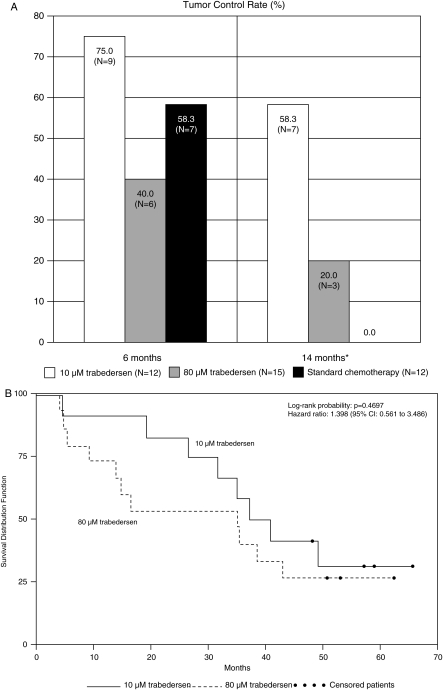
This randomized, open-label, active-controlled, dose-finding phase IIb study evaluated the efficacy and safety of trabedersen (AP 12009) administered intratumorally by convection-enhanced delivery compared with standard chemotherapy in patients with recurrent/refractory high-grade glioma. One hundred and forty-five patients with central reference histopathology of recurrent/refractory glioblastoma multiforme (GBM) or anaplastic astrocytoma (AA) were randomly assigned to receive trabedersen at doses of 10 or 80 µM or standard chemotherapy (temozolomide or procarbazine/lomustine/vincristine). Primary endpoint was 6-month tumor control rate, and secondary endpoints included response at further timepoints, survival, and safety. Six-month tumor control rates were not significantly different in the entire study population (AA and GBM). Prespecified AA subgroup analysis showed a significant benefit regarding the 14-month tumor control rate for 10 µM trabedersen vs chemotherapy (p= .0032). The 2-year survival rate had a trend for superiority for 10 µM trabedersen vs chemotherapy (p = .10). Median survival for 10 µM trabedersen was 39.1 months compared with 35.2 months for 80 µM trabedersen and 21.7 months for chemotherapy (not significant). In GBM patients, response and survival results were comparable among the 3 arms. Exploratory analysis on GBM patients aged ≤55 years with Karnofsky performance status >80% at baseline indicated a 3-fold survival at 2 and 3 years for 10 µM trabedersen vs chemotherapy. The frequency of patients with related or possibly drug-related adverse events was higher with standard chemotherapy (64%) than with 80 µM trabedersen (43%) and 10 µM trabedersen (27%). Superior efficacy and safety for 10 µM trabedersen over 80 µM trabedersen and chemotherapy and positive risk-benefit assessment suggest it as the optimal dose for further clinical development in high-grade glioma.
Overview
The claims and statistics of this paper haven’t been checked yet.
Free: it reads the open-access text and checks the first 5 claims that cite a source we can check. Create a free account to check every claim.
Integrity signals
Registry
Cites
Statistics
Figures
Verification
Claims the paper makes
The claims and statistics of this paper haven’t been checked yet.
Free: it reads the open-access text and checks the first 5 claims that cite a source we can check. Create a free account to check every claim.
Claims other papers make about this one
Each is checked against this paper’s own text: does it say what the citing paper says it does?
The source backs part of the claim, not all of it — or backs it for a different population, condition or comparison.
In the citing paper
“Lastly, phase 1 clinical studies with trabedersen (AP12009), Lucanix (belagenpumatucel‐L), or with ASOs against TGF‐β2 mRNA, showed better survival in glioblastoma, melanoma, pancreatic cancer or colorectal cancer patients [173, 174].”
From Tumor microenvironment signaling and therapeutics in cancer progression (2023) · cites this paper as [174]
Experimental — accuracy not yet measured
Self-check
Percentages, sums and reported differences re-computed from the paper’s own numbers.
The self-check needs the paper’s full text.
Citations
Cites
Radiotherapy Plus Concomitant and Adjuvant Temozolomide for Glioblastoma
Stupp, R., Mason, W. P., van den Bent, M. J., Weller, M., Fisher, B., Taphoorn, M. J. B., Belanger, K., Brandes, A. A., Marosi, C., Bogdahn, U., et al. (2005) · New England Journal of Medicine · doi:10.1056/nejmoa043330 · Cited by 21,807
Self-citationStupp, R., Hegi, M. E., Mason, W. P., van den Bent, M. J., Taphoorn, M. J., Janzer, R. C., Ludwin, S. K., Allgeier, A., Fisher, B., Belanger, K., et al. (2009) · The Lancet Oncology · doi:10.1016/s1470-2045(09)70025-7 · Cited by 7,668 · cited 1×
“9%.(2) However, overall survival (OS) is still poor, especially in patients with recurrent or refractory tumors with a median survival of 11.”
BackgroundSelf-citationMassagué, J. (2008) · Cell · doi:10.1016/j.cell.2008.07.001 · Cited by 3,907
Response criteria for phase II studies of supratentorial malignant glioma.
Macdonald, D. R., Cascino, T. L., Schold, S. C., & Cairncross, J. G. (1990) · Journal of Clinical Oncology · doi:10.1200/jco.1990.8.7.1277 · Cited by 2,409 · cited 1×
“Tumor assessments were done via central, blinded MRI readings of 2 independent radiologists and 1 adjudicator using the classical Macdonald criteria.(17) The tumor control rate was defined as the percentage of patients with complete response (CR) + partial response (PR) + stable disease (SD).”
MethodDAOUD, G. (1965) · Archives of Pediatrics & Adolescent Medicine · doi:10.1001/archpedi.1965.02090030355030 · Cited by 1,171
Outcomes and Prognostic Factors in Recurrent Glioma Patients Enrolled Onto Phase II Clinical Trials
Wong, E. T., Hess, K. R., Gleason, M. J., Jaeckle, K. A., Kyritsis, A. P., Prados, M. D., Levin, V. A., & Yung, W. K. A. (1999) · Journal of Clinical Oncology · doi:10.1200/jco.1999.17.8.2572 · Cited by 902
Brandes, A. A., Franceschi, E., Tosoni, A., Blatt, V., Pession, A., Tallini, G., Bertorelle, R., Bartolini, S., Calbucci, F., Andreoli, A., et al. (2008) · Journal of Clinical Oncology · doi:10.1200/jco.2007.14.8163 · Cited by 840 · cited 2×
“In these patients, pseudoprogression was associated with a favorable survival (manuscript in preparation), as has been reported previously in high-grade glioma patients treated with radiotherapy and TMZ.33 In conclusion, 10 mM trabedersen represents the optimal dose for further clinical development of trabedersen.”
Prognostic factors for survival of patients with glioblastoma: Recursive partitioning analysis
Lamborn, K. R., Chang, S. M., & Prados, M. D. (2004) · Neuro-Oncology · doi:10.1215/s1152851703000620 · Cited by 546
Laske, D. W., Youle, R. J., & Oldfield, E. H. (1997) · Nature Medicine · doi:10.1038/nm1297-1362 · Cited by 525
Taal, W., Brandsma, D., de Bruin, H. G., Bromberg, J. E., Swaak‐Kragten, A. T., Sillevis Smitt, P. A. E., van Es, C. A., & van den Bent, M. J. (2008) · Cancer · doi:10.1002/cncr.23562 · Cited by 465
Research works printed but not linked: 1
- Fontana A Bodmer S Frei K Malipiero U Siepl C Expression of TGF-beta 2 in human glioblastoma: a role in resistance to immune rejection? Ciba Found Symp. 1991 157 232 241 1649035
Cited by
Items 301–400 of 442
Molecularly targeted therapy in neuro-oncology
Sathornsumetee, S., & Rich, J. N. (2012) · Handbook of clinical neurology · doi:10.1016/b978-0-444-52138-5.00018-9 · Cited by 12
Chamberlain, M. C. (2011) · Neuro-Oncology · doi:10.1093/neuonc/nor048 · Cited by 11
Yu, Y., Ahmed, A., Lai, H., Cheng, W., Yang, J.-C., Chang, W., Chen, L., Shan, Y., & Ma, W. (2022) · Frontiers in Oncology · doi:10.3389/fonc.2022.1057930 · Cited by 12
Sun, Z., Yan, T., Jiang, H., Cai, J., Zhu, X., & Chen, Q. (2023) · Medical Oncology · doi:10.1007/s12032-023-02136-0 · Cited by 10
Molecular Pathways Governing the Termination of Liver Regeneration
de Haan, L. R., van Golen, R. F., & Heger, M. (2024) · Pharmacological Reviews · doi:10.1124/pharmrev.123.000955 · Cited by 11
The predictive value of transforming growth factor-β in Wilms tumor immunopathogenesis
Amarante, M. K., de Oliveira, C. E. C., Ariza, C. B., Sakaguchi, A. Y., Ishibashi, C. M., & Watanabe, M. A. E. (2017) · International Reviews of Immunology · doi:10.1080/08830185.2017.1291639 · Cited by 11
“Besides its ambiguous scopes in cancer, recent investigations have boosted TGF-β pathway as a therapeutic target to treat tumors, in which TGF-β exerts strong immunosuppressive effects, such as malignant melanoma and renal cell carcinoma [57], glioblastoma [58], hepatocellular carcinoma [59], and malignant pleural mes…”
BackgroundKorleski, J., Sall, S., Luly, K. M., Johnson, M. K., Johnson, A. L., Khela, H. S., Lal, B., Taylor, T., Ashby, J. M., Alonso, H., et al. (2025) · Signal Transduction and Targeted Therapy · doi:10.1038/s41392-025-02223-w · Cited by 9
Wang, H., Hung, W., Chen, L., & Pan, M. (2018) · International Journal of Molecular Sciences · doi:10.3390/ijms19113584 · Cited by 9
Challenging Hurdles of Current Targeting in Glioblastoma: A Focus on Immunotherapeutic Strategies
Genoud, V., & Migliorini, D. (2021) · International Journal of Molecular Sciences · doi:10.3390/ijms22073493 · Cited by 9
“Other strategies such as the antisense oligonucleotide trabedersen (AP 12009) were tested to inhibit TGFβ signaling [87], but with no clinical efficacy.”
MethodUnraveling the peripheral and local role of inflammatory cytokines in glioblastoma survival
Cavalheiro, V. J., Campos, A. C. P., de Lima, L. G. C. A., Roça, C. T., Docema, M. F. L., Lancellotti, C. L. P., Martinez, R. C. R., Pagano, R. L., Chammas, R. J., Teixeira, M. J., et al. (2022) · Cytokine · doi:10.1016/j.cyto.2022.156059 · Cited by 9
Chen, W., Liu, D., Liu, P., Kong, Z., Wang, Y., Wang, Y., & Ma, W. (2021) · Chinese Journal of Cancer Research · doi:10.21147/j.issn.1000-9604.2021.03.12 · Cited by 9
“Moreover, most of the other trials obtained negative results, and the details are supplemented and summarized in Table 1 (56-77).”
ResultParadoxical roles of TGF-β signaling in suppressing and promoting squamous cell carcinoma
Wu, F., Weigel, K. J., Zhou, H., & Wang, X. (2018) · Acta Biochimica et Biophysica Sinica · doi:10.1093/abbs/gmy013 · Cited by 9
Oligonucleotides for Upregulating Gene Expression
Khorkova, O., Hsiao, J. H., & Wahlestedt, C. (2013) · Pharmaceutical Patent Analyst · doi:10.4155/ppa.13.4 · Cited by 9
Nduom, E. K.-E., Walbridge, S., & Lonser, R. R. (2012) · Journal of neurosurgery · doi:10.3171/2012.9.jns12506 · Cited by 8
Ding, X., Li, X., Chen, F., Wang, H., & Jiang, Y. (2025) · MedComm – Oncology · doi:10.1002/mog2.70023 · Cited by 9
Cytokines and cancer-associated fibroblasts
Hu, Y., Liang, J.-J., Duan, L., Zhu, J., Shan, G., Cheng, T., Wu, Y., Tan, L., & Zhan, C. (2026) · Journal of Hematology & Oncology · doi:10.1186/s13045-026-01801-x · Cited by 8
Orphan drugs in glioblastoma multiforme: a review
Lassen, U., Mau-Soerensen, M., & Poulsen, H. S. (2014) · Orphan Drugs Research and Reviews · doi:10.2147/odrr.s46018 · Cited by 7
Targeted Local Therapy for Management of Intracranial High-Grade Gliomas
Paldor, I., Chaichana, K. L., Brem, H., & Tyler, B. (2018) · Progress in neurological surgery · doi:10.1159/000469688 · Cited by 7
Therapeutic Modulation of Prostate Cancer Metastasis
Krishna, S. N., & Bergan, R. C. (2014) · Future Medicinal Chemistry · doi:10.4155/fmc.13.201 · Cited by 7
Therapeutic Oligonucleotides Against Cancer: Recent Approaches and New Perspectives
Palomino-Vizcaíno, G., & Álvarez-Salas, L. M. (2019) · Elsevier eBooks · doi:10.1016/b978-0-12-814470-1.00001-0 · Cited by 7
Convection-enhanced drug delivery: prospects for glioblastoma treatment
Barua, N. U., & Gill, S. S. (2014) · CNS Oncology · doi:10.2217/cns.14.41 · Cited by 7
Habibi, M. A., Nejati, N., Najafi, M. B., Khodadadiyan, A., Dashti, M., Lorestani, P., Karimizadeh, Z., Ahmadpour, M., Kalantari, A., Jokar-Derisi, A., et al. (2025) · Cancer Treatment and Research Communications · doi:10.1016/j.ctarc.2025.100999 · Cited by 11
Schettini, F., Pineda, E., Rocca, A., Buché, V., Donofrio, C. A., Mazariegos, M., Ferrari, B., Tancredi, R. J., Panni, S., Cominetti, M., et al. (2024) · The Oncologist · doi:10.1093/oncolo/oyae338 · Cited by 6
Epithelial to Mesenchymal Transition
Dalton, A. C., & Howe, P. H. (2021) · Elsevier eBooks · doi:10.1016/b978-0-12-820472-6.00005-0 · Cited by 6
Role of Cytokines in Tumor Immunity and Immune Tolerance to Cancer
Murugaiyan, G. (2014) · Springer eBooks · doi:10.1007/978-3-662-44006-3_7 · Cited by 8
Evolution of care for patients with relapsed glioblastoma
Balañá, C., Villà, S., & Teixidor, P. (2011) · Expert Review of Anticancer Therapy · doi:10.1586/era.11.152 · Cited by 6
Developing immunotherapeutic strategies to target brain tumors
Lieberman, N. A. P., Moyes, K. W., & Crane, C. A. (2016) · Expert Review of Anticancer Therapy · doi:10.1080/14737140.2016.1192470 · Cited by 7
“GBM with agents that inhibit either VEGF ([59, 60]) (NCT00967330, NCT00884741) or TGF-β alone [61] (NCT00431561) indicate that inhibiting a single soluble factor may also be insufficient to make a significant impact when designing immunotherapies.”
BackgroundGuo, B., Zhang, S., Xu, L., Sun, J., Chan, W., Zheng, P., Zhang, J., & Zhang, L. (2023) · Frontiers in Immunology · doi:10.3389/fimmu.2023.966696 · Cited by 6
“Boosting innate immunity: Immunopotentiators (IP) such as transforming growth factor (TGF)-b2 anti-sense oligonucleotide (ODN) and Cpg-ODN (20, 21).”
BackgroundMethodRole of Non-Coding RNAs in TGF-β Signalling in Glioma
Shree, B., & Sharma, V. (2023) · Brain Sciences · doi:10.3390/brainsci13101376 · Cited by 8
“Several anti-TGF-β antibodies, inhibitors, and antisense oligonucleotides (ASOs) against TGF-β pathway components have been evaluated in the pre-clinical and clinical trials for GBM, with limited success [18,34–36].”
BackgroundAntisense therapies for cancer
MacLeod, A. R. (2013) · Drug Discovery Today Therapeutic Strategies · doi:10.1016/j.ddstr.2013.04.002 · Cited by 6
Advances in antisense oligonucleotide treatment for cancer
Zhu, L., Muhtar, P., Goyama, S., & Yoshimi, A. (2026) · Japanese Journal of Clinical Oncology · doi:10.1093/jjco/hyag017 · Cited by 6
“In the following clinical trials, trabedersen has shown its tolerance and efficacy in treating gliomas [101, 102, 124].”
Biphasic Role of TGF-β in Cancer Progression: From Tumor Suppressor to Tumor Promotor
Fan, C., Zhang, J., Hua, W., & ten Dijke, P. (2018) · Elsevier eBooks · doi:10.1016/b978-0-12-801238-3.64983-8 · Cited by 6
Role of Cytokines in Tumor Immunity and Immune Tolerance to Cancer
Garo, L. P., & Murugaiyan, G. (2020) · Springer eBooks · doi:10.1007/978-3-030-30845-2_13 · Cited by 6
The 100 Most-Cited Articles About Convection-Enhanced Delivery to the Brain: A Bibliometric Analysis
Lu, V. M., Rechberger, J. S., Himes, B. T., & Daniels, D. J. (2019) · World Neurosurgery · doi:10.1016/j.wneu.2019.05.179 · Cited by 5
Blum, A. E., Ravillah, D., Singh, S., Miao, Y., Kresak, A. M., Willis, J. E., Canto, M. I., Wang, J. S., Shaheen, N. J., Chak, A., et al. (2022) · Gastroenterology · doi:10.1053/j.gastro.2022.07.073 · Cited by 5
Xie, Y., Chen, L., Zhou, J., Wang, Q., Yang, C., Xu, C., Fan, X., Tan, Y., Wang, Y., Kang, C., et al. (2020) · Cancer Biology and Medicine · doi:10.20892/j.issn.2095-3941.2019.0356 · Cited by 5
Dynamics of transforming growth factor β signaling and therapeutic efficacy
Wu, S., Luwor, R. B., & Zhu, H. (2023) · Growth Factors · doi:10.1080/08977194.2023.2215335 · Cited by 5
Inhibiting TGF-β signaling pathway for disease therapy: challenges and opportunities
Gao, X., Li, X., Zhang, C., Zhou, J., Gu, K., Liu, X., & Bai, C. (2025) · Cytokine · doi:10.1016/j.cyto.2025.157048 · Cited by 4
Sarkar, S., & Patranabis, S. (2024) · Human Cell · doi:10.1007/s13577-024-01112-8 · Cited by 4
Qin, N., Wu, W., & Li, B. (2025) · Frontiers in Bioscience-Landmark · doi:10.31083/fbl45595 · Cited by 4
“In addition, its overexpression has been strongly associated with multiple fibrotic disorders, exhibiting a positive correlation with disease severity [5,6].”
Antisense Technology: From Unique Laboratory Tool to Novel Anticancer Treatments
Cresce, C. D., Way, C., Rytelewski, M., Vareki, S. M., Nilam, S., Vincent, M. D., Koropatnick, J. D., & Ferguson, P. J. (2012) · RNA technologies · doi:10.1007/978-3-642-27426-8_7 · Cited by 6
Macrophages and Microglia in Brain Malignancies
Riccadonna, C., & Paul, R. (2012) · InTech eBooks · doi:10.5772/35163 · Cited by 4
“However, when tested clinically as a monotherapy in recurrent high grade glioma, the clinical effects were disappointing (Bogdahn et al., 2011).”
Negrón, K., Khalasawi, N., & Suk, J. S. (2020) · Neuromethods · doi:10.1007/978-1-0716-1052-7_7 · Cited by 4
Tang, L., Yu, S., Zhang, Q., Cai, Y., Li, W., Yao, S., & Cheng, H. (2022) · Frontiers in Genetics · doi:10.3389/fgene.2022.915282 · Cited by 4
“Recent studies have shown that TGFB2 expression is upregulated in gastric cancer, non–small cell lung cancer, gallbladder cancer, colorectal carcinoma, and high-grade glioma, which is associated with poor prognosis (Bogdahn et al., 2011; Zhang et al., 2020; Liao et al., 2021; Song and Zhou, 2021).”
BackgroundSilginer, M., Papa, E., Szabó, E., Vasella, F., Pruschy, M. N., Stroh, C., Roth, P., Weiß, T., & Weller, M. (2023) · Acta Neuropathologica Communications · doi:10.1186/s40478-023-01527-8 · Cited by 4
Signaling Cascades Driving the Malignant Phenotype of Glioma Cells
Nakada, M., Kita, D., Furuta, T., Watanabe, T., Hayashi, Y., & Hamada, J. (2014) · Springer eBooks · doi:10.1007/978-3-7091-1431-5_3 · Cited by 4
Castellano, A., Pieri, V., Segato, A., Riva, M., Pecco, N., Tian, Y., Vidotto, M., Zani, D. D., Brizzola, S., Trovatelli, M., et al. (2025) · bioRxiv (Cold Spring Harbor Laboratory) · doi:10.1101/2025.04.15.648763 · Cited by 4
Tsang, V., Riccio, F., Wilson, A. S., Nudds, H., Coombes, J. D., Wurdak, H., Bulstrode, H. J. C. J., Lieberam, I., & Danovi, D. (2025) · Scientific Reports · doi:10.1038/s41598-025-30914-5 · Cited by 3
“Given the importance of axon-guided migration in GBM, we included inhibitors of Ephrin receptors (ALW-II-41–27 for EphA2, NVP-BHG712 for EphB4, and Ehp-inhibitor-1), and the CXCL12/CXCR4 axis (motixafortide), known to regulate directed migration in the hypoxic tumour core in immunotherapy 47,48 .”
Silginer, M., Weller, M., Becher, B., Mastall, M., Weiß, T., Núñez, N. G., Kienzler, J. C., & Roth, P. (2026) · Journal for ImmunoTherapy of Cancer · doi:10.1136/jitc-2025-011824 · Cited by 3
Mapping glioblastoma’s isoform diversity using long-read single-cell analysis
Tang, W., Lo, C. W. S., Chu, A. T.-W., Lee, W. L., Wang, D., Kiang, K. M. Y., Li, L., Leung, G. K. K., Hong Kong Genome Project, Helali, A. E., et al. (2026) · Nature Communications · doi:10.1038/s41467-026-72258-2 · Cited by 4
“%) were also detected as differentially used across tumor subtypes in the MAST analysis (adjusted P value <0.05) (Supplementary Data 9).”
InfluentialTGF-β signaling pathway in the regulations of development and disease
Sun, H., Wei, S., & Xi, Q. (2024) · Chinese Science Bulletin (Chinese Version) · doi:10.1360/tb-2024-0326 · Cited by 5
Tumor microenvironment as a target of malignant gliomas treatment
Borisov, K. E., & Дамировна, С. Д. (2015) · Malignant tumours · doi:10.18027/2224-5057-2015-4-14-23 · Cited by 3
Gene Therapy in the Nervous System: Failures and Successes
Chandran, J. S., Scarrott, J. M., Shaw, P. J., & Azzouz, M. (2017) · Advances in experimental medicine and biology · doi:10.1007/978-3-319-60733-7_13 · Cited by 3
Multimodality Targeting of Glioma Cells
He, Z., Mitteer, R. A., Mou, Y., & Fan, Y. (2016) · Elsevier eBooks · doi:10.1016/b978-0-323-47660-7.00005-7 · Cited by 6
The path forward for anti-programmed cell death-1 therapy in gliomas
Majd, N., Kamiya-Matsuoka, C., & de Groot, J. (2019) · Current Opinion in Neurology · doi:10.1097/wco.0000000000000746 · Cited by 3
Yadav, P., Kundu, P., Pandey, V. K., Amin, P. J., Nair, J., & Shankar, B. S. (2022) · International Journal of Radiation Biology · doi:10.1080/09553002.2022.2069299 · Cited by 3
Palavani, L. B., Mitre, L. P., Camerotte, R., Nogueira, B. V., Canto, G. L., Chen, H.-C., Pacheco-Barrios, N. V., Ferreira, M. Y., Batista, S., Andreão, F. F., et al. (2024) · Journal of Neuro-Oncology · doi:10.1007/s11060-024-04813-0 · Cited by 3
Common Denominators of Self-renewal and Malignancy in Neural Stem Cells and Glioma
Wicher, G., Holmqvist, K., & Forsberg‐Nilsson, K. (2011) · Springer eBooks · doi:10.1007/978-94-007-2801-1_17 · Cited by 3
VEGF and Notch Signaling in Angiogenesis
Teodorczyk, M., Stanković, N. D., Bicker, F., & Schmidt, M. H. H. (2015) · Springer eBooks · doi:10.1007/978-1-4939-2907-8_1 · Cited by 5
RETRACTED: Lipid-mediated regulation of epithelial-mesenchymal transition in colorectal cancer
Shah, M. A., Nagpal, S., Shankar, S. G., Samrot, A. V., & Mishra, A. K. (2025) · Journal of Pharmaceutical Analysis · doi:10.1016/j.jpha.2025.101541 · Cited by 2
Retracted[Epigenetic alterations in cervical cancer progression].
Ríos-Romero, M., Soto-Valladares, A. G. P., & Piña‐Sánchez, P. (2015) · PubMed · Cited by 2
Small RNA-mediated prevention, diagnosis and therapies of cancer
Hasan, A. A., & Azam, A. T. M. Z. (2018) · Elsevier eBooks · doi:10.1016/b978-0-12-813669-0.00009-9 · Cited by 3
Kassab, C., Kerrigan, B. C. P., Caruso, H. G., Al-Enazy, S., & Heimberger, A. B. (2019) · Elsevier eBooks · doi:10.1016/b978-0-12-813997-4.00015-3 · Cited by 4
Togni, C., Rom, E., Burghardt, I., Roth, P., Rushing, E. J., Weller, M., & Gramatzki, D. (2022) · Journal of Neuropathology & Experimental Neurology · doi:10.1093/jnen/nlac007 · Cited by 2
Cellular signaling in glioblastoma: A molecular and clinical perspective
Ghosh, D., Pryor, B., & Jiang, N. (2024) · International review of cytology · doi:10.1016/bs.ircmb.2024.01.007 · Cited by 2
Industry progress report on neuro-oncology: a biotech update
Haber, J. S., Banu, M. A., Ray, A. E., Kesavabhotla, K., & Boockvar, J. A. (2013) · Journal of Neuro-Oncology · doi:10.1007/s11060-012-1036-8 · Cited by 2
Antisense: Progress Towards Gene-Directed Cancer Therapy☆
Crooke, S. T., & MacLeod, A. R. (2016) · Elsevier eBooks · doi:10.1016/b978-0-12-801238-3.98738-5 · Cited by 3
Pharmacokinetics and Pharmacodynamics of Antisense Oligonucleotides
Lightfoot, H. L., Schneider, A., & Hall, J. (2018) · Wiley eBooks · doi:10.1002/9781119070153.ch4 · Cited by 5
Immunopathology and Immunotherapy of Central Nervous System Cancer
Sonabend, A. M., Showers, C. R., & Anderson, R. C. E. (2015) · Springer eBooks · doi:10.1007/978-3-662-46410-6_18 · Cited by 2
Prediction of Laser Ablation in Brain: Sensitivity, Calibration, and Validation
Fahrenholtz, S. J. (2015) · Digital Commons-TMC (Texas Medical Center) · Cited by 2
Vigneron, E., Vignau, J., Lowyck, O., den Bossche, V. V., Ambroise, J., Kieffer, Y., Mechta‐Grigoriou, F., Rizzi, I., Giolito, M. V., Desgres, M., et al. (2026) · Journal of Experimental & Clinical Cancer Research · doi:10.1186/s13046-026-03765-9 · Cited by 1
Ji, L., Hl, L., & Zhu, W. (2026) · Human Cell · doi:10.1007/s13577-026-01430-z · Cited by 1
Extracellular matrix stiffness and mechanotransduction in cancer drug resistance
Song, Y., Huang, C., Han, J., Wang, S., Liu, H., Li, Y., Jiang, Z., Tan, X., Wu, T., & Jiang, F. (2026) · Drug Resistance Updates · doi:10.1016/j.drup.2026.101470 · Cited by 1
Targeting Pro-Angiogenic TGF-β Signaling in the Tumor Microenvironment
Pietras, K., & Cunha, S. I. (2013) · Springer eBooks · doi:10.1007/978-4-431-54409-8_19 · Cited by 2
Some observations on the mechanics and dynamics of tumor heterogeneity
Gillies, G. T. (2012) · AIP Advances · doi:10.1063/1.3697847 · Cited by 1
Bogdahn, U. (2011) · Neuro-Oncology · doi:10.1093/neuonc/nor047 · Cited by 1
Self-citationModulating the Tumor Microenvironment
Ruby, C. E., & Kaufman, H. L. (2011) · Springer eBooks · doi:10.1007/978-1-61779-407-0_18 · Cited by 1
Transforming Growth Factor – β and Glioma
Handoko, H., & Hardiany, N. S. (2020) · International Journal of Human and Health Sciences (IJHHS) · doi:10.31344/ijhhs.v4i3.194 · Cited by 1
Strategies to Modulate the Blood-Brain Barrier for Directed Brain Tumor Targeting
Schiapparelli, P. V., Lara-Velazquez, M. A., Al‐kharboosh, R., Su, H., Cui, H., & Quiñones‐Hinojosa, A. (2020) · Neuromethods · doi:10.1007/978-1-0716-1052-7_3 · Cited by 1
Ochs, K., Bunse, L., Mildenberger, I. C., Wick, W., & Platten, M. (2018) · best practice onkologie · doi:10.1007/s11654-018-0088-4 · Cited by 1
“Die gezielte Hemmung immunsuppressiver Stoffwechselwege wie beispielsweise des Transforming-growth-factor-β(TGFβ)-Signalwegs oder des Abbaus der essenziellen Aminosäure Tryptophan zu immunsuppressiven Metaboliten stellt prinzipiell eine attraktive Behandlungsoption dar, wird bisher jedoch vorwiegend in präklinischen M…”
BackgroundImmunopathology and Immunotherapy of Central Nervous System Cancer
Hanaei, S., Arrieta, V. A., & Sonabend, A. M. (2020) · Springer eBooks · doi:10.1007/978-3-030-57949-4_16 · Cited by 1
Martin, B., Leshan, R. L., Milner, T. A., & Souweidane, M. M. (2022) · Springer eBooks · doi:10.1007/978-3-030-88832-9_129 · Cited by 1
New surgical approaches in glioblastoma
Alves, J. L., & Barbosa, M. (2023) · Elsevier eBooks · doi:10.1016/b978-0-323-99873-4.00030-x · Cited by 1
Ding, X., Chen, C., Liu, Q., Yang, Y., Wang, G., & Qian, H. (2023) · ACS Applied Polymer Materials · doi:10.1021/acsapm.3c00535 · Cited by 1
TGF-β Signaling Pathway and Its Therapeutic Role in Cancer
James, A. W., Bhat, H. M., Yousuf, S., Jan, M., Rehman, M. U., & Rashid, S. M. (2025) · Springer eBooks · doi:10.1007/978-981-96-2763-9_11 · Cited by 2
Zhang, S., Xu, L., Chen, G., Liu, J., Wang, Q., Hu, X., Wen, N., Liu, X., Peng, X., Fan, L., et al. (2019) · Research Square · doi:10.21203/rs.2.10495/v2 · Cited by 1
CAR-MODIFIED T CELLS CAPABLE OF DISTINGUISHING NORMAL CELLS FROM MALIGNANT CELLS
Caruso, H. G. (2014) · Digital Commons-TMC (Texas Medical Center)
Song, X., & Heimberger, A. B. (2013) · Journal für Kardiologie (Krause & Pachernegg GmbH)
Rios, W. M. (2013) · Digital Library of Theses and Dissertations (Universidade de São Paulo) · doi:10.11606/t.17.2013.tde-22112013-101030
Study of molecular mechanisms implicated in the TGF-beta oncogenic effect in Glioma
Juncà, A. G. (2013) · Dipòsit Digital de la Universitat de Barcelona (Universitat de Barcelona)
Brain Tumor Stem Cells and Immunotherapy
Saga, I., & Toda, M. (2012) · Journal of cancer research updates · doi:10.6000/1929-2279.2012.01.01.06
“In contrast, among these studies, the blockage of TGF- showed promising results in a phase IIB clinical trial [81].”
Martins-Gomes, A. (2012) · OpenGrey (Institut de l'Information Scientifique et Technique)
Therapie des Gliommikromilieus
Herrlinger, U., & Platten, M. (2015) · Der Nervenarzt · doi:10.1007/s00115-014-4225-1
Fibrosis: a novel approach for an old problem
(2014) · Receptors & Clinical Investigation · doi:10.14800/rci.151 · Cited by 1
“Trabedersen, interferes with TGFβ2 mRNA translation and has reached the phase III of clinical trials for glioblastoma treatment ([22]).”
BackgroundGene therapy in neurology: review of ongoing clinical trials
Molnár, M. J., & Németh, G. (2012) · Clinical Investigation · doi:10.4155/cli.12.47
Neurochirurgie, L. F., & Medizin, F. (2014)
Targeting the TGFβ signalling pathway in disease
Family, H. D. (2012)
The Tumor Microenvironment as a Target for Therapeutic Intervention
Hua, F., & DeClerck, Y. A. (2015) · Wiley eBooks · doi:10.1002/9781118468678.ch5
Targeting regulatory T cells and other strategies to enable cancer vaccines
Paustian, C. C., Jensen, S. M., Church, S., Puri, S., Twitty, C., Hu, H., Curti, B. D., Urba, W. J., Puri, R. K., & Fox, B. A. (2013) · CRC Press eBooks · doi:10.3109/9781841848303-15
Precision medicine in glioblastoma therapy
Royer-Perron, L., Idbaïh, A., Sanson, M., Delattre, J., Hoang‐Xuan, K., & Alentorn, A. (2016) · Expert Review of Precision Medicine and Drug Development · doi:10.1080/23808993.2016.1241128
“comparable in the three groups for patients with GBM [70].”
Result
Metadata
- Authors
- Bogdahn, U., Hau, P., Stockhammer, G., Venkataramana, N. K., Mahapatra, A. K., Suri, A., Balasubramaniam, A., Nair, S., Oliushine, V., Parfenov, V., Poverennova, I., Zaaroor, M., Jachimczak, P., Ludwig, S., Schmaus, S., Heinrichs, H., Schlingensiepen, K. H., & the Trabedersen Glioma Study Group
- Affiliations
- University of Regensburg (DE)
- Sanjay Gandhi Post Graduate Institute of Medical Sciences (IN)
- Corresponding author
- Bogdahn, U.
- Venue
- Neuro-Oncology
- Publisher
- Oxford University Press (OUP)
- Published
- 2010-10-27
- Volume
- 13
- Issue
- 1
- Pages
- 132-142
- ISSN
- 1522-8517 (ISSN-L)
- 1523-5866
- PMC
- PMC3018908
- OpenAlex
- W2116583846
- Cited by
- 433
- References
- 34
- Citations by year
- 2026: 13 · 2025: 20 · 2024: 28 · 2023: 29 · 2022: 28 · 2021: 21 · 2020: 33 · 2019: 24 · 2018: 24 · 2017: 31 · 2016: 22 · 2015: 39 · 2014: 34 · 2013: 31 · 2012: 33
- FWCI
- 12.38
- Type
- journal article
- Language
- en
- Open access
- hybrid
- doi.org
- Licence
- Locations
- Neuro-Oncology (publishedVersion, cc-by-nc)
- Europe PMC (PubMed Central) (publishedVersion, cc-by-nc)
- PubMed Central (publishedVersion, cc-by-nc)
- PubMed (publishedVersion)
- Topics
- Health Sciences › Medicine › Oncology › Glioma Diagnosis and Treatment
- Health Sciences › Medicine › Oncology › Ovarian cancer diagnosis and treatment
- Health Sciences › Medicine › Oncology › Cancer survivorship and care
- Keywords
- high-grade glioma, anaplastic astrocytoma, temozolomide, procarbazine, lomustine, and vincristine, tumor control rate, survival, dose-finding, adverse events
- MeSH terms
- Adult, Antineoplastic Agents, Brain Neoplasms, Female, Glioblastoma, Humans, International Agencies, Male, Middle Aged, Neoplasm Recurrence, Local, Oligodeoxyribonucleotides, Thionucleotides, Survival Rate, Treatment Outcome, Transforming Growth Factor beta2
About these checks
Registry, retraction, Cites and statistics results are computed, not judged, with one exception: a printed reference that no index lists is read once by a model before it counts as a citation error. Claims are extracted by a model and kept only when their quote appears verbatim in the text; each cited source is then checked, with a model’s help, for whether it says what the claim relies on. Those verdicts can be wrong — read the claim’s quote and the cited source before relying on one.
Statistics and arithmetic are recomputed, not judged.
Confidence bands are shown only for fields calibrated on our annotated test set. None is calibrated yet, so no band is shown.
What counts as a claim ›How we measure confidence ›How we check this ›
Are you an author, or do you see a problem with this page? Request a review
Data sources
Bibliographic data: Semantic Scholar, OpenAlex, Crossref.
Contains information from the Semantic Scholar Academic Graph Datasets, made available under the ODC Attribution License (ODC-BY 1.0).
Semantic Scholar’s data is described in: Kinney, R., et al. (2023). The Semantic Scholar Open Data Platform. arXiv:2301.10140.
