

The DOI matches its Crossref record; 71 of the 74 references it cites were found in a registry or an index.
Global blue carbon accumulation in tidal wetlands increases with climate change
Open accessAbstract
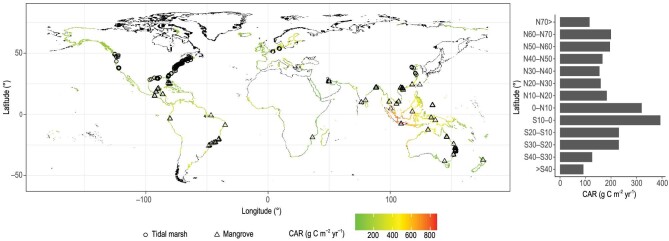
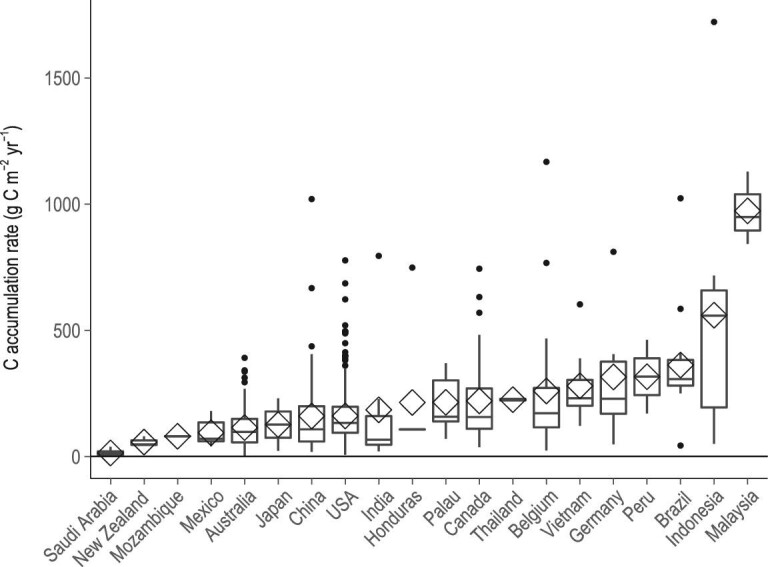
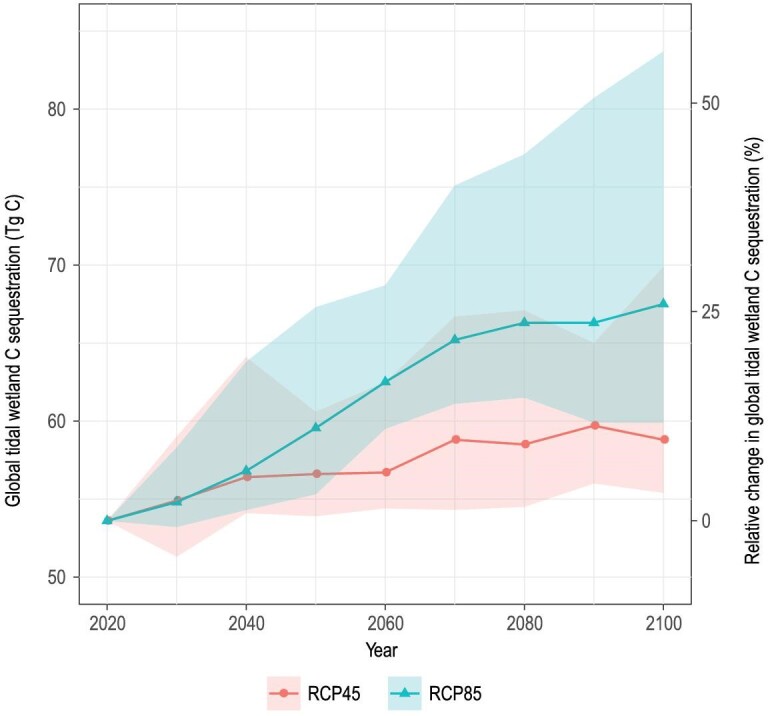
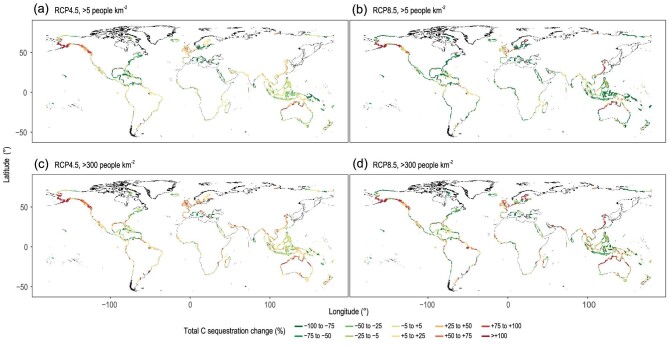
Abstract Coastal tidal wetlands produce and accumulate significant amounts of organic carbon (C) that help to mitigate climate change. However, previous data limitations have prevented a robust evaluation of the global rates and mechanisms driving C accumulation. Here, we go beyond recent soil C stock estimates to reveal global tidal wetland C accumulation and predict changes under relative sea level rise, temperature and precipitation. We use data from literature study sites and our new observations spanning wide latitudinal gradients and 20 countries. Globally, tidal wetlands accumulate 53.65 (95%CI: 48.52–59.01) Tg C yr−1, which is ∼30% of the organic C buried on the ocean floor. Modeling based on current climatic drivers and under projected emissions scenarios revealed a net increase in the global C accumulation by 2100. This rapid increase is driven by sea level rise in tidal marshes, and higher temperature and precipitation in mangroves. Countries with large areas of coastal wetlands, like Indonesia and Mexico, are more susceptible to tidal wetland C losses under climate change, while regions such as Australia, Brazil, the USA and China will experience a significant C accumulation increase under all projected scenarios.
Overview
The claims and statistics of this paper haven’t been checked yet.
Run the check — free, no account needed. It reads the open-access text and checks the sources it cites.
Integrity signals
Registry
Cites
Statistics
Figures
Verification
Claims the paper makes
The claims and statistics of this paper haven’t been checked yet.
Run the check — free, no account needed. It reads the open-access text and checks the sources it cites.
Claims other papers make about this one
Each is checked against this paper’s own text: does it say what the citing paper says it does?
In the citing paper
“Globally, tidal marshes and mangroves capture 196.72 Tg CO2 per year, which is 30% of the organic C deposited on the ocean floor.205”
From Technologies and perspectives for achieving carbon neutrality (2021) · cites this paper as [205]
In the citing paper
“The C stored in these coastal ecosystems as blue C can be preserved over millennia, together with the continuous accretion of soil and sediment organic C driven by sea-level rise, the C sequestration efficiency in marine ecosystems is much higher than that of terrestrial ecosystems.205,206”
From Technologies and perspectives for achieving carbon neutrality (2021) · cites this paper as [205]
Self-check
Percentages, sums and reported differences re-computed from the paper’s own numbers.
The self-check needs the paper’s full text.
Citations
Cites
R: A Language and Environment for Statistical Computing
R Core Team (2000) · doi:10.32614/r.manuals · Cited by 355,817
Fitting Linear Mixed-Effects Models Using lme4
Bates, D., Mächler, M., Bolker, B., & Walker, S. (2015) · Journal of Statistical Software · doi:10.18637/jss.v067.i01 · Cited by 86,835
WorldClim 2: new 1‐km spatial resolution climate surfaces for global land areas
Fick, S. E., & Hijmans, R. J. (2017) · International Journal of Climatology · doi:10.1002/joc.5086 · Cited by 16,088
An Overview of CMIP5 and the Experiment Design
Taylor, K. E., Stouffer, R. J., & Meehl, G. A. (2012) · Bulletin of the American Meteorological Society · doi:10.1175/bams-d-11-00094.1 · Cited by 14,052
A general and simple method for obtaining R 2 from generalized linear mixed‐effects models
Nakagawa, S., & Schielzeth, H. (2013) · Methods in Ecology and Evolution · doi:10.1111/j.2041-210x.2012.00261.x · Cited by 10,356
The representative concentration pathways: an overview
van Vuuren, D. P., Edmonds, J., Kainuma, M., Riahi, K., Thomson, A., Hibbard, K., Hurtt, G. C., Kram, T., Krey, V., Lamarque, J.-F., et al. (2011) · Climatic Change · doi:10.1007/s10584-011-0148-z · Cited by 7,741
Temperature sensitivity of soil carbon decomposition and feedbacks to climate change
Davidson, E. A., & Janssens, I. A. (2006) · Nature · doi:10.1038/nature04514 · Cited by 6,919
The next generation of scenarios for climate change research and assessment
Moss, R. H., Edmonds, J. A., Hibbard, K. A., Manning, M. R., Rose, S. K., van Vuuren, D. P., Carter, T. R., Emori, S., Kainuma, M., Kram, T., et al. (2010) · Nature · doi:10.1038/nature08823 · Cited by 6,467
Chemical analysis of ecological materials.
Allen, S. E. (1974) · Blackwell Scientific Publications eBooks · Cited by 4,375
Mangroves among the most carbon-rich forests in the tropics
Donato, D. C., Kauffman, J. B., Murdiyarso, D., Kurnianto, S., Stidham, M., & Kanninen, M. (2011) · Nature Geoscience · doi:10.1038/ngeo1123 · Cited by 3,651
Research works printed but not linked: 2
- Breithaupt, 2012, Organic carbon burial rates in mangrove sediments: strengthening the global budget, Glob Biogeochem Cycles, 26, GB3011, 10.1029/2012GB004375 · DOI · Paper page
- Center for Hazards and Risk Research Columbia University, Center for International Earth Science Information Network Columbia University and International Bank for Reconstruction and Development - The World Bank, 2005, Global Cyclone Hazard Frequency and Distribution
Cited by
Sorted by citations
Items 401–408 of 408
Chen, Y., Sun, S., Du, J., Zhang, F., Wu, D., Liu, J., Zhang, Y., Du, J., & Chen, X. (2026) · Journal of Hydrology · doi:10.1016/j.jhydrol.2026.136478
Zhang, B., Zhuo, W., Zheng, L., Zhang, M., Li, X., Jia, W., & Wu, N. (2026) · Remote Sensing · doi:10.3390/rs18193334
Self-citationWang, Z., Cui, Q., Guo, P., Wang, C., Zhou, H., Li, M., Shen, Q., Zhang, Z., & Lin, X. (2026) · Limnology and Oceanography · doi:10.1002/lno.70512
Hong, Z., Xi, Y., Zhu, A., Yu, Z., Hao, J., Wang, F., Wei, C., He, C., Zhang, L., Liu, G., et al. (2026) · Diversity · doi:10.3390/d18100600
Self-citationWei, S., Chu, X., Sun, B., Sun, R., Zhang, X., Song, W., Wang, X., Pendall, E. G., & Han, G. (2026) · Global Change Biology · doi:10.1111/gcb.71151
Combatting Global Degradation of the Blue Carbon Ecosystem
Li, S., Xie, L., & Duan, L. (2026) · ACS ES&T Water · doi:10.1021/acsestwater.6c00362
Depth-Independent Soil Organic Carbon Persistence across Climate Gradients in Coastal Wetlands
Wu, L., Song, Z., ZWIETEN, L. V., Wu, H., Yang, X., Guo, L., Chen, J., Chen, X., Hartley, I. P., Xia, S., et al. (2026) · Environmental Science & Technology · doi:10.1021/acs.est.6c08028
A 7200-year palaeoenvironmental reconstruction from Chang Island mangroves, eastern Gulf of Thailand
Englong, A., Punwong, P., Jirapinyakul, A., Marchant, R., Traiperm, P., Chirawatkul, P., Pumijumnong, N., & Maprasop, P. (2026) · Palaeogeography Palaeoclimatology Palaeoecology · doi:10.1016/j.palaeo.2026.114317
Metadata
- Authors
- Wang, F., Sanders, C. J., Santos, I. R., Tang, J., Schuerch, M., Kirwan, M. L., Kopp, R. E., Zhu, K., Li, X., Yuan, J., Liu, W., & Li, Z.
- Affiliations
- Chinese Academy of Sciences (CN)
- State Key Laboratory of Estuarine and Coastal Research (CN)
- Southern Cross University (AU)
- University of Lincoln (GB)
- William & Mary (US)
- Rutgers, The State University of New Jersey (US)
- University of California, Santa Cruz (US)
- Xiaoliang Research Station for Tropical Coastal Ecosystems, Key Laboratory of Vegetation Restoration and Management of Degraded Ecosystems, and the CAS Engineering Laboratory for Ecological Restoration of Island and Coastal Ecosystems, South China Botanical Garden, Chinese Academy of Sciences, Guangzhou 510650, China
- Corresponding author
- Wang, Faming
- Sanders, Christian J
- ORCID
- Venue
- National Science Review
- Publisher
- Oxford University Press (OUP)
- Published
- 2020-12-15
- Volume
- 8
- Issue
- 9
- Pages
- nwaa296-nwaa296
- ISSN
- 2053-714X (ISSN-L)
- 2095-5138
- PMC
- PMC8433083
- OpenAlex
- W3112344741
- Cited by
- 408
- References
- 74
- Citations by year
- 2026: 89 · 2025: 106 · 2024: 80 · 2023: 62 · 2022: 59 · 2021: 12
- FWCI
- 17.64
- Type
- journal article
- Language
- en
- Open access
- gold
- doi.org
- Licence
- Locations
- National Science Review (publishedVersion, cc-by)
- PubMed Central (publishedVersion, cc-by)
- PubMed (publishedVersion)
- Lincoln Repository (University of Lincoln) (acceptedVersion)
- W&M Publish (College of William & Mary) (submittedVersion, cc-by)
- Figshare (submittedVersion, cc-by)
- NOAA Institutional Repository (submittedVersion, cc-by)
- Funders
- National Natural Science Foundation of China (31670621, 31870463)
- Key Special Project for Introduced Talents Team of Southern Marine Science and Engineering Guangdong Laboratory (GML2019ZD0408)
- Guangdong Natural Science Foundation for Distinguished Young Scholars
- CAS Youth Innovation Promotion Association
- National Forestry and Grassland Administration Youth Talent Support Program (2020BJ003)
- R & D program of Guangdong Provincial Department of Science and Technology (2018B030324003)
- I.R.S.
- Australian Research Council (DE160100443, DP150103286, DE140101733, LE140100083)
- NOAA National Estuarine Research Reserve Science Collaborative (NA09NOS4190153, NA14NOS4190145)
- Topics
- Physical Sciences › Environmental Science › Ecology › Coastal wetland ecosystem dynamics
- Physical Sciences › Environmental Science › Ecology › Peatlands and Wetlands Ecology
- Life Sciences › Agricultural and Biological Sciences › Soil Science › Soil Carbon and Nitrogen Dynamics
- Keywords
- blue carbon, tidal wetlands, organic carbon accumulation, coastal carbon sequestration, sea level rise, mangroves, tidal marshes, climate change impacts, latitudinal gradient
About these checks
Registry, retraction, Cites and statistics results are computed, not judged, with one exception: a printed reference that no index lists is read once by a model before it counts as a citation error. Claims are extracted by a model and kept only when their quote appears verbatim in the text; each cited source is then checked, with a model’s help, for whether it says what the claim relies on. Those verdicts can be wrong — read the claim’s quote and the cited source before relying on one.
Statistics and arithmetic are recomputed, not judged.
Confidence bands are shown only for fields calibrated on our annotated test set. None is calibrated yet, so no band is shown.
What counts as a claim ›How we measure confidence ›How we check this ›
Are you an author, or do you see a problem with this page? Request a review
