

The DOI matches its Crossref record; 43 of the 43 references it cites were found in a registry or an index.
An artificial chromosome for data storage
Open accessAbstract
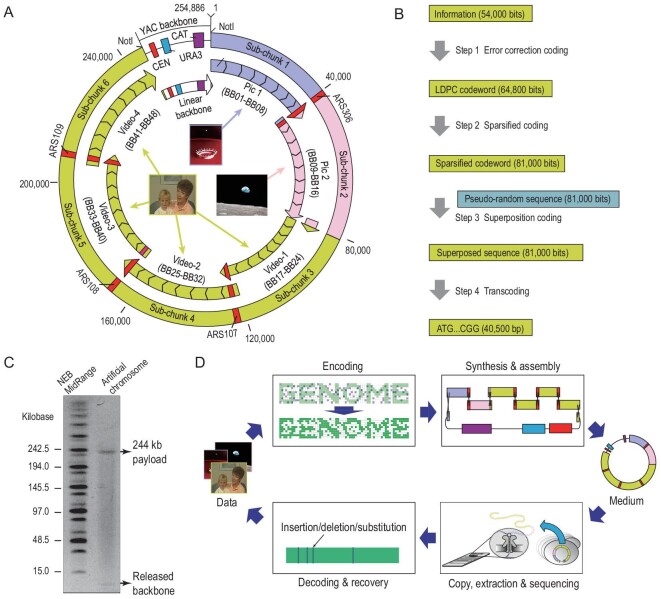
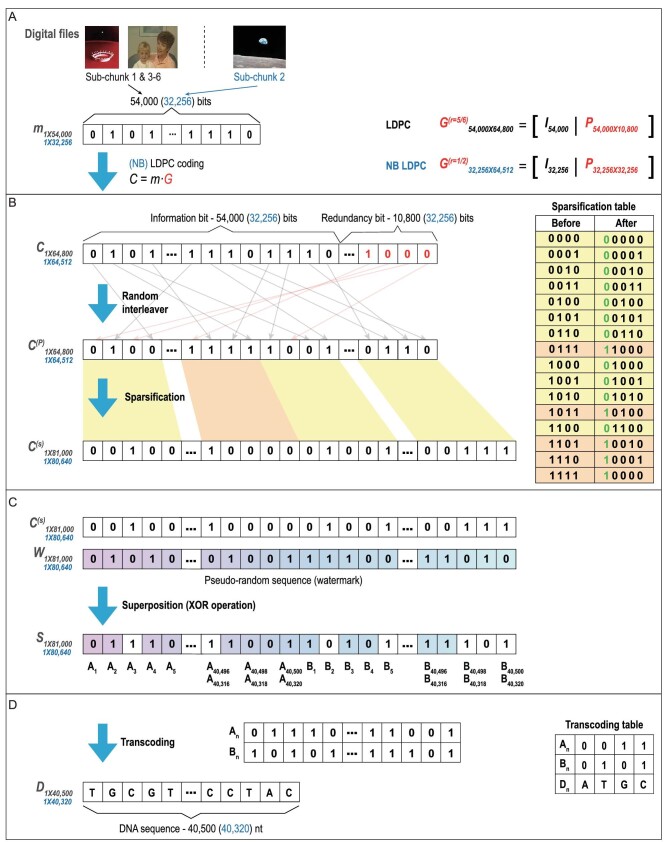
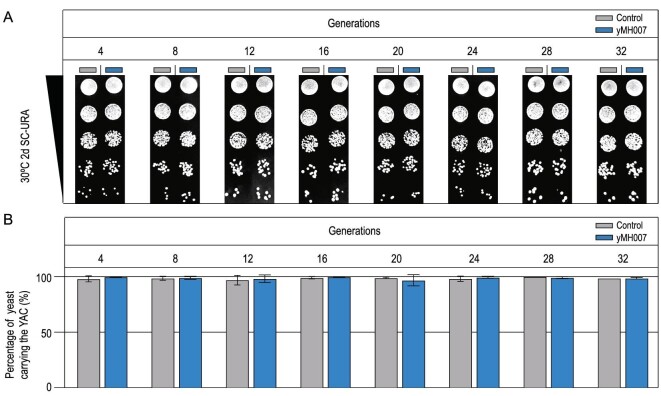
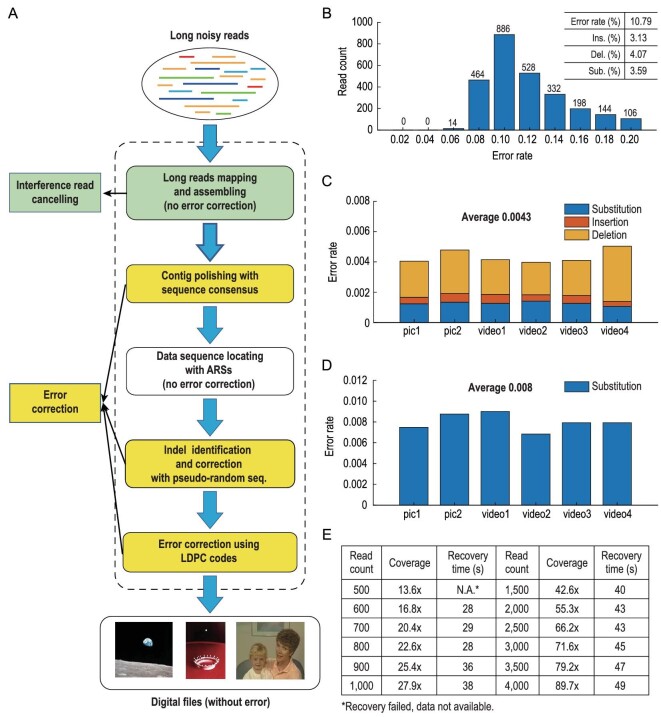
Abstract DNA digital storage provides an alternative for information storage with high density and long-term stability. Here, we report the de novo design and synthesis of an artificial chromosome that encodes two pictures and a video clip. The encoding paradigm utilizing the superposition of sparsified error correction codewords and pseudo-random sequences tolerates base insertions/deletions and is well suited to error-prone nanopore sequencing for data retrieval. The entire 254 kb sequence was 95.27% occupied by encoded data. The Transformation-Associated Recombination method was used in the construction of this chromosome from DNA fragments and necessary autonomous replication sequences. The stability was demonstrated by transmitting the data-carrying chromosome to the 100th generation. This study demonstrates a data storage method using encoded artificial chromosomes via in vivo assembly for write-once and stable replication for multiple retrievals, similar to a compact disc, with potential in economically massive data distribution.
Overview
The claims and statistics of this paper haven’t been checked yet.
Run the check — free, no account needed. It reads the open-access text and checks the sources it cites.
Integrity signals
Registry
Cites
Statistics
Figures
Verification
Claims the paper makes
The claims and statistics of this paper haven’t been checked yet.
Run the check — free, no account needed. It reads the open-access text and checks the sources it cites.
Claims other papers make about this one
Each is checked against this paper’s own text: does it say what the citing paper says it does?
The source backs part of the claim, not all of it — or backs it for a different population, condition or comparison.
In the citing paper
“Moreover, the dChr was replicated with high fidelity, no mutation appeared after the 100th generation of replication, while the encoding method used in this setup was tolerant toward a comparatively low accuracy of Nanopore sequencing, enabling the fast retrieval of reliable data [69].”
From DNA Data Storage. (2023) · cites this paper as [69]
Experimental — accuracy not yet measuredThe source backs part of the claim, not all of it — or backs it for a different population, condition or comparison.
In the citing paper
“In 2021, Chen et al. created a circular 255 kbp yeast artificial chromosome (a data-carrying chromosome; dChr) encoding a total of 38 KB of digital data (two pictures and a video) [69].”
From DNA Data Storage. (2023) · cites this paper as [69]
Experimental — accuracy not yet measuredIn the citing paper
“Chen et al. (2021) encoded the information in a synthetic yeast artificial chromosome with four autonomously replicating sequences and maintained good stability during yeast replication.”
From Large-Scale de Novo Oligonucleotide Synthesis for Whole-Genome Synthesis and Data Storage: Challenges and Opportunities (2021) · cites this paper as Chen et al., 2021
In the citing paper
“It is also important to mention that the preservation of DNA digital archives can be implemented using not only in vitro substrates but also in vivo approaches.150−153”
From Emerging Approaches to DNA Data Storage: Challenges and Prospects (2022) · cites this paper as [150]
Self-check
Percentages, sums and reported differences re-computed from the paper’s own numbers.
The self-check needs the paper’s full text.
Citations
Cites
Low-density parity-check codes
Gallager, R. G. (1962) · IEEE Transactions on Information Theory · doi:10.1109/tit.1962.1057683 · Cited by 10,727
Fast and accurate de novo genome assembly from long uncorrected readsPreprint
Vaser, R., Sović, I., Nagarajan, N., & Šikić, M. (2017) · Genome Research · doi:10.1101/gr.214270.116 · Cited by 3,059
Near Shannon limit performance of low density paritycheck codes
Mackay, D., & Neal, R. M. (1997) · Electronics Letters · doi:10.1049/el:19970362 · Cited by 2,694
Creation of a Bacterial Cell Controlled by a Chemically Synthesized Genome
Gibson, D. G., Glass, J. I., Lartigue, C., Noskov, V. N., Chuang, R.-Y., Algire, M. A., Benders, G. A., Montague, M. G., Ma, L., Moodie, M. M., et al. (2010) · Science · doi:10.1126/science.1190719 · Cited by 2,638
Minimap and miniasm: fast mapping and de novo assembly for noisy long sequences
Li, H. (2016) · Bioinformatics · doi:10.1093/bioinformatics/btw152 · Cited by 1,500
Next-Generation Digital Information Storage in DNA
Church, G. M., Gao, Y., & Kosuri, S. (2012) · Science · doi:10.1126/science.1226355 · Cited by 1,441
Towards Practical, High-Capacity, Low-Maintenance Information Storage in Synthesized DNA
Goldman, N., Bertone, P., Chen, S., Dessimoz, C., LeProust, E. M., Sipos, B., & Birney, E. (2013) · Nature · doi:10.1038/nature11875 · Cited by 1,220
Low-density parity check codes over GF(q)
Davey, M. C., & Mackay, D. (1998) · IEEE Communications Letters · doi:10.1109/4234.681360 · Cited by 1,216
DNA Fountain enables a robust and efficient storage architecture
Erlich, Y., & Zielinski, D. (2017) · Science · doi:10.1126/science.aaj2038 · Cited by 898
Benner, S. A., & Sismour, A. M. (2005) · Nature Reviews Genetics · doi:10.1038/nrg1637 · Cited by 834
Cited by
Sorted by citations
Emerging Approaches to DNA Data Storage: Challenges and Prospects
Doricchi, A., Platnich, C. M., Gimpel, A., Horn, F., Earle, M., Lanzavecchia, G., Cortajarena, A. L., Liz-Marzán, L. M., Liu, N., Heckel, R., et al. (2022) · ACS Nano · doi:10.1021/acsnano.2c06748 · Cited by 235
Towards practical and robust DNA-based data archiving using the yin–yang codec system
Ping, Z., Chen, S., Zhou, G., Huang, X., Zhu, S. J., Zhang, H., Lee, H. H., Lan, Z., Cui, J., Chen, T., et al. (2022) · Nature Computational Science · doi:10.1038/s43588-022-00231-2 · Cited by 152
Self-citationRobust data storage in DNA by de Bruijn graph-based de novo strand assembly
Song, L., Geng, F., Gong, Z.-Y., Chen, X., Tang, J., Gong, C., Zhou, L., Xia, R., Han, M., Xu, J.-Y., et al. (2022) · Nature Communications · doi:10.1038/s41467-022-33046-w · Cited by 98
Self-citationHigh-throughput DNA synthesis for data storage
Yu, M., Tang, X., Li, Z., Wang, W., Wang, S., Li, M., Yu, Q., Xie, S., Zuo, X., & Chen, C. Q. (2024) · Chemical Society Reviews · doi:10.1039/d3cs00469d · Cited by 92
Wang, S., Mao, X., Wang, F., Zuo, X., & Fan, C. (2023) · Advanced Materials · doi:10.1002/adma.202307499 · Cited by 89
Metadata
- Authors
- Chen, W., Han, M., Zhou, J., Ge, Q., Wang, P., Zhang, X., Zhu, S., Song, L., & Yuan, Y.
- Affiliations
- Tianjin University (CN)
- Frontier Science Center for Synthetic Biology and Key Laboratory of Systems Bioengineering (Ministry of Education), Tianjin University, Tianjin 300072, China
- ORCID
- Venue
- National Science Review
- Publisher
- Oxford University Press (OUP)
- Published
- 2021-02-12
- Volume
- 8
- Issue
- 5
- Pages
- nwab028-nwab028
- ISSN
- 2053-714X (ISSN-L)
- 2095-5138
- PMC
- PMC8288405
- OpenAlex
- W3130820694
- Cited by
- 136
- References
- 43
- Citations by year
- 2026: 22 · 2025: 36 · 2024: 24 · 2023: 23 · 2022: 23 · 2021: 7
- FWCI
- 6.04
- Type
- journal article
- Language
- en
- Open access
- gold
- doi.org
- Licence
- Locations
- National Science Review (publishedVersion, cc-by)
- PubMed Central (publishedVersion, cc-by)
- PubMed (publishedVersion)
- Funders
- National Natural Science Foundation of China (21621004)
- Topics
- Physical Sciences › Mathematics › Theoretical Computer Science › DNA and Biological Computing
- Life Sciences › Biochemistry, Genetics and Molecular Biology › Molecular Biology › Advanced biosensing and bioanalysis techniques
- Life Sciences › Biochemistry, Genetics and Molecular Biology › Molecular Biology › DNA and Nucleic Acid Chemistry
- Keywords
- DNA data storage, artificial chromosomes, error correction coding, nanopore sequencing, transformation-associated recombination, in vivo assembly, autonomous replication sequence, data retrieval
About these checks
Registry, retraction, Cites and statistics results are computed, not judged, with one exception: a printed reference that no index lists is read once by a model before it counts as a citation error. Claims are extracted by a model and kept only when their quote appears verbatim in the text; each cited source is then checked, with a model’s help, for whether it says what the claim relies on. Those verdicts can be wrong — read the claim’s quote and the cited source before relying on one.
Statistics and arithmetic are recomputed, not judged.
Confidence bands are shown only for fields calibrated on our annotated test set. None is calibrated yet, so no band is shown.
What counts as a claim ›How we measure confidence ›How we check this ›
Are you an author, or do you see a problem with this page? Request a review
