

Red-light excited efficient metal-free near-infrared room-temperature phosphorescent films
Open accessThe DOI matches its Crossref record; 45 of the 45 references it cites were found in a registry or an index; 4 of the 15 sources its claims cite were checked for support.
Abstract
A set of red-light-excited, metal-free room-temperature phosphorescence (RTP) systems was constructed with brominated phenolsulfonephthaleine derivatives. The best metal-free RTP system has the reddest near-infrared (NIR) RTP emission (λp = 819 nm) with the highest phosphorescence quantum yield (ΦRTP = 3.0%) so far identified. The RTP emission can be switched ON-OFF by adding acid and alkali alternately. A logic operation with half-subtractor function and dual-channel response (visible light emission/NIR RTP emission) was also constructed based on these properties.
Overview
CoChat Summary
TL;DR
A set of red-light-excited, metal-free near-infrared room-temperature phosphorescent films was built by doping brominated phenolsulfonephthaleine derivatives into polyvinyl alcohol. The best film, TBPB@PVA-N, gave NIR RTP at λp = 819 nm with ΦRTP = 3.0%, and the system was used for an acid/base-controlled ON–OFF switch and half-subtractor logic operation.
Key findings
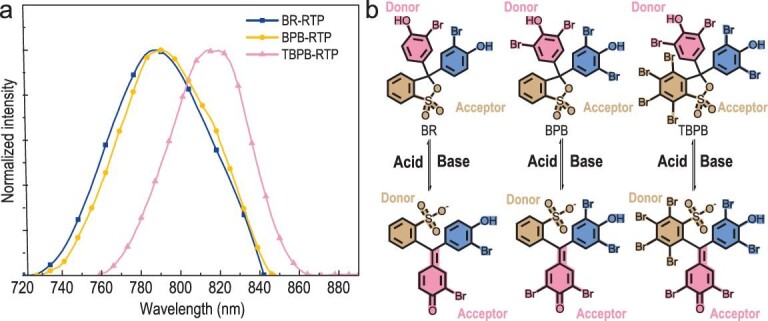
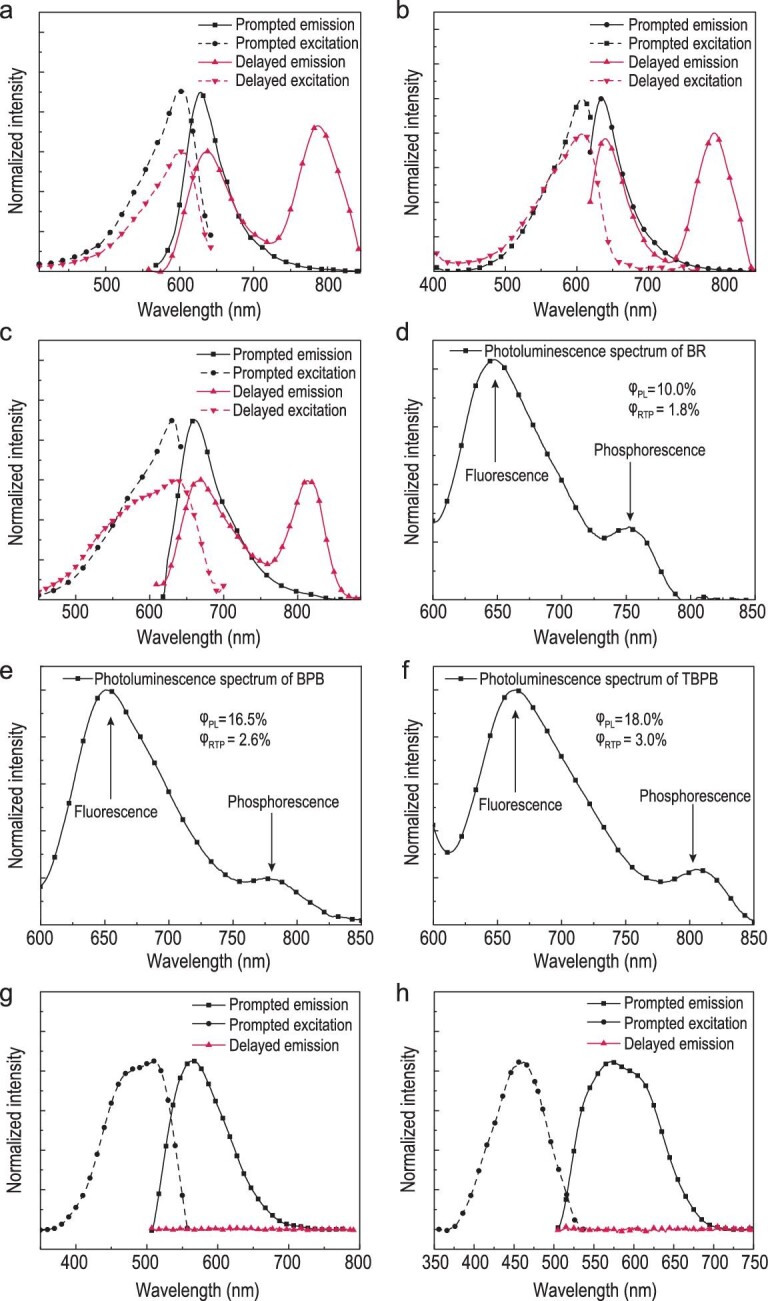
- TBPB@PVA-N showed the reddest NIR RTP emission and highest phosphorescence quantum yield reported here: λex = 634 nm, λp = 819 nm, ΦRTP = 3.0%, τP = 0.27 ms.
- BR@PVA-N and BPB@PVA-N emitted at λp = 789 nm (ΦRTP = 1.8%, τP = 0.72 ms) and λp = 793 nm (ΦRTP = 2.6%, τP = 0.58 ms), respectively; the paper’s reference metal-free NIR RTP material had λp = 770 nm and ΦRTP = 0.5%.
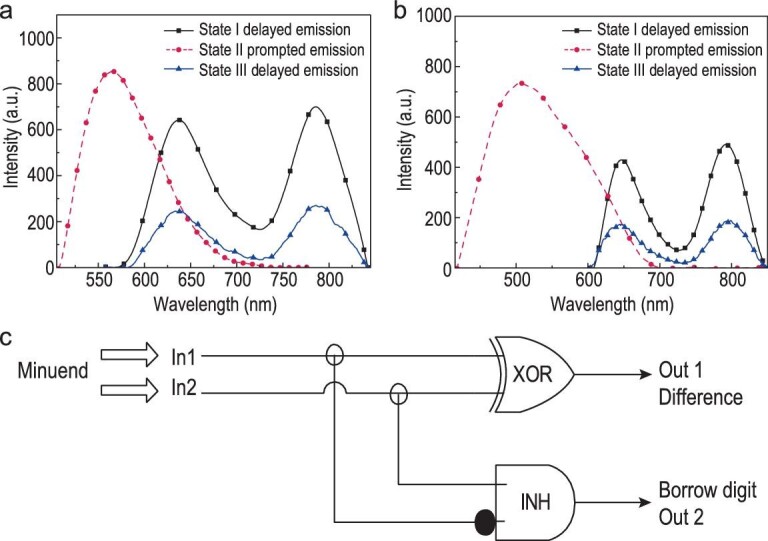
- RTP emission could be switched ON–OFF by alternating acid and base, and a half-subtractor logic operation was constructed with dual-channel response (visible light emission/NIR RTP emission).
- The total responsive speed of the logic operation was around 2–4 seconds per loop.
Methods
- Three brominated phenolsulfonephthaleine derivatives—bromophenol red (BR), bromophenol blue (BPB), and tetrabromophenol blue (TBPB)—were doped at 1 wt% into PVA films; neutral films (PSP@PVA-N) were open-ring, and acidic films (PSP@PVA-H) were closed-ring.
- Photophysical characterization included UV-Vis absorption, prompt fluorescence, delayed emission, excitation spectra, delayed-emission lifetimes, and absolute photoluminescence quantum yields.
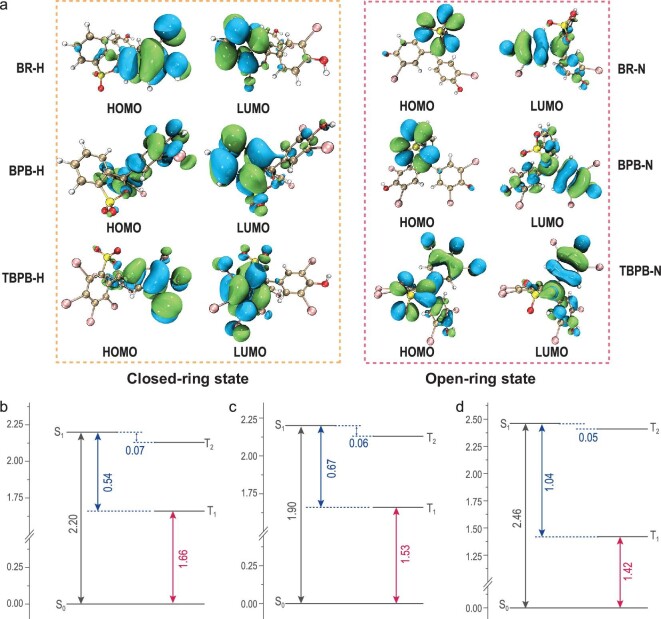
- DFT/TD-DFT calculations analyzed HOMO/LUMO orbitals, excited-state energy diagrams, and spin-orbit matrix elements for BR-N, BPB-N, and TBPB-N.
Limitations
- The paper states that constructing NIR emission is difficult because of the energy-gap law, and that the short triplet-state lifetime must be reconsidered because a long lifetime can quench NIR radiative emission.
- The paper notes that PVA with low alcoholysis degree can crosslink under alkaline conditions, and excessive base can sharply quench both visible and NIR emissions; regenerated RTP after acid–base cycling was reduced compared with the original state before vacuum drying.
- Evident from the text: the study is limited to three related dyes in a PVA matrix and to film-based photophysical/logic demonstrations, with no broader application testing reported.
Model-written summary. Check it against the paper before relying on it.
Integrity signals
Registry
Cites
Statistics
Figures
Verification
Claims the paper makes
3 Valid · 1 Not valid · 6 Not checked · 45 Own results and interpretations
The sources with a verdict support this claim; the rest weren’t checked yet, have no full text we could read, or their verdicts aren’t rated yet.
In the paper
“Compared with the traditional half-subtractor [44,45], no parallel logic gates are needed in this system to respond synchronously to achieve the effect of binary subtraction calculation.”
§ Red-light excited efficient metal-free near-infrared room-temperature phosphorescent films > RESULTS AND DISCUSSION
What the sources say
- Supportedcites [44] Andreasson J, Pischel U, Straight SD et al. All-photonic multifunctional molecular logic device. J Am Chem Soc 2011; 133: 11641– 8. 10.1021/ja203456h 21563823 PMC3144677 source
The Binary Arithmetic section states that a half-subtractor combines XOR and INH1 gates responding to the same inputs. The claim that the citing authors’ own system needs no parallel gates is their comparison, not a property attributed to this source. (LLM, conf=0.90)
- Not checked — no full text of the sourcecites [45] Langford SJ, Yann T. Molecular logic: a half-subtractor based on tetraphenylporphyrin. J Am Chem Soc 2003; 125: 14951. 10.1021/ja038843o 16220932 source
plain- Asserted: passes — The authors put it forward as true.
- Checkable: passes — It can be checked against evidence.
- Load-bearing: passes — The paper’s conclusions depend on it.
- Based: passes — The paper gives a reason why it holds.
- Supported
A result the paper reports from its own data — it cites no other source for it, so there is none to check. The quote shows it is in the paper.
In the paper
“Additionally, the open-ring (PSP@PVA-N)/closed-ring state (PSP@PVA-H) of PSP derivatives can be controlled in situ by adding acids and bases to the PVA matrix.”
§ Red-light excited efficient metal-free near-infrared room-temperature phosphorescent films > RESULTS AND DISCUSSION
plainstates a cause- Asserted: passes — The authors put it forward as true.
- Checkable: passes — It can be checked against evidence.
- Load-bearing: passes — The paper’s conclusions depend on it.
- Based: passes — The paper gives a reason why it holds.
A result the paper reports from its own data — it cites no other source for it, so there is none to check. The quote shows it is in the paper.
In the paper
“A logic operation with the half-subtractor function and the dual-channel response was developed (Fig. 4c).”
§ Red-light excited efficient metal-free near-infrared room-temperature phosphorescent films > RESULTS AND DISCUSSION
plain- Asserted: passes — The authors put it forward as true.
- Checkable: passes — It can be checked against evidence.
- Load-bearing: passes — The paper’s conclusions depend on it.
- Based: passes — The paper gives a reason why it holds.
A result the paper states — it cites no source for it, so there is none to check. The quote shows it is in the paper.
In the paper
“It was observed that the absorption spectra of open-ring and closed-ring PSP derivatives in the PVA matrix had significant changes (absorption peak and changes in shapes).”
§ Red-light excited efficient metal-free near-infrared room-temperature phosphorescent films > RESULTS AND DISCUSSION
plainstates an association- Asserted: passes — The authors put it forward as true.
- Checkable: passes — It can be checked against evidence.
- Load-bearing: unclear — It is unclear whether the paper’s conclusions depend on it.
- Based: passes — The paper gives a reason why it holds.
A result the paper states — it cites no source for it, so there is none to check. The quote shows it is in the paper.
In the paper
“Also, the calculated quantitative data of TD-DFT were in good agreement with the experimental data.”
§ Red-light excited efficient metal-free near-infrared room-temperature phosphorescent films > RESULTS AND DISCUSSION
plainstates an association- Asserted: passes — The authors put it forward as true.
- Checkable: passes — It can be checked against evidence.
- Load-bearing: unclear — It is unclear whether the paper’s conclusions depend on it.
- Based: passes — The paper gives a reason why it holds.
30 more claims
Create a free account to see all 55 claims and every source verdict.
- Probably not a substantial claim. 3
- It may state two separate claims as one. 18
- The quote only partly states this claim. 1
Self-check
Percentages, sums and reported differences re-computed from the paper’s own numbers.
Each contradiction between two passages listed here was confirmed by an independent check.
Rated minor: it would not touch a result — a value no result rests on, a p-value that stays on the same side of the significance level, or a conflict that is clerical, resolved elsewhere in the paper, or outside its own findings.
In the paper
§ Red-light excited efficient metal-free near-infrared room-temperature phosphorescent films > RESULTS AND DISCUSSION
“the PSP derivatives could be considered as compounds with an electron donor (D)–acceptor (A) structure, whether in the open-ring or closed-ring state.”
§ Red-light excited efficient metal-free near-infrared room-temperature phosphorescent films > RESULTS AND DISCUSSION
“the closed-ring state of PSP@PVA-H films without the D-A structure had no long-wavelength emission.”
Citations
Cites
Multiwfn: A multifunctional wavefunction analyzer
Lu, T., & Chen, F. (2012) · Journal of Computational Chemistry · doi:10.1002/jcc.22885 · Cited by 45,371
Application of the energy gap law to nonradiative, excited-state decay
Caspar, J. V., & Meyer, T. J. (1983) · The Journal of Physical Chemistry · doi:10.1021/j100229a010 · Cited by 1,004
Ma, X., Wang, J., & Tian, H. (2019) · Accounts of Chemical Research · doi:10.1021/acs.accounts.8b00620 · Cited by 762 · cited 1×
“A review of the literature provides recent reports on construction of metal-free RTP systems in the crystalline state [17–20], solution state [21,22] and amorphous state [23,24], among others [7,10,25–28].”
BackgroundSelf-citationLi, D., Lu, F., Wang, J., Hu, W., Cao, X.-M., Ma, X., & Tian, H. (2018) · Journal of the American Chemical Society · doi:10.1021/jacs.7b12800 · Cited by 646 · cited 1×
“A review of the literature provides recent reports on construction of metal-free RTP systems in the crystalline state [17–20], solution state [21,22] and amorphous state [23,24], among others [7,10,25–28].”
BackgroundSelf-citationMa, H., Peng, Q., An, Z., Huang, W., & Shuai, Z. (2019) · Journal of the American Chemical Society · doi:10.1021/jacs.8b11224 · Cited by 613 · cited 1×
“This is because a rigid external environment may effectively inhibit the non-radiative relaxation at its triplet excited state [14], and the environment’s oxygen barrier efficiency/ability may also inhibit the triplet-triplet energy transfer process between the phosphors and the triplet oxygen to reduce the non-radiat…”
BackgroundThe energy gap law for triplet states in Pt-containing conjugated polymers and monomers
Wilson, J. S., Chawdhury, N., Al-Mandhary, M. R. A., Younus, M., Khan, M. S., Raithby, P. R., Köhler, A., & Friend, R. H. (2001) · Journal of the American Chemical Society · doi:10.1021/ja010986s · Cited by 553
Wide‐Range Color‐Tunable Organic Phosphorescence Materials for Printable and Writable Security Inks
Lei, Y., Dai, W., Guan, J., Guo, S., Ren, F., Zhou, Y., Shi, J., Tong, B., Cai, Z., Zheng, J., et al. (2020) · Angewandte Chemie International Edition · doi:10.1002/anie.202003585 · Cited by 541
Ma, X., Xu, C., Wang, J., & Tian, H. (2018) · Angewandte Chemie International Edition · doi:10.1002/anie.201803947 · Cited by 496 · cited 1×
“A review of the literature provides recent reports on construction of metal-free RTP systems in the crystalline state [17–20], solution state [21,22] and amorphous state [23,24], among others [7,10,25–28].”
BackgroundSelf-citationColor-tunable ultralong organic room temperature phosphorescence from a multicomponent copolymer
Gu, L., Wu, H., Ma, H., Ye, W., Jia, W., Wang, H., Chen, H., Zhang, N., Wang, D., Qian, C., et al. (2020) · Nature Communications · doi:10.1038/s41467-020-14792-1 · Cited by 471
Wang, J., Huang, Z., Ma, X., & Tian, H. (2020) · Angewandte Chemie International Edition · doi:10.1002/anie.201914513 · Cited by 463
Self-citation
Research works printed but not linked: 1
- Wu H, Gu L, Baryshnikov GV et al. Molecular phosphorescence in polymer matrix with reversible sensitivity. ACS Appl Mater Interfaces 2020; 12: 20765– 74. 10.1021/acsami.0c04859 32272835 · DOI · Paper page
Cited by
Phosphorescence resonance energy transfer from purely organic supramolecular assembly
Dai, X.-Y., Huo, M., & Liu, Y. (2023) · Nature Reviews Chemistry · doi:10.1038/s41570-023-00555-1 · Cited by 267
“However, achieving high quantum yields and a tunable afterglow emission, especially in the red or near-infrared (NIR) region under ambient conditions 37–40 , still remains an important challenge in organic phosphors owing to limits imposed by the energy-gap law 41 .”
BackgroundZhu, T., Yang, T., Zhang, Q., & Yuan, W. Z. (2022) · Nature Communications · doi:10.1038/s41467-022-30368-7 · Cited by 235
Recent Advances of Pure Organic Room Temperature Phosphorescence Based on Functional Polymers
Ding, B., Ma, X., & Tian, H. (2023) · Accounts of Materials Research · doi:10.1021/accountsmr.3c00090 · Cited by 228
Self-citationSong, J., Ma, L., Sun, S., Tian, H., & Ma, X. (2022) · Angewandte Chemie International Edition · doi:10.1002/anie.202206157 · Cited by 167
Self-citationAchieving purely organic room temperature phosphorescence in aqueous solution
Sun, H., & Zhu, L. (2023) · Aggregate · doi:10.1002/agt2.253 · Cited by 166
Photoswitchable diarylethenes: From molecular structures to biological applications
Li, Z., Zeng, X., Gao, C., Song, J., He, F., Tian, H., Guo, H., & Yin, J. (2023) · Coordination Chemistry Reviews · doi:10.1016/j.ccr.2023.215451 · Cited by 166
Self-citationA Universal Strategy for Tunable Persistent Luminescent Materials via Radiative Energy Transfer
Ma, L., Xu, Q., Sun, S., Ding, B., Huang, Z., Ma, X., & Tian, H. (2021) · Angewandte Chemie International Edition · doi:10.1002/anie.202115748 · Cited by 146
Self-citationAn elastic organic crystal with multilevel stimuli-responsive room temperature phosphorescence
Song, J., Zhou, Y., Pan, Z., Hu, Y., He, Z., Tian, H., & Ma, X. (2023) · Matter · doi:10.1016/j.matt.2023.04.006 · Cited by 131
Self-citationHighly efficient circularly polarized near-infrared phosphorescence in both solution and aggregate
Liu, D., Wang, W., Alam, P., Yang, Z. Y., Wu, K., Zhu, L., Xiong, Y., Chang, S., Liu, Y., Wu, B., et al. (2024) · Nature Photonics · doi:10.1038/s41566-024-01538-4 · Cited by 179
Ma, L., & Ma, X. (2022) · Science China Chemistry · doi:10.1007/s11426-022-1400-6 · Cited by 132
Self-citationZhou, L., Song, J., He, Z., et al. (2024) · Angewandte Chemie International Edition · doi:10.1002/anie.202403773 · Cited by 131
Self-citationA Universal Strategy for Organic Fluid Phosphorescence Materials**
Sun, S., Wang, J., Ma, L., Ma, X., & Tian, H. (2021) · Angewandte Chemie International Edition · doi:10.1002/anie.202107323 · Cited by 125
Self-citationHighly Efficient TADF‐Type Organic Afterglow of Long Emission Wavelengths
Pan, Y., Li, J., Wang, X., Sun, Y., Li, J., Wang, B., & Zhang, K. (2021) · Advanced Functional Materials · doi:10.1002/adfm.202110207 · Cited by 103
Miao, Y., Lin, F., Guo, D., Chen, J., Zhang, K., Wu, T., Huang, H., Chi, Z., & Yang, Z. (2024) · Science Advances · doi:10.1126/sciadv.adk3354 · Cited by 109
“Correspondingly, their RTP performance, e.g., phosphorescent lifetime, tunable emission color, and quantum yield, has been obviously improved ( 16 – 19 ).”
Sunlight‐Activated Hour‐Long Afterglow from Transparent and Flexible Polymers
Zhou, Y., Zhang, P., Liu, Z., Yan, W., Gao, H., Liang, G., & Qin, W. (2024) · Advanced Materials · doi:10.1002/adma.202312439 · Cited by 108
Liu, Z., Tian, Y., Yang, J., Li, A., Wang, Y., Ren, J., Fang, M., Tang, B. Z., & Li, Z. (2022) · Light Science & Applications · doi:10.1038/s41377-022-00826-4 · Cited by 100
Photoinduced Radical Emission in a Coassembly System
Li, Y., Baryshnikov, G., Xu, C., et al. (2021) · Angewandte Chemie International Edition · doi:10.1002/anie.202110405 · Cited by 87
Stimuli‐Responsive Polymers with Room‐Temperature Phosphorescence
Gu, F., & Ma, X. (2022) · Chemistry - A European Journal · doi:10.1002/chem.202104131 · Cited by 89
Self-citationGu, J., Yuan, W., Chang, K., Zhong, C. M., Yuan, Y., Li, J., Zhang, Y., Deng, T., Fan, Y., Yuan, L., et al. (2024) · Angewandte Chemie International Edition · doi:10.1002/anie.202415637 · Cited by 96
Tang, S., Jiang, S., Wang, K., et al. (2025) · Advanced Materials · doi:10.1002/adma.202416397 · Cited by 81
Li, Y., Wu, Z., Huang, Z., Yin, C., Tian, H., & Ma, X. (2024) · National Science Review · doi:10.1093/nsr/nwae383 · Cited by 90
“The local viscosity of lysosomes has been reported to increase following treatment with ionophores such as dexamethasone and nystatin [41 –43 ].”
Self-citationHe, M., Ding, C., Guo, H., & Li, Q. (2024) · Responsive Materials · doi:10.1002/rpm.20240014 · Cited by 71
Chen, K., Xiong, Y., Wang, D., Pan, Y., Zhao, Z., Wang, D., & Tang, B. Z. (2023) · Advanced Functional Materials · doi:10.1002/adfm.202312883 · Cited by 77
Deng, Z., Zhang, J., Zhou, J., Shen, W., Zuo, Y., Wang, J., Yang, S., Liu, J., Chen, Y., Chen, C., et al. (2024) · Advanced Materials · doi:10.1002/adma.202311384 · Cited by 74
Self-citationStanitska, M., Volyniuk, D. Y., Minaev, B. F., Ågren, H., & Gražulevičius, J. V. (2024) · Journal of Materials Chemistry C · doi:10.1039/d3tc04514e · Cited by 69
Photoactivated room temperature phosphorescence from lignin
Zhou, J., Tian, B., Zhai, Y., Wang, M., Liu, S., Li, J., Li, S., James, T. D., & Chen, Z. (2024) · Nature Communications · doi:10.1038/s41467-024-51545-w · Cited by 78
Halide-containing organic persistent luminescent materials for environmental sensing applications
Li, F., Wang, M., Liu, S., & Zhao, Q. (2022) · Chemical Science · doi:10.1039/d1sc06586f · Cited by 58
Zhou, Y., Jin, L., Chen, J., Hong, W., Liang, G., & Qin, W. (2023) · Chemical Engineering Journal · doi:10.1016/j.cej.2023.142506 · Cited by 54
Ma, L., Liu, Y., Tian, H., & Ma, X. (2023) · JACS Au · doi:10.1021/jacsau.3c00268 · Cited by 56
“For example, the emission wavelength of organic RTP material was up to 819 nm (28).”
BackgroundSelf-citationHuo, M., Dai, X., & Liu, Y. (2022) · Advanced Science · doi:10.1002/advs.202201523 · Cited by 49
External Heavy-Atom Activated Phosphorescence of Organic Luminophores in a Rigid Fluid Matrix
Yan, Z., & Ma, X. (2022) · ACS Materials Letters · doi:10.1021/acsmaterialslett.2c01020 · Cited by 49
Self-citationThermal annealing promoted room temperature phosphorescence: motion models and internal mechanism
Gao, Y., Lu, J., Liao, Q., et al. (2023) · National Science Review · doi:10.1093/nsr/nwad239 · Cited by 48
Liu, S., Lin, Y., & Yan, D. (2023) · Science China Chemistry · doi:10.1007/s11426-023-1656-y · Cited by 48
A 3D Phosphorescent Supramolecular Organic Framework in Aqueous Solution
Yin, C., Yan, Z., Yan, R., Xu, C., Ding, B., Ji, Y., & Ma, X. (2024) · Advanced Functional Materials · doi:10.1002/adfm.202316008 · Cited by 44
Self-citationLi, S.-H., Gu, J., Wang, J., Yuan, W., Ye, G., Yuan, L., Liao, Q., Wang, L., Li, Z., & Li, Q. (2024) · Advanced Science · doi:10.1002/advs.202402846 · Cited by 47
Self-citationWang, C., Liu, Y., Liu, Y., et al. (2022) · Small · doi:10.1002/smll.202201821 · Cited by 45
Feng, R., Wang, M., Zhang, Z., Hu, P., Wu, Z., Shi, G., Xu, B., Liu, H. S., & Ma, L. (2023) · ACS Applied Materials & Interfaces · doi:10.1021/acsami.3c03207 · Cited by 44
Self-citationChen, K., Wang, Y., Chu, B., et al. (2022) · Journal of Materials Chemistry C · doi:10.1039/d2tc03754h · Cited by 41
Visible-light-excited organic room temperature phosphorescence
Li, L., Liu, D., Zhou, J., Qi, M., Yin, G., & Chen, T. (2024) · Materials Horizons · doi:10.1039/d4mh00873a · Cited by 43
Hou, H., Wang, H., He, M., Li, Q., Wang, X., Guo, F., Chen, Q., Qu, L., & Yang, C. (2024) · Angewandte Chemie International Edition · doi:10.1002/anie.202411323 · Cited by 44
Zhang, Z., Wang, Q., Zhang, X., et al. (2024) · JACS Au · doi:10.1021/jacsau.4c00187 · Cited by 39
Self-citationLin, X., Xu, Q., & Ma, X. (2021) · Advanced Optical Materials · doi:10.1002/adom.202101646 · Cited by 39
Self-citationXu, Q., Ma, L., Lin, X., Wang, Q., & Ma, X. (2022) · Chinese Chemical Letters · doi:10.1016/j.cclet.2021.12.097 · Cited by 34
Self-citationA functional unit combination strategy for enhancing red room-temperature phosphorescence
Zhao, S., Yang, Z., Zhang, X., Liu, H., Lv, Y., Wang, S., Yang, Z., Zhang, S., & Yang, B. (2023) · Chemical Science · doi:10.1039/d3sc03668e · Cited by 37
Zhou, J., Liu, D., Li, L., Qi, M., Yin, G., & Chen, T. (2024) · Chinese Chemical Letters · doi:10.1016/j.cclet.2024.109929 · Cited by 40
Producing a Room Temperature Phosphorescent Film from Natural Wood Using a Top‐Down Approach
Liu, R., Guo, H., Cao, M., Dang, B., Zhai, Y., Liu, S., Li, S., Li, J., James, T. D., & Chen, Z. (2023) · Advanced Functional Materials · doi:10.1002/adfm.202312254 · Cited by 37
Guo, D., Wang, Y., Chen, J., Cao, Y., Miao, Y., Huang, H., Chi, Z., & Yang, Z. (2022) · Chinese Chemical Letters · doi:10.1016/j.cclet.2022.107882 · Cited by 32
Tunable Nano-Supramolecules Based on Cucurbiturils for Near-Infrared Phosphorescence Imaging
Yu, J., Yu, H., Niu, J., Lei, Z., & Liu, Y. (2024) · Nano Letters · doi:10.1021/acs.nanolett.4c04920 · Cited by 33
Liang, Z., Wei, M., Zhang, S., Huang, W., Shi, N., Lv, A., Ma, H., & He, Z. (2023) · ACS Applied Materials & Interfaces · doi:10.1021/acsami.3c06621 · Cited by 35
Cao, Y., Zhang, K., Wang, H., Jiang, S., Lin, F., Guo, D., Li, Y., Huang, H., Yang, Z., & Chi, Z. (2023) · Chemical Engineering Journal · doi:10.1016/j.cej.2023.146781 · Cited by 32
Regulation Strategies of Dynamic Organic Room-Temperature Phosphorescence Materials
Jiang, P., Liu, Y., Ding, B., & Ma, X. (2024) · Chem & Bio Engineering · doi:10.1021/cbe.3c00095 · Cited by 29
Self-citationLiu, Z., Li, D., Tong, L., Meng, Y., Fang, M., Yang, J., Tang, B. Z., & Li, Z. (2023) · Advanced Optical Materials · doi:10.1002/adom.202203069 · Cited by 29
Ding, B., & Ma, X. (2021) · Langmuir · doi:10.1021/acs.langmuir.1c02612 · Cited by 23
Self-citationYan, X., Wang, L., Zhong, W., et al. (2024) · Nano Research · doi:10.26599/nr.2025.94907172 · Cited by 23
Bright Free‐Radical Emission in Ionic Liquids
Zheng, W., Li, X., Baryshnikov, G., et al. (2023) · Angewandte Chemie International Edition · doi:10.1002/anie.202305925 · Cited by 22
Jin, K., Ji, X., Zhang, J., Mi, Q., Wu, J. L., & Zhang, J. (2022) · Materials Today Chemistry · doi:10.1016/j.mtchem.2022.101179 · Cited by 23
Li, J., Wei, K., Wu, J., et al. (2024) · Chemical Science · doi:10.1039/d4sc00161c · Cited by 20
Triboluminescence and Selective Hydrogen-Bond Responsiveness of Thiochromanone Derivative
Ma, L., Ding, B., Yuan, Z., et al. (2021) · ACS Materials Letters · doi:10.1021/acsmaterialslett.1c00339 · Cited by 18
Self-citationA Universal Strategy for Organic Fluid Phosphorescence Materials**
Sun, S., Wang, J., Ma, L., Ma, X., & Tian, H. (2021) · Angewandte Chemie · doi:10.1002/ange.202107323 · Cited by 19
Self-citationLi, Y., Huang, Z., Shao, A., Wu, Z., He, Z., Tian, H., & Ma, X. (2025) · Chemical Science · doi:10.1039/d4sc08330j · Cited by 19
Self-citationXu, Q., Ma, L., Sun, S., & Ma, X. (2021) · Journal of Materials Chemistry C · doi:10.1039/d1tc04056a · Cited by 17
Self-citationSupramolecular nanotherapeutics based on cucurbiturils
Muheyati, M., Wu, G., Li, Y., Pan, Z., & Chen, Y. (2024) · Journal of Nanobiotechnology · doi:10.1186/s12951-024-03024-z · Cited by 19
Li, J., Wen, X., Li, J., Wang, G., Wang, X., Mo, Z., Chen, X., & Zhang, K. (2023) · Advanced Optical Materials · doi:10.1002/adom.202302311 · Cited by 20
Full-color programmable high temperature afterglow polymers based on single-molecule emitters
Xu, Z., Huang, Y., Sun, S., Ma, L., Ding, B., Tian, H., & Ma, X. (2025) · Nature Communications · doi:10.1038/s41467-025-64677-4 · Cited by 39
Self-citationSong, J., Ma, L., Sun, S., Tian, H., & Ma, X. (2022) · Angewandte Chemie · doi:10.1002/ange.202206157 · Cited by 19
Self-citationConstructing matrix-free solid-state carbon dots with efficient room-temperature phosphorescence
He, P., Zhu, Y., Bai, J., Qin, F., Wang, X., Wu, S., Yu, X., & Ren, L. (2022) · Journal of Luminescence · doi:10.1016/j.jlumin.2022.119454 · Cited by 14
Programmable Ultralong Phosphorescent Ionogels for Intelligent Monitoring
Xu, Z., Huang, Y., Sun, S., et al. (2025) · Angewandte Chemie International Edition · doi:10.1002/anie.202518340 · Cited by 14
Self-citationPhoto‐Controllable Ultralong Room‐Temperature Phosphorescence: State of the Art
Nie, F., & Yan, D. (2023) · Chemistry - A European Journal · doi:10.1002/chem.202303611 · Cited by 14
Zhou, L., Song, J., He, Z., et al. (2024) · Angewandte Chemie · doi:10.1002/ange.202403773 · Cited by 13
Self-citationShi, J., Zhou, Y., Lin, F., Li, G., Yan, W., Liang, G., Tang, B. Z., & Qin, W. (2025) · Advanced Materials · doi:10.1002/adma.202412325 · Cited by 17
Ultraflexible Organic Room-Temperature Phosphorescent Crystals
Cao, J., Song, J., Hu, Y., Zhang, F., Tian, H., & Ma, X. (2025) · ACS Materials Letters · doi:10.1021/acsmaterialslett.5c01042 · Cited by 16
Self-citationA Universal Strategy for Tunable Persistent Luminescent Materials via Radiative Energy Transfer
Ma, L., Xu, Q., Sun, S., Ding, B., Huang, Z., Ma, X., & Tian, H. (2021) · Angewandte Chemie · doi:10.1002/ange.202115748 · Cited by 14
Self-citationMa, J., Zhang, X., Zhang, T., Yu, M., Bai, J., Lin, H., Bu, L., Chen, M., Ma, Z., & Ma, Z. (2025) · ACS Applied Materials & Interfaces · doi:10.1021/acsami.5c08470 · Cited by 11
Hou, H., Wang, H., He, M., Li, Q., Wang, X., Guo, F., Chen, Q., Qu, L., & Yang, C. (2024) · Angewandte Chemie · doi:10.1002/ange.202411323 · Cited by 17
Gu, J., Yuan, W., Chang, K., Zhong, C. M., Yuan, Y., Li, J., Zhang, Y., Deng, T., Fan, Y., Yuan, L., et al. (2024) · Angewandte Chemie · doi:10.1002/ange.202415637 · Cited by 17
Photoinduced Radical Emission in a Coassembly System
Li, Y., Baryshnikov, G., Xu, C., et al. (2021) · Angewandte Chemie · doi:10.1002/ange.202110405 · Cited by 10
Local Constraints on Junctions to Strengthen Near-Infrared Phosphorescence of Organic Dyes
Sun, S., Fan, Y., Ma, L., et al. (2021) · The Journal of Physical Chemistry Letters · doi:10.1021/acs.jpclett.1c03396 · Cited by 9
Self-citationMultichannel afterglow regulated by protonation-induced reversed intersystem crossing
Yan, R., Ding, B., Li, T., Yin, C., & Ma, X. (2025) · Chemical Communications · doi:10.1039/d5cc01443c · Cited by 13
Self-citationRegulation of various photo-active UOPs in a polymer matrix by tuning intermolecular charge transfer
Sun, H., Wei, X., He, Y., Xiao, Y., Wu, Y., Xie, Z., & Yu, T. (2023) · Materials Chemistry Frontiers · doi:10.1039/d3qm00214d · Cited by 8
An activatable near-infrared fluorescent probe for tracking nitroxyl in vitro and in vivo
Zhou, Z., Xia, X., Li, Z., Zhou, T., Wang, E., Ma, C., Lu, C., Nie, J., Yang, G., Wang, J., et al. (2022) · Dyes and Pigments · doi:10.1016/j.dyepig.2022.110945 · Cited by 7
Self-citationDu, R., Wang, Z., Zhao, Z., Liu, H., Jiao, S., Wu, Y., Li, W., Yuan, H., Ou, H., & Ding, D. (2025) · Materials Chemistry Frontiers · doi:10.1039/d5qm00369e · Cited by 10
Zhang, Q., Yin, Z., Zhu, T., Dong, W., & Yuan, W. Z. (2025) · Dyes and Pigments · doi:10.1016/j.dyepig.2025.112904 · Cited by 7
Rigid Graphene Nanoribbons Enable Efficient Near-Infrared Room-Temperature Phosphorescence Emission
Zhang, Y., Chen, K., Jiang, W., Xiong, C., Zhao, Y., Yan, W., Li, G., Zhang, K., Cao, Y., Wang, H., et al. (2026) · ACS Nano · doi:10.1021/acsnano.5c20919 · Cited by 7
Chen, Z., Qing-qing, X., Zhu, Y., Yu, J., Wang, L., Wang, X., & Wu, M. (2024) · Polymer Chemistry · doi:10.1039/d3py00977g · Cited by 7
Hua, X., Jing, Y., & Ni, Y. (2024) · Applied Materials Today · doi:10.1016/j.apmt.2024.102309 · Cited by 6
Near-infrared TADF-type organic afterglow materials
Ye, Z., Li, J., Li, X., Wang, G., & Zhang, K. (2024) · Organic Electronics · doi:10.1016/j.orgel.2024.107128 · Cited by 7
Ding, S., Xu, Y., Li, J., Wang, X., Wang, G., Li, H., Ren, S., & Zhang, K. (2022) · Dyes and Pigments · doi:10.1016/j.dyepig.2022.110984 · Cited by 6
Kawaguchi, K., Ito, M., & Kubo, Y. (2023) · Chemical Communications · doi:10.1039/d2cc07049a · Cited by 6
Near-Infrared Emission in Organic Cocrystals Based on Twisted-Component Pseudoencapsulation
Li, T., Liu, B., Liu, J., Sule, N. A., Ou, J. T., Huang, J. Y., Ou, C., Jia, J., & Feng, Y. (2025) · ACS Materials Letters · doi:10.1021/acsmaterialslett.5c00275 · Cited by 7
Zhou, X., Xu, T., Du, W., Liang, Y., Gong, S., Meng, Z., Xu, X., Wang, S., & Wang, Z. (2024) · Journal of Molecular Structure · doi:10.1016/j.molstruc.2024.139412 · Cited by 6
A near-infrared absorbing ring-fused quinoid-bisboron pyrrole dye with double BF2 chelation
Liang, Y., Zhang, D., Wang, J., Lv, M., Yan, F., Xu, Z., Du, J., & Jiang, X. (2022) · Dyes and Pigments · doi:10.1016/j.dyepig.2022.110613 · Cited by 4
Self-citationConstruction of diene-extended meso-CF3-BODIPY for spectroscopic study and photothermal exploration
Chen, Y., Wang, Z., Zhang, D., Gong, X., Du, J., Jiang, X., & Wang, G. (2023) · Dyes and Pigments · doi:10.1016/j.dyepig.2023.111500 · Cited by 6
Stimulus-responsive organic room temperature phosphorescence materials
Xu, J., Du, W., Zhong, X., et al. (2026) · Science China Materials · doi:10.1007/s40843-025-3932-1 · Cited by 4
“[61] developed a series of RTP films with relatively high quantum yield ( Φ RTP = 1.8%–3.0%, τ P = 0.27–0.72 ms) in the NIR band ( λ p = 789–819 nm) by using PVA and brominated phenolsulfonephthalein dyes as the host and guest, respectively ( 40 – 45 ).”
InfluentialLi, C., Huang, Z., Li, T., et al. (2026) · Chemical Science · doi:10.1039/d6sc02475k · Cited by 4
Self-citationWater-Dispersible Glassy Organic Dots Exhibiting Near-Infrared Delayed Emission for Bioimaging
Masvikeni, T. R., Primrose, W. L., Mikulin, S., & Hudson, Z. M. (2025) · ACS Applied Nano Materials · doi:10.1021/acsanm.5c01049 · Cited by 4
Wang, H., Li, Y., Shao, M.-C., et al. (2024) · Chemical Engineering Journal · doi:10.1016/j.cej.2024.158772 · Cited by 4
Zhou, C., Huang, G., Liang, Y., Xu, B., Islam, A., Chen, S., Ni, S., Dang, L., & Li, M. (2023) · The Journal of Physical Chemistry C · doi:10.1021/acs.jpcc.3c02882 · Cited by 4
Zheng, H., Lin, F., Chen, L., et al. (2023) · Laser & Photonics Review · doi:10.1002/lpor.202300301 · Cited by 4
Zhou, J., Shi, J., Mao, L., Wang, Y., Luo, W., Qi, M., Li, L., Wang, M., Yin, G., & Chen, T. (2025) · Advanced Optical Materials · doi:10.1002/adom.202501684 · Cited by 3
Song, X., Zhai, X., Zeng, Y., Wang, G., Wang, T., Li, Y., Yan, Q., Chan, C., Wang, B., & Zhang, K. (2024) · ChemPhysChem · doi:10.1002/cphc.202400522 · Cited by 2
Metadata
- Authors
- Sun, S., Ma, L., Wang, J., Ma, X., & Tian, H.
- Affiliations
- East China University of Science and Technology (CN)
- Corresponding author
- Ma, Xiang
- Venue
- National Science Review
- Publisher
- Oxford University Press (OUP)
- Published
- 2021-05-11
- Volume
- 9
- Issue
- 2
- Pages
- nwab085-nwab085
- ISSN
- 2053-714X (ISSN-L)
- 2095-5138
- PMC
- PMC8866102
- OpenAlex
- W3163480234
- Cited by
- 108
- References
- 45
- Citations by year
- 2026: 8 · 2025: 14 · 2024: 30 · 2023: 24 · 2022: 17 · 2021: 15
- FWCI
- 6.53
- Type
- journal article
- Language
- en
- Open access
- gold
- doi.org
- Licence
- Locations
- National Science Review (publishedVersion, cc-by)
- PubMed Central (publishedVersion, cc-by)
- PubMed (publishedVersion)
- Funders
- National Natural Science Foundation of China (21788102, 22125803, 22020102006, 21871083, 21722603)
- Shanghai Municipal Science and Technology Commission (2018SHZDZX03)
- Program of Shanghai Academic/Technology Research Leader (20XD1421300)
- Shanghai Education Development Foundation (19SG26)
- Shanghai Municipal Education Commission (2017-01-07-00-02-E00010)
- Topics
- Physical Sciences › Materials Science › Materials Chemistry › Luminescence and Fluorescent Materials
- Physical Sciences › Chemistry › Spectroscopy › Molecular Sensors and Ion Detection
- Physical Sciences › Materials Science › Materials Chemistry › Luminescence Properties of Advanced Materials
- Keywords
- room-temperature phosphorescence, metal-free phosphors, near-infrared emission, red light excitation, logic gates, half subtractor, phosphorescence quantum yield
About these checks
Registry, retraction, Cites and statistics results are computed, not judged, with one exception: a printed reference that no index lists is read once by a model before it counts as a citation error. Claims are extracted by a model and kept only when their quote appears verbatim in the text; each cited source is then checked, with a model’s help, for whether it says what the claim relies on. Those verdicts can be wrong — read the claim’s quote and the cited source before relying on one.
The claim verdicts this report counts are experimental: their accuracy is not yet measured.
A language model drew the claims from the paper on 2026-10-10, under version 3 of the claim definition (model deepseek-v4.1-flash, prompt extract-v3).
A second model labelled each claim on 2026-10-10 (model jev-1.13-20260917, definition revision gold-guideline-v0.2).
Cited sources are checked with a language model’s help (gpt-6-sol).
Statistics and arithmetic are recomputed, not judged.
Confidence bands are shown only for fields calibrated on our annotated test set. None is calibrated yet, so no band is shown.
What counts as a claim ›How we measure confidence ›How we check this ›
Are you an author, or do you see a problem with this page? Request a review
Data sources
Bibliographic data: Semantic Scholar, OpenAlex, Crossref.
Contains information from the Semantic Scholar Academic Graph Datasets, made available under the ODC Attribution License (ODC-BY 1.0).
Semantic Scholar’s data is described in: Kinney, R., et al. (2023). The Semantic Scholar Open Data Platform. arXiv:2301.10140.
