

The DOI matches its Crossref record; 159 of the 159 references it cites were found in a registry or an index.
Advances and prospects in biomimetic multilayered scaffolds for articular cartilage regeneration
Open accessAbstract
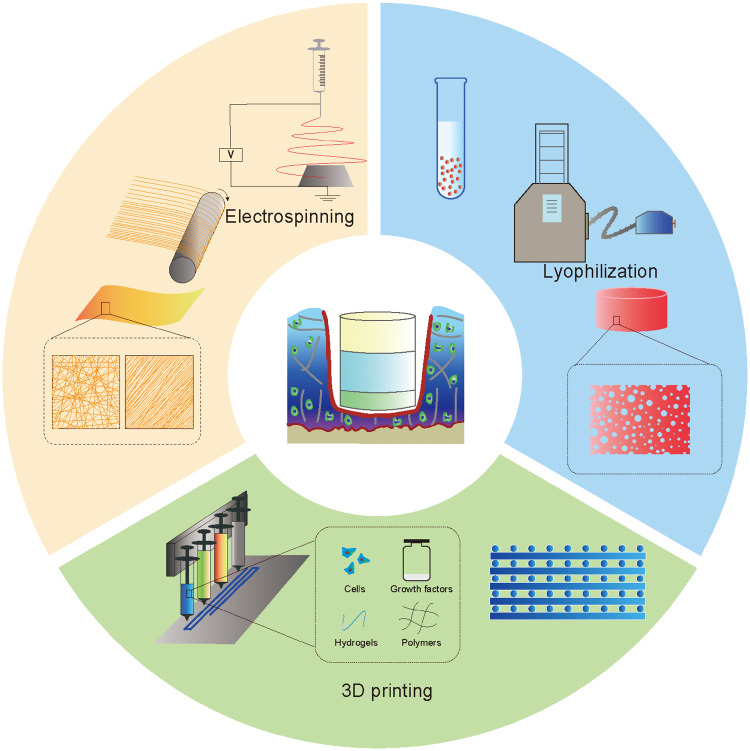
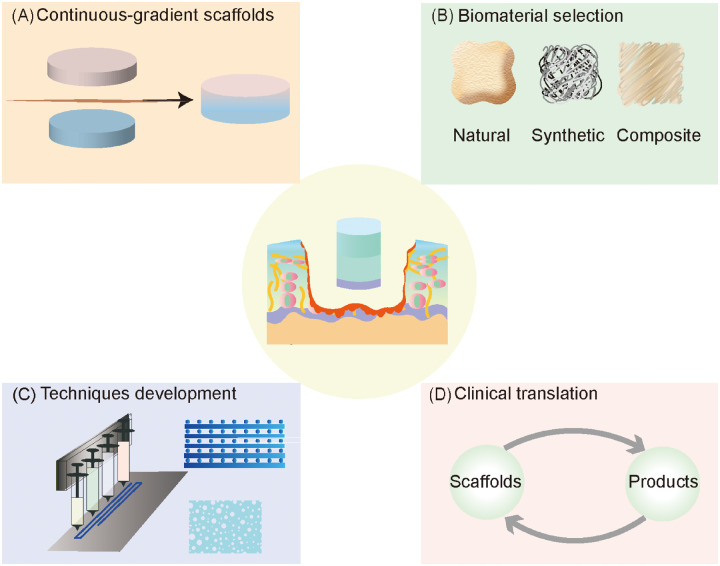
Due to the sophisticated hierarchical structure and limited reparability of articular cartilage (AC), the ideal regeneration of AC defects has been a major challenge in the field of regenerative medicine. As defects progress, they often extend from the cartilage layer to the subchondral bone and ultimately lead to osteoarthritis. Tissue engineering techniques bring new hope for AC regeneration. To meet the regenerative requirements of the heterogeneous and layered structure of native AC tissue, a substantial number of multilayered biomimetic scaffolds have been studied. Ideal multilayered scaffolds should generate zone-specific functional tissue similar to native AC tissue. This review focuses on the current status of multilayered scaffolds developed for AC defect repair, including design strategies based on the degree of defect severity and the zone-specific characteristics of AC tissue, the selection and composition of biomaterials, and techniques for design and manufacturing. The challenges and future perspectives of biomimetic multilayered scaffold strategies for AC regeneration are also discussed.
Overview
The claims and statistics of this paper haven’t been checked yet.
Run the check — free, no account needed. It reads the open-access text and checks the sources it cites.
Integrity signals
Registry
Cites
Statistics
Figures
Verification
Claims the paper makes
The claims and statistics of this paper haven’t been checked yet.
Run the check — free, no account needed. It reads the open-access text and checks the sources it cites.
Claims other papers make about this one
Each is checked against this paper’s own text: does it say what the citing paper says it does?
The cited source says what the claim attributes to it.
In the citing paper
“Biomimetic scaffolds have demonstrated cartilage-regenerating properties, acting as a structural support matrix that enhances cell proliferation and tissue repair [105].”
Self-check
Percentages, sums and reported differences re-computed from the paper’s own numbers.
The self-check needs the paper’s full text.
Citations
Cites
Osteoarthritis: A disease of the joint as an organ
Loeser, R. F., Goldring, S. R., Scanzello, C. R., & Goldring, M. B. (2012) · Arthritis & Rheumatism · doi:10.1002/art.34453 · Cited by 3,255
Biology of Bone Tissue: Structure, Function, and Factors That Influence Bone Cells
Florencio-Silva, R., Sasso, G. R. D. S., Sasso-Cerri, E., Simões, M. J., & Cerri, P. S. (2015) · BioMed Research International · doi:10.1155/2015/421746 · Cited by 2,044
Synthesis of polycaprolactone: A review
Labet, M., & Thielemans, W. (2009) · Chemical Society Reviews · doi:10.1039/b820162p · Cited by 1,673
Silk fibroin biomaterials for tissue regenerations
Kundu, B., Rajkhowa, R., Kundu, S. C., & Wang, X. (2013) · Advanced Drug Delivery Reviews · doi:10.1016/j.addr.2012.09.043 · Cited by 1,391
Organ printing: computer-aided jet-based 3D tissue engineering
Mironov, V., Boland, T., Trusk, T., Forgacs, G., & Markwald, R. R. (2003) · Trends in Biotechnology · doi:10.1016/s0167-7799(03)00033-7 · Cited by 1,276
Repair and tissue engineering techniques for articular cartilage
Makris, E. A., Gomoll, A. H., Malizos, K. N., Hu, J. C., & Athanasiou, K. A. (2015) · Nature Reviews Rheumatology · doi:10.1038/nrrheum.2014.157 · Cited by 1,245
Electrospun Nanofibers: New Concepts, Materials, and Applications
Xue, J., Xie, J., Liu, W., & Xia, Y. (2017) · Accounts of Chemical Research · doi:10.1021/acs.accounts.7b00218 · Cited by 1,195
Osteoarthritis: toward a comprehensive understanding of pathological mechanism
Chen, D., Shen, J., Zhao, W., Wang, T., Han, L., Hamilton, J. L., & Im, H.-J. (2017) · Bone Research · doi:10.1038/boneres.2016.44 · Cited by 1,187
Unlike Bone, Cartilage Regeneration Remains Elusive
Huey, D. J., Hu, J. C., & Athanasiou, K. A. (2012) · Science · doi:10.1126/science.1222454 · Cited by 1,182
Progress in 3D bioprinting technology for tissue/organ regenerative engineering
Matai, I., Kaur, G., Seyedsalehi, A., McClinton, A., & Laurencin, C. T. (2020) · Biomaterials · doi:10.1016/j.biomaterials.2019.119536 · Cited by 1,156
Cited by
Goulian, A. J., Goldstein, B., & Saad, M. A. (2025) · Journal of Clinical Medicine · doi:10.3390/jcm14062061 · Cited by 25
“Biomimetic scaffolds have demonstrated cartilage-regenerating properties, acting as a structural support matrix that enhances cell proliferation and tissue repair [105].”
Metadata
- Authors
- Fu, L., Yang, Z., Gao, C., Li, H., Yuan, Z., Wang, F., Sui, X., Liu, S., & Guo, Q.
- Affiliations
- Nankai University (CN)
- Shanghai Jiao Tong University (CN)
- Chinese PLA General Hospital (CN)
- Corresponding author
- Guo, Quanyi
- Venue
- Regenerative Biomaterials
- Publisher
- Oxford University Press (OUP)
- Published
- 2020-09-30
- Volume
- 7
- Issue
- 6
- Pages
- 527-542
- ISSN
- 2056-3418 (ISSN-L)
- 2056-3426
- PMC
- PMC7748444
- OpenAlex
- W3091055634
- Cited by
- 65
- References
- 159
- Citations by year
- 2026: 11 · 2025: 15 · 2024: 7 · 2023: 8 · 2022: 10 · 2021: 14
- FWCI
- 1.24
- Type
- journal article
- Language
- en
- Open access
- gold
- doi.org
- Licence
- Locations
- Regenerative Biomaterials (publishedVersion, cc-by)
- PubMed Central (publishedVersion, cc-by)
- PubMed (publishedVersion)
- Funders
- National Key Research and Development Program of China (2019YFA0110600)
- National Natural Science Foundation of China (81772319)
- Topics
- Health Sciences › Medicine › Rheumatology › Osteoarthritis Treatment and Mechanisms
- Physical Sciences › Engineering › Biomedical Engineering › Bone Tissue Engineering Materials
- Health Sciences › Medicine › Surgery › Tissue Engineering and Regenerative Medicine
- Keywords
- articular cartilage regeneration, multilayered scaffolds, biomimetic scaffolds, cartilage defects, osteoarthritis, biomaterial selection, scaffold fabrication, tissue engineering
About these checks
Registry, retraction, Cites and statistics results are computed, not judged, with one exception: a printed reference that no index lists is read once by a model before it counts as a citation error. Claims are extracted by a model and kept only when their quote appears verbatim in the text; each cited source is then checked, with a model’s help, for whether it says what the claim relies on. Those verdicts can be wrong — read the claim’s quote and the cited source before relying on one.
Statistics and arithmetic are recomputed, not judged.
Confidence bands are shown only for fields calibrated on our annotated test set. None is calibrated yet, so no band is shown.
What counts as a claim ›How we measure confidence ›How we check this ›
Are you an author, or do you see a problem with this page? Request a review
Data sources
Bibliographic data: Semantic Scholar, OpenAlex, Crossref.
Contains information from the Semantic Scholar Academic Graph Datasets, made available under the ODC Attribution License (ODC-BY 1.0).
Semantic Scholar’s data is described in: Kinney, R., et al. (2023). The Semantic Scholar Open Data Platform. arXiv:2301.10140.
