

Explicit and implicit emotion regulation: a multi-level framework
Open accessThe DOI matches its Crossref record; 156 of the 161 references it cites were found in a registry or an index; 33 of the 110 sources its claims cite were checked for support.
Abstract
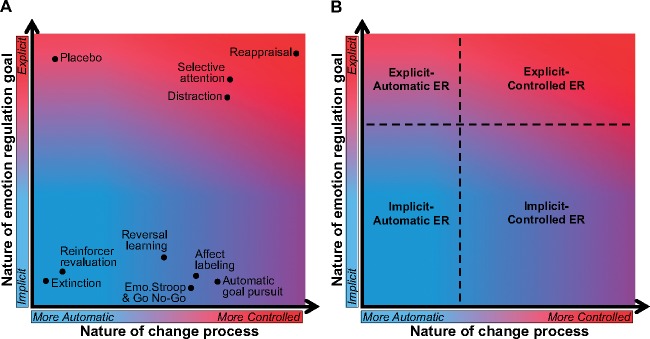
The ability to adaptively regulate emotion is essential for mental and physical well-being. How should we organize the myriad ways people attempt to regulate their emotions? We explore the utility of a framework that distinguishes among four fundamental classes of emotion regulation strategies. The framework describes each strategy class in terms their behavioral characteristics, underlying psychological processes and supporting neural systems. A key feature of this multi-level framework is its conceptualization of the psychological processes in terms of two orthogonal dimensions that describe (i) the nature of the emotion regulation goal (ranging from to implicit to explicit) and (ii) the nature of the emotion change process (ranging from more automatic to more controlled). After describing the core elements of the framework, we use it to review human and animal research on the neural bases of emotion regulation and to suggest key directions for future research on emotion regulation.
Overview
CoChat Summary
TL;DR
The paper proposes a multi-level framework that organizes emotion regulation strategies by crossing two orthogonal dimensions: implicit vs explicit regulation goals and automatic vs controlled change processes. It reviews behavioral and neural evidence for the resulting four classes—explicit-controlled, implicit-automatic, implicit-controlled, and explicit-automatic—and identifies unresolved questions about their neural bases.
Key findings
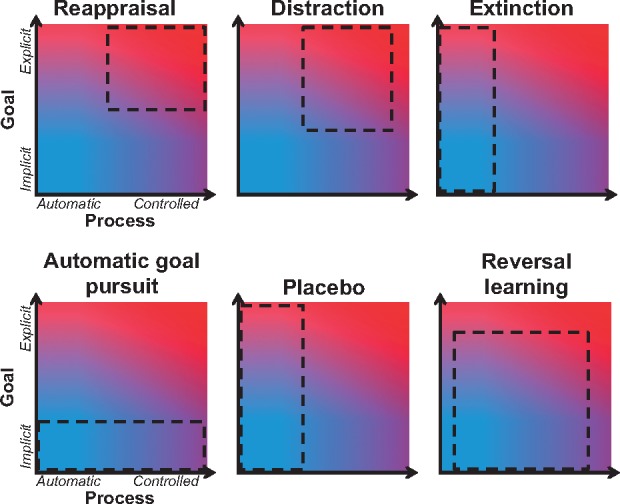
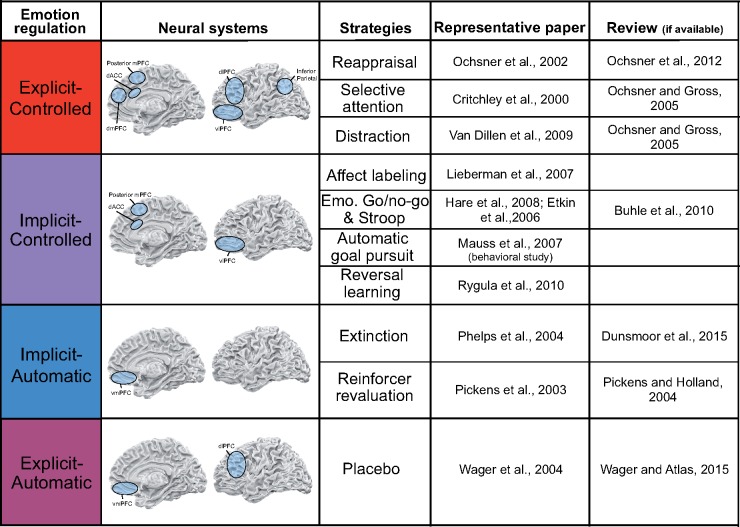
- The framework defines four classes of emotion regulation: explicit-controlled (explicit goal + controlled process), implicit-automatic (implicit goal + automatic process), implicit-controlled (implicit goal + controlled process), and explicit-automatic (explicit goal + automatic process).
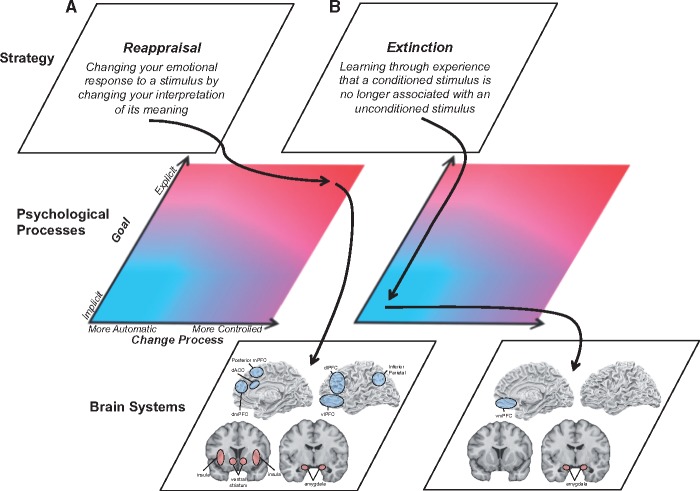
- Explicit-controlled regulation is best studied via selective attention, distraction, and reappraisal; it implicates dlPFC, vlPFC, dACC, and dmPFC, and modulates amygdala, ventral striatum, and insula activity.
- Implicit-automatic regulation is exemplified by extinction and reinforcer revaluation and is supported primarily by vmPFC, which integrates context, goals, motivational states, and learning history to update affective value.
- The paper notes a 40-fold increase in papers including “emotion regulation” between 2002 and 2012, and argues that hybrid classes—implicit-controlled (e.g., affect labeling, reversal learning) and explicit-automatic (e.g., placebo effects)—are less systematically studied.
Methods
- Conceptual/review article, not an empirical study; no primary sample, dataset, or experimental design is reported.
- It synthesizes human and animal behavioral, neuroimaging, lesion, and structural research to describe each strategy class at behavioral, psychological-process, and neural-system levels.
- Main analysis is narrative theoretical integration, using prior findings to constrain a two-dimensional framework and to identify knowledge gaps.
Limitations
- The paper states that current brain data are ambiguous about whether specific prefrontal systems implement explicit vs implicit regulatory goals or controlled vs automatic change processes, and that behavioral data are currently best for classifying strategies.
- The paper states that there are too few studies of each hybrid strategy, with methods differing in multiple ways, to draw firm conclusions.
- Evident from the text: the framework is theoretical and does not provide systematic or meta-analytic quantification; it is limited to self-regulation of emotion, with social/interpersonal emotion regulation acknowledged but not reviewed.
Model-written summary. Check it against the paper before relying on it.
Integrity signals
Registry
Cites
Statistics
Figures
Verification
Claims the paper makes
19 Valid · 5 Not valid · 40 Not checked · 21 Own results and interpretations
At least one cited source doesn’t support this claim or points to a different paper, and none confirmed it — see the verdicts below.
In the paper
“and decreases for devalued stimuli (Gottfried et al., 2003; Kerfoot et al., 2007).”
§ Explicit and implicit emotion regulation: a multi-level framework > Implicit-automatic emotion regulation
What the sources say
- Not checked yetcites Gottfried et al., 2003 matched to “Encoding Predictive Reward Value in Human Amygdala and Orbitofrontal Cortex” (2003) source
- Disputedcites Kerfoot et al., 2007 matched to “Control of appetitive and aversive taste-reactivity responses by an auditory conditioned stimulus in a devaluation task: A FOS and behavioral analysis” (2007) sourceExperimental — accuracy not yet measured
Kerfoot et al. (2007) report the opposite direction: in the FOS immunocytochemistry results, FOS expression in BLA, OFC and GC was greater in group Devalue than in group Maintain or Control (OFC F(2,11)=11.82, P=0.0018), and the Discussion states explicitly that this 'contrasts with the results of recent human imaging experiments, in which the blood oxygenation-level-dependent response in BLA and OFC to a visual cue for a particular food was reduced after devaluation' — a decrease the paper credits to Gottfried et al. (2003), not to itself. Moreover, our copy measures lateral OFC, BLA, GC, CeA, ACB and LH; it contains no vmPFC/medial prefrontal assessment (searched: vmPFC, medial prefrontal, orbitofrontal devaluation FOS), so the region named in the claim is not addressed by this paper at all. The attributed point (activity decreases for devalued stimuli) is therefore contradicted by the source's own findings. (LLM, conf=0.85)
Checked by a reasoning model — may be wrong.
plainstates a cause- Asserted: passes — The authors put it forward as true.
- Checkable: passes — It can be checked against evidence.
- Load-bearing: unclear — It is unclear whether the paper’s conclusions depend on it.
- Based: passes — The paper gives a reason why it holds.
The cited sources support only part of this claim — read each source’s verdict below.
In the paper
“there may be instances where one rethinks the meaning of a situation without having the conscious intention to change emotion or where the reliance of reappraisal on controlled processes diminishes—for example, after some degree of reappraisal training and/or practice”
§ Explicit and implicit emotion regulation: a multi-level framework > A multi-level framework for explicit and implicit emotion regulation > Differentiating classes of regulatory strategies
What the sources say
- Supportedcites Denny and Ochsner, 2014 matched to “Behavioral effects of longitudinal training in cognitive reappraisal.” (2014) source
The Discussion (Implications for differential effects of reappraisal training tactics; page unavailable) suggests that distancing became more habitual or automatic after training, including when participants were not instructed to reappraise. This supports the citing sentence’s hedged example of reduced reliance on controlled processes, specifically for distancing rather than all reappraisal tactics. (LLM, conf=0.88)
- Partly supportedcites Denny et al., 2015 matched to “Getting Over It: Long-Lasting Effects of Emotion Regulation on Amygdala Response” (2015) sourceExperimental — accuracy not yet measured
The Discussion reports that, after four reappraisals, reduced amygdala responses persisted during passive viewing without evidence of ongoing prefrontal control (page not available in our copy). This supports the possibility that the effects of practiced reappraisal need less ongoing control, but the paper does not show that performing reappraisal itself becomes less reliant on controlled processes after training or practice. (LLM, conf=0.87)
hedgedstates a possible cause- Asserted: passes — The authors put it forward as true.
- Checkable: passes — It can be checked against evidence.
- Load-bearing: passes — The paper’s conclusions depend on it.
- Based: passes — The paper gives a reason why it holds.
- Rests on 2 assumptions not shown here.
- Supported
The cited sources support only part of this claim — read each source’s verdict below.
In the paper
“these reviews offer differing descriptions of ‘implicit’ regulation, sometimes focusing on the lack of a conscious and explicit goal to regulate and other times arguing that it occurs automatically and/or without need for cognitive control.”
§ Explicit and implicit emotion regulation: a multi-level framework > Introduction
What the sources say
- Not checked yetcites Berkman and Lieberman, 2009
- Partly supportedcites Gyurak et al., 2011 matched to “Explicit and implicit emotion regulation: a dual-process framework.” (2011) sourceExperimental — accuracy not yet measured
In “Defining Emotion Regulation” (page unavailable), the paper describes implicit processes as automatically evoked and able to proceed without monitoring or awareness; its discussion of regulatory goals also says they can operate outside awareness. These passages support the descriptions of implicit regulation, but the paper does not establish that different reviews favor different descriptions or that implicit regulation requires no cognitive control. (LLM, conf=0.78)
- Not checked yetcites Etkin et al., 2015 matched to “The neural bases of emotion regulation” (2015) source
plain- Asserted: passes — The authors put it forward as true.
- Checkable: passes — It can be checked against evidence.
- Load-bearing: passes — The paper’s conclusions depend on it.
- Based: passes — The paper gives a reason why it holds.
The cited sources support only part of this claim — read each source’s verdict below.
In the paper
“Four such control systems (Figures 3 and 4) have been most strongly implicated in explicit-controlled emotion regulation: dorsolateral prefrontal cortex (dlPFC), ventrolateral prefrontal cortex (vlPFC), dorsal anterior cingulate cortex (dACC) and dorsal medial prefrontal cortex (dmPFC)”
§ Explicit and implicit emotion regulation: a multi-level framework > Explicit-controlled emotion regulation
What the sources say
- Not checked yetcites Diekhof et al., 2011 matched to “Fear is only as deep as the mind allows” (2011) source
- Supportedcites Ochsner et al., 2012 matched to “Functional imaging studies of emotion regulation: a synthetic review and evolving model of the cognitive control of emotion” (2012) source
The “Mechanisms of Emotion Regulation” section identifies dorsolateral prefrontal cortex, dorsal anterior cingulate cortex, ventrolateral prefrontal cortex, and dorsomedial prefrontal regions as involved in cognitive control of emotion via reappraisal. It qualifies dorsomedial involvement as depending on whether reappraisal involves interpreting emotional states. No page number is provided in our copy. (LLM, conf=0.92)
- Partly supportedcites Buhle et al., 2014 matched to “Cognitive Reappraisal of Emotion: A Meta-Analysis of Human Neuroimaging Studies” (2014) sourceExperimental — accuracy not yet measured
The Discussion reports that reappraisal consistently activated dlPFC, vlPFC and dmPFC. It does not identify dACC as a fourth control region; instead, it lists posterior parietal cortex. The paper also examines cognitive reappraisal specifically, rather than explicit-controlled emotion regulation generally. (LLM, conf=0.86)
boostedstates an association- Asserted: passes — The authors put it forward as true.
- Checkable: passes — It can be checked against evidence.
- Load-bearing: passes — The paper’s conclusions depend on it.
- Based: passes — The paper gives a reason why it holds.
The cited sources support only part of this claim — read each source’s verdict below.
In the paper
“Meta-analyses of human imaging studies have demonstrated that vmPFC is the primary (but not only) region whose activity tracks the current subjective value of food, money or various goods (Chib et al., 2009)”
§ Explicit and implicit emotion regulation: a multi-level framework > Implicit-automatic emotion regulation
What the sources say
- Partly supportedcites Chib et al., 2009 matched to “Evidence for a Common Representation of Decision Values for Dissimilar Goods in Human Ventromedial Prefrontal Cortex” (2009) sourceExperimental — accuracy not yet measured
The substantive core is supported: the Abstract and Discussion (pp. 1, Discussion) of Chib et al. (2009) report that human fMRI activity in vmPFC/mOFC correlates with subjects' decision value (WTP) for each of three categories of good — monetary gambles/prizes, trinkets (nonfood consumables), and food — with a single vmPFC area common to all. However, this is an original two-experiment fMRI study that describes itself as providing 'the first direct evidence' of a common vmPFC value region, not a meta-analysis of imaging studies; the Discussion only narrates individual prior studies (Knutson 2001; O'Doherty 2001; Kim 2006; Daw 2006; Kable & Glimcher 2007; Plassmann 2007; Tom 2007; Hare 2008). Nor does the paper state vmPFC is the 'primary (but not only)' value region — it hedges that valuation is mediated 'at least in part' by this region and notes overlapping value activity in striatum in another study (Izuma et al., 2008). The 'meta-analyses have demonstrated' framing and the primacy claim are therefore not attributable to this source. (LLM, conf=0.75)
boostedstates an association- Asserted: passes — The authors put it forward as true.
- Checkable: passes — It can be checked against evidence.
- Load-bearing: unclear — It is unclear whether the paper’s conclusions depend on it.
- Based: passes — The paper gives a reason why it holds.
- Partly supported
50 more claims · 9 with their cited sources checked
Create a free account to see all 85 claims and to verify the 77 references still open.
- It may state two separate claims as one. 16
- Probably not a substantial claim. 15
Claims other papers make about this one
Each is checked against this paper’s own text: does it say what the citing paper says it does?
The cited source says what the claim attributes to it.
In the citing paper
“Our findings can be conceptualized within a recent framework of emotion regulation along two dimensions: the goal, ranging from implicit to explicit, and the change process, ranging from automatic to controlled (Braunstein, Gross, & Ochsner, 2017).”
From Changes in functional connectivity with cognitive behavioral therapy for social anxiety disorder predict outcomes at follow-up (2020) · cites this paper as Braunstein, Gross, & Ochsner, 2017
In the citing paper
“Furthermore, ER can be explicit or implicit, as well as controlled or automatic (Braunstein et al., 2017).”
From New Technologies for the Understanding, Assessment, and Intervention of Emotion Regulation (2019) · cites this paper as Braunstein et al., 2017
Self-check
Percentages, sums and reported differences re-computed from the paper’s own numbers.
Each contradiction between two passages listed here was confirmed by an independent check.
Rated minor: it would not touch a result — a value no result rests on, a p-value that stays on the same side of the significance level, or a conflict that is clerical, resolved elsewhere in the paper, or outside its own findings.
In the paper
§ Explicit and implicit emotion regulation: a multi-level framework > Explicit-automatic emotion regulation
“placebo treatment is generally accompanied by increased recruitment of several regions, including vmPFC, dlPFC, lateral OFC, ventral striatum and periaqueductal gray”
§ Explicit and implicit emotion regulation: a multi-level framework > Explicit-automatic emotion regulation
“Accompanying these activity increases are reductions in activity in pain-sensitive brain regions including the medial thalamus, anterior insula, and dACC, periaqueductal gray and secondary somatosensory cortex-dorsal posterior insula”
Citations
Cites
An Integrative Theory of Prefrontal Cortex Function
Miller, E. K., & Cohen, J. D. (2001) · Annual Review of Neuroscience · doi:10.1146/annurev.neuro.24.1.167 · Cited by 12,803 · cited 10×
“selecting/inhibiting responses, and posterior mPFC/dACC regions important for performance monitoring and evaluating the need for cognitive control (Miller and Cohen, 2001; Wager and Smith, 2003; Shenhav et al., 2016).”
BackgroundInfluentialGross, J. J., & John, O. P. (2003) · Journal of Personality and Social Psychology · doi:10.1037/0022-3514.85.2.348 · Cited by 11,929 · cited 2×
“ance in maintaining mental and physical well-being (Gross and John, 2003; Diener, 2009), emotion regulation has increasingly been the focus of behavioral and neuroscience research.”
BackgroundSelf-citationThe emerging field of emotion regulation: an integrative review
Gross, J. J. (1998) · Review of General Psychology · doi:10.1037/1089-2680.2.3.271 · Cited by 9,916 · cited 4×
“Reappraisal (Figures 1A and 2) involves intentionally changing how we think about and describe a stimulus’s meaning so as to alter our emotional response to it (Gross, 1998).”
BackgroundMethodInfluentialSelf-citationA neural substrate of prediction and reward
Schultz, W., Dayan, P., & Montague, P. R. (1997) · Science · doi:10.1126/science.275.5306.1593 · Cited by 9,388 · cited 3×
“The second is a chronically active goal that is important for survival, such as the goal to identify, respond to and accurately represent the value of goal-relevant stimuli (Schultz et al., 1997; Ledoux, 2012).”
BackgroundConflict monitoring and cognitive control
Botvinick, M. M., Braver, T. S., Barch, D. M., Carter, C. S., & Cohen, J. D. (2001) · Psychological Review · doi:10.1037/0033-295x.108.3.624 · Cited by 7,351 · cited 2×
“…et al., 2014) engage the dACC and adjacent posterior dmPFC, which monitor conflicts between intended and actual behavioral outcomes and signal when appropriate adjustments in control are needed (Botvinick et al., 2001; Badre and Wagner, 2004; Botvinick et al., 2004; Carter and Van Veen, 2007).”
BackgroundHow do you feel — now? The anterior insula and human awareness
(Bud) Craig, A. D. (2009) · Nature Reviews Neuroscience · doi:10.1038/nrn2555 · Cited by 6,657 · cited 2×
“…Brosch, 2012; Janak and Tye, 2015); the ventral striatum, involved in learning the reinforcement/reward value of stimuli (O’doherty, 2004; Delgado, 2007) and the insula, which may support awareness of body states in the context of emotion (Critchley et al., 2004; Craig, 2009; Zaki et al., 2012).”
BackgroundEmotion regulation: current status and future prospects
Gross, J. J. (2015) · Psychological Inquiry · doi:10.1080/1047840x.2014.940781 · Cited by 5,229 · cited 4×
“…be distinguished in many ways (Ochsner and Gross, 2005; Berkman and Lieberman, 2009; Hartley and Phelps, 2009; Gyurak et al., 2011; Ochsner et al., 2012; Gross, 2015), we focus on a high-level classification scheme that trades on the distinction between explicit and implicit forms of regulation.”
BackgroundMethodInfluentialSelf-citationThe cognitive control of emotion
OCHSNER, K., & GROSS, J. (2005) · Trends in Cognitive Sciences · doi:10.1016/j.tics.2005.03.010 · Cited by 4,495 · cited 9×
“Selective attention studies have used a disparate array of methods that often lack behavioral measures verifying how well attention has been controlled (Ochsner and Gross, 2005; Buhle et al., 2010), thereby limiting the conclusions that”
BackgroundInfluentialSelf-citationThe reward circuit: linking primate anatomy and human imaging
Haber, S. N., & Knutson, B. (2010) · Neuropsychopharmacology · doi:10.1038/npp.2009.129 · Cited by 3,718 · cited 3×
“…the initial valuation of these stimuli and their features— including the amygdala (Amaral and Price, 1984) and ventral striatum (Öngür and Price, 2000; Haber and Knutson, 2010), which provide information about the relevance of stimuli to affective goals and (iii) provide important contextual…”
BackgroundConflict monitoring and anterior cingulate cortex: an update
Botvinick, M. M., Cohen, J. D., & Carter, C. S. (2004) · Trends in Cognitive Sciences · doi:10.1016/j.tics.2004.10.003 · Cited by 3,623 · cited 2×
“…et al., 2014) engage the dACC and adjacent posterior dmPFC, which monitor conflicts between intended and actual behavioral outcomes and signal when appropriate adjustments in control are needed (Botvinick et al., 2001; Badre and Wagner, 2004; Botvinick et al., 2004; Carter and Van Veen, 2007).”
Background
Cited by
Items 401–500 of 551
Guo, S., Yang, J., Lipp, O. V., & Zhang, J. (2025) · Cognition & Emotion · doi:10.1080/02699931.2025.2459149 · Cited by 2
Offline rTMS inhibition of the bilateral dorsolateral prefrontal cortex impairs reappraisal efficacyPreprint
Wyczesany, M., Adamczyk, A. K., Hobot, J., Barbalinardo, G., Adamczyk, P., Labaza, A., & Ligeza, T. S. (2022) · Research Square · doi:10.21203/rs.3.rs-1411756/v1 · Cited by 1
Self-Regulation of Emotions in Relation to Students’ Attitudes Towards School Life
Hrbáčková, K., & Petr Šafránková, A. (2023) · European Journal of Contemporary Education · doi:10.13187/ejced.2023.4.1283 · Cited by 3
Enhancing Emotion Regulation: A Review of tDCS Effects
Ülker, S. V., & Yağcı, S. (2024) · Current Research in Social Sciences · doi:10.30613/curesosc.1496519 · Cited by 1
Tacchino, C., Angelosanto, R., & Velotti, P. (2026) · F&S Reviews · doi:10.1016/j.xfnr.2026.100103 · Cited by 3
Hou, C., Yan, M., Pei, H., Deng, Y., Jiang, S., Li, H., Huang, H., Zhou, Y., Rodríguez‐Labrada, R., & Luo, C. (2025) · Brain Research Bulletin · doi:10.1016/j.brainresbull.2025.111534 · Cited by 1
Tan, R., Hu, K., Huang, P., & Cai, L. (2025) · Behavioral Sciences · doi:10.3390/bs15081082 · Cited by 2
Kain, W. (2020) · Springer eBooks · doi:10.1007/978-3-662-59288-5_21 · Cited by 1
Cosic, K., Kuljanac, A., & Palermo, S. (2026) · Frontiers in psychology · doi:10.3389/fpsyg.2026.1821242 · Cited by 3
“…is consistent with broader literature on stress exposure training, mental readiness training, and emotion regulation, which frame resilience as a trainable set of cognitive and affective skills rather than a fixed trait (Driskell et al., 2018; Thompson and McCreary, 2006; Braunstein et al., 2017).”
Emotion in Nonverbal Communication: Comparing Animal and Human Vocalizations and Human Text Messages
Gruber, T., Briefer, E. F., Grütter, A., Xanthos, A., Grandjean, D., Manser, M. B., & Frühholz, S. (2025) · Emotion Review · doi:10.1177/17540739241303505 · Cited by 3
McMillan, J., & Soundy, A. (2025) · Behavioral Sciences · doi:10.3390/bs15101399 · Cited by 3
Kaźmierczak, I., & Lacko, D. (2026) · Journal of Clinical Psychology · doi:10.1002/jclp.70127 · Cited by 2
Messung interindividueller Unterschiede in der Emotionsregulation
Holt, D. V., Aguilar‐Raab, C., & Pruessner, L. (2020) · Springer eBooks · doi:10.1007/978-3-662-60280-5_4 · Cited by 1
Guo, W., Zhao, C., & Zhang, W. (2026) · Psychiatry Research Neuroimaging · doi:10.1016/j.pscychresns.2026.112193 · Cited by 1
Turnbull, A. G., Gross, J. J., & Lin, F. V. (2026) · Neuron · doi:10.1016/j.neuron.2026.01.022 · Cited by 2
Self-citationEight-week Chinese mind-body exercise improves the inhibition of negative emotion
Wu, W., He, M., & Yang, S. (2026) · Mental health and physical activity · doi:10.1016/j.mhpa.2026.100761 · Cited by 1
Neurocognitive Effects of Preceding Facial Expressions on Perception of Subsequent Emotions
Kim, S. A., & Kim, S. H. (2021) · Frontiers in Behavioral Neuroscience · doi:10.3389/fnbeh.2021.683833 · Cited by 1
Chen, D., Zhang, Y., Gao, H., Luo, H., Guo, F., & Jing, L. (2026) · International Journal of Computer-Supported Collaborative Learning · doi:10.1007/s11412-026-09467-w · Cited by 2
Rojas-Saffie, J. P., Álamos-Vial, N., & Pinzón-Merchán, M. (2025) · Frontiers in Psychology · doi:10.3389/fpsyg.2024.1454900 · Cited by 3
Reappraising reappraisalPreprint
Uusberg, A., Taxer, J. L., Yih, J., et al. (2019) · doi:10.31234/osf.io/e69nx · Cited by 1
Crawford, B., Muhlert, N., MacDonald, G., & Lawrence, A. D. (2020) · bioRxiv (Cold Spring Harbor Laboratory) · doi:10.1101/2020.02.03.916999 · Cited by 2
Masanotti, G. M., Paolucci, S., Abbafati, E., Serratore, C., & Caricato, M. (2021) · Journal of integrative nursing and palliative care · doi:10.51847/t4ttdoi1gf · Cited by 1
Colombo, D. (2020) · Tesis Doctorals en Xarxa (Consorci de Serveis Universitaris de Catalunya) · doi:10.6035/14109.2020.762821 · Cited by 1
Parkinson, B. (2019) · Cambridge University Press eBooks · doi:10.1017/9781108696234.002 · Cited by 1
Altered prefrontal effective connectivity during emotion regulation in social anxiety disorder
Schrammen, E., Jamieson, A. J., Meinert, H., Böhnlein, J., Slump, T. M., Vogler, R. A., Menze, A., Meinert, S., Bauer, J., Goltermann, J., et al. (2026) · The British Journal of Psychiatry · doi:10.1192/bjp.2026.10628 · Cited by 2
Neural dynamics of cognitive control: Current tensions and future promise
Zhou, D., Cosme, D., Kang, Y., Stanoi, O. A., Lydon‐Staley, D. M., Mucha, P. J., Falk, E. B., Ochsner, K. N., & Bassett, D. S. (2026) · Neuroscience & Biobehavioral Reviews · doi:10.1016/j.neubiorev.2026.106909 · Cited by 2
Self-citationExploring the Emotional Effects of Enhanced Interoception via Heartbeat-Synchronized Haptic Feedback
Kim, M. M., Whitmore, N. W., Chua, P., Pei, S., Abdalla, M., & Maes, P. (2025) · Proceedings of the ACM on Interactive Mobile Wearable and Ubiquitous Technologies · doi:10.1145/3770663 · Cited by 2
Kiil, F. (2025) · Politics and the Life Sciences · doi:10.1017/pls.2025.10001 · Cited by 1
Cavalli, J. M., Cuttler, C., & Cservenka, A. (2024) · Human Psychopharmacology Clinical and Experimental · doi:10.1002/hup.2915 · Cited by 2
Costache, M. E., Gioia, F., Vanello, N., et al. (2024) · Research Square · doi:10.21203/rs.3.rs-4095099/v1 · Cited by 1
Parkinson, B. (2019) · Cambridge University Press eBooks · doi:10.1017/9781108696234.006 · Cited by 1
From Effortful to Effortless: Conceptualizing Emotional Labor Automaticity
Lee, F. C., Diefendorff, J. M., Thornton-Lugo, M. A., & Ong, X. W. (2025) · Organizational Psychology Review · doi:10.1177/20413866251370353 · Cited by 2
Lloyd, W., Morriss, J., Macdonald, B., Joanknecht, K., Nihouarn, J., & van Reekum, C. V. (2019) · bioRxiv · doi:10.1101/867689 · Cited by 25
Pauw, L. S., Medland, H., Paling, S. J., et al. (2021) · doi:10.31234/osf.io/ztw53 · Cited by 1
Dynamic Compression for Novel Haptic Interactions
Foo, E. W. (2020) · University of Minnesota Digital Conservancy (University of Minnesota) · Cited by 1
Chaudhary, S., Chen, Y., Wong, H. K., Chao, H. H., & Li, C. R. (2026) · Psychiatry Research Neuroimaging · doi:10.1016/j.pscychresns.2026.112174
The Organizational Neuroscience of EmotionsPreprint
Massaro, S. (2019) · PsyArXiv (OSF Preprints) · doi:10.31234/osf.io/u8z2g
Asiri, A. M., Alzahrani, S. A., Saddeek, A. Y., Ghazwani, F. A., Alotaibi, A., & Alqani, S. (2023) · International Journal of Pharmaceutical Quality Assurance · doi:10.25258/ijpqa.14.3.09
The role of inferior frontal gyrus in emotion regulation: Evidence from fMRI and tDCS investigation
Li, W., Ngetich, R. K., Zhang, Q., Zhang, J., Jin, Z., & Li, L. (2026) · International Journal of Psychophysiology · doi:10.1016/j.ijpsycho.2026.113438
What’s at the Heart of Emotions?
Parkinson, B. (2019) · Cambridge University Press eBooks · doi:10.1017/9781108696234.001
Carruthers, P. (2024) · Oxford University Press eBooks · doi:10.1093/oso/9780198906131.003.0003 · Cited by 2
Parkinson, B. (2019) · Cambridge University Press eBooks · doi:10.1017/9781108696234.010
A Breath of Hope: A Modified Tonglen Meditation for Practitioners
Tomasulo, D. (2026) · Mindfulness · doi:10.1007/s12671-026-02897-5
Leveraging transcranial ultrasound stimulation to enhance self-regulation in emotion and sleep
Dunsford, S., Komarnyckyj, M., & Fouragnan, E. F. (2025) · Frontiers in Human Neuroscience · doi:10.3389/fnhum.2025.1594106 · Cited by 2
Rodríguez-López, M. E., Higueras‐Castillo, E., Liébana-Cabanillas, F. J., & García-Carrión, B. (2026) · Journal of Hospitality and Tourism Technology · doi:10.1108/jhtt-09-2025-0770
Choi, M. E., & Yoon, H. Y. (2022) · Korean Journal of Stress Research · doi:10.17547/kjsr.2022.30.4.288
The Neural Bases of Emotion Regulation Within a Process Model Framework
Saragosa‐Harris, N. M., & Silvers, J. A. (2021) · Elsevier eBooks · doi:10.1016/b978-0-12-819641-0.00072-4
Ansari, F., Farajkhoda, T., Nokhostin, F., Mahmoodabadi, H. Z., & Sarebanhassanabadi, M. (2026) · BMC Cancer · doi:10.1186/s12885-025-15180-y
Elimari, N., Nguyen, C., Verger, N. B., Shankland, R., van Zyl, L. E., & Hallez, Q. (2026) · Current Psychology · doi:10.1007/s12144-026-10013-y
Carruthers, P. (2024) · Oxford University Press eBooks · doi:10.1093/oso/9780198906131.003.0008
Neural correlates of threat and emotion processing in panic disorder
Taake, I. (2018) · Summit (Simon Fraser University)
Balter, A.-S., Bertrand, J., & Katz, E. (2025) · Social and Emotional Learning Research Practice and Policy · doi:10.1016/j.sel.2025.100127
Oprel, D. A. C., Hoeboer, C. M., de Kleine, R. A., Schoorl, M., van der Does, W. A. J., & van Minnen, A. (2026) · Journal of Anxiety Disorders · doi:10.1016/j.janxdis.2026.103174 · Cited by 2
Carruthers, P. (2024) · Oxford University Press eBooks · doi:10.1093/oso/9780198906131.002.0004
Emotion Regulation in Individuals with ADHD: A Clinical Guide
Mahdavi, A., & Elaheh, H. (2024) · IntechOpen eBooks · doi:10.5772/intechopen.1006053
Carruthers, P. (2024) · Oxford University Press eBooks · doi:10.1093/oso/9780198906131.002.0003
Halfon, S., Albayrak, M., Bulut, M. K., Eğrilmez, D., Gülzari, E., Arikan, K., Buyukasik, C., Hoffman, L., Kufferath-Lin, T., Prout, T. A., et al. (2026) · Psychotherapy Research · doi:10.1080/10503307.2026.2738632
Avaliação multimétodos da tomada de decisão, regulação emocional e personalidade em jovens adultos
Pinto, A. L. D. C. B. (2020) · Digital Library of Theses and Dissertations (Universidade de São Paulo) · doi:10.11606/t.59.2020.tde-11122020-154944 · Cited by 1
The neurophysiology of emotion is related to intertemporal decision-making
Gui, D.-Y., Yang, J., & Xu, F. (2026) · Current Psychology · doi:10.1007/s12144-026-09042-4 · Cited by 1
Sturm, V. E., & Seeley, W. W. (2026) · Social Cognitive and Affective Neuroscience · doi:10.1093/scan/nsag014 · Cited by 1
Neuroscientific Approaches to the Study of Self and Social Emotion Regulation During Development
Leal, A. S. M., & Silvers, J. A. (2022) · Oxford University Press eBooks · doi:10.1093/oxfordhb/9780198855903.013.7 · Cited by 2
Parkinson, B. (2019) · Cambridge University Press eBooks · doi:10.1017/9781108696234.011
Carruthers, P. (2024) · Oxford University Press eBooks · doi:10.1093/oso/9780198906131.003.0001
Neuroimaging and Circuit Mechanisms of Anxiety and Trauma-Related Disorders
Fonzo, G. A. (2025) · Oxford University Press eBooks · doi:10.1093/med/9780197640654.003.0038
Extending psychoradiology of emotion regulation from mental health to adaptiveness promotion
Wu, T., & Yuan, J. (2025) · Psychoradiology · doi:10.1093/psyrad/kkaf037 · Cited by 1
Strauss, G. P., Bartolomeo, L. A., & Ayawvi, G. (2025) · European Archives of Psychiatry and Clinical Neuroscience · doi:10.1007/s00406-025-02006-y
Chen, S., Luo, L., Zhang, X., Yang, J., Wang, T., & Yuan, J. (2026) · General Psychiatry · doi:10.1002/gps3.70051
Jiang, Y., Zhang, Y., Campbell, K.-A. B., Zhong, T., Zehner, T. M., James, V., Devlin, B. L., Geer, E. A., Shire, S. Y., & Schmitt, S. A. (2025) · Educational Psychology Review · doi:10.1007/s10648-025-10066-8 · Cited by 1
Kanaya, Y., & Kawai, N. (2025) · The Japanese journal of psychology · doi:10.4992/jjpsy.96.23402
Rethinking the link between cognitive control and emotion regulation: A meta-analytic review
Schulze, K., Mueller, I., Holt, D. V., Putz, S., Barnow, S., & Pruessner, L. (2026) · Neuroscience & Biobehavioral Reviews · doi:10.1016/j.neubiorev.2026.106708 · Cited by 1
Parkinson, B. (2019) · Cambridge University Press eBooks · doi:10.1017/9781108696234.008
Interpreting Children’s Defenses Promotes Emotion Regulation Development
Rice, T. (2026) · The Psychoanalytic Study of the Child · doi:10.1080/00797308.2026.2692896
Liu, X., Du, J., Huang, J., Qian, W., Wen, X., & Liang, P. (2025) · British Journal of Developmental Psychology · doi:10.1111/bjdp.70029 · Cited by 1
Are They Real? Examining the Regulatory Effects of Non-Deceptive Placebos on Emotional Distress
Guevarra, D. A. (2019) · Deep Blue (University of Michigan)
Carruthers, P. (2024) · Oxford University Press eBooks · doi:10.1093/oso/9780198906131.003.0007
van Reekum, C. M., Tupitsa, E., Lloyd, W. K., Momeni, A., Shahki, J., Feredoes, E. A., & Woodward, T. S. (2025) · bioRxiv (Cold Spring Harbor Laboratory) · doi:10.1101/2025.10.27.684758
Traumatic brain injury and rTMS-ERPs: Case report and literature review
Fu, Y., Xu, C., Fan, H. D., Yang, X., Ou, J., Yao, L., & Wang, W. (2023) · Open Life Sciences · doi:10.1515/biol-2022-0677 · Cited by 1
Emotion dysregulation in autistic adults : an ecological, self-report, and physiological approach
Costache, M. E. (2024) · theses.fr (ABES) · doi:10.70675/575e0a4az1174z4c91z976cz320b40c5304a
Sang, L., Mo, Z., Zhang, J., Li, P., Wang, Q., Wang, L., Zhang, Y., Liao, Y., Qiao, L., & Qiu, M. (2026) · Journal of Affective Disorders · doi:10.1016/j.jad.2026.121669 · Cited by 1
Fombouchet, Y. (2022) · theses.fr (ABES) · doi:10.70675/d2a95d53ze728z40cbza605zde9a40929df5 · Cited by 4
Carruthers, P. (2024) · Oxford University Press eBooks · doi:10.1093/oso/9780198906131.003.0002
Zhu, C., Ip, K. I., Liu, Z., & Yan, N. (2026) · Child Development · doi:10.1093/chidev/aacaf033
Wilkinson, E. (2024) · Scholars Archive - University at Albany (University at Albany, State University of New York) · doi:10.54014/7sew-4fp4
Rogier, G., Bertolini, M., Bruno, S., Cataudella, S., & Velotti, P. (2025) · Thinking Skills and Creativity · doi:10.1016/j.tsc.2025.101838
Generalizability of control across cognitive and emotional conflictPreprint
Straub, E., Schiltenwolf, M., Dignath, D., et al. (2022) · doi:10.31234/osf.io/3x9mq
A comparison of emotion regulation strategies’ effectiveness under cognitive fatigue
Churassamee, S., & Ariyabuddhiphongs, K. (2019) · Chula Digiverse · doi:10.58837/chula.the.2019.454
Facial Activity and Emotion Expression
Parkinson, B. (2019) · Cambridge University Press eBooks · doi:10.1017/9781108696234.003
Roskam, I., Gross, J. J., & Mikolajczak, M. (2023) · Cambridge University Press eBooks · doi:10.1017/9781009304368.002
Self-citationDistinct and similar patterns of emotional development in adolescents and young adultsPreprint
Bos, D. J., Dreyfuss, M., Tottenham, N., Hare, T. A., Galván, A., Casey, B. J., & Jones, R. M. (2019) · PsyArXiv (OSF Preprints) · doi:10.31234/osf.io/s98mh
Shukla, M., & Mishra, A. (2026) · Current Psychology · doi:10.1007/s12144-026-09229-9 · Cited by 1
Modulation of attentional bias by hypnosis: Disentangling the effect of induction and suggestion
Brunel, J., Mathey, S., Landry, M., & Delord, S. (2025) · Consciousness and Cognition · doi:10.1016/j.concog.2025.103948
Viering, T. C. (2022) · University of Groningen research database (University of Groningen / Centre for Information Technology) · doi:10.33612/diss.215191995
Faimann, P. G., Harrison, B., Davey, C., Steward, T., & Jamieson, A. (2026) · Biological Psychiatry: Cognitive Neuroscience and Neuroimaging · doi:10.1016/j.bpsc.2026.05.010
Hou, C., Yan, M., Pei, H., Ye, T., Jiang, S., Li, H., Rodríguez-Labrada, R., Yao, D., & Luo, C. (2026) · Frontiers in Human Neuroscience · doi:10.3389/fnhum.2026.1824753
Parkinson, B. (2019) · Cambridge University Press eBooks · doi:10.1017/9781108696234.007
Metadata
- Authors
- Braunstein, L. M., Gross, J. J., & Ochsner, K. N.
- Affiliations
- Columbia University (US)
- Stanford University (US)
- Corresponding author
- Ochsner, Kevin N
- Venue
- Social Cognitive and Affective Neuroscience
- Publisher
- Oxford University Press (OUP)
- Published
- 2017-09-15
- Volume
- 12
- Issue
- 10
- Pages
- 1545-1557
- ISSN
- 1749-5016 (ISSN-L)
- 1749-5024
- PMC
- PMC5647798
- OpenAlex
- W2755931351
- Cited by
- 539
- References
- 161
- Citations by year
- 2026: 56 · 2025: 73 · 2024: 71 · 2023: 58 · 2022: 62 · 2021: 61 · 2020: 68 · 2019: 71 · 2018: 16 · 2017: 2
- FWCI
- 4.80
- Type
- journal article
- Language
- en
- Open access
- gold
- doi.org
- Licence
- Locations
- Social Cognitive and Affective Neuroscience (publishedVersion, cc-by-nc)
- PubMed Central (publishedVersion, cc-by-nc)
- PubMed (publishedVersion)
- Funders
- National Institute on Aging (AG043463)
- National Institute of Child Health and Human Development (HD069178)
- National Institute of Mental Health (MH090964)
- National Institute on Alcohol Abuse and Alcoholism (AA023704)
- Topics
- Life Sciences › Neuroscience › Cognitive Neuroscience › Neural and Behavioral Psychology Studies
- Social Sciences › Psychology › Social Psychology › Emotions and Moral Behavior
- Social Sciences › Psychology › Experimental and Cognitive Psychology › Anxiety, Depression, Psychometrics, Treatment, Cognitive Processes
- Keywords
- emotion regulation, implicit emotion regulation, multi-level framework, emotion regulation strategies
- MeSH terms
- Animals, Behavior, Emotions, Humans
About these checks
Registry, retraction, Cites and statistics results are computed, not judged, with one exception: a printed reference that no index lists is read once by a model before it counts as a citation error. Claims are extracted by a model and kept only when their quote appears verbatim in the text; each cited source is then checked, with a model’s help, for whether it says what the claim relies on. Those verdicts can be wrong — read the claim’s quote and the cited source before relying on one.
The claim verdicts this report counts are experimental: their accuracy is not yet measured.
A language model drew the claims from the paper on 2026-10-06, under version 3 of the claim definition (model deepseek-v4.1-flash, prompt extract-v3).
A second model labelled each claim on 2026-10-06 (model jev-1.13-20260917, definition revision gold-guideline-v0.2).
Cited sources are checked with a language model’s help (qwen3.8-omni-flash and gpt-6-sol).
Statistics and arithmetic are recomputed, not judged.
Confidence bands are shown only for fields calibrated on our annotated test set. None is calibrated yet, so no band is shown.
What counts as a claim ›How we measure confidence ›How we check this ›
Are you an author, or do you see a problem with this page? Request a review
Data sources
Bibliographic data: Semantic Scholar, OpenAlex, Crossref.
Contains information from the Semantic Scholar Academic Graph Datasets, made available under the ODC Attribution License (ODC-BY 1.0).
Semantic Scholar’s data is described in: Kinney, R., et al. (2023). The Semantic Scholar Open Data Platform. arXiv:2301.10140.
