

Explicit and implicit emotion regulation: a multi-level framework
Open accessThe DOI matches its Crossref record; 156 of the 161 references it cites were found in a registry or an index; 33 of the 110 sources its claims cite were checked for support.
Abstract
The ability to adaptively regulate emotion is essential for mental and physical well-being. How should we organize the myriad ways people attempt to regulate their emotions? We explore the utility of a framework that distinguishes among four fundamental classes of emotion regulation strategies. The framework describes each strategy class in terms their behavioral characteristics, underlying psychological processes and supporting neural systems. A key feature of this multi-level framework is its conceptualization of the psychological processes in terms of two orthogonal dimensions that describe (i) the nature of the emotion regulation goal (ranging from to implicit to explicit) and (ii) the nature of the emotion change process (ranging from more automatic to more controlled). After describing the core elements of the framework, we use it to review human and animal research on the neural bases of emotion regulation and to suggest key directions for future research on emotion regulation.
Overview
CoChat Summary
TL;DR
The paper proposes a multi-level framework that organizes emotion regulation strategies by crossing two orthogonal dimensions: implicit vs explicit regulation goals and automatic vs controlled change processes. It reviews behavioral and neural evidence for the resulting four classes—explicit-controlled, implicit-automatic, implicit-controlled, and explicit-automatic—and identifies unresolved questions about their neural bases.
Key findings
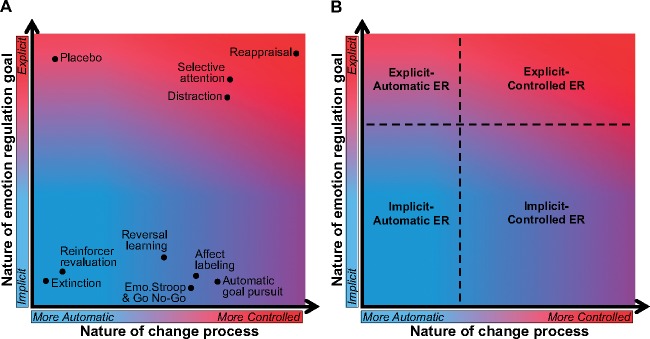
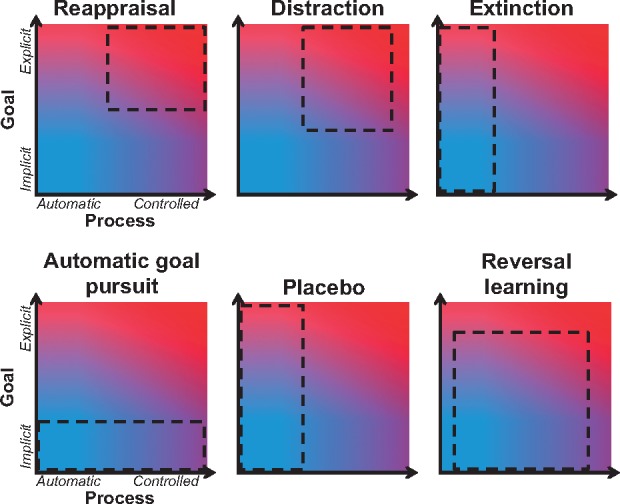
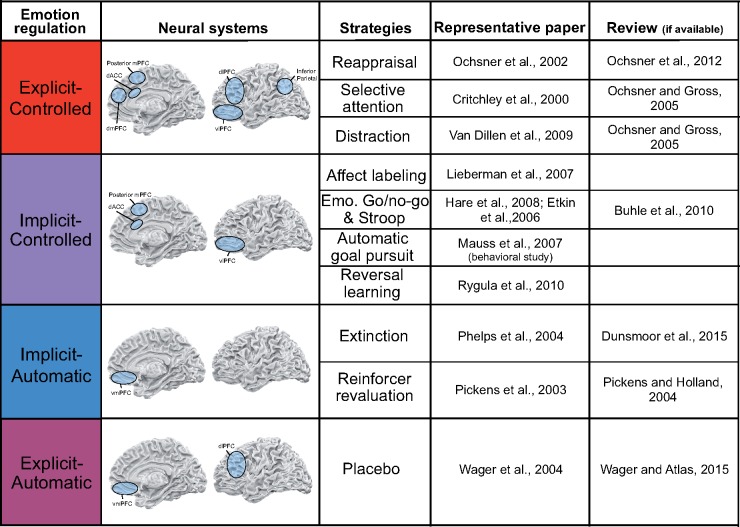
- The framework defines four classes of emotion regulation: explicit-controlled (explicit goal + controlled process), implicit-automatic (implicit goal + automatic process), implicit-controlled (implicit goal + controlled process), and explicit-automatic (explicit goal + automatic process).
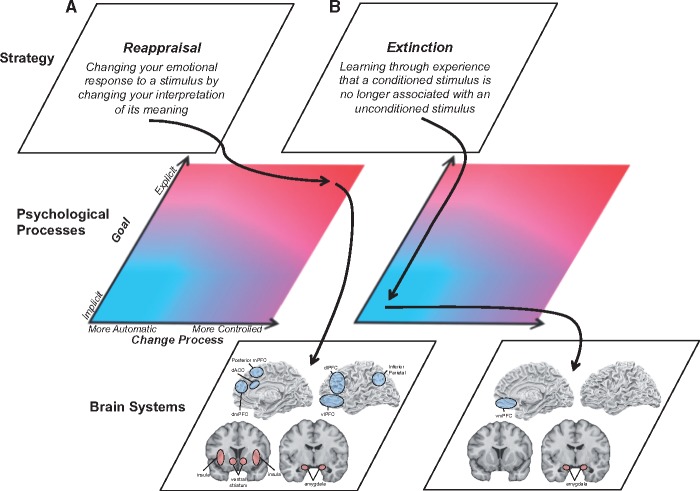
- Explicit-controlled regulation is best studied via selective attention, distraction, and reappraisal; it implicates dlPFC, vlPFC, dACC, and dmPFC, and modulates amygdala, ventral striatum, and insula activity.
- Implicit-automatic regulation is exemplified by extinction and reinforcer revaluation and is supported primarily by vmPFC, which integrates context, goals, motivational states, and learning history to update affective value.
- The paper notes a 40-fold increase in papers including “emotion regulation” between 2002 and 2012, and argues that hybrid classes—implicit-controlled (e.g., affect labeling, reversal learning) and explicit-automatic (e.g., placebo effects)—are less systematically studied.
Methods
- Conceptual/review article, not an empirical study; no primary sample, dataset, or experimental design is reported.
- It synthesizes human and animal behavioral, neuroimaging, lesion, and structural research to describe each strategy class at behavioral, psychological-process, and neural-system levels.
- Main analysis is narrative theoretical integration, using prior findings to constrain a two-dimensional framework and to identify knowledge gaps.
Limitations
- The paper states that current brain data are ambiguous about whether specific prefrontal systems implement explicit vs implicit regulatory goals or controlled vs automatic change processes, and that behavioral data are currently best for classifying strategies.
- The paper states that there are too few studies of each hybrid strategy, with methods differing in multiple ways, to draw firm conclusions.
- Evident from the text: the framework is theoretical and does not provide systematic or meta-analytic quantification; it is limited to self-regulation of emotion, with social/interpersonal emotion regulation acknowledged but not reviewed.
Model-written summary. Check it against the paper before relying on it.
Integrity signals
Registry
Cites
Statistics
Figures
Verification
Claims the paper makes
19 Valid · 5 Not valid · 40 Not checked · 21 Own results and interpretations
At least one cited source doesn’t support this claim or points to a different paper, and none confirmed it — see the verdicts below.
In the paper
“and decreases for devalued stimuli (Gottfried et al., 2003; Kerfoot et al., 2007).”
§ Explicit and implicit emotion regulation: a multi-level framework > Implicit-automatic emotion regulation
What the sources say
- Not checked yetcites Gottfried et al., 2003 source
- Disputedcites Kerfoot et al., 2007 sourceExperimental — accuracy not yet measured
Kerfoot et al. (2007) report the opposite direction: in the FOS immunocytochemistry results, FOS expression in BLA, OFC and GC was greater in group Devalue than in group Maintain or Control (OFC F(2,11)=11.82, P=0.0018), and the Discussion states explicitly that this 'contrasts with the results of recent human imaging experiments, in which the blood oxygenation-level-dependent response in BLA and OFC to a visual cue for a particular food was reduced after devaluation' — a decrease the paper credits to Gottfried et al. (2003), not to itself. Moreover, our copy measures lateral OFC, BLA, GC, CeA, ACB and LH; it contains no vmPFC/medial prefrontal assessment (searched: vmPFC, medial prefrontal, orbitofrontal devaluation FOS), so the region named in the claim is not addressed by this paper at all. The attributed point (activity decreases for devalued stimuli) is therefore contradicted by the source's own findings. (LLM, conf=0.85)
Checked by a reasoning model — may be wrong.
plainstates a cause- Asserted: passes — The authors put it forward as true.
- Checkable: passes — It can be checked against evidence.
- Load-bearing: unclear — It is unclear whether the paper’s conclusions depend on it.
- Based: passes — The paper gives a reason why it holds.
The cited sources support only part of this claim — read each source’s verdict below.
In the paper
“there may be instances where one rethinks the meaning of a situation without having the conscious intention to change emotion or where the reliance of reappraisal on controlled processes diminishes—for example, after some degree of reappraisal training and/or practice”
§ Explicit and implicit emotion regulation: a multi-level framework > A multi-level framework for explicit and implicit emotion regulation > Differentiating classes of regulatory strategies
What the sources say
- Supportedcites Denny and Ochsner, 2014 source
The Discussion (Implications for differential effects of reappraisal training tactics; page unavailable) suggests that distancing became more habitual or automatic after training, including when participants were not instructed to reappraise. This supports the citing sentence’s hedged example of reduced reliance on controlled processes, specifically for distancing rather than all reappraisal tactics. (LLM, conf=0.88)
- Partly supportedcites Denny et al., 2015 sourceExperimental — accuracy not yet measured
The Discussion reports that, after four reappraisals, reduced amygdala responses persisted during passive viewing without evidence of ongoing prefrontal control (page not available in our copy). This supports the possibility that the effects of practiced reappraisal need less ongoing control, but the paper does not show that performing reappraisal itself becomes less reliant on controlled processes after training or practice. (LLM, conf=0.87)
hedgedstates a possible cause- Asserted: passes — The authors put it forward as true.
- Checkable: passes — It can be checked against evidence.
- Load-bearing: passes — The paper’s conclusions depend on it.
- Based: passes — The paper gives a reason why it holds.
- Rests on 2 assumptions not shown here.
- Supported
The cited sources support only part of this claim — read each source’s verdict below.
In the paper
“these reviews offer differing descriptions of ‘implicit’ regulation, sometimes focusing on the lack of a conscious and explicit goal to regulate and other times arguing that it occurs automatically and/or without need for cognitive control.”
§ Explicit and implicit emotion regulation: a multi-level framework > Introduction
What the sources say
- Not checked yetcites Berkman and Lieberman, 2009
- Partly supportedcites Gyurak et al., 2011 sourceExperimental — accuracy not yet measured
In “Defining Emotion Regulation” (page unavailable), the paper describes implicit processes as automatically evoked and able to proceed without monitoring or awareness; its discussion of regulatory goals also says they can operate outside awareness. These passages support the descriptions of implicit regulation, but the paper does not establish that different reviews favor different descriptions or that implicit regulation requires no cognitive control. (LLM, conf=0.78)
- Not checked yetcites Etkin et al., 2015 source
plain- Asserted: passes — The authors put it forward as true.
- Checkable: passes — It can be checked against evidence.
- Load-bearing: passes — The paper’s conclusions depend on it.
- Based: passes — The paper gives a reason why it holds.
The cited sources support only part of this claim — read each source’s verdict below.
In the paper
“Four such control systems (Figures 3 and 4) have been most strongly implicated in explicit-controlled emotion regulation: dorsolateral prefrontal cortex (dlPFC), ventrolateral prefrontal cortex (vlPFC), dorsal anterior cingulate cortex (dACC) and dorsal medial prefrontal cortex (dmPFC)”
§ Explicit and implicit emotion regulation: a multi-level framework > Explicit-controlled emotion regulation
What the sources say
- Not checked yetcites Diekhof et al., 2011 source
- Supportedcites Ochsner et al., 2012 source
The “Mechanisms of Emotion Regulation” section identifies dorsolateral prefrontal cortex, dorsal anterior cingulate cortex, ventrolateral prefrontal cortex, and dorsomedial prefrontal regions as involved in cognitive control of emotion via reappraisal. It qualifies dorsomedial involvement as depending on whether reappraisal involves interpreting emotional states. No page number is provided in our copy. (LLM, conf=0.92)
- Partly supportedcites Buhle et al., 2014 sourceExperimental — accuracy not yet measured
The Discussion reports that reappraisal consistently activated dlPFC, vlPFC and dmPFC. It does not identify dACC as a fourth control region; instead, it lists posterior parietal cortex. The paper also examines cognitive reappraisal specifically, rather than explicit-controlled emotion regulation generally. (LLM, conf=0.86)
boostedstates an association- Asserted: passes — The authors put it forward as true.
- Checkable: passes — It can be checked against evidence.
- Load-bearing: passes — The paper’s conclusions depend on it.
- Based: passes — The paper gives a reason why it holds.
The cited sources support only part of this claim — read each source’s verdict below.
In the paper
“Meta-analyses of human imaging studies have demonstrated that vmPFC is the primary (but not only) region whose activity tracks the current subjective value of food, money or various goods (Chib et al., 2009)”
§ Explicit and implicit emotion regulation: a multi-level framework > Implicit-automatic emotion regulation
What the sources say
- Partly supportedcites Chib et al., 2009 sourceExperimental — accuracy not yet measured
The substantive core is supported: the Abstract and Discussion (pp. 1, Discussion) of Chib et al. (2009) report that human fMRI activity in vmPFC/mOFC correlates with subjects' decision value (WTP) for each of three categories of good — monetary gambles/prizes, trinkets (nonfood consumables), and food — with a single vmPFC area common to all. However, this is an original two-experiment fMRI study that describes itself as providing 'the first direct evidence' of a common vmPFC value region, not a meta-analysis of imaging studies; the Discussion only narrates individual prior studies (Knutson 2001; O'Doherty 2001; Kim 2006; Daw 2006; Kable & Glimcher 2007; Plassmann 2007; Tom 2007; Hare 2008). Nor does the paper state vmPFC is the 'primary (but not only)' value region — it hedges that valuation is mediated 'at least in part' by this region and notes overlapping value activity in striatum in another study (Izuma et al., 2008). The 'meta-analyses have demonstrated' framing and the primacy claim are therefore not attributable to this source. (LLM, conf=0.75)
boostedstates an association- Asserted: passes — The authors put it forward as true.
- Checkable: passes — It can be checked against evidence.
- Load-bearing: unclear — It is unclear whether the paper’s conclusions depend on it.
- Based: passes — The paper gives a reason why it holds.
- Partly supported
50 more claims · 9 with their cited sources checked
Create a free account to see all 85 claims and to verify the 77 references still open.
- It may state two separate claims as one. 16
- Probably not a substantial claim. 15
Claims other papers make about this one
Each is checked against this paper’s own text: does it say what the citing paper says it does?
The cited source says what the claim attributes to it.
In the citing paper
“Our findings can be conceptualized within a recent framework of emotion regulation along two dimensions: the goal, ranging from implicit to explicit, and the change process, ranging from automatic to controlled (Braunstein, Gross, & Ochsner, 2017).”
From Changes in functional connectivity with cognitive behavioral therapy for social anxiety disorder predict outcomes at follow-up (2020) · cites this paper as Braunstein, Gross, & Ochsner, 2017
In the citing paper
“Furthermore, ER can be explicit or implicit, as well as controlled or automatic (Braunstein et al., 2017).”
From New Technologies for the Understanding, Assessment, and Intervention of Emotion Regulation (2019) · cites this paper as Braunstein et al., 2017
Self-check
Percentages, sums and reported differences re-computed from the paper’s own numbers.
Each contradiction between two passages listed here was confirmed by an independent check.
Rated minor: it would not touch a result — a value no result rests on, a p-value that stays on the same side of the significance level, or a conflict that is clerical, resolved elsewhere in the paper, or outside its own findings.
In the paper
§ Explicit and implicit emotion regulation: a multi-level framework > Explicit-automatic emotion regulation
“placebo treatment is generally accompanied by increased recruitment of several regions, including vmPFC, dlPFC, lateral OFC, ventral striatum and periaqueductal gray”
§ Explicit and implicit emotion regulation: a multi-level framework > Explicit-automatic emotion regulation
“Accompanying these activity increases are reductions in activity in pain-sensitive brain regions including the medial thalamus, anterior insula, and dACC, periaqueductal gray and secondary somatosensory cortex-dorsal posterior insula”
Citations
Cites
An Integrative Theory of Prefrontal Cortex Function
Miller, E. K., & Cohen, J. D. (2001) · Annual Review of Neuroscience · doi:10.1146/annurev.neuro.24.1.167 · Cited by 12,803 · cited 10×
“selecting/inhibiting responses, and posterior mPFC/dACC regions important for performance monitoring and evaluating the need for cognitive control (Miller and Cohen, 2001; Wager and Smith, 2003; Shenhav et al., 2016).”
BackgroundInfluentialGross, J. J., & John, O. P. (2003) · Journal of Personality and Social Psychology · doi:10.1037/0022-3514.85.2.348 · Cited by 11,929 · cited 2×
“ance in maintaining mental and physical well-being (Gross and John, 2003; Diener, 2009), emotion regulation has increasingly been the focus of behavioral and neuroscience research.”
BackgroundSelf-citationThe emerging field of emotion regulation: an integrative review
Gross, J. J. (1998) · Review of General Psychology · doi:10.1037/1089-2680.2.3.271 · Cited by 9,916 · cited 4×
“Reappraisal (Figures 1A and 2) involves intentionally changing how we think about and describe a stimulus’s meaning so as to alter our emotional response to it (Gross, 1998).”
BackgroundMethodInfluentialSelf-citationA neural substrate of prediction and reward
Schultz, W., Dayan, P., & Montague, P. R. (1997) · Science · doi:10.1126/science.275.5306.1593 · Cited by 9,388 · cited 3×
“The second is a chronically active goal that is important for survival, such as the goal to identify, respond to and accurately represent the value of goal-relevant stimuli (Schultz et al., 1997; Ledoux, 2012).”
BackgroundConflict monitoring and cognitive control
Botvinick, M. M., Braver, T. S., Barch, D. M., Carter, C. S., & Cohen, J. D. (2001) · Psychological Review · doi:10.1037/0033-295x.108.3.624 · Cited by 7,351 · cited 2×
“…et al., 2014) engage the dACC and adjacent posterior dmPFC, which monitor conflicts between intended and actual behavioral outcomes and signal when appropriate adjustments in control are needed (Botvinick et al., 2001; Badre and Wagner, 2004; Botvinick et al., 2004; Carter and Van Veen, 2007).”
BackgroundHow do you feel — now? The anterior insula and human awareness
(Bud) Craig, A. D. (2009) · Nature Reviews Neuroscience · doi:10.1038/nrn2555 · Cited by 6,657 · cited 2×
“…Brosch, 2012; Janak and Tye, 2015); the ventral striatum, involved in learning the reinforcement/reward value of stimuli (O’doherty, 2004; Delgado, 2007) and the insula, which may support awareness of body states in the context of emotion (Critchley et al., 2004; Craig, 2009; Zaki et al., 2012).”
BackgroundEmotion regulation: current status and future prospects
Gross, J. J. (2015) · Psychological Inquiry · doi:10.1080/1047840x.2014.940781 · Cited by 5,229 · cited 4×
“…be distinguished in many ways (Ochsner and Gross, 2005; Berkman and Lieberman, 2009; Hartley and Phelps, 2009; Gyurak et al., 2011; Ochsner et al., 2012; Gross, 2015), we focus on a high-level classification scheme that trades on the distinction between explicit and implicit forms of regulation.”
BackgroundMethodInfluentialSelf-citationThe cognitive control of emotion
OCHSNER, K., & GROSS, J. (2005) · Trends in Cognitive Sciences · doi:10.1016/j.tics.2005.03.010 · Cited by 4,495 · cited 9×
“Selective attention studies have used a disparate array of methods that often lack behavioral measures verifying how well attention has been controlled (Ochsner and Gross, 2005; Buhle et al., 2010), thereby limiting the conclusions that”
BackgroundInfluentialSelf-citationThe reward circuit: linking primate anatomy and human imaging
Haber, S. N., & Knutson, B. (2010) · Neuropsychopharmacology · doi:10.1038/npp.2009.129 · Cited by 3,718 · cited 3×
“…the initial valuation of these stimuli and their features— including the amygdala (Amaral and Price, 1984) and ventral striatum (Öngür and Price, 2000; Haber and Knutson, 2010), which provide information about the relevance of stimuli to affective goals and (iii) provide important contextual…”
BackgroundConflict monitoring and anterior cingulate cortex: an update
Botvinick, M. M., Cohen, J. D., & Carter, C. S. (2004) · Trends in Cognitive Sciences · doi:10.1016/j.tics.2004.10.003 · Cited by 3,623 · cited 2×
“…et al., 2014) engage the dACC and adjacent posterior dmPFC, which monitor conflicts between intended and actual behavioral outcomes and signal when appropriate adjustments in control are needed (Botvinick et al., 2001; Badre and Wagner, 2004; Botvinick et al., 2004; Carter and Van Veen, 2007).”
BackgroundNeural systems supporting interoceptive awareness
Critchley, H. D., Wiens, S., Rotshtein, P., Öhman, A., & Dolan, R. J. (2004) · Nature Neuroscience · doi:10.1038/nn1176 · Cited by 3,406 · cited 2×
“…Brosch, 2012; Janak and Tye, 2015); the ventral striatum, involved in learning the reinforcement/reward value of stimuli (O’doherty, 2004; Delgado, 2007) and the insula, which may support awareness of body states in the context of emotion (Critchley et al., 2004; Craig, 2009; Zaki et al., 2012).”
BackgroundStress signalling pathways that impair prefrontal cortex structure and function
Arnsten, A. F. T. (2009) · Nature Reviews Neuroscience · doi:10.1038/nrn2648 · Cited by 3,299 · cited 3×
“For instance, recent work suggests that stress may impair explicit-controlled regulation (Raio et al., 2013), perhaps by disrupting prefrontal function (Arnsten, 2009; van Ast et al., 2014).”
BackgroundHandbook of emotion regulation
(2014) · Choice Reviews Online · doi:10.5860/choice.52-1127 · Cited by 3,280
Inhibition and the right inferior frontal cortex
Aron, A. R., Robbins, T. W., & Poldrack, R. A. (2004) · Trends in Cognitive Sciences · doi:10.1016/j.tics.2004.02.010 · Cited by 3,197 · cited 2×
“of inappropriate ones, both functions of vlPFC (Aron et al., 2004; Cohen and Lieberman, 2010).”
BackgroundThe amygdala: vigilance and emotion
Davis, M., & Whalen, P. J. (2001) · Molecular Psychiatry · doi:10.1038/sj.mp.4000812 · Cited by 2,882 · cited 2×
“including the amygdala, important for detecting, encoding and triggering responses to goal-relevant stimuli in general and potential threats in particular (Phelps, 2006; Davis and Whalen, 2001; Cunningham and Brosch, 2012; Janak and Tye, 2015); the ventral striatum, involved in learning the reinforcement/reward”
BackgroundOngur, D. (2000) · Cerebral Cortex · doi:10.1093/cercor/10.3.206 · Cited by 2,627 · cited 4×
“the initial valuation of these stimuli and their features— including the amygdala (Amaral and Price, 1984) and ventral striatum (Öngür and Price, 2000; Haber and Knutson, 2010), which provide information about the relevance of stimuli to affective goals and (iii) provide important contextual information”
BackgroundInfluentialAppraisal Processes in Emotion: Theory, Methods, Research
(2001) · doi:10.1093/oso/9780195130072.001.0001 · Cited by 2,384
Appraisal processes in emotion: Theory, methods, research.
Scherer, K. R., Schorr, A., & Johnstone, T. (2001) · Cited by 2,362
From circuits to behaviour in the amygdala
Janak, P. H., & Tye, K. M. (2015) · Nature · doi:10.1038/nature14188 · Cited by 2,011 · cited 2×
“…responses to goal-relevant stimuli in general and potential threats in particular (Phelps, 2006; Davis and Whalen, 2001; Cunningham and Brosch, 2012; Janak and Tye, 2015); the ventral striatum, involved in learning the reinforcement/reward value of stimuli (O’doherty, 2004; Delgado, 2007) and the…”
BackgroundPlacebo-Induced Changes in fMRI in the Anticipation and Experience of Pain
Wager, T. D., Rilling, J. K., Smith, E. E., Sokolik, A., Casey, K. L., Davidson, R. J., Kosslyn, S. M., Rose, R. M., & Cohen, J. D. (2004) · Science · doi:10.1126/science.1093065 · Cited by 1,992 · cited 1×
“…and Gross, 2005 Ochsner and Gross, 2005 Lieberman et al., 2007 Phelps et al., 2004 Dunsmoor et al., 2015 Pickens et al., 2003 Wager and Atlas, 2015 Wager et al., 2004 Hare et al., 2008; Etkin et al.,2006 Rygula et al., 2010 Mauss et al., 2007 (behavioral study) Buhle et al., 2010 Pickens and…”
Self-Control in Decision-Making Involves Modulation of the vmPFC Valuation System
Hare, T. A., Camerer, C. F., & Rangel, A. (2009) · Science · doi:10.1126/science.1168450 · Cited by 1,928 · cited 1×
“Importantly, the vmPFC tracks the subjective value for stimuli as a function of one’s chronic goals—for example, in successful dieters, vmPFC activity correlates with evaluations of how tasty and healthy foods are vs only tastiness in non-dieters (Hare et al., 2009; Hare et al., 2011).”
BackgroundCognitive Reappraisal of Emotion: A Meta-Analysis of Human Neuroimaging Studies
Buhle, J. T., Silvers, J. A., Wager, T. D., Lopez, R., Onyemekwu, C., Kober, H., Weber, J., & Ochsner, K. N. (2014) · Cerebral Cortex · doi:10.1093/cercor/bht154 · Cited by 1,896 · cited 9×
“Distraction (Kanske et al., 2010; McRae et al., 2010) and reappraisal (Buhle et al., 2014) engage the dACC and adjacent posterior dmPFC, which monitor conflicts between intended and actual behavioral outcomes and signal when appropriate adjustments in control are needed (Botvinick et al., 2001;…”
BackgroundInfluentialSelf-citationNeuroimaging studies of working memory:
Wager, T. D., & Smith, E. E. (2003) · Cognitive, Affective, & Behavioral Neuroscience · doi:10.3758/cabn.3.4.255 · Cited by 1,889 · cited 1×
“…control, including lateral PFC regions critical for holding in mind rules or selecting/inhibiting responses, and posterior mPFC/dACC regions important for performance monitoring and evaluating the need for cognitive control (Miller and Cohen, 2001; Wager and Smith, 2003; Shenhav et al., 2016).”
BackgroundOchsner, K. N., Silvers, J. A., & Buhle, J. T. (2012) · Annals of the New York Academy of Sciences · doi:10.1111/j.1749-6632.2012.06751.x · Cited by 1,879 · cited 13×
“…strategies can be distinguished in many ways (Ochsner and Gross, 2005; Berkman and Lieberman, 2009; Hartley and Phelps, 2009; Gyurak et al., 2011; Ochsner et al., 2012; Gross, 2015), we focus on a high-level classification scheme that trades on the distinction between explicit and implicit forms…”
BackgroundMethodInfluentialSelf-citationThe automated will: nonconscious activation and pursuit of behavioral goals.
Bargh, J. A., Gollwitzer, P. M., Lee-Chai, A., Barndollar, K., & Trötschel, R. (2001) · Journal of Personality and Social Psychology · doi:10.1037/0022-3514.81.6.1014 · Cited by 1,865 · cited 2×
“matic goal pursuit (Figures 1A and 2) an externally given goal is activated outside of awareness and guides subsequent behavior (Bargh et al., 2001).”
BackgroundEmotion and Cognition: Insights from Studies of the Human Amygdala
Phelps, E. A. (2006) · Annual Review of Psychology · doi:10.1146/annurev.psych.56.091103.070234 · Cited by 1,798 · cited 2×
“…the amygdala, important for detecting, encoding and triggering responses to goal-relevant stimuli in general and potential threats in particular (Phelps, 2006; Davis and Whalen, 2001; Cunningham and Brosch, 2012; Janak and Tye, 2015); the ventral striatum, involved in learning the…”
BackgroundPhelps, E. A., Delgado, M. R., Nearing, K. I., & LeDoux, J. E. (2004) · Neuron · doi:10.1016/j.neuron.2004.08.042 · Cited by 1,753 · cited 2×
“…or various goods (Chib et al., 2009), its activity increases for highly valued stimuli or when extinction requires that these values are updated (Wik et al., 1997; Gottfried and Dolan, 2004; Phelps et al., 2004) and decreases for devalued stimuli (Gottfried et al., 2003; Kerfoot et al., 2007).”
BackgroundEffects of an expanding-spaced vs massed exposure schedule on fear reduction and return of fear
Rowe, M. K., & Craske, M. G. (1998) · Behaviour Research and Therapy · doi:10.1016/s0005-7967(97)10016-x · Cited by 1,676
Neural Mechanisms of Extinction Learning and Retrieval
Quirk, G. J., & Mueller, D. (2008) · Neuropsychopharmacology · doi:10.1038/sj.npp.1301555 · Cited by 1,645 · cited 2×
“erable attention in both human and animal studies (Pickens and Holland, 2004; Delgado et al., 2006; Murray et al., 2007; Quirk and Mueller, 2007), which suggest that they are supported by the medial orbitofrontal cortex and vmPFC (Figures 3 and 4).”
BackgroundNeurocircuitry of Mood Disorders
Price, J. L., & Drevets, W. C. (2010) · Neuropsychopharmacology · doi:10.1038/npp.2009.104 · Cited by 1,606 · cited 2×
“…that may constrain the range of appropriate responses— including medial temporal regions that may have encoded specific prior experiences with stimuli (Price and Drevets, 2009), subcortical and cortical (e.g. insula) regions representing current motivational (e.g. hunger) and other body states…”
BackgroundAn fMRI-Based Neurologic Signature of Physical Pain
Wager, T. D., Atlas, L. Y., Lindquist, M. A., Roy, M., Woo, C.-W., & Kross, E. (2013) · New England Journal of Medicine · doi:10.1056/nejmoa1204471 · Cited by 1,597 · cited 2×
“D ow nloaded from https://academ ic.oup.com /scan/article-abstract/12/10/1545/4158838 by guest on 03 M ay 2019 reduced by distraction from pain (Wager et al., 2013) and sometimes by distraction from negative emotion (Van Dillen et al., 2009).”
BackgroundFrontal Lobe Contributions to Theory of Mind
Stone, V. E., Baron-Cohen, S., & Knight, R. T. (1998) · Journal of Cognitive Neuroscience · doi:10.1162/089892998562942 · Cited by 1,524 · cited 2×
“…information (e.g. social norms) to guide their behavior, including general disruptions of social behavior and emotional experience (Hornak et al., 2003), teasing strangers in inappropriate ways (Beer et al., 2003) and failing to recognize when others commit a faux pas (Stone et al., 1998).”
BackgroundSheppes, G., Scheibe, S., Suri, G., & Gross, J. J. (2011) · Psychological Science · doi:10.1177/0956797611418350 · Cited by 1,435 · cited 1×
“For instance, aversive image intensity affects explicit-controlled strategy choice (Sheppes et al., 2011).”
BackgroundSelf-citationReward representations and reward-related learning in the human brain: Insights from neuroimaging
O’Doherty, J. P. (2004) · Current Opinion in Neurobiology · doi:10.1016/j.conb.2004.10.016 · Cited by 1,426 · cited 2×
“…2001; Cunningham and Brosch, 2012; Janak and Tye, 2015); the ventral striatum, involved in learning the reinforcement/reward value of stimuli (O’doherty, 2004; Delgado, 2007) and the insula, which may support awareness of body states in the context of emotion (Critchley et al., 2004; Craig,…”
BackgroundEtkin, A., Egner, T., Peraza, D. M., Kandel, E. R., & Hirsch, J. (2006) · Neuron · doi:10.1016/j.neuron.2006.07.029 · Cited by 1,360 · cited 3×
“the emotional Stroop (Figure 1A) (Pessoa, 2005; Etkin et al., 2006; Buhle et al., 2010) or emotional go-nogo (Figure 1A) (Hare et al.”
BackgroundThe neural bases of emotion regulation
Etkin, A., Büchel, C., & Gross, J. J. (2015) · Nature Reviews Neuroscience · doi:10.1038/nrn4044 · Cited by 1,244
Self-citationThe neuroscience of empathy: Progress, pitfalls and promise
Zaki, J., & Ochsner, K. N. (2012) · Nature Neuroscience · doi:10.1038/nn.3085 · Cited by 1,231 · cited 2×
“Rostral portions of dmPFC, thought to play a key role in mentalizing (Zaki and Ochsner, 2012), have been implicated in some studies of reappraisal, likely to support monitoring and reflection on one’s own emotional states and reflection on and reinterpretation of the mental states of stimulus persons (Ochsner et al.”
BackgroundSelf-citationConditional automaticity: Varieties of automatic influence in social perception and cognition.
Bargh, J. A. (1989) · Cited by 1,183
Encoding Predictive Reward Value in Human Amygdala and Orbitofrontal Cortex
Gottfried, J. A., O'Doherty, J., & Dolan, R. J. (2003) · Science · doi:10.1126/science.1087919 · Cited by 1,165 · cited 2×
“…or various goods (Chib et al., 2009), its activity increases for highly valued stimuli or when extinction requires that these values are updated (Wik et al., 1997; Gottfried and Dolan, 2004; Phelps et al., 2004) and decreases for devalued stimuli (Gottfried et al., 2003; Kerfoot et al., 2007).”
BackgroundAmygdalo‐cortical projections in the monkey ( Macaca fascicularis )
Amaral, D. G., & Price, J. L. (1984) · Journal of Comparative Neurology · doi:10.1002/cne.902300402 · Cited by 1,162 · cited 2×
“…features of stimuli (Öngür and Price, 2000), (ii) indicate the initial valuation of these stimuli and their features— including the amygdala (Amaral and Price, 1984) and ventral striatum (Öngür and Price, 2000; Haber and Knutson, 2010), which provide information about the relevance of…”
BackgroundLieberman, M. D., Eisenberger, N. I., Crockett, M. J., Tom, S. M., Pfeifer, J. H., & Way, B. M. (2007) · Psychological Science · doi:10.1111/j.1467-9280.2007.01916.x · Cited by 1,150
Anterior cingulate cortex and conflict detection: an update of theory and data
Carter, C. S., & van Veen, V. (2007) · Cognitive, Affective, & Behavioral Neuroscience · doi:10.3758/cabn.7.4.367 · Cited by 1,056
Urry, H. L., van Reekum, C. M., Johnstone, T., Kalin, N. H., Thurow, M. E., Schaefer, H. S., Jackson, C. A., Frye, C. J., Greischar, L. L., Alexander, A. L., et al. (2006) · The Journal of Neuroscience · doi:10.1523/jneurosci.3215-05.2006 · Cited by 1,056 · cited 2×
“, 2014), older adults (Urry et al., 2006; Winecoff et al., 2011; Tucker et al., 2012) and individuals with depression (Johnstone et al.”
BackgroundJohnstone, T., van Reekum, C. M., Urry, H. L., Kalin, N. H., & Davidson, R. J. (2007) · The Journal of Neuroscience · doi:10.1523/jneurosci.2063-07.2007 · Cited by 1,051 · cited 2×
“, 2012) and individuals with depression (Johnstone et al., 2007) or borderline personality disorder (Koenigsberg et al.”
BackgroundExplicit and implicit emotion regulation: a dual-process framework.
Gyurak, A., Gross, J. J., & Etkin, A. (2011) · Cognition and Emotion · doi:10.1080/02699931.2010.544160 · Cited by 1,015
Self-citationInterpersonal emotion regulation.
Zaki, J., & Williams, W. C. (2013) · Emotion · doi:10.1037/a0033839 · Cited by 988 · cited 2×
“…we limit our review to the self-regulation of emotion, we acknowledge that social/interpersonal forms of emotion regulation represent an important new area of research that may benefit from the types of distinctions made here (Zaki and Williams, 2013; Coan and Maresh, 2014; Reeck et al., 2016).”
BackgroundThe role of ventromedial prefrontal cortex in the recovery of extinguished fear
Quirk, G. J., Russo, G. K., Barron, J. L., & Lebron, K. (2000) · The Journal of Neuroscience · doi:10.1523/jneurosci.20-16-06225.2000 · Cited by 957 · cited 2×
“human research, vmPFC lesions disrupt retention of the newly learned values acquired in extinction (Morgan et al., 1993; Quirk et al., 2000), and in humans, vmPFC thickness predicts retention of extinguished responses (Milad et al.”
BackgroundThe psychophysiology of emotion.
Larsen, J. T., Berntson, G. G., Poehlmann, K. M., Ito, T. A., & Cacioppo, J. T. (1993) · Cited by 956
Hare, T. A., Tottenham, N., Galvan, A., Voss, H. U., Glover, G. H., & Casey, B. J. (2008) · Biological Psychiatry · doi:10.1016/j.biopsych.2008.03.015 · Cited by 928 · cited 3×
“…and Gross, 2005 Lieberman et al., 2007 Phelps et al., 2004 Dunsmoor et al., 2015 Pickens et al., 2003 Wager and Atlas, 2015 Wager et al., 2004 Hare et al., 2008; Etkin et al.,2006 Rygula et al., 2010 Mauss et al., 2007 (behavioral study) Buhle et al., 2010 Pickens and Holland, 2004 Emotion…”
BackgroundThe Anatomical Connections of the Macaque Monkey Orbitofrontal Cortex. A Review
Cavada, C. (2000) · Cerebral Cortex · doi:10.1093/cercor/10.3.220 · Cited by 917 · cited 2×
“…and Drevets, 2009), subcortical and cortical (e.g. insula) regions representing current motivational (e.g. hunger) and other body states (e.g. pain) (Cavada et al., 2000; Price, 2007), and lateral prefrontal and cingulate regions representing current task goals (Cavada et al., 2000; Price,…”
BackgroundExtinction of emotional learning: contribution of medial prefrontal cortex
Morgan, M. A., Romanski, L. M., & LeDoux, J. E. (1993) · Neuroscience Letters · doi:10.1016/0304-3940(93)90241-c · Cited by 897 · cited 2×
“human research, vmPFC lesions disrupt retention of the newly learned values acquired in extinction (Morgan et al., 1993; Quirk et al., 2000), and in humans, vmPFC thickness predicts retention of extinguished responses (Milad et al.”
BackgroundEmotion regulation: taking stock and moving forward
Gross, J. J. (2013) · Emotion · doi:10.1037/a0032135 · Cited by 864 · cited 1×
“Indeed, between 2002 and 2012, there was a 40-fold increase in the number of papers including the phrase ‘emotion regulation’ (Gross, 2013).”
BackgroundSelf-citationVentromedial prefrontal–subcortical systems and the generation of affective meaning
Roy, M., Shohamy, D., & Wager, T. D. (2012) · Trends in Cognitive Sciences · doi:10.1016/j.tics.2012.01.005 · Cited by 856 · cited 4×
“…about one’s current context, goals, motivational states and learning history to provide an integrated representation of the expected (subjective, affective) value(s) of actions, stimuli and outcomes (Schoenbaum et al., 2011; Roy et al., 2012; Ochsner and Gross, 2014; Rudebeck and Murray 2014).”
BackgroundInfluentialThe neuroscience of placebo effects: connecting context, learning and health
Wager, T. D., & Atlas, L. Y. (2015) · Nature Reviews Neuroscience · doi:10.1038/nrn3976 · Cited by 844 · cited 7×
“Accompanying these activity increases are reductions in activity in pain-sensitive brain regions including the medial thalamus, anterior insula, and dACC, periaqueductal gray and secondary somatosensory cortex-dorsal posterior insula (Wager and Atlas, 2015).”
BackgroundInfluential(2009) · Social Indicators Research Series · doi:10.1007/978-90-481-2350-6 · Cited by 841 · cited 1×
“Given its importance in maintaining mental and physical well-being (Gross and John, 2003; Diener, 2009), emotion regulation has increasingly been the focus of behavioral and neuroscience research.”
BackgroundCools, R., Clark, L., Owen, A. M., & Robbins, T. W. (2002) · The Journal of Neuroscience · doi:10.1523/jneurosci.22-11-04563.2002 · Cited by 784 · cited 2×
“However, studies using repeated/serial reversals, which foster the development and application of rules, find that the vlPFC is involved in both human fMRI (Cools et al., 2002; Remijnse et al., 2005; Mitchell et al., 2008; Hampshire et al., 2012) and animal le-”
BackgroundReward‐Related Responses in the Human Striatum
DELGADO, M. R. (2007) · Annals of the New York Academy of Sciences · doi:10.1196/annals.1390.002 · Cited by 736 · cited 2×
“value of stimuli (O’doherty, 2004; Delgado, 2007) and the insula, which may support awareness of body states in the context of emotion (Critchley et al.”
BackgroundHornak, J., Rolls, E. T., & Wade, D. (1996) · Neuropsychologia · doi:10.1016/0028-3932(95)00106-9 · Cited by 735 · cited 2×
“, 2011a) and disrupt evaluation of social stimuli such as facial expressions (Hornak et al., 1996; Heberlein et al., 2008) and stereotyped groups (Milne and Grafman, 2001).”
BackgroundChanges in emotion after circumscribed surgical lesions of the orbitofrontal and cingulate cortices
Hornak, J. (2003) · Brain · doi:10.1093/brain/awg168 · Cited by 725 · cited 2×
“…contextual information (e.g. social norms) to guide their behavior, including general disruptions of social behavior and emotional experience (Hornak et al., 2003), teasing strangers in inappropriate ways (Beer et al., 2003) and failing to recognize when others commit a faux pas (Stone et…”
BackgroundPrefrontal–striatal pathway underlies cognitive regulation of craving
Kober, H., Mende-Siedlecki, P., Kross, E. F., Weber, J., Mischel, W., Hart, C. L., & Ochsner, K. N. (2010) · Proceedings of the National Academy of Sciences · doi:10.1073/pnas.1007779107 · Cited by 695 · cited 2×
“And ventral striatum activity has been reduced by distraction (Delgado et al., 2008; Martin and Delgado, 2011) and reappraisal (Kober et al., 2010).”
BackgroundSelf-citationBehavioral and neural correlates of delay of gratification 40 years later
Casey, B. J., Somerville, L. H., Gotlib, I. H., Ayduk, O., Franklin, N. T., Askren, M. K., Jonides, J., Berman, M. G., Wilson, N. L., Teslovich, T., et al. (2011) · Proceedings of the National Academy of Sciences · doi:10.1073/pnas.1108561108 · Cited by 683
Chib, V. S., Rangel, A., Shimojo, S., & O'Doherty, J. P. (2009) · The Journal of Neuroscience · doi:10.1523/jneurosci.2575-09.2009 · Cited by 643 · cited 2×
“…demonstrated that vmPFC is the primary (but not only) region whose activity tracks the current subjective value of food, money or various goods (Chib et al., 2009), its activity increases for highly valued stimuli or when extinction requires that these values are updated (Wik et al., 1997;…”
BackgroundThe Neural Bases of Distraction and Reappraisal
McRae, K., Hughes, B., Chopra, S., Gabrieli, J. D. E., Gross, J. J., & Ochsner, K. N. (2010) · Journal of Cognitive Neuroscience · doi:10.1162/jocn.2009.21243 · Cited by 642 · cited 6×
“Distraction (Kanske et al., 2010; McRae et al., 2010) and reappraisal (Buhle et al., 2014) engage the dACC and adjacent posterior dmPFC, which monitor conflicts between intended and actual behavioral outcomes and signal when appropriate adjustments in control are needed (Botvinick et al., 2001;…”
BackgroundInfluentialSelf-citationHornak, J., O'Doherty, J., Bramham, J., Rolls, E. T., Morris, R. G., Bullock, P. R., & Polkey, C. E. (2004) · Journal of Cognitive Neuroscience · doi:10.1162/089892904322926791 · Cited by 603 · cited 1×
“Some studies suggest that reversal learning involves the kind of vmPFC-dependent value updating found in implicit-automatic regulation (Hornak et al., 2004; Murray et al., 2007; Schiller et al., 2008; Fellows, 2011).”
BackgroundHow to Regulate Emotion? Neural Networks for Reappraisal and Distraction
Kanske, P., Heissler, J., Schönfelder, S., Bongers, A., & Wessa, M. (2011) · Cerebral Cortex · doi:10.1093/cercor/bhq216 · Cited by 589 · cited 6×
“Distraction (Kanske et al., 2010; McRae et al., 2010) and reappraisal (Buhle et al., 2014) engage the dACC and adjacent posterior dmPFC, which monitor conflicts between intended and actual behavioral outcomes and signal when appropriate adjustments in control are needed (Botvinick et al., 2001;…”
BackgroundInfluentialThe Unconscious Will: How the Pursuit of Goals Operates Outside of Conscious Awareness
Custers, R., & Aarts, H. (2010) · Science · doi:10.1126/science.1188595 · Cited by 573 · cited 4×
“, 2012) as well as automatic goal pursuit, which demonstrates that goals can be activated and shape behavior outside of conscious awareness (Custers and Aarts, 2010).”
BackgroundInfluentialDorsal anterior cingulate cortex and the value of control
Shenhav, A., Cohen, J. D., & Botvinick, M. M. (2016) · Nature Neuroscience · doi:10.1038/nn.4384 · Cited by 565 · cited 2×
“…control, including lateral PFC regions critical for holding in mind rules or selecting/inhibiting responses, and posterior mPFC/dACC regions important for performance monitoring and evaluating the need for cognitive control (Miller and Cohen, 2001; Wager and Smith, 2003; Shenhav et al., 2016).”
BackgroundWorking memory capacity and the self-regulation of emotional expression and experience.
Schmeichel, B. J., Volokhov, R. N., & Demaree, H. A. (2008) · Journal of Personality and Social Psychology · doi:10.1037/a0013345 · Cited by 564 · cited 1×
“Third, working memory capacity predicts behavioral indicators of reappraisal success (Schmeichel et al., 2008).”
BackgroundHare, T. A., Malmaud, J., & Rangel, A. (2011) · Journal of Neuroscience · doi:10.1523/jneurosci.6383-10.2011 · Cited by 556 · cited 1×
“Importantly, the vmPFC tracks the subjective value for stimuli as a function of one’s chronic goals—for example, in successful dieters, vmPFC activity correlates with evaluations of how tasty and healthy foods are vs only tastiness in non-dieters (Hare et al., 2009; Hare et al., 2011).”
BackgroundCritchley, H., Daly, E., Phillips, M., Brammer, M., Bullmore, E., Williams, S., Van Amelsvoort, T., Robertson, D., David, A., & Murphy, D. (2000) · Human Brain Mapping · doi:10.1002/(sici)1097-0193(200002)9:2<93::aid-hbm4>3.0.co;2-z · Cited by 553 · cited 1×
“…Automatic goal pursuit Reversal learning Extinction Reinforcer revaluation Placebo ExplicitAutomatic Ochsner et al., 2002 Ochsner et al., 2012 Critchley et al., 2000 Van Dillen et al., 2009 Ochsner and Gross, 2005 Ochsner and Gross, 2005 Lieberman et al., 2007 Phelps et al., 2004 Dunsmoor et…”
BackgroundSilvers, J. A., McRae, K., Gabrieli, J. D. E., Gross, J. J., Remy, K. A., & Ochsner, K. N. (2012) · Emotion · doi:10.1037/a0028297 · Cited by 522 · cited 1×
“For example, relative to young adults, reappraisal ability may be diminished in children and adolescents (Silvers et al., 2012; Silvers et al., 2014), older adults (Urry et al., 2006; Winecoff et al., 2011; Tucker et al., 2012) and individuals with depression (Johnstone et al., 2007) or borderline…”
BackgroundSelf-citationUnpacking cognitive reappraisal: Goals, tactics, and outcomes.
McRae, K., Ciesielski, B., & Gross, J. J. (2012) · Emotion · doi:10.1037/a0026351 · Cited by 512
Self-citationTo what extent are emotional visual stimuli processed without attention and awareness?
Pessoa, L. (2005) · Current Opinion in Neurobiology · doi:10.1016/j.conb.2005.03.002 · Cited by 505 · cited 2×
“the emotional Stroop (Figure 1A) (Pessoa, 2005; Etkin et al., 2006; Buhle et al., 2010) or emotional go-nogo (Figure 1A) (Hare et al.”
BackgroundPrefrontal cortex regulates inhibition and excitation in distributed neural networks
Knight, R. T., Richard Staines, W., Swick, D., & Chao, L. L. (1999) · Acta Psychologica · doi:10.1016/s0001-6918(99)00004-9 · Cited by 498 · cited 2×
“…cognitive neuroscience research suggesting that cognitive control is implemented through the influence of domain general PFCbased control systems on posterior and subcortical systems that represent specific kinds of sensory or mnemonic information (Knight et al., 1999; Miller and Cohen, 2001).”
BackgroundChanging Fear: The Neurocircuitry of Emotion Regulation
Hartley, C. A., & Phelps, E. A. (2010) · Neuropsychopharmacology · doi:10.1038/npp.2009.121 · Cited by 495 · cited 2×
“While emotion regulation strategies can be distinguished in many ways (Ochsner and Gross, 2005; Berkman and Lieberman, 2009; Hartley and Phelps, 2009; Gyurak et al., 2011; Ochsner et al., 2012; Gross, 2015), we focus on a high-level classification scheme that trades on the distinction between…”
Background(1994) · The MIT Press eBooks · doi:10.7551/mitpress/4545.001.0001 · Cited by 483
van Kesteren, R. E., Syed, N. I., Munno, D. W., Bouwman, J., Feng, Z.-P., Geraerts, W. P. M., & Smit, A. B. (2001) · The Journal of Neuroscience · doi:10.1523/jneurosci.21-16-j0004.2001 · Cited by 470
Selection, Integration, and Conflict Monitoring
Badre, D., & Wagner, A. D. (2004) · Neuron · doi:10.1016/s0896-6273(03)00851-1 · Cited by 466 · cited 2×
“…et al., 2014) engage the dACC and adjacent posterior dmPFC, which monitor conflicts between intended and actual behavioral outcomes and signal when appropriate adjustments in control are needed (Botvinick et al., 2001; Badre and Wagner, 2004; Botvinick et al., 2004; Carter and Van Veen, 2007).”
BackgroundOverlapping activity in anterior insula during interoception and emotional experience
Zaki, J., Davis, J. I., & Ochsner, K. N. (2012) · NeuroImage · doi:10.1016/j.neuroimage.2012.05.012 · Cited by 462 · cited 2×
“…Brosch, 2012; Janak and Tye, 2015); the ventral striatum, involved in learning the reinforcement/reward value of stimuli (O’doherty, 2004; Delgado, 2007) and the insula, which may support awareness of body states in the context of emotion (Critchley et al., 2004; Craig, 2009; Zaki et al., 2012).”
BackgroundSelf-citationVentromedial Prefrontal Cortex Is Critical for the Regulation of Amygdala Activity in Humans
Motzkin, J. C., Philippi, C. L., Wolf, R. C., Baskaya, M. K., & Koenigs, M. (2015) · Biological Psychiatry · doi:10.1016/j.biopsych.2014.02.014 · Cited by 454 · cited 1×
“Most critically, individuals with vmPFC lesions show heightened amygdala responses to aversive images, providing evidence that the vmPFC is involved in regulating the amygdala (Motzkin et al., 2015).”
BackgroundFrom Fear to Safety and Back: Reversal of Fear in the Human Brain
Schiller, D., Levy, I., Niv, Y., LeDoux, J. E., & Phelps, E. A. (2008) · The Journal of Neuroscience · doi:10.1523/jneurosci.2265-08.2008 · Cited by 429 · cited 1×
“Some studies suggest that reversal learning involves the kind of vmPFC-dependent value updating found in implicit-automatic regulation (Hornak et al., 2004; Murray et al., 2007; Schiller et al., 2008; Fellows, 2011).”
BackgroundDynamic cooperation and competition between brain systems during cognitive control
Cocchi, L., Zalesky, A., Fornito, A., & Mattingley, J. B. (2013) · Trends in Cognitive Sciences · doi:10.1016/j.tics.2013.08.006 · Cited by 429 · cited 2×
“tent while controlling the focus of attention on strategy relevant information, all of which are thought to depend on a dlPFCparietal control network (Miller and Cohen, 2001; Cocchi et al., 2013).”
BackgroundFear is only as deep as the mind allows
Diekhof, E. K., Geier, K., Falkai, P., & Gruber, O. (2011) · NeuroImage · doi:10.1016/j.neuroimage.2011.05.073 · Cited by 413 · cited 2×
“…most strongly implicated in explicit-controlled emotion regulation: dorsolateral prefrontal cortex (dlPFC), ventrolateral prefrontal cortex (vlPFC), dorsal anterior cingulate cortex (dACC) and dorsal medial prefrontal cortex (dmPFC) (Diekhof et al., 2011; Ochsner et al., 2012; Buhle et al., 2014).”
BackgroundThickness of ventromedial prefrontal cortex in humans is correlated with extinction memory
Milad, M. R., Quinn, B. T., Pitman, R. K., Orr, S. P., Fischl, B., & Rauch, S. L. (2005) · Proceedings of the National Academy of Sciences · doi:10.1073/pnas.0502441102 · Cited by 412 · cited 2×
“, 2000), and in humans, vmPFC thickness predicts retention of extinguished responses (Milad et al., 2005).”
BackgroundRudebeck, P. H., & Murray, E. A. (2014) · Neuron · doi:10.1016/j.neuron.2014.10.049 · Cited by 405 · cited 2×
“…about one’s current context, goals, motivational states and learning history to provide an integrated representation of the expected (subjective, affective) value(s) of actions, stimuli and outcomes (Schoenbaum et al., 2011; Roy et al., 2012; Ochsner and Gross, 2014; Rudebeck and Murray 2014).”
BackgroundThe regulatory function of self-conscious emotion: Insights from patients with orbitofrontal damage.
Beer, J. S., Heerey, E. A., Keltner, D., Scabini, D., & Knight, R. T. (2003) · Journal of Personality and Social Psychology · doi:10.1037/0022-3514.85.4.594 · Cited by 405 · cited 2×
“, 2003), teasing strangers in inappropriate ways (Beer et al., 2003) and”
BackgroundPRICE, J. L. (2007) · Annals of the New York Academy of Sciences · doi:10.1196/annals.1401.008 · Cited by 395 · cited 3×
“(Cavada et al., 2000; Price, 2007), and lateral prefrontal and cingulate regions representing current task goals (Cavada et al.”
BackgroundDifferent Roles for Orbitofrontal Cortex and Basolateral Amygdala in a Reinforcer Devaluation Task
Pickens, C. L., Saddoris, M. P., Setlow, B., Gallagher, M., Holland, P. C., & Schoenbaum, G. (2003) · The Journal of Neuroscience · doi:10.1523/jneurosci.23-35-11078.2003 · Cited by 384 · cited 1×
“…al., 2000 Van Dillen et al., 2009 Ochsner and Gross, 2005 Ochsner and Gross, 2005 Lieberman et al., 2007 Phelps et al., 2004 Dunsmoor et al., 2015 Pickens et al., 2003 Wager and Atlas, 2015 Wager et al., 2004 Hare et al., 2008; Etkin et al.,2006 Rygula et al., 2010 Mauss et al., 2007 (behavioral…”
Prefrontal mechanisms of behavioral flexibility, emotion regulation and value updating
Rudebeck, P. H., Saunders, R. C., Prescott, A. T., Chau, L. S., & Murray, E. A. (2013) · Nature Neuroscience · doi:10.1038/nn.3440 · Cited by 383 · cited 3×
“…repeated/serial reversals, which foster the development and application of rules, find that the vlPFC is involved in both human fMRI (Cools et al., 2002; Remijnse et al., 2005; Mitchell et al., 2008; Hampshire et al., 2012) and animal lesion studies (Rygula et al., 2010; Rudebeck et al., 2013).”
BackgroundExtending animal models of fear conditioning to humans
Delgado, M. R., Olsson, A., & Phelps, E. A. (2006) · Biological Psychology · doi:10.1016/j.biopsycho.2006.01.006 · Cited by 366 · cited 2×
“erable attention in both human and animal studies (Pickens and Holland, 2004; Delgado et al., 2006; Murray et al., 2007; Quirk and Mueller, 2007), which suggest that they are supported by the medial orbitofrontal cortex and vmPFC (Figures 3 and 4).”
BackgroundPredicting Cognitive Control From Preschool to Late Adolescence and Young Adulthood
Eigsti, I.-M., Zayas, V., Mischel, W., Shoda, Y., Ayduk, O., Dadlani, M. B., Davidson, M. C., Aber, J. L., & Casey, B. J. (2006) · Psychological Science · doi:10.1111/j.1467-9280.2006.01732.x · Cited by 365 · cited 2×
“…involves selectively attending to perceptual features of stimuli, such as the emotional Stroop (Figure 1A) (Pessoa, 2005; Etkin et al., 2006; Buhle et al., 2010) or emotional go-nogo (Figure 1A) (Hare et al., 2005; Eigsti et al., 2006; Hare et al., 2008; Berkman et al., 2009; Casey et al., 2011).”
BackgroundQuirk, G. J. (2002) · Learning & Memory · doi:10.1101/lm.49602 · Cited by 360 · cited 1×
“Regarding implicit-automatic strategies, we know that the effect of extinction is also durable and lasts days to weeks (e.g. Quirk, 2002), but extinction memories are sensitive to context and are more fragile than the original conditioned association (Dunsmoor et al., 2015).”
BackgroundUnconscious Activation of the Cognitive Control System in the Human Prefrontal Cortex
Lau, H. C., & Passingham, R. E. (2007) · The Journal of Neuroscience · doi:10.1523/jneurosci.4335-06.2007 · Cited by 358 · cited 2×
“regulation, one study demonstrated that top-down control processes and lateral PFC can be engaged by non-consciously primed conflict (Lau and Passingham, 2007).”
BackgroundGottfried, J. A., & Dolan, R. J. (2004) · Nature Neuroscience · doi:10.1038/nn1314 · Cited by 353 · cited 1×
“…or various goods (Chib et al., 2009), its activity increases for highly valued stimuli or when extinction requires that these values are updated (Wik et al., 1997; Gottfried and Dolan, 2004; Phelps et al., 2004) and decreases for devalued stimuli (Gottfried et al., 2003; Kerfoot et al., 2007).”
BackgroundIs the frontal lobe involved in conscious perception?
Safavi, S., Kapoor, V., Logothetis, N. K., & Panagiotaropoulos, T. I. (2014) · Frontiers in Psychology · doi:10.3389/fpsyg.2014.01063 · Cited by 351
Contributions of amygdala and striatal activity in emotion regulation.
Hare, T. A., Tottenham, N., Davidson, M. C., Glover, G. H., & Casey, B. J. (2005) · Biological Psychiatry · doi:10.1016/j.biopsych.2004.12.038 · Cited by 351 · cited 2×
“…involves selectively attending to perceptual features of stimuli, such as the emotional Stroop (Figure 1A) (Pessoa, 2005; Etkin et al., 2006; Buhle et al., 2010) or emotional go-nogo (Figure 1A) (Hare et al., 2005; Eigsti et al., 2006; Hare et al., 2008; Berkman et al., 2009; Casey et al., 2011).”
BackgroundFellows, L. K., & Farah, M. J. (2007) · Cerebral Cortex · doi:10.1093/cercor/bhl176 · Cited by 337 · cited 2×
“pression of simple stimulus preferences (Fellows and Farah, 2007), render preference hierarchies unstable (Camille et al.”
BackgroundDunsmoor, J. E., Niv, Y., Daw, N., & Phelps, E. A. (2015) · Neuron · doi:10.1016/j.neuron.2015.09.028 · Cited by 329
Motivational Salience: Amygdala Tuning From Traits, Needs, Values, and Goals
Cunningham, W. A., & Brosch, T. (2012) · Current Directions in Psychological Science · doi:10.1177/0963721411430832 · Cited by 312
Cognitive emotion regulation fails the stress test
Raio, C. M., Orederu, T. A., Palazzolo, L., Shurick, A. A., & Phelps, E. A. (2013) · Proceedings of the National Academy of Sciences · doi:10.1073/pnas.1305706110 · Cited by 302 · cited 2×
“For instance, recent work suggests that stress may impair explicit-controlled regulation (Raio et al., 2013), perhaps by disrupting prefrontal function (Arnsten, 2009; van Ast et al., 2014).”
BackgroundThe Social Regulation of Emotion: An Integrative, Cross-Disciplinary Model
Reeck, C., Ames, D. R., & Ochsner, K. N. (2016) · Trends in Cognitive Sciences · doi:10.1016/j.tics.2015.09.003 · Cited by 298 · cited 2×
“…we limit our review to the self-regulation of emotion, we acknowledge that social/interpersonal forms of emotion regulation represent an important new area of research that may benefit from the types of distinctions made here (Zaki and Williams, 2013; Coan and Maresh, 2014; Reeck et al., 2016).”
BackgroundSelf-citationAnxious: Using the Brain to Understand and Treat Fear and Anxiety
Cecala, A. L. (2016) · Europe PMC (PubMed Central) · Cited by 295
Automatic emotion regulation during anger provocation
Mauss, I. B., Cook, C. L., & Gross, J. J. (2007) · Journal of Experimental Social Psychology · doi:10.1016/j.jesp.2006.07.003 · Cited by 294 · cited 5×
“For example, reductions in anger (Mauss et al., 2007) and physiological reactivity (Williams et al.”
BackgroundInfluentialSelf-citationSubjective responses to emotional stimuli during labeling, reappraisal, and distraction
Lieberman, M. D., Inagaki, T. K., Tabibnia, G., & Crockett, M. J. (2011) · Emotion · doi:10.1037/a0023503 · Cited by 288 · cited 1×
“And ventral striatum activity has been reduced by distraction (Delgado et al., 2008; Martin and Delgado, 2011) and reappraisal (Kober et al., 2010).”
BackgroundSearching for “the Top” in Top-Down Control
Miller, B. T., & D'Esposito, M. (2005) · Neuron · doi:10.1016/j.neuron.2005.11.002 · Cited by 284
Different Forms of Self-Control Share a Neurocognitive Substrate
Tabibnia, G., Monterosso, J. R., Baicy, K., Aron, A. R., Poldrack, R. A., Chakrapani, S., Lee, B., & London, E. D. (2011) · The Journal of Neuroscience · doi:10.1523/jneurosci.2859-10.2011 · Cited by 271 · cited 2×
“First, structural data show that gray matter volume in the right vlPFC predicts successful behavioral performance on both a reappraisal task and a stop-signal task, which is a common measure of response inhibition (Tabibnia et al., 2011).”
BackgroundBehavioral effects of longitudinal training in cognitive reappraisal.
Denny, B. T., & Ochsner, K. N. (2014) · Emotion · doi:10.1037/a0035276 · Cited by 269 · cited 3×
“some degree of reappraisal training and/or practice (Denny and Ochsner, 2014; Denny et al., 2015).”
BackgroundSelf-citationYes It Can: On the Functional Abilities of the Human Unconscious
Hassin, R. R. (2013) · Perspectives on Psychological Science · doi:10.1177/1745691612460684 · Cited by 263
Distinct Brain Systems Mediate the Effects of Nociceptive Input and Self-Regulation on Pain
Woo, C.-W., Roy, M., Buhle, J. T., & Wager, T. D. (2015) · PLoS Biology · doi:10.1371/journal.pbio.1002036 · Cited by 263 · cited 2×
“This difference between reappraisal and placebo effects was hit home in a recent imaging study showing that placebo acts directly on activity in pain-sensitive regions, whereas reappraisal changes connectivity between pain-sensitive regions and regions related to reward (Woo et al., 2015).”
BackgroundVan Dillen, L. F., Heslenfeld, D. J., & Koole, S. L. (2009) · NeuroImage · doi:10.1016/j.neuroimage.2009.01.016 · Cited by 253 · cited 7×
“Go/no-go & Stroop Automatic goal pursuit Reversal learning Extinction Reinforcer revaluation Placebo ExplicitAutomatic Ochsner et al., 2002 Ochsner et al., 2012 Critchley et al., 2000 Van Dillen et al., 2009 Ochsner and Gross, 2005 Ochsner and Gross, 2005 Lieberman et al., 2007 Phelps et al., 2004 Dunsmoor et al., 201…”
BackgroundInfluentialKoenigsberg, H. W., Fan, J., Ochsner, K. N., Liu, X., Guise, K. G., Pizzarello, S., Dorantes, C., Guerreri, S., Tecuta, L., Goodman, M., et al. (2009) · Biological Psychiatry · doi:10.1016/j.biopsych.2009.06.010 · Cited by 250 · cited 2×
“, 2007) or borderline personality disorder (Koenigsberg et al., 2009), in part, because of lateral PFC dysfunction.”
BackgroundSelf-citationDoux, L. (2012) · doi:10.1016/b978-0-444-53860-4.00021-0 · Cited by 241 · cited 2×
“The second is a chronically active goal that is important for survival, such as the goal to identify, respond to and accurately represent the value of goal-relevant stimuli (Schultz et al., 1997; Ledoux, 2012).”
BackgroundThe unconscious regulation of emotion: Nonconscious reappraisal goals modulate emotional reactivity.
Williams, L. E., Bargh, J. A., Nocera, C. C., & Gray, J. R. (2009) · Emotion · doi:10.1037/a0017745 · Cited by 238 · cited 2×
“Fourth, better performance on a battery of memory and cognitive control tasks predicts greater decreases in amygdala activity during reappraisal (Winecoff et al., 2011).”
BackgroundMurray, E. A., O'Doherty, J. P., & Schoenbaum, G. (2007) · The Journal of Neuroscience · doi:10.1523/jneurosci.1556-07.2007 · Cited by 238 · cited 2×
“Some studies suggest that reversal learning involves the kind of vmPFC-dependent value updating found in implicit-automatic regulation (Hornak et al., 2004; Murray et al., 2007; Schiller et al., 2008; Fellows, 2011).”
BackgroundDoes the orbitofrontal cortex signal value?
Schoenbaum, G., Takahashi, Y., Liu, T., & McDannald, M. A. (2011) · Annals of the New York Academy of Sciences · doi:10.1111/j.1749-6632.2011.06210.x · Cited by 232 · cited 3×
“…about one’s current context, goals, motivational states and learning history to provide an integrated representation of the expected (subjective, affective) value(s) of actions, stimuli and outcomes (Schoenbaum et al., 2011; Roy et al., 2012; Ochsner and Gross, 2014; Rudebeck and Murray 2014).”
BackgroundVentromedial Frontal Lobe Damage Disrupts Value Maximization in Humans
Camille, N., Griffiths, C. A., Vo, K., Fellows, L. K., & Kable, J. W. (2011) · The Journal of Neuroscience · doi:10.1523/jneurosci.6527-10.2011 · Cited by 219 · cited 3×
“…learning (Camille et al., 2011b) and expression of simple stimulus preferences (Fellows and Farah, 2007), render preference hierarchies unstable (Camille et al., 2011a) and disrupt evaluation of social stimuli such as facial expressions (Hornak et al., 1996; Heberlein et al., 2008) and…”
BackgroundRegulating the expectation of reward via cognitive strategies
Delgado, M. R., Gillis, M. M., & Phelps, E. A. (2008) · Nature Neuroscience · doi:10.1038/nn.2141 · Cited by 215 · cited 2×
“And ventral striatum activity has been reduced by distraction (Delgado et al., 2008; Martin and Delgado, 2011) and reappraisal (Kober et al., 2010).”
BackgroundVentromedial Frontal Lobe Plays a Critical Role in Facial Emotion Recognition
Heberlein, A. S., Padon, A. A., Gillihan, S. J., Farah, M. J., & Fellows, L. K. (2008) · Journal of Cognitive Neuroscience · doi:10.1162/jocn.2008.20049 · Cited by 205 · cited 2×
“, 2011a) and disrupt evaluation of social stimuli such as facial expressions (Hornak et al., 1996; Heberlein et al., 2008) and stereotyped groups (Milne and Grafman, 2001).”
BackgroundCamille, N., Tsuchida, A., & Fellows, L. K. (2011) · The Journal of Neuroscience · doi:10.1523/jneurosci.3164-11.2011 · Cited by 195 · cited 3×
“…learning (Camille et al., 2011b) and expression of simple stimulus preferences (Fellows and Farah, 2007), render preference hierarchies unstable (Camille et al., 2011a) and disrupt evaluation of social stimuli such as facial expressions (Hornak et al., 1996; Heberlein et al., 2008) and…”
BackgroundCognitive and neural contributors to emotion regulation in aging
Winecoff, A., LaBar, K. S., Madden, D. J., Cabeza, R., & Huettel, S. A. (2011) · Social Cognitive and Affective Neuroscience · doi:10.1093/scan/nsq030 · Cited by 191 · cited 4×
“predicts greater decreases in amygdala activity during reappraisal (Winecoff et al., 2011).”
BackgroundInfluentialToward a personalized science of emotion regulation
Doré, B. P., Silvers, J. A., & Ochsner, K. N. (2016) · Social and Personality Psychology Compass · doi:10.1111/spc3.12240 · Cited by 189 · cited 2×
“Different situational and contextual factors also influence regulation success (Doré et al., 2016), and future work could probe how the four classes of regulatory strategies are affected”
BackgroundSelf-citationThe Psychophysiology of Emotion
Boucsein, W. (2000) · 한국감성과학회 춘계학술대회 · Cited by 180
The neural bases of emotion and emotion regulation: A valuation perspective.
Ochsner, K. N., & Gross, J. J. (2014) · Cited by 176
Self-citationFellows, L. K. (2011) · Annals of the New York Academy of Sciences · doi:10.1111/j.1749-6632.2011.06229.x · Cited by 169
Viewpoints: Dialogues on the functional role of the ventromedial prefrontal cortex
Delgado, M. R., Beer, J. S., Fellows, L. K., Huettel, S. A., Platt, M. L., Quirk, G. J., & Schiller, D. (2016) · Nature Neuroscience · doi:10.1038/nn.4438 · Cited by 165 · cited 2×
“These studies highlight the myriad functions that have been attributed to the vmPFC, and its specific roles are still under debate (Delgado et al., 2016).”
BackgroundREMIJNSE, P., NIELEN, M., UYLINGS, H., & VELTMAN, D. (2005) · NeuroImage · doi:10.1016/j.neuroimage.2005.02.009 · Cited by 163 · cited 2×
“…repeated/serial reversals, which foster the development and application of rules, find that the vlPFC is involved in both human fMRI (Cools et al., 2002; Remijnse et al., 2005; Mitchell et al., 2008; Hampshire et al., 2012) and animal lesion studies (Rygula et al., 2010; Rudebeck et al., 2013).”
BackgroundThe Common Neural Basis of Exerting Self-Control in Multiple Domains
Cohen, J. R., & Lieberman, M. D. (2010) · Self Control in Society, Mind, and Brain · doi:10.1093/acprof:oso/9780195391381.003.0008 · Cited by 147 · cited 4×
“of inappropriate ones, both functions of vlPFC (Aron et al., 2004; Cohen and Lieberman, 2010).”
BackgroundInfluentialBerkman, E. T., Burklund, L., & Lieberman, M. D. (2009) · NeuroImage · doi:10.1016/j.neuroimage.2009.04.084 · Cited by 146 · cited 2×
“…involves selectively attending to perceptual features of stimuli, such as the emotional Stroop (Figure 1A) (Pessoa, 2005; Etkin et al., 2006; Buhle et al., 2010) or emotional go-nogo (Figure 1A) (Hare et al., 2005; Eigsti et al., 2006; Hare et al., 2008; Berkman et al., 2009; Casey et al., 2011).”
BackgroundUsing Neuroscience To Broaden Emotion Regulation: theoretical and methodological considerations
Berkman, E. T., & Lieberman, M. D. (2009) · Social and Personality Psychology Compass · doi:10.1111/j.1751-9004.2009.00186.x · Cited by 142 · cited 6×
“In recognition of the potential value of an explicit/ implicit distinction, some reviews already have begun to explore its application to an emotion regulation context (e.g. Berkman and Lieberman, 2009; Gyurak et al., 2011; Etkin et al., 2015).”
BackgroundResultInfluentialSilvers, J. A., Shu, J., Hubbard, A. D., Weber, J., & Ochsner, K. N. (2015) · Developmental Science · doi:10.1111/desc.12260 · Cited by 138 · cited 3×
“For example, relative to young adults, reappraisal ability may be diminished in children and adolescents (Silvers et al., 2012; Silvers et al., 2014), older adults (Urry et al., 2006; Winecoff et al., 2011; Tucker et al., 2012) and individuals with depression (Johnstone et al., 2007) or borderline…”
BackgroundSelf-citationRygula, R., Walker, S. C., Clarke, H. F., Robbins, T. W., & Roberts, A. C. (2010) · The Journal of Neuroscience · doi:10.1523/jneurosci.2631-10.2010 · Cited by 136 · cited 2×
“…repeated/serial reversals, which foster the development and application of rules, find that the vlPFC is involved in both human fMRI (Cools et al., 2002; Remijnse et al., 2005; Mitchell et al., 2008; Hampshire et al., 2012) and animal lesion studies (Rygula et al., 2010; Rudebeck et al., 2013).”
BackgroundGetting Over It: Long-Lasting Effects of Emotion Regulation on Amygdala Response
Denny, B. T., Inhoff, M. C., Zerubavel, N., Davachi, L., & Ochsner, K. N. (2015) · Psychological Science · doi:10.1177/0956797615578863 · Cited by 128 · cited 3×
“some degree of reappraisal training and/or practice (Denny and Ochsner, 2014; Denny et al., 2015).”
Self-citation(2016) · Medical Entomology and Zoology · Cited by 126
Ventromedial Prefrontal Cortex Lesions in Humans Eliminate Implicit Gender Stereotyping
Milne, E., & Grafman, J. (2001) · The Journal of Neuroscience · doi:10.1523/jneurosci.21-12-j0001.2001 · Cited by 125 · cited 1×
“…and expression of simple stimulus preferences (Fellows and Farah, 2007), render preference hierarchies unstable (Camille et al., 2011a) and disrupt evaluation of social stimuli such as facial expressions (Hornak et al., 1996; Heberlein et al., 2008) and stereotyped groups (Milne and Grafman, 2001).”
BackgroundSelf Control in Society, Mind, and Brain
(2010) · doi:10.1093/acprof:oso/9780195391381.001.0001 · Cited by 120
The common and distinct neural bases of affect labeling and reappraisal in healthy adults
Burklund, L. J., Creswell, J. D., Irwin, M. R., & Lieberman, M. D. (2014) · Frontiers in Psychology · doi:10.3389/fpsyg.2014.00221 · Cited by 118 · cited 2×
“amygdala activity) markers of affective responding (Lieberman et al., 2007; Cohen and Lieberman, 2010; Lieberman et al., 2011; Payer et al., 2012; Torrisi et al., 2013; Burklund et al., 2014).”
BackgroundDistraction and Placebo: Two Separate Routes to Pain Control
Buhle, J. T., Stevens, B. L., Friedman, J. J., & Wager, T. D. (2012) · Psychological Science · doi:10.1177/0956797611427919 · Cited by 105
The Influence of Emotion Regulation on Decision-making under Risk
Martin, L. N., & Delgado, M. R. (2011) · Journal of Cognitive Neuroscience · doi:10.1162/jocn.2011.21618 · Cited by 105 · cited 2×
“And ventral striatum activity has been reduced by distraction (Delgado et al., 2008; Martin and Delgado, 2011) and reappraisal (Kober et al., 2010).”
BackgroundSelf control in society, mind, and brain
(2010) · Choice Reviews Online · doi:10.5860/choice.48-1165 · Cited by 89
Advancing understanding of affect labeling with dynamic causal modeling
Torrisi, S. J., Lieberman, M. D., Bookheimer, S. Y., & Altshuler, L. L. (2013) · NeuroImage · doi:10.1016/j.neuroimage.2013.06.025 · Cited by 81 · cited 2×
“amygdala activity) markers of affective responding (Lieberman et al., 2007; Cohen and Lieberman, 2010; Lieberman et al., 2011; Payer et al., 2012; Torrisi et al., 2013; Burklund et al., 2014).”
BackgroundHampshire, A., Chaudhry, A. M., Owen, A. M., & Roberts, A. C. (2012) · NeuroImage · doi:10.1016/j.neuroimage.2011.10.072 · Cited by 78 · cited 2×
“…repeated/serial reversals, which foster the development and application of rules, find that the vlPFC is involved in both human fMRI (Cools et al., 2002; Remijnse et al., 2005; Mitchell et al., 2008; Hampshire et al., 2012) and animal lesion studies (Rygula et al., 2010; Rudebeck et al., 2013).”
BackgroundSocial Baseline Theory and the Social Regulation of Emotion
(2013) · The Science of the Couple · doi:10.4324/9780203134160-10 · Cited by 74
Pickens, C. L., & Holland, P. C. (2004) · Neuroscience & Biobehavioral Reviews · doi:10.1016/j.neubiorev.2004.09.003 · Cited by 69 · cited 3×
“…and Atlas, 2015 Wager et al., 2004 Hare et al., 2008; Etkin et al.,2006 Rygula et al., 2010 Mauss et al., 2007 (behavioral study) Buhle et al., 2010 Pickens and Holland, 2004 Emotion regulation vmPFC dlPFC vmPFC Posterior mPFC vlPFC dACC dmPFC vlPFC dlPFC Inferior Parietal Posterior mPFC dACC Fig.”
BackgroundKerfoot, E. C., Agarwal, I., Lee, H. J., & Holland, P. C. (2007) · Learning & Memory · doi:10.1101/lm.627007 · Cited by 68 · cited 2×
“…or various goods (Chib et al., 2009), its activity increases for highly valued stimuli or when extinction requires that these values are updated (Wik et al., 1997; Gottfried and Dolan, 2004; Phelps et al., 2004) and decreases for devalued stimuli (Gottfried et al., 2003; Kerfoot et al., 2007).”
BackgroundDurable effects of cognitive restructuring on conditioned fear.
Shurick, A. A., Hamilton, J. R., Harris, L. T., Roy, A. K., Gross, J. J., & Phelps, E. A. (2012) · Emotion · doi:10.1037/a0029143 · Cited by 65 · cited 2×
“This leads to a third question—do the classes of regulation differ in how durable are their effects on emotional responding? The effects of explicit-controlled regulation may last from minutes to days, depending on the degree of regulatory practice (Shurick et al., 2012; Denny and Ochsner, 2014; Silvers et al., 2014;…”
BackgroundSelf-citationPayer, D. E., Baicy, K., Lieberman, M. D., & London, E. D. (2012) · Emotion · doi:10.1037/a0027421 · Cited by 65 · cited 3×
“…regulation goals as implicit, our conceptualization is guided by recent advances in the study of self-regulation (Berkman and Lieberman, 2009; Payer et al., 2012) as well as automatic goal pursuit, which demonstrates that goals can be activated and shape behavior outside of conscious…”
BackgroundMethodDisgust regulation via placebo: an fMRI study
Schienle, A., Übel, S., Schöngaßner, F., Ille, R., & Scharmüller, W. (2014) · Social Cognitive and Affective Neuroscience · doi:10.1093/scan/nst072 · Cited by 61 · cited 1×
“Placebo beliefs also can regulate other types of affective responses, including the experience of disgust and associated insula activity (Schienle et al., 2013).”
BackgroundThe contribution of ventrolateral and dorsolateral prefrontal cortex to response reversal
Mitchell, D. G. V., Rhodes, R. A., Pine, D. S., & Blair, J. (2007) · Behavioural Brain Research · doi:10.1016/j.bbr.2007.08.034 · Cited by 61 · cited 2×
“…repeated/serial reversals, which foster the development and application of rules, find that the vlPFC is involved in both human fMRI (Cools et al., 2002; Remijnse et al., 2005; Mitchell et al., 2008; Hampshire et al., 2012) and animal lesion studies (Rygula et al., 2010; Rudebeck et al., 2013).”
BackgroundBrain Mechanisms of Social Threat Effects on Working Memory
van Ast, V. A., Spicer, J., Smith, E. E., Schmer-Galunder, S., Liberzon, I., Abelson, J. L., & Wager, T. D. (2014) · Cerebral Cortex · doi:10.1093/cercor/bhu206 · Cited by 54 · cited 1×
“For instance, recent work suggests that stress may impair explicit-controlled regulation (Raio et al., 2013), perhaps by disrupting prefrontal function (Arnsten, 2009; van Ast et al., 2014).”
BackgroundTucker, A. M., Feuerstein, R., Mende-Siedlecki, P., Ochsner, K. N., & Stern, Y. (2012) · Emotion · doi:10.1037/a0028207 · Cited by 53 · cited 1×
“…may be diminished in children and adolescents (Silvers et al., 2012; Silvers et al., 2014), older adults (Urry et al., 2006; Winecoff et al., 2011; Tucker et al., 2012) and individuals with depression (Johnstone et al., 2007) or borderline personality disorder (Koenigsberg et al., 2009), in part,…”
BackgroundSelf-citationConcrete behaviour and reappraisal deficits after a left frontal stroke: A case study
Salas, C. E., Gross, J. J., Rafal, R. D., Viñas-Guasch, N., & Turnbull, O. H. (2013) · Neuropsychological Rehabilitation · doi:10.1080/09602011.2013.784709 · Cited by 44 · cited 1×
“…control (Miller and Cohen, 2001) and the same may be true for reappraisal: a left frontal stroke patient was unable to spontaneously generate reappraisals (Salas et al., 2013) and group of patients with focal frontal unilateral lesions were slower to generate reappraisals (Salas et al., 2014).”
BackgroundSelf-citationReappraisal generation after acquired brain damage: The role of laterality and cognitive control
Salas, C. E., Gross, J. J., & Turnbull, O. H. (2014) · Frontiers in Psychology · doi:10.3389/fpsyg.2014.00242 · Cited by 42 · cited 2×
“…control (Miller and Cohen, 2001) and the same may be true for reappraisal: a left frontal stroke patient was unable to spontaneously generate reappraisals (Salas et al., 2013) and group of patients with focal frontal unilateral lesions were slower to generate reappraisals (Salas et al., 2014).”
BackgroundSelf-citationNonconscious Goal Pursuit and the Effortful Control of Behavior
Hassin, R. R., Aarts, H., Eitam, B., Custers, R., & Kleiman, T. (2008) · Oxford University Press eBooks · doi:10.1093/oso/9780195309980.003.0026 · Cited by 42
Using the Stroop Task to Study Emotion Regulation
Buhle, J., Wager, T., & Smith, E. (2010) · Self Control in Society, Mind, and Brain · doi:10.1093/acprof:oso/9780195391381.003.0006 · Cited by 21 · cited 6×
“Selective attention studies have used a disparate array of methods that often lack behavioral measures verifying how well attention has been controlled (Ochsner and Gross, 2005; Buhle et al., 2010), thereby limiting the conclusions that”
BackgroundInfluentialShidlovski, D., & Hassin, R. R. (2011) · Psychological Science · doi:10.1177/0956797611417135 · Cited by 12 · cited 2×
“nonconsciously by cues present in a specific situation (Shidlovski and Hassin, 2011).”
BackgroundMagnetic brain imaging of extinction processes in human classical conditioning
Wik, G., Elbert, T., Fredrikson, M., Hoke, M., & Ross, B. (1997) · NeuroReport · doi:10.1097/00001756-199705060-00044 · Cited by 12 · cited 1×
“…or various goods (Chib et al., 2009), its activity increases for highly valued stimuli or when extinction requires that these values are updated (Wik et al., 1997; Gottfried and Dolan, 2004; Phelps et al., 2004) and decreases for devalued stimuli (Gottfried et al., 2003; Kerfoot et al., 2007).”
Background
Research works printed but not linked: 1
- Ochsner, 2014, Handbook of Emotion Regulation
Cited by
Adolescence as a pivotal period for emotion regulation development
Silvers, J. A. (2022) · Current Opinion in Psychology · doi:10.1016/j.copsyc.2021.09.023 · Cited by 381
Alexander, R., Aragón, O. R., Bookwala, J., Cherbuin, N., Gatt, J. M., Kahrilas, I. J., Kästner, N., Lawrence, A., Lowe, L., Morrison, R. G., et al. (2021) · Neuroscience & Biobehavioral Reviews · doi:10.1016/j.neubiorev.2020.12.002 · Cited by 303
Mental illness and well‐being: an affect regulation perspective
Gross, J. J., Uusberg, H., & Uusberg, A. (2019) · World Psychiatry · doi:10.1002/wps.20618 · Cited by 240
Self-citationA cognitive control framework for understanding emotion regulation flexibility.
Pruessner, L., Barnow, S., Holt, D. V., Joormann, J., & Schulze, K. (2020) · Emotion · doi:10.1037/emo0000658 · Cited by 235
Dolcos, F., Katsumi, Y., Moore, M., Berggren, N., de Gelder, B., Derakshan, N., Hamm, A. O., Koster, E. H. W., Ladouceur, C. D., Okon-Singer, H., et al. (2020) · Neuroscience & Biobehavioral Reviews · doi:10.1016/j.neubiorev.2019.08.017 · Cited by 221
Metadata
- Authors
- Braunstein, L. M., Gross, J. J., & Ochsner, K. N.
- Affiliations
- Columbia University (US)
- Stanford University (US)
- Corresponding author
- Ochsner, Kevin N
- Venue
- Social Cognitive and Affective Neuroscience
- Publisher
- Oxford University Press (OUP)
- Published
- 2017-09-15
- Volume
- 12
- Issue
- 10
- Pages
- 1545-1557
- ISSN
- 1749-5016 (ISSN-L)
- 1749-5024
- PMC
- PMC5647798
- OpenAlex
- W2755931351
- Cited by
- 539
- References
- 161
- Citations by year
- 2026: 56 · 2025: 73 · 2024: 71 · 2023: 58 · 2022: 62 · 2021: 61 · 2020: 68 · 2019: 71 · 2018: 16 · 2017: 2
- FWCI
- 4.80
- Type
- journal article
- Language
- en
- Open access
- gold
- doi.org
- Licence
- Locations
- Social Cognitive and Affective Neuroscience (publishedVersion, cc-by-nc)
- PubMed Central (publishedVersion, cc-by-nc)
- PubMed (publishedVersion)
- Funders
- National Institute on Aging (AG043463)
- National Institute of Child Health and Human Development (HD069178)
- National Institute of Mental Health (MH090964)
- National Institute on Alcohol Abuse and Alcoholism (AA023704)
- Topics
- Life Sciences › Neuroscience › Cognitive Neuroscience › Neural and Behavioral Psychology Studies
- Social Sciences › Psychology › Social Psychology › Emotions and Moral Behavior
- Social Sciences › Psychology › Experimental and Cognitive Psychology › Anxiety, Depression, Psychometrics, Treatment, Cognitive Processes
- Keywords
- emotion regulation, implicit emotion regulation, multi-level framework, emotion regulation strategies
- MeSH terms
- Animals, Behavior, Emotions, Humans
About these checks
Registry, retraction, Cites and statistics results are computed, not judged, with one exception: a printed reference that no index lists is read once by a model before it counts as a citation error. Claims are extracted by a model and kept only when their quote appears verbatim in the text; each cited source is then checked, with a model’s help, for whether it says what the claim relies on. Those verdicts can be wrong — read the claim’s quote and the cited source before relying on one.
The claim verdicts this report counts are experimental: their accuracy is not yet measured.
A language model drew the claims from the paper on 2026-10-06, under version 3 of the claim definition (model deepseek-v4.1-flash, prompt extract-v3).
A second model labelled each claim on 2026-10-06 (model jev-1.13-20260917, definition revision gold-guideline-v0.2).
Cited sources are checked with a language model’s help (qwen3.8-omni-flash and gpt-6-sol).
Statistics and arithmetic are recomputed, not judged.
Confidence bands are shown only for fields calibrated on our annotated test set. None is calibrated yet, so no band is shown.
What counts as a claim ›How we measure confidence ›How we check this ›
Are you an author, or do you see a problem with this page? Request a review
Data sources
Bibliographic data: Semantic Scholar, OpenAlex, Crossref.
Contains information from the Semantic Scholar Academic Graph Datasets, made available under the ODC Attribution License (ODC-BY 1.0).
Semantic Scholar’s data is described in: Kinney, R., et al. (2023). The Semantic Scholar Open Data Platform. arXiv:2301.10140.
