

Are physical activity interventions for healthy inactive adults effective in promoting behavior change and maintenance, and which behavior change techniques are effective? A systematic review and meta-analysis
Open accessThe DOI matches its Crossref record; 79 of the 79 references it cites were found in a registry or an index.
Abstract
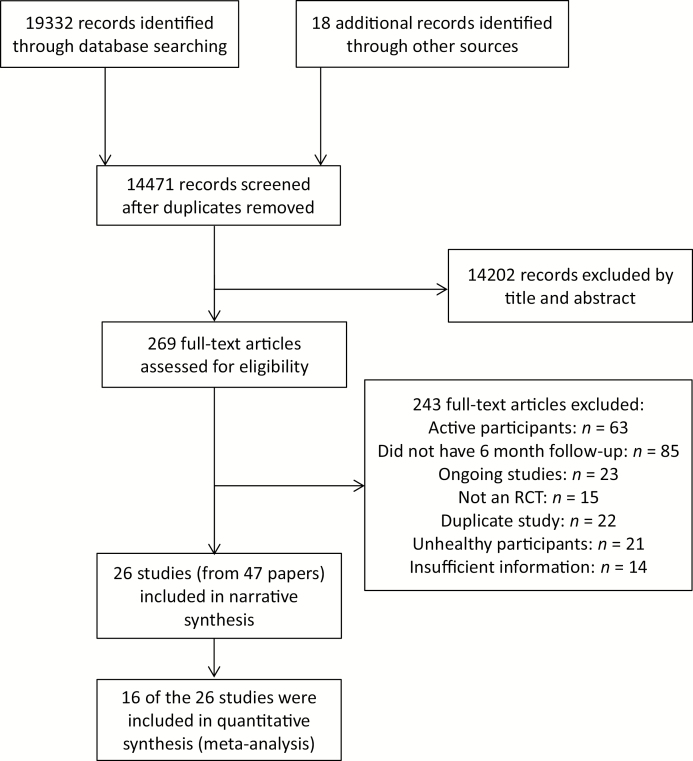
Physical inactivity and sedentary behavior relate to poor health outcomes independently. Healthy inactive adults are a key target population for prevention. This systematic review and meta-analysis aimed to evaluate the effectiveness of physical activity and/or sedentary behavior interventions, measured postintervention (behavior change) and at follow-up (behavior change maintenance), to identify behavior change techniques (BCT) within, and report on fidelity. Included studies were randomized controlled trials, targeting healthy inactive adults, aiming to change physical activity and/or sedentary behavior, with a minimum postintervention follow-up of 6 months, using 16 databases from 1990. Two reviewers independently coded risk of bias, the "Template for Intervention Description and Replication" (TIDieR) checklist, and BCTs. Twenty-six studies were included; 16 pooled for meta-analysis. Physical activity interventions were effective at changing behavior (d = 0.32, 95% confidence intervals = 0.16-0.48, n = 2,346) and maintaining behavior change after 6 months or more (d = 0.21, 95% confidence intervals = 0.12-0.30, n = 2,190). Sedentary behavior interventions (n = 2) were not effective. At postintervention, physical activity intervention effectiveness was associated with the BCTs "Biofeedback," "Demonstration of the behavior," "Behavior practice/rehearsal," and "Graded tasks." At follow-up, effectiveness was associated with using "Action planning," "Instruction on how to perform the behavior," "Prompts/cues," "Behavior practice/rehearsal," "Graded tasks," and "Self-reward." Fidelity was only documented in one study. Good evidence was found for behavior change maintenance effects in healthy inactive adults, and underlying BCTs. This review provides translational evidence to improve research, intervention design, and service delivery in physical activity interventions, while highlighting the lack of fidelity measurement.
Overview
The claims and statistics of this paper haven’t been checked yet.
Free: it reads the open-access text and checks the first 5 claims that cite a source we can check. Create a free account to check every claim.
Integrity signals
Registry
Cites
Statistics
Figures
Verification
Claims the paper makes
The claims and statistics of this paper haven’t been checked yet.
Free: it reads the open-access text and checks the first 5 claims that cite a source we can check. Create a free account to check every claim.
Claims other papers make about this one
Each is checked against this paper’s own text: does it say what the citing paper says it does?
The cited source doesn’t support the claim as written.
In the citing paper
“In addition, lifestyle interventions have shown to be effective in reducing sedentary behavior [13].”
From Consumer-based wearable activity trackers increase physical activity participation: systematic review and meta-analysis (2019) · cites this paper as [13]
Checked by a reasoning model — may be wrong.
Experimental — accuracy not yet measuredThe source backs part of the claim, not all of it — or backs it for a different population, condition or comparison.
In the citing paper
“Interventions shown to increase PA level or reduce sedentary behaviour include behaviour theory-based interventions, such as goal-setting, re-evaluation of goals, self-monitoring, and feedback.112,113”
From 2023 ESC guidelines for the management of cardiovascular disease in patients with diabetes. (2023) · cites this paper as [113]
Experimental — accuracy not yet measured
Self-check
Percentages, sums and reported differences re-computed from the paper’s own numbers.
The self-check needs the paper’s full text.
Citations
Cites
The Cochrane Collaboration's tool for assessing risk of bias in randomised trials
Higgins, J. P. T., Altman, D. G., Gotzsche, P. C., Juni, P., Moher, D., Oxman, A. D., Savovic, J., Schulz, K. F., Weeks, L., Sterne, J. A. C., et al. (2011) · BMJ · doi:10.1136/bmj.d5928 · Cited by 33,817
Dermyshi, E., Wang, Y., Yan, C., Hong, W., Qiu, G., Gong, X., & Zhang, T. (2017) · Neonatology · doi:10.1159/000454668 · Cited by 24,451
GRADE guidelines: 1. Introduction—GRADE evidence profiles and summary of findings tables
Guyatt, G., Oxman, A. D., Akl, E. A., Kunz, R., Vist, G., Brozek, J., Norris, S., Falck-Ytter, Y., Glasziou, P., & deBeer, H. (2011) · Journal of Clinical Epidemiology · doi:10.1016/j.jclinepi.2010.04.026 · Cited by 10,681 · cited 3×
“Using the GRADE criteria [41-42] the post-intervention physical activity outcome was downgraded two levels to low quality, because there was a high level of heterogeneity”
BackgroundMethodHoffmann, T. C., Glasziou, P. P., Boutron, I., Milne, R., Perera, R., Moher, D., Altman, D. G., Barbour, V., Macdonald, H., Johnston, M., et al. (2014) · BMJ · doi:10.1136/bmj.g1687 · Cited by 10,548 · cited 1×
“The ‘Template for Intervention Description and Replication’ (TIDieR; [24]) allows”
Background‘Small Changes' to Diet and Physical Activity Behaviors for Weight Management
Hills, A. P., Byrne, N. M., Lindstrom, R., & Hill, J. O. (2013) · Obesity Facts · doi:10.1159/000345030 · Cited by 9,493
GRADE guidelines: 3. Rating the quality of evidence
Balshem, H., Helfand, M., Schünemann, H. J., Oxman, A. D., Kunz, R., Brozek, J., Vist, G. E., Falck-Ytter, Y., Meerpohl, J., & Norris, S. (2011) · Journal of Clinical Epidemiology · doi:10.1016/j.jclinepi.2010.07.015 · Cited by 8,285 · cited 2×
“Using the GRADE criteria [41-42] the post-intervention physical activity outcome was downgraded two levels to low quality, because there was a high level of heterogeneity”
MethodMichie, S., Richardson, M., Johnston, M., Abraham, C., Francis, J., Hardeman, W., Eccles, M. P., Cane, J., & Wood, C. E. (2013) · Annals of Behavioral Medicine · doi:10.1007/s12160-013-9486-6 · Cited by 7,629 · cited 3×
“is essential for implementing, replicating, and synthesising successful approaches [19].”
BackgroundMethodInfluentialEvaluating the public health impact of health promotion interventions: the RE-AIM framework.
Glasgow, R. E., Vogt, T. M., & Boles, S. M. (1999) · American Journal of Public Health · doi:10.2105/ajph.89.9.1322 · Cited by 7,217 · cited 1×
“investigate whether positive behavioral changes can be sustained [74].”
BackgroundHistorical Origins of the Health Belief Model
Rosenstock, I. M. (1974) · Health Education Monographs · doi:10.1177/109019817400200403 · Cited by 6,116
Answering the Call for a Standard Reliability Measure for Coding Data
Hayes, A. F., & Krippendorff, K. (2007) · Communication Methods and Measures · doi:10.1080/19312450709336664 · Cited by 4,225 · cited 1×
“Inter-rater reliability throughout this review was assessed using Krippendorf’s α, a reliability coefficient that compares favourably to alternatives [39].”
Method
Research works printed but not linked: 1
- Higgins, 2011, Chapter 16: special topics in statistics
Cited by
Items 301–400 of 447
It Has To Be My Way—Reducing Sedentary Time in the Transition to Retirement
Hultman, L., Eklund, C., Wågert, P. V. H., Söderlund, A., & Elfström, M. L. (2024) · Journal of Aging and Physical Activity · doi:10.1123/japa.2023-0414 · Cited by 2
Phetla, M. C., & Skaal, L. (2024) · International Journal of Environmental Research and Public Health · doi:10.3390/ijerph21121592 · Cited by 4
“Brief interventions, which are techniques used to initiate a change in unhealthy behaviours, have been used over the years and found to be effective in some instances [7,8].”
Bengoechea, E. G., Doyle, C. B., Forte, C., O’Regan, A., Clifford, A. M., Gallagher, S. M., Donnelly, A., Glynn, L. G., Murphy, A. W., Sheikhi, A., et al. (2025) · PLoS ONE · doi:10.1371/journal.pone.0318911 · Cited by 4
“…as part of the intervention (e.g., instruction on how to perform PA, graded tasks, information about health consequences, autonomy and social support, goal setting and self-monitoring, action and coping planning), are useful to facilitate PA in adults through relevant mediators [2,55–57].”
InfluentialHuizinga, F., Westerink, N.-D. L., Walenkamp, A., Berendsen, A. J., Greef, M. H. G. D., de Boer, M. R., de Bock, G. H., Berger, M. Y., & Brandenbarg, D. (2025) · British Journal of General Practice · doi:10.3399/bjgp.2024.0558 · Cited by 2
Hesselink, A. E., Kloek, G. C., Feleus, A., Rosbergen, I. C. M., Schipper, S., de Boer, J. J., Kruijssen, A., de Vries, S. I., & Siemonsma, P. C. (2025) · Patient Education and Counseling · doi:10.1016/j.pec.2025.109218 · Cited by 2
Cancer Survivors Becoming and Staying Physically Active: Challenges of Behavior Change
Pinto, B. M., Kindred, M. M., & Grimmett, C. (2020) · Springer eBooks · doi:10.1007/978-3-030-42011-6_17 · Cited by 4
Low-Intensity Resistance Training Improves Flow-Mediated Dilation in Young Hispanic Adults
Briceño-Torres, J. M., Carpio‐Rivera, E., Herrera, A. S., Forsse, J. S., Grandjean, P. W., & Moncada‐Jiménez, J. (2022) · The Journal of Strength and Conditioning Research · doi:10.1519/jsc.0000000000004273 · Cited by 5
“However, physical activity is considered a behavior, and changes on physical activity patterns in 8 weeks are unlikely to occur (16).”
BackgroundHejtmanek, K. R., & Ocobock, C. J. (2022) · Ethos · doi:10.1111/etho.12373 · Cited by 1
Dyadic Effects of Pokémon GO on Physical Activity and Sedentary Behavior in Mothers and Children
Wang, S. D., Dzubur, E., Naya, C. H., Mason, T. B., & Dunton, G. F. (2022) · International journal of exercise science · doi:10.70252/gwxw4068 · Cited by 4
“Behavioral interventions seeking to increase physical activity and reduce sedentary behavior have been moderately successful, with some promising long-term maintenance (11, 25).”
BackgroundWillinger, N., Steele, J., Atkinson, L., Liguori, G. A., Jiménez, A., Mann, S., & Horton, E. (2019) · SportRxiv (OSF Preprints) · doi:10.31236/osf.io/a5fc2 · Cited by 1
Thal, S. B., Ntoumanis, N., Bright, S. J., MYERS, B. J., Kwaśnicka, D., Verboon, P., & Quested, E. (2023) · OSF Preprints (OSF Preprints) · doi:10.31219/osf.io/jmr38 · Cited by 3
Koemel, N. A., Bissett, M., Ryde, G. C., Ahmadi, M. N., Atsiaris, K., Chen, I., Teixeira-Pinto, A. M., Liu, S., Maher, C. A., Chong, K. H., et al. (2025) · medRxiv · doi:10.1101/2025.10.28.25339013 · Cited by 3
Ramírez-Pérez, J. I., Lugo-González, I. V., Erazo, L. R., & Cabrera-Castañón, R. (2024) · Revista Mexicana de Trastornos Alimentarios/Mexican Journal of Eating Disorders · doi:10.22201/fesi.20071523e.2024.1.780 · Cited by 2
“Por su parte, Howlett et al. (2019) en una revisión respecto a la efectividad de las TMC en la AF en adul-tos inactivos, encontraron que las técnicas asociadas a la efectividad fueron la retroalimentación (con ayuda de aparatos electrónicos), la demostración del comportamiento y la asignación de…”
Locke, S., & Osborne, J. (2024) · JMIR Formative Research · doi:10.2196/47181 · Cited by 1
“A recent meta-analysis revealed that physical activity interventions highlighted biofeedback as 1 of the 4 BCTs related to the effective initiation of physical activity [37].”
BackgroundWen, C. K. F., Schneider, S., Junghaenel, D. U., Toledo, M. J. L., Lee, P.-J., Smyth, J. M., & Stone, A. A. (2024) · JMIR Formative Research · doi:10.2196/59950 · Cited by 1
“Although existing physical activity promotion efforts that focus on skill development, barrier reduction, and other important aspects of behavior change have been developed to remedy this, the effects of these interventions have been modest [5,6].”
BackgroundChia, K. S. W., Carland, J. E., Brown, K., Kotlyar, E., Faux, S. G., & Shiner, C. T. (2025) · Disability and Rehabilitation · doi:10.1080/09638288.2025.2469777 · Cited by 1
“This resonates with broader literature on exercise behavior change, whereby self-monitoring, feedback, action planning, goal-setting and knowledge shaping techniques have all been identified as key motivators of increased physical activity [37–40].”
Guillermo-Tregoning, G., & Stevens, M. R. (2025) · Psychology of sport and exercise · doi:10.1016/j.psychsport.2025.102922 · Cited by 2
Yerrakalva, D., Hajna, S., Brage, S., & Griffin, S. J. (2025) · npj Digital Medicine · doi:10.1038/s41746-025-01785-x · Cited by 2
“However, few interventions designed to increase PA among adults have demonstrated sustained changes beyond 12 months 8 – 11 .”
Henriksson, M., Nilsson, S., Berin, E., Hammar, M. L., Holm, A.-C. S., & Lindblom, H. (2025) · Maturitas · doi:10.1016/j.maturitas.2025.108696 · Cited by 2
Thal, S. B., Ntoumanis, N., Bright, S. J., Quested, E., Kwaśnicka, D., Maung, M., & MYERS, B. J. (2025) · Drugs Education Prevention and Policy · doi:10.1080/09687637.2025.2566013 · Cited by 1
“This is not surprising as Action planning is an effective behaviour change technique for long-term PA promotion (Howlett et al., 2019) and an important aspect of Motivational Interviewing (Hardcastle et al., 2017).”
Promoting physical activity with open goals: A pilot randomised controlled trial
Goddard, S. G., Buchan, J., Clarke, M. M., Redden, G., Vandelanotte, C., & Swann, C. (2025) · Psychology of sport and exercise · doi:10.1016/j.psychsport.2025.103018 · Cited by 3
Paraskevas, K. I., Mikhailidis, D. P., Myrcha, P., AbuRahma, A. F., Blecha, M. J., Mansilha, A., Blinc, A., Heiß, C., Sawicka, A., Setacci, C., et al. (2025) · Seminars in Vascular Surgery · doi:10.1053/j.semvascsurg.2025.11.003 · Cited by 1
Vigneron, L., Núñez, J. M., Tortosa, J. Z., Benítez, J. R., Ciuró, A. H., Ortíz‐Rubio, A., & Valenza, M. C. (2025) · Burns · doi:10.1016/j.burns.2025.107829 · Cited by 1
Furman, C. R., & Volz, S. C. (2026) · Applied Psychology Health and Well-Being · doi:10.1111/aphw.70110 · Cited by 1
“…inactive individuals to increase their physical activity and sustain behavioral changes after intervention cessation (see Bernard et al., 2017; Howlett et al., 2019; Gasana et al., 2023; McEwan et al., 2020; Murray et al., 2017; Sheeran et al., 2016, 2020; Yuan et al., 2024 for recent…”
The effects of graded tasks on physical activity: a systematic review and meta-analysis
Gibson, S., Epton, T., Newby, K. V., Brown, K., Armitage, C. J., & Howlett, N. (2026) · Health Psychology Review · doi:10.1080/17437199.2026.2618195 · Cited by 2
“By contrast, Howlett et al. (2019) found that interventions including Graded Tasks were not only effective at the post intervention stage but also maintained their effect at 6-month follow-up.”
Self-citationCrawford, J., Åsberg, K., Blomqvist, J., Lundgren, O., Henriksson, H., Henriksson, P., Bendtsen, P., Löf, M., & Bendtsen, M. (2026) · Journal of Medical Internet Research · doi:10.2196/88881 · Cited by 1
“Participants tive [44,45,57,58].”
van Vliet, M. H. M., Meijer, E., Albers, N., Penfornis, K. M., Baccinelli, W., Scheltinga, B. L., van Eersel, R. A., Chavannes, N. H., & Versluis, A. (2026) · JMIR Human Factors · doi:10.2196/83456 · Cited by 1
“Similarly, PA interventions incorporating behavioral support elements (eg, feedback on performance) can effectively promote both the initiation and maintenance of PA [19].”
Murphy, J., & Jeune, I. L. (2022) · Acute Medicine Journal · doi:10.52964/amja.0924 · Cited by 2
Willett, M., Rushton, A., Stephens, G., Fenton, S. A. M., Rich, S., Greig, C. A., & Duda, J. L. (2023) · Pilot and Feasibility Studies · doi:10.1186/s40814-023-01274-6 · Cited by 3
“Although this definition is based on addictive behaviours, it has also been utilised in previous systematic reviews examining PA in healthy young and middle-aged [83] and inactive adult populations [84].”
MethodTheory‐based obesity intervention program for women: A randomized controlled study
Göger, S., & Çevirme, A. (2024) · Japan Journal of Nursing Science · doi:10.1111/jjns.12590 · Cited by 1
Supporting physical activity adoption through recommender system technology: A pilot study
Agans, J. P., Ma, F., Schade, S. A., & Sciamanna, C. (2024) · Journal of Health Psychology · doi:10.1177/13591053241242541 · Cited by 2
“However, interventions for PA adoption and maintenance often focus more on cognition and behavior (Howlett et al., 2019), and fail to examine affective experience despite the importance of activity enjoyment for PA maintenance (e.g., Ekkekakis et al., 2010).”
Bourne, J. E., Kelly, P., & Armstrong, M. E. G. (2024) · JMIR Cancer · doi:10.2196/54785 · Cited by 1
“The use of self-rewards has been associated with sustained physical activity behavior at least 6 months after intervention [68].”
BackgroundShi, Y., Xie, T., Xie, X., Shao, L., Lao, A., & Zhang, J. (2024) · Journal of Health Psychology · doi:10.1177/13591053241270491 · Cited by 3
“Studies further found that they are frequently used in conjunction with behavior change interventions (Howlett et al., 2019; Meade et al., 2019).”
Collazo‐Castiñeira, P., Echegoyen, I., Schoufour, J. D., Díaz, N. Á., Botella, J., Janiszewska, K., Jiménez-Domínguez, C., Lavilla, V., López-Iglesias, A., Ramírez-Arellano, M. V. M., et al. (2025) · Health Psychology Review · doi:10.1080/17437199.2025.2492042 · Cited by 2
Hawkins, R. M., Swann, C., & Jackman, P. C. (2025) · International Journal of Sport and Exercise Psychology · doi:10.1080/1612197x.2025.2570187 · Cited by 1
Howlett, N., Trivedi, D. P., Troop, N. A., Jones, A., & Chater, A. (2018) · University of Hertfordshire Research Archive (University of Hertfordshire) · Cited by 1
Self-citationMasotti, S., Menegatti, E., Zerbini, V., Raisi, A., Piva, T., Morelli, M., Lordi, R., Grazzi, G., Mazzoni, G., & Mandini, S. (2022) · Journal of Aging and Physical Activity · doi:10.1123/japa.2021-0491 · Cited by 2
Nível de atividade física e satisfação com a saúde entre professores da educação básica
de Alencar, G. P., Ferreira, J. S., Rabacow, F. M., Pontes, E. R. J. C., & Carvalho, A. M. A. (2022) · Ciência em Movimento · doi:10.15602/1983-9480/cm.v23n48p21-33 · Cited by 1
Danso, A., Kekäläinen, T., Koehler, F., Knittle, K. P., Nijhuis, P., Burunat, I., Neto, P., Mavrolampados, A., Randall, W. M., Hansen, N. C., et al. (2024) · medRxiv · doi:10.1101/2024.05.28.24308089 · Cited by 1
Kennedy, F., Smith, S., Beeken, R. J., Buck, C., Williams, S. S., Martin, C., Lally, P. J., & Fisher, A. (2024) · doi:10.2196/preprints.64747 · Cited by 1
Rowley, N. (2020) · Cited by 1
Developing healthcare professional training to promote exercise in prostate cancer patients
Turner, R. R. (2020) · Sheffield Hallam University · doi:10.7190/shu-thesis-00335 · Cited by 1
Why they do not Exercise Regularly
Arabnarmi, B. (2021) · doi:10.22054/nass.2021.13101
Physical activity and cardiovascular disease risk in women with polycystic ovary syndrome
Woodward, A. (2021) · Sheffield Hallam University · doi:10.7190/shu-thesis-00398 · Cited by 2
Lally, P. J., Miller, N. E., Roberts, A., Beeken, R. J., Greenfield, D., POTTS, H. W. W., Counsell, N., Latimer, N. R., Thomas, C., Smith, L., et al. (2021) · Research Square · doi:10.21203/rs.3.rs-895677/v1
van Keulen, H. M., Voogt, C. V., Kleinjan, M., Andree, R., & van Empelen, P. (2022) · doi:10.2196/preprints.36969
Cattivelli, R., Usubini, A. G., Mirto, A. M., Pietrantonio, C., Cau, N., Galli, M., Granese, V., Varallo, G., Pietrabissa, G., Manzoni, G. M., et al. (2020) · Springer eBooks · doi:10.1007/978-3-030-32274-8_14
AlSwayied, G., Guo, H., Rookes, T., Frost, R., & Hamilton, F. L. (2022) · doi:10.2196/preprints.40271
Enfermeros en la prevención del cáncer: cómo llegar a los que no se llega
de la Serna, C. D. D. L. R., & Fernández‐Ortega, P. (2022) · Magna Scientia UCEVA · doi:10.54502/msuceva.v2n1a8
Baldwin, A. S., Lamb, C. L., Geary, B. A., Mitchell, A. D., Kouros, C. D., Levens, S. M., & Martin, L. E. (2022) · doi:10.2196/preprints.40908
Bentlage, E., Nyamadi, J. J., & Dubbeldam, R. (2022) · doi:10.2196/preprints.42968
Concept, Science and Practice of Health Promotion
Nutbeam, D., & Aungles, T. (2023) · Elsevier eBooks · doi:10.1016/b978-0-323-99967-0.00042-9
Kreppke, J.-N., Cody, R., Beck, J., Brand, S., Donath, L., Eckert, A., Faude, O., Hatzinger, M., Imboden, C., Lang, U. E., et al. (2023) · Research Square · doi:10.21203/rs.3.rs-3248284/v1
Guan, J., Zitkus, E., de Bont, C. J. P. M., & Dong, H. (2023) · International Association of Societies of Design Research Congress (IASDR) · doi:10.21606/iasdr.2023.739
The Vitality Active Rewards with Apple Watch Benefit: A follow-up study
Romanelli, R. J., Parkinson, S., Phillips, W., Stockwell, S., & Stolk, C. V. (2023) · RAND Corporation eBooks · doi:10.7249/rra2623-1
Multi-media based Workout Assistance For Obese Adolescents
Roslan, H. S., Nasrudin, N. H., Junid, R. A., & Language Studies, U. T. M. (2023) · Mathematical Sciences and Informatics Journal · doi:10.24191/mij.v4i2.24389 · Cited by 1
Mylius, C. (2024) · University of Groningen research database (University of Groningen / Centre for Information Technology) · doi:10.33612/diss.893591302
Estilo de vida de professores do ensino básico antes e durante a pandemia de COVID-19
Guedes, D. P., de Lima, K. A., & Paula, C. D. (2024) · Revista Contexto & Saúde · doi:10.21527/2176-7114.2024.48.13744
Castro, Ó., Norris, E., Wright, A. J., Hayes, E., Howes, E., Moore, C., West, R., & Michie, S. (2024) · Wellcome Open Research · doi:10.12688/wellcomeopenres.21664.1 · Cited by 3
The Role of Exercise in the CVD Prevention
Lewek, J., Bytyçi, I., & Banach, M. (2024) · Advances in biochemistry in health and disease · doi:10.1007/978-3-031-62806-1_18
Does Attraction Toward Physical Activity Predict Physical Activity Behavior in Older Adults?
Hudgins, B. L., Seo, Y., Bittel, K. M., Williams, K., Hevel, D. J., Labban, J. D., & Maher, J. P. (2024) · Journal of Aging and Physical Activity · doi:10.1123/japa.2024-0013 · Cited by 1
Walters, R., & Özakinci, G. (2024) · doi:10.2196/preprints.66433
Cabot, I., & Surprenant, R. (2024) · Recherches en éducation · doi:10.4000/12qxq · Cited by 3
Sjöberg, V., Monnier, A., Tseli, E., LoMartire, R., Hagströmer, M., Björk, M., Äng, B. O., & Vixner, L. (2024) · Digital Health · doi:10.1177/20552076241299648
Bengoechea, E. G., & Woods, C. B. (2025) · European Journal of Ageing · doi:10.1007/s10433-025-00847-z
“Adults not meeting recommended physical activity (PA) guidelines, regardless of their current health status, face potential future risk of developing ill health and are, therefore, a key target for intervention seeking long-term life-style change (Howlett et al. 2019).”
Viegas, R., de Moura, I. U. E. Z., Cavaco, A. M. D. N., Duarte‐Ramos, F., Mendes, R., & da Costa, F. A. (2025) · Journal of Evaluation in Clinical Practice · doi:10.1111/jep.70105
Wu, C., Chang, C.-N., Chang, C.-F., Lin, M.-H., Chen, H., & Chen, Y. (2025) · doi:10.2196/preprints.77616
Longitudinal study of open goals in physical activity promotion: protocol for ‘Open to Move’
Clarke, M. M., Gargioli, D., Biddle, S., Rebar, A. L., Beauchamp, M. R., Jackman, P. C., Rosenbaum, S., Vella, S. A., & Swann, C. (2025) · BMJ Open Sport & Exercise Medicine · doi:10.1136/bmjsem-2025-002621 · Cited by 2
Kulaklı, F., İlhanlı, İ., & Sarı, İ. F. (2025) · Irish Journal of Medical Science (1971 -) · doi:10.1007/s11845-025-03981-w
Fernandez, M., Di, K., Pinheiro, M. B., de Luca, K. E., Hébert, J. J., & Stilwell, P. (2025) · Journal of Back and Musculoskeletal Rehabilitation · doi:10.1177/10538127251350848
Wang, L., Huo, Y., & Li, B. (2025) · Journal of Computational Methods in Sciences and Engineering · doi:10.1177/14727978251361411 · Cited by 1
Normatov, B., Song, H., Jin, S., Zhang, X., He, Y. N., Lim, N. W.-H., Zheng, V.-F., Aziz, M. H., Müller‐Riemenschneider, F., Lee, C. P. L., et al. (2025) · medRxiv · doi:10.1101/2025.08.14.25333249
“28,29 With rising costs of T2DM treatment and associated chronic diseases, physical activity interventions could be especially cost-effective if designed to be self-motivated with support from peers and general practitioners, as is the focus of the NSC and other schemes.”
Åsberg, K., Löf, M., & Bendtsen, M. (2025) · JMIR Human Factors · doi:10.2196/66208 · Cited by 3
Outcomes of a Physical Activity Intervention in Patients With Glaucoma: A Feasibility Study
Banerjee, S., Mihailović, A., Sotimehin, A. E., Mukherjee, M. R., Almidani, L., Chen, X., Diaz, M., Schrack, J. A., Stewart, K. J., & Ramulu, P. Y. (2025) · Translational Vision Science & Technology · doi:10.1167/tvst.14.9.25
“24 Significantly, only a small percentage of participants decreased their activity, which can be the result of personal obstacles such as health concerns, motivation, or environmental limitations.”
Implementation of SHARP: A Summer Home Reading Program for Early Learners
Arca, Q., & Ortizo, G. C. (2025) · Journal of interdisciplinary perspectives · doi:10.69569/jip.2025.304
Shi, Y., Kim, J., Mizushima, R., Mizuno, S., Yanagisawa, T., & Nakata, Y. (2025) · doi:10.2196/preprints.85390
Toxværd, C. G., Elsborg, P., Birke, H., Thomsen, T., Jørgensen, S. M., Fromberg, E. B., Håkansson, H. N., Dahlerup, J., Stage, A., & Aadahl, M. (2025) · Scandinavian Journal of Public Health · doi:10.1177/14034948251383396
Song, D., Hightow‐Weidman, L., Bhandari, B., Yang, Y., Bailey, J., & Wang, J. (2025) · AIDS Care · doi:10.1080/09540121.2025.2564197
“…are consistent with meta-analyses of behavioral physical activity interventions in general adult populations, which reported step count increases ranging from 421 to 2185 steps per day in intervention groups compared with controls (Howlett et al., 2019; Jahangiry et al., 2017; Romeo et al., 2019).”
InfluentialBarrett, S., Begg, S. J., O’Halloran, P., Howlett, O., Lawrence, J., & Kingsley, M. (2021) · Figshare · doi:10.6084/m9.figshare.13544135
Landais, L. L., Damman, O. C., Schoonmade, L. J., Timmermans, D. R. M., Verhagen, E. A. L. M., & Jelsma, J. G. M. (2020) · Figshare · doi:10.6084/m9.figshare.12097494
Barrett, S., Begg, S. J., O’Halloran, P., & Kingsley, M. (2020) · Figshare · doi:10.6084/m9.figshare.13310083
Sedhed, J., Johansson, H., Andersson, N., Åkesson, E., Kalbe, E., Franzén, E., & Leavy, B. (2024) · Figshare · doi:10.6084/m9.figshare.25556640
Willett, M., Rushton, A., Stephens, G., Fenton, S., Rich, S., Greig, C. A., & Duda, J. (2024) · Figshare · doi:10.6084/m9.figshare.26579582
Auchincloss, A. H., Michael, Y. L., Niamatullah, S., Li, S., Melly, S. J., Pharis, M., & Fuller, D. (2022) · Figshare · doi:10.6084/m9.figshare.21273849
Willett, M., Rushton, A., Stephens, G., Fenton, S., Rich, S., Greig, C. A., & Duda, J. L. (2024) · Figshare · doi:10.6084/m9.figshare.26579579
Crawshaw, J., Meyer, C., Antonopoulou, V., Antony, J., Grimshaw, J., Ivers, N., Konnyu, K., Lacroix, M., Presseau, J., Simeoni, M., et al. (2024) · Figshare · doi:10.6084/m9.figshare.26643373
Barrett, S., Begg, S. J., O’Halloran, P., Howlett, O., Lawrence, J., & Kingsley, M. (2021) · Figshare · doi:10.6084/m9.figshare.13544129
Alòs, F., Colomer, M. À., Martín-Cantera, C., Muñoz, M. S., Bort‐Roig, J., Saigi, I., Chirveches-Pérez, E., Solà-Gonfaus, M., Molina-Aragonés, J. M., & Puig-Ribera, A. (2022) · Figshare · doi:10.6084/m9.figshare.20193936
Landais, L. L., Damman, O. C., Jelsma, J. G. M., Verhagen, E. A. L. M., & Timmermans, D. R. M. (2022) · Figshare · doi:10.6084/m9.figshare.19670057
Landais, L. L., Damman, O. C., Schoonmade, L. J., Timmermans, D. R. M., Verhagen, E. A. L. M., & Jelsma, J. G. M. (2020) · Figshare · doi:10.6084/m9.figshare.12097482
Landais, L. L., Damman, O. C., Jelsma, J. G. M., Verhagen, E. A. L. M., & Timmermans, D. R. M. (2022) · Figshare · doi:10.6084/m9.figshare.19670060
Crawshaw, J., Meyer, C., Antonopoulou, V., Antony, J., Grimshaw, J., Ivers, N., Konnyu, K., Lacroix, M., Presseau, J., Simeoni, M., et al. (2024) · Figshare · doi:10.6084/m9.figshare.26643367
Loughran, M. T., Lyons, S., Plack, C. J., & Armitage, C. J. (2020) · Figshare · doi:10.6084/m9.figshare.12949541
Alòs, F., Colomer, M. À., Martín-Cantera, C., Muñoz, M. S., Bort‐Roig, J., Saigi, I., Chirveches-Pérez, E., Solà-Gonfaus, M., Molina-Aragonés, J. M., & Puig-Ribera, A. (2022) · Figshare · doi:10.6084/m9.figshare.20193939
Mabweazara, S., Manne‐Goehler, J., Hamer, M., Cellini, J., & Siedner, M. (2024) · Figshare · doi:10.6084/m9.figshare.26570722
Crawshaw, J., Meyer, C., Antonopoulou, V., Antony, J., Grimshaw, J. M., Ivers, N. M., Konnyu, K., Lacroix, M., Presseau, J., Simeoni, M., et al. (2024) · Figshare · doi:10.6084/m9.figshare.26643370
Barrett, S., Begg, S. J., O’Halloran, P., & Kingsley, M. (2020) · Figshare · doi:10.6084/m9.figshare.13310089
Loughran, M. T., Lyons, S., Plack, C. J., & Armitage, C. J. (2020) · Figshare · doi:10.6084/m9.figshare.12949544
Metadata
- Authors
- Howlett, N., Trivedi, D., Troop, N. A., & Chater, A. M.
- Affiliations
- University of Hertfordshire (GB)
- Corresponding author
- Howlett, Neil
- Venue
- Translational Behavioral Medicine
- Publisher
- Oxford University Press (OUP)
- Published
- 2018-02-28
- Volume
- 9
- Issue
- 1
- Pages
- 147-157
- ISSN
- 1613-9860 (ISSN-L)
- 1869-6716
- PMC
- PMC6305562
- OpenAlex
- W2788581315
- Cited by
- 448
- References
- 78
- Citations by year
- 2026: 38 · 2025: 59 · 2024: 73 · 2023: 64 · 2022: 76 · 2021: 62 · 2020: 43 · 2019: 27 · 2018: 5
- FWCI
- 4.49
- Type
- journal article
- Language
- en
- Open access
- hybrid
- doi.org
- Licence
- Locations
- Translational Behavioral Medicine (publishedVersion, cc-by-nc)
- Europe PMC (PubMed Central) (publishedVersion, cc-by-nc)
- PubMed Central (publishedVersion, cc-by-nc)
- PubMed (publishedVersion)
- University of Hertfordshire Research Archive (University of Hertfordshire) (acceptedVersion)
- University of Hertfordshire Research Archive (University of Hertfordshire) (submittedVersion, cc-by-nc)
- UCL Discovery (University College London) (submittedVersion)
- University of Bedfordshire Repository (University of Bedfordshire) (submittedVersion)
- University of Bedfordshire Repository (University of Bedfordshire) (submittedVersion, cc-by-nc-nd)
- Funders
- University of Hertfordshire
- Topics
- Health Sciences › Medicine › Public Health, Environmental and Occupational Health › Physical Activity and Health
- Social Sciences › Psychology › Applied Psychology › Behavioral Health and Interventions
- Social Sciences › Psychology › Developmental and Educational Psychology › Behavioral and Psychological Studies
- Keywords
- physical activity interventions, sedentary behavior, behaviour change techniques, behavior maintenance, intervention fidelity, biofeedback, action planning, prompts and cues, self-reward
- MeSH terms
- Behavior Therapy, Health Promotion, Humans, Health Behavior, Exercise, Sedentary Behavior
About these checks
Registry, retraction, Cites and statistics results are computed, not judged, with one exception: a printed reference that no index lists is read once by a model before it counts as a citation error. Claims are extracted by a model and kept only when their quote appears verbatim in the text; each cited source is then checked, with a model’s help, for whether it says what the claim relies on. Those verdicts can be wrong — read the claim’s quote and the cited source before relying on one.
Statistics and arithmetic are recomputed, not judged.
Confidence bands are shown only for fields calibrated on our annotated test set. None is calibrated yet, so no band is shown.
What counts as a claim ›How we measure confidence ›How we check this ›
Are you an author, or do you see a problem with this page? Request a review
Data sources
Bibliographic data: Semantic Scholar, OpenAlex, Crossref.
Contains information from the Semantic Scholar Academic Graph Datasets, made available under the ODC Attribution License (ODC-BY 1.0).
Semantic Scholar’s data is described in: Kinney, R., et al. (2023). The Semantic Scholar Open Data Platform. arXiv:2301.10140.
