

Wellness-Centered Leadership: Equipping Health Care Leaders to Cultivate Physician Well-Being and Professional Fulfillment
Open accessThe DOI matches its Crossref record; 68 of the 69 references it cites were found in a registry or an index.
Abstract
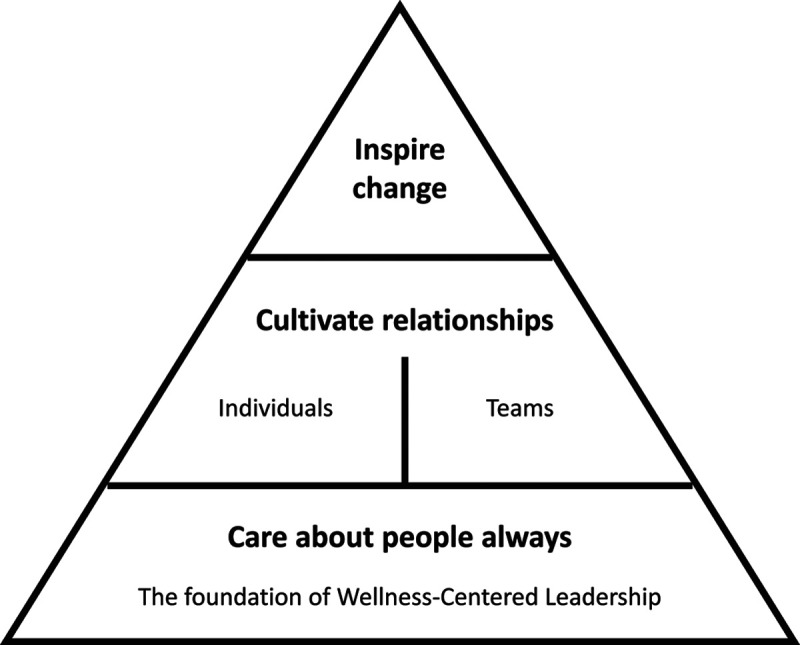
These are challenging times for physicians. Extensive changes in the practice environment have altered the nature of physicians’ interactions with patients and their role in the health care delivery system. Many physicians feel as if they are “cogs in the wheel” of austere corporations that care more about productivity and finances than compassion or quality. They often do not see how the strategy and plan of their organization align with the values of the profession. Despite their expertise, they frequently do not feel they have a voice or input in the operational plan of their work unit, department, or organization. At their core, the authors believe all of these factors represent leadership issues. Many models of leadership have been proposed, and there are a number of effective philosophies and approaches. Here, the authors propose a new integrative model of Wellness-Centered Leadership (WCL). WCL includes core skills and qualities from the foremost leadership philosophies along with evidence on the relationship between leadership and physician well-being and distills them into a single framework designed to cultivate leadership behaviors that promote engagement and professional fulfillment. The 3 elements of WCL are: care about people always, cultivate individual and team relationships, and inspire change. A summary of the mindset, behaviors, and outcomes of the elements of the WCL model is presented, and the application of the elements for physician leaders is discussed. The authors believe that learning and developing the skills that advance these elements should be the aspiration of all health care leaders and a foundational focus of leadership development programs. If cultivated, the authors believe that WCL will empower individual and team performance to address the current problems faced by health care organizations as well as the iterative innovation needed to address challenges that may arise in the decades to come.
Overview
The claims and statistics of this paper haven’t been checked yet.
Free: it reads the open-access text and checks the first 5 claims that cite a source we can check. Create a free account to check every claim.
Integrity signals
Registry
Cites
Statistics
Figures
Verification
Claims the paper makes
The claims and statistics of this paper haven’t been checked yet.
Free: it reads the open-access text and checks the first 5 claims that cite a source we can check. Create a free account to check every claim.
Claims other papers make about this one
Each is checked against this paper’s own text: does it say what the citing paper says it does?
The source backs part of the claim, not all of it — or backs it for a different population, condition or comparison.
In the citing paper
“This dyadic interaction forms the backbone of organizational culture and significantly influences job satisfaction, employee retention, and overall workplace morale [15].”
From The Work-life Check-ins randomized controlled trial: a leader-based adaptive, semi-structured burnout intervention in primary care clinics (2024) · cites this paper as [15]
Experimental — accuracy not yet measured
Self-check
Percentages, sums and reported differences re-computed from the paper’s own numbers.
The self-check needs the paper’s full text.
Citations
Cites
Shanafelt, T. D., Boone, S., Tan, L., Dyrbye, L. N., Sotile, W., Satele, D., West, C. P., Sloan, J., & Oreskovich, M. R. (2012) · Archives of Internal Medicine · doi:10.1001/archinternmed.2012.3199 · Cited by 3,439
Self-citationShanafelt, T. D., Hasan, O., Dyrbye, L. N., Sinsky, C., Satele, D., Sloan, J., & West, C. P. (2015) · Mayo Clinic Proceedings · doi:10.1016/j.mayocp.2015.08.023 · Cited by 2,885
Self-citationPhysician burnout: contributors, consequences and solutions
West, C. P., Dyrbye, L. N., & Shanafelt, T. D. (2018) · Journal of Internal Medicine · doi:10.1111/joim.12752 · Cited by 2,768
Self-citationExecutive Leadership and Physician Well-being
Shanafelt, T. D., & Noseworthy, J. H. (2017) · Mayo Clinic Proceedings · doi:10.1016/j.mayocp.2016.10.004 · Cited by 1,776
Self-citationAllocation of Physician Time in Ambulatory Practice: A Time and Motion Study in 4 Specialties
Sinsky, C., Colligan, L., Li, L., Prgomet, M., Reynolds, S., Goeders, L., Westbrook, J., Tutty, M., & Blike, G. (2016) · Annals of Internal Medicine · doi:10.7326/m16-0961 · Cited by 1,494
Singer, T., & Klimecki, O. M. (2014) · Current Biology · doi:10.1016/j.cub.2014.06.054 · Cited by 1,254
Shanafelt, T. D., Dyrbye, L. N., Sinsky, C., Hasan, O., Satele, D., Sloan, J., & West, C. P. (2016) · Mayo Clinic Proceedings · doi:10.1016/j.mayocp.2016.05.007 · Cited by 1,086
Self-citationShanafelt, T. D., West, C. P., Sinsky, C., Trockel, M., Tutty, M., Satele, D. V., Carlasare, L. E., & Dyrbye, L. N. (2019) · Mayo Clinic Proceedings · doi:10.1016/j.mayocp.2018.10.023 · Cited by 914
Self-citationImpact of Organizational Leadership on Physician Burnout and Satisfaction
Shanafelt, T. D., Gorringe, G., Menaker, R., Storz, K. A., Reeves, D., Buskirk, S. J., Sloan, J. A., & Swensen, S. J. (2015) · Mayo Clinic Proceedings · doi:10.1016/j.mayocp.2015.01.012 · Cited by 707
Self-citationCareer Fit and Burnout Among Academic Faculty
Shanafelt, T. D., West, C. P., Sloan, J. A., Novotny, P. J., Poland, G. A., Menaker, R., Rummans, T. A., & Dyrbye, L. N. (2009) · Archives of Internal Medicine · doi:10.1001/archinternmed.2009.70 · Cited by 617
Self-citationWorking Conditions in Primary Care: Physician Reactions and Care Quality
Linzer, M., Manwell, L. B., Williams, E. S., Bobula, J. A., Brown, R. L., Varkey, A. B., Man, B., McMurray, J. E., Maguire, A., Horner-Ibler, B., et al. (2009) · Annals of Internal Medicine · doi:10.7326/0003-4819-151-1-200907070-00006 · Cited by 519
Shanafelt, T. D., West, C. P., Sinsky, C., Trockel, M., Tutty, M., Wang, H., Carlasare, L. E., & Dyrbye, L. N. (2022) · Mayo Clinic Proceedings · doi:10.1016/j.mayocp.2021.11.021 · Cited by 434
Self-citationIn Search of Joy in Practice: A Report of 23 High-Functioning Primary Care Practices
Sinsky, C. A., Willard-Grace, R., Schutzbank, A. M., Sinsky, T. A., Margolius, D., & Bodenheimer, T. (2013) · The Annals of Family Medicine · doi:10.1370/afm.1531 · Cited by 415
Melnick, E. R., Dyrbye, L. N., Sinsky, C. A., Trockel, M., West, C. P., Nedelec, L., Tutty, M. A., & Shanafelt, T. (2020) · Mayo Clinic Proceedings · doi:10.1016/j.mayocp.2019.09.024 · Cited by 413
Self-citationGreiner, L. E. (1997) · Family Business Review · doi:10.1111/j.1741-6248.1997.00397.x · Cited by 412
the Society of General Internal Medicine (SGIM) Career Satisfaction Study Group (CSSG), Linzer, M., Konrad, T. R., Douglas, J., McMurray, J. E., Pathman, D. E., Williams, E. S., Schwartz, M. D., Gerrity, M., Scheckler, W., et al. (2000) · Journal of General Internal Medicine · doi:10.1046/j.1525-1497.2000.05239.x · Cited by 411
Shanafelt, T. D. (2009) · JAMA · doi:10.1001/jama.2009.1385 · Cited by 393
Self-citationSelf-compassion and emotional intelligence in nurses
Heffernan, M., Quinn Griffin, M. T., McNulty, S. R., & Fitzpatrick, J. J. (2010) · International Journal of Nursing Practice · doi:10.1111/j.1440-172x.2010.01853.x · Cited by 313
Empathy and complex task performance: Two routes to leadership
Kellett, J. B., Humphrey, R. H., & Sleeth, R. G. (2002) · The Leadership Quarterly · doi:10.1016/s1048-9843(02)00142-x · Cited by 287
Interpersonal Power: A Review, Critique, and Research Agenda
Sturm, R. E., & Antonakis, J. (2015) · Journal of Management · doi:10.1177/0149206314555769 · Cited by 273
Worklife and Wellness in Academic General Internal Medicine: Results from a National Survey
Linzer, M., Poplau, S., Babbott, S., Collins, T., Guzman-Corrales, L., Menk, J., Murphy, M. L., & Ovington, K. (2016) · Journal of General Internal Medicine · doi:10.1007/s11606-016-3720-4 · Cited by 254
The ongoing legacy of R.L. Katz: An updated typology of management skills
Peterson, T. O., & Fleet, D. D. V. (2004) · Management Decision · doi:10.1108/00251740410568980 · Cited by 238
Erickson, S. M., Rockwern, B., Koltov, M., McLean, R. M., & for the Medical Practice and Quality Committee of the American College of Physicians* (2017) · Annals of Internal Medicine · doi:10.7326/m16-2697 · Cited by 238
The Role of Compulsiveness in the Normal Physician
Gabbard, G. O. (1985) · JAMA: The Journal of the American Medical Association · doi:10.1001/jama.1985.03360200078031 · Cited by 229
Swensen, S., Kabcenell, A., & Shanafelt, T. (2016) · Journal of Healthcare Management · doi:10.1097/00115514-201603000-00008 · Cited by 217
Self-citationMeasuring Physician Job Satisfaction in a Changing Workplace and a Challenging Environment
Konrad, T. R., Williams, E. S., Linzer, M., McMurray, J., Pathman, D. E., Gerrity, M., Schwartz, M. D., Scheckler, W. E., Van Kirk, J., Rhodes, E., et al. (1999) · Medical Care · doi:10.1097/00005650-199911000-00010 · Cited by 216
Healing the Professional Culture of Medicine
Shanafelt, T. D., Schein, E., Minor, L. B., Trockel, M., Schein, P., & Kirch, D. (2019) · Mayo Clinic Proceedings · doi:10.1016/j.mayocp.2019.03.026 · Cited by 212
Self-citationDeveloping Physician-Leaders: A Call to Action
Stoller, J. K. (2009) · Journal of General Internal Medicine · doi:10.1007/s11606-009-1007-8 · Cited by 200
Lee, T. H.-Y. (2010) · PubMed · Cited by 184
Professional Dissonance and Burnout in Primary Care: A Qualitative Study
Agarwal, S. D., Pabo, E., Rozenblum, R., & Sherritt, K. M. (2020) · JAMA Internal Medicine · doi:10.1001/jamainternmed.2019.6326 · Cited by 182
Managed care, professional autonomy, and income: Effects on physician career satisfaction
Stoddard, J. J., Hargraves, J. L., Reed, M., & Vratil, A. (2001) · Journal of General Internal Medicine · doi:10.1111/j.1525-1497.2001.01206.x · Cited by 180
What Do Doctors Find Meaningful about Their Work?
Horowitz, C. R., Suchman, A. L., Branch, W. T., & Frankel, R. M. (2003) · Annals of Internal Medicine · doi:10.7326/0003-4819-138-9-200305060-00028 · Cited by 160
Physician leadership: essential skills in a changing environment
Schwartz, R. W., & Pogge, C. R. (2000) · The American Journal of Surgery · doi:10.1016/s0002-9610(00)00481-5 · Cited by 152
Straus, S. E., Soobiah, C., & Levinson, W. (2013) · Academic Medicine · doi:10.1097/acm.0b013e31828af493 · Cited by 141
Tak, H. J., Curlin, F. A., & Yoon, J. D. (2017) · Journal of General Internal Medicine · doi:10.1007/s11606-017-3997-y · Cited by 138
Relationship Between Organizational Leadership and Health Care Employee Burnout and Satisfaction
Dyrbye, L. N., Major-Elechi, B. T., Hays, J. T., Fraser, C. H., Buskirk, S. J., & West, C. P. (2020) · Mayo Clinic Proceedings · doi:10.1016/j.mayocp.2019.10.041 · Cited by 133
Association Between Physician Burnout and Identification With Medicine as a Calling
Jager, A. J., Tutty, M., & Kao, A. C. (2017) · Mayo Clinic Proceedings · doi:10.1016/j.mayocp.2016.11.012 · Cited by 132
SGIM Career Satisfaction Study Group (CSSG), McMurray, J. E., Williams, E. S., Schwartz, M. D., Douglas, J., Kirk, J. V., Konrad, T. R., Gerrity, M., Bigby, J. A., & Linzer, M. (1997) · Journal of General Internal Medicine · doi:10.1046/j.1525-1497.1997.07145.x · Cited by 130
Physicians’ View of Their Work Environment and Organisation
Arnetz, B. B. (1997) · Psychotherapy and Psychosomatics · doi:10.1159/000289127 · Cited by 120
Leadership in Academic Medicine: Capabilities and Conditions for Organizational Success
Lobas, J. G. (2006) · The American Journal of Medicine · doi:10.1016/j.amjmed.2006.04.005 · Cited by 117
Skinner, C., & Spurgeon, P. (2005) · Health Services Management Research · doi:10.1258/0951484053051924 · Cited by 117
Dweck, C. S. (2015) · British Journal of Educational Psychology · doi:10.1111/bjep.12072 · Cited by 107
A TEST OF THE SITUATIONAL LEADERSHIP THEORY
BLANK, W., GREEN, S. G., & WEITZEL, J. R. (1990) · Personnel Psychology · doi:10.1111/j.1744-6570.1990.tb02397.x · Cited by 103
Trockel, M. T., Hamidi, M. S., Menon, N. K., Rowe, S. G., Dudley, J. C., Stewart, M. T., Geisler, C. Z., Bohman, B. D., & Shanafelt, T. D. (2019) · Mayo Clinic Proceedings · doi:10.1016/j.mayocp.2019.04.040 · Cited by 102
Self-citationShanafelt, T. D., Makowski, M. S., Wang, H., Bohman, B., Leonard, M., Harrington, R. A., Minor, L., & Trockel, M. (2020) · JAMA Network Open · doi:10.1001/jamanetworkopen.2020.7961 · Cited by 102
Self-citationLeadership Development Programs at Academic Health Centers: Results of a National Survey
Lucas, R. H., Goldman, E. F., Scott, A. R., & Dandar, V. M. (2017) · Academic Medicine · doi:10.1097/acm.0000000000001813 · Cited by 96
Westerlund, H., Nyberg, A., Bernin, P., Hyde, M., Oxenstierna, G., Jäppinen, P., Väänänen, A., & Theorell, T. (2010) · Work · doi:10.3233/wor-2010-1058 · Cited by 90
Demmy, T. L., Kivlahan, C., Stone, T. T., Teague, L., & Sapienza, P. (2002) · Academic Medicine · doi:10.1097/00001888-200212000-00020 · Cited by 89
Relative Value Units and the Measurement of Physician Performance
Nurok, M., & Gewertz, B. L. (2019) · JAMA · doi:10.1001/jama.2019.11163 · Cited by 72
Academic Medicine and the Search for Meaning and Purpose
Souba, W. W. (2002) · Academic Medicine · doi:10.1097/00001888-200202000-00008 · Cited by 67
The New Leader: New Demands in a Changing, Turbulent Environment
Souba, W. W. (2003) · Journal of the American College of Surgeons · doi:10.1016/s1072-7515(03)00335-1 · Cited by 66
Meaning and the nature of physicians’ work
Rosenthal, D. I., & Verghese, A. (2016) · New England Journal of Medicine · doi:10.1056/nejmp1609055 · Cited by 63
Lack of sleep and the development of leader-follower relationships over time
Guarana, C. L. O., & Barnes, C. M. (2017) · Organizational Behavior and Human Decision Processes · doi:10.1016/j.obhdp.2017.04.003 · Cited by 63
New ways of understanding and accomplishing leadership in academic medicine
Souba, W. W. (2004) · Journal of Surgical Research · doi:10.1016/j.jss.2004.01.020 · Cited by 59
Professionalism, Performance, and the Future of Physician Incentives
Khullar, D., Wolfson, D. B., & Casalino, L. P. (2018) · JAMA · doi:10.1001/jama.2018.17719 · Cited by 55
Keller, E. J., Giafaglione, B., Chrisman, H. B., Collins, J. D., & Vogelzang, R. L. (2019) · PLoS ONE · doi:10.1371/journal.pone.0212014 · Cited by 38
Mcmurray, J. (1997) · Journal of Internal Medicine · Cited by 37
A Competency-Based Approach to Recruiting, Developing, and Giving Feedback to Department Chairs
Palmer, M. M., Hoffmann-Longtin, K. J., Walvoord, E. C., Bogdewic, S. P., & Dankoski, M. E. (2015) · Academic Medicine · doi:10.1097/acm.0000000000000647 · Cited by 36
Emotional intelligence and leadership traits among family physicians
Çoşkun, Ö., Ulutaş, İ., Budakoğlu, I. İ., Uğurlu, M., & Üstü, Y. (2018) · Postgraduate Medicine · doi:10.1080/00325481.2018.1515563 · Cited by 35
Lemaire, J. B., & Wallace, J. E. (2014) · BMC Health Services Research · doi:10.1186/s12913-014-0616-z · Cited by 34
Cultivating the joy of medicine: A focus on intrinsic factors and the meaning of our work
Serwint, J. R., & Stewart, M. T. (2019) · Current problems in pediatric and adolescent health care · doi:10.1016/j.cppeds.2019.100665 · Cited by 29
Hackworth, J. M., Steel, S. A., Cooksey, E., DePalma, M., & Kahn, J. A. (2018) · The Journal of Pediatrics · doi:10.1016/j.jpeds.2018.05.007 · Cited by 28
The relationship of mindfulness and self-compassion to desired wildland fire leadership
Waldron, A. L., & Ebbeck, V. (2015) · International Journal of Wildland Fire · doi:10.1071/wf13212 · Cited by 27
Gregory, P. J., Robbins, B., Schwaitzberg, S. D., & Harmon, L. (2016) · Surgical Endoscopy · doi:10.1007/s00464-016-5386-8 · Cited by 25
Stoller, J. K. (2018) · CHEST Journal · doi:10.1016/j.chest.2017.12.014 · Cited by 24
Mayo Clinic Strategies to Reduce Burnout. 12 Actions to Create the Ideal Workplace
Greenberg, N. (2022) · Occupational Medicine · doi:10.1093/occmed/kqac058 · Cited by 24
What Does It Mean to Be a Physician?
Schwenk, T. L. (2020) · JAMA · doi:10.1001/jama.2020.0146 · Cited by 23
The Leadership of Corporate Change
Blake, R. R., & McKee, R. K. (1993) · Journal of Leadership Studies · doi:10.1177/107179199300100108 · Cited by 4
Research works printed but not linked: 6
- Kane CK. Updated Data on Physician Practice Arrangements: For the First Time, Fewer Physicians Are Owners Than Employees. 2019. Chicago, IL: American Medical Association; https://www.ama-assn.org/system/files/2019-07/prp-fewer-owners-benchmark-survey-2018.pdf. Accessed December 10, 2020.
- Northouse PJ. Leadership: Theory and Practice. 2016. 7th ed. Los Angeles, CA: SAGE Publications;
- Dweck CS. Growth mindset, revisited. Educ Week. 2015; 35: 20– 24.
- Barnes C. Sleep well lead better. Harv Bus Rev. 2018;September-October: 140– 143.
- Graham JR Harvey CR Popdak J Rajgopal S. Corporate Culture: Evidence From the Field. NBER Working Paper 23255. 2017. Cambridge, MA: National Bureau of Economic Research; https://www.nber.org/papers/w23255. Accessed December 10, 2020.
- Greiner LE. Evolution and revolution as organizations grow. 1972. Harv Bus Rev. 1998; 76: 55– 60. 10179654
Cited by
COVID-Related Stress and Work Intentions in a Sample of US Health Care Workers
Sinsky, C. A., Brown, R. L., Stillman, M. J., & Linzer, M. (2021) · Mayo Clinic Proceedings: Innovations, Quality & Outcomes · doi:10.1016/j.mayocpiqo.2021.08.007 · Cited by 214
“42-47 Applying a systems approach to interventions, aimed at improving organizational culture 35,48 and practice ef fi - ciency, 45,49-52 will be most successful at reducing burnout.”
Physician Well-being 2.0: Where Are We and Where Are We Going?
Shanafelt, T. D. (2021) · Mayo Clinic Proceedings · doi:10.1016/j.mayocp.2021.06.005 · Cited by 213
Self-citationMéte, M., Goldman, C. C., Shanafelt, T. D., & Marchalik, D. (2022) · BMJ Open · doi:10.1136/bmjopen-2021-057554 · Cited by 92
Self-citationShanafelt, T. D., Wang, H., Leonard, M., Hawn, M., McKenna, Q., Majzun, R., Minor, L., & Trockel, M. (2021) · JAMA Network Open · doi:10.1001/jamanetworkopen.2020.35622 · Cited by 91
Self-citationOrganization-Wide Approaches to Foster Effective Unit-Level Efforts to Improve Clinician Well-Being
Shanafelt, T. D., Larson, D. B., Bohman, B. D., Roberts, R., Trockel, M., Weinlander, E. E., Springer, J., Wang, H., Stolz, S., & Murphy, D. J. (2023) · Mayo Clinic Proceedings · doi:10.1016/j.mayocp.2022.10.031 · Cited by 73
Self-citation
Metadata
- Authors
- Shanafelt, T., Trockel, M., Rodriguez, A., & Logan, D.
- Affiliations
- Stanford Medicine (US)
- University of Southern California (US)
- Corresponding author
- Shanafelt, Tait
- Venue
- Academic Medicine
- Publisher
- Oxford University Press (OUP)
- Published
- 2021-04-27
- Volume
- 96
- Issue
- 5
- Pages
- 641-651
- ISSN
- 1040-2446 (ISSN-L)
- PMC
- PMC8078125
- OpenAlex
- W3115391915
- Semantic Scholar
- ac23978fb9da525faa93906b072d6ac068696e3e
- Cited by
- 157
- References
- 69
- Citations by year
- 2026: 27 · 2025: 33 · 2024: 29 · 2023: 34 · 2022: 23 · 2021: 11
- FWCI
- 17.74
- Type
- journal article
- Language
- en
- Open access
- hybrid
- doi.org
- Licence
- Locations
- Academic Medicine (publishedVersion, cc-by-nc-nd)
- PubMed Central (publishedVersion, cc-by-nc-nd)
- PubMed (publishedVersion)
- Topics
- Health Sciences › Health Professions › General Health Professions › Healthcare professionals’ stress and burnout
- Social Sciences › Education › Innovations in Medical Education
- Social Sciences › Business, Management and Accounting › Strategy and Management › Organizational Leadership and Management Strategies
- Keywords
- physician well-being, healthcare leadership, leadership development, professional fulfillment, physician engagement, leadership models, team relationships, organizational values
- MeSH terms
- Burnout, Professional, Health Promotion, Humans, Job Satisfaction, Leadership, Physician Executives, Physicians
About these checks
Registry, retraction, Cites and statistics results are computed, not judged, with one exception: a printed reference that no index lists is read once by a model before it counts as a citation error. Claims are extracted by a model and kept only when their quote appears verbatim in the text; each cited source is then checked, with a model’s help, for whether it says what the claim relies on. Those verdicts can be wrong — read the claim’s quote and the cited source before relying on one.
Statistics and arithmetic are recomputed, not judged.
Confidence bands are shown only for fields calibrated on our annotated test set. None is calibrated yet, so no band is shown.
What counts as a claim ›How we measure confidence ›How we check this ›
Are you an author, or do you see a problem with this page? Request a review
Data sources
Bibliographic data: Semantic Scholar, OpenAlex, Crossref.
Contains information from the Semantic Scholar Academic Graph Datasets, made available under the ODC Attribution License (ODC-BY 1.0).
Semantic Scholar’s data is described in: Kinney, R., et al. (2023). The Semantic Scholar Open Data Platform. arXiv:2301.10140.
